Kabutops
Generation I · #0141 — Shellfish Pokémon
Kabutops is built around Attack first — 115 at base is the clearest signal of how it's meant to be used, more than its rock/water typing alone would suggest. With a overall stat sum of 495, Kabutops excels in physical offense with an impressive Attack stat of 115, complemented by a respectable Defense of 105, making it a well-rounded physical attacker. Its three available abilities—Swift Swim, Battle Armor, and the hidden ability Weak Armor—provide strategic versatility depending on battle conditions and team composition. The Pokédex consistently describes Kabutops as a sleek, efficient hunter whose body was perfectly adapted for aquatic predation, using its razor-sharp scythes to slice prey and drain their body fluids.
Editor's Take
Kabutops's Swift Swim in rain is the only context where it is genuinely threatening, which makes it a Pokémon that requires an entire team built around it to be worth one slot.
Base Stats
Height
1.3m
Weight
40.5kg
Category
Shellfish Pokémon
Gender
Male 87.5% / Female 12.5%
Color
brown
Shape
upright
Habitat
sea
Abilities
Doubles Speed during rain.
Protects against critical hits.
Raises Speed and lowers Defense by one stage each upon being hit by a physical move.

Kabutops Biology & Physical Characteristics
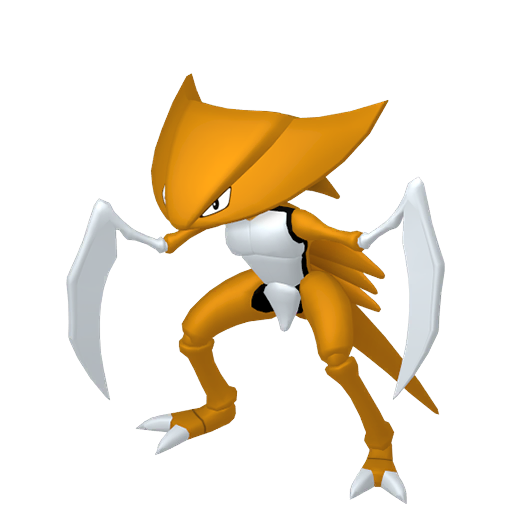
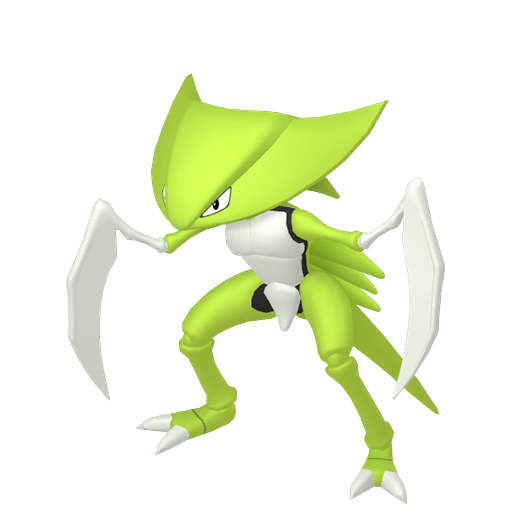
Kabutops is a bipedal arthropod Pokémon with a distinctly skeletal, heavily-armored physiology that reflects its ancient origins. Its most striking features are its pair of large, gray scythes that serve as forearms, perfectly designed for slicing through prey with lethal efficiency. The Pokémon's head is flat and half-circular with small eyes on the front and pointed projections on each side, topped with a segmented shell running down its spine lined with three flat spines on either side. Its body coloration is predominantly brown with light gray markings along the chest and abdomen, creating a natural camouflage for hunting in murky prehistoric waters. The thin, muscular legs terminate in small feet equipped with two prominent gray claws, allowing for stable movement both in water and on land. According to Ruby and Sapphire Pokédex entries, Kabutops was in active evolutionary transition, developing the ability to survive on land as indicated by changes in its gills and leg structure—a transformation likely driven by the migration of its prey species from aquatic to terrestrial environments.
Pokedex Numbers
Training
Breeding
Kabutops Breeding, Gender Ratio & Egg Groups
Kabutops exhibits a strongly male-skewed gender ratio of approximately 87.5% male to 12.5% female, a distribution that is notably more extreme than many other Pokémon species and reflects the male-dominant nature of many predatory arthropods in nature. This gender imbalance creates particular challenges for breeders seeking to obtain Kabutops through natural breeding methods, as the scarcity of female specimens makes pairing somewhat difficult in controlled breeding environments. Kabutops belongs to both the Water 1 and Water 3 egg groups, granting it remarkable breeding flexibility with numerous water-type partners that share either of these classifications. The species has a base happiness value of 70, indicating moderate friendliness toward trainers, and its eggs require 30 cycles to hatch—approximately 7,454 to 7,710 steps depending on game mechanics. Despite its fearsome predatory nature and aggressive hunting behavior documented in Pokédex entries, Kabutops demonstrates sufficient docility toward human handlers to permit captive breeding programs, suggesting that while it retains its ancient instincts, domestication has rendered it manageable in controlled settings.
Sprites




TMs & HMs
tm01
lets go pikachu lets go eevee
tm02
yellow
tm02
red blue
tm01
sword shield
tm02
crystal
tm02
gold silver
tm02
blue japan
tm02
red green japan
tm03
yellow
tm03
crystal
tm03
gold silver
tm03
ruby sapphire
tm03
red blue
tm03
platinum
tm03
firered leafgreen
tm03
heartgold soulsilver
tm03
diamond pearl
tm03
emerald
tm03
xd
tm03
colosseum
+713 more TMs/HMs
Kabutops's Evolution Chain


Kabutops Evolution, Mega Evolution & Special Forms
Kabutops evolves from Kabuto upon reaching level 40, representing the culmination of the ancient Shellfish Pokémon's growth into its final, apex predator form. This evolution is not merely a matter of size increase; it reflects a fundamental transformation in combat capability and specialization. While Kabuto maintains relatively balanced stats across its elemental types, Kabutops's evolution dramatically amplifies its Attack stat from 80 to an impressive 115, establishing it as a specialized physical sweeper. Simultaneously, its Defense increases from 90 to 105, creating a formidable physical tank-attacker hybrid. The evolution also boosts Kabutops's Speed from 55 to 80, allowing it to outpace many comparable threats in competitive play. This particular evolution represents Kabutops's full maturation into the hunting machine described throughout the Pokédex, with its scythes fully developed and its predatory instincts honed to perfection. No Mega Evolution exists for Kabutops, keeping it grounded as a singular evolutionary endpoint that has remained competitive across multiple generations through carefully designed base statistics and movepool versatility.
Where to Find
Location data not available for this Pokémon in the database.
Kabutops Behaviour and Natural Habitat
In ancient times, Kabutops was a formidable underwater predator that inhabited ocean environments where it hunted with remarkable efficiency. The Pokémon possessed the remarkable ability to tuck its limbs compactly against its body, dramatically increasing its hydrodynamic profile and allowing it to achieve swimming speeds of approximately 29 knots—an extraordinary velocity for an arthropod-based creature. Gold Version's Pokédex entry specifically describes how Kabutops would wiggle its shell to propel itself through water with devastating speed and precision. Once it located prey, Kabutops would use its razor-sharp sickle-shaped arms to slice open victims and drain their internal body fluids, utilizing them as a primary nutritional source. The creature's predatory efficiency was so complete that other Pokémon would scavenge any remains left behind, suggesting Kabutops's high position in its ecosystem's food chain. Despite its obvious aquatic adaptations, the species showed clear signs of transitioning toward a semi-terrestrial lifestyle, gradually developing stronger legs and modified gill structures that would enable survival beyond strictly aquatic environments.
Pokedex Entries
Its sleek shape is perfect for swim ming. It slashes prey with its claws and drains the body fluids.
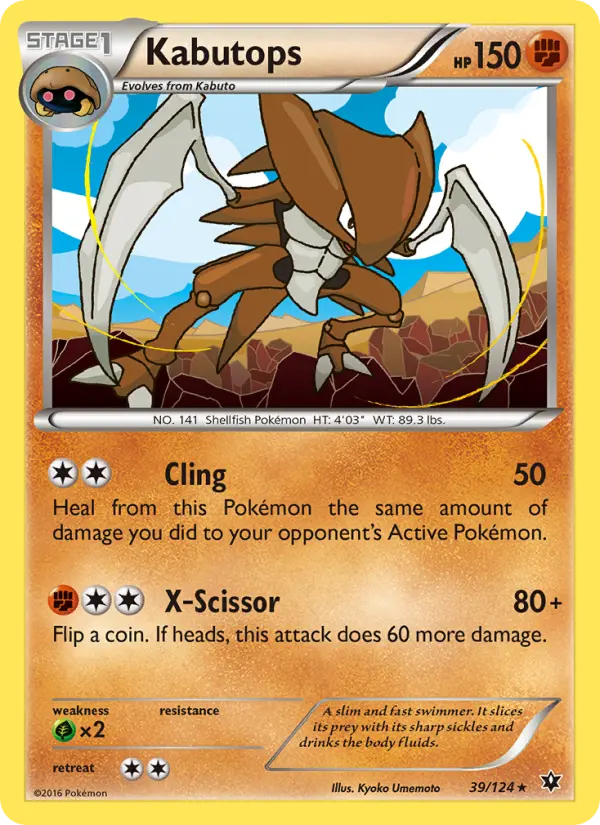
A slim and fast swimmer. It slices its prey with its sharp sickles and drinks the body fluids.
In the water, it tucks in its limbs to become more compact, then it wiggles its shell to swim fast.
With sharp claws, this ferocious, ancient POKéMON rips apart prey and sucks their body fluids.
It was able to swim quickly thro ugh the water by compactly folding up its razor-sharp sickles.
KABUTOPS swam underwater to hunt for its prey in ancient times. The POKéMON was apparently evolving from being a water-dweller to living on land as evident from the beginnings of change in its gills and legs.
KABUTOPS once swam underwater to hunt for prey. It was apparently evolving from being a water dweller to living on land as evident from changes in its gills and legs.
It swims freely through water. It catches prey with its scythe-like arms and drains the victim’s fluids.
Its sleek shape is perfect for swimming. It slashes prey with its claws and drains their fluids.
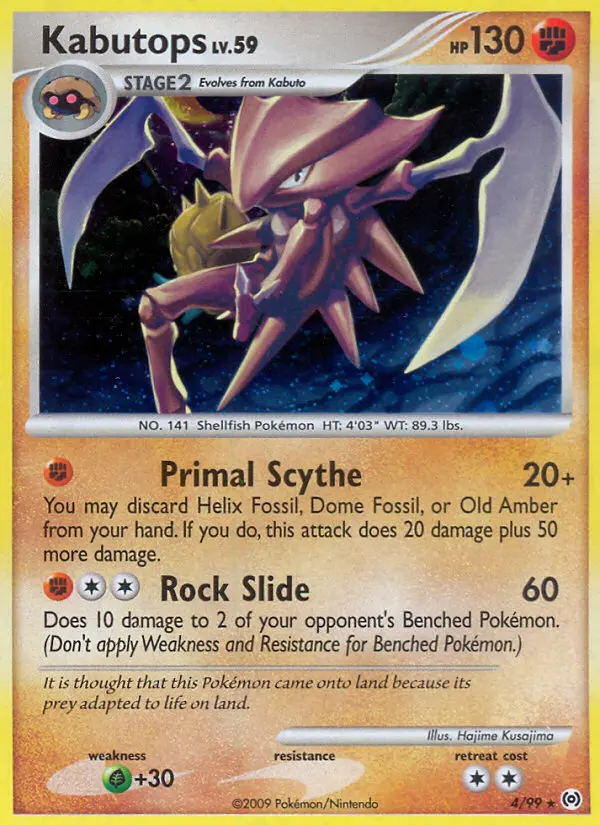
It is thought that this Pokémon came onto land because its prey adapted to life on land.
In the water, it tucks in its limbs to become more compact, then it wiggles its shell to swim fast.
With sharp claws, this ferocious, ancient Pokémon rips apart prey and sucks their body fluids.
It is thought that this Pokémon came onto land because its prey adapted to life on land.
It is thought that this Pokémon came onto land because its prey adapted to life on land.
In the water, it tucks in its limbs to become more compact, then it wiggles its shell to swim fast.
A slim and fast swimmer. It slices its prey with its sharp sickles and drinks the body fluids.
Kabutops swam underwater to hunt for its prey in ancient times. The Pokémon was apparently evolving from being a water dweller to living on land as evident from the beginnings of change in its gills and legs.
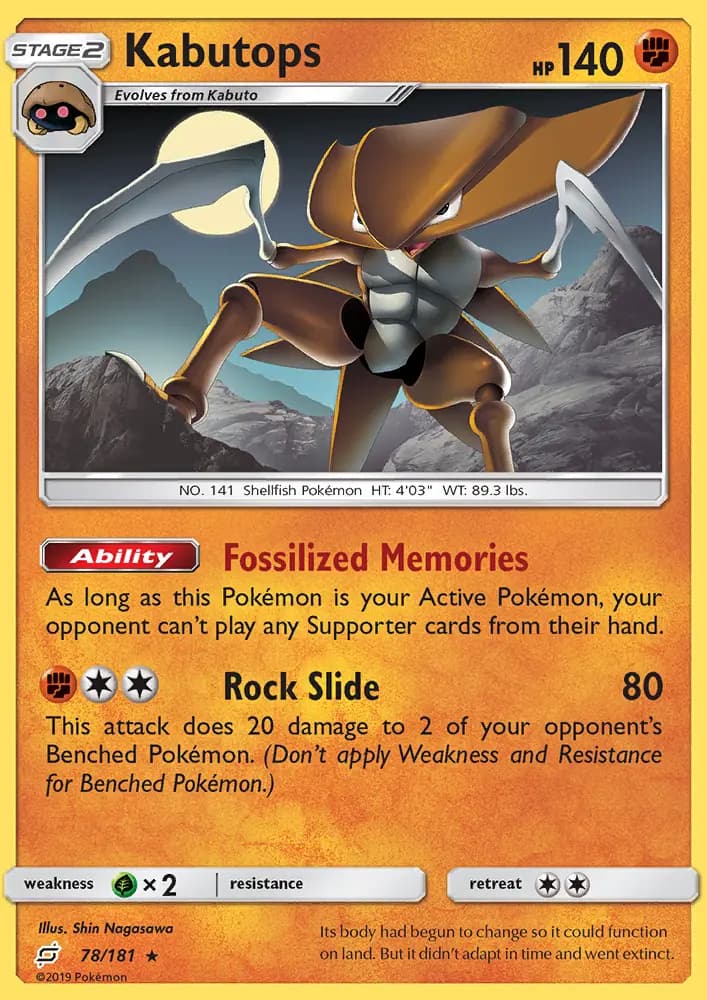
Its body had begun to change so it could function on land. But it didn’t adapt in time and went extinct.
It swims at speeds of roughly 29 knots, quickly closing in on its prey and slashing into them with its scythes to finish them off.
A slim and fast swimmer. It sliced its prey with its sharp sickles and drank the body fluids.
Kabutops slices its prey apart and sucks out the fluids. The discarded body parts become food for other Pokémon.
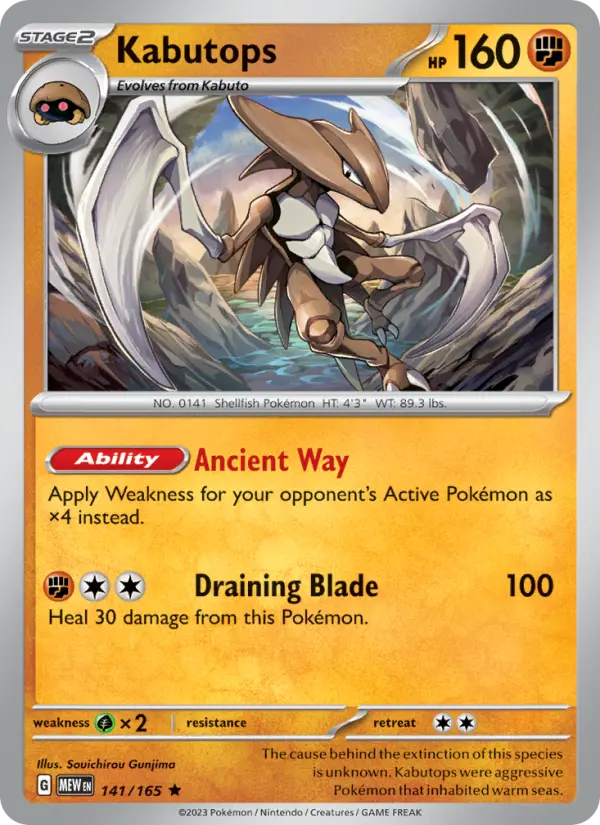
The cause behind the extinction of this species is unknown. Kabutops were aggressive Pokémon that inhabited warm seas.
Kabutops Name Origin & Design Inspiration
Kabutops's name can be traced to 'kabuto,' the Japanese word for samurai helmet, combined with 'tops,' referencing its resemblance to a samurai warrior's weaponry and aesthetic. This etymology brilliantly encapsulates both its defensive shell structure and its prominent scythe-like weapons, creating a visual metaphor for an ancient warrior preserved in fossil form. The design itself draws heavy inspiration from trilobites and other prehistoric arthropods, particularly the extinct eurypterids (sea scorpions), which explains the prominent pincers and segmented body structure. The silhouette and coloration scheme intentionally evoke a samurai's armor plates and cutting implements, creating a cohesive design philosophy that bridges prehistoric biology with historical weaponry. The gray scythes and claws are rendered with sharp, angular geometry that emphasizes lethality, while the brown body provides earthy naturalism that grounds the creature's ancient provenance. The three-pronged spine running down its back creates an almost crown-like appearance when viewed from above, adding regal authority to what is ultimately a predatory killing machine designed by evolution rather than craftspeople.
Learnable Moves
Kabutops can learn 81 moves:
Move | Type | Cat. | Power | Acc. | PP |
|---|---|---|---|---|---|
| absorb | grass | Special | 20 | 100 | 25 |
| aerial ace | flying | Physical | 60 | — | 20 |
| ancient power | rock | Special | 60 | 100 | 5 |
| attract | normal | Status | — | 100 | 15 |
| bide | normal | Physical | — | — | 10 |
| blizzard | ice | Special | 110 | 70 | 5 |
| body slam | normal | Physical | 85 | 100 | 15 |
| brick break | fighting | Physical | 75 | 100 | 15 |
| brine | water | Special | 65 | 100 | 10 |
| bubble beam | water | Special | 65 | 100 | 20 |
| confuse ray | ghost | Status | — | 100 | 10 |
| curse | ghost | Status | — | — | 10 |
| cut | normal | Physical | 50 | 95 | 30 |
| dig | ground | Physical | 80 | 100 | 10 |
| dive | water | Physical | 80 | 100 | 10 |
| double team | normal | Status | — | — | 15 |
| double edge | normal | Physical | 120 | 100 | 15 |
| endure | normal | Status | — | — | 10 |
| facade | normal | Physical | 70 | 100 | 20 |
| feint | normal | Physical | 30 | 100 | 10 |
| frustration | normal | Physical | — | 100 | 20 |
| fury cutter | bug | Physical | 40 | 95 | 20 |
| giga drain | grass | Special | 75 | 100 | 10 |
| hail | ice | Status | — | — | 10 |
| harden | normal | Status | — | — | 30 |
| headbutt | normal | Physical | 70 | 100 | 15 |
| hidden power | normal | Special | 60 | 100 | 15 |
| hydro pump | water | Special | 110 | 80 | 5 |
| hyper beam | normal | Special | 150 | 90 | 5 |
| ice beam | ice | Special | 90 | 100 | 10 |
| icy wind | ice | Special | 55 | 95 | 15 |
| iron defense | steel | Status | — | — | 15 |
| knock off | dark | Physical | 65 | 100 | 20 |
| leech life | bug | Physical | 80 | 100 | 10 |
| leer | normal | Status | — | 100 | 30 |
| low kick | fighting | Physical | — | 100 | 20 |
| mega drain | grass | Special | 40 | 100 | 15 |
| mega kick | normal | Physical | 120 | 75 | 5 |
| metal sound | steel | Status | — | 85 | 40 |
| mimic | normal | Status | — | — | 10 |
| mud shot | ground | Special | 55 | 95 | 15 |
| mud slap | ground | Special | 20 | 100 | 10 |
| natural gift | normal | Physical | — | 100 | 15 |
| nature power | normal | Status | — | — | 20 |
| protect | normal | Status | — | — | 10 |
| rage | normal | Physical | 20 | 100 | 20 |
| rain dance | water | Status | — | — | 5 |
| razor wind | normal | Special | 80 | 100 | 10 |
| reflect | psychic | Status | — | — | 20 |
| rest | psychic | Status | — | — | 5 |
| return | normal | Physical | — | 100 | 20 |
| rock blast | rock | Physical | 25 | 90 | 10 |
| rock slide | rock | Physical | 75 | 90 | 10 |
| rock smash | fighting | Physical | 40 | 100 | 15 |
| rock throw | rock | Physical | 50 | 90 | 15 |
| rock tomb | rock | Physical | 60 | 95 | 15 |
| rollout | rock | Physical | 30 | 90 | 20 |
| sand attack | ground | Status | — | 100 | 15 |
| sandstorm | rock | Status | — | — | 10 |
| scratch | normal | Physical | 40 | 100 | 35 |
| screech | normal | Status | — | 85 | 40 |
| secret power | normal | Physical | 70 | 100 | 20 |
| seismic toss | fighting | Physical | — | 100 | 20 |
| skull bash | normal | Physical | 130 | 100 | 10 |
| slash | normal | Physical | 70 | 100 | 20 |
| sleep talk | normal | Status | — | — | 10 |
| snore | normal | Special | 50 | 100 | 15 |
| stealth rock | rock | Status | — | — | 20 |
| submission | fighting | Physical | 80 | 80 | 20 |
| substitute | normal | Status | — | — | 10 |
| superpower | fighting | Physical | 120 | 100 | 5 |
| surf | water | Special | 90 | 100 | 15 |
| swagger | normal | Status | — | 85 | 15 |
| swords dance | normal | Status | — | — | 20 |
| take down | normal | Physical | 90 | 85 | 20 |
| thief | dark | Physical | 60 | 100 | 25 |
| toxic | poison | Status | — | 90 | 10 |
| water gun | water | Special | 40 | 100 | 25 |
| water pulse | water | Special | 60 | 100 | 20 |
| waterfall | water | Physical | 80 | 100 | 15 |
| whirlpool | water | Special | 35 | 85 | 15 |
Kabutops Competitive Battle Guide
Kabutops occupies a distinctive niche in competitive Pokémon battle environments as a physical attacker-sweeper with excellent coverage moves and ability-based utility options. Its 115 Attack stat, combined with a solid 80 Speed, allows it to function as a genuine threat in physical teams, particularly when equipped with moves like Stone Edge (97 power, 80% accuracy Rock move), X-Scissor, Earthquake, and Superpower. Swift Swim is its most competitively valuable ability, doubling its Speed stat during rain-based weather conditions and enabling sweep-potential that can overwhelm unprepared teams—particularly effective in rain-based team architectures. Battle Armor provides a valuable defensive alternative by negating critical hits, offering protection against high-crit moves like Scope Lens-boosted attacks or moves like Slash. The hidden ability Weak Armor presents an interesting offensive trade-off, raising Speed while lowering Defense upon contact with physical moves, creating a high-risk aggressive strategy. However, Kabutops's special movepool is relatively limited with a 65 Special Attack stat, restricting it primarily to physical-based strategies. In higher-tier competitive play, Kabutops faces intense competition from faster, stronger physical attackers, though it maintains viability in specific metagames where rain teams or specific role-filling is required.
Commonly Asked Questions About Kabutops
What type is Kabutops?
Kabutops is a rock and water type Pokemon.
What does Kabutops evolve from?
Kabutops evolved from kabuto.
What are Kabutops's weaknesses?
Kabutops is weak to fighting, ground, grass and electric type moves.
Kabutops Cultural Impact & Franchise History
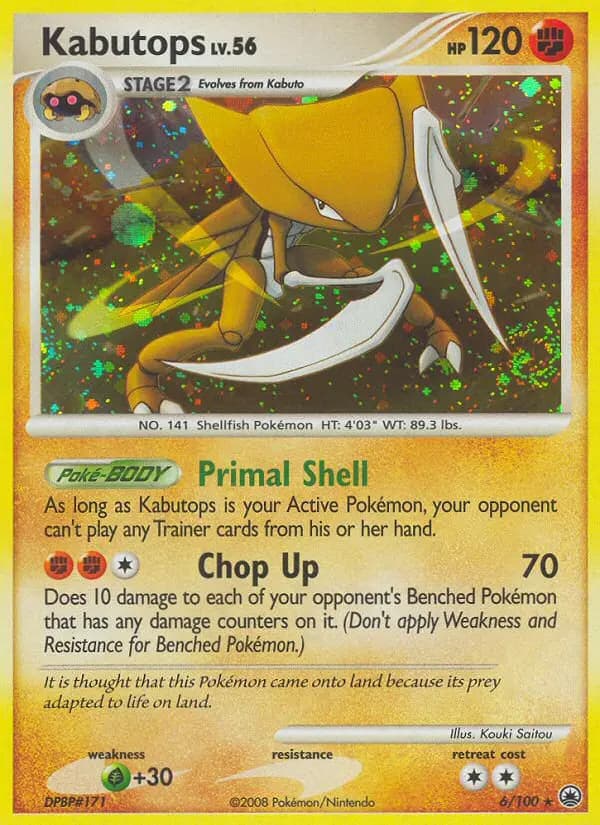
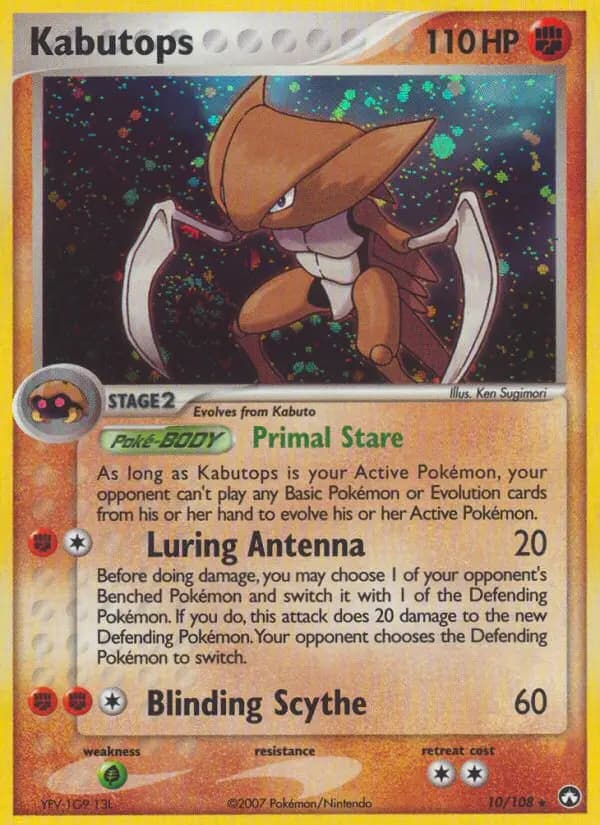
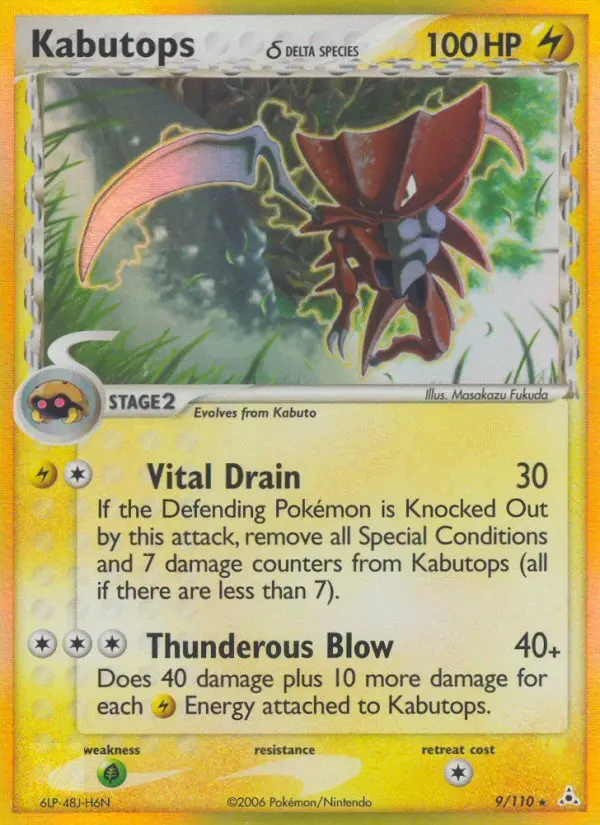
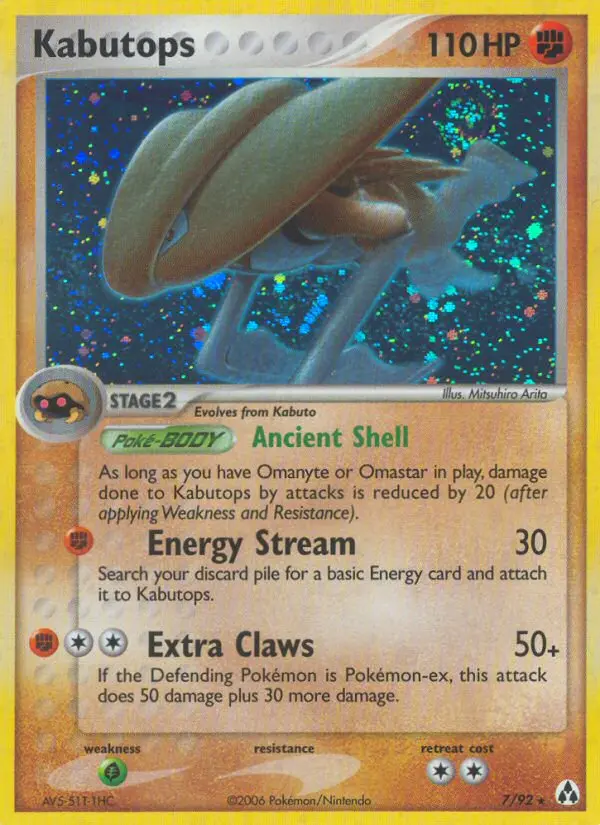
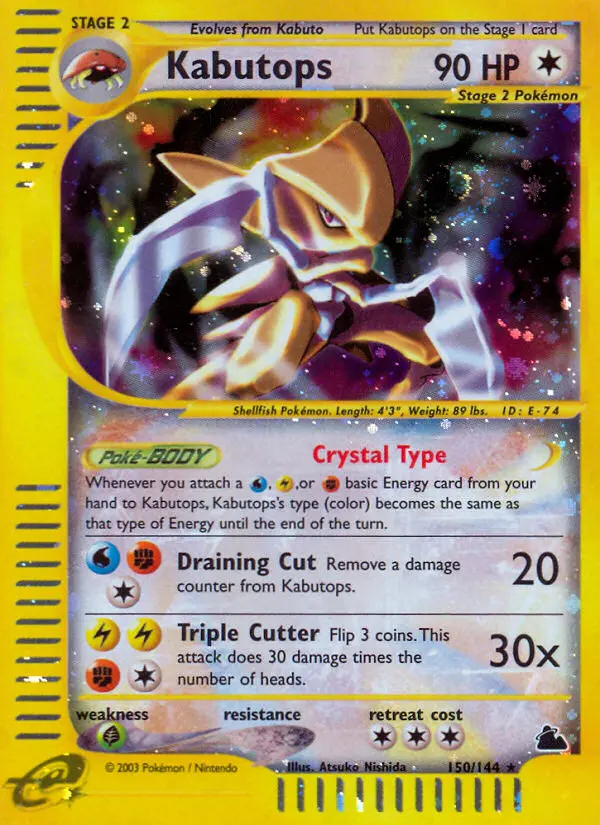
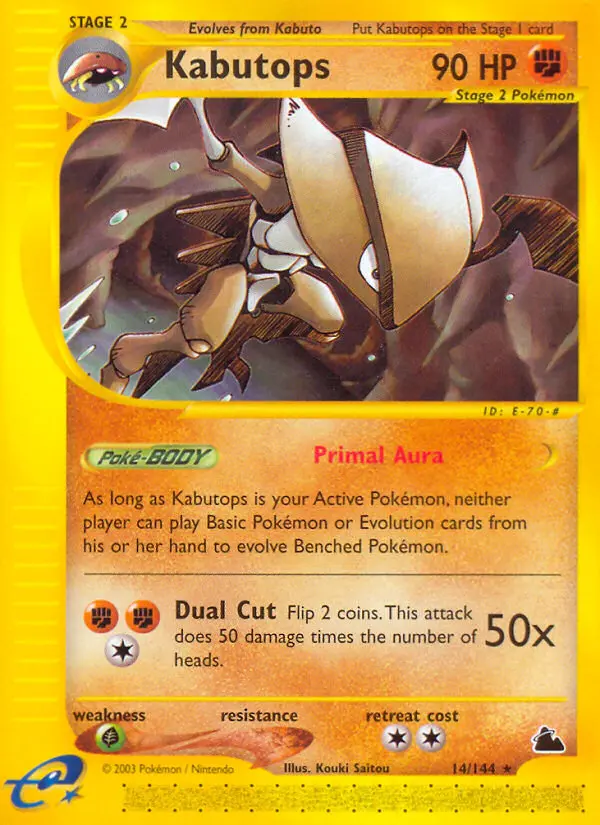
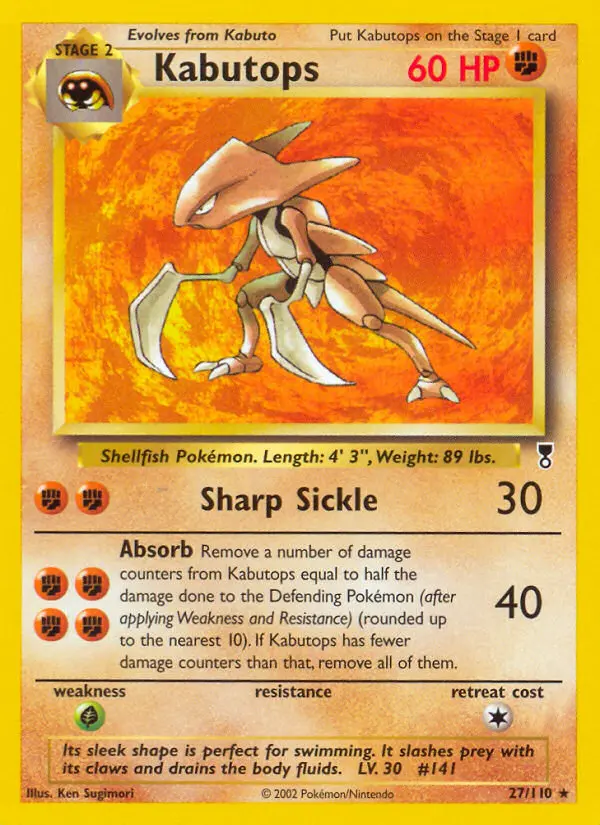
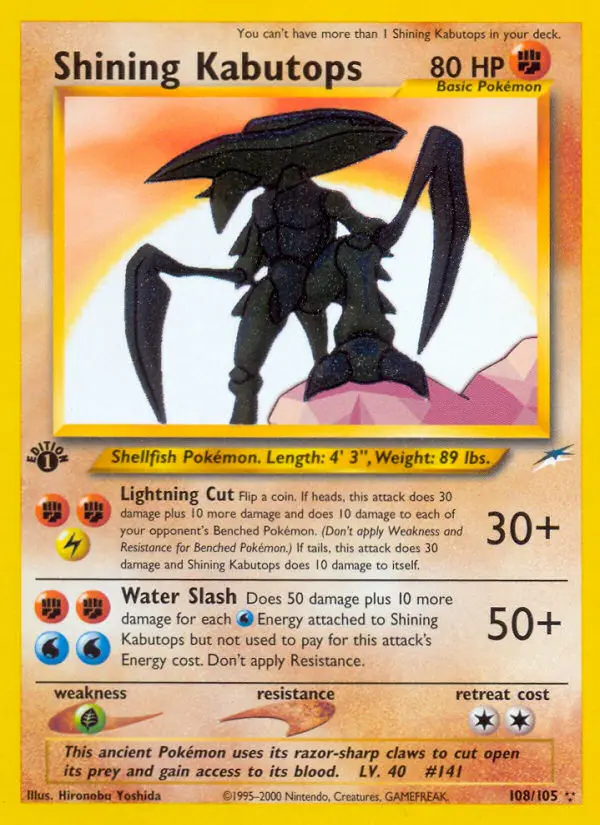
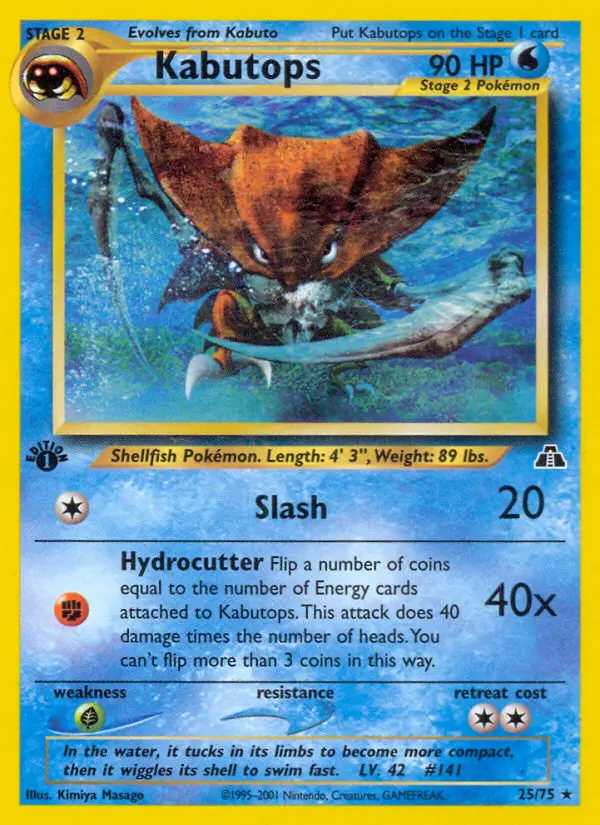
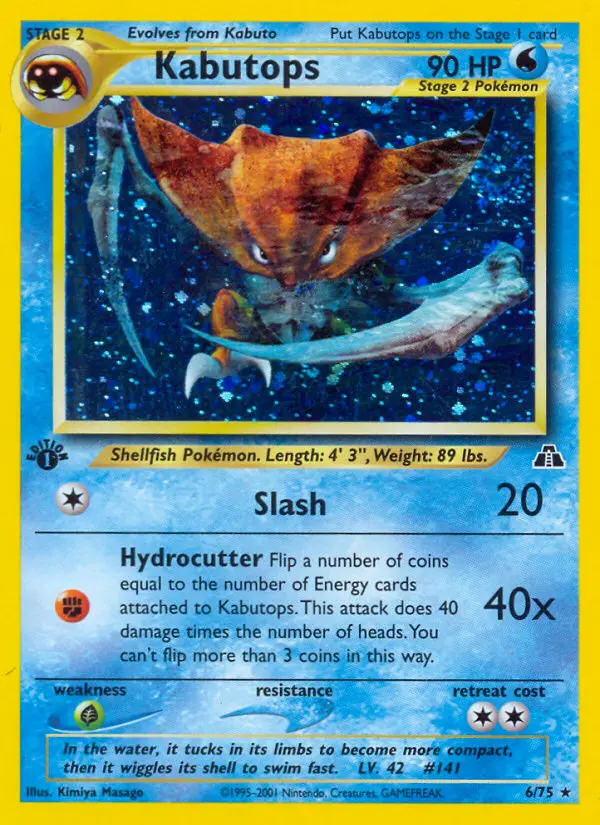
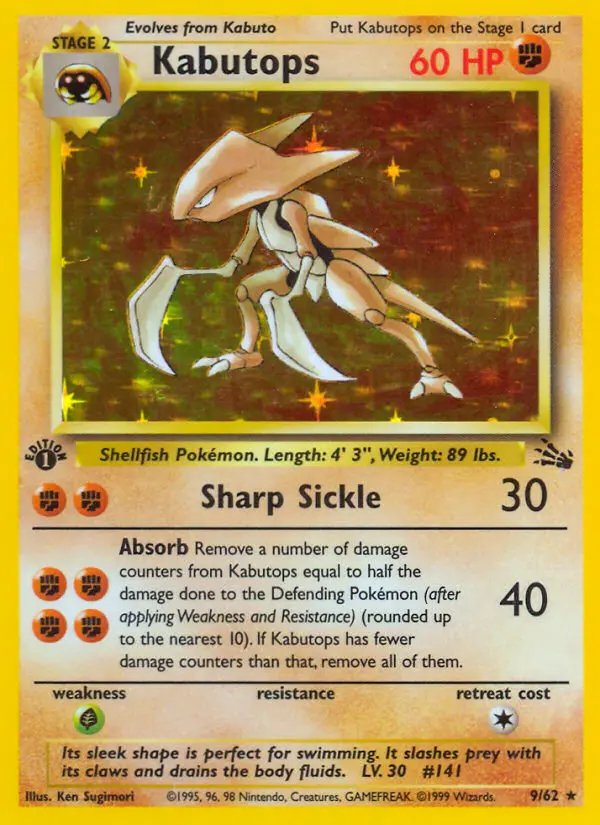
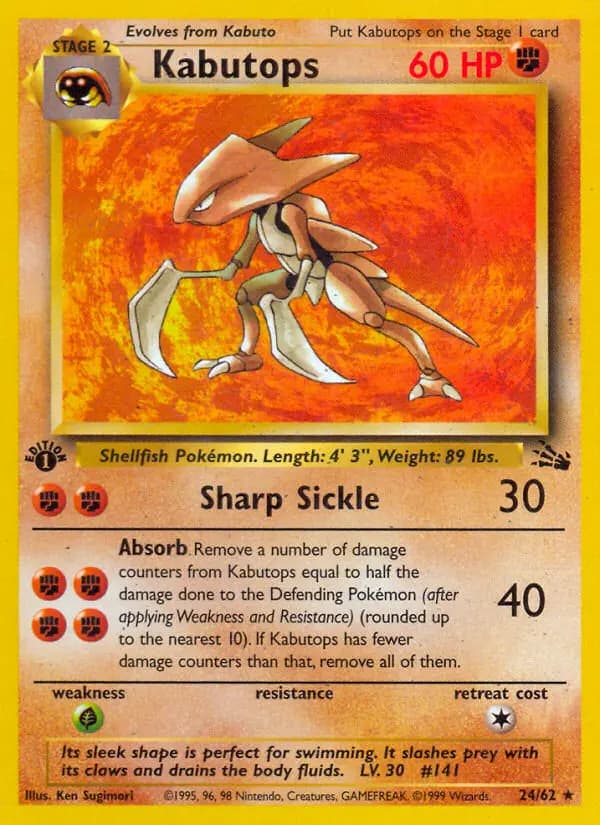
Kabutops holds a significant position within Pokémon's fossil-based creature roster as one of the original Generation I prehistoric Pokémon that established the franchise's concept of ancient, extinct species available through fossil restoration. Its design philosophy—blending prehistoric arthropod biology with samurai warrior aesthetics—influenced subsequent fossil Pokémon designs and demonstrated the creative potential of cross-cultural inspiration in creature design. The species has maintained consistent appearances across multiple anime iterations, including the original series where fossil Pokémon encounters provided narrative opportunities to explore themes of extinction and evolutionary adaptation. Kabutops's predatory nature and body-fluid-draining behavior, while graphically depicted in Pokédex entries, contributed to the franchise's willingness to portray Pokémon as genuine animals with realistic predator-prey relationships rather than purely anthropomorphic creatures. In competitive communities, Kabutops became particularly notable during specific metagame periods when rain-based teams dominated tournament play, establishing itself as a legitimate threat worthy of team-building consideration. Trading card game representations of Kabutops have appeared consistently since the Base Set era, often showcasing its scythe-based attacks and water-based characteristics through artwork that emphasizes its dual nature as both a fossil relic and an active combatant.
Where to Find Kabutops in Every Pokémon Game
Kabutops is primarily obtained through evolution of Kabuto at level 40, making its availability contingent on securing its unevolved form through fossil restoration or direct encounter. In the original Red, Blue, and Yellow versions, Kabuto could be revived from the Dome Fossil in Cinnabar Island's laboratory, subsequently evolved to Kabutops through level progression. Throughout subsequent generations, Kabutops has remained consistently available through similar fossil resurrection mechanics in titles including FireRed/LeafGreen, HeartGold/SoulSilver, and multiple modern iterations. In contemporary titles like Pokémon Sword and Shield, Kabutops appears in the Crown Tundra DLC as a wild encounter, simplifying acquisition without requiring fossil restoration. The Pokédex number remains consistent at #141 across most games, with occasional regional Pokédex renumbering in specific releases (such as #223 in Gold/Silver/Crystal or #228 in HeartGold/SoulSilver). Kabutops's catch rate of 45 is relatively moderate, indicating neither exceptional rarity nor common availability, though evolved Pokémon are typically encountered less frequently than their unevolved predecessors in wild encounters. Competitive players and collectors can obtain Kabutops through Pokémon HOME transfers from previous generations, ensuring consistent availability across the modern gaming ecosystem.