Kabuto
Generation I · #0140 — Shellfish Pokémon
Kabuto's rock/water typing gets most of the attention, but swift swim is doing just as much work in how it holds up in practice. At 0.5 m and 11.5 kg, its build reflects a specialist role rather than a generalist one. Unlike most Pokémon, Kabuto can be obtained through fossil resurrection, specifically from the Dome Fossil, making it a direct link to creatures that inhabited the planet 300 million years ago. What makes Kabuto particularly intriguing is that while it is commonly believed to be completely extinct, isolated populations have been discovered living unchanged since the prehistoric era, earning it the distinction of being called a living fossil. With a total base stat of 355, Kabuto's statistical distribution emphasizes its defensive and offensive capabilities while maintaining modest special stats and speed.
Editor's Take
Kabuto is the fossil most Gen 1 players did not pick, and Kabutops being the more offensive of the two has never quite made up for Omastar being the better one.
Base Stats
Height
0.5m
Weight
11.5kg
Category
Shellfish Pokémon
Gender
Male 87.5% / Female 12.5%
Color
brown
Shape
armor
Habitat
sea
Abilities
Doubles Speed during rain.
Protects against critical hits.
Raises Speed and lowers Defense by one stage each upon being hit by a physical move.

Kabuto Biology & Physical Characteristics
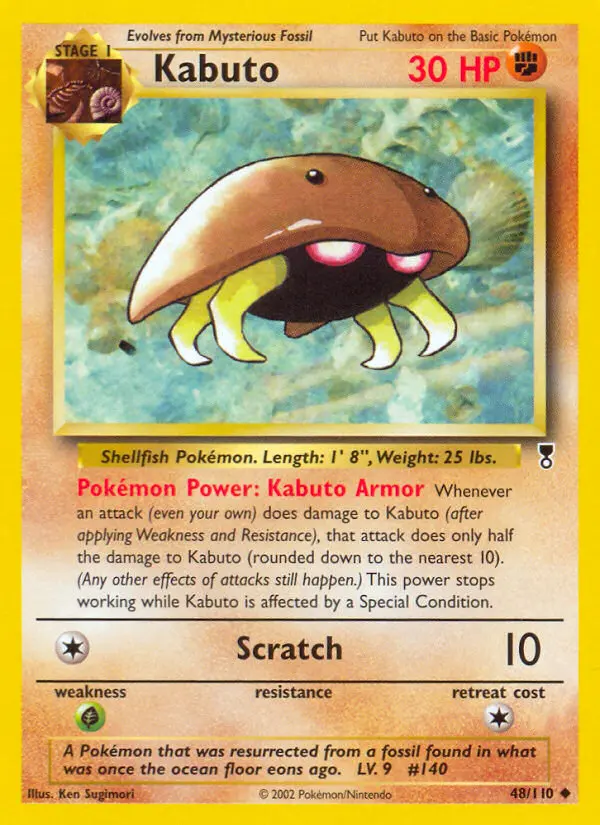
Kabuto is a small arthropod Pokémon bearing striking resemblance to a horseshoe crab, one of Earth's most ancient living creatures. The Pokémon's body is mostly flat and covered by a protective, rounded brown shell that serves as its primary defense against predators and environmental hazards. Most distinctive is its dual set of eyes: a pair of small black eyes positioned on the upper surface of its shell that it uses for sight when hiding on the ocean floor, and a second pair of luminescent red eyes located on its underside. Beneath the protective shell lies its main body structure, largely obscured from view, with only four short, yellow legs visible when the creature ventures out. This unusual ocular arrangement allowed Kabuto to remain aware of threats while remaining camouflaged against the seafloor, a survival strategy that has persisted unchanged for millions of years. At merely 0.5 meters in height and weighing only 11.5 kilograms, Kabuto is among the smaller Pokémon, yet its physical durability is evident in its base Defense stat of 90 and solid base Attack stat of 80.
Pokedex Numbers
Training
Breeding
Kabuto Breeding, Gender Ratio & Egg Groups
Kabuto exhibits a pronounced sexual dimorphism in terms of population ratio, with approximately 88% of specimens being male and only 12% female, one of the most skewed gender distributions among Generation I Pokémon. This heavily male-biased population ratio is thought to reflect evolutionary pressures from the prehistoric era when Kabuto inhabited ancient oceans, possibly indicating that males were more numerous or more likely to survive in fossil form. The Pokémon belongs to the Water 1 and Water 3 egg groups, making it compatible with a diverse range of breeding partners including other aquatic and semi-aquatic Pokémon. With a base happiness of 70, Kabuto shows moderate friendliness toward trainers, suggesting it was neither particularly hostile nor exceptionally docile in its prehistoric form. The species has a hatch counter of 30 cycles, translating to approximately 7,454–7,710 steps of travel before an egg produces a hatched Kabuto. This relatively moderate incubation period reflects the Pokémon's adaptation to stable, controlled environments, though wild specimens resurrect instantly from fossils through scientific processes rather than through traditional breeding.
Sprites






TMs & HMs
tm01
black white
tm01
black 2 white 2
tm01
lets go pikachu lets go eevee
tm01
omega ruby alpha sapphire
tm01
x y
tm02
crystal
tm02
gold silver
tm03
crystal
tm03
gold silver
tm03
ruby sapphire
tm03
platinum
tm03
firered leafgreen
tm03
heartgold soulsilver
tm03
diamond pearl
tm03
emerald
tm03
xd
tm03
colosseum
tm04
gold silver
tm04
crystal
tm05
lets go pikachu lets go eevee
+627 more TMs/HMs
Kabuto's Evolution Chain


Kabuto Evolution, Mega Evolution & Special Forms
Kabuto evolves into its powerful second-form Kabutops upon reaching level 40, a transformation that represents the creature's maturation into a more formidable predator. The evolution maintains Kabuto's Rock/Water typing while dramatically increasing its offensive capabilities and overall base stats, raising its total from 355 to 495. This evolution line does not possess a Mega Evolution form, but the standard evolution itself provides substantial improvements in Attack, Special Attack, and Speed stats, transforming Kabuto from a defensive, grounded creature into an agile, predatory hunter. The evolution is faithful to natural progression, with Kabutops developing scythe-like appendages and a more aggressive appearance while retaining the essential characteristics that made Kabuto successful for three centuries. This evolutionary arc mirrors the natural predator-prey relationships seen in paleontological evidence, suggesting that Kabutops represents the apex form of the Kabuto line's ancient ecological niche.
Where to Find
Cinnabar Island
kanto
+6 more
Alola Route 8
alola
Kabuto Behaviour and Natural Habitat
In its original prehistoric environment, Kabuto was prominently found on beaches and shallow ocean floors, leveraging its powerful and fast swimming ability to hunt and evade larger predators. The Pokémon is primarily nocturnal and spends much of its time hidden beneath sand and sediment on the ocean floor, using its back-mounted eyes to observe potential threats and prey without exposing its vulnerable shell. Its behavior demonstrates remarkable adaptation to aquatic life, though modern specimens recovered from fossils display the same behavioral patterns as their ancient ancestors. When confronted or threatened, Kabuto relies on its protective shell as its primary defense mechanism, making it difficult for attackers to land critical strikes—a trait reflected in its ability Battle Armor. According to Pokédex entries, a particularly notable characteristic is Kabuto's inability to right itself if flipped over, suggesting its flat anatomy evolved specifically for benthic existence. The Pokémon is capable of thriving in various water environments, from shallow coastal regions to deeper oceanic trenches, though it shows a marked preference for sandy substrates where it can effectively camouflage itself.
Pokedex Entries
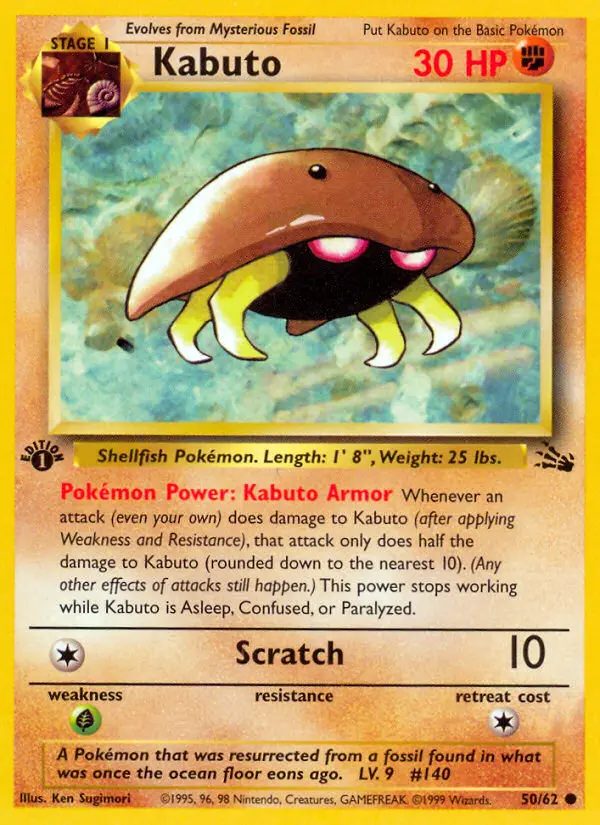
A POKéMON that was resurrected from a fossil found in what was once the ocean floor eons ago.
A POKéMON that was recovered from a fossil. It uses the eyes on its back while hiding on the sea floor.
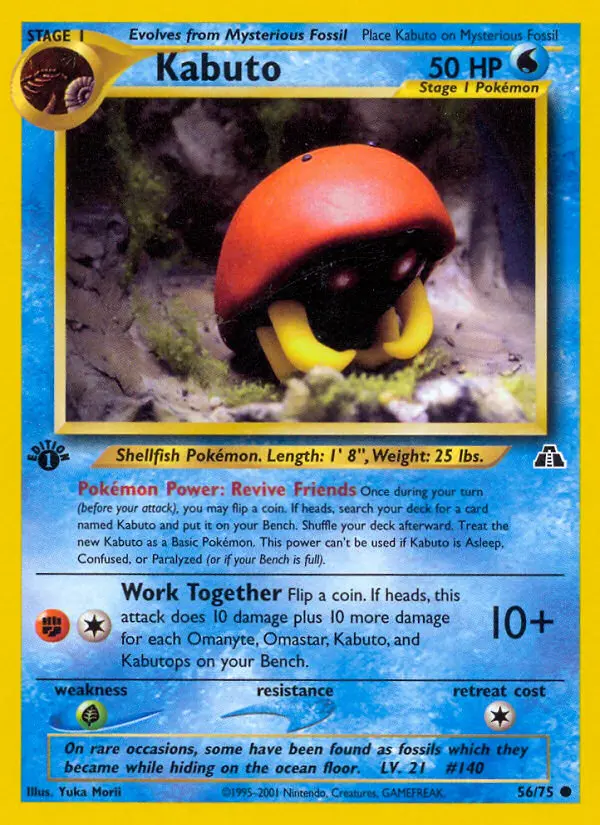
On rare occasions, some have been found as fossils which they became while hiding on the ocean floor.
This POKéMON lived in ancient times. On rare occasions, it has been discovered as a living fossil.
Three hundred million years ago, it hid on the sea floor. It also has eyes on its back that glow.
KABUTO is a POKéMON that has been regenerated from a fossil. However, in extremely rare cases, living examples have been discovered. The POKéMON has not changed at all for 300 million years.
It is a POKéMON that has been regenerated from a fossil. However, in rare cases, living examples have been discovered. KABUTO have not changed for 300 million years.
This POKéMON was regenerated from the fossil of an ancient creature. It protects itself with a hard shell.
A POKéMON that was regenerated from a fossil found in what was once the ocean floor long ago.
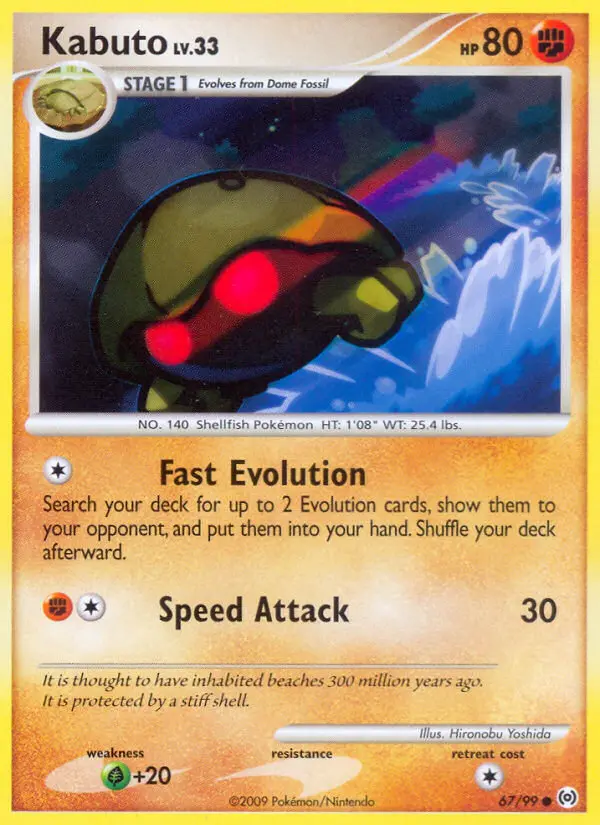
It is thought to have inhabited beaches 300 million years ago. It is protected by a stiff shell.
On rare occasions, some have been found as fossils which they became while hiding on the ocean floor.
This Pokémon lived in ancient times. On rare occasions, it has been discovered as a living fossil.
It is thought to have inhabited beaches 300 million years ago. It is protected by a stiff shell.
It is thought to have inhabited beaches 300 million years ago. It is protected by a stiff shell.
It is thought to have inhabited beaches 300 million years ago. It is protected by a stiff shell.
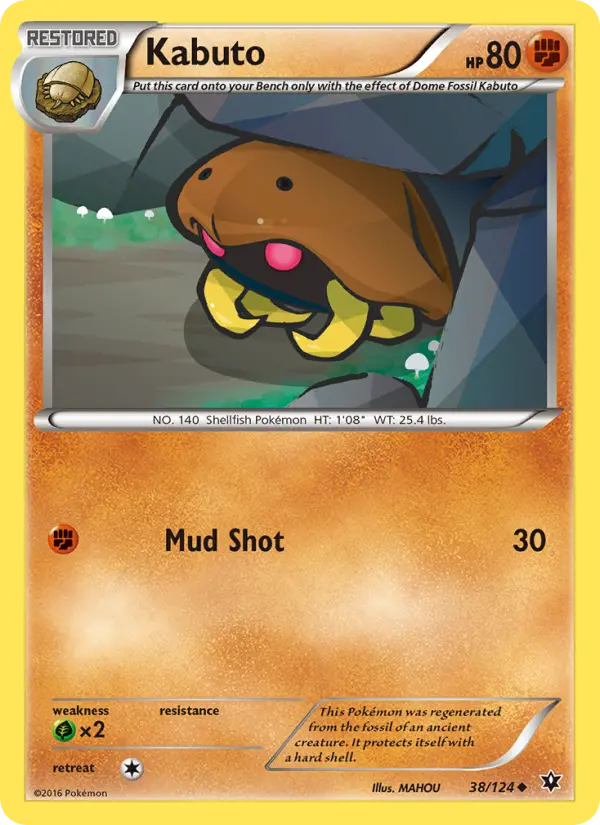
This Pokémon was regenerated from the fossil of an ancient creature. It protects itself with a hard shell.
Kabuto is a Pokémon that has been regenerated from a fossil. However, in extremely rare cases, living examples have been discovered. The Pokémon has not changed at all for 300 million years.
Kabuto is a Pokémon that has been regenerated from a fossil. However, in extremely rare cases, living examples have been discovered. The Pokémon has not changed at all for 300 million years.
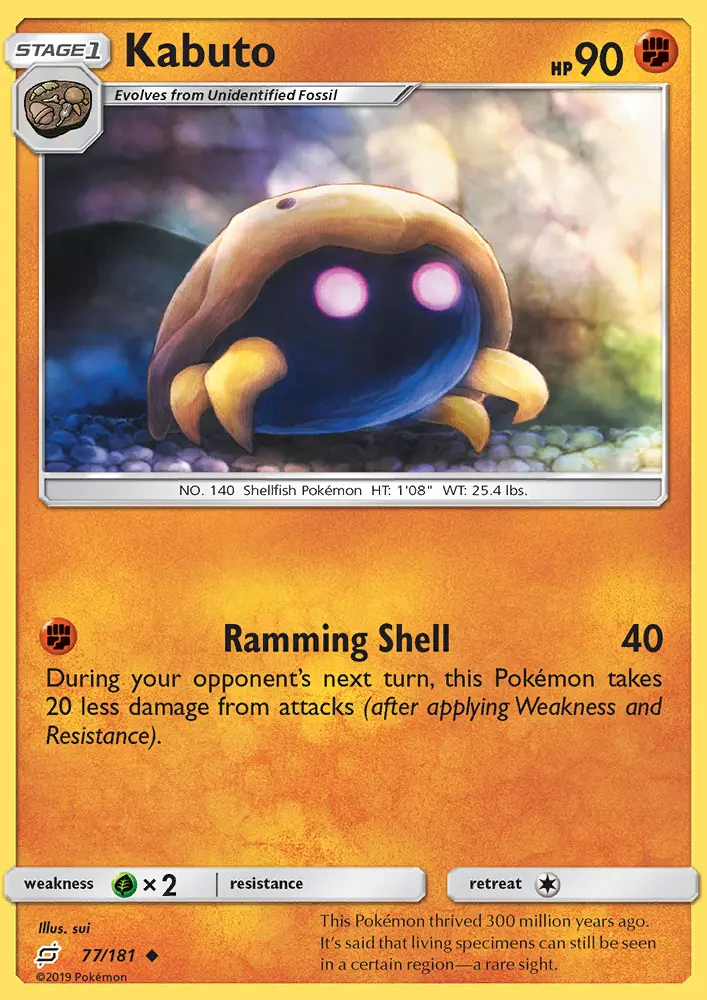
This Pokémon thrived 300 million years ago. It’s said that living specimens can still be seen in a certain region—a rare sight.
This Pokémon became extinct everywhere, except in a few areas. It protects itself with its hard shell.
A Pokémon that was recovered from a fossil. It used the eyes on its back while hiding on the seafloor.
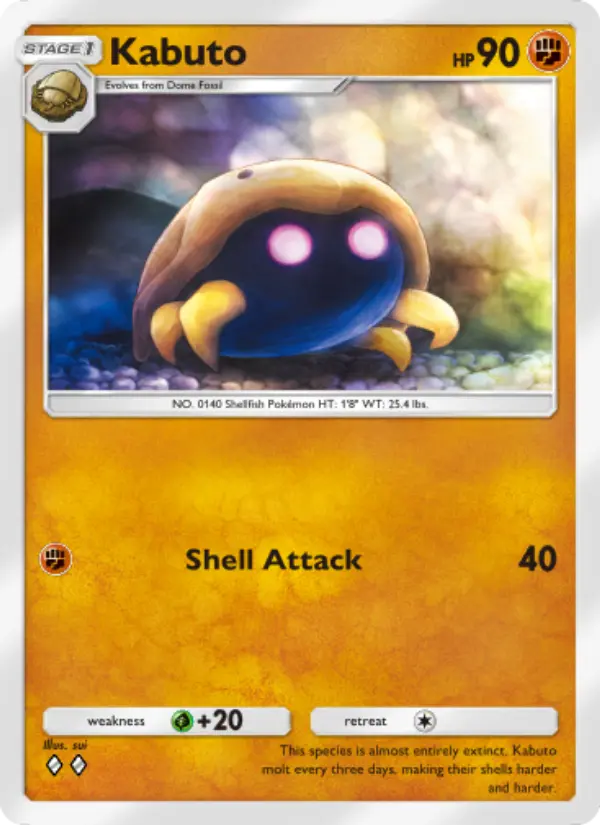
This species is almost entirely extinct. Kabuto molt every three days, making their shells harder and harder.
While some say this species has gone extinct, Kabuto sightings are apparently fairly common in some places.
Kabuto Name Origin & Design Inspiration
Kabuto's name traces back to the Japanese word "kabuto" (兜), which refers to a traditional Japanese warrior's helmet, particularly the segmented, protective headgear worn by samurai. This etymological choice reflects the Pokémon's shell-like appearance and defensive nature, as well as the cultural significance of protective armor in Japanese aesthetics. The English classification as "Shellfish Pokémon" emphasizes its biological inspiration from horseshoe crabs, one of Earth's most ancient arthropods, virtually unchanged for hundreds of millions of years. The design philosophy behind Kabuto intentionally mirrors this ancient lineage; its brown coloration matches the sandy seafloor environments where it historically thrived, while its dorsoventrally flattened body mirrors the actual body plan of horseshoe crabs. The dual eyes—one pair for surface scanning and one pair for subsurface observation—serve as a brilliant design element that simultaneously explains the Pokémon's survival strategies and provides visual intrigue. The incorporation of luminescent red eyes on its underside adds an element of mystery and otherworldliness, emphasizing Kabuto's status as a creature from an alien prehistoric era.
Learnable Moves
Kabuto can learn 77 moves:
Move | Type | Cat. | Power | Acc. | PP |
|---|---|---|---|---|---|
| absorb | grass | Special | 20 | 100 | 25 |
| aerial ace | flying | Physical | 60 | — | 20 |
| ancient power | rock | Special | 60 | 100 | 5 |
| aqua jet | water | Physical | 40 | 100 | 20 |
| attract | normal | Status | — | 100 | 15 |
| aurora beam | ice | Special | 65 | 100 | 20 |
| bide | normal | Physical | — | — | 10 |
| blizzard | ice | Special | 110 | 70 | 5 |
| body slam | normal | Physical | 85 | 100 | 15 |
| brine | water | Special | 65 | 100 | 10 |
| bubble beam | water | Special | 65 | 100 | 20 |
| captivate | normal | Status | — | 100 | 20 |
| confuse ray | ghost | Status | — | 100 | 10 |
| curse | ghost | Status | — | — | 10 |
| dig | ground | Physical | 80 | 100 | 10 |
| double team | normal | Status | — | — | 15 |
| double edge | normal | Physical | 120 | 100 | 15 |
| earth power | ground | Special | 90 | 100 | 10 |
| endure | normal | Status | — | — | 10 |
| facade | normal | Physical | 70 | 100 | 20 |
| flail | normal | Physical | — | 100 | 15 |
| foresight | normal | Status | — | — | 40 |
| frustration | normal | Physical | — | 100 | 20 |
| giga drain | grass | Special | 75 | 100 | 10 |
| hail | ice | Status | — | — | 10 |
| harden | normal | Status | — | — | 30 |
| headbutt | normal | Physical | 70 | 100 | 15 |
| hidden power | normal | Special | 60 | 100 | 15 |
| hone claws | dark | Status | — | — | 15 |
| hydro pump | water | Special | 110 | 80 | 5 |
| ice beam | ice | Special | 90 | 100 | 10 |
| icy wind | ice | Special | 55 | 95 | 15 |
| iron defense | steel | Status | — | — | 15 |
| knock off | dark | Physical | 65 | 100 | 20 |
| leech life | bug | Physical | 80 | 100 | 10 |
| leer | normal | Status | — | 100 | 30 |
| mega drain | grass | Special | 40 | 100 | 15 |
| metal sound | steel | Status | — | 85 | 40 |
| mimic | normal | Status | — | — | 10 |
| mud shot | ground | Special | 55 | 95 | 15 |
| mud slap | ground | Special | 20 | 100 | 10 |
| natural gift | normal | Physical | — | 100 | 15 |
| protect | normal | Status | — | — | 10 |
| rage | normal | Physical | 20 | 100 | 20 |
| rain dance | water | Status | — | — | 5 |
| rapid spin | normal | Physical | 50 | 100 | 40 |
| reflect | psychic | Status | — | — | 20 |
| rest | psychic | Status | — | — | 5 |
| return | normal | Physical | — | 100 | 20 |
| rock blast | rock | Physical | 25 | 90 | 10 |
| rock polish | rock | Status | — | — | 20 |
| rock slide | rock | Physical | 75 | 90 | 10 |
| rock smash | fighting | Physical | 40 | 100 | 15 |
| rock throw | rock | Physical | 50 | 90 | 15 |
| rock tomb | rock | Physical | 60 | 95 | 15 |
| rollout | rock | Physical | 30 | 90 | 20 |
| sand attack | ground | Status | — | 100 | 15 |
| sandstorm | rock | Status | — | — | 10 |
| scratch | normal | Physical | 40 | 100 | 35 |
| screech | normal | Status | — | 85 | 40 |
| secret power | normal | Physical | 70 | 100 | 20 |
| slash | normal | Physical | 70 | 100 | 20 |
| sleep talk | normal | Status | — | — | 10 |
| snore | normal | Special | 50 | 100 | 15 |
| stealth rock | rock | Status | — | — | 20 |
| stone edge | rock | Physical | 100 | 80 | 5 |
| substitute | normal | Status | — | — | 10 |
| surf | water | Special | 90 | 100 | 15 |
| swagger | normal | Status | — | 85 | 15 |
| take down | normal | Physical | 90 | 85 | 20 |
| thief | dark | Physical | 60 | 100 | 25 |
| toxic | poison | Status | — | 90 | 10 |
| water gun | water | Special | 40 | 100 | 25 |
| water pulse | water | Special | 60 | 100 | 20 |
| waterfall | water | Physical | 80 | 100 | 15 |
| whirlpool | water | Special | 35 | 85 | 15 |
| wring out | normal | Special | — | 100 | 5 |
Kabuto Competitive Battle Guide
From a competitive standpoint, Kabuto serves as a specialized defensive pivot and physical wall, particularly in lower competitive tiers where its modest speed can be overlooked in favor of its solid bulk. Its base Defense stat of 90 is its most reliable attribute, providing real durability against physical attackers, while its base Attack of 80 offers respectable coverage with moves like Stone Edge, X-Scissor, and Waterfall. The Pokémon's three available abilities each serve distinct competitive niches: Swift Swim doubles Kabuto's Speed during rain, transforming it from a sluggish creature into a viable rain-team sweeper; Battle Armor provides critical-hit immunity, making it reliable for sustained battles; and the hidden ability Weak Armor grants a Speed boost while lowering Defense when struck by physical moves, creating interesting trading scenarios. Kabuto's movepool includes essential competitive moves such as Stealth Rock for entry hazard setup, Knock Off for utility support, and coverage moves like Earthquake and Ancient Power. Its dual Rock/Water typing provides interesting resistances to Fire, Flying, and Normal-type attacks while granting a notable immunity to Electric-type moves. However, Kabuto's low Speed stat of 55 and relatively weak Special Defense of 45 limit its overall utility in higher-tier competitive play, where faster, more specially bulky Pokémon generally outperform it.
Commonly Asked Questions About Kabuto
What type is Kabuto?
Kabuto is a rock and water type Pokemon.
What does Kabuto evolve into?
Kabuto evolves into kabutops.
What are Kabuto's weaknesses?
Kabuto is weak to fighting, ground, grass and electric type moves.
Does Kabuto evolve by trading?
No — Kabuto evolves entirely through leveling up, with no trade required at any stage.
Where can I find Kabuto?
Kabuto can be found in cinnabar island (kanto) and alola route 8 (alola).
Kabuto Cultural Impact & Franchise History
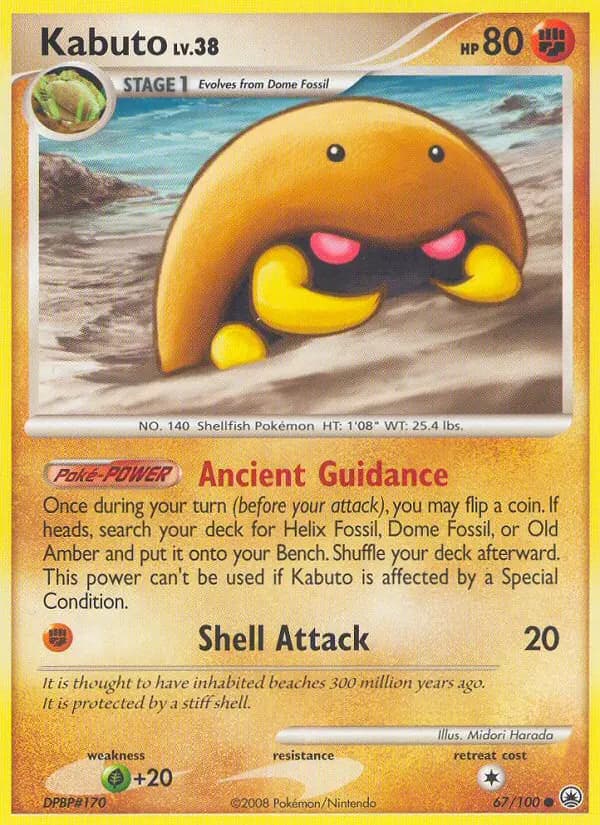
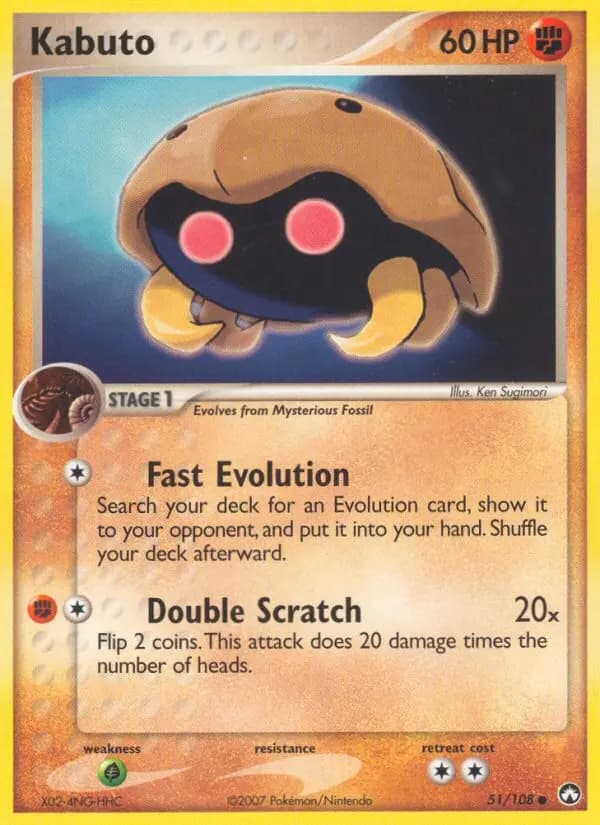
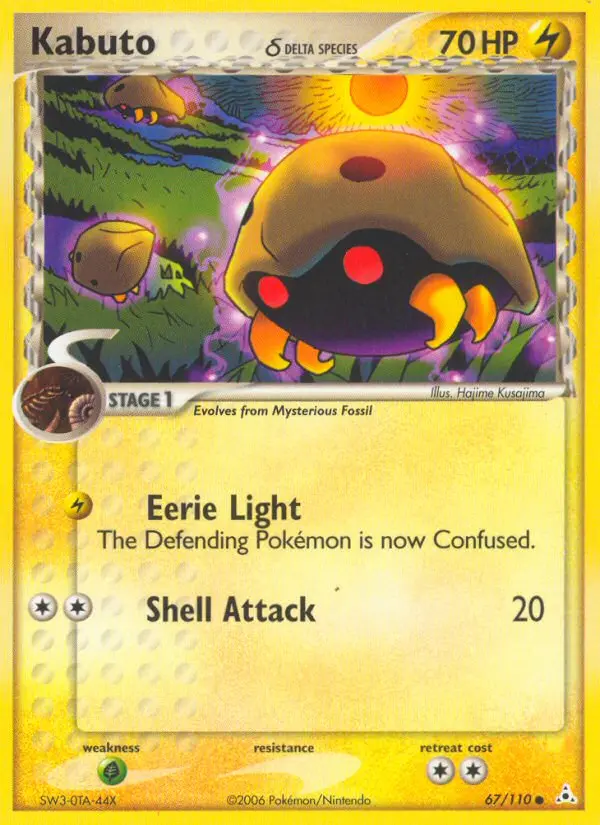
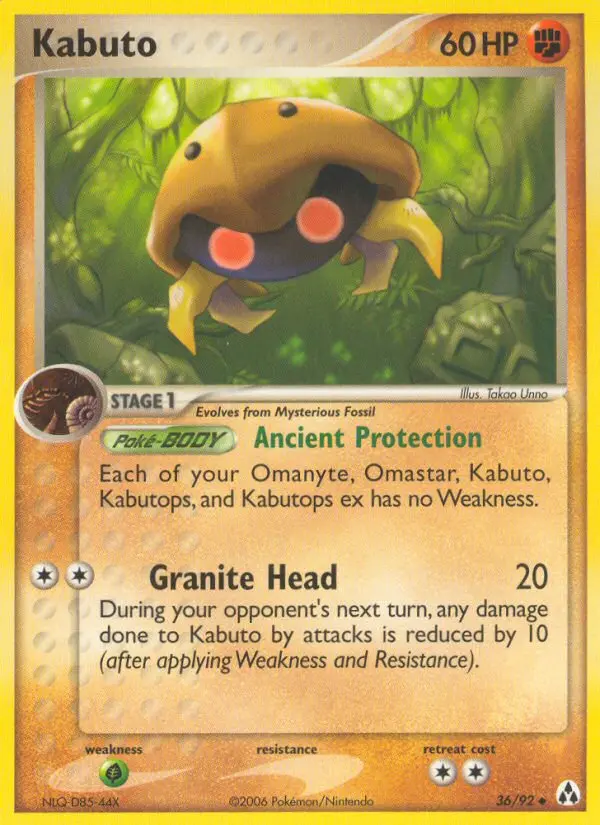
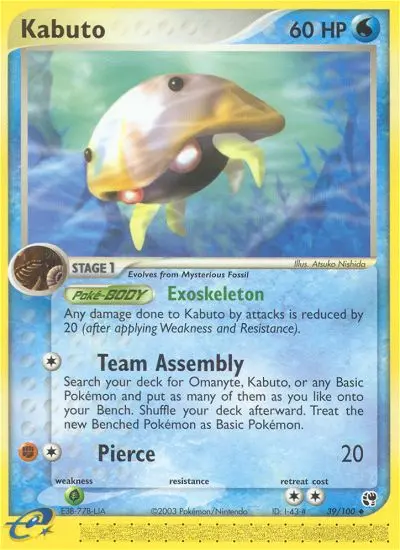
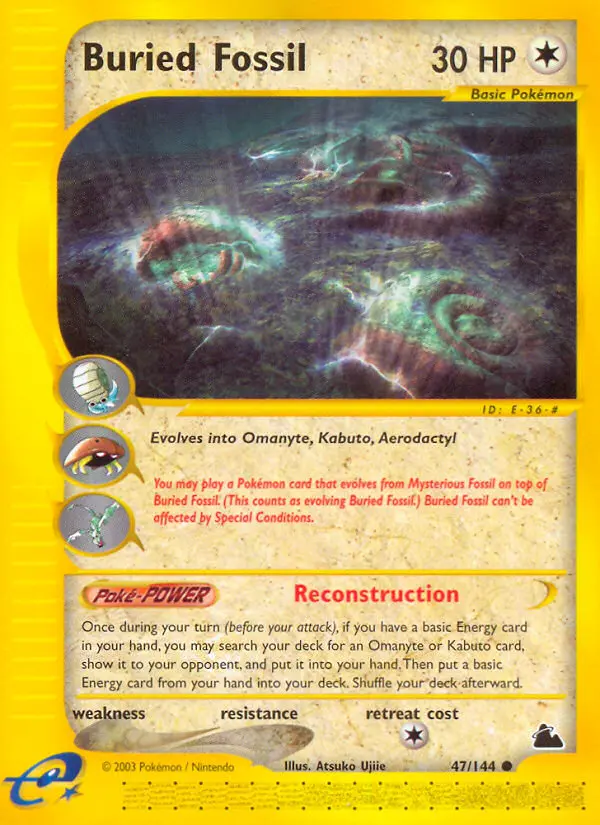
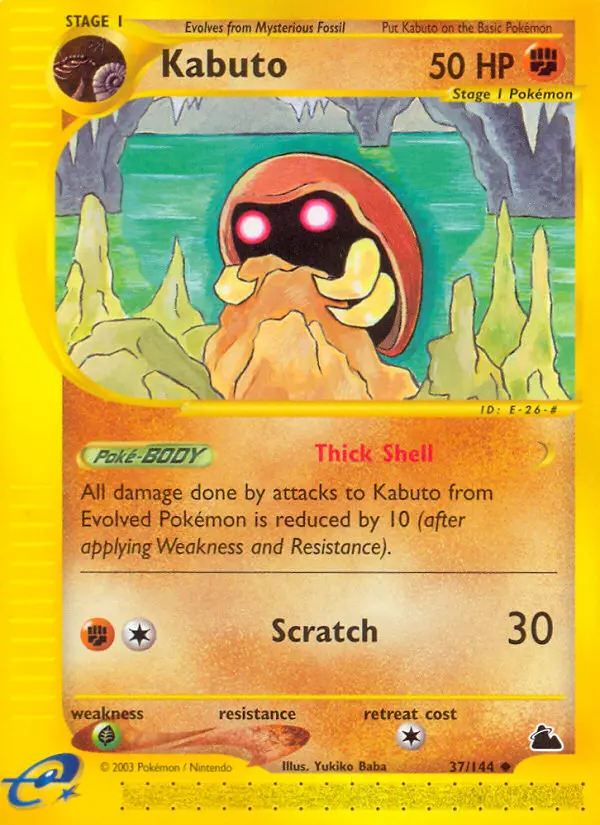
Kabuto holds significant cultural importance within the Pokémon franchise as one of the original fossil Pokémon, helping establish the concept of paleontological discovery and resurrection within the games. The Pokémon represents a fascination with prehistoric life that resonates deeply with players interested in paleontology and natural history, appearing prominently in museum exhibits and fossil-themed locations across the game series. In the anime, Kabuto has made memorable appearances that emphasize its ancient origins and unusual sensory capabilities, contributing to the broader narrative of the Pokémon world's deep evolutionary history. The Pokémon's design has influenced subsequent fossil Pokémon introductions, establishing a template for creating creatures that blend realistic paleontological inspiration with fantastical gaming mechanics. Trading card game representations of Kabuto frequently highlight its fossil nature and defensive characteristics, making it a staple in water-type and fossil-themed deck archetypes. Beyond gameplay, Kabuto symbolizes the scientific and adventurous spirit of Pokémon trainers who seek to understand and interact with creatures from Earth's distant past, embodying themes of discovery, preservation, and the wonder of encountering life from epochs long vanished.
Where to Find Kabuto in Every Pokémon Game
Kabuto's availability varies significantly across Pokémon generations and game versions, reflecting its unique status as a fossil Pokémon. In the original Red, Blue, and Yellow versions, Kabuto is obtained by resurrecting a Dome Fossil at Cinnabar Island's Pokémon Lab, making it a mid-to-late game acquisition. Subsequent generations have maintained this fossil-based acquisition method, with the Dome Fossil appearing as a reward for choosing it over the Helix Fossil (Omanyte's fossil) in various games including FireRed/LeafGreen, HeartGold/SoulSilver, and Diamond/Pearl/Platinum. In more recent generations, fossil Pokémon have been made increasingly accessible; Let's Go Pikachu and Let's Go Eevee feature Kabuto as a pokémon obtainable through fossil revival, while Sword and Shield include it in the Crown Tundra DLC. The Pokémon also appears as a catchable encounter in certain water routes in games where fossil acquisition is supplemented by wild encounters. Competitive players can access Kabuto through breeding Kabutops or through direct in-game distribution in some versions. Trading between players remains another essential method for obtaining Kabuto, particularly in games where version exclusivity relegates the Dome Fossil to limited availability. The species' availability has gradually expanded across generations, making it one of the more accessible fossil Pokémon in the modern game landscape.