Omastar
Generation I · #0139 — Spiral Pokémon
Omastar is built around Defense first — 125 at base is the clearest signal of how it's meant to be used, more than its rock/water typing alone would suggest. This combination, paired with moderate HP and Special Defense stats of 70 each, creates a unique defensive-yet-magical attacker profile. Omastar's three available abilities—Swift Swim, Shell Armor, and the hidden ability Weak Armor—offer distinct strategic advantages depending on battle conditions and playstyle preferences.
Editor's Take
Omastar's Shell Smash set is legitimately dangerous and completely dependent on getting one free turn, which is the trade every Shell Smash user makes.
Base Stats
Height
1.0m
Weight
35.0kg
Category
Spiral Pokémon
Gender
Male 87.5% / Female 12.5%
Color
blue
Shape
tentacles
Habitat
sea
Abilities
Doubles Speed during rain.
Protects against critical hits.
Raises Speed and lowers Defense by one stage each upon being hit by a physical move.

Omastar Biology & Physical Characteristics
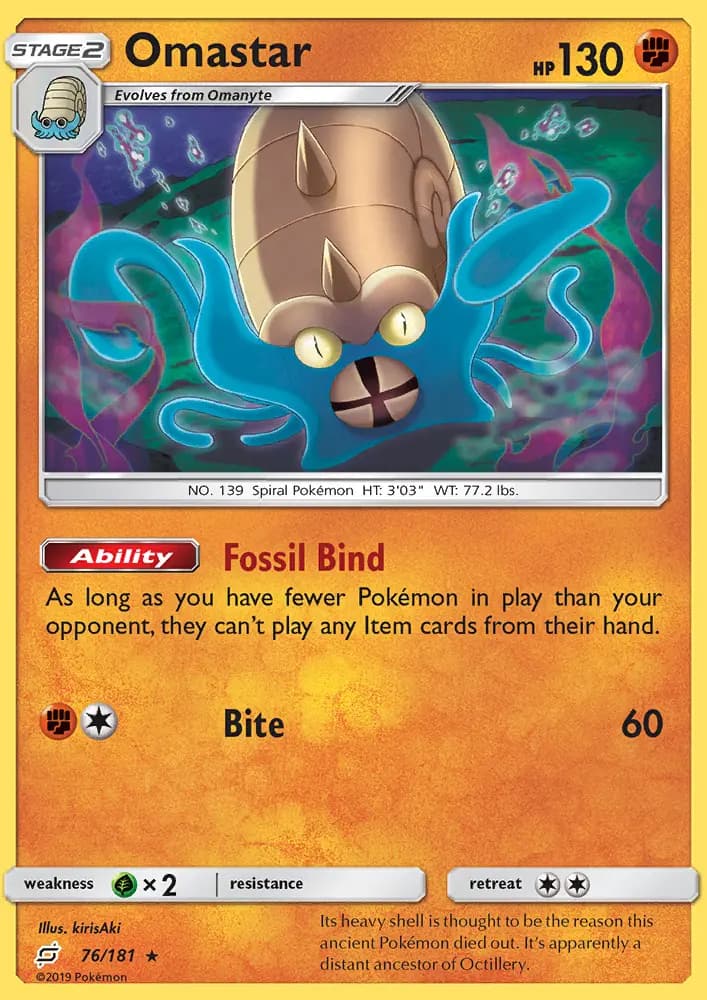
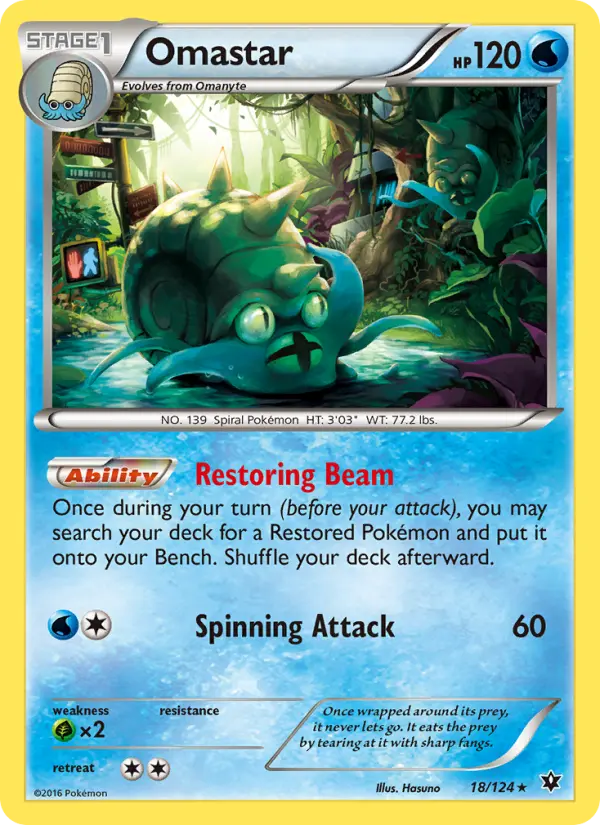
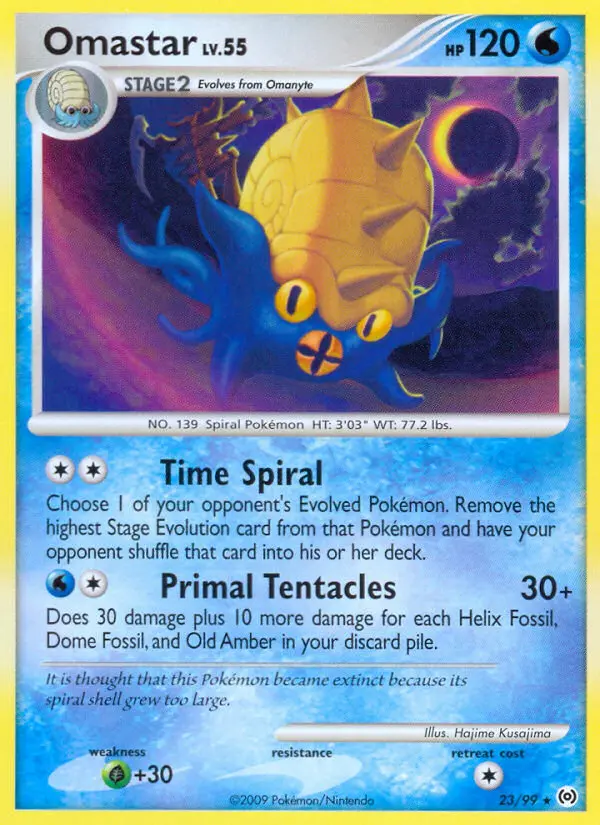
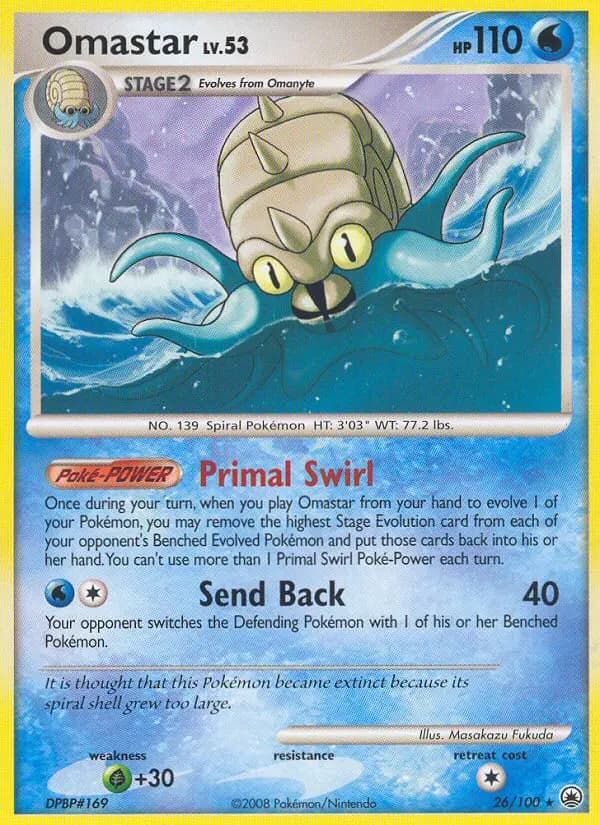
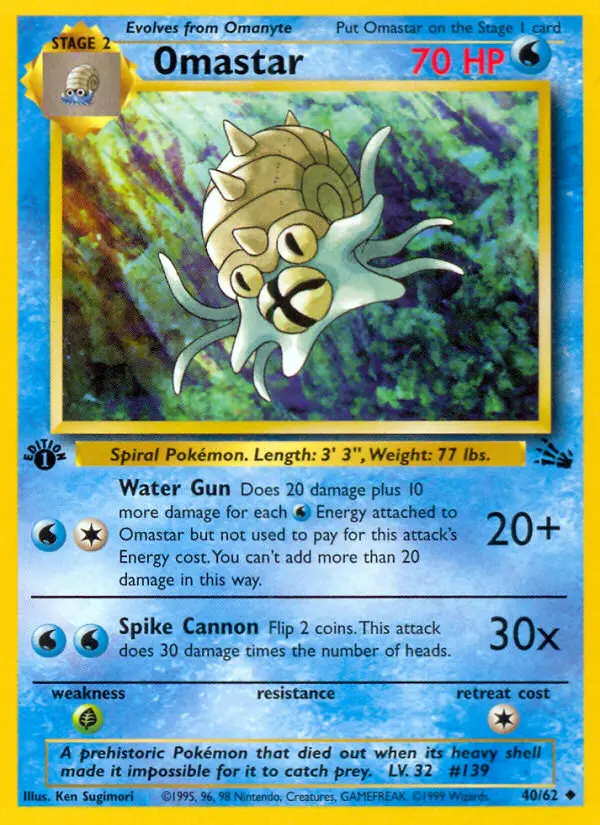
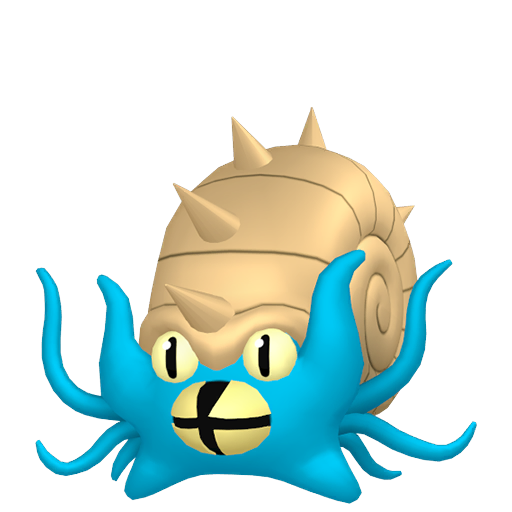
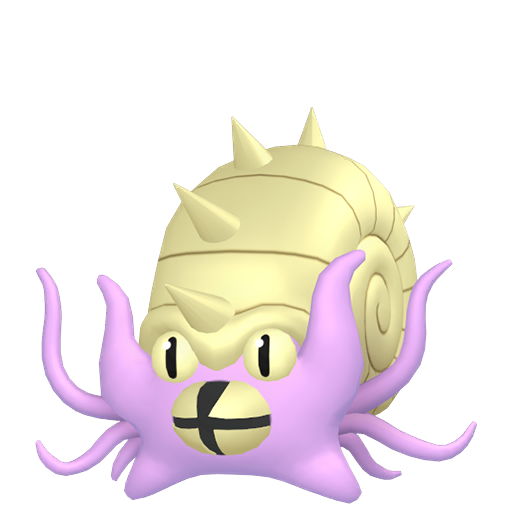
Omastar is a cephalopod mollusk Pokémon bearing striking resemblance to ancient ammonites and nautiluses, creatures that dominated prehistoric oceans. Its sky blue body is adorned with multiple tentacles of varying lengths, with shorter, thicker tentacles toward the front contrasting with longer, more delicate appendages extending from its rear. The defining feature of Omastar's anatomy is its pale yellow, helix-spiraled shell that crowns its back, serving both as a protective carapace and the source of its genus name. Sharp spikes line the shell's midsection, creating a formidable defensive structure, while two circular indents along the shell's rim reveal the position of Omastar's distinctive eyes, which feature yellow sclerae and vertically-slit pupils characteristic of cephalopod predators. Omastar measures 1.0 meters in height and weighs 35.0 kilograms, making it a compact yet robust creature. Its most fearsome feature is its mouth, which houses an oval aperture containing a four-sectioned, fang-like beak of sufficient strength to crack solid rock, enabling Omastar to prey upon hard-shelled creatures like Shellder by cracking their shells and extracting the soft insides.
Pokedex Numbers
Training
Breeding
Omastar Breeding, Gender Ratio & Egg Groups
Omastar exhibits a notable gender ratio skewed heavily toward males, with approximately 87.5% of the species being male and only 12.5% female, a statistic that carries potential evolutionary implications for the historical population. This significant gender imbalance appears across most Pokédex generations, suggesting either a biological predisposition toward male offspring or a selective breeding pattern in captivity that has perpetuated this ratio. Omastar belongs to the Water 1 and Water 3 egg groups, enabling breeding compatibility with a diverse range of aquatic and semi-aquatic Pokémon species. The species exhibits a base friendship value of 70 (adjusted to 50 in later generations), indicating moderate receptiveness to trainer bonding and affection—appropriate for a prehistoric creature that retains some of the primal nature expected from fossil Pokémon. Eggs require 30 cycles to hatch, translating to approximately 7,454 to 7,710 steps depending on specific game mechanics, placing Omastar within the moderate hatching duration range. Breeding Omastar with compatible partners allows trainers to pass down inherited moves and abilities, with certain egg move combinations creating movepool possibilities unavailable through level-up or technical machine instruction.
Sprites




TMs & HMs
tm01
lets go pikachu lets go eevee
tm02
crystal
tm02
gold silver
tm03
crystal
tm03
gold silver
tm03
ruby sapphire
tm03
platinum
tm03
firered leafgreen
tm03
heartgold soulsilver
tm03
diamond pearl
tm03
emerald
tm03
xd
tm03
colosseum
tm04
gold silver
tm04
crystal
tm05
lets go pikachu lets go eevee
tm06
yellow
tm06
gold silver
tm06
red blue
tm06
crystal
+682 more TMs/HMs
Omastar's Evolution Chain


Omastar Evolution, Mega Evolution & Special Forms
Omastar evolves from Omanyte at level 40, marking the transformation from a juvenile cephalopod into a mature predatory form. Upon evolution, Omastar experiences significant stat increases, particularly in its already-impressive Defense stat which grows from Omanyte's base 55 to an exceptional 125—a gain of 70 points that fundamentally alters the species' tactical role. Special Attack also increases substantially from Omanyte's 90 to Omastar's 115, enabling the evolved form to leverage special moves with considerably greater impact. The evolution represents both a physical maturation and a shift in behavioral patterns, as Omastar develops the fully-realized predatory instincts suggested in its unevolved form. This single-stage evolution is notably straightforward compared to many contemporary Pokémon, requiring only the straightforward level threshold without held items or special conditions. The evolutionary transformation also grants access to a broader movepool, including powerful Rock and Water-type moves that complement its dual typing and special attack prowess.
Where to Find
Location data not available for this Pokémon in the database.
Omastar Behaviour and Natural Habitat
In prehistoric times, Omastar dominated shallow seas and coastal waters as an apex predator, using its highly developed tentacles as sophisticated hunting implements. The creature possessed remarkable dexterity in manipulating its prey, ensnaring victims with tentacular precision before delivering the killing bite with its powerful beak. According to various Pokédex entries, Omastar demonstrated a preference for Shellder, suggesting it occupied a specific ecological niche as a specialized shell-breaker within ancient marine ecosystems. However, Omastar's predatory prowess was fundamentally limited by its own anatomy—despite possessing strong fangs and tentacles, the species could only effectively capture prey within immediate reach of its appendages, rendering it unable to pursue fast-moving quarry across open water. The creature's hunting strategy relied on ambush tactics rather than pursuit, positioning itself in areas where stationary or slow-moving prey concentrated. Ironically, Omastar itself fell prey to more adaptable predators such as Carracosta, suggesting it existed within a complex prehistoric food web where its defensive advantages eventually proved insufficient for survival.
Pokedex Entries
A prehistoric POKéMON that died out when its heavy shell made it impossible to catch prey.
Sharp beaks ring its mouth. Its shell was too big for it to move freely, so it became extinct.
Apparently, it cracked SHELLDER's shell with its sharp fangs and sucked out the insides.
Once wrapped around its prey, it never lets go. It eats the prey by tearing at it with sharp fangs.
Its heavy shell allowed it to reach only nearby food. This could be the reason it is extinct.
OMASTAR uses its tentacles to capture its prey. It is believed to have become extinct because its shell grew too large and heavy, causing its movements to become too slow and ponderous.
An OMASTAR uses its tentacles to capture its prey. It is believed to have become extinct because its shell grew too large, making its movements slow and ponderous.
Its tentacles are highly developed as if they are hands and feet. As soon as it ensnares prey, it bites.
Despite having strong fangs and tentacles, it went extinct when its heavy shell made it unable to catch prey.
It is thought that this Pokémon became extinct because its spiral shell grew too large.
Apparently, it cracked SHELLDER’s shell with its sharp fangs and sucked out the insides.
Once wrapped around its prey, it never lets go. It eats the prey by tearing at it with sharp fangs.
It is thought that this Pokémon became extinct because its spiral shell grew too large.
It is thought that this Pokémon became extinct because its spiral shell grew too large.
Its tentacles are highly developed as if they are hands and feet. As soon as it ensnares prey, it bites.
Once wrapped around its prey, it never lets go. It eats the prey by tearing at it with sharp fangs.
Omastar uses its tentacles to capture its prey. It is believed to have become extinct because its shell grew too large and heavy, causing its movements to become too slow and ponderous.
Omastar uses its tentacles to capture its prey. It is believed to have become extinct because its shell grew too large and heavy, causing its movements to become too slow and ponderous.
Its heavy shell is thought to be the reason this ancient Pokémon died out. It’s apparently a distant ancestor of Octillery.
It wraps its prey in its tentacles to immobilize them and then finishes them off with its sharp fangs.
Its sharp beak rings its mouth. Its shell was too big for it to move freely, so it became extinct.
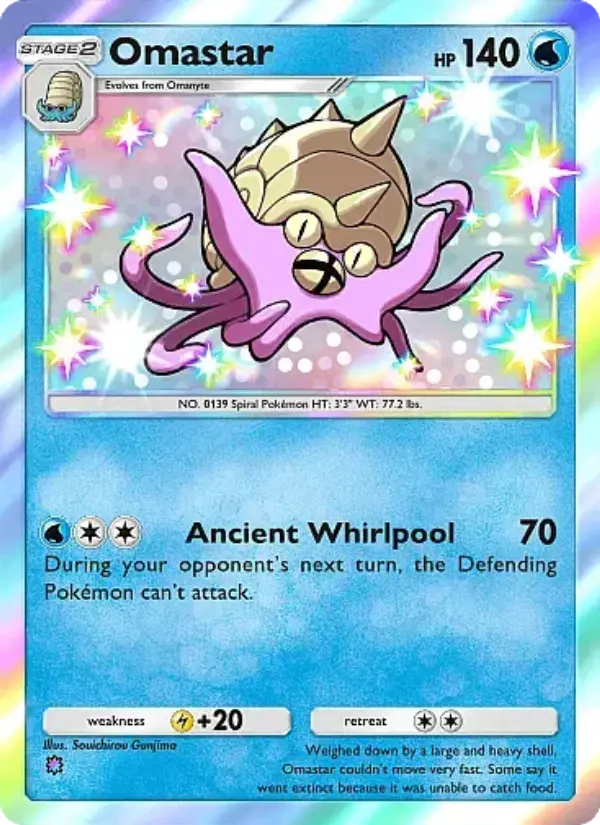
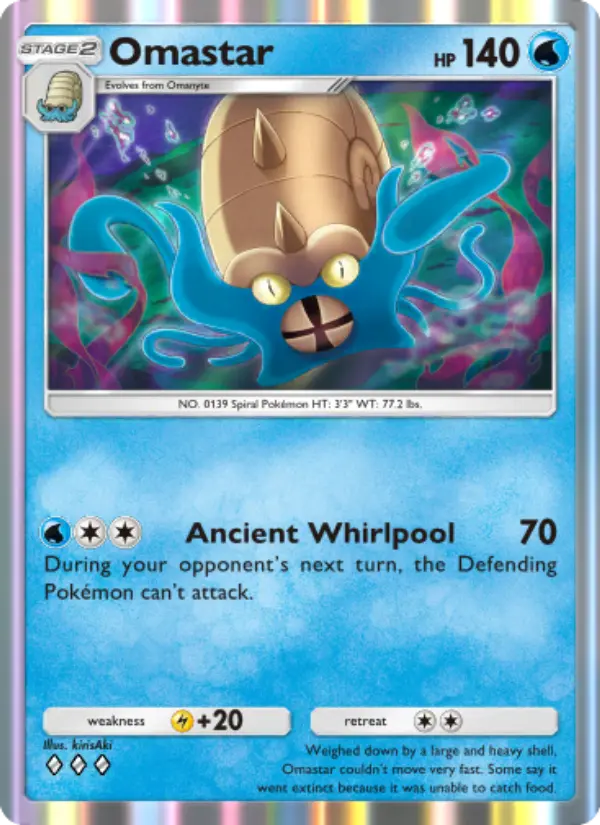
Weighed down by a large and heavy shell, Omastar couldn’t move very fast. Some say it went extinct because it was unable to catch food.
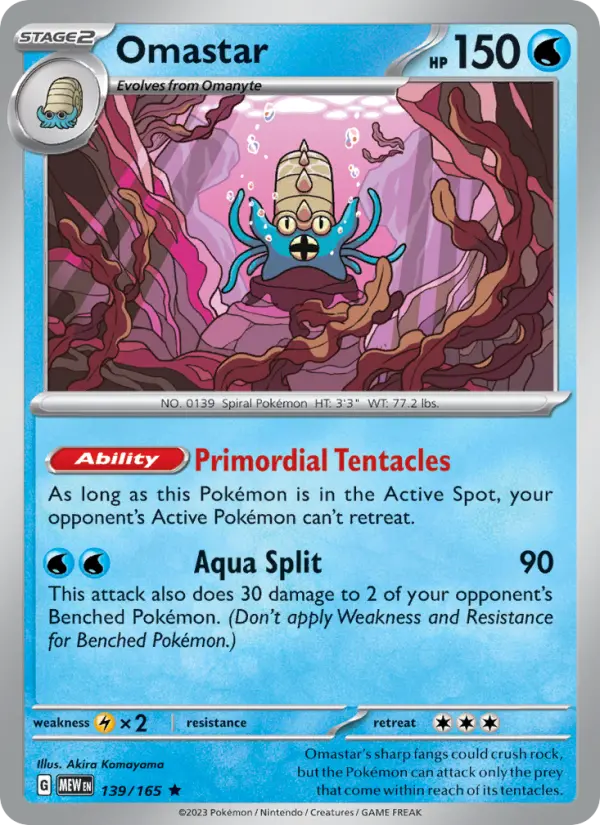
Omastar’s sharp fangs could crush rock, but the Pokémon can attack only the prey that come within reach of its tentacles.
Omastar Name Origin & Design Inspiration
Omastar's name comes from 'ammonite'—the extinct spiral-shelled cephalopod mollusk—combined with the suffix 'star,' a common English modifier suggesting superiority or excellence. The Japanese name 'Omstar' (オムスター) follows similar etymological principles, maintaining reference to the ammonite while adding the 'star' suffix. This nomenclature directly reflects Omastar's biological inspiration, as the creature's spiral shell pattern mirrors the perfectly logarithmic spiral characteristic of true ammonite fossils. The Pokédex designation as the 'Spiral Pokémon' explicitly reinforces this paleontological connection, emphasizing the distinctive helical architecture that defines Omastar's visual identity. The design team's choice to base Omastar and its pre-evolution on ammonites rather than other cephalopods represents a particularly elegant paleontological reference, as ammonites are among the most recognizable extinct creatures and their spiral shells provide immediate visual distinctiveness. The creature's coloration—sky blue body with pale yellow shell—suggests an ancient sea creature, evoking the aesthetic of museum-preserved fossils while maintaining the vivid color palette characteristic of Pokémon design.
Learnable Moves
Omastar can learn 86 moves:
Move | Type | Cat. | Power | Acc. | PP |
|---|---|---|---|---|---|
| ancient power | rock | Special | 60 | 100 | 5 |
| attract | normal | Status | — | 100 | 15 |
| bide | normal | Physical | — | — | 10 |
| bind | normal | Physical | 15 | 85 | 20 |
| bite | dark | Physical | 60 | 100 | 25 |
| blizzard | ice | Special | 110 | 70 | 5 |
| body slam | normal | Physical | 85 | 100 | 15 |
| brine | water | Special | 65 | 100 | 10 |
| bubble beam | water | Special | 65 | 100 | 20 |
| captivate | normal | Status | — | 100 | 20 |
| confide | normal | Status | — | — | 20 |
| constrict | normal | Physical | 10 | 100 | 35 |
| crunch | dark | Physical | 80 | 100 | 15 |
| curse | ghost | Status | — | — | 10 |
| dive | water | Physical | 80 | 100 | 10 |
| double team | normal | Status | — | — | 15 |
| double edge | normal | Physical | 120 | 100 | 15 |
| earth power | ground | Special | 90 | 100 | 10 |
| endure | normal | Status | — | — | 10 |
| facade | normal | Physical | 70 | 100 | 20 |
| frustration | normal | Physical | — | 100 | 20 |
| giga impact | normal | Physical | 150 | 90 | 5 |
| gyro ball | steel | Physical | — | 100 | 5 |
| hail | ice | Status | — | — | 10 |
| headbutt | normal | Physical | 70 | 100 | 15 |
| hidden power | normal | Special | 60 | 100 | 15 |
| horn attack | normal | Physical | 65 | 100 | 25 |
| horn drill | normal | Physical | — | 30 | 5 |
| hydro pump | water | Special | 110 | 80 | 5 |
| hyper beam | normal | Special | 150 | 90 | 5 |
| ice beam | ice | Special | 90 | 100 | 10 |
| icy wind | ice | Special | 55 | 95 | 15 |
| iron defense | steel | Status | — | — | 15 |
| knock off | dark | Physical | 65 | 100 | 20 |
| leer | normal | Status | — | 100 | 30 |
| liquidation | water | Physical | 85 | 100 | 10 |
| meteor beam | rock | Special | 120 | 90 | 10 |
| mimic | normal | Status | — | — | 10 |
| mud shot | ground | Special | 55 | 95 | 15 |
| muddy water | water | Special | 90 | 85 | 10 |
| natural gift | normal | Physical | — | 100 | 15 |
| pin missile | bug | Physical | 25 | 95 | 20 |
| protect | normal | Status | — | — | 10 |
| rage | normal | Physical | 20 | 100 | 20 |
| rain dance | water | Status | — | — | 5 |
| reflect | psychic | Status | — | — | 20 |
| rest | psychic | Status | — | — | 5 |
| return | normal | Physical | — | 100 | 20 |
| rock blast | rock | Physical | 25 | 90 | 10 |
| rock climb | normal | Physical | 90 | 85 | 20 |
| rock polish | rock | Status | — | — | 20 |
| rock slide | rock | Physical | 75 | 90 | 10 |
| rock smash | fighting | Physical | 40 | 100 | 15 |
| rock throw | rock | Physical | 50 | 90 | 15 |
| rock tomb | rock | Physical | 60 | 95 | 15 |
| rollout | rock | Physical | 30 | 90 | 20 |
| round | normal | Special | 60 | 100 | 15 |
| sand attack | ground | Status | — | 100 | 15 |
| sandstorm | rock | Status | — | — | 10 |
| scald | water | Special | 80 | 100 | 15 |
| secret power | normal | Physical | 70 | 100 | 20 |
| seismic toss | fighting | Physical | — | 100 | 20 |
| shell smash | normal | Status | — | — | 15 |
| skull bash | normal | Physical | 130 | 100 | 10 |
| sleep talk | normal | Status | — | — | 10 |
| smack down | rock | Physical | 50 | 100 | 15 |
| snore | normal | Special | 50 | 100 | 15 |
| spike cannon | normal | Physical | 20 | 100 | 15 |
| spikes | ground | Status | — | — | 20 |
| stealth rock | rock | Status | — | — | 20 |
| stone edge | rock | Physical | 100 | 80 | 5 |
| submission | fighting | Physical | 80 | 80 | 20 |
| substitute | normal | Status | — | — | 10 |
| supersonic | normal | Status | — | 55 | 20 |
| surf | water | Special | 90 | 100 | 15 |
| swagger | normal | Status | — | 85 | 15 |
| take down | normal | Physical | 90 | 85 | 20 |
| thief | dark | Physical | 60 | 100 | 25 |
| tickle | normal | Status | — | 100 | 20 |
| toxic | poison | Status | — | 90 | 10 |
| toxic spikes | poison | Status | — | — | 20 |
| water gun | water | Special | 40 | 100 | 25 |
| water pulse | water | Special | 60 | 100 | 20 |
| waterfall | water | Physical | 80 | 100 | 15 |
| whirlpool | water | Special | 35 | 85 | 15 |
| withdraw | water | Status | — | — | 40 |
Omastar Competitive Battle Guide
Omastar occupies a distinctive competitive niche as a bulky special attacker capable of leveraging its exceptional 125 Defense stat alongside respectable 115 Special Attack to wall physical threats while delivering powerful special moves. Its dual Rock/Water typing provides interesting coverage, with Rock-type moves covering Flying, Bug, and Fire threats while Water moves address Ground, Rock, and Fire vulnerabilities, though the typing simultaneously creates concerning weaknesses to common Grass and Electric coverage moves. The ability Swift Swim deserves particular emphasis in competitive contexts, as it doubles Omastar's Speed during rain—transforming its otherwise sluggish 55 base Speed into a more respectable 110 during rain-weather teams, enabling it to outspeed normally faster threats. This weather-dependent speed boost synergizes excellently with water-type teammates and rain-setting abilities like Drizzle. Shell Armor provides passive critical-hit immunity, eliminating surprise one-hit kills from high-crit moves, while the hidden ability Weak Armor presents an aggressive option that trades defensive investment for speed boosts when struck by physical moves. Competitive movesets typically emphasize special attacks such as Hydro Pump, Power Gem, and Psychic, supplemented by utility moves like Stealth Rock, Toxic Spikes, or Recover depending on team requirements. However, Omastar's low 55 Speed stat without weather support and vulnerability to faster special attackers limit its viability in highest-level competitive play.
Commonly Asked Questions About Omastar
What type is Omastar?
Omastar is a rock and water type Pokemon.
What does Omastar evolve from?
Omastar evolved from omanyte.
What are Omastar's weaknesses?
Omastar is weak to fighting, ground, grass and electric type moves.
Omastar Cultural Impact & Franchise History
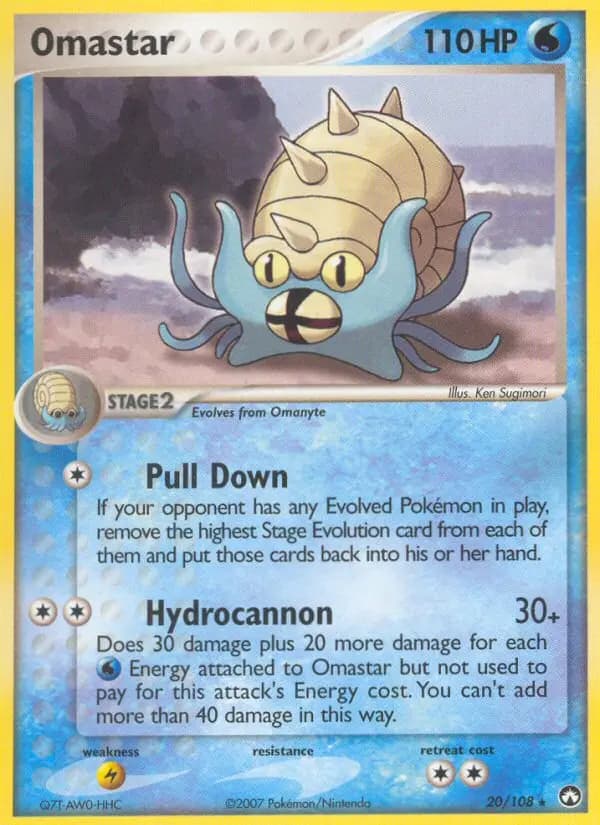
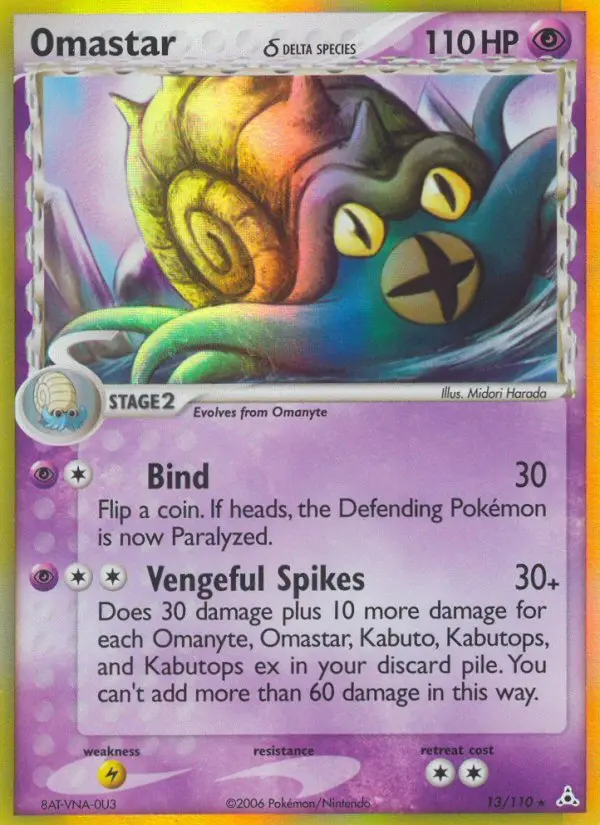
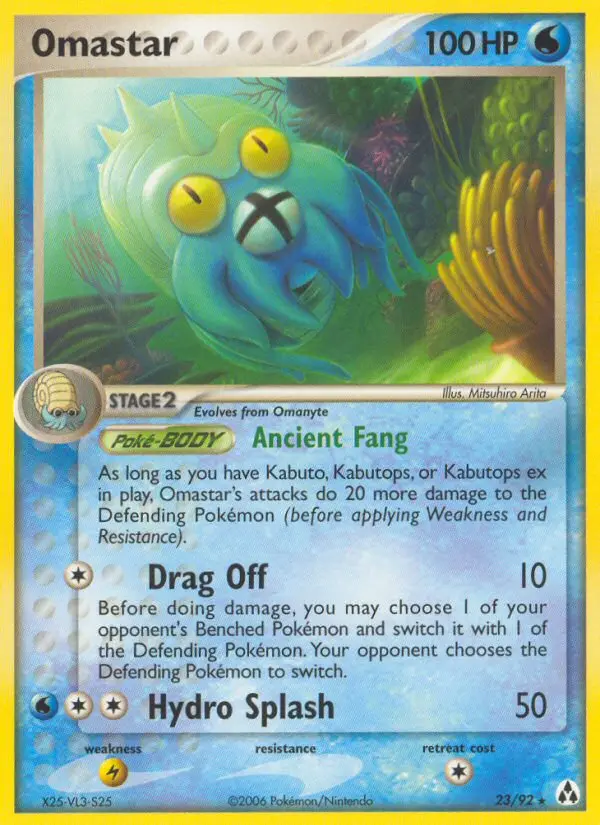
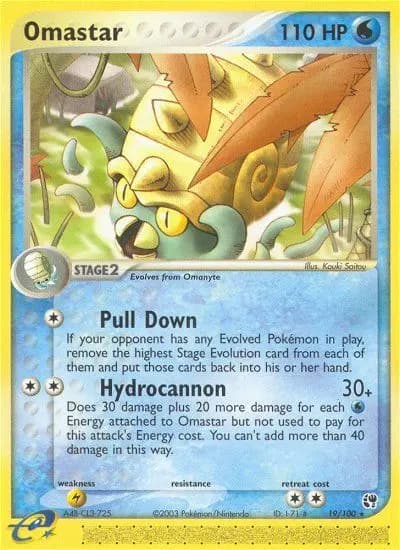
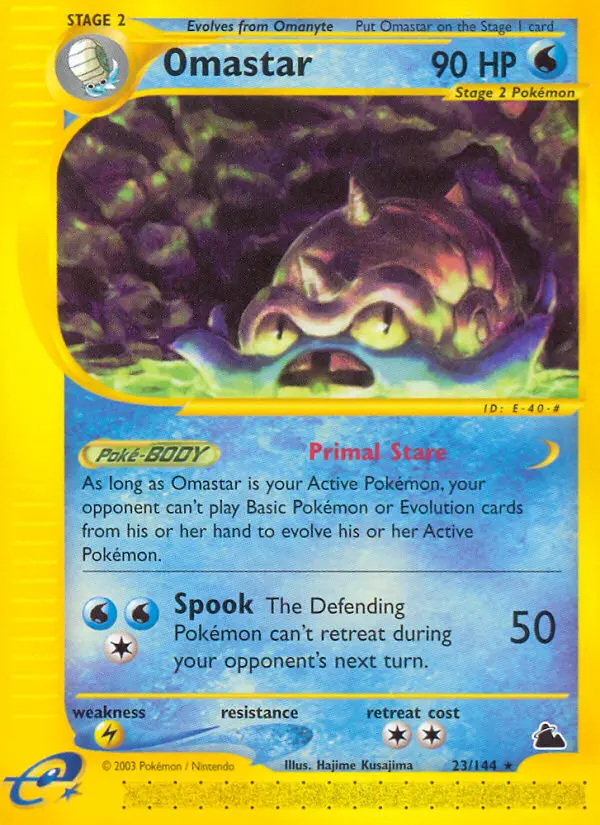
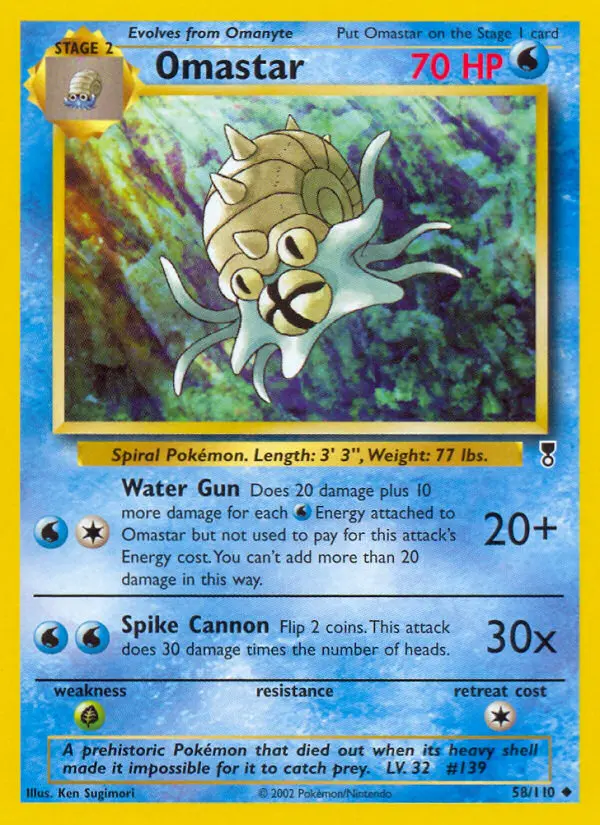
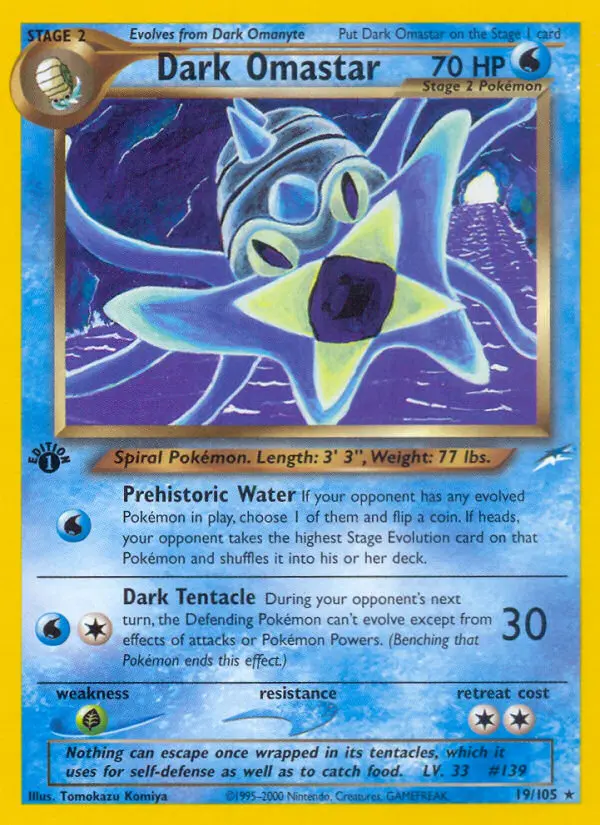
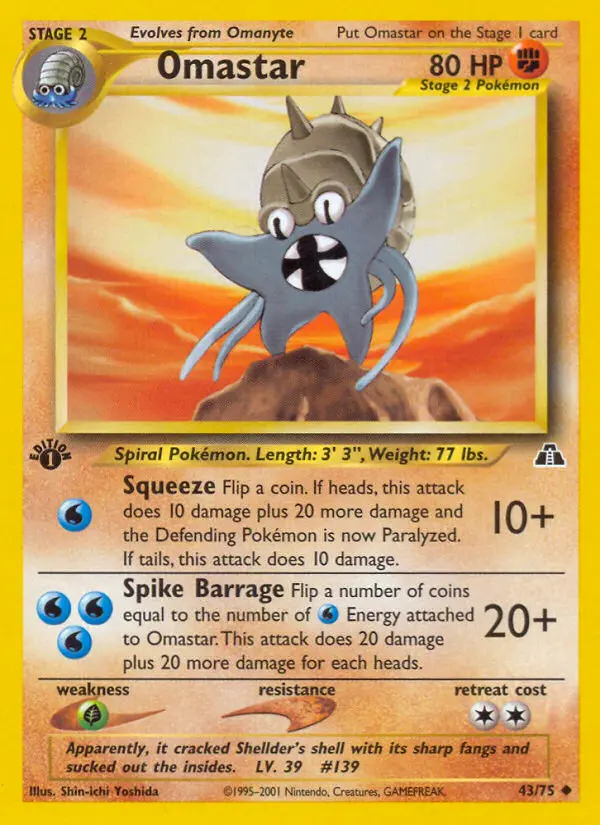
Omastar represents a fascinating intersection of paleontology and Pokémon design, capturing the public imagination as one of the earliest fossil Pokémon introduced in the franchise. The creature's tragic extinction narrative—where its own shell grew too large and heavy to maintain hunting success—provides a poignant commentary on evolutionary dead-ends and ecological specialization, themes that resonate with scientific understanding of actual extinction events. This narrative appears consistently across multiple Pokédex entries spanning generations, suggesting deliberate thematic emphasis from the design team. Omastar's presence in early anime episodes and the trading card game established it as a recognizable icon of prehistoric Pokémon lore, though it never achieved the mainstream recognition of more visually distinctive fossils like Aerodactyl or Lapras. The species maintains a devoted fanbase among players who appreciate its complex stat distribution and competitive movepool flexibility. In fan communities, Omastar often appears in discussions of underrated Pokémon and paleontology-inspired designs, with its ammonite inspiration earning praise from scientifically-minded players. The creature has appeared in various Pokédex-focused media and educational resources that leverage Pokémon to teach paleontological concepts.
Where to Find Omastar in Every Pokémon Game
Omastar's availability varies significantly across Pokémon games, reflecting its status as a fossil Pokémon that must be resurrected from ancient remains rather than caught in standard wild encounters. In the original Generation I games (Red, Blue, Yellow), trainers obtain Omanyte fossils as part of the main story progression at Mt. Moon, choosing between the Omanyte fossil or Kabuto fossil—a choice that permanently locks players into one fossil lineage per playthrough unless using multiple save files. Subsequent remakes and generations generally maintain this fossil-selection mechanic, with Omanyte fossils available through similar story-driven methods. In Generation II games (Gold/Silver/Crystal), Omanyte fossils can be resurrected at the Azalea Town museum, expanding availability. FireRed and LeafGreen maintain the original Mt. Moon location system, while HeartGold and SoulSilver follow Generation II patterns. More recent games like Pokémon Let's Go Pikachu/Eevee feature fossil availability mechanics similar to original versions, and Pokémon Sword/Shield's Expansion Pass (The Crown Tundra) provides additional Omanyte availability through fossil-combining mechanics. The Pokédex capture rate of 45 suggests moderate difficulty if encounters occur in wild circumstances, though standard fossil resurrection methods eliminate capture rate considerations. Trading with other players remains the most reliable method for obtaining multiple Omastar specimens or accessing it in games where fossil selection prevents its availability.