Larvitar
Generation II · #0246 — Rock Skin Pokémon
Larvitar, known as the Rock Skin Pokémon, is a dual-type Rock/Ground Pokémon introduced in Generation II that serves as the first stage of one of the most powerful pseudo-legendary evolutionary lines in the series. With a National Pokédex number of 246, Larvitar represents the humble beginning of a creature destined for tremendous growth and power. Standing merely 0.6 meters tall and weighing 72.0 kilograms, this small reptilian Pokémon belies the massive potential that lies within its genetic code. As the progenitor of the evolution line leading to the formidable Tyranitar, Larvitar captures the imagination of trainers worldwide who understand that patience and proper care can transform this modest creature into a force of nature capable of devastating entire landscapes.
Editor's Take
Larvitar takes until level 55 to become Tyranitar, which is the same grind as Dragonite, and it is one of the few times the payoff genuinely justifies the wait.
Base Stats
Height
0.6m
Weight
72.0kg
Category
Rock Skin Pokémon
Gender
Male 50% / Female 50%
Color
green
Shape
upright
Habitat
mountain
Abilities
Increases Attack to 1.5× with a major status ailment.
Increases evasion to 1.25× during a sandstorm. Protects against sandstorm damage.

Larvitar Biology & Physical Characteristics
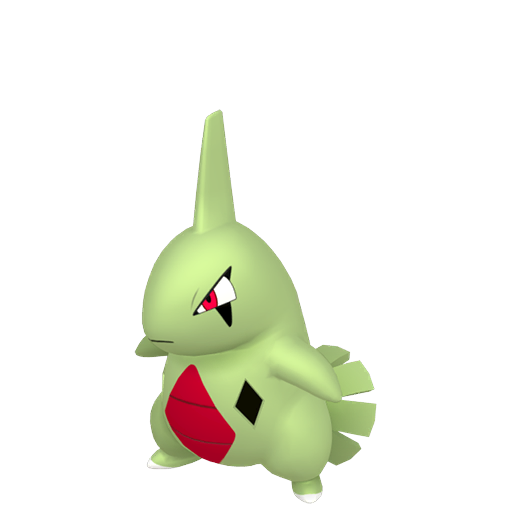
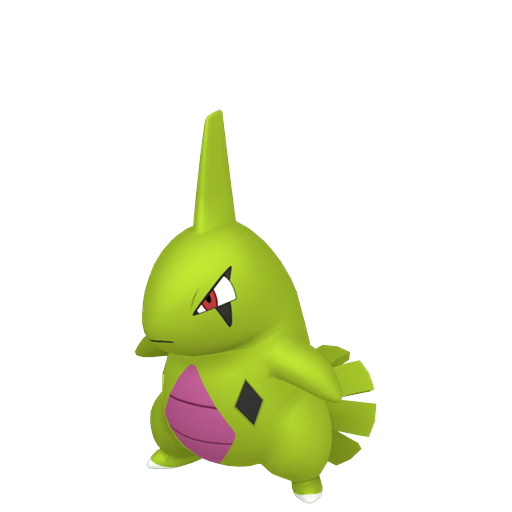
Larvitar is a small, quadrupedal reptilian Pokémon with a distinctive green coloration and rocky texture to its skin that perfectly reflects its Rock/Ground typing. Its most recognizable feature is the blunt spike protruding from the crown of its head, accompanied by a short, rounded snout and striking red eyes with characteristic black triangular markings positioned below and at the upper corners of the eye sockets. The creature's belly is covered in distinctive red scales arranged in a diamond pattern, while several small diamond-shaped holes perforate its body throughout. Its short arms lack proper fingers, terminating instead in simple appendages, while its feet each possess a single toenail for traction through soil and stone. Most notably, Larvitar's tail resembles a sophisticated tunnel-boring apparatus, featuring a conical center surrounded by a ring of plate-like scales that rotate and compress earth as the Pokémon burrows through geological layers. This specialized anatomy perfectly suits Larvitar's primary biological function: consuming vast quantities of soil and stone to fuel its growth and development toward its more powerful evolutionary forms.
Pokedex Numbers
Training
Breeding
Larvitar Breeding, Gender Ratio & Egg Groups
Larvitar exhibits a perfectly balanced gender ratio with an even 50% chance of being male or female, a standard distribution that applies across all known populations of the species. The species belongs to the Monster egg group, which encompasses a diverse array of primarily reptilian, draconic, and beast-like Pokémon that share similar reproductive characteristics. With a base happiness value of only 35, Larvitar begins with lower-than-average affection for newly caught specimens, requiring patient training and bonding to develop loyalty and improve its battle performance through happiness-dependent mechanics. The relatively low base happiness may reflect the species' underground, solitary birth and adaptation to independent survival, contrasting with more sociable Pokémon that begin with higher friendship values. Breeding two compatible Pokémon can produce Larvitar eggs that require 40 cycles to hatch, equivalent to 10,024 to 10,280 steps of overworld travel, making it a moderately lengthy incubation period that reflects the creature's slow growth rate classification. Trainers seeking to breed Larvitar should note that egg moves passed from parent Pokémon can provide movepool diversity beyond what Larvitar learns naturally through leveling, enabling strategic customization of its combat abilities before it even enters battle.
Sprites




TMs & HMs
tm01
lets go pikachu lets go eevee
tm02
crystal
tm02
gold silver
tm02
lets go pikachu lets go eevee
tm03
crystal
tm03
gold silver
tm03
lets go pikachu lets go eevee
tm05
lets go pikachu lets go eevee
tm06
yellow
tm06
gold silver
tm06
red blue
tm06
crystal
tm06
emerald
tm06
firered leafgreen
tm06
diamond pearl
tm06
platinum
tm06
ruby sapphire
tm06
colosseum
tm06
black 2 white 2
tm06
xd
+625 more TMs/HMs
Larvitar's Evolution Chain


Larvitar Evolution, Mega Evolution & Special Forms
Larvitar evolves into Pupitar starting at level 30, marking the first significant transformation in its growth toward ultimate power. At level 55, Pupitar undergoes its final evolution into Tyranitar, a pseudo-legendary Pokémon of formidable strength and typing that shifts from Rock/Ground to Rock/Dark. This three-stage evolutionary line represents one of the most dramatic power progressions in the Pokémon world, with Larvitar's modest base stat total of 300 serving as the foundation for Tyranitar's commanding 600 base stat total. The evolutionary journey mirrors Larvitar's biological imperative: as it consumes more earth and grows larger, it develops the protective pupal casing of Pupitar before finally emerging as the dominant predatory form of Tyranitar. Each stage represents a distinct phase of development, with Larvae functioning as the juvenile forager, Pupitar as the metamorphic chrysalis, and Tyranitar as the apex form capable of reshaping landscapes through its sheer power and presence. This evolution line demonstrates the game's central theme of growth and transformation, rewarding trainers who invest time and care in raising Larvitar from its vulnerable larval state.
Where to Find
Mt Silver
johto
+59 more
Sevault Canyon
kanto
+1 more
Sinnoh Route 207
sinnoh
+1 more
Sinnoh Route 206
sinnoh
Johto Safari Zone
johto
+1 more
Digletts Tunnel
alola
Larvitar Behaviour and Natural Habitat
Larvitar is born deep underground in extensive tunnel systems and caverns, isolated from its parents at birth in a remarkable survival adaptation found throughout its species. The newly hatched Pokémon must eat its way through the soil above it before it can emerge to the surface and finally see its parent's face—a poignant biological imperative that drives the young creature's relentless consumption of earth and minerals. This feeding behavior is not merely a survival mechanism but an essential component of Larvitar's growth cycle; the Pokédex entries consistently note that after consuming a mountain's worth of soil, Larvitar falls into a deep sleep during which it undergoes significant physical development and growth spurts. The species typically inhabits mountainous regions, hills, and cave systems where soil and stone are abundant, though Larvitar adapts poorly to bright light sources and prefers the darkness of underground environments. According to Pokémon Sleep research, wild Larvitar can be found clutching half-eaten clumps of earth while sleeping, suggesting the Pokémon continues to snack even in slumber or falls asleep immediately after satiation from a particularly large meal. This creature's lifestyle is fundamentally shaped by its geological environment and its inexhaustible appetite for earthen materials.
Pokedex Entries
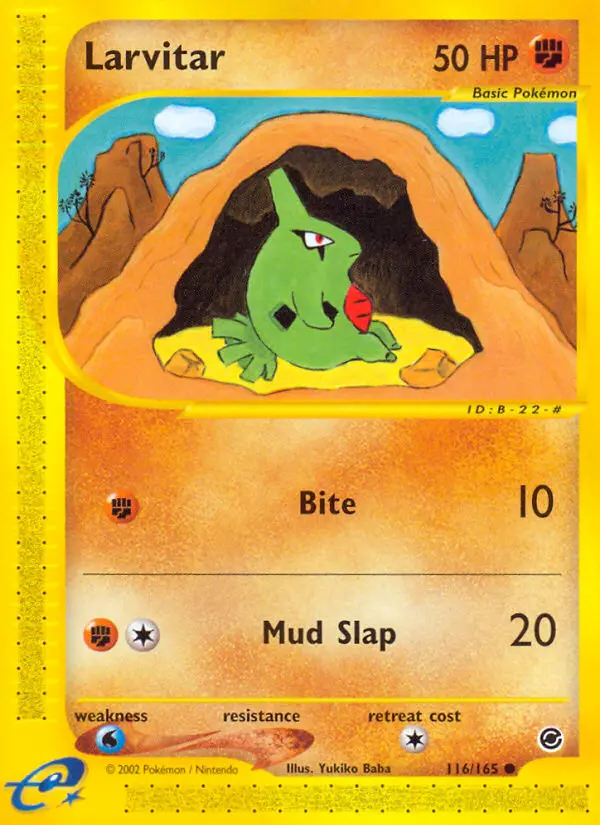
It feeds on soil. After it has eaten a large mountain, it will fall asleep so it can grow.
It is born deep underground. It can't emerge until it has entirely consumed the soil around it.
Born deep under ground, this POKéMON becomes a pupa after eating enough dirt to make a mountain.
LARVITAR is born deep under the ground. To come up to the surface, this POKéMON must eat its way through the soil above. Until it does so, LARVITAR cannot see its parent’s face.
A LARVITAR is born deep under the ground. It must eat its way through the soil above and reach the surface for it to see its parents’ faces.
It is born deep underground. It can’t emerge until it has entirely consumed the soil around it.
It feeds on soil. After it has eaten a large mountain, it will fall asleep so it can grow.
A Pokémon that eats soil. Once it has eaten a large mountain, it goes to sleep so it can grow.
It feeds on soil. After it has eaten a large mountain, it falls asleep so it can grow.
It is born deep underground. It can’t emerge until it has entirely consumed the soil around it.
A Pokémon that eats soil. Once it has eaten a large mountain, it goes to sleep so it can grow.
Born deep underground, it comes aboveground and becomes a pupa once it has finished eating the surrounding soil.
It feeds on soil. After it has eaten a large mountain, it falls asleep so it can grow.
Born deep underground, it comes aboveground and becomes a pupa once it has finished eating the surrounding soil.
Larvitar is born deep under the ground. To come up to the surface, this Pokémon must eat its way through the soil above. Until it does so, Larvitar cannot see its parents.
Born underground, it eats its way through dirt to the surface, where its parents are. It doesn’t deal well with the bright light it finds there.
Raised on nutrients it finds in the dirt, it eats roughly a mountain’s worth of dirt before it becomes a pupa.
Born deep underground, it comes aboveground and becomes a pupa once it has finished eating the surrounding soil.
It feeds on soil. After it has eaten a large mountain, it will fall asleep so it can grow.
Larvitar Name Origin & Design Inspiration
The name Larvitar is a straightforward portmanteau of 'larva' and 'titan,' cleverly encapsulating the Pokémon's dual nature as both a juvenile creature and the progenitor of a titanic evolutionary form. The Japanese name Yogiras (ヨーギラス) follows a similar pattern, derived from 'yōchū' meaning larva and 'giras' suggesting giant or colossus. This nomenclature establishes the entire evolutionary line's thematic consistency, as each stage's name reinforces its role in the progression from small insect-like creature to world-altering behemoth. The design itself draws inspiration from multiple sources: the overall body structure echoes the form of caterpillars and other soil-dwelling larvae, while the rocky texture and mineral composition reference geological formations and mining operations. The tail design, specifically resembling a tunnel-boring machine, represents a clever fusion of biological and mechanical aesthetics that emphasizes Larvitar's primary function as a creature that literally eats through mountains. The diamond-shaped markings across its body may reference crystalline structures found in minerals and gems, while the spike atop its head suggests the crustacean-like exoskeleton typical of insects undergoing metamorphosis. This multifaceted design creates a creature that is simultaneously recognizable as a larval stage while hinting at the power it will eventually achieve.
Learnable Moves
Larvitar can learn 79 moves:
Move | Type | Cat. | Power | Acc. | PP |
|---|---|---|---|---|---|
| ancient power | rock | Special | 60 | 100 | 5 |
| assurance | dark | Physical | 60 | 100 | 10 |
| attract | normal | Status | — | 100 | 15 |
| bite | dark | Physical | 60 | 100 | 25 |
| body slam | normal | Physical | 85 | 100 | 15 |
| brick break | fighting | Physical | 75 | 100 | 15 |
| captivate | normal | Status | — | 100 | 20 |
| chip away | normal | Physical | 70 | 100 | 20 |
| confide | normal | Status | — | — | 20 |
| crunch | dark | Physical | 80 | 100 | 15 |
| curse | ghost | Status | — | — | 10 |
| dark pulse | dark | Special | 80 | 100 | 15 |
| detect | fighting | Status | — | — | 5 |
| dig | ground | Physical | 80 | 100 | 10 |
| double team | normal | Status | — | — | 15 |
| double edge | normal | Physical | 120 | 100 | 15 |
| dragon dance | dragon | Status | — | — | 20 |
| earth power | ground | Special | 90 | 100 | 10 |
| earthquake | ground | Physical | 100 | 100 | 10 |
| endure | normal | Status | — | — | 10 |
| facade | normal | Physical | 70 | 100 | 20 |
| focus energy | normal | Status | — | — | 30 |
| frustration | normal | Physical | — | 100 | 20 |
| giga impact | normal | Physical | 150 | 90 | 5 |
| headbutt | normal | Physical | 70 | 100 | 15 |
| helping hand | normal | Status | — | — | 20 |
| hidden power | normal | Special | 60 | 100 | 15 |
| hyper beam | normal | Special | 150 | 90 | 5 |
| iron defense | steel | Status | — | — | 15 |
| iron head | steel | Physical | 80 | 100 | 15 |
| iron tail | steel | Physical | 100 | 75 | 15 |
| leer | normal | Status | — | 100 | 30 |
| mimic | normal | Status | — | — | 10 |
| mud shot | ground | Special | 55 | 95 | 15 |
| mud slap | ground | Special | 20 | 100 | 10 |
| muddy water | water | Special | 90 | 85 | 10 |
| natural gift | normal | Physical | — | 100 | 15 |
| outrage | dragon | Physical | 120 | 100 | 10 |
| payback | dark | Physical | 50 | 100 | 10 |
| power up punch | fighting | Physical | 40 | 100 | 20 |
| protect | normal | Status | — | — | 10 |
| pursuit | dark | Physical | 40 | 100 | 20 |
| rain dance | water | Status | — | — | 5 |
| rest | psychic | Status | — | — | 5 |
| retaliate | normal | Physical | 70 | 100 | 5 |
| return | normal | Physical | — | 100 | 20 |
| rock blast | rock | Physical | 25 | 90 | 10 |
| rock polish | rock | Status | — | — | 20 |
| rock slide | rock | Physical | 75 | 90 | 10 |
| rock smash | fighting | Physical | 40 | 100 | 15 |
| rock throw | rock | Physical | 50 | 90 | 15 |
| rock tomb | rock | Physical | 60 | 95 | 15 |
| round | normal | Special | 60 | 100 | 15 |
| sand tomb | ground | Physical | 35 | 85 | 15 |
| sandstorm | rock | Status | — | — | 10 |
| scary face | normal | Status | — | 100 | 10 |
| screech | normal | Status | — | 85 | 40 |
| secret power | normal | Physical | 70 | 100 | 20 |
| sleep talk | normal | Status | — | — | 10 |
| smack down | rock | Physical | 50 | 100 | 15 |
| snarl | dark | Special | 55 | 95 | 15 |
| snore | normal | Special | 50 | 100 | 15 |
| spite | ghost | Status | — | 100 | 10 |
| stealth rock | rock | Status | — | — | 20 |
| stomp | normal | Physical | 65 | 100 | 20 |
| stomping tantrum | ground | Physical | 75 | 100 | 10 |
| stone edge | rock | Physical | 100 | 80 | 5 |
| substitute | normal | Status | — | — | 10 |
| sunny day | fire | Status | — | — | 5 |
| superpower | fighting | Physical | 120 | 100 | 5 |
| swagger | normal | Status | — | 85 | 15 |
| tackle | normal | Physical | 40 | 100 | 35 |
| take down | normal | Physical | 90 | 85 | 20 |
| taunt | dark | Status | — | 100 | 20 |
| tera blast | normal | Special | 80 | 100 | 10 |
| thrash | normal | Physical | 120 | 100 | 10 |
| torment | dark | Status | — | 100 | 15 |
| toxic | poison | Status | — | 90 | 10 |
| uproar | normal | Special | 90 | 100 | 10 |
Larvitar Competitive Battle Guide
In tournament-level play, Larvitar is rarely used in its base form due to its modest overall stat sum of 300 and underwhelming individual statistics across most categories, with particularly low speed (41), special attack (45), and HP (50) values. However, Larvitar's accessibility and potential as a stepping stone to Tyranitar make it valuable in lower-tier competitive formats and for trainers building toward endgame teams. The two signature abilities available to Larvitar—Guts and the hidden ability Sand Veil—offer distinct strategic applications despite Larvitar's own limitations. The Guts ability increases Attack to 1.5 times its normal value when afflicted with a major status condition, a mechanic that enables setup strategies through self-inflicted burns or paralysis, though Larvitar's modest attack stat of 64 limits its immediate damage output. Sand Veil, the hidden ability, increases evasion to 1.25 times during sandstorm conditions while simultaneously protecting Larvitar from sandstorm damage, making it a superior choice for teams built around sand support from Pokémon like Tyranitar itself or Hippowdon. Competitive trainers typically use Larvitar as a placeholder or breeding specimen rather than fielding it directly in serious matches, instead focusing efforts on training it to level 30 for Pupitar and ultimately to level 55 for Tyranitar, which becomes a genuine force in competitive environments with its pseudolegendary stats and dual Rock/Dark typing.
Commonly Asked Questions About Larvitar
What type is Larvitar?
Larvitar is a rock and ground type Pokemon.
What does Larvitar evolve into?
Larvitar evolves into pupitar, then into tyranitar.
What are Larvitar's weaknesses?
Larvitar is weak to fighting, ground, steel, water, grass and ice type moves.
Does Larvitar evolve by trading?
No — Larvitar evolves entirely through leveling up, with no trade required at any stage.
Where can I find Larvitar?
Larvitar can be found in mt silver (johto), sevault canyon (kanto) and sinnoh route 207 (sinnoh) and 3 other locations.
Larvitar Cultural Impact & Franchise History
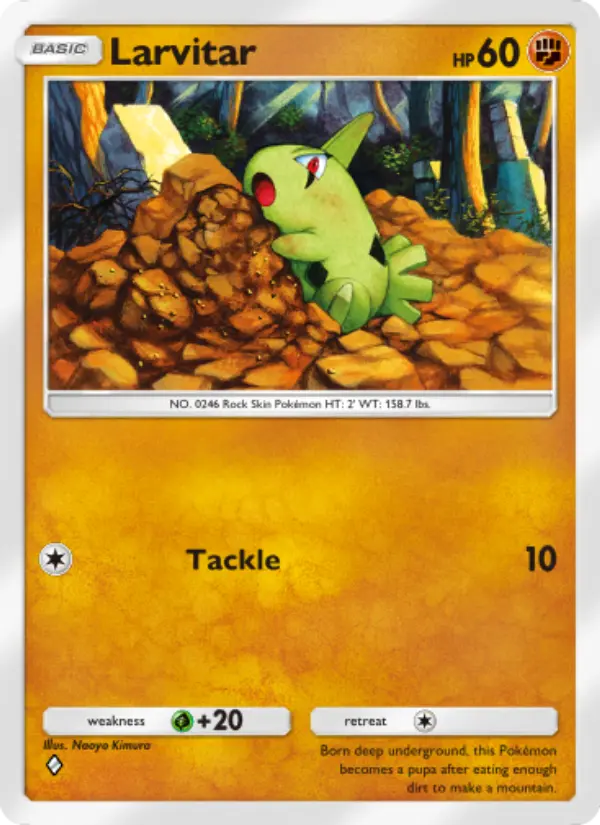
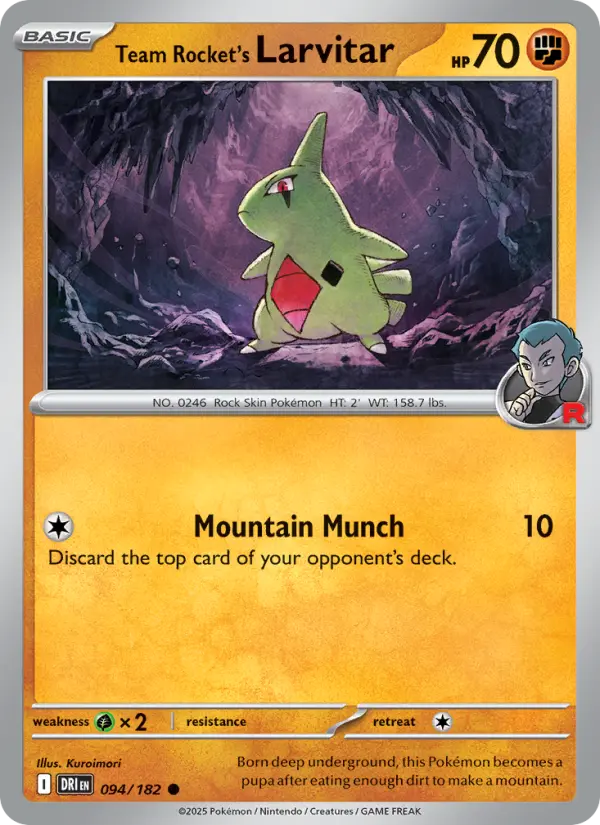
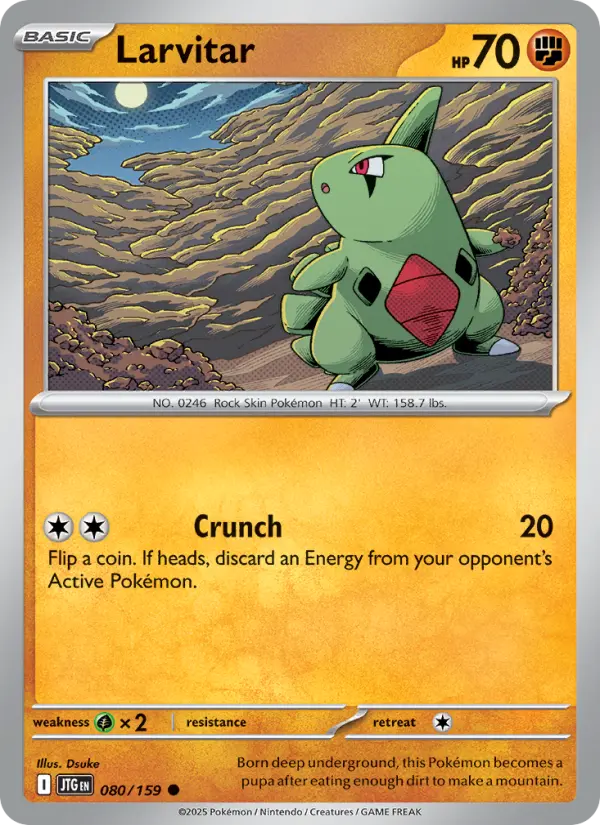
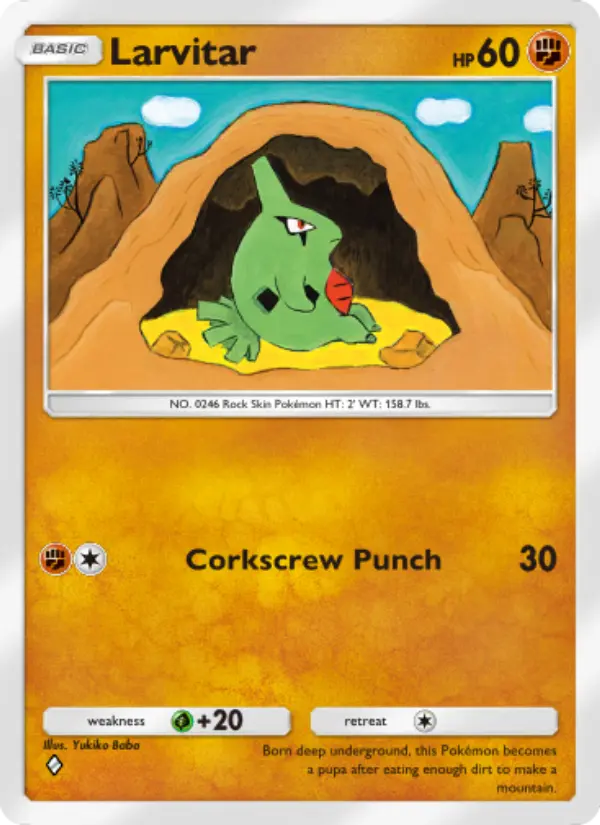
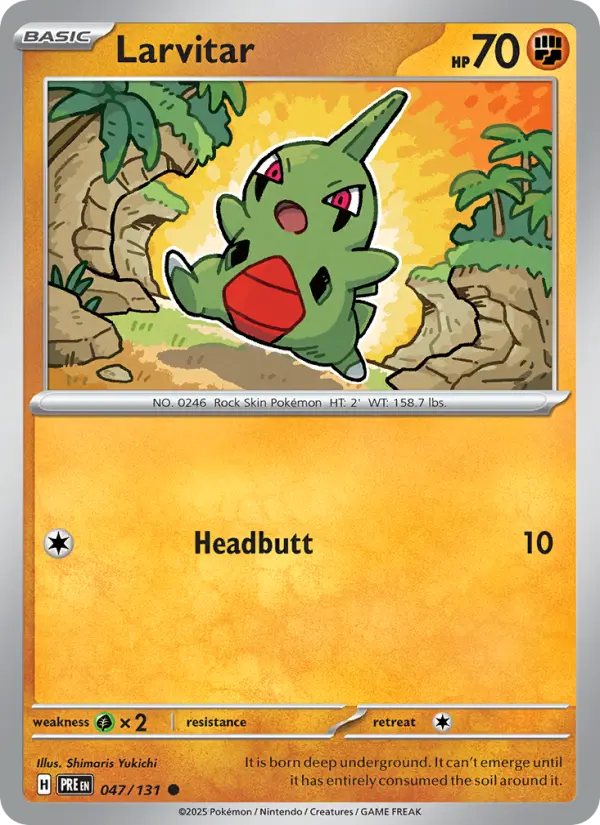
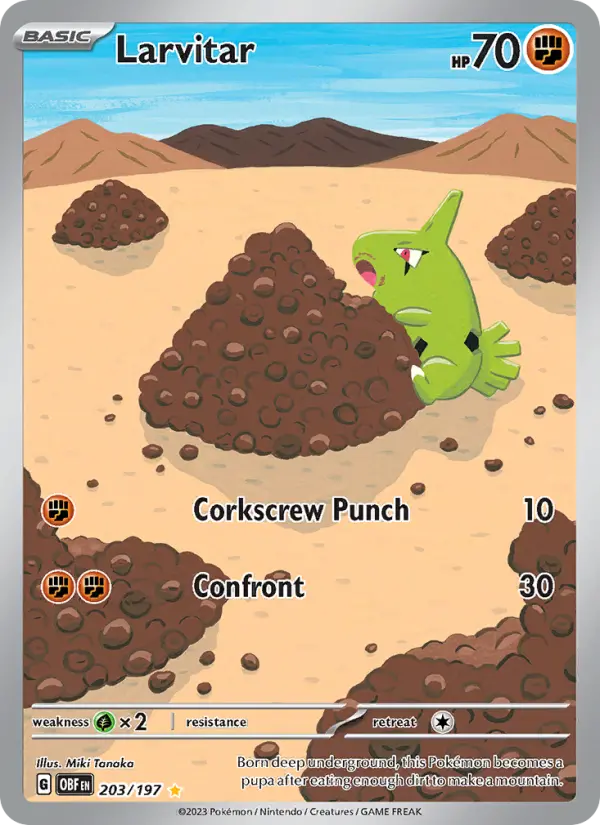
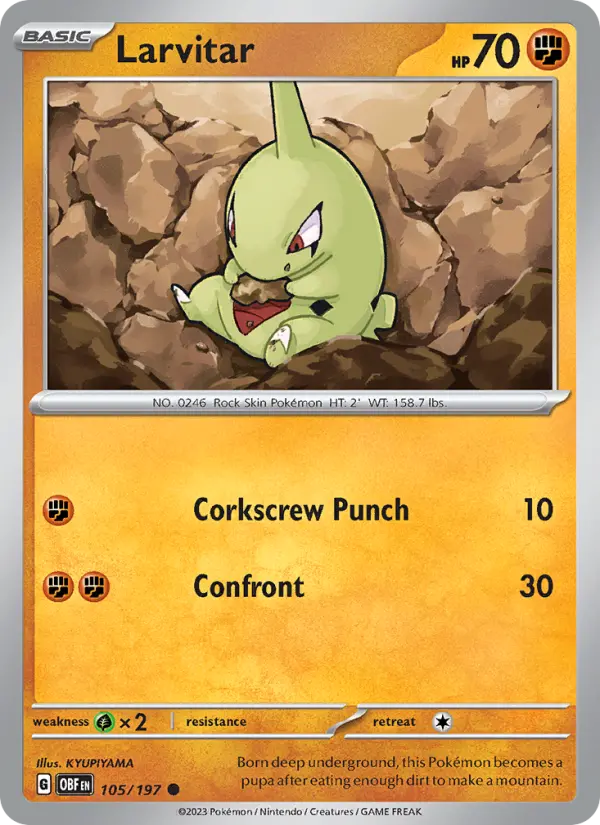
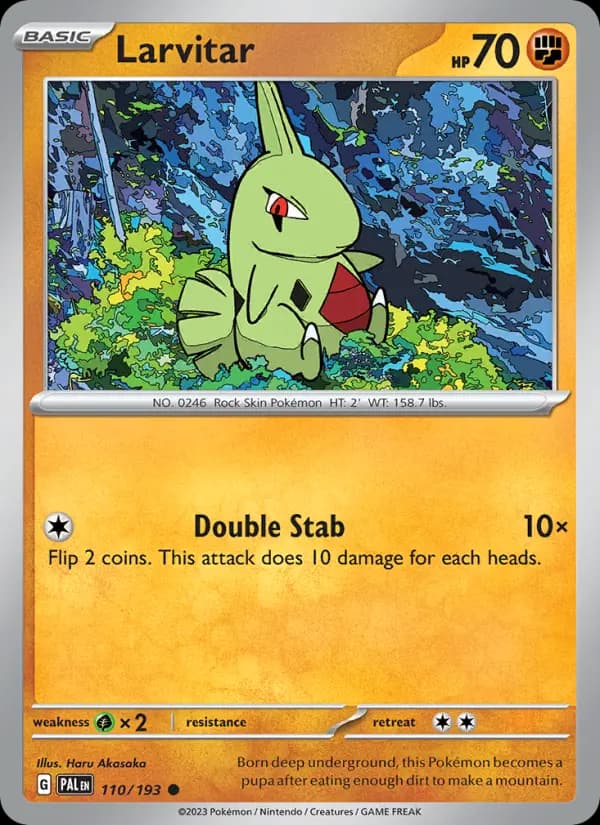
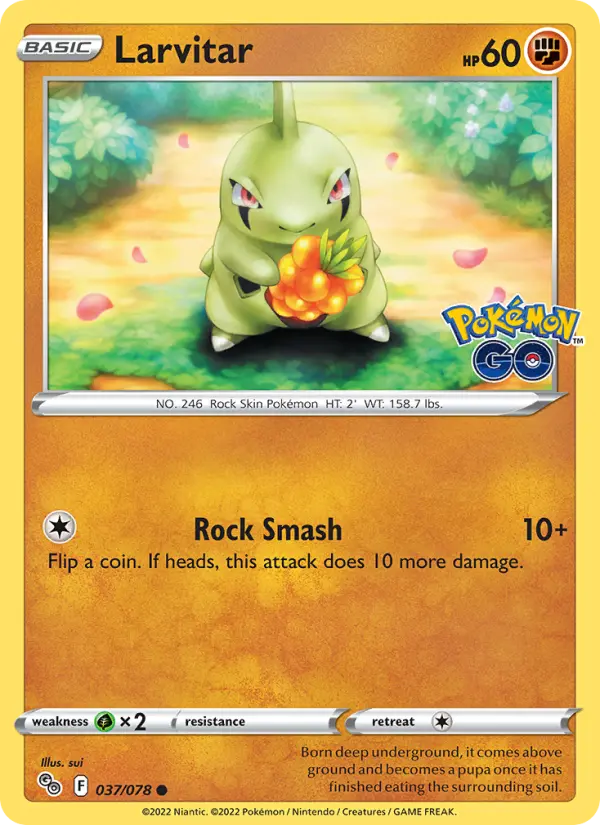
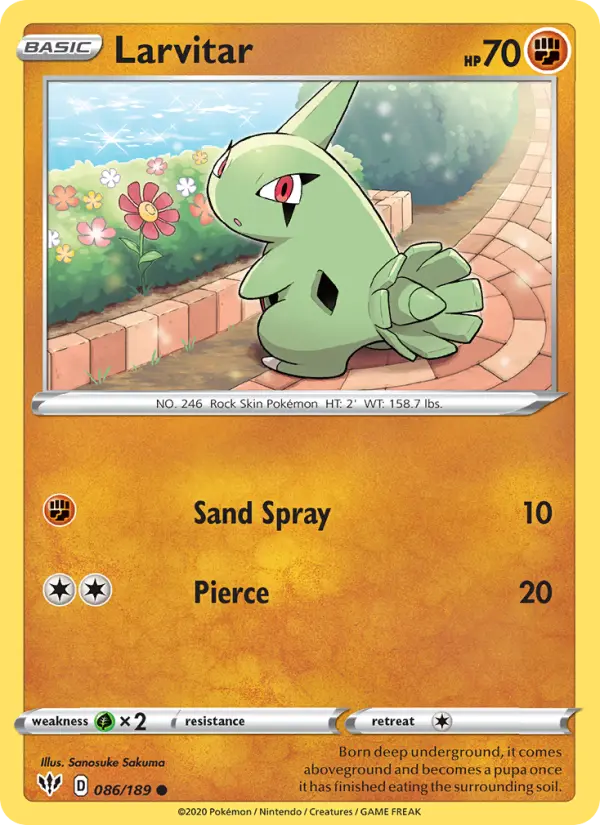
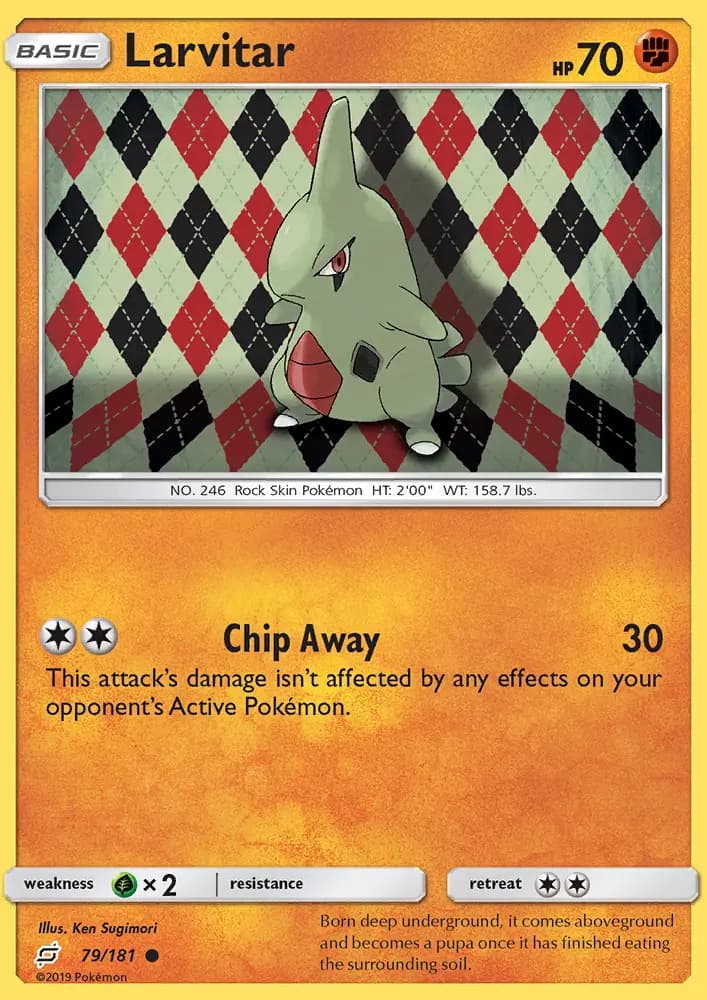
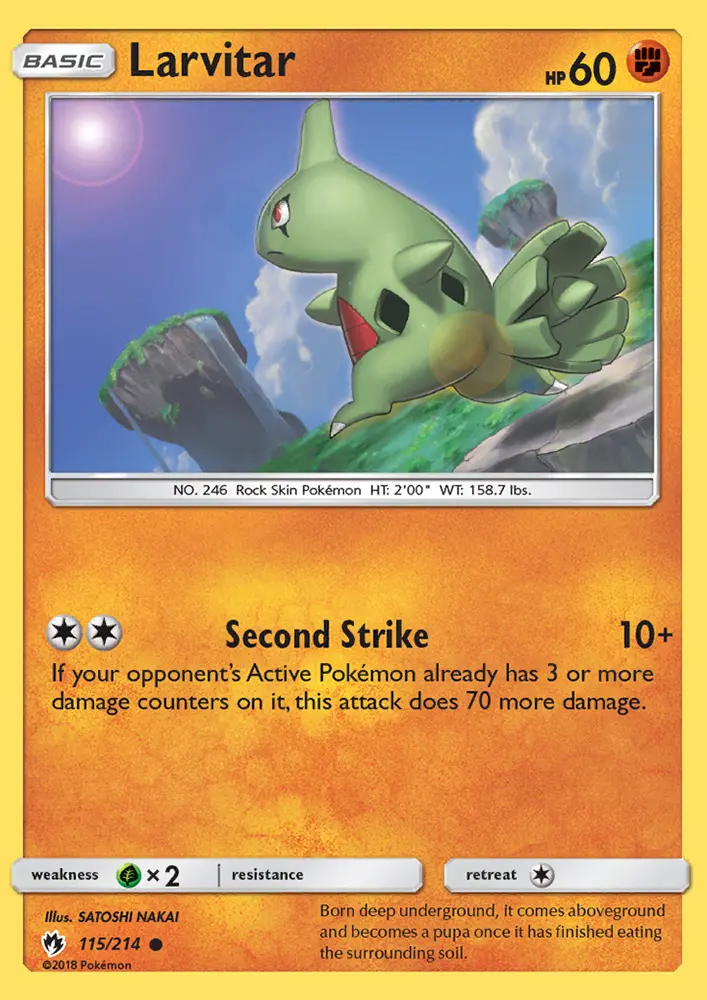
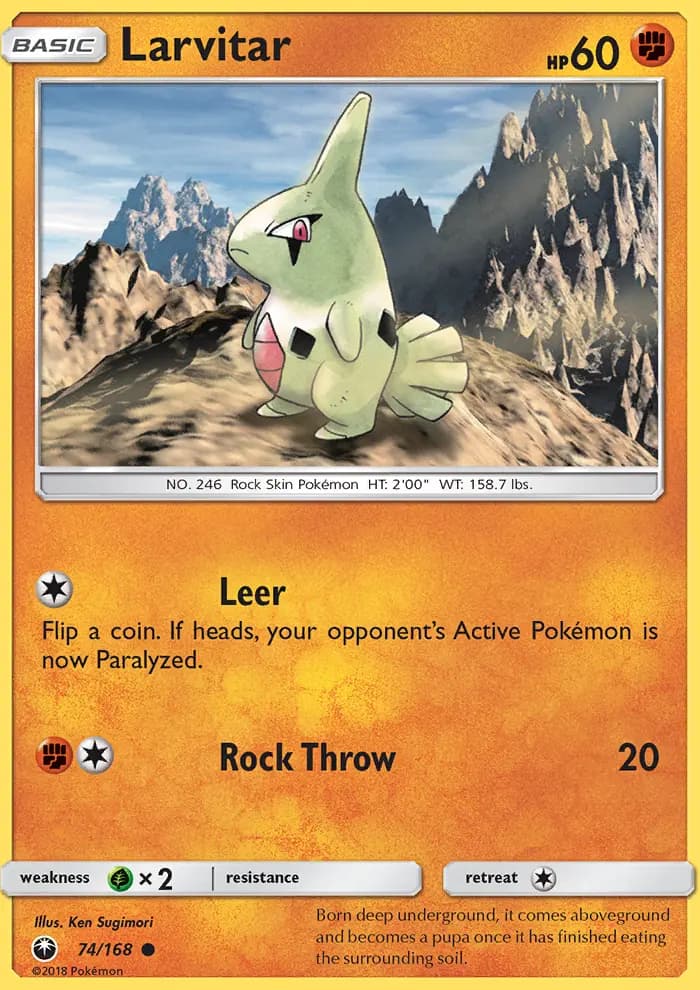
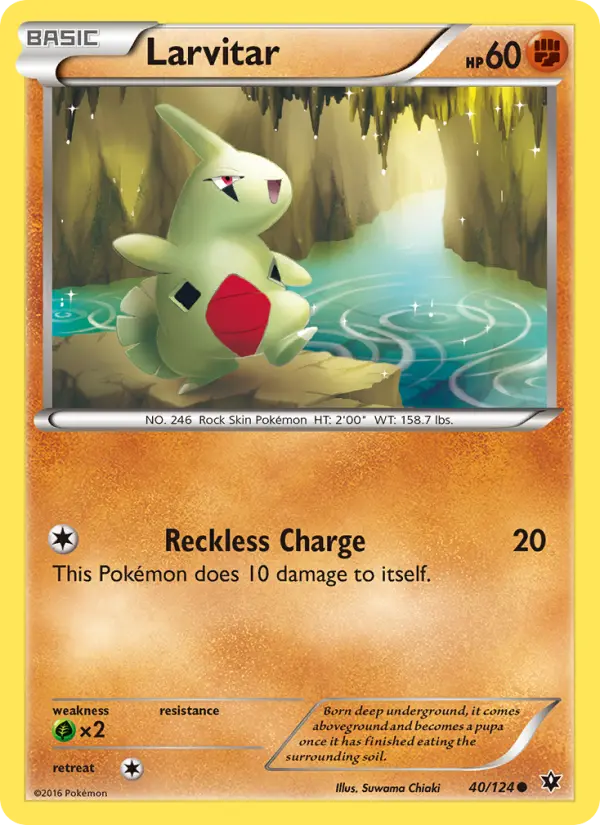
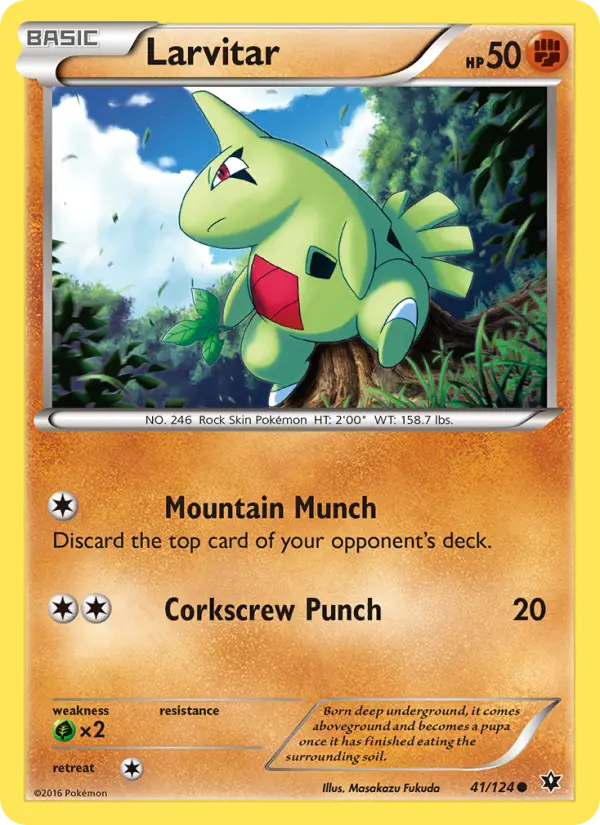
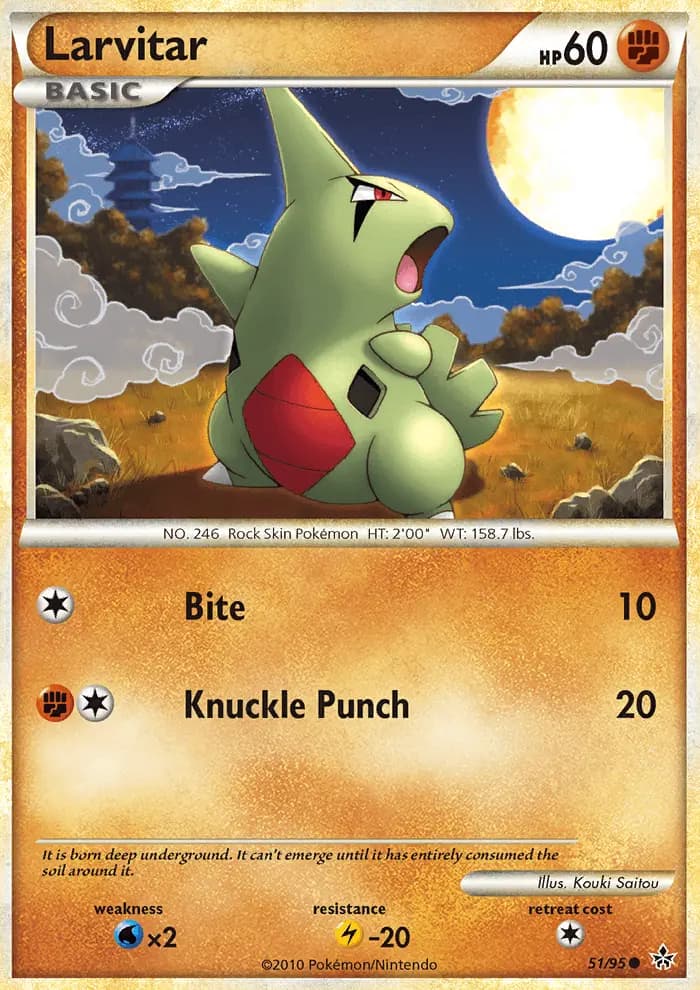
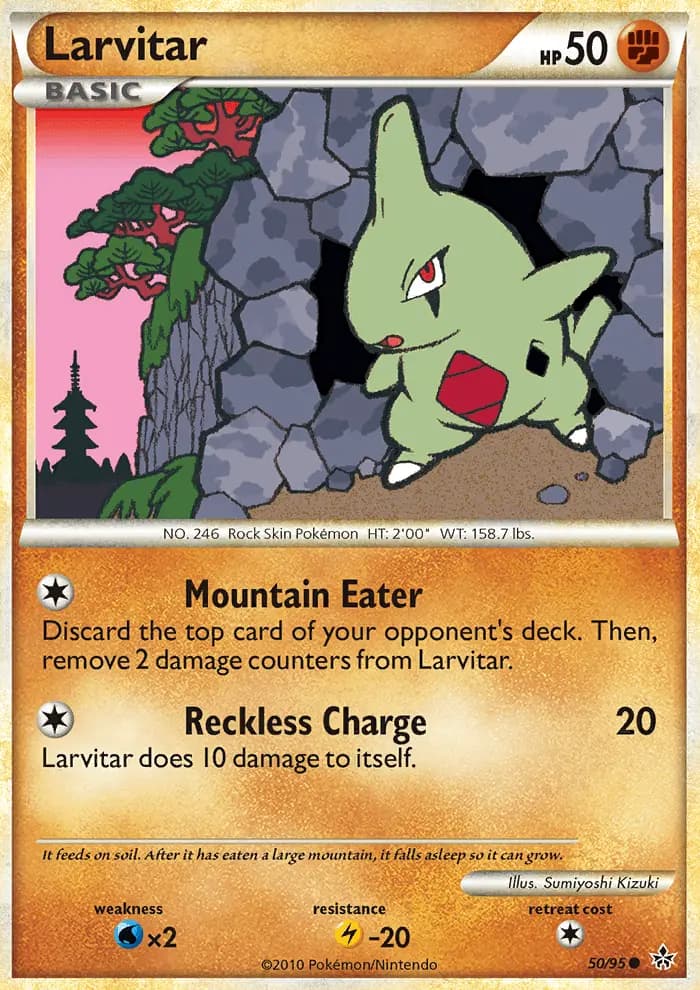
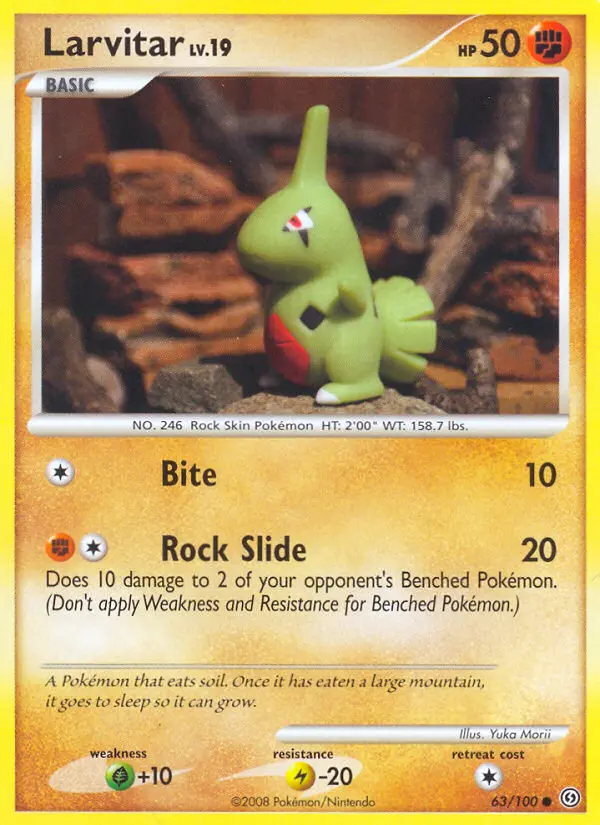
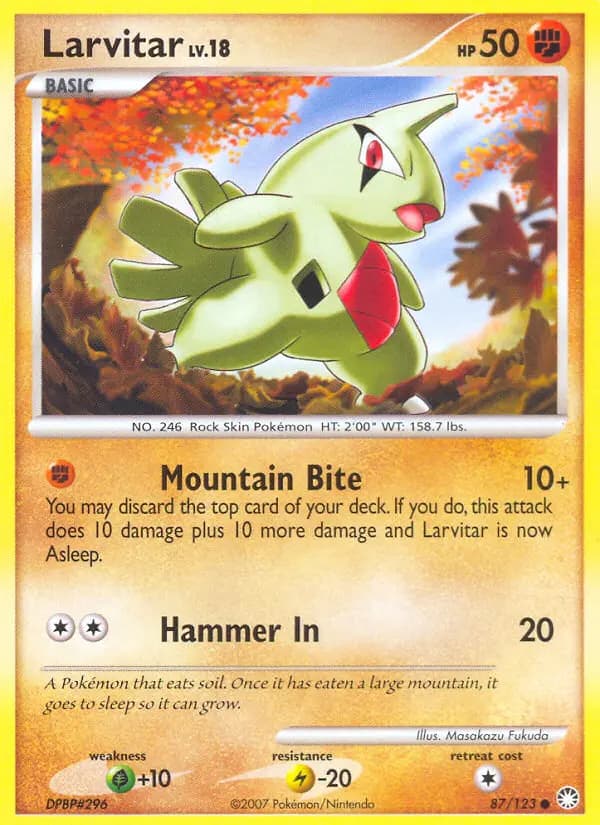
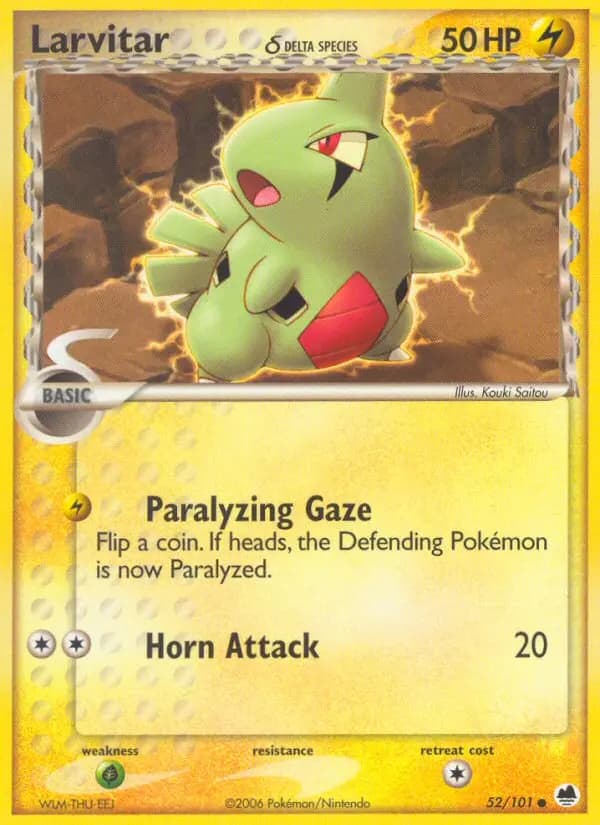
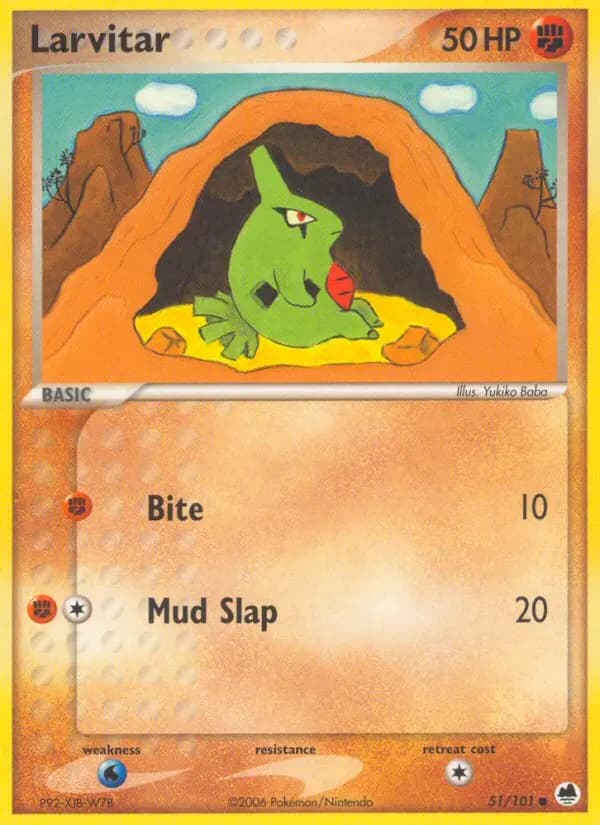
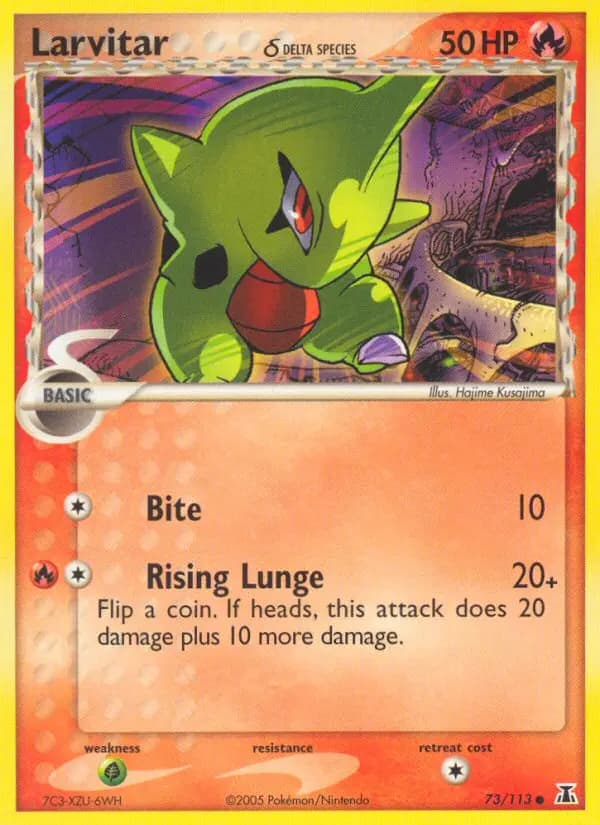
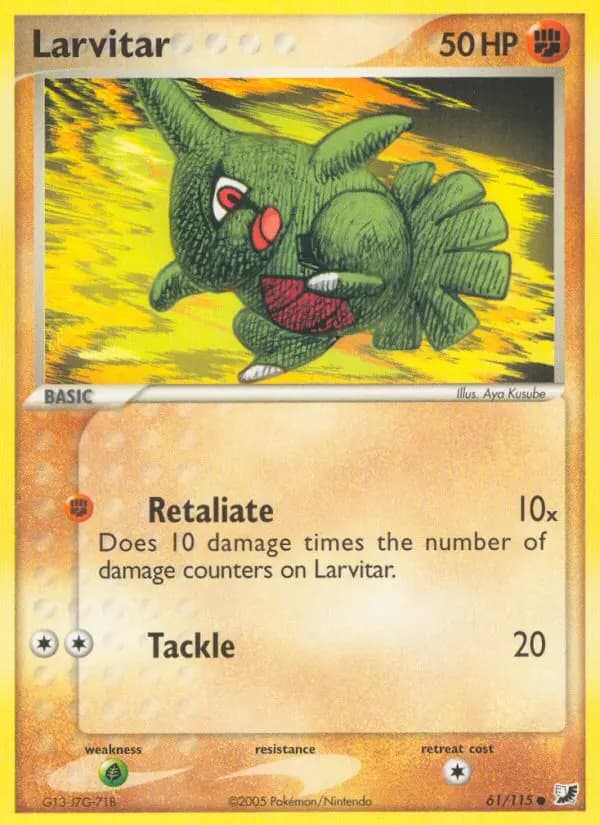
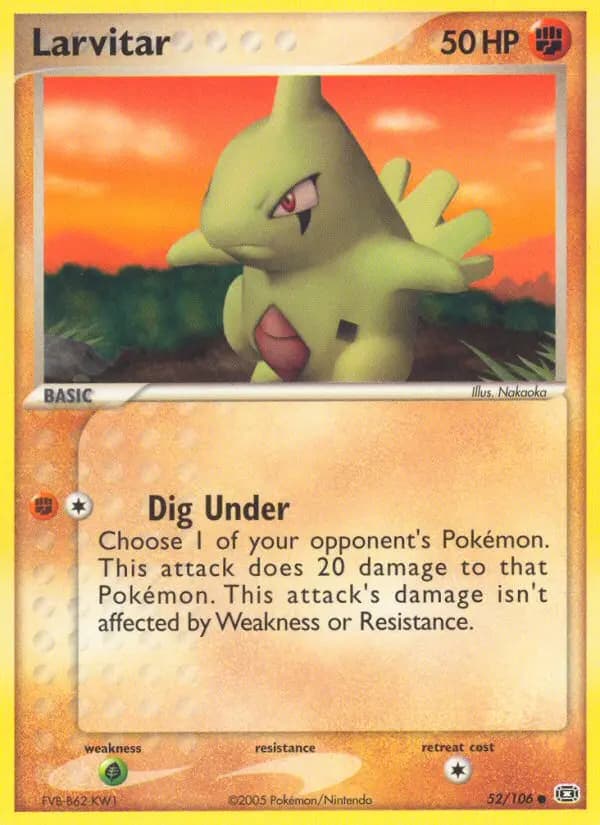
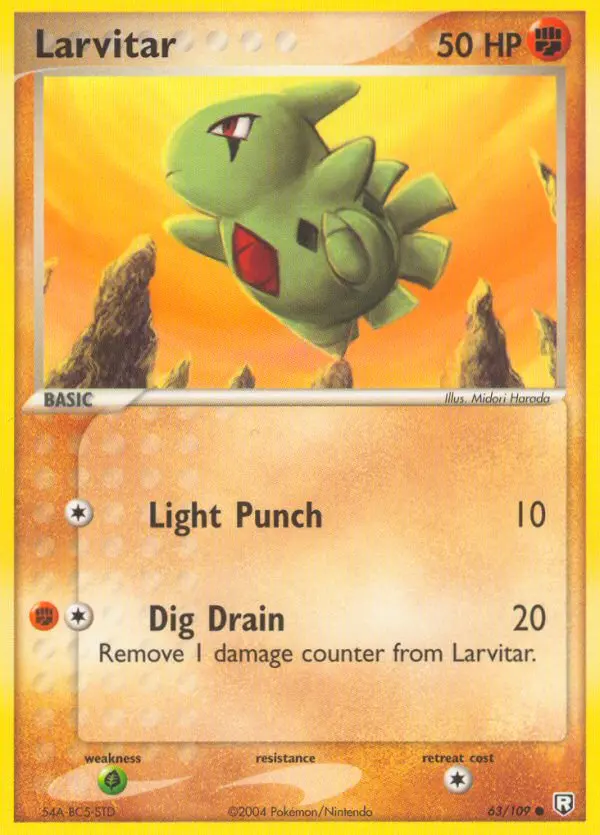
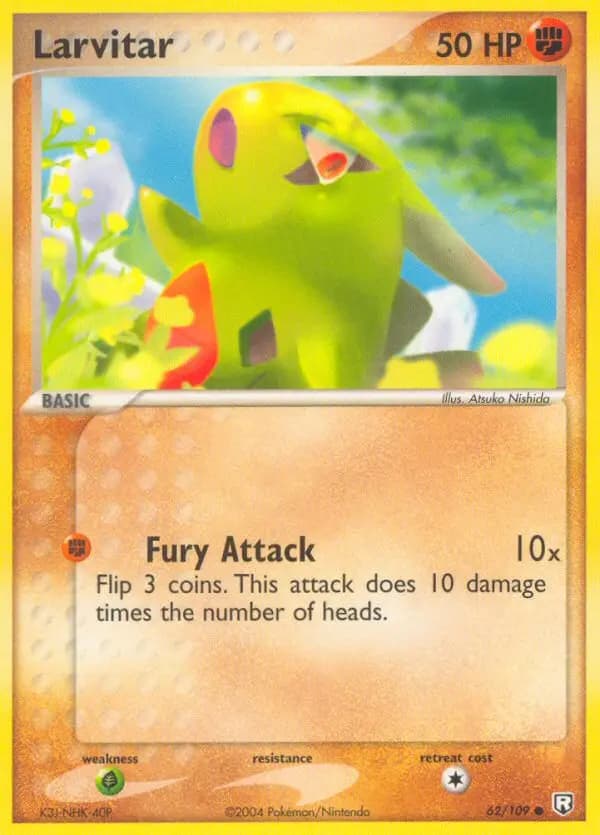
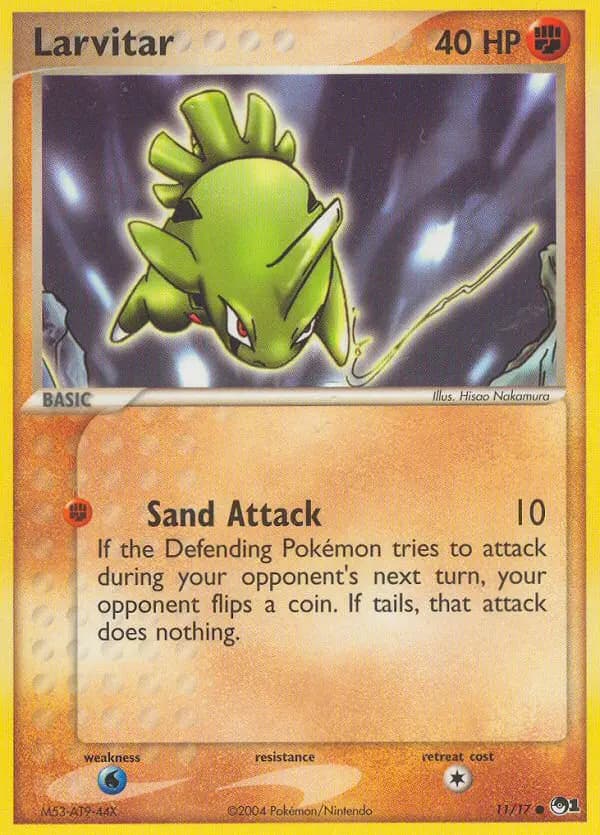
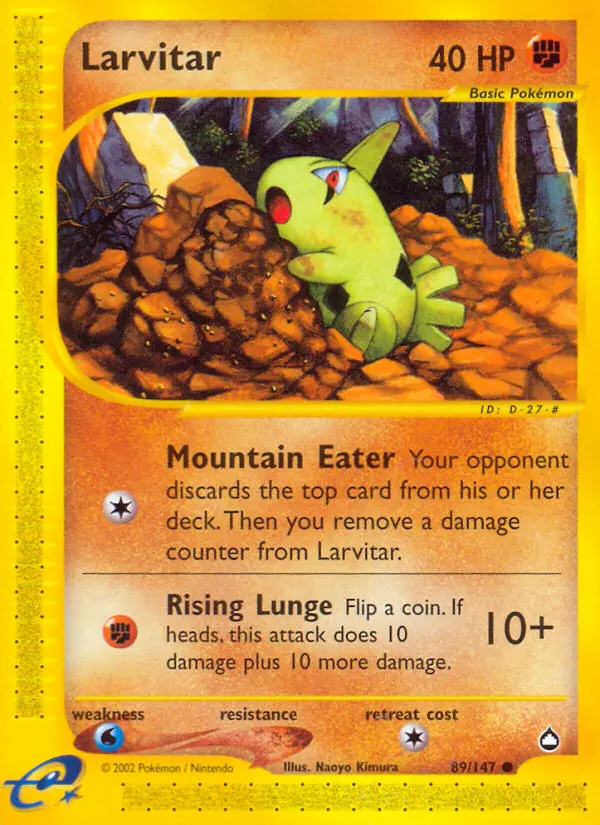
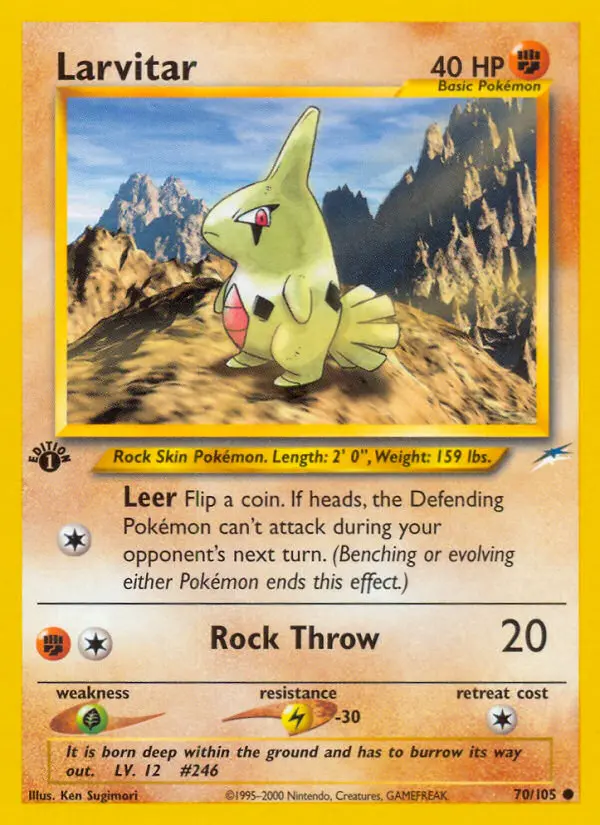
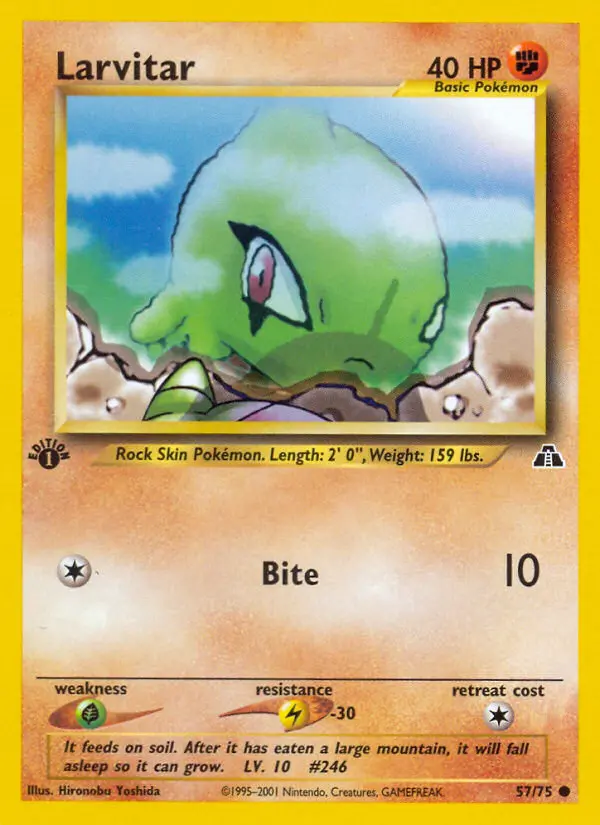
Larvitar holds a special place in Pokémon culture as the archetypal example of potential unfulfilled—a creature that embodies the journey from weakness to strength that defines the trainer experience. The species is particularly memorable due to its appearance in the main anime series through Ash's Larvitar, a plot-significant individual that serves as a metaphor for loyalty, growth, and the trainer-Pokémon bond. This particular Larvitar, abandoned by its previous trainer, represents the show's recurring themes of redemption and second chances, resonating with viewers who appreciate stories of underdogs achieving greatness through proper guidance and affection. The evolutionary line's prominence in the competitive scene, particularly Tyranitar's status as a viable pseudo-legendary, elevates Larvitar's cultural significance as the origin point of aspiration for many players. Furthermore, Larvitar's unique biological narrative—being born underground and forced to eat through stone to see its parents—has inspired considerable creative work within the fan community, from artwork exploring the bittersweet aspects of the species' development to fan fiction examining the emotional dimensions of its isolated birth and growth. The species also appears frequently in Pokémon media, including the Trading Card Game, where its evolution line has received numerous illustrated cards highlighting the dramatic transformation across its three stages.
Where to Find Larvitar in Every Pokémon Game
Larvitar's availability varies considerably across different game generations and titles. In the original Generation II games (Gold, Silver, and Crystal), Larvitar occupies National Pokédex slot 244 in the regional Johto Pokédex, making it accessible to players during their journey through the mountain regions of that generation. In Generation IV's HeartGold and SoulSilver remakes, Larvitar receives local Pokédex number 249, maintaining its presence in these beloved titles. The species appears in Generation V's Black 2 and White 2 as Pokédex number 292, and in Generation VI's X and Y in the Mountain Kalos region as number 102. For Generation VII players, Larvitar can be caught in the Alola region with local number 247 in Ultra Sun and Ultra Moon. More recent titles including Sword and Shield (local number 383), Scarlet and Violet (local number 316), and Legends: Arceus (local number 206) continue to feature Larvitar, ensuring the species remains obtainable across multiple modern platforms. Additionally, Pokémon Legends: Z-A includes Larvitar as local number 206, suggesting its importance in future generations. Players seeking Larvitar should typically explore mountainous, hilly, and cave environments within their respective game versions, as the species' thematic connection to rocky terrain consistently influences its in-game locations across all generations.