Pupitar
Generation II · #0247 — Hard Shell Pokémon
Pupitar measures in at 1.2 m and 152 kg, a build that matches its shed skin ability better than it matches raw offense or defense. With a total stat allocation of 410, Pupitar excels in physical attack with a base of 84, making it a formidable force despite its classification as a middle evolution. The Pokémon's defining characteristic is its ability Shed Skin, which grants it a 33% chance to cure any major status ailment after each turn, providing valuable survivability in both casual and competitive encounters. At 1.2 meters tall and weighing 152 kilograms, Pupitar represents a significant jump in size and power from its pre-evolution, though it still has considerable growing to do before reaching its final form.
Editor's Take
Pupitar is a cocoon stage with 84 base Attack that can still fight, which makes it a considerably better middle stage than the Gen 1 bug cocoons it resembles.
Base Stats
Height
1.2m
Weight
152.0kg
Category
Hard Shell Pokémon
Gender
Male 50% / Female 50%
Color
gray
Shape
squiggle
Habitat
mountain
Abilities
Has a 33% chance of curing any major status ailment after each turn.

Pupitar Biology & Physical Characteristics
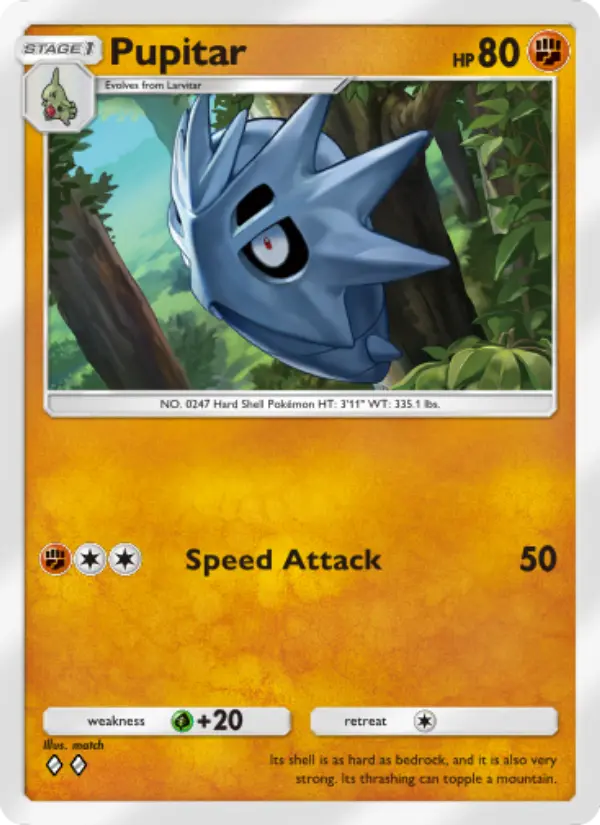
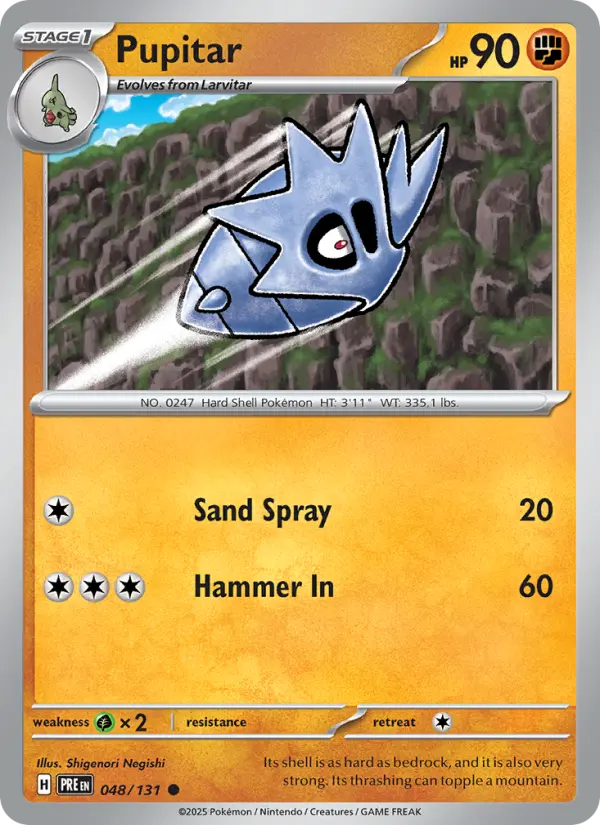
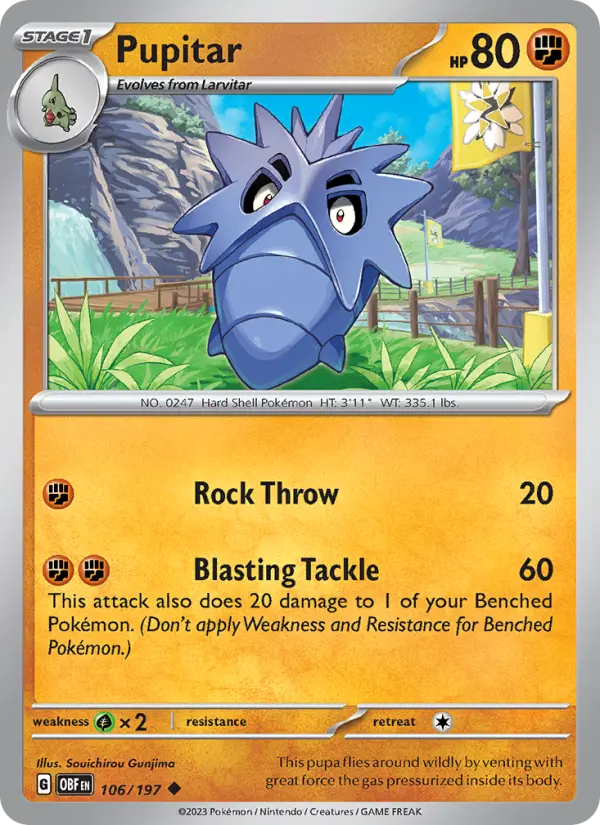
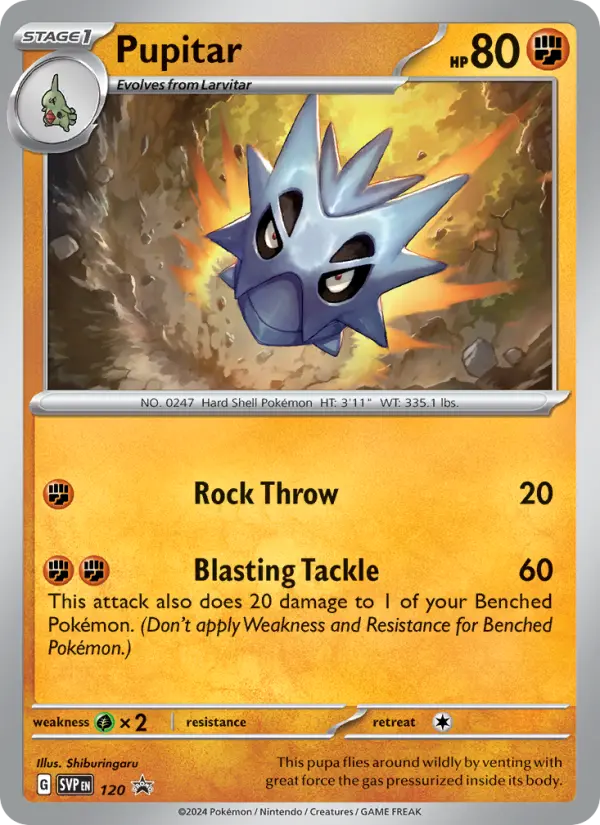
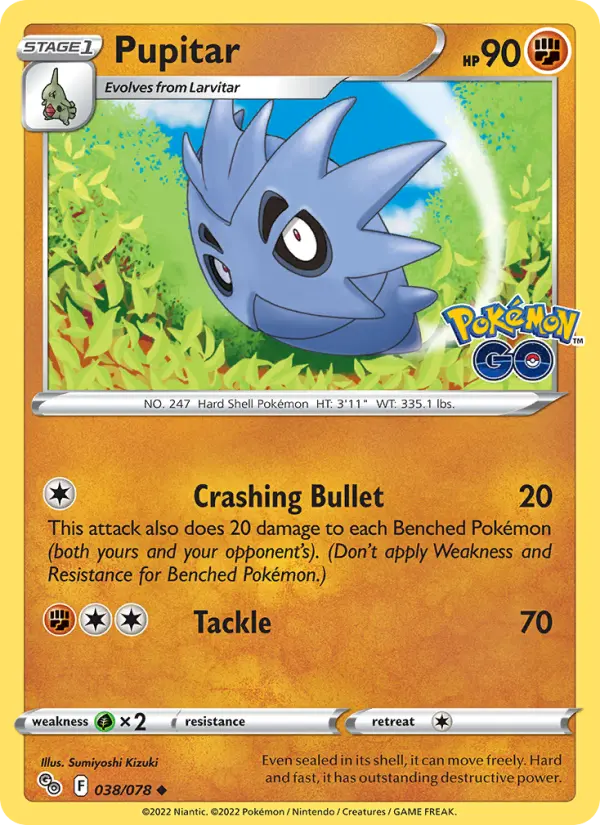
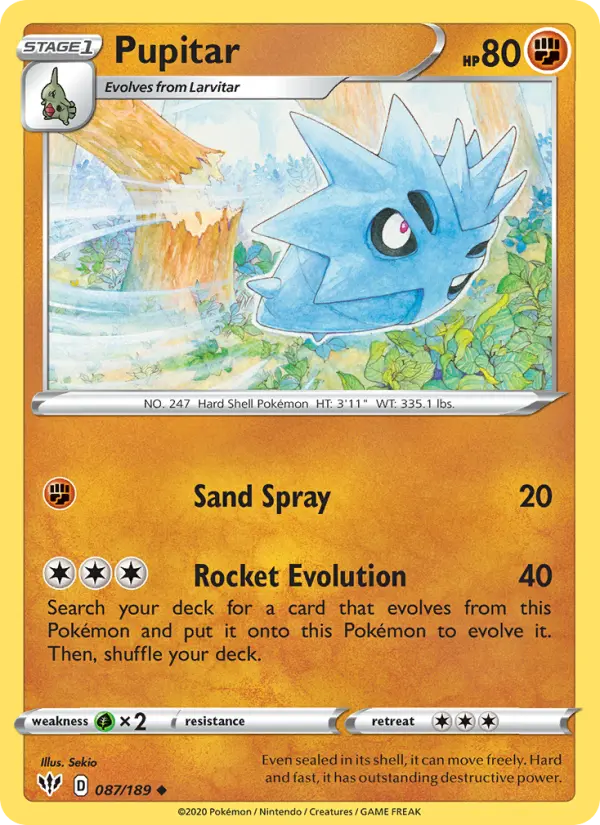
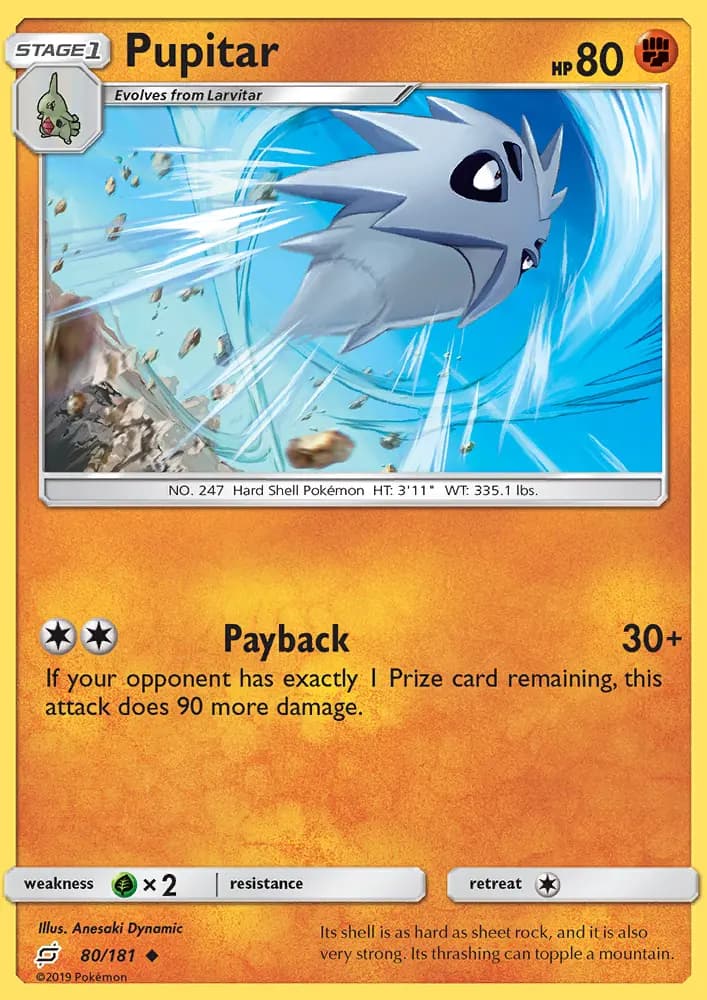
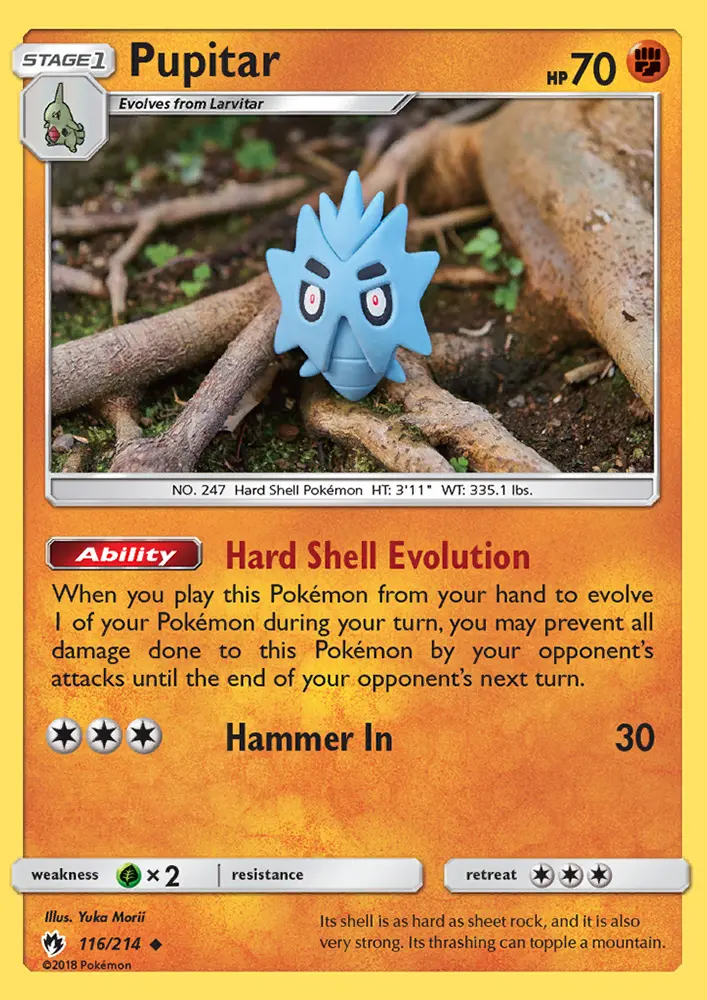
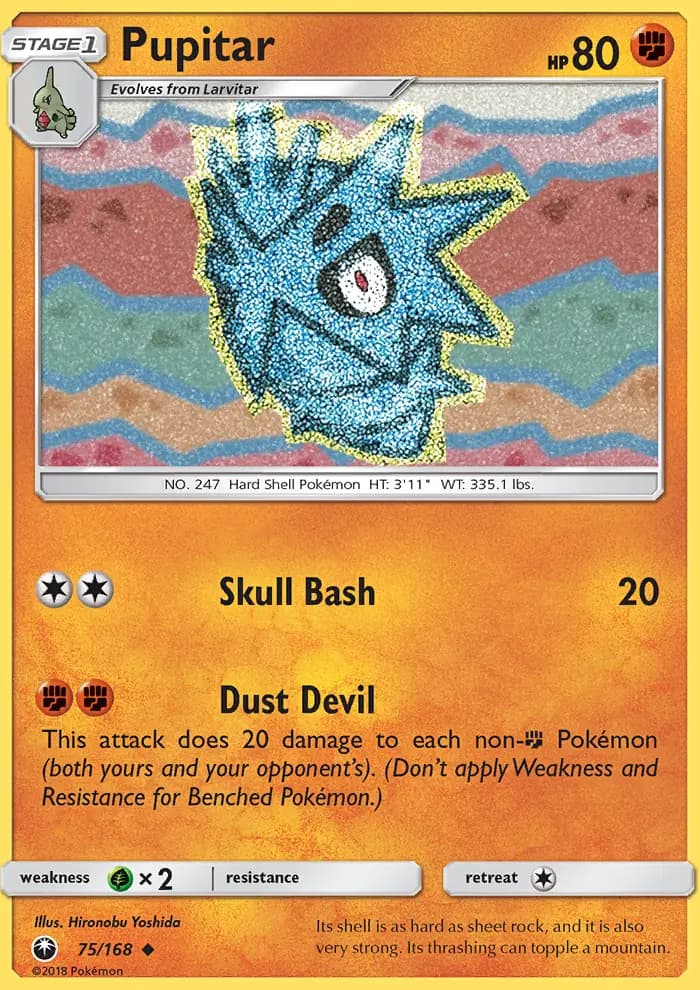
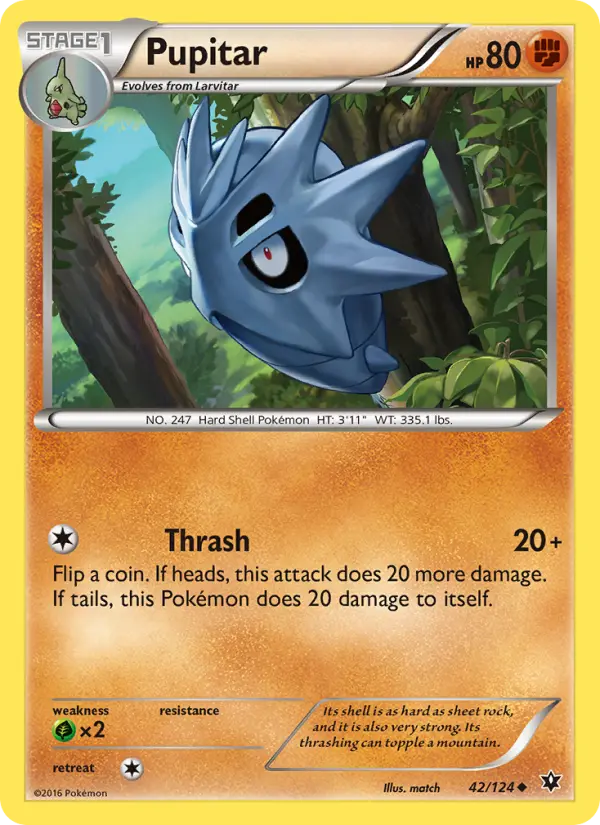
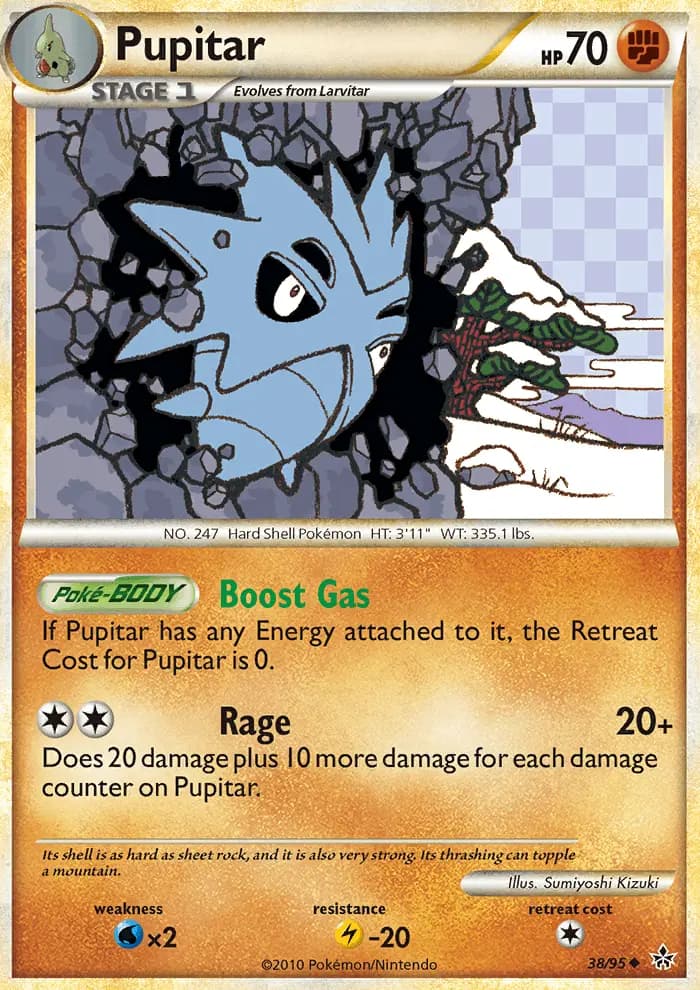
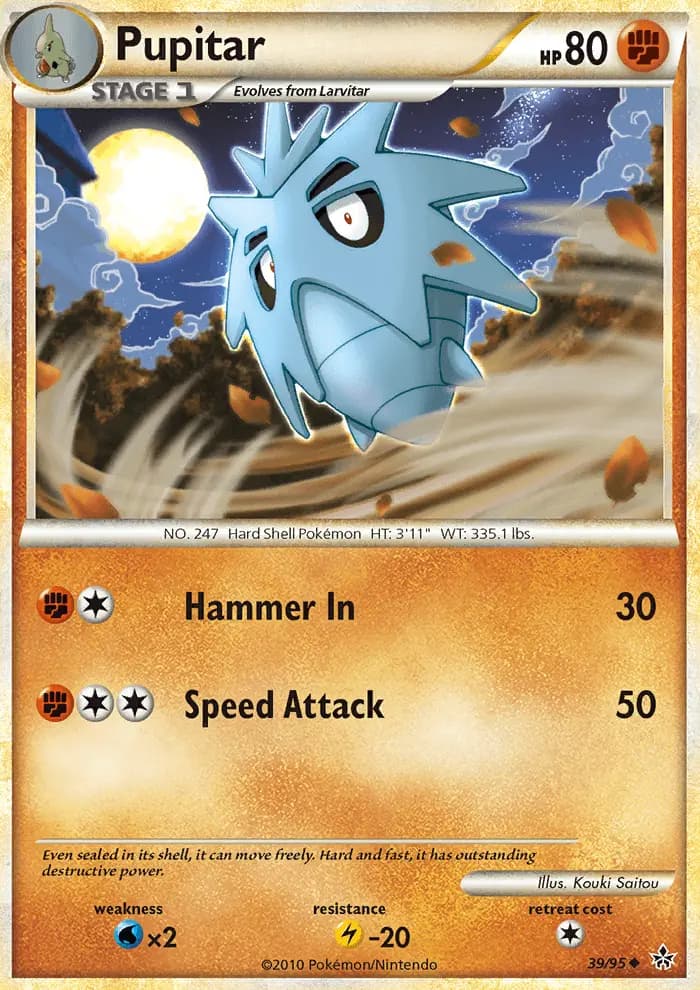
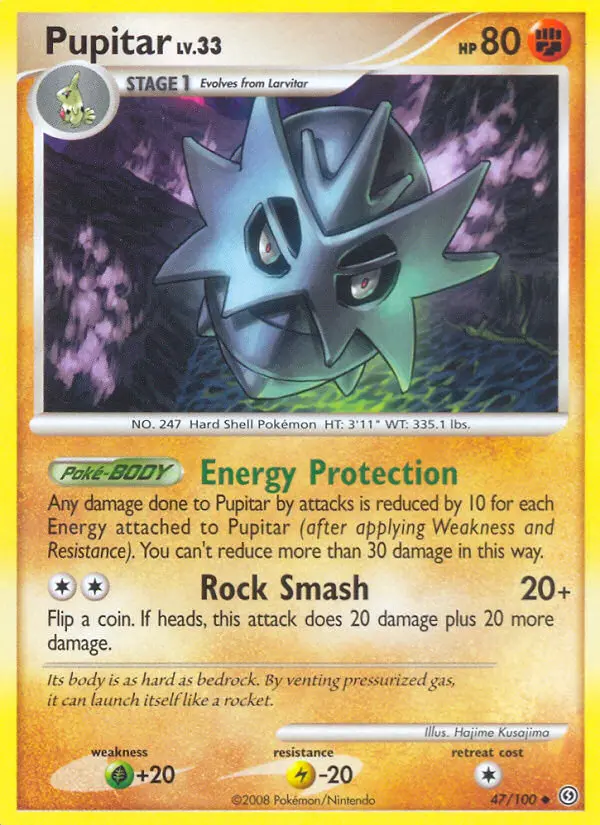
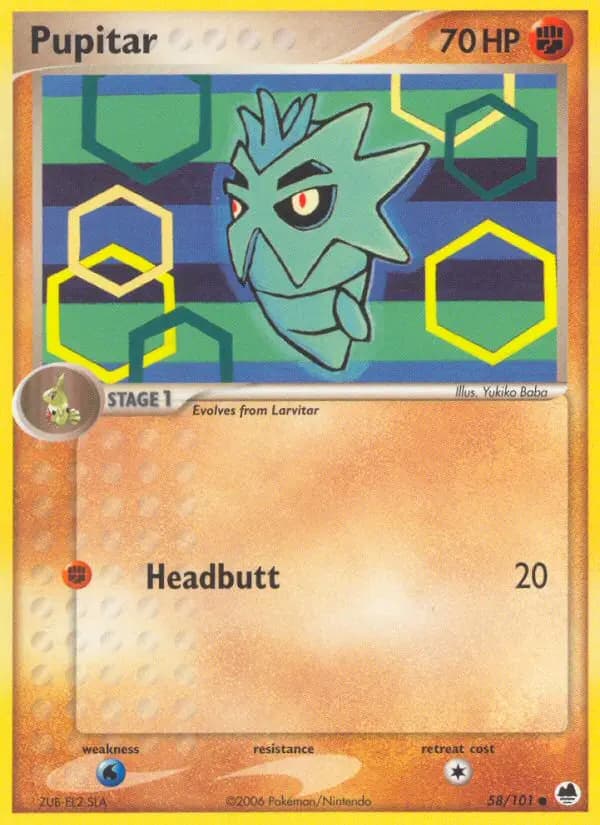
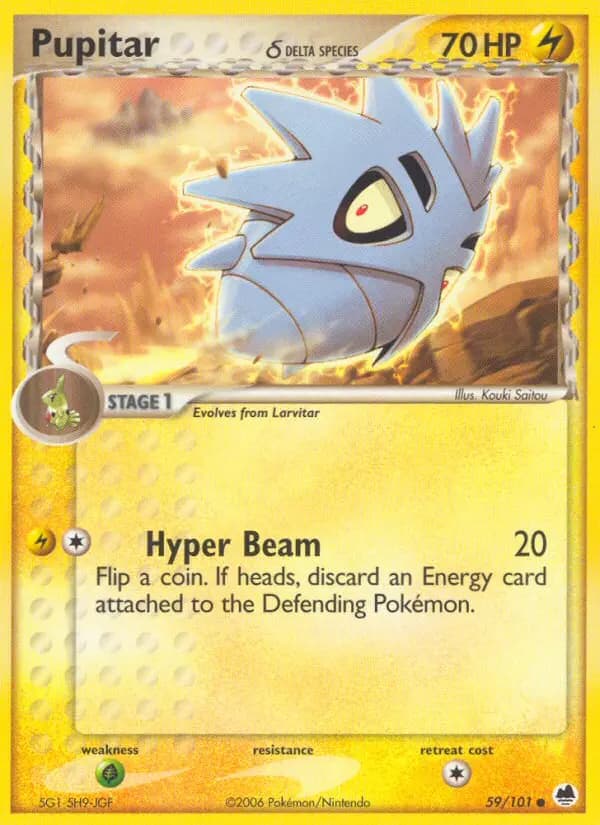
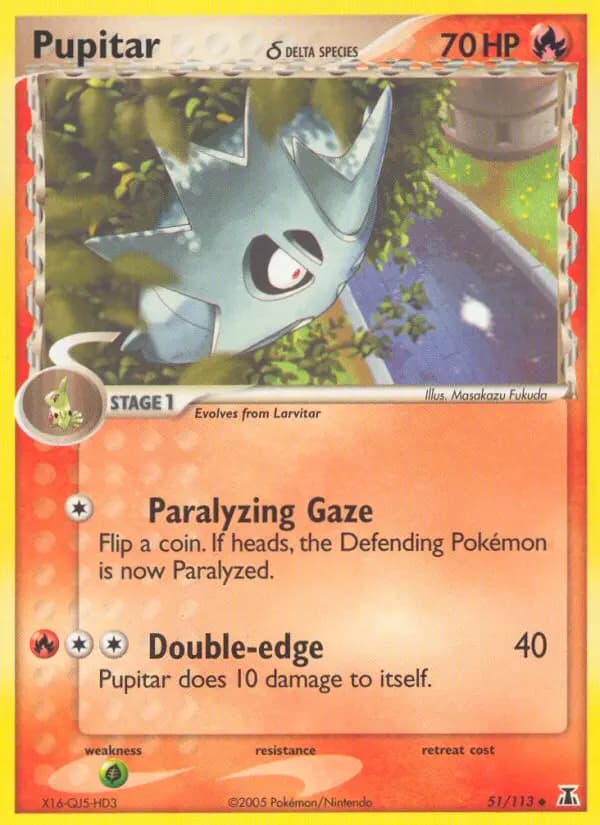
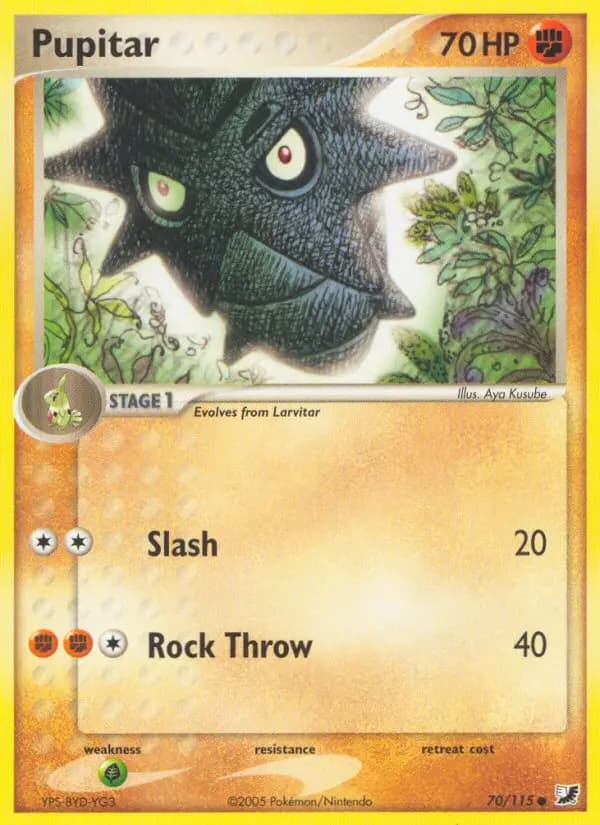
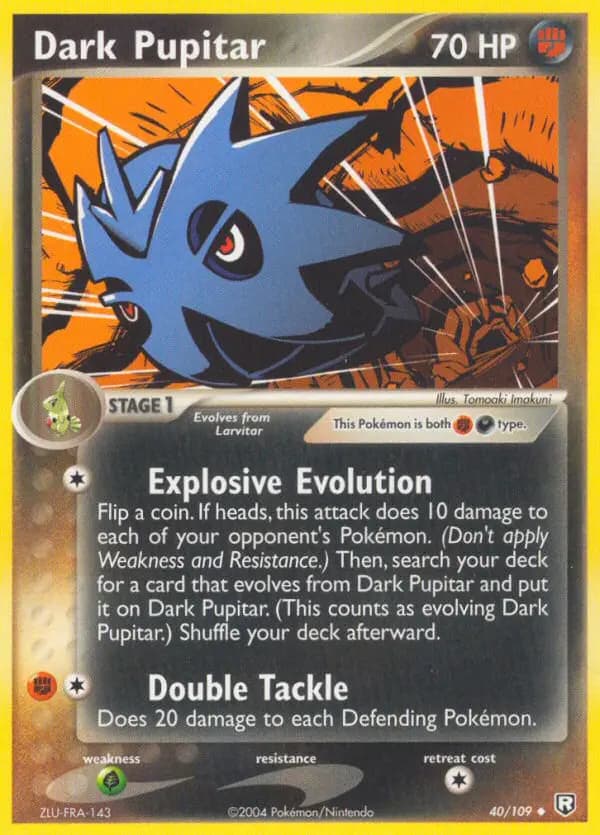
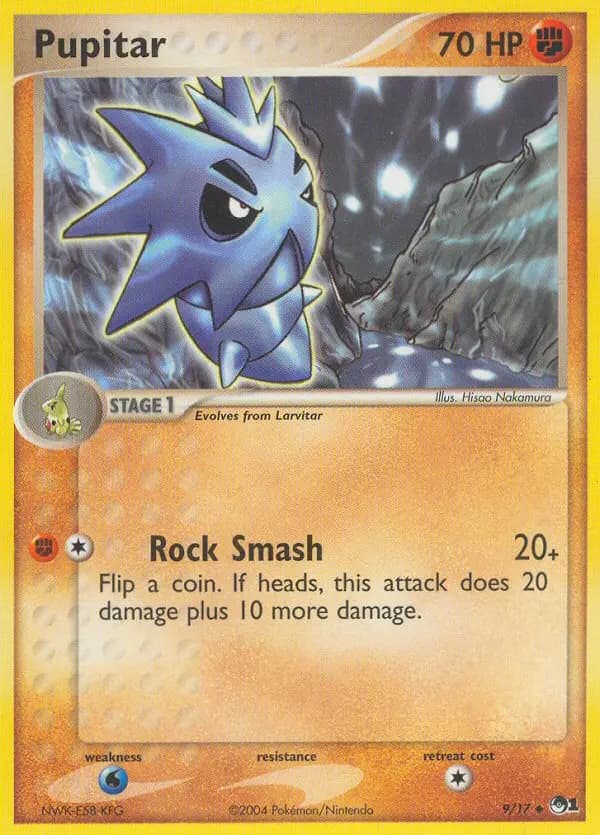
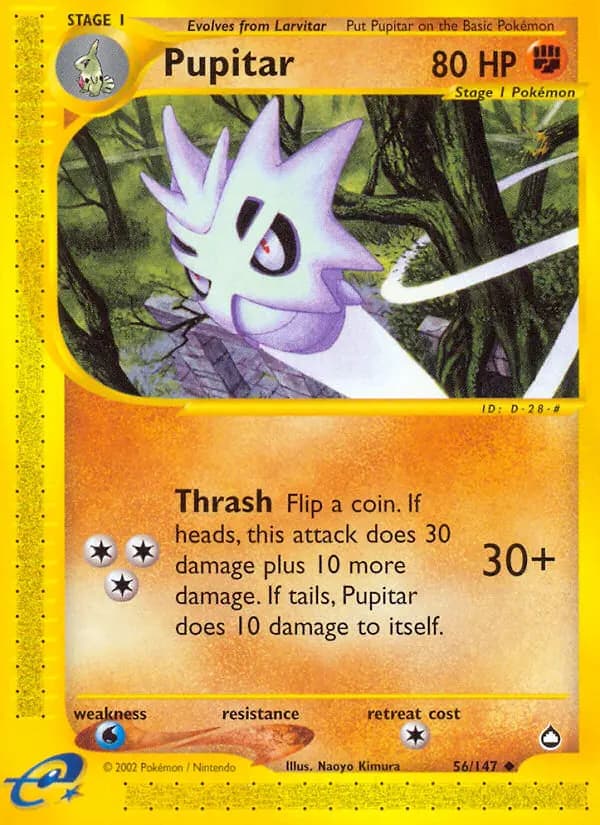
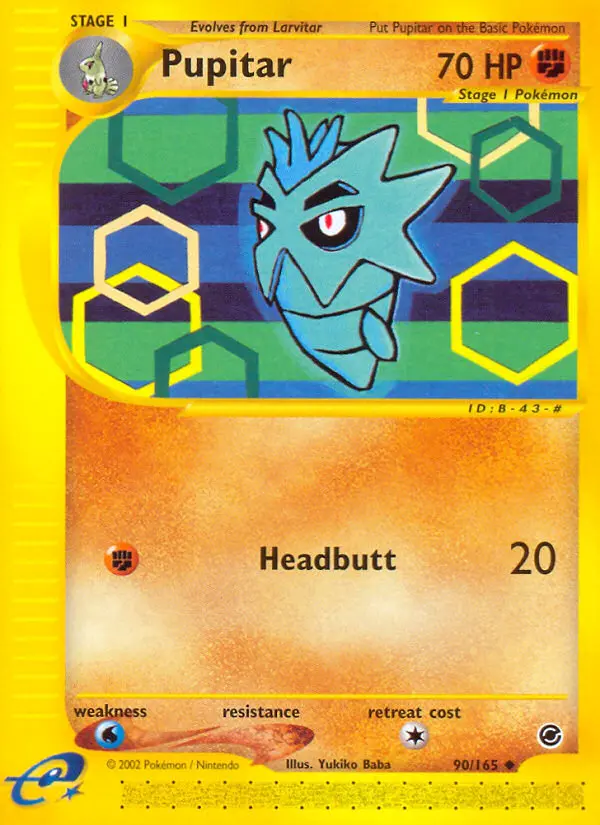
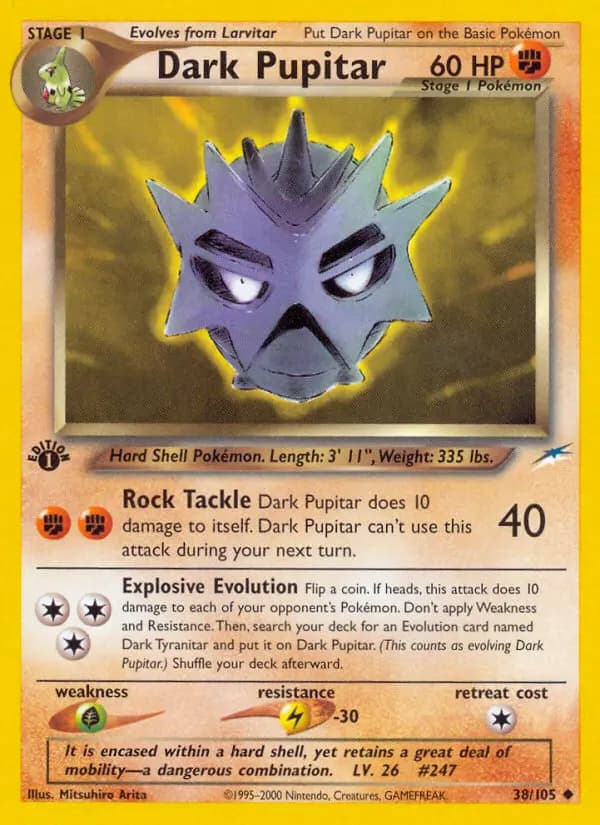
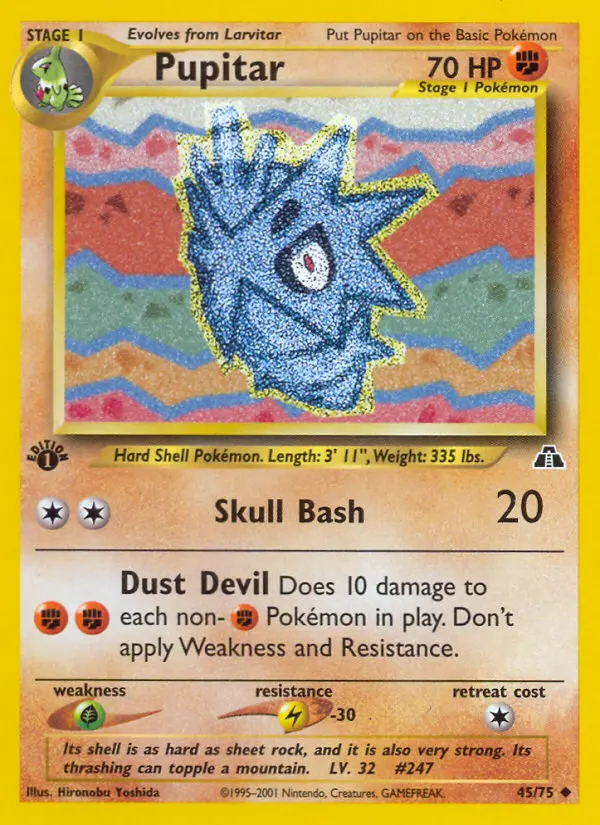
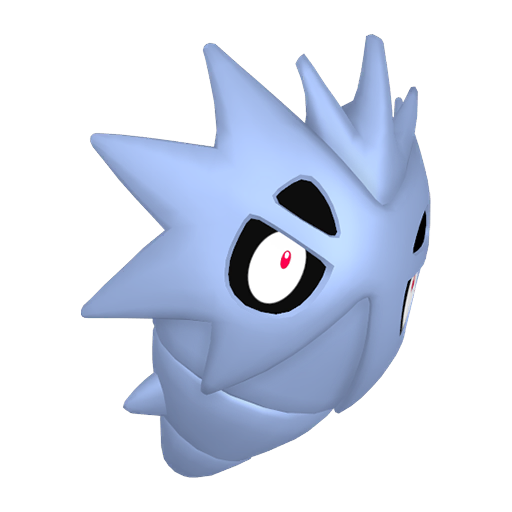
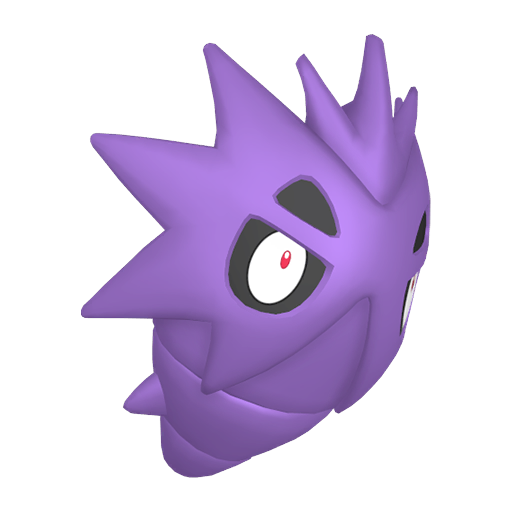
Pupitar's body is encased in an extremely durable grayish-blue shell with a hardness comparable to bedrock or sheet rock, as documented in numerous Pokédex entries across generations. The shell features a distinctive mask-like plate on its upper body adorned with four large spikes on either side, with three additional spikes protruding from its forehead and another pair visible on its lower body. Two red eyes peer through holes in the shell, and two additional holes directly above resemble eyebrows, giving Pupitar an intimidating expression. Unlike the vulnerable pupa stage it represents, Pupitar already possesses fully developed arms and legs beneath its protective casing, allowing it remarkable mobility despite its enclosure. The Pokémon creates pressurized gas within its body that it compresses and forcefully ejects to propel itself like a jet, enabling it to launch itself with tremendous force even while resting. This internal propulsion system is so powerful that Pupitar performs this technique continuously, even during sleep, making it a perpetually mobile threat on harsh mountain ranges.
Pokedex Numbers
Training
Breeding
Pupitar Breeding, Gender Ratio & Egg Groups
Gender-wise, Pupitar is an even 50/50 split between males and females, following standard Pokémon breeding conventions and indicating no sexual dimorphism within the species. As a member of the Monster egg group, Pupitar can breed with other compatible Pokémon to produce Larvitar offspring, with a hatch counter of 40 cycles translating to approximately 10,024 to 10,280 steps required for eggs to hatch. The species exhibits a slow growth rate, meaning trainers pursuing Pupitar must invest considerable time and experience points to reach the level 55 threshold required for its evolution into Tyranitar. Base happiness begins at a notably low 35, substantially below the standard 70-point baseline, indicating that Pupitar eggs hatched from wild-caught parents or traded from other trainers require deliberate nurturing and bonding to reach higher friendship levels. This lower friendship value creates an interesting breeding dynamic where trainers must actively develop their relationship with Pupitar through battles and item usage to optimize its stats and move pools through happiness-based mechanics. The Monster egg group classification places Pupitar alongside other powerhouse Pokémon like Tyranitar itself, Rhyperior, and numerous pseudo-legendary lines, emphasizing its status as a serious competitive threat for players willing to invest breeding effort.
Sprites




TMs & HMs
tm01
lets go pikachu lets go eevee
tm02
crystal
tm02
gold silver
tm02
lets go pikachu lets go eevee
tm03
crystal
tm03
gold silver
tm03
lets go pikachu lets go eevee
tm05
lets go pikachu lets go eevee
tm06
yellow
tm06
gold silver
tm06
red blue
tm06
crystal
tm06
emerald
tm06
firered leafgreen
tm06
diamond pearl
tm06
platinum
tm06
ruby sapphire
tm06
colosseum
tm06
black 2 white 2
tm06
xd
+655 more TMs/HMs
Pupitar's Evolution Chain


Pupitar Evolution, Mega Evolution & Special Forms
Pupitar occupies a critical position within the Larvitar evolutionary line, evolving from Larvitar at level 30 and subsequently evolving into the legendary Tyranitar upon reaching level 55. This three-stage evolution chain represents a dramatic power progression, with Pupitar serving as the crucial intermediate form where the creature's Rock/Ground typing is maintained before Tyranitar's transformation into Rock/Dark typing. The evolution from Larvitar to Pupitar marks the moment when the species becomes genuinely mobile and dangerous, shedding much of its vulnerability and gaining the physical prowess necessary to become a true threat in mountain ecosystems. The transition from Pupitar to Tyranitar represents the final metamorphosis, where the Pokémon emerges from its shell-like pupa stage into a towering, apex predator with dramatically enhanced stats and a secondary Dark typing that reflects its fearsome nature. The 25-level gap between Pupitar's evolution point and Tyranitar's represents a lengthy training period where trainers must nurture their Pupitar's combative spirit before it achieves its final, legendary form. This evolution structure perfectly mirrors natural biological metamorphosis, with each stage representing a distinct phase in the creature's development from larva to pupa to fully-realized adult.
Where to Find
Mt Silver
johto
+1 more
Unova Route 15
unova
+21 more
Kalos Route 18
kalos
+1 more
Terminus Cave
kalos
+7 more
Pupitar Behaviour and Natural Habitat
Pupitar inhabits the mountainous regions where Larvitar thrive, preferring harsh, rocky terrain that suits its aggressive and restless nature. This Pokémon is renowned for its inability to remain still, constantly moving and thrashing about with destructive energy that can topple mountains according to Gold version's Pokédex entry. Even when sealed within its impenetrable shell, Pupitar maintains complete freedom of movement, launching itself through its environment with jet-like propulsion and leaving a trail of destruction in its wake. The species exhibits a lower-than-average base friendship value of 35, suggesting a temperamental and aggressive disposition that reflects its intermediate evolutionary status—more powerful than its pre-evolution but not yet the fearsome predator it will become. Pupitar is known to move around constantly, even during rest periods, as documented in Pokémon Sleep data, indicating this species operates on almost a compulsion to remain active. Its behavior is marked by high-impact thrashing and collision-based movement patterns, demonstrating the raw, uncontrolled power characteristic of a Pokémon still developing its potential.
Pokedex Entries
Its shell is as hard as sheet rock, and it is also very strong. Its THRASHING can topple a mountain.
Even sealed in its shell, it can move freely. Hard and fast, it has out standing destruc tive power.
It will not stay still, even while it's a pupa. It already has arms and legs under its solid shell.
PUPITAR creates a gas inside its body that it compresses and forcefully ejects to propel itself like a jet. The body is very durable - it avoids damage even if it hits solid steel.
A PUPITAR creates a gas inside its body that it ejects under compression to propel itself like a jet. Its body can withstand a collision with solid steel.
Even sealed in its shell, it can move freely. Hard and fast, it has outstanding destructive power.
Its shell is as hard as sheet rock, and it is also very strong. Its THRASHING can topple a mountain.
Its body is as hard as bedrock. By venting pressurized gas, it can launch itself like a rocket.
Its shell is as hard as sheet rock, and it is also very strong. Its thrashing can topple a mountain.
Even sealed in its shell, it can move freely. Hard and fast, it has outstanding destructive power.
Its body is as hard as bedrock. By venting pressurized gas, it can launch itself like a rocket.
This pupa flies around wildly by venting with great force the gas pressurized inside its body.
Its body is as hard as bedrock. By venting pressurized gas, it can launch itself like a rocket.
Its shell is as hard as sheet rock, and it is also very strong. Its thrashing can topple a mountain.
Pupitar creates a gas inside its body that it compresses and forcefully ejects to propel itself like a jet. The body is very durable—it avoids damage even if it hits solid steel.
This troublesome Pokémon can’t wait to evolve, so it relieves its stress by wildly propelling itself around using compressed gas.
This dangerous pupa thrashes about. Its shell is as hard as bedrock, containing its gradually forming new body within.
Even sealed in its shell, it can move freely. Hard and fast, it has outstanding destructive power.
It will not stay still, even while it’s a pupa. It already has arms and legs under its solid shell.
Pupitar Name Origin & Design Inspiration
Pupitar's design brilliantly captures the aesthetic of a pupating insect encased in a protective chrysalis, translated into a Rock-type Pokémon framework. The Japanese name Sanagiras combines 'sanagi' (pupa) with an onomatopoeia suggesting rocky hardness, perfectly encapsulating the creature's nature as a stone-enclosed intermediate form. The English name Pupitar similarly derives from 'pupa,' emphasizing the Pokémon's role as a transitional life stage between vulnerable larva and formidable adult. The shell's grayish-blue coloration and bedrock-like hardness evoke actual stone formations, while the mask-like face plate with its four prominent spikes creates an intimidating visage that suggests barely-contained power straining against its shell prison. The red eyes and eyebrow-like holes add anthropomorphic character to an otherwise geological design, making Pupitar feel simultaneously alien and relatable. The spike arrangements—three on the forehead and pairs on the lower body—suggest aggressive protrusions bursting through the shell's surface, visual metaphors for the Pokémon's untamed destructive potential. The design philosophy prioritizes functionality and biological realism; every element serves both practical defensive purposes and the conveyed narrative of a creature preparing for its final, devastating transformation.
Learnable Moves
Pupitar can learn 81 moves:
Move | Type | Cat. | Power | Acc. | PP |
|---|---|---|---|---|---|
| aerial ace | flying | Physical | 60 | — | 20 |
| ancient power | rock | Special | 60 | 100 | 5 |
| assurance | dark | Physical | 60 | 100 | 10 |
| attract | normal | Status | — | 100 | 15 |
| bite | dark | Physical | 60 | 100 | 25 |
| body slam | normal | Physical | 85 | 100 | 15 |
| brick break | fighting | Physical | 75 | 100 | 15 |
| bulldoze | ground | Physical | 60 | 100 | 20 |
| captivate | normal | Status | — | 100 | 20 |
| chip away | normal | Physical | 70 | 100 | 20 |
| confide | normal | Status | — | — | 20 |
| crunch | dark | Physical | 80 | 100 | 15 |
| curse | ghost | Status | — | — | 10 |
| dark pulse | dark | Special | 80 | 100 | 15 |
| detect | fighting | Status | — | — | 5 |
| dig | ground | Physical | 80 | 100 | 10 |
| double team | normal | Status | — | — | 15 |
| double edge | normal | Physical | 120 | 100 | 15 |
| dragon dance | dragon | Status | — | — | 20 |
| earth power | ground | Special | 90 | 100 | 10 |
| earthquake | ground | Physical | 100 | 100 | 10 |
| endure | normal | Status | — | — | 10 |
| facade | normal | Physical | 70 | 100 | 20 |
| focus energy | normal | Status | — | — | 30 |
| frustration | normal | Physical | — | 100 | 20 |
| giga impact | normal | Physical | 150 | 90 | 5 |
| headbutt | normal | Physical | 70 | 100 | 15 |
| helping hand | normal | Status | — | — | 20 |
| hidden power | normal | Special | 60 | 100 | 15 |
| high horsepower | ground | Physical | 95 | 95 | 10 |
| hyper beam | normal | Special | 150 | 90 | 5 |
| iron defense | steel | Status | — | — | 15 |
| iron head | steel | Physical | 80 | 100 | 15 |
| iron tail | steel | Physical | 100 | 75 | 15 |
| lash out | dark | Physical | 75 | 100 | 5 |
| leer | normal | Status | — | 100 | 30 |
| mimic | normal | Status | — | — | 10 |
| mud shot | ground | Special | 55 | 95 | 15 |
| mud slap | ground | Special | 20 | 100 | 10 |
| muddy water | water | Special | 90 | 85 | 10 |
| natural gift | normal | Physical | — | 100 | 15 |
| outrage | dragon | Physical | 120 | 100 | 10 |
| payback | dark | Physical | 50 | 100 | 10 |
| power up punch | fighting | Physical | 40 | 100 | 20 |
| protect | normal | Status | — | — | 10 |
| rain dance | water | Status | — | — | 5 |
| rest | psychic | Status | — | — | 5 |
| retaliate | normal | Physical | 70 | 100 | 5 |
| return | normal | Physical | — | 100 | 20 |
| rock blast | rock | Physical | 25 | 90 | 10 |
| rock polish | rock | Status | — | — | 20 |
| rock slide | rock | Physical | 75 | 90 | 10 |
| rock smash | fighting | Physical | 40 | 100 | 15 |
| rock throw | rock | Physical | 50 | 90 | 15 |
| rock tomb | rock | Physical | 60 | 95 | 15 |
| round | normal | Special | 60 | 100 | 15 |
| sand tomb | ground | Physical | 35 | 85 | 15 |
| sandstorm | rock | Status | — | — | 10 |
| scary face | normal | Status | — | 100 | 10 |
| screech | normal | Status | — | 85 | 40 |
| secret power | normal | Physical | 70 | 100 | 20 |
| sleep talk | normal | Status | — | — | 10 |
| smack down | rock | Physical | 50 | 100 | 15 |
| snarl | dark | Special | 55 | 95 | 15 |
| snore | normal | Special | 50 | 100 | 15 |
| spite | ghost | Status | — | 100 | 10 |
| stealth rock | rock | Status | — | — | 20 |
| stomping tantrum | ground | Physical | 75 | 100 | 10 |
| stone edge | rock | Physical | 100 | 80 | 5 |
| substitute | normal | Status | — | — | 10 |
| sunny day | fire | Status | — | — | 5 |
| superpower | fighting | Physical | 120 | 100 | 5 |
| swagger | normal | Status | — | 85 | 15 |
| tackle | normal | Physical | 40 | 100 | 35 |
| take down | normal | Physical | 90 | 85 | 20 |
| taunt | dark | Status | — | 100 | 20 |
| tera blast | normal | Special | 80 | 100 | 10 |
| thrash | normal | Physical | 120 | 100 | 10 |
| torment | dark | Status | — | 100 | 15 |
| toxic | poison | Status | — | 90 | 10 |
| uproar | normal | Special | 90 | 100 | 10 |
Pupitar Competitive Battle Guide
Competitively, Pupitar occupies an awkward middle ground between its more viable pre-evolution and its heavily-used final form, though it possesses distinctive advantages in specific metagames and strategies. With 84 base attack, 70 base defense, and 70 base special defense, Pupitar functions as a physical attacker with reasonable defensive staying power, though its 51 base speed relegates it to operating as a slow, bulky sweeper rather than a speedy striker. The Shed Skin ability proves invaluable in competitive environments, granting Pupitar protection against status conditions that would cripple most other Pokémon, providing consistent utility against teams relying on burns, paralysis, or poison to neutralize threats. Pupitar's movepool includes access to critical rock and ground-type moves including Stone Edge, Earthquake, and Rock Slide, alongside useful coverage moves and priority options that provide flexibility in team construction. In lower-tier competitive formats, Pupitar sees occasional use as a choice-locked attacker or bulky pivot, though players almost universally prefer either the bulkier, friendlier Larvitar in certain sets or the overwhelmingly superior Tyranitar in standard competitive play. Pupitar's real competitive niche emerges in level-50 formats and specific Little Cups where its base stats prove surprisingly competitive, and in Pokémon Sword/Shield's Isle of Armor competitive scenarios where team-building restrictions elevate intermediate evolutions to relevance. The 410 cumulative stat total, while respectable for a middle evolution, ultimately limits Pupitar's viability against the statistical juggernauts of competitive Pokémon, making it a Pokémon more valued for its role in the evolution narrative than its independent competitive prowess.
Commonly Asked Questions About Pupitar
What type is Pupitar?
Pupitar is a rock and ground type Pokemon.
What does Pupitar evolve into?
Pupitar evolves into tyranitar.
What are Pupitar's weaknesses?
Pupitar is weak to fighting, ground, steel, water, grass and ice type moves.
Does Pupitar evolve by trading?
No — Pupitar evolves entirely through leveling up, with no trade required at any stage.
Where can I find Pupitar?
Pupitar can be found in mt silver (johto), unova route 15 (unova) and kalos route 18 (kalos) and 1 other locations.
Pupitar Cultural Impact & Franchise History
Pupitar represents a beloved milestone in Pokémon training journeys, occupying a nostalgic position in the hearts of players who grew up during Generation II and subsequent remakes. The Larvitar line's introduction in Gold and Silver versions captured trainer imagination with the epic 25-level commitment required to fully evolve into Tyranitar, creating a sense of genuine achievement and progression that distinguished this evolution line from faster alternatives. The species appears frequently in Pokémon anime episodes and spin-off media, with notable appearances including trainer Billy's Pupitar supporting his Tyranitar in Pokémon Ranger, establishing it as the reliable intermediate form that bridges development stages. Pupitar's design philosophy—combining crystalline rock formations with organic biological metamorphosis—has influenced subsequent pseudo-legendary design philosophies, establishing templates that Game Freak continues to reference in modern generations. The species serves as a cultural touchstone representing perseverance and patience, as trainers must sustain commitment through levels 30-55 knowing that only the final evolution delivers maximum power, creating narrative satisfaction when Tyranitar finally emerges. In competitive communities, Pupitar holds particular significance as the training ground for aspiring players learning type matchups and stat optimization, often appearing in beginner-tier discussions and educational content. The line's iconic status has ensured Pupitar remains instantly recognizable across all demographics, representing the specific charm of Generation II's design philosophy that balanced innovation with tactical depth.
Where to Find Pupitar in Every Pokémon Game
Pupitar's availability varies significantly across Pokémon games, though it remains consistently accessible through either wild encounters or evolution of Larvitar throughout most generations. In the original Generation II titles (Gold, Silver, and Crystal), Pupitar appears in Mt. Mortar and surrounding mountain areas as a wild encounter, with Larvitar available in the same regions for trainers preferring to raise from the base evolution. HeartGold and SoulSilver remakes maintain this availability pattern, placing both Larvitar and Pupitar in mountainous environments corresponding to the original Johto locations. Later generations modified availability—Pokémon Black 2 and White 2 feature Pupitar in desert regions, while X and Y placed it in Mountain Kalos near the evolution threshold, and subsequent titles (Sun/Moon, Sword/Shield, and Scarlet/Violet) incorporated it into region-specific dex rotations tied to generation cycles and thematic mountain zones. The species appears consistently in post-game content areas where trainers can encounter wild Pupitar already at high levels, useful for players seeking to complete the evolution line without extensive leveling investments. Pokémon Legends: Arceus includes Pupitar in its Sinnoh-based Pokédex with modified availability reflecting the game's different historical setting. Availability in modern titles (Scarlet/Violet, Sword/Shield) generally positions Pupitar as a mid-to-late-game encounter accessible through standard progression, though it may require advancing into post-game regions or utilizing DLC content like The Crown Tundra to encounter it in optimal level ranges. Trade evolution remains inaccessible for this species, ensuring that all players can obtain Pupitar through legitimate gameplay without external trading dependencies.