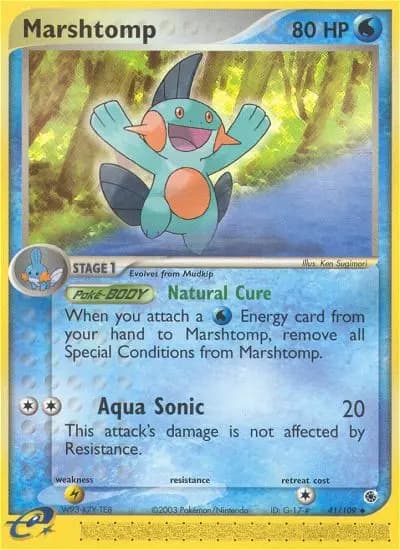
Marshtomp
Generation III · #0259 — Mud Fish Pokémon
Marshtomp measures in at 0.7 m and 28 kg, a build that matches its torrent ability better than it matches raw offense or defense. Standing at just 0.7 meters tall and weighing 28.0 kilograms, Marshtomp is a compact but powerful amphibian that has adapted remarkably well to life on muddy terrain. The Pokémon is predominantly found in the Hoenn region and serves as a popular choice for trainers seeking a balanced Water-type Pokémon with surprising terrestrial capabilities. Its dual typing grants it unique defensive properties and tactical advantages that distinguish it from other Water-types, making it a noteworthy member of any trainer's team during their journey through Hoenn.
Editor's Take
Marshtomp picking up Ground typing removes the Electric weakness entirely, which makes the Mudkip line the easiest starter run in the series by a wide margin.
Base Stats
Height
0.7m
Weight
28.0kg
Category
Mud Fish Pokémon
Gender
Male 87.5% / Female 12.5%
Color
blue
Shape
upright
Habitat
waters-edge
Abilities
Strengthens water moves to inflict 1.5× damage at 1/3 max HP or less.
Prevents self destruct, explosion, and aftermath from working while the Pokémon is in battle.

Marshtomp Biology & Physical Characteristics
Marshtomp is a bipedal amphibian Pokémon with a distinctly salamander-like or mudskipper-like appearance that reflects its evolutionary adaptation to swampy environments. Its body is primarily light blue with a lighter shade of blue covering its underside and an distinctive orange belly that provides visual contrast. The Pokémon features an angular black fin on its head, small orange eyes, and a pair of prominent orange gills positioned at the ends of both cheeks, allowing it to extract oxygen from both air and water. Marshtomp possesses long arms equipped with three-fingered hands and feet bearing three small toes, along with two characteristic black fins that serve as tails. The most remarkable biological feature is the thin, sticky film that envelops Marshtomp's entire body surface, which enables it to thrive on dry land despite its aquatic heritage. This mucous coating prevents dehydration and allows the Pokémon to maintain moisture in terrestrial environments, though it must regularly replenish fluids by playing in mud to remain healthy and vigorous.
Pokedex Numbers
Training
Breeding
Marshtomp Breeding, Gender Ratio & Egg Groups
Marshtomp exhibits a heavily male-biased gender ratio, with approximately 87.5 percent of wild-encountered specimens being male and only 12.5 percent female, making female Marshtomp considerably rarer in the wild. This significant gender imbalance is characteristic of the entire Mudkip evolutionary line and suggests that male Marshtomp may possess some evolutionary or reproductive advantage within their ecological niche. The species belongs to both the Monster and Water 1 egg groups, providing breeders with multiple pathways for producing Marshtomp offspring and expanding moveset possibilities through strategic breeding combinations. Female Marshtomp, though uncommon, are equally capable of breeding and can produce either male or female offspring depending on the nature of their breeding partner. The Pokémon has a base happiness value of 70 and requires 20 egg cycles to hatch, making it moderately convenient for dedicated breeders seeking to develop optimal individuals for competitive play. The rarity of female Marshtomp adds a layer of collectibility for trainers who appreciate gender diversity in their teams or who seek specific breeding lineages with optimal individual values and natures.
Sprites






TMs & HMs
tm00
sword shield
tm01
yellow
tm01
gold silver
tm01
crystal
tm01
red blue
tm01
platinum
tm01
emerald
tm01
diamond pearl
tm01
firered leafgreen
tm01
ruby sapphire
tm01
xd
tm01
colosseum
tm01
heartgold soulsilver
tm01
lets go pikachu lets go eevee
tm01
ultra sun ultra moon
tm01
sun moon
tm01
blue japan
tm01
red green japan
tm01
sword shield
tm02
crystal
+722 more TMs/HMs
Marshtomp's Evolution Chain


Marshtomp Evolution, Mega Evolution & Special Forms
Marshtomp occupies a crucial midpoint in one of Generation III's most iconic evolution lines, serving as the intermediate stage between Mudkip and the powerful final form, Swampert. The evolutionary transition from Mudkip to Marshtomp occurs at level 16, representing the Pokémon's first major transformation as it gains the Ground-type to complement its Water typing. This addition of the Ground type marks a significant shift in Marshtomp's capabilities, introducing new resistances and immunities while fundamentally altering its movepool and strategic applications. At level 36, Marshtomp undergoes its final evolution into Swampert, during which it gains substantial increases to its physical stats, particularly in Attack and HP, while its Speed remains comparatively modest. Swampert's transformation also grants access to new moves and abilities, making it a formidable force in competitive play. The evolutionary arc represents a journey from aquatic origins toward increasingly terrestrial adaptation, with Marshtomp serving as the bridge where the Pokémon truly embraces its dual nature as both swimmer and mud-dweller. Notably, Swampert received a Mega Evolution form in later generations, though Marshtomp itself does not benefit from Mega Evolution, remaining a solid but non-Mega stage in the evolutionary line.
Where to Find
Brooklet Hill
alola
Marshtomp Behaviour and Natural Habitat
Marshtomp exhibits distinctive behavioral patterns that reflect its unique ecological niche as an amphibious creature equally at home in water and mud. According to various Pokédex entries, this species demonstrates remarkable mobility through muddy terrain, traveling faster through mud than it does through swimming—a counterintuitive ability that highlights its terrestrial specialization. The Pokémon is particularly formidable on muddy ground with poor footing, where it uses its sturdy, well-developed hindquarters to maintain balance while overwhelming opponents who struggle in such conditions. Marshtomp spends its time playing in mud on beaches during low tide, an activity essential for maintaining its skin hydration and overall health. When preparing to rest, Marshtomp burrows into dirt and mud, apparently finding safety and comfort in these subterranean retreats. Its habitat consists primarily of swamps and other wetland environments where muddy substrate predominates, allowing it to leverage its evolutionary advantages. The species' hindquarters have developed considerable musculature, enabling it to walk on its hind legs alone—a capability that provides flexibility in movement across varied terrain and suggests continued evolutionary refinement toward increased terrestrial competence.
Pokedex Entries
The surface of MARSHTOMP’s body is enveloped by a thin, sticky film that enables it to live on land. This POKéMON plays in mud on beaches when the ocean tide is low.
MARSHTOMP is much faster at traveling through mud than it is at swimming. This POKéMON’s hindquarters exhibit obvious development, giving it the ability to walk on just its hind legs.
Its toughened hind legs enable it to stand upright. Because it weakens if its skin dries out, it replenishes fluids by playing in mud.
It is at its best when on muddy ground with poor footing. It quickly overwhelms foes struggling in mud.
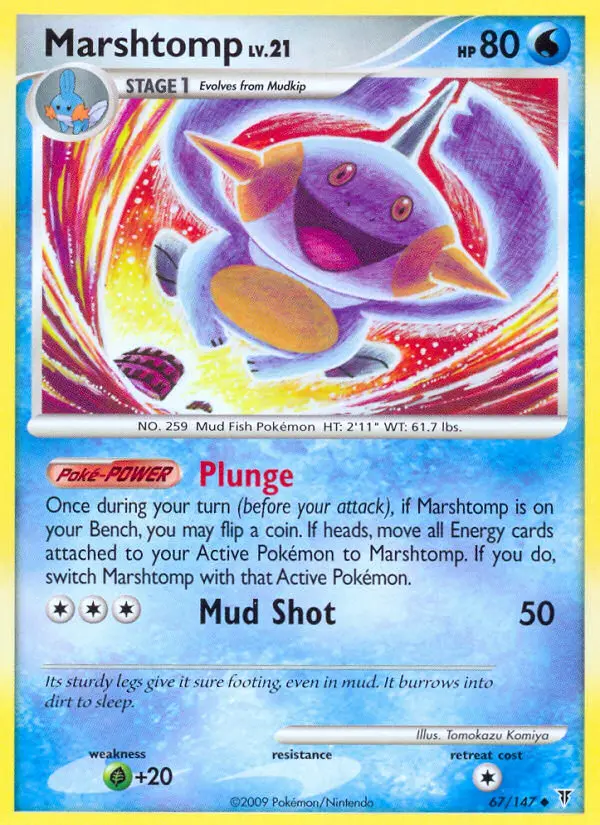
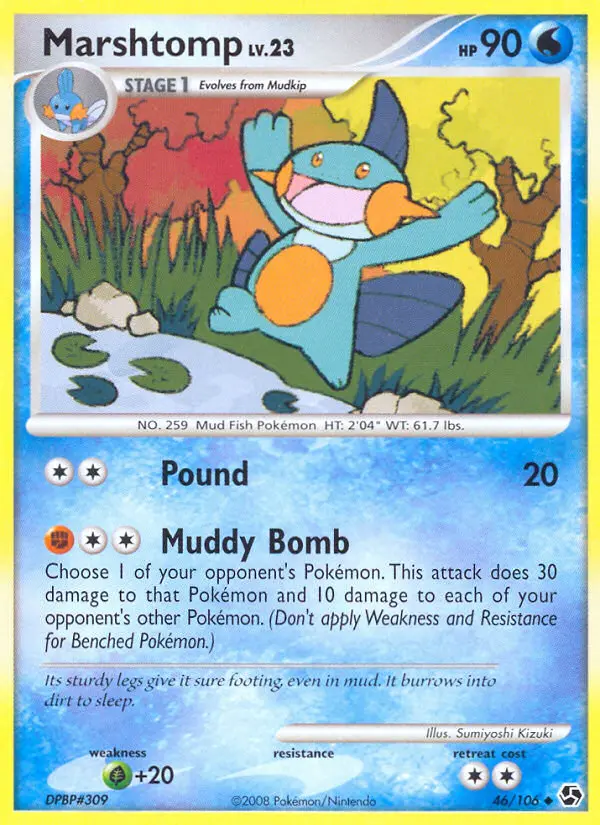
Its sturdy legs give it sure footing, even in mud. It burrows into dirt to sleep.
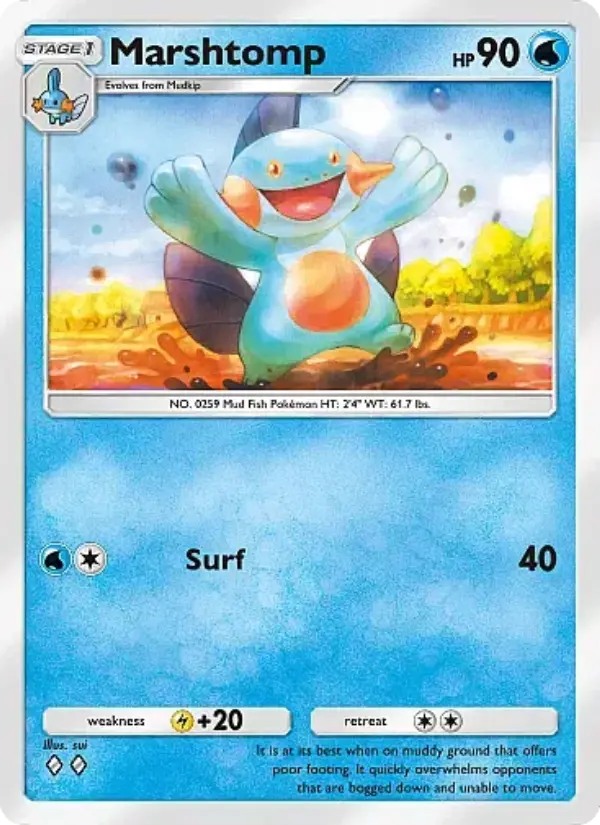
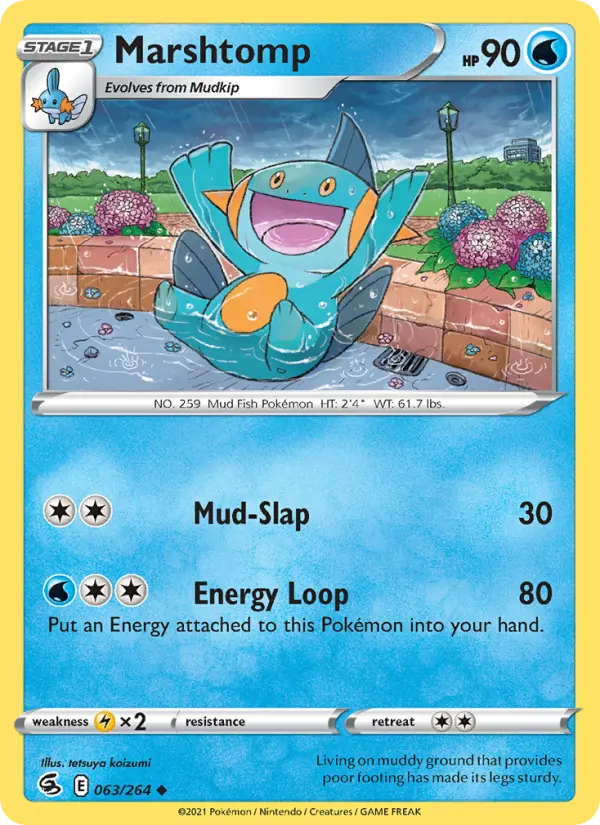
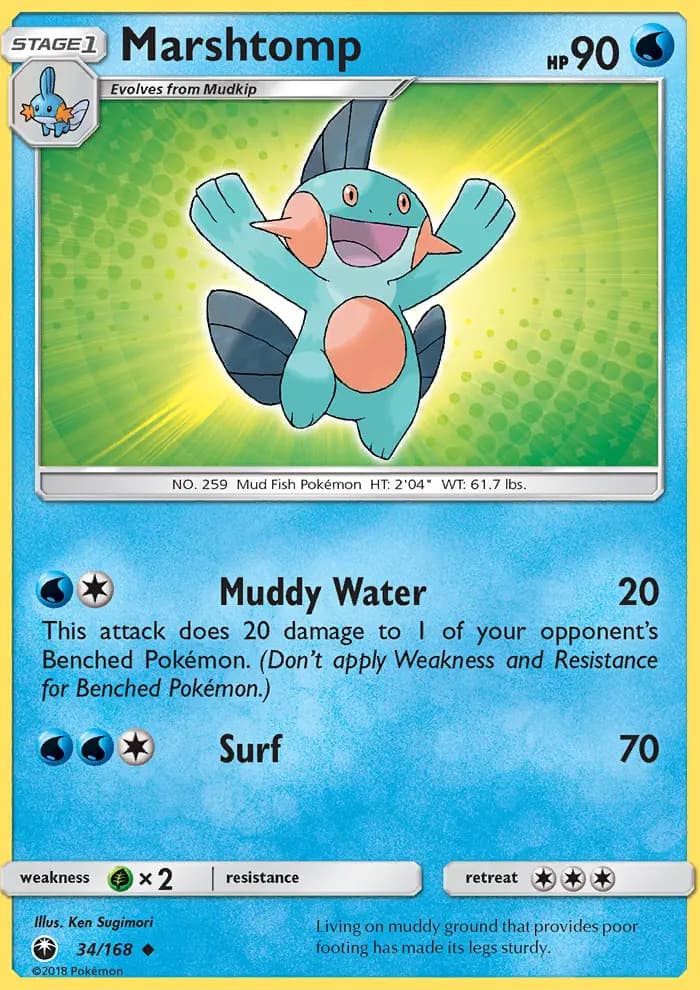
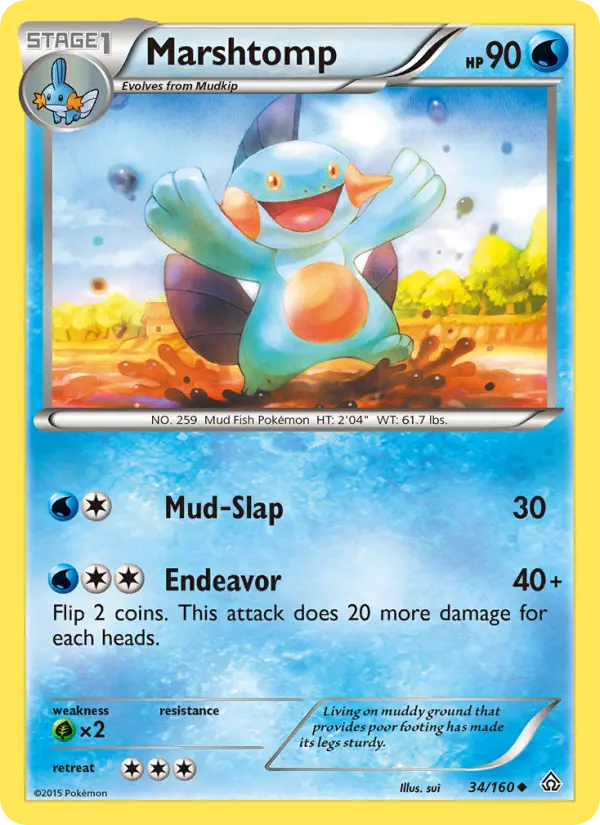
Living on muddy ground that provides poor footing has made its legs sturdy.
Its sturdy legs give it sure footing, even in mud. It burrows into dirt to sleep.
Its sturdy legs give it sure footing, even in mud. It burrows into dirt to sleep.
Its sturdy legs give it sure footing, even in mud. It burrows into dirt to sleep.
Living on muddy ground that provides poor footing has made its legs sturdy.
The surface of Marshtomp’s body is enveloped by a thin, sticky film that enables it to live on land. This Pokémon plays in mud on beaches when the ocean tide is low.
Marshtomp is much faster at traveling through mud than it is at swimming. This Pokémon’s hindquarters exhibit obvious development, giving it the ability to walk on just its hind legs.
Marshtomp Name Origin & Design Inspiration
Marshtomp's name comes from a logical blend of its biological and environmental characteristics: 'marsh,' referencing the swampy wetland habitats it favors, and 'stomp,' reflecting its ground-based locomotion and physical prowess in terrestrial combat. The Japanese name, Numacraw, uses 'numa' meaning swamp or marsh combined with 'craw,' potentially referencing the mudskipper's crawling locomotion. The Pokémon's design draws substantial inspiration from mudskippers and aquatic salamanders, creatures known for their remarkable ability to thrive in transitional zones between water and land. Its physical form reflects real-world amphibians that have evolved specialized limbs and gill structures for exploiting muddy, low-oxygenation environments. The angular black fin, orange coloration, and gill arrangements all echo the appearance of actual mudskippers, creating a Pokémon that feels grounded in realistic biology while maintaining the fantastical design principles of the franchise. The thick, sticky mucous film coating its body parallels the protective secretions of real amphibians, while the emphasis on sturdy hindquarters and bipedal stance suggests evolutionary pressure toward increasingly land-oriented locomotion. Overall, Marshtomp represents a thoughtful translation of real biological adaptation into a compelling Pokémon design that balances aesthetic appeal with ecological plausibility.
Learnable Moves
Marshtomp can learn 96 moves:
Move | Type | Cat. | Power | Acc. | PP |
|---|---|---|---|---|---|
| amnesia | psychic | Status | — | — | 20 |
| ancient power | rock | Special | 60 | 100 | 5 |
| aqua tail | water | Physical | 90 | 90 | 10 |
| attract | normal | Status | — | 100 | 15 |
| avalanche | ice | Physical | 60 | 100 | 10 |
| bide | normal | Physical | — | — | 10 |
| bite | dark | Physical | 60 | 100 | 25 |
| blizzard | ice | Special | 110 | 70 | 5 |
| body slam | normal | Physical | 85 | 100 | 15 |
| brick break | fighting | Physical | 75 | 100 | 15 |
| bulldoze | ground | Physical | 60 | 100 | 20 |
| captivate | normal | Status | — | 100 | 20 |
| chilling water | water | Special | 50 | 100 | 20 |
| confide | normal | Status | — | — | 20 |
| counter | fighting | Physical | — | 100 | 20 |
| curse | ghost | Status | — | — | 10 |
| defense curl | normal | Status | — | — | 40 |
| dig | ground | Physical | 80 | 100 | 10 |
| dive | water | Physical | 80 | 100 | 10 |
| double team | normal | Status | — | — | 15 |
| double edge | normal | Physical | 120 | 100 | 15 |
| dynamic punch | fighting | Physical | 100 | 50 | 5 |
| earth power | ground | Special | 90 | 100 | 10 |
| earthquake | ground | Physical | 100 | 100 | 10 |
| echoed voice | normal | Special | 40 | 100 | 15 |
| endeavor | normal | Physical | — | 100 | 5 |
| endure | normal | Status | — | — | 10 |
| facade | normal | Physical | 70 | 100 | 20 |
| fling | dark | Physical | — | 100 | 10 |
| focus punch | fighting | Physical | 150 | 100 | 20 |
| foresight | normal | Status | — | — | 40 |
| frustration | normal | Physical | — | 100 | 20 |
| growl | normal | Status | — | 100 | 40 |
| hail | ice | Status | — | — | 10 |
| headbutt | normal | Physical | 70 | 100 | 15 |
| helping hand | normal | Status | — | — | 20 |
| hidden power | normal | Special | 60 | 100 | 15 |
| hydro pump | water | Special | 110 | 80 | 5 |
| ice beam | ice | Special | 90 | 100 | 10 |
| ice punch | ice | Physical | 75 | 100 | 15 |
| icy wind | ice | Special | 55 | 95 | 15 |
| iron tail | steel | Physical | 100 | 75 | 15 |
| liquidation | water | Physical | 85 | 100 | 10 |
| low kick | fighting | Physical | — | 100 | 20 |
| mega kick | normal | Physical | 120 | 75 | 5 |
| mega punch | normal | Physical | 80 | 85 | 20 |
| mimic | normal | Status | — | — | 10 |
| mirror coat | psychic | Special | — | 100 | 20 |
| mud bomb | ground | Special | 65 | 85 | 10 |
| mud shot | ground | Special | 55 | 95 | 15 |
| mud sport | ground | Status | — | — | 15 |
| mud slap | ground | Special | 20 | 100 | 10 |
| muddy water | water | Special | 90 | 85 | 10 |
| natural gift | normal | Physical | — | 100 | 15 |
| power up punch | fighting | Physical | 40 | 100 | 20 |
| protect | normal | Status | — | — | 10 |
| rain dance | water | Status | — | — | 5 |
| rest | psychic | Status | — | — | 5 |
| return | normal | Physical | — | 100 | 20 |
| roar | normal | Status | — | — | 20 |
| rock slide | rock | Physical | 75 | 90 | 10 |
| rock smash | fighting | Physical | 40 | 100 | 15 |
| rock throw | rock | Physical | 50 | 90 | 15 |
| rock tomb | rock | Physical | 60 | 95 | 15 |
| rollout | rock | Physical | 30 | 90 | 20 |
| round | normal | Special | 60 | 100 | 15 |
| sand tomb | ground | Physical | 35 | 85 | 15 |
| scald | water | Special | 80 | 100 | 15 |
| screech | normal | Status | — | 85 | 40 |
| secret power | normal | Physical | 70 | 100 | 20 |
| seismic toss | fighting | Physical | — | 100 | 20 |
| sleep talk | normal | Status | — | — | 10 |
| sludge | poison | Special | 65 | 100 | 20 |
| sludge wave | poison | Special | 95 | 100 | 10 |
| snore | normal | Special | 50 | 100 | 15 |
| stealth rock | rock | Status | — | — | 20 |
| stomp | normal | Physical | 65 | 100 | 20 |
| strength | normal | Physical | 80 | 100 | 15 |
| substitute | normal | Status | — | — | 10 |
| superpower | fighting | Physical | 120 | 100 | 5 |
| supersonic | normal | Status | — | 55 | 20 |
| surf | water | Special | 90 | 100 | 15 |
| swagger | normal | Status | — | 85 | 15 |
| tackle | normal | Physical | 40 | 100 | 35 |
| take down | normal | Physical | 90 | 85 | 20 |
| tera blast | normal | Special | 80 | 100 | 10 |
| toxic | poison | Status | — | 90 | 10 |
| uproar | normal | Special | 90 | 100 | 10 |
| water gun | water | Special | 40 | 100 | 25 |
| water pledge | water | Special | 80 | 100 | 10 |
| water pulse | water | Special | 60 | 100 | 20 |
| waterfall | water | Physical | 80 | 100 | 15 |
| whirlpool | water | Special | 35 | 85 | 15 |
| wide guard | rock | Status | — | — | 10 |
| work up | normal | Status | — | — | 30 |
| yawn | normal | Status | — | — | 10 |
Marshtomp Competitive Battle Guide
Marshtomp presents a mixed competitive profile as a middling Water/Ground-type with modest base stats totaling 405 points. Its Attack stat of 85 serves as its most respectable offensive attribute, complemented by adequate Defense and Special Defense stats of 70 each, though its HP of 70 and Speed of 50 represent notable weaknesses. The Pokémon's Special Attack of 60 further limits its viability as a special attacker, constraining its movepool utility in competitive formats. Marshtomp's primary abilities, Torrent and the hidden ability Damp, offer situational benefits; Torrent boosts Water-type move power to 1.5 times effectiveness when Marshtomp's HP drops to one-third or below, while Damp prevents Self-Destruct, Explosion, and Aftermath from functioning—a niche defensive utility. In competitive play, Marshtomp generally serves as a stepping stone rather than a genuinely competitive option, with players typically preferring either Mudkip for its lower leveling requirements or Swampert for its substantially superior stats and available Mega Evolution. However, in format-specific metagames such as Little Cup or Pokémon Sword and Shield's lower-tier classifications, Marshtomp's balanced stat distribution and dual typing can prove surprisingly serviceable. The Pokémon's movepool includes valuable coverage moves accessible through TMs and breeding, allowing creative trainers to construct viable Marshtomp sets for casual or restricted competitive environments.
Commonly Asked Questions About Marshtomp
What type is Marshtomp?
Marshtomp is a water and ground type Pokemon.
What does Marshtomp evolve into?
Marshtomp evolves into swampert.
What are Marshtomp's weaknesses?
Marshtomp is weak to grass and electric type moves.
Does Marshtomp evolve by trading?
No — Marshtomp evolves entirely through leveling up, with no trade required at any stage.
Where can I find Marshtomp?
Marshtomp can be found in brooklet hill (alola).
Marshtomp Cultural Impact & Franchise History
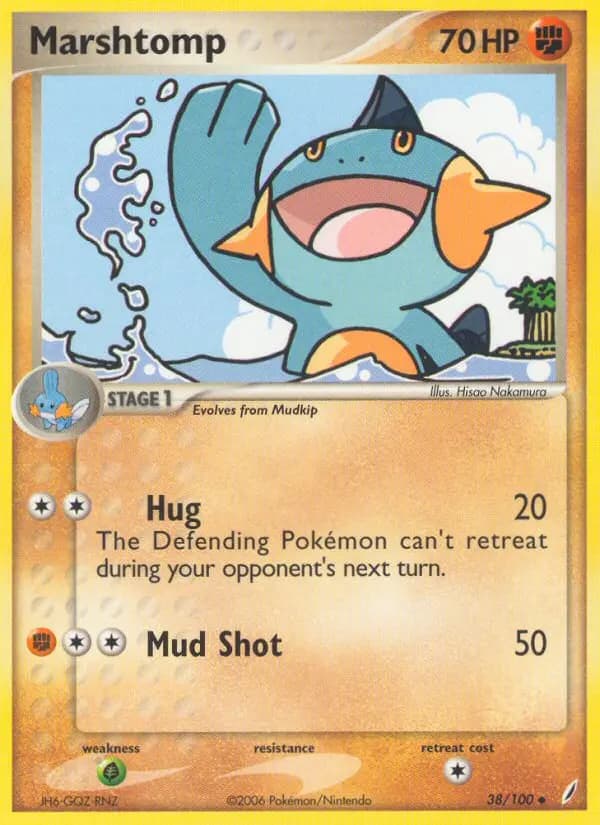
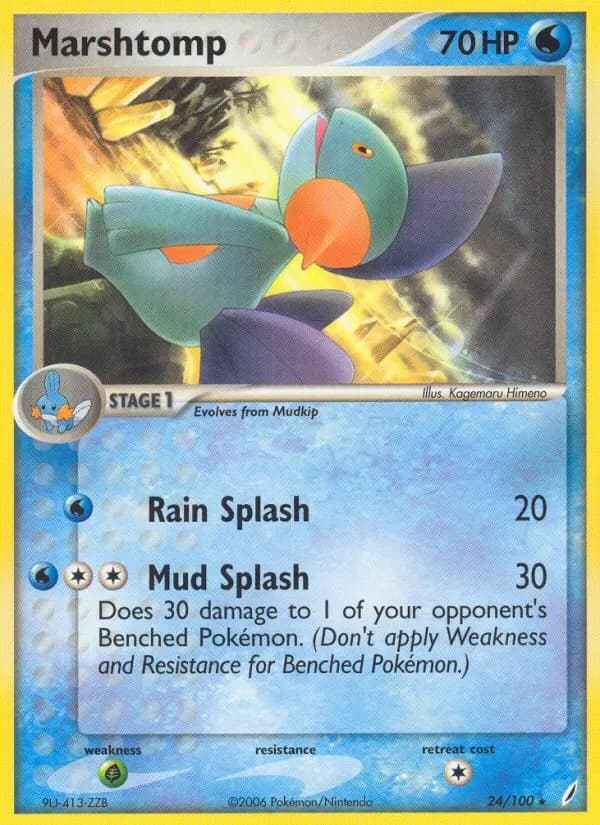
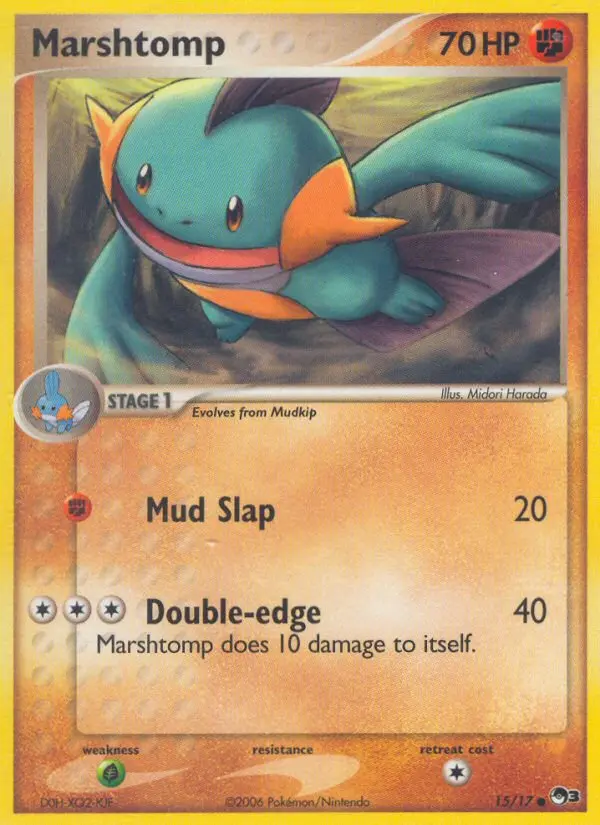
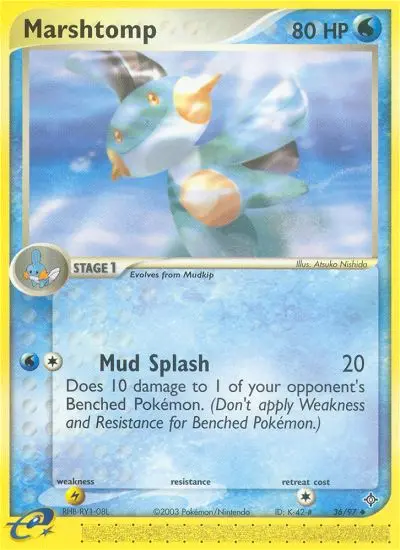
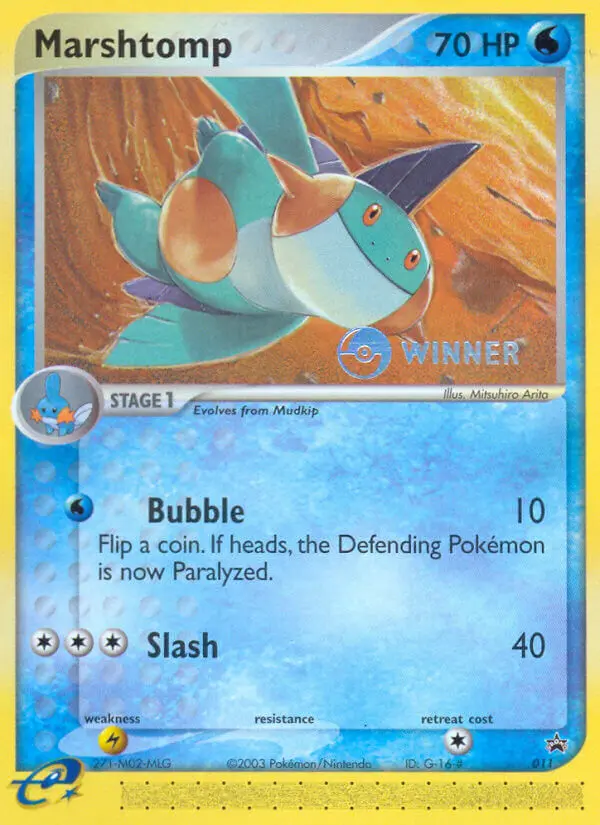
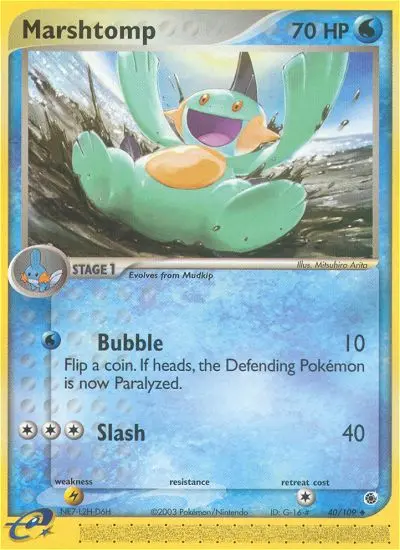
Marshtomp achieved significant cultural prominence primarily through its appearance in the Pokémon anime series, particularly through Brock's Marshtomp, which became one of the most memorable Pokémon in his roster. Brock's Marshtomp demonstrated remarkable personality and combat effectiveness throughout numerous episodes, establishing itself as a fan favorite and contributing meaningfully to the character's development and tactical capabilities. The species also appears prominently in Pokémon Adventures manga and various trading card game releases, securing its position within broader franchise media. Marshtomp's design resonated with fans as an appealing middle ground between Mudkip's youth and charm and Swampert's raw power, earning it a dedicated following among players and collectors who appreciated its unique aesthetic. The Pokémon has maintained consistent availability across multiple game generations, ensuring that new trainers continually encounter and potentially train Marshtomp during their Hoenn journeys. Its representation in promotional materials, merchandise, and competitive discussions reflects its status as a recognizable and beloved Generation III Pokémon. While perhaps not commanding the immediate recognition of starter forms like Charizard or Blastoise, Marshtomp maintains a respected position within the franchise's cultural landscape, representing the transitional stage that many trainers experience as they progress through their adventures.
Where to Find Marshtomp in Every Pokémon Game
Marshtomp is obtainable through multiple pathways depending on the game generation and version. In Pokémon Ruby, Sapphire, and Emerald, players receive Mudkip from Professor Birch early in their adventure, with Marshtomp becoming available after Mudkip reaches level 16. These games represent Marshtomp's primary habitat in the Hoenn region, where it naturally inhabits swamps and wetland areas. In Pokémon Omega Ruby and Alpha Sapphire, Marshtomp maintains its availability through the same progression, though it can also be encountered as a wild Pokémon in specific locations. More recent generations including Pokémon Sword and Shield's Expansion Pass content and Pokémon Scarlet and Violet provide access to Marshtomp through various means, including catching evolved Mudkip or encountering Marshtomp directly in designated locations. The Pokédex number for Marshtomp is #0259 nationally, with regional Pokédex numbers varying by game version and region. Trainers can also obtain Marshtomp through breeding any member of the Mudkip evolutionary line, a method available across all generations where breeding mechanics exist. The species' consistent availability across numerous game releases and formats ensures that dedicated trainers can reliably acquire Marshtomp for their teams regardless of which Pokémon game they're playing, making it one of the more accessible Water-type Pokémon for those specifically seeking a Hoenn-native amphibian.