Octillery
Generation II · #0224 — Jet Pokémon
As a Generation II water-type, Octillery leans on suction cups to cover what its raw numbers don't, particularly on the attack side. At 0.9 m and 28.5 kg, its build reflects a specialist role rather than a generalist one. Standing at just 0.9 meters tall and weighing 28.5 kilograms, Octillery is a compact but formidable water-dweller that has become a beloved fixture in the Pokémon franchise since its debut in the Gold and Silver generations. Its balanced yet unconventional stat distribution, featuring equal Attack and Special Attack values of 105, makes it a versatile choice for trainers seeking a water-type with offensive capabilities. The species is neither legendary nor mythical, positioning it firmly as an accessible and trainable Pokémon that bridges the gap between casual gameplay and competitive battling.
Editor's Take
Octillery has 105 base Special Attack, 45 base Speed and Suction Cups, which is a Pokémon assembled from parts that do not belong together.
Base Stats
Height
0.9m
Weight
28.5kg
Category
Jet Pokémon
Gender
Male 50% / Female 50%
Color
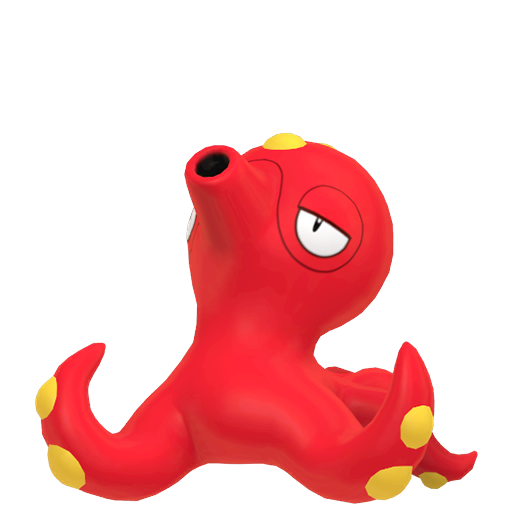
red
Shape
tentacles
Habitat
sea
Abilities
Prevents being forced out of battle by other Pokémon's moves.
Strengthens critical hits to inflict 3× damage rather than 2×.
Raises a random stat two stages and lowers another one stage after each turn.

Octillery Biology & Physical Characteristics
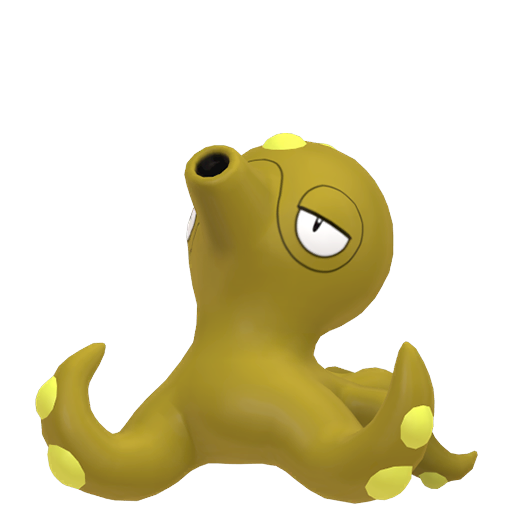
Octillery is a distinctive cephalopod-like Pokémon displaying a vibrant red coloration with notable physical features that define its aggressive hunting nature. Its most recognizable traits are its large, round eyes that convey keen intelligence and its turret-like mouth positioned prominently on its body, allowing it to spray ink with remarkable precision and force. The creature possesses eight tentacles lined with yellow suction cups—structures of extraordinary gripping power that allow it to immobilize prey and resist being dislodged from battle through moves designed to force switches. Crowning its squat, muscular body is a rock-hard head adorned with yellow bumps that serve as weapons in combat. Interestingly, sexual dimorphism appears in the species, as female Octillery display smaller yellow bumps and suction cups compared to their male counterparts, a subtle but notable biological distinction. The suction cups are not merely decorative; they function as sophisticated sensory organs and manipulative appendages, enabling Octillery to interact precisely with its environment while maintaining iron-like grip strength that makes it nearly impossible to dislodge once it has latched onto an opponent or secured itself within a rocky crevice.
Pokedex Numbers
Training
Breeding
Octillery Breeding, Gender Ratio & Egg Groups
There's no gender skew here: Octillery breeds at an even 50% male / 50% female rate, allowing equal breeding opportunities regardless of player preference. Both males and females can serve as primary breeders, and the species belongs to both the Water 1 and Water 2 egg groups, granting it substantial breeding flexibility with numerous other water-type and amphibious Pokémon. The species takes approximately 20 egg cycles to hatch, translating to roughly 4,884 to 5,140 steps in most games, making it a moderate commitment for breeders seeking optimal individual values or specific move combinations through egg move inheritance. Sexual dimorphism, while subtle, appears in the physical characteristics of mature specimens, with females displaying noticeably smaller yellow bumps and suction cups compared to males—a trait that reflects biological investment differences in reproduction. The base friendship value of 70 indicates that Octillery responds reasonably well to trainer affection and care, though it requires more interaction than some Pokémon to achieve maximum happiness for evolution triggers or competitive bonuses. Trainers seeking to breed for competitive specimens would benefit from recognizing that either gender can carry desirable traits, and the species' accessibility through two egg groups makes it relatively simple to produce offspring with desired movesets.
Sprites




TMs & HMs
tm03
crystal
tm03
gold silver
tm03
ruby sapphire
tm03
platinum
tm03
firered leafgreen
tm03
heartgold soulsilver
tm03
diamond pearl
tm03
emerald
tm03
xd
tm03
colosseum
tm03
lets go pikachu lets go eevee
tm05
lets go pikachu lets go eevee
tm06
yellow
tm06
gold silver
tm06
red blue
tm06
crystal
tm06
emerald
tm06
firered leafgreen
tm06
diamond pearl
tm06
platinum
+696 more TMs/HMs
Gender Differences
This Pokémon has visible differences between male and female forms.
Octillery's Evolution Chain


Octillery Evolution, Mega Evolution & Special Forms
Octillery evolves from Remoraid starting at level 25, marking a complete transformation from a sleek, gun-like water sniper into a tentacled, hole-dwelling powerhouse. This evolution represents a shift in ecological niche and hunting strategy; while Remoraid maintains a more streamlined aquatic lifestyle, Octillery commits itself to a sedentary existence rooted in rocky environments where it can leverage its immense gripping strength and ink-spraying abilities. The evolution is not accompanied by a Mega Evolution or Gigantamax form, meaning Octillery remains in its singular evolved state throughout battles, though this has not diminished its competitive viability across multiple generations. The transformation's significance lies less in visual dramatics and more in the complete overhaul of the creature's behavioral and physical capabilities—what emerges is a Pokémon fundamentally adapted to ambush-based hunting and territorial defense rather than the pursuit-based predation of its pre-evolved form. From a gameplay perspective, the evolution grants Octillery access to a broader movepool and superior base stats, allowing trainers to convert Remoraid's moderate offensive presence into Octillery's more rounded combat potential.
Where to Find
Hoenn Safari Zone
hoenn
Sinnoh Sea Route 230
sinnoh
Sinnoh Sea Route 223
sinnoh
+2 more
Sinnoh Route 222
sinnoh
+6 more
Sinnoh Route 213
sinnoh
+6 more
Sunyshore City
sinnoh
+6 more
Pastoria City
sinnoh
+6 more
Sinnoh Route 224
sinnoh
+6 more
Sinnoh Pokemon League
sinnoh
+6 more
Sinnoh Route 212
sinnoh
Undella Bay
unova
+3 more
Undella Town
unova
Unova Route 21
unova
+1 more
Kalos Route 12
kalos
Shalour City
kalos
Azure Bay
kalos
Kalae Bay
alola
+1 more
Alola Route 8
alola
+1 more
Hauoli City
alola
+1 more
Melemele Sea
alola
+1 more
Octillery Behaviour and Natural Habitat
Octillery exhibits a fascinating paradox between its domesticated and wild temperaments. When raised by trainers, it becomes a relatively relaxed and affectionate Pokémon that enjoys attention and care, yet in its natural habitat it can prove remarkably stubborn and territorial. The species possesses a strong instinctual drive to inhabit rocky holes and crevices—both in coastal oceanic environments and deep cave systems—making such spaces essential to its psychological well-being. When sleepy or seeking shelter, Octillery demonstrates a particularly mischievous behavior: it will actively seek out and steal the nesting holes of fellow Octillery, engaging in what appears to be a form of shelter-based competition among the species. When threatened or cornered, Octillery employs its legendary ink as both an offensive weapon and escape mechanism; this pitch-black secretion contains special compounds that dull the olfactory senses of predators and prey alike, allowing it to vanish into murky waters before delivering a devastating counterattack. The ink possesses such unique properties that it has found practical application in culinary traditions, suggesting that Octillery's biological secretions hold value beyond mere combat utility.
Pokedex Entries
It traps enemies with its suction- cupped tentacles then smashes them with its rock-hard head.
It instinctively sneaks into rocky holes. If it gets sleepy, it steals the nest of a fel low OCTILLERY.
Its instinct is to bury itself in holes. It often steals the nesting holes of others to sleep in them.
OCTILLERY grabs onto its foe using its tentacles. This POKéMON tries to immobilize it before delivering the finishing blow. If the foe turns out to be too strong, OCTILLERY spews ink to escape.
It ensnares its foe with its suction- cupped tentacles before delivering the finishing blow. If the foe turns out to be too strong, it spews ink to escape.
It instinctively sneaks into rocky holes. If it gets sleepy, it steals the nest of a fellow OCTILLERY.
It traps enemies with its suction-cupped tentacles, then smashes them with its rock-hard head.
It lives in the gaps of boulders and in holes on the seafloor. Its suction cups grip prey tightly.
It obscures its foe’s vision by spitting a cloud of murky ink. It makes its nest among boulders.
It loves to lurk inside holes in rocks. It sometimes sprays ink on prey by sticking out only its mouth.
It traps foes with the suction cups on its tentacles, then smashes them with its rock-hard head.
It instinctively sneaks into rocky holes. If it gets sleepy, it steals the nest of a fellow OCTILLERY.
It loves to lurk inside holes in rocks. It sometimes sprays ink on prey by sticking out only its mouth.
It has a tendency to want to be in holes. It prefers rock crags or pots and sprays ink from them before attacking.
It has a tendency to want to be in holes. It prefers rock crags or pots and sprays ink from them before attacking.
It traps foes with the suction cups on its tentacles, then smashes them with its rock-hard head.
Octillery grabs onto its foe using its tentacles. This Pokémon tries to immobilize it before delivering the finishing blow. If the foe turns out to be too strong, Octillery spews ink to escape.
The ink it spits when escaping is special. It contains a substance that dulls the sense of smell, so Pokémon with keen noses get lost.
It usually sleeps in caves. The pitch-black ink that Octillery spits is also used for cooking.
It has a tendency to want to be in holes. It prefers rock crags or pots and sprays ink from them before attacking.
It traps enemies with its suction-cupped tentacles, then smashes them with its rock-hard head.
While Octillery still shoots water from its mouth, the drastic anatomical difference between it and Remoraid meant that for a long time, no one believed the former evolved from the latter.
Octillery Name Origin & Design Inspiration
The name Octillery is a clever portmanteau combining 'octopus'—referencing its eight-tentacled body plan—with 'artillery,' an apt description for its signature ink-spraying combat style that functions much like a biological cannon or turret system. The Japanese name, Okutank, similarly merges 'okutopasu' (octopus) with 'tank,' emphasizing the creature's role as a heavily-armored, immobile defensive position. The design draws substantial inspiration from real-world cephalopods, particularly octopi and their mastery of ink-based defense mechanisms, while adding distinct Pokémon elements such as the yellow suction cups, rock-hard head, and exaggerated turret-like mouth that distinguish it from naturalistic depictions. The artistic choice to color Octillery in vibrant red rather than the more typical browns and grays of real cephalopods serves both aesthetic and identification purposes, making it instantly recognizable while maintaining thematic coherence with its water-type classification. The genus designation as 'Jet Pokémon' references both its lineage connection to Remoraid and its ink-jet propulsion capabilities, while the visual evolution from the sleek, horizontal orientation of Remoraid to the compact, rounded form of Octillery represents a shift from a jet-like aquatic flyer to something more akin to a submarine or armored turret.
Learnable Moves
Octillery can learn 81 moves:
Move | Type | Cat. | Power | Acc. | PP |
|---|---|---|---|---|---|
| acid spray | poison | Special | 40 | 100 | 20 |
| assurance | dark | Physical | 60 | 100 | 10 |
| attract | normal | Status | — | 100 | 15 |
| aurora beam | ice | Special | 65 | 100 | 20 |
| bind | normal | Physical | 15 | 85 | 20 |
| blizzard | ice | Special | 110 | 70 | 5 |
| bounce | flying | Physical | 85 | 85 | 5 |
| brine | water | Special | 65 | 100 | 10 |
| bubble | water | Special | 40 | 100 | 30 |
| bubble beam | water | Special | 65 | 100 | 20 |
| bullet seed | grass | Physical | 25 | 100 | 30 |
| captivate | normal | Status | — | 100 | 20 |
| charge beam | electric | Special | 50 | 90 | 10 |
| confide | normal | Status | — | — | 20 |
| constrict | normal | Physical | 10 | 100 | 35 |
| curse | ghost | Status | — | — | 10 |
| defense curl | normal | Status | — | — | 40 |
| dive | water | Physical | 80 | 100 | 10 |
| double team | normal | Status | — | — | 15 |
| double edge | normal | Physical | 120 | 100 | 15 |
| endure | normal | Status | — | — | 10 |
| energy ball | grass | Special | 90 | 100 | 10 |
| facade | normal | Physical | 70 | 100 | 20 |
| fire blast | fire | Special | 110 | 85 | 5 |
| flamethrower | fire | Special | 90 | 100 | 15 |
| flash cannon | steel | Special | 80 | 100 | 10 |
| focus energy | normal | Status | — | — | 30 |
| frustration | normal | Physical | — | 100 | 20 |
| giga impact | normal | Physical | 150 | 90 | 5 |
| gunk shot | poison | Physical | 120 | 80 | 5 |
| helping hand | normal | Status | — | — | 20 |
| hidden power | normal | Special | 60 | 100 | 15 |
| hydro pump | water | Special | 110 | 80 | 5 |
| hyper beam | normal | Special | 150 | 90 | 5 |
| ice beam | ice | Special | 90 | 100 | 10 |
| icy wind | ice | Special | 55 | 95 | 15 |
| incinerate | fire | Special | 60 | 100 | 15 |
| liquidation | water | Physical | 85 | 100 | 10 |
| lock on | normal | Status | — | — | 5 |
| mimic | normal | Status | — | — | 10 |
| mud shot | ground | Special | 55 | 95 | 15 |
| mud slap | ground | Special | 20 | 100 | 10 |
| natural gift | normal | Physical | — | 100 | 15 |
| octazooka | water | Special | 65 | 85 | 10 |
| payback | dark | Physical | 50 | 100 | 10 |
| protect | normal | Status | — | — | 10 |
| psybeam | psychic | Special | 65 | 100 | 20 |
| psychic | psychic | Special | 90 | 100 | 10 |
| rain dance | water | Status | — | — | 5 |
| rest | psychic | Status | — | — | 5 |
| return | normal | Physical | — | 100 | 20 |
| rock blast | rock | Physical | 25 | 90 | 10 |
| round | normal | Special | 60 | 100 | 15 |
| scald | water | Special | 80 | 100 | 15 |
| screech | normal | Status | — | 85 | 40 |
| secret power | normal | Physical | 70 | 100 | 20 |
| seed bomb | grass | Physical | 80 | 100 | 15 |
| seismic toss | fighting | Physical | — | 100 | 20 |
| signal beam | bug | Special | 75 | 100 | 15 |
| skitter smack | bug | Physical | 70 | 90 | 10 |
| sleep talk | normal | Status | — | — | 10 |
| sludge bomb | poison | Special | 90 | 100 | 10 |
| sludge wave | poison | Special | 95 | 100 | 10 |
| smack down | rock | Physical | 50 | 100 | 15 |
| snore | normal | Special | 50 | 100 | 15 |
| soak | water | Status | — | 100 | 20 |
| string shot | bug | Status | — | 95 | 40 |
| substitute | normal | Status | — | — | 10 |
| sunny day | fire | Status | — | — | 5 |
| surf | water | Special | 90 | 100 | 15 |
| swagger | normal | Status | — | 85 | 15 |
| swift | normal | Special | 60 | — | 20 |
| thief | dark | Physical | 60 | 100 | 25 |
| thunder wave | electric | Status | — | 90 | 20 |
| toxic | poison | Status | — | 90 | 10 |
| water gun | water | Special | 40 | 100 | 25 |
| water pulse | water | Special | 60 | 100 | 20 |
| waterfall | water | Physical | 80 | 100 | 15 |
| whirlpool | water | Special | 35 | 85 | 15 |
| wrap | normal | Physical | 15 | 90 | 20 |
| wring out | normal | Special | — | 100 | 5 |
Octillery Competitive Battle Guide
Octillery occupies a unique competitive niche as an offensive water-type with dual physical and special attack capabilities, boasting matching base Attack and Special Attack values of 105 alongside a total base stat sum of 480. Its signature move, Octazooka, combines the spray-based mechanics befitting its design with respectable power, though the move's accuracy of 85% introduces an element of unpredictability in high-stakes battles. The ability Suction Cups prevents Octillery from being forced out of battle through moves like Dragon Tail or Roar, allowing it to maintain presence and control switch dynamics—a valuable property in tactical gameplay where momentum management proves crucial. Alternatively, the Sniper ability enhances critical hits to deal triple damage rather than the standard 2x multiplier, rewarding trainers who build Octillery around high critical-hit-chance moves such as Aqua Jet, Crabhammer, or moves with inherent critical properties. The hidden ability Moody introduces unpredictable stat fluctuations, raising one random stat two stages while lowering another each turn, making Octillery a potentially chaotic presence in longer battles though requiring careful team support to function optimally. Octillery's relatively low base speed of 45 necessitates either priority move strategies or team support through Tailwind or Trick Room setups, as it will rarely outspeed opponents without significant investment or external assistance.
Commonly Asked Questions About Octillery
What type is Octillery?
Octillery is a water type Pokemon.
What does Octillery evolve from?
Octillery evolved from remoraid.
What are Octillery's weaknesses?
Octillery is weak to grass and electric type moves.
Where can I find Octillery?
Octillery can be found in hoenn safari zone (hoenn), sinnoh sea route 230 (sinnoh) and sinnoh sea route 223 (sinnoh) and 17 other locations.
Octillery Cultural Impact & Franchise History
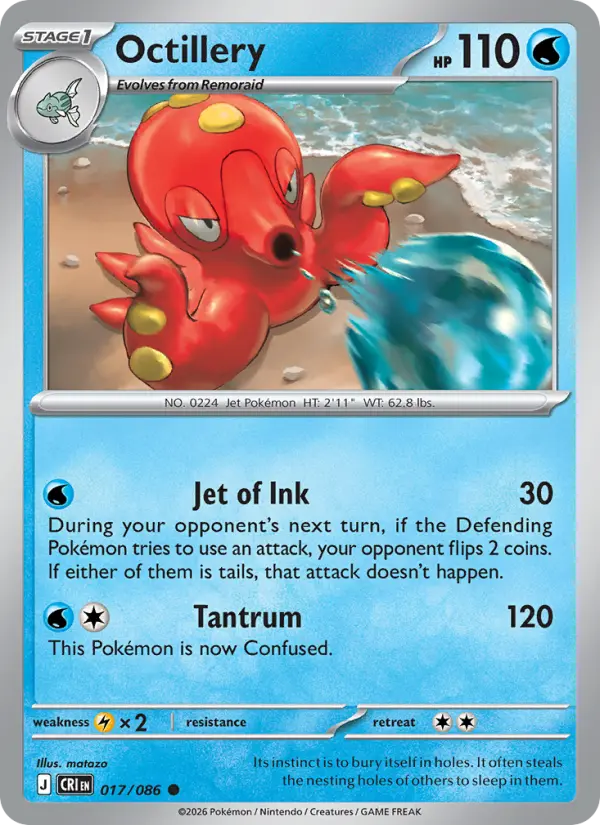
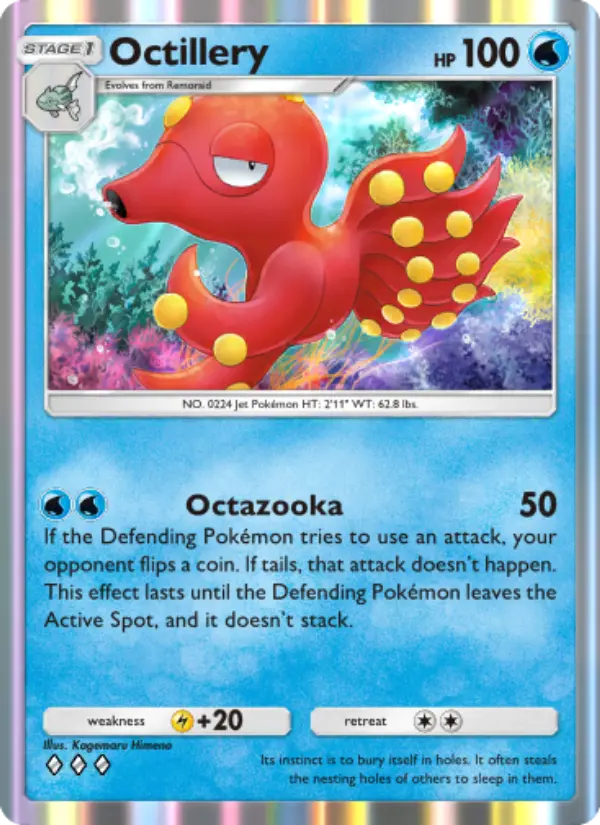
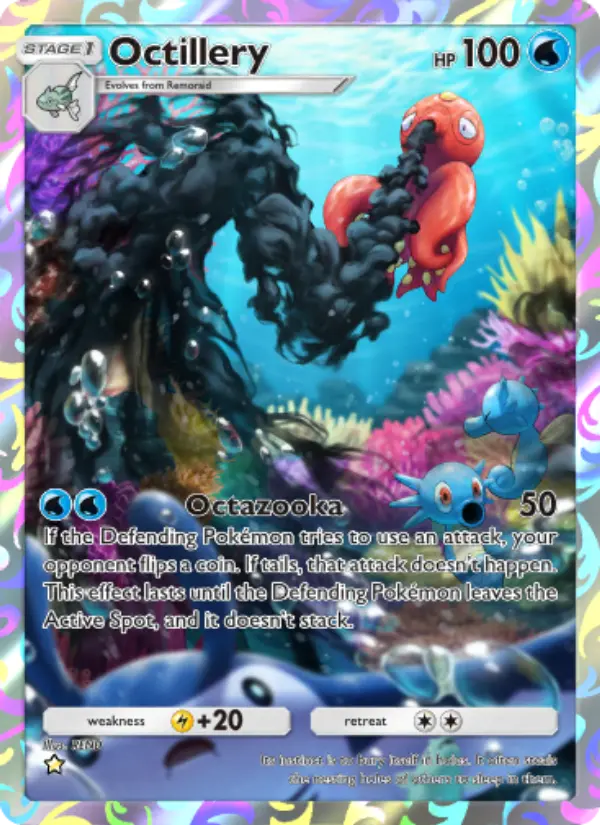
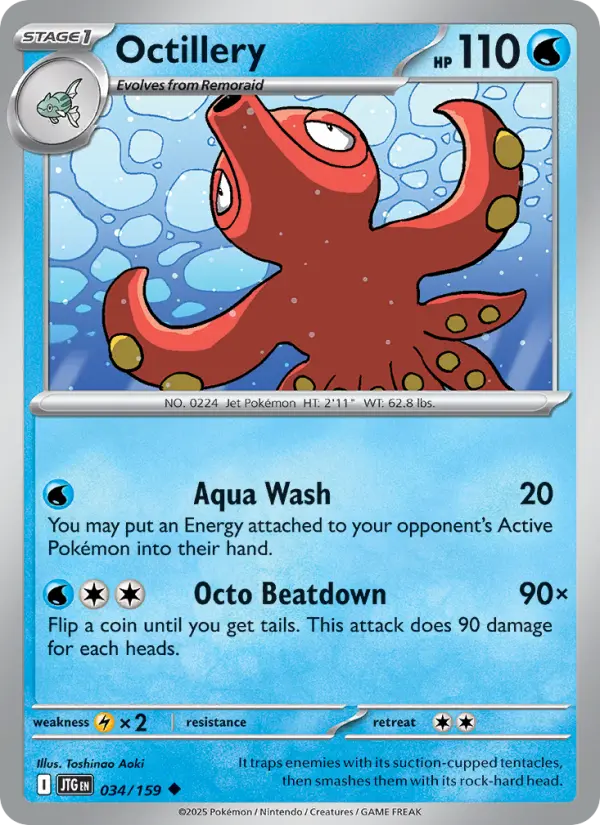
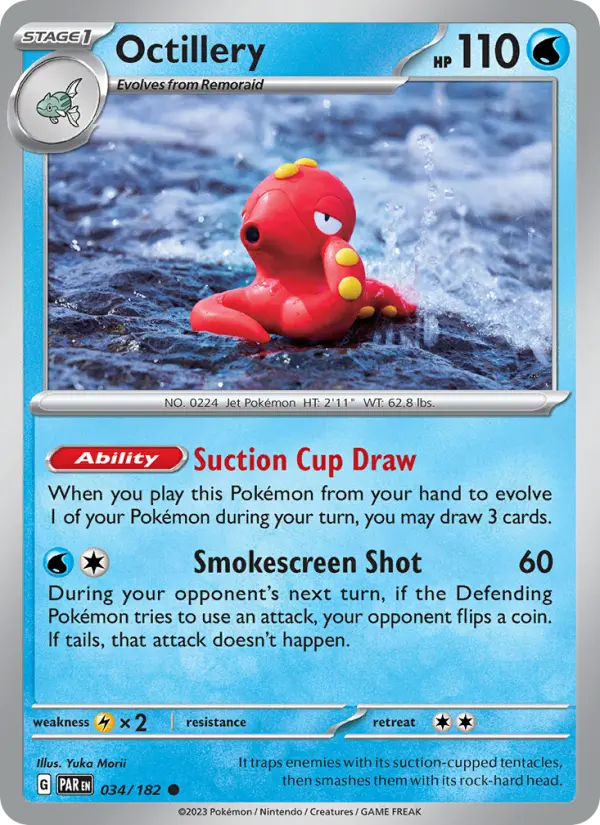
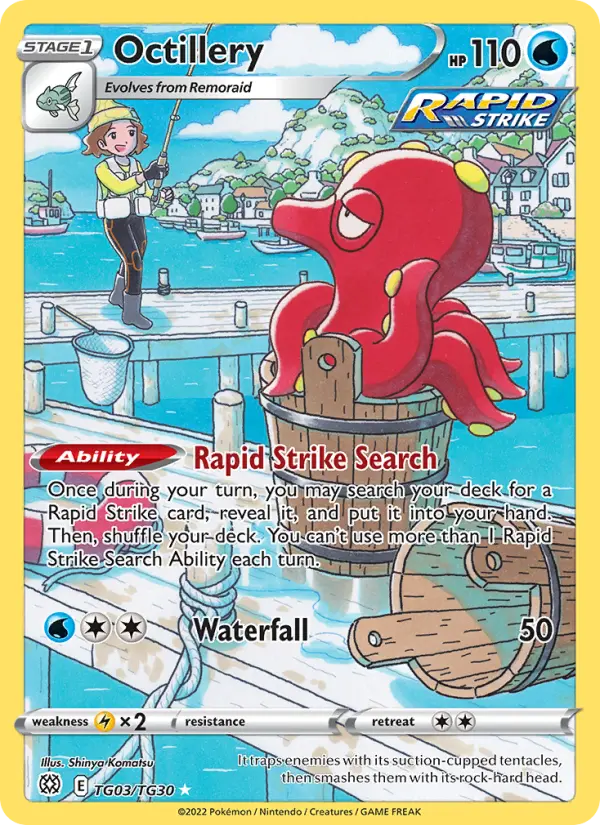
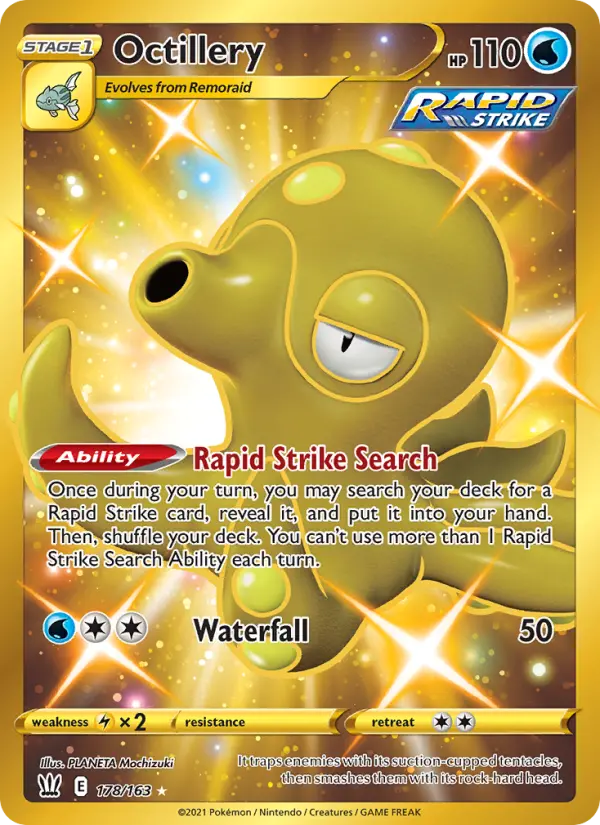
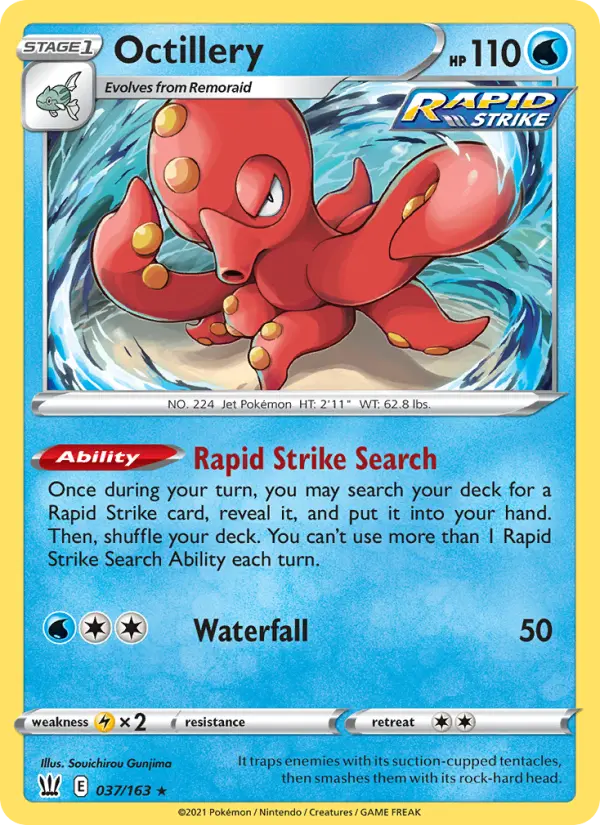
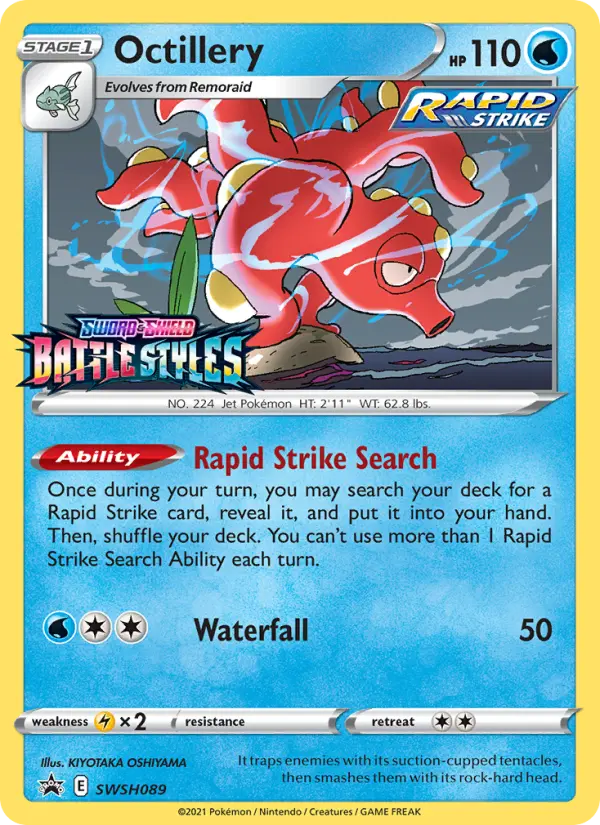
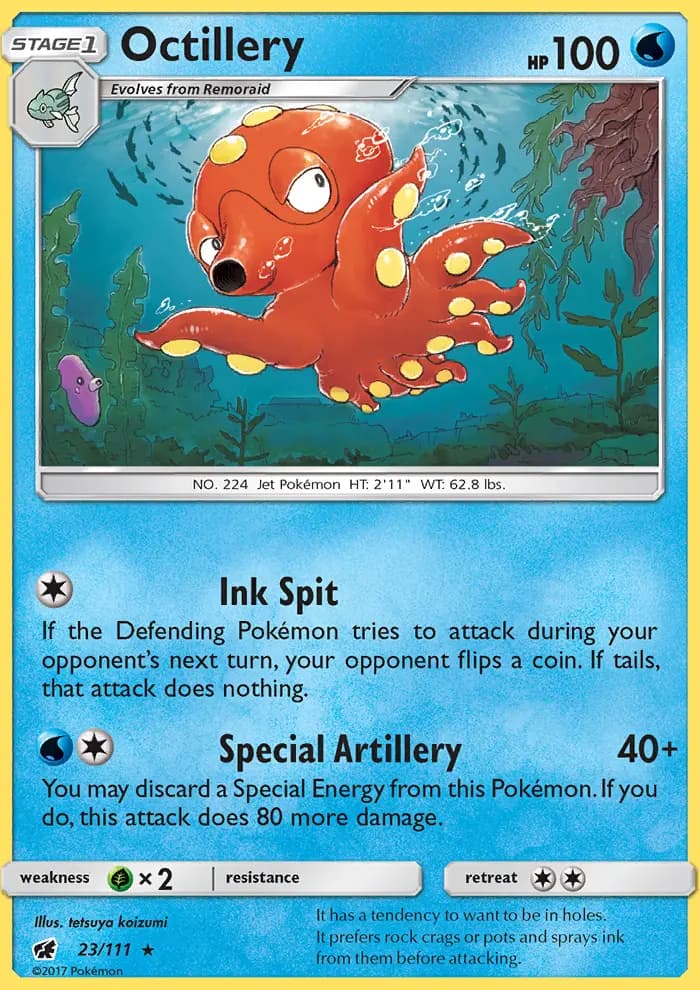
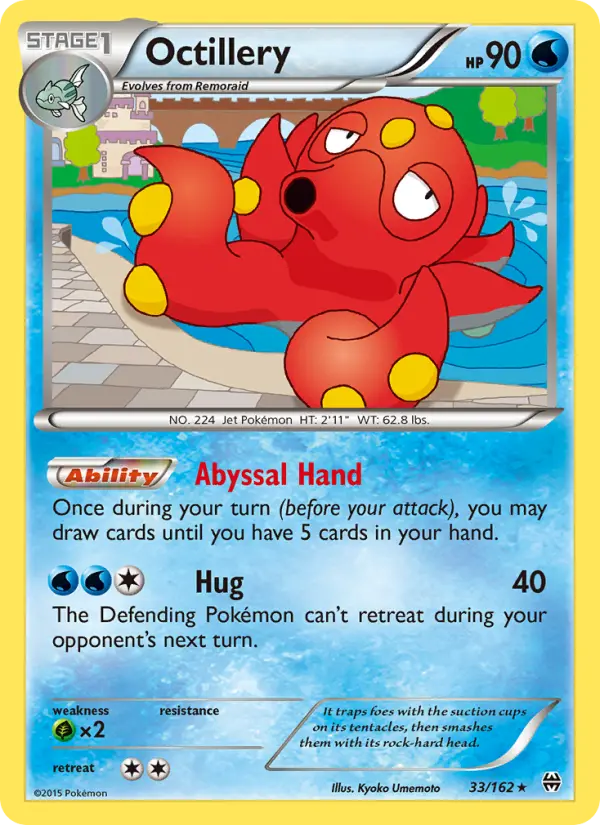
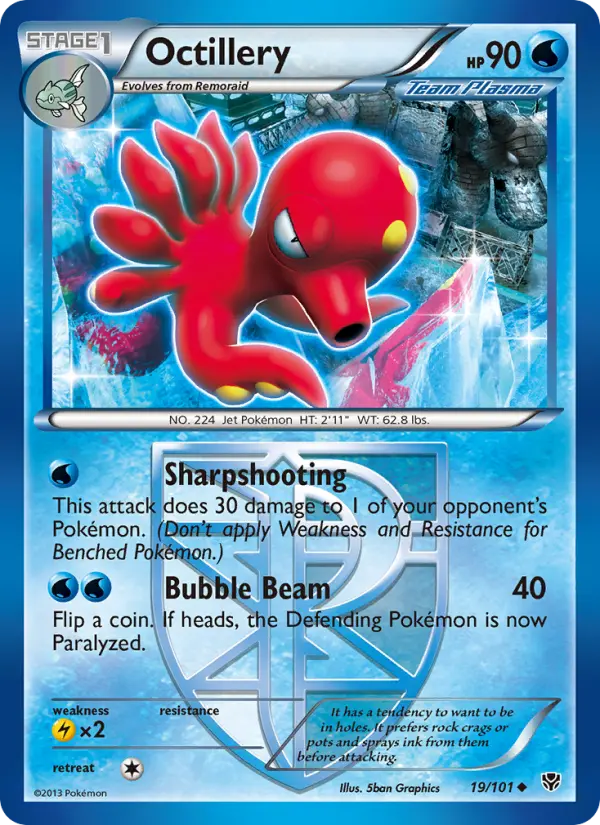
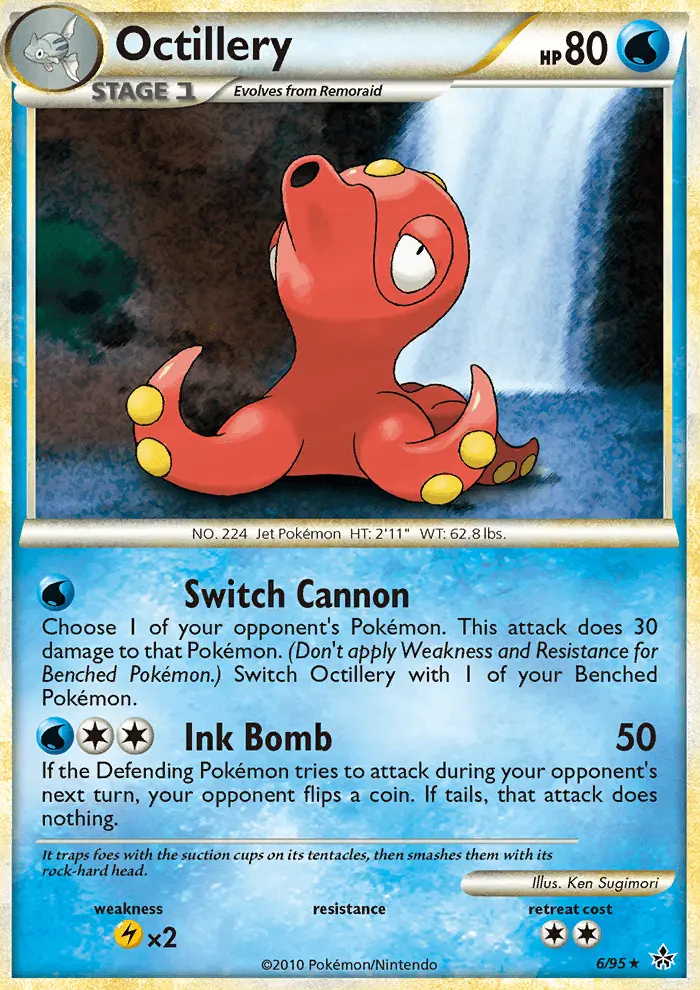
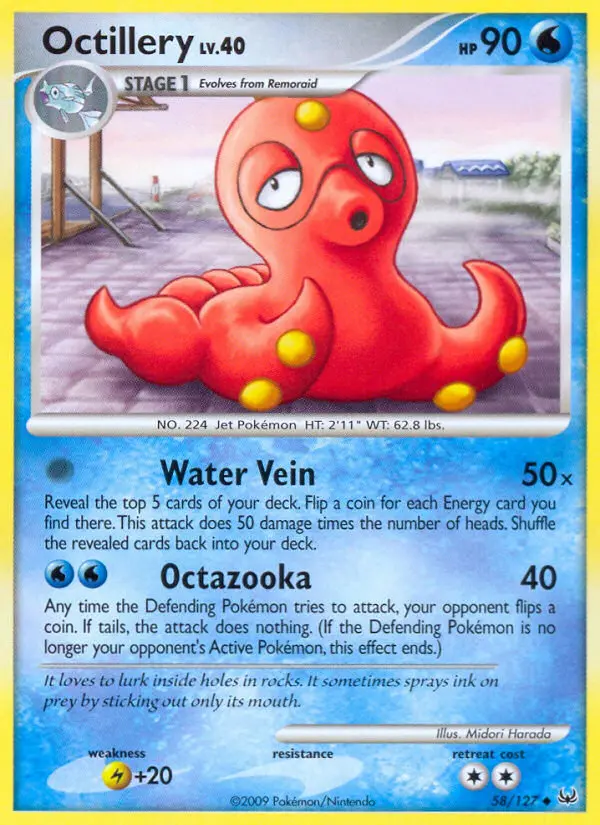
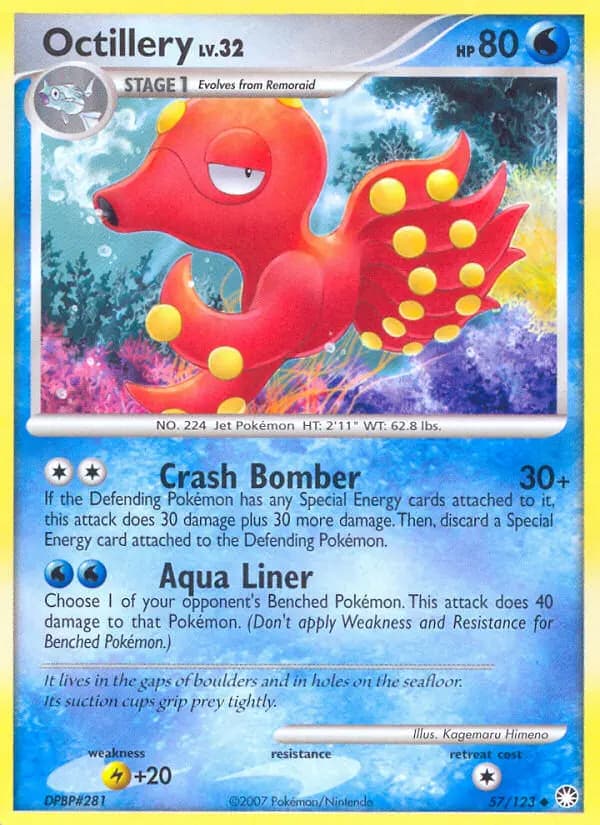
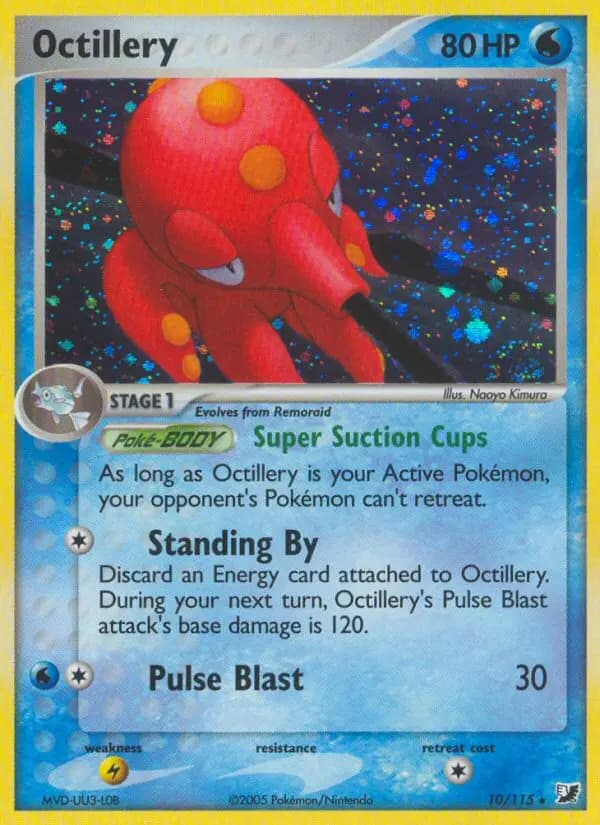
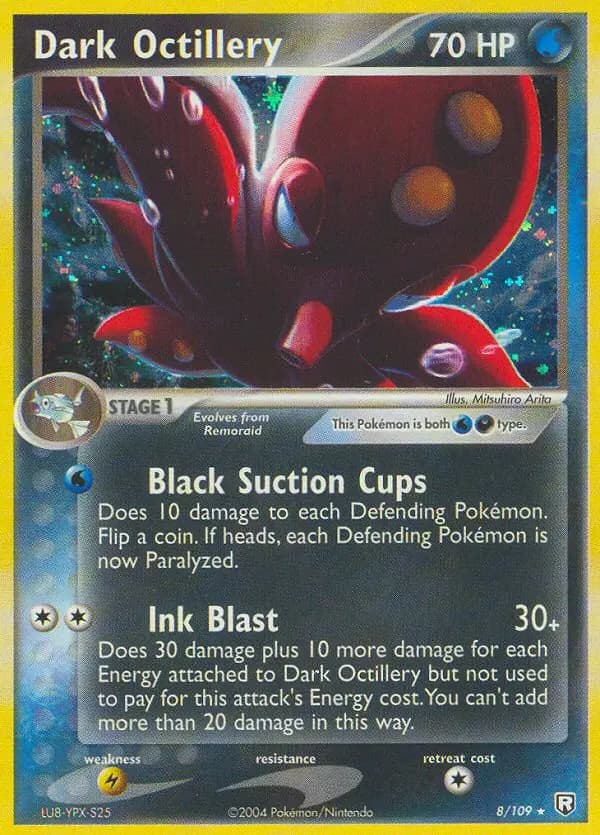
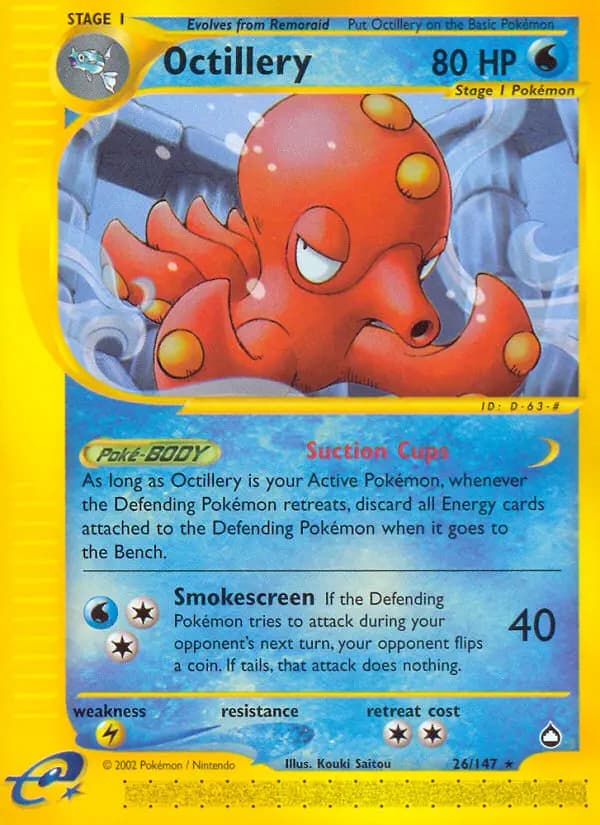
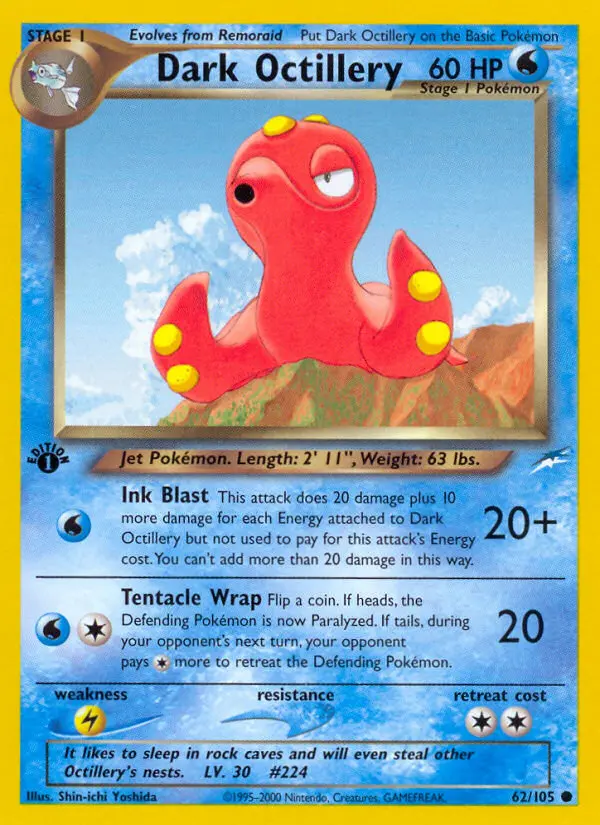
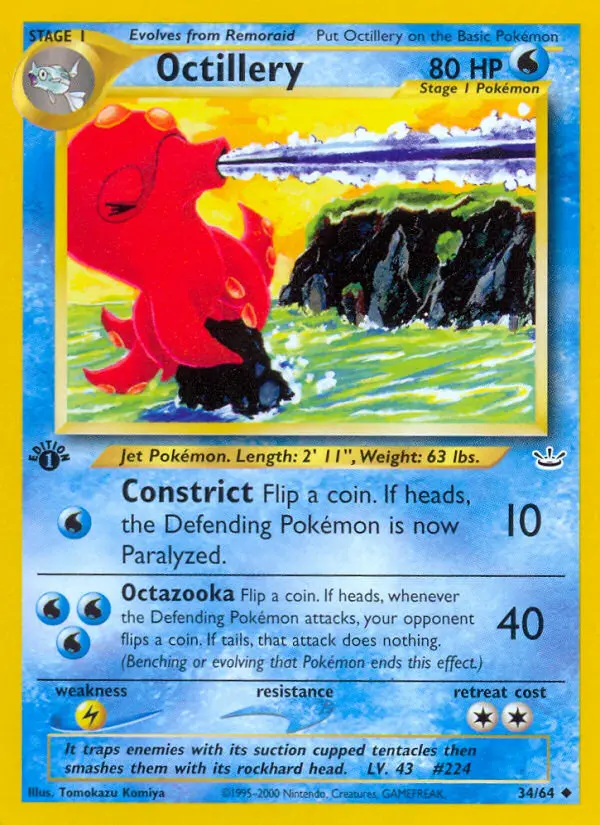
Since its introduction in Generation II, Octillery has maintained steady presence in Pokémon media and competitive communities despite never achieving the widespread recognition of more iconic water-types like Blastoise or Gyarados. Its distinctive design and utility have made it a fan favorite among players who appreciate unconventional team compositions and creative moveset building, fostering a dedicated community of enthusiasts who champion its competitive viability. The species has appeared in the Pokémon Trading Card Game across multiple generations, with various card iterations showcasing its ink-spraying abilities and reflecting mechanically the creature's competitive role shifts throughout the franchise's evolution. In the Pokémon anime, Octillery has made appearances both as wild specimens and as trained Pokémon, generally portrayed as temperamental but formidable combatants whose ink attacks prove decisive in crucial battles. The character design itself has influenced broader Pokémon aesthetics, establishing templates for how cephalopod-inspired creatures could be interpreted with more aggressive, militaristic designs rather than purely naturalistic approaches. Octillery's presence in Pokémon Legends: Arceus and subsequent games reinforces its canonical status as a consistent, if underappreciated, member of the water-type roster, ensuring it remains available for trainers seeking alternative options beyond the overshadowed powerhouses.
Where to Find Octillery in Every Pokémon Game
Octillery's availability has evolved significantly across Pokémon generations, typically appearing as a catchable species in water routes or as an evolution of the more commonly encountered Remoraid. In the Generation II games (Gold, Silver, and Crystal), it could be caught in ocean routes throughout Johto or obtained through evolving Remoraid at level 25. Subsequent generations have maintained this accessibility pattern, though with varying local Pokédex numbers reflecting regional organization changes—appearing as number 0133 in Diamond and Pearl, returning to higher numbers in newer generations like Sword and Shield. The species is not restricted to any particular time of day or weather condition, making it consistently available once trainers reach the appropriate level progression or access coastal environments. In recent generations including Sword and Shield, Legends: Arceus, and Isle of Armor, Octillery remains available through standard water encounters or Remoraid evolution, ensuring new players can experience the species without excessive grinding or trading requirements. The species' moderate catch rate of 75 means it can be captured without excessive Ultra Ball expenditure, and with a base happiness of 70, freshly caught specimens respond reasonably well to trainer interaction. Octillery's consistent availability across generations reflects its status as a reliable, accessible Pokémon suitable for both casual playthroughs and competitive team building, never relegated to post-game-only status or severely restricted distribution that would prevent mainstream access.