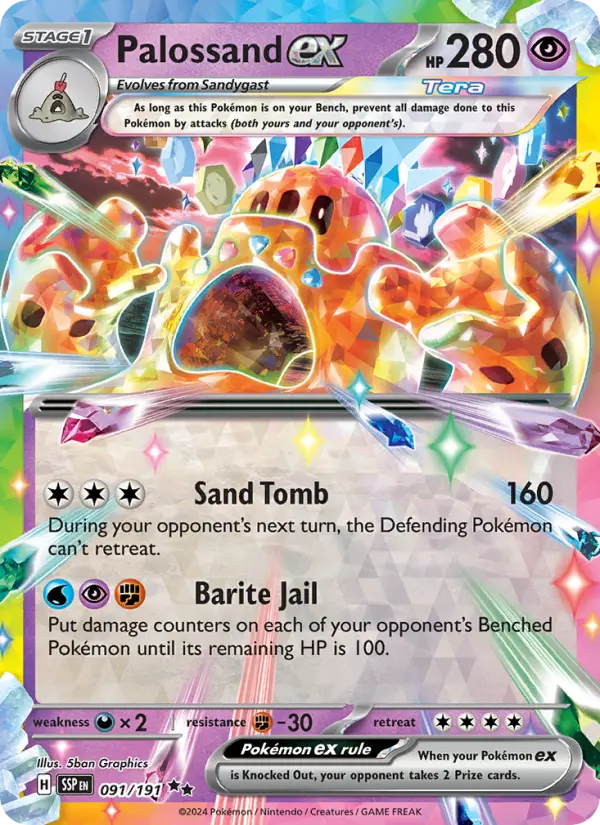
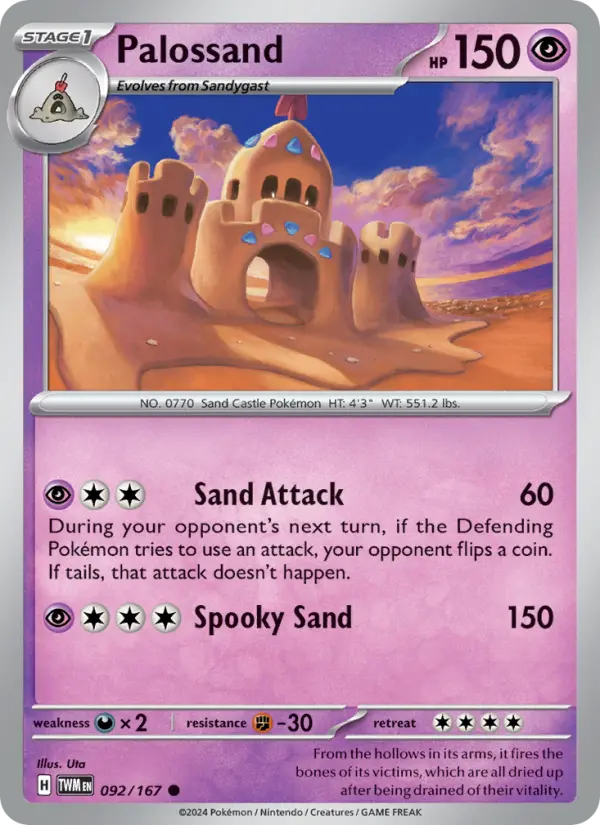
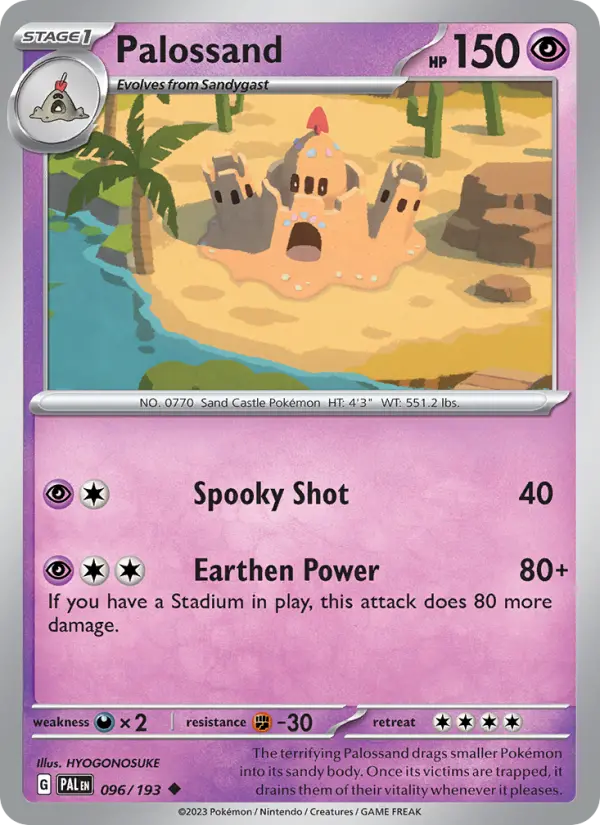
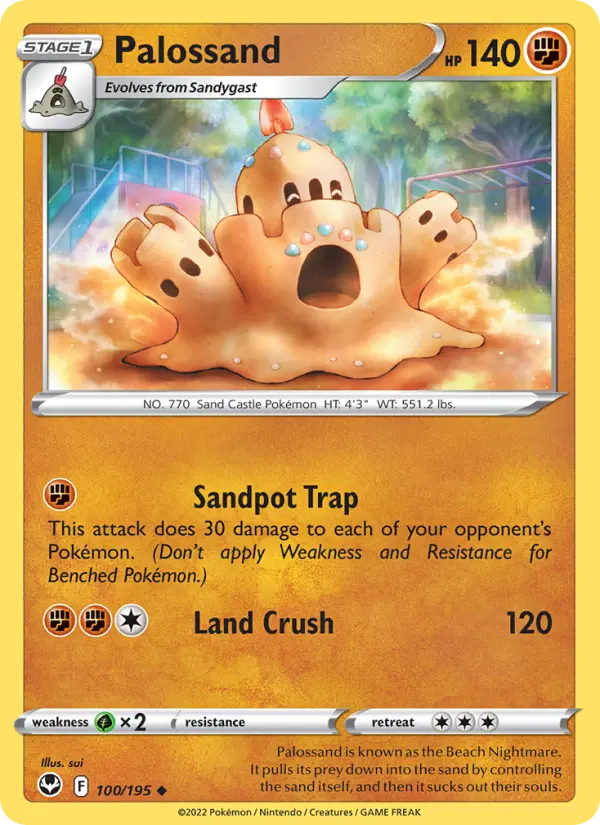
Palossand
Generation VII · #0770 — Sand Castle Pokémon
Since its Generation VII debut, Palossand has carried a stat spread built around hp — 50 at base, its clearest strength. At 1.3 m and 250.0 kg, its build reflects a specialist role rather than a generalist one. Standing at 1.3 meters tall and weighing a substantial 250 kilograms, Palossand combines the supernatural properties of its Ghost typing with the earthbound characteristics of Ground, creating a uniquely menacing Pokémon that has earned the ominous title of "Beach Nightmare" in various regions. Its combined stat total of 480 is distributed to emphasize defensive capabilities and special offense, with Defense reaching 110 and Special Attack reaching 100, making it an effective wall that can still deal considerable damage to opponents.
Editor's Take
Palossand's Water Compaction turns its own Water weakness into a Defense boost, which is a genuinely clever piece of design on a Ghost/Ground type.
Base Stats
Height
1.3m
Weight
250.0kg
Category
Sand Castle Pokémon
Gender
Male 50% / Female 50%
Color
brown
Shape
squiggle
Abilities
Raises this Pokémon's Defense by two stages when it's hit by a Water move.
Increases evasion to 1.25× during a sandstorm. Protects against sandstorm damage.

Palossand Biology & Physical Characteristics
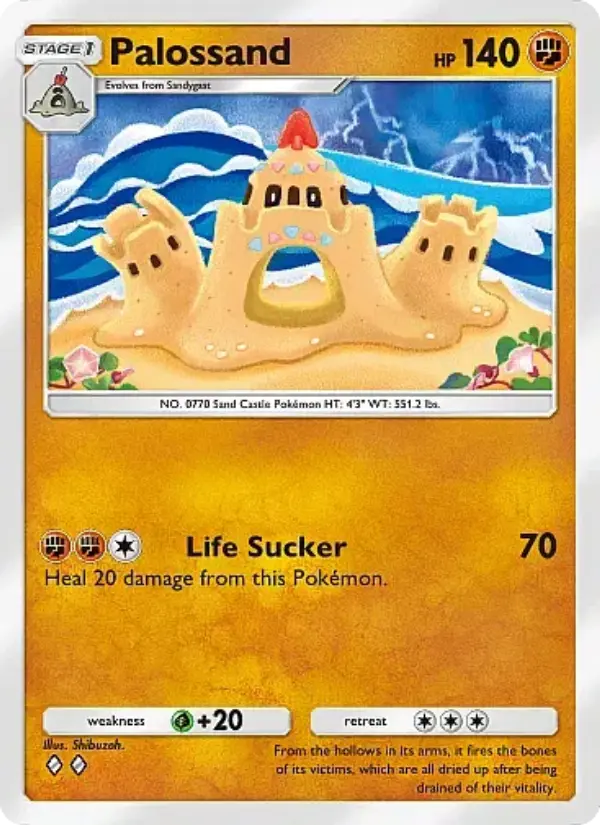
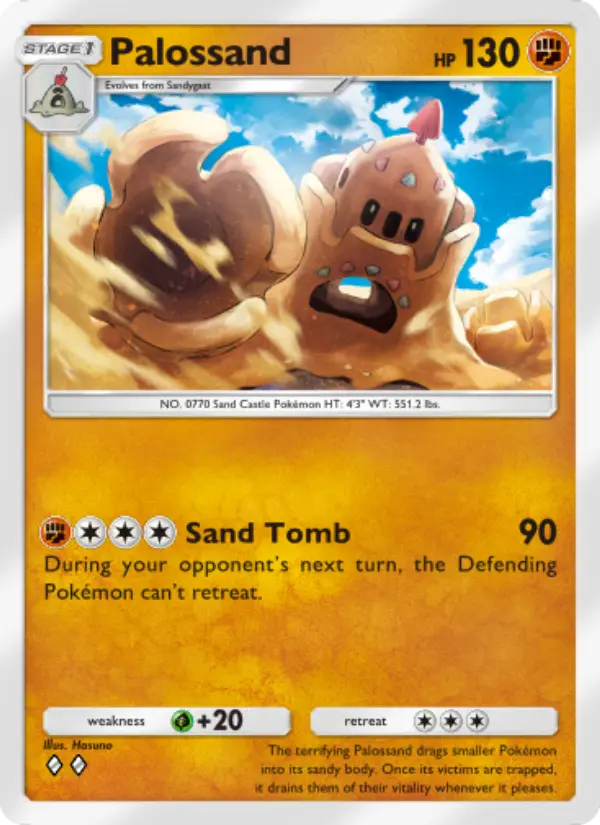
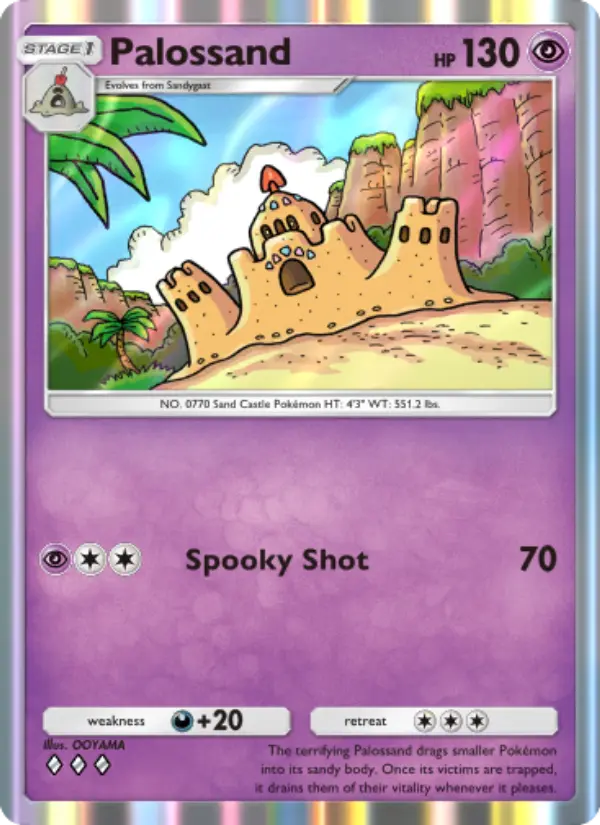
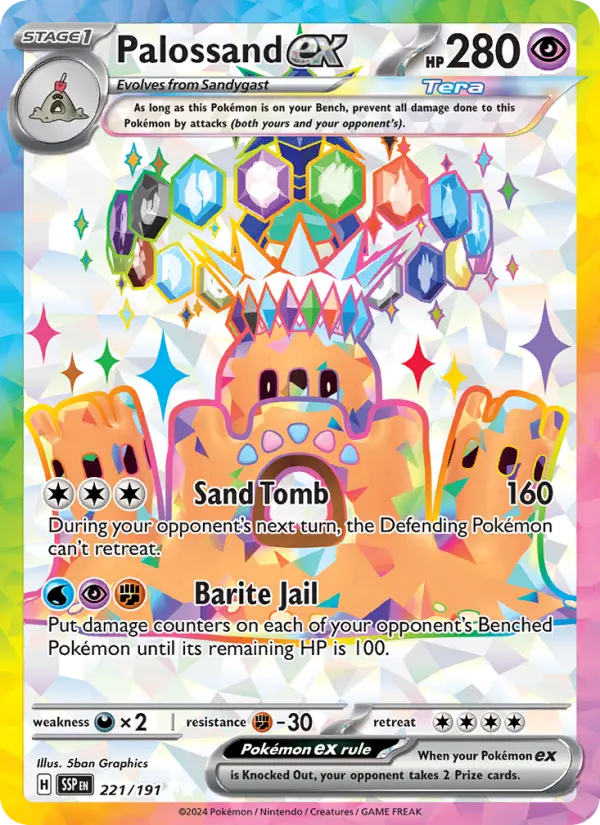
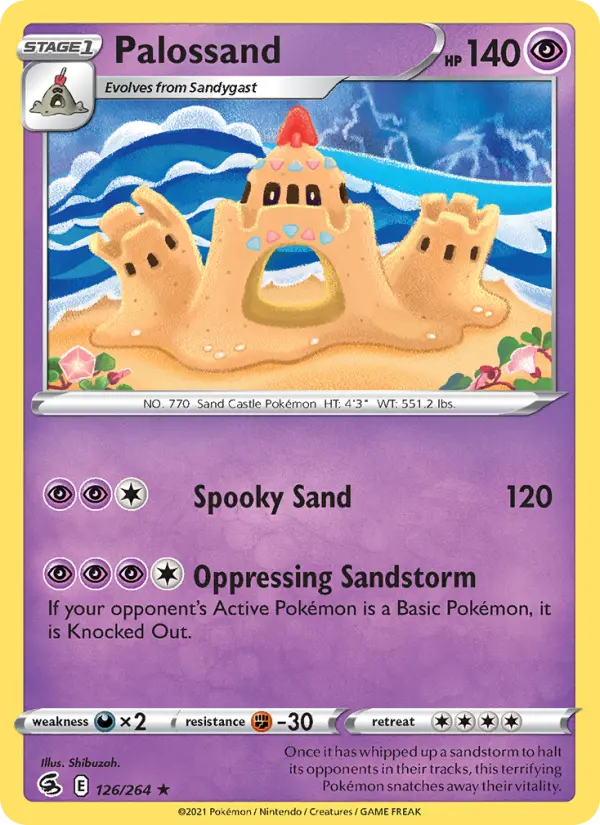
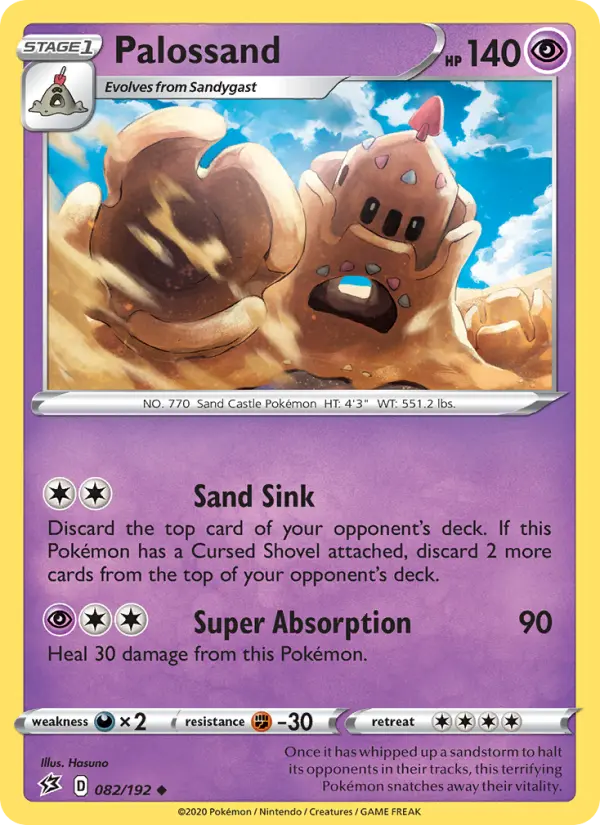
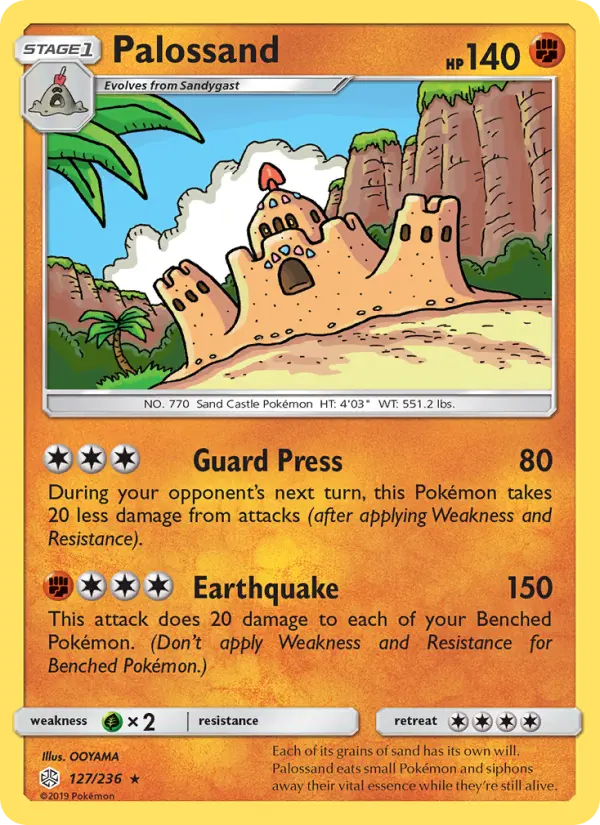
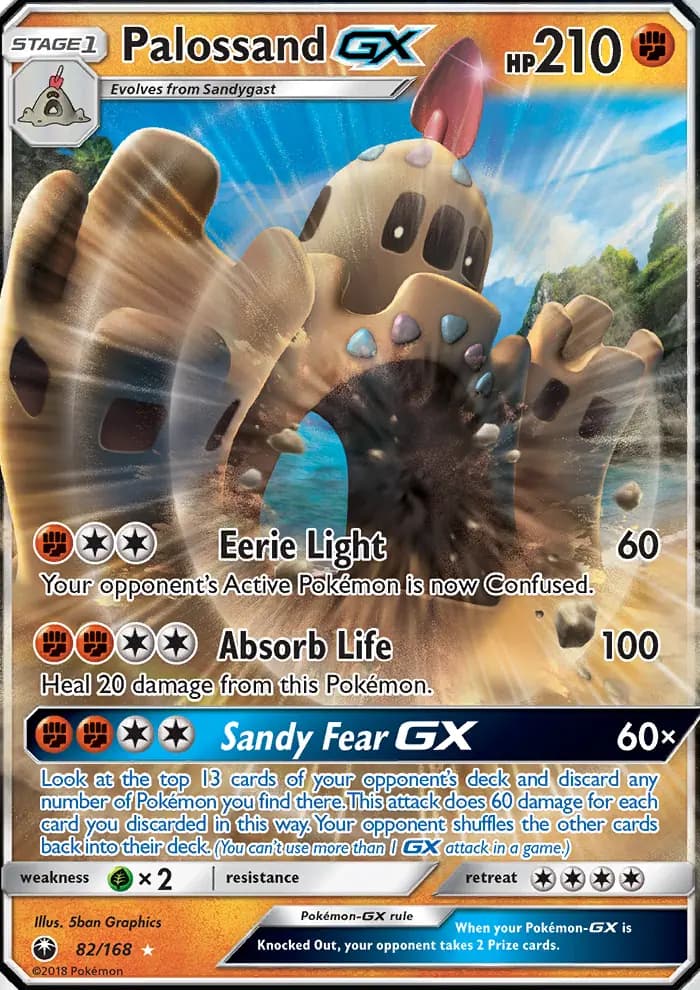
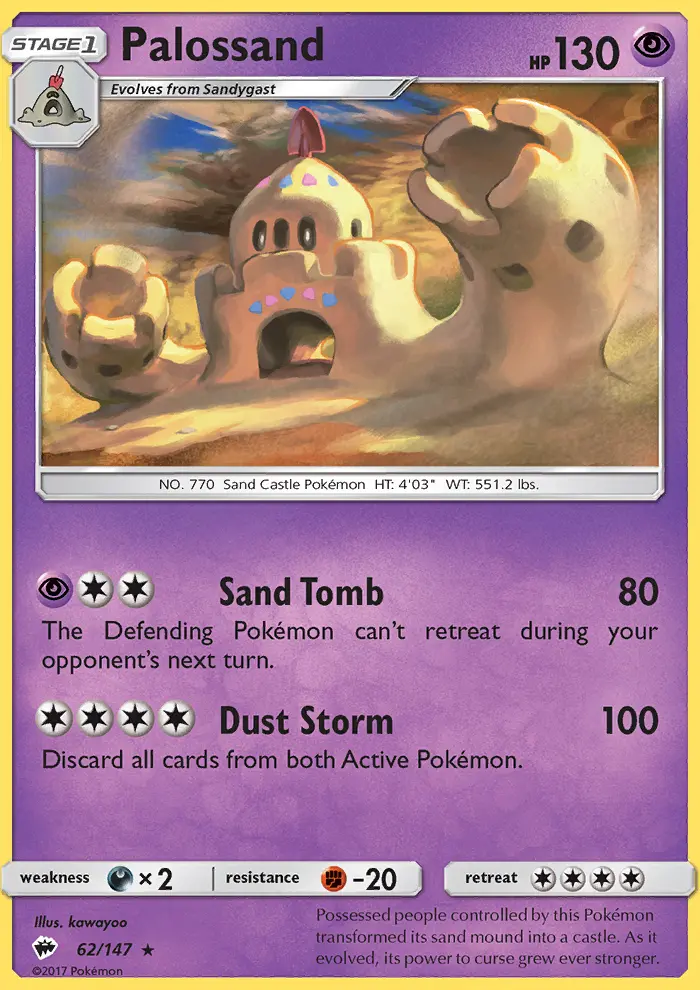
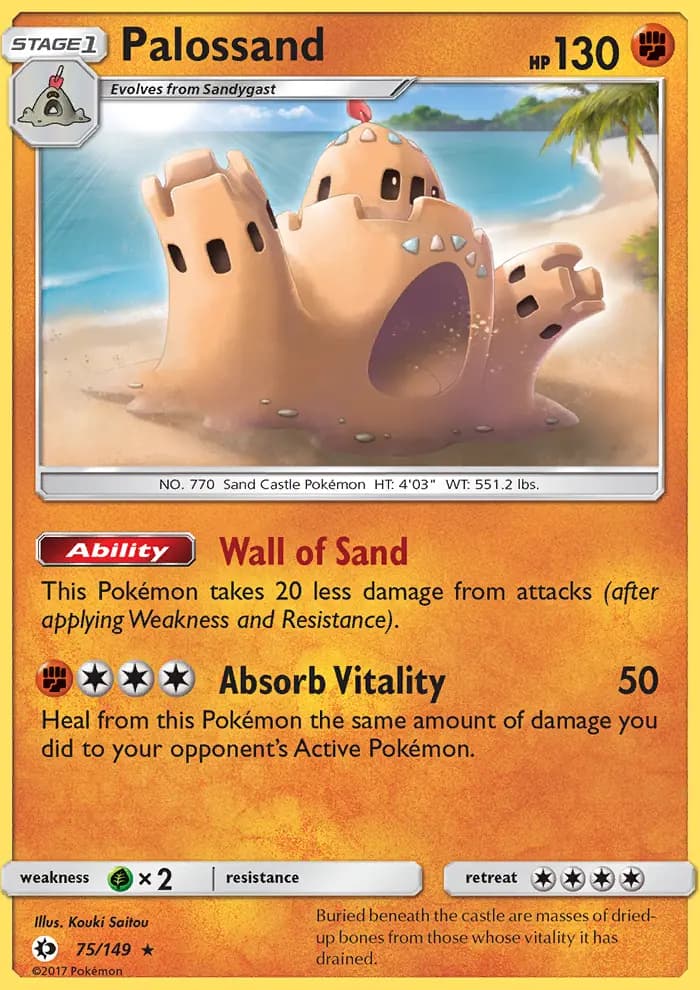
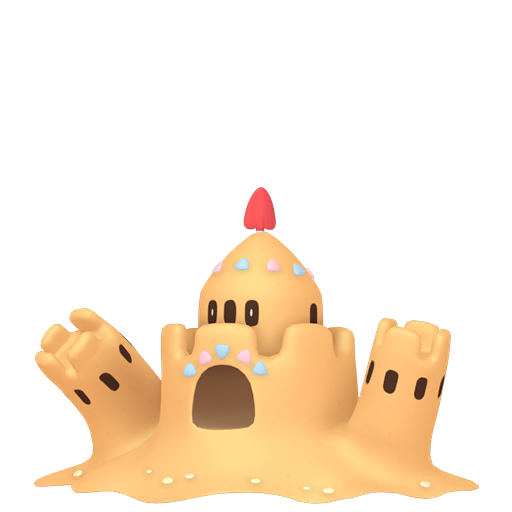
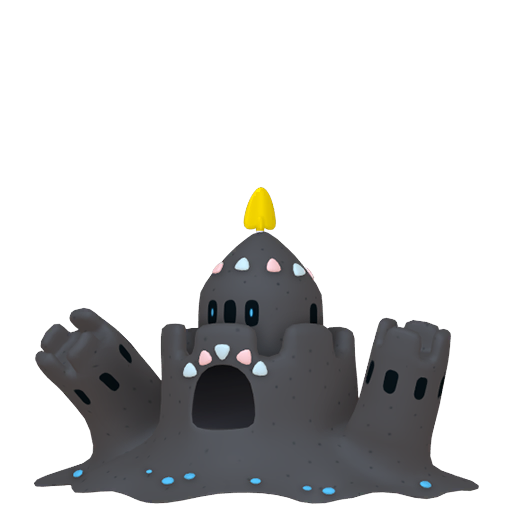
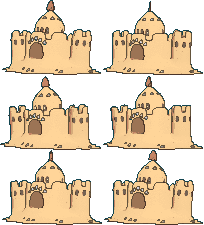
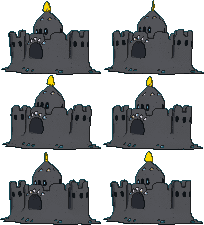
Palossand is a quadrupedal Pokémon that resembles a sandcastle with remarkably intricate architectural details. Its body consists of a large square main castle structure, complemented by two rounded towers serving as arms and a central tower rising from its body topped with a pointed roof. The castle features multiple windows and crenellations that give it an authentic fortified appearance, while a red shovel is embedded handle-first into its peak. Most remarkably, each individual grain of sand composing Palossand's body possesses its own independent will and consciousness, allowing the Pokémon to exert microscopic control over its entire form. Unlike its pre-evolution Sandygast, Palossand possesses the extraordinary ability to replenish any sand it loses autonomously, effectively making it self-sustaining as long as it remains in suitable environments. The shovel atop its head serves a critical biological function, rotating when Palossand searches for prey and functioning as a sensory radar system that helps locate potential victims across beach landscapes.
Pokedex Numbers
Training
Breeding
Palossand Breeding, Gender Ratio & Egg Groups
Palossand exhibits a perfectly balanced gender ratio with 50% male and 50% female individuals occurring naturally in the wild, providing equal breeding opportunities regardless of gender. The species belongs to the Amorphous Egg Group, a classification that encompasses many Ghost-type and amorphous Pokémon whose undefined body structures make traditional reproduction mechanisms difficult to categorize. Palossand has a relatively high base friendship value of 70, indicating that despite its predatory and sinister nature, individual specimens can develop meaningful bonds with trainers who care for them properly. The creature requires 15 egg cycles to hatch from its eggs, translating to approximately 3,599 to 3,855 steps of travel with a breeding partner. The Amorphous Egg Group compatibility allows Palossand to breed with various other shapeless or ghost-like Pokémon, potentially creating interesting hybrid offspring with varied inherited movesets and abilities. Trainers seeking specific natures or individual values for competitive purposes should note that Palossand's medium-fast growth rate allows for steady progression, though breeding provides a more efficient path to obtaining optimal specimens for tournament play.
Sprites


Held Items
Spell Tag
type-enhancement
Held: Ghost-Type moves from holder do 20% more damage.
Cost: 1000
Spell Tag
type-enhancement
Held: Ghost-Type moves from holder do 20% more damage.
Cost: 1000
Spell Tag
type-enhancement
Held: Ghost-Type moves from holder do 20% more damage.
Cost: 1000
Spell Tag
type-enhancement
Held: Ghost-Type moves from holder do 20% more damage.
Cost: 1000
TMs & HMs
tm03
crystal
tm03
gold silver
tm05
lets go pikachu lets go eevee
tm06
yellow
tm06
gold silver
tm06
red blue
tm06
crystal
tm06
emerald
tm06
firered leafgreen
tm06
diamond pearl
tm06
platinum
tm06
ruby sapphire
tm06
colosseum
tm06
black 2 white 2
tm06
xd
tm06
black white
tm06
heartgold soulsilver
tm06
omega ruby alpha sapphire
tm06
ultra sun ultra moon
tm06
sun moon
+597 more TMs/HMs
Palossand's Evolution Chain


Palossand Evolution, Mega Evolution & Special Forms
Palossand evolves from Sandygast starting at level 42, representing a significant transformation in both physical form and power. Where Sandygast appears as a simple sand mound occasionally topped with a shovel, Palossand's evolution grants it a fully-realized castle structure complete with towers, windows, crenellations, and architectural sophistication that mirrors real medieval fortifications. This evolution is accompanied by a substantial increase in offensive and defensive capabilities—Defense jumps from 80 to 110, Special Attack increases from 70 to 100, and Health Points rise from 55 to 85. The evolution process also fundamentally enhances Palossand's mystical powers, as Pokédex entries explicitly note that "as it evolved, its power to curse grew ever stronger," suggesting that the architectural transformation grants it increased supernatural influence. Additionally, Palossand gains the ability to autonomously regenerate lost sand, a crucial advantage over its pre-evolution form that required environmental sand sources. The evolution represents not merely a physical change but a consolidation of Palossand's predatory nature and psychic dominion over other creatures.
Where to Find
Location data not available for this Pokémon in the database.
Palossand Behaviour and Natural Habitat
Palossand inhabits sandy beaches throughout various regions, thriving in coastal environments where it can maintain its castle-like structure. However, this Pokémon has a peculiar vulnerability to water—it cannot preserve its castle form during heavy rainfall or when drenched, making it paradoxically averse to the very environment it calls home. According to Pokédex entries, Palossand engages in deeply disturbing predatory behavior, pulling smaller Pokémon into its sandy body and draining their vital essence while they remain alive. The creature also possesses the ability to exert supernatural influence over humans and other Pokémon, compelling them through curses to gather additional sand to expand and reinforce its body. When threatened, Palossand demonstrates tactical intelligence by whipping up sandstorms to disorient opponents before extracting their life force. Historical records from Alola describe instances where possessed people were controlled by Palossand to construct elaborate sand structures, suggesting its influence extends far beyond simple predation into outright mind control and manipulation of sentient beings.
Pokedex Entries
Possessed people controlled by this Pokémon transformed its sand mound into a castle. As it evolved, its power to curse grew ever stronger.
Each of its grains of sand has its own will. Palossand eats small Pokémon and siphons away their vital essence while they’re still alive.
Buried beneath the castle are masses of dried-up bones from those whose vitality it has drained.
Once it has whipped up a sandstorm to halt its opponents in their tracks, this terrifying Pokémon snatches away their vitality.
Palossand is known as the Beach Nightmare. It pulls its prey down into the sand by controlling the sand itself, and then it sucks out their souls.
This Pokémon lives on beaches, but it hates water. Palossand can’t maintain its castle-like shape if it gets drenched by a heavy rain.
Palossand Name Origin & Design Inspiration
Palossand's name traces back to the fusion of "palace" and "sand," directly reflecting its sand castle appearance and architectural sophistication. The Japanese name Sirodethna similarly combines "shiro" (castle) with "dethna," creating a distinctly Japanese aesthetic that emphasizes its ghostly, supernatural qualities alongside its sandy composition. Design-wise, Palossand draws inspiration from medieval European castles, featuring authentic architectural elements like crenellations, arrow slits represented as windows, towers, and a drawbridge-like mouth structure. The inclusion of seashells arranged decoratively over its mouth and around its central tower adds a coastal aesthetic that grounds the design in its beach habitat. The red shovel protruding from its peak serves dual purposes—both as a literal tool for moving sand and as a symbolic radar antenna reflecting its ability to sense and hunt prey. The contrast between the cheerful, whimsical appearance of a sandcastle as a children's beach toy and the horrifying predatory nature described in Pokédex entries creates striking cognitive dissonance that defines Palossand's unsettling appeal. Its color palette of warm sandy yellows contrasted with gray pebbles and blue-pink seashells maintains visual interest while emphasizing its composite nature as a constructed rather than naturally-born entity.
Learnable Moves
Palossand can learn 73 moves:
Move | Type | Cat. | Power | Acc. | PP |
|---|---|---|---|---|---|
| absorb | grass | Special | 20 | 100 | 25 |
| after you | normal | Status | — | — | 15 |
| amnesia | psychic | Status | — | — | 20 |
| astonish | ghost | Physical | 30 | 100 | 15 |
| attract | normal | Status | — | 100 | 15 |
| block | normal | Status | — | — | 5 |
| body slam | normal | Physical | 85 | 100 | 15 |
| brine | water | Special | 65 | 100 | 10 |
| bulldoze | ground | Physical | 60 | 100 | 20 |
| chilling water | water | Special | 50 | 100 | 20 |
| confide | normal | Status | — | — | 20 |
| confuse ray | ghost | Status | — | 100 | 10 |
| curse | ghost | Status | — | — | 10 |
| double team | normal | Status | — | — | 15 |
| earth power | ground | Special | 90 | 100 | 10 |
| earthquake | ground | Physical | 100 | 100 | 10 |
| embargo | dark | Status | — | 100 | 15 |
| endure | normal | Status | — | — | 10 |
| energy ball | grass | Special | 90 | 100 | 10 |
| facade | normal | Physical | 70 | 100 | 20 |
| flash cannon | steel | Special | 80 | 100 | 10 |
| fling | dark | Physical | — | 100 | 10 |
| frustration | normal | Physical | — | 100 | 20 |
| giga drain | grass | Special | 75 | 100 | 10 |
| giga impact | normal | Physical | 150 | 90 | 5 |
| gravity | psychic | Status | — | — | 5 |
| harden | normal | Status | — | — | 30 |
| hex | ghost | Special | 65 | 100 | 10 |
| hidden power | normal | Special | 60 | 100 | 15 |
| hyper beam | normal | Special | 150 | 90 | 5 |
| hypnosis | psychic | Status | — | 60 | 20 |
| imprison | psychic | Status | — | — | 10 |
| infestation | bug | Special | 20 | 100 | 20 |
| iron defense | steel | Status | — | — | 15 |
| mega drain | grass | Special | 40 | 100 | 15 |
| mud shot | ground | Special | 55 | 95 | 15 |
| mud slap | ground | Special | 20 | 100 | 10 |
| night shade | ghost | Special | — | 100 | 15 |
| pain split | normal | Status | — | — | 20 |
| poltergeist | ghost | Physical | 110 | 90 | 5 |
| protect | normal | Status | — | — | 10 |
| psychic | psychic | Special | 90 | 100 | 10 |
| quash | dark | Status | — | 100 | 15 |
| rain dance | water | Status | — | — | 5 |
| recycle | normal | Status | — | — | 10 |
| rest | psychic | Status | — | — | 5 |
| return | normal | Physical | — | 100 | 20 |
| rock polish | rock | Status | — | — | 20 |
| rock slide | rock | Physical | 75 | 90 | 10 |
| rock tomb | rock | Physical | 60 | 95 | 15 |
| role play | psychic | Status | — | — | 10 |
| round | normal | Special | 60 | 100 | 15 |
| sand attack | ground | Status | — | 100 | 15 |
| sand tomb | ground | Physical | 35 | 85 | 15 |
| sandstorm | rock | Status | — | — | 10 |
| scary face | normal | Status | — | 100 | 10 |
| scorching sands | ground | Special | 70 | 100 | 10 |
| shadow ball | ghost | Special | 80 | 100 | 15 |
| shore up | ground | Status | — | — | 5 |
| skill swap | psychic | Status | — | — | 10 |
| sleep talk | normal | Status | — | — | 10 |
| sludge bomb | poison | Special | 90 | 100 | 10 |
| snore | normal | Special | 50 | 100 | 15 |
| spite | ghost | Status | — | 100 | 10 |
| stealth rock | rock | Status | — | — | 20 |
| stone edge | rock | Physical | 100 | 80 | 5 |
| substitute | normal | Status | — | — | 10 |
| sunny day | fire | Status | — | — | 5 |
| swagger | normal | Status | — | 85 | 15 |
| tera blast | normal | Special | 80 | 100 | 10 |
| terrain pulse | normal | Special | 50 | 100 | 10 |
| toxic | poison | Status | — | 90 | 10 |
| trick | psychic | Status | — | 100 | 10 |
Palossand Competitive Battle Guide
Palossand occupies an interesting niche in competitive Pokémon battling, functioning primarily as a special attacking tank with exceptional Defense. Its base Defense stat of 110 combined with the signature ability Water Compaction creates a particularly threatening defensive profile, as every Water-type move absorbed results in a two-stage Defense increase, potentially allowing Palossand to become progressively more unkillable as the battle progresses. With a Special Attack base of 100 and access to powerful Ghost and Ground-type moves, Palossand can deal significant damage while maintaining survivability. The hidden ability Sand Veil increases Palossand's evasion during sandstorm weather, providing additional tactical flexibility, particularly when paired with sandstorm-setting teammates. However, Palossand's critical weakness lies in its abysmal Speed stat of merely 35, making it essentially immobile without support from priority moves or Choice Scarf usage. This sluggishness necessitates team building around Trick Room strategies or aggressive switching tactics to maximize effectiveness. Its Ghost/Ground typing provides excellent resistances and immunities, resisting Rock, Bug, and Poison moves while granting immunity to Normal, Fighting, and Electric attacks, though its Water weakness of 4x represents a significant vulnerability that competent opponents readily exploit.
Commonly Asked Questions About Palossand
What type is Palossand?
Palossand is a ghost and ground type Pokemon.
What does Palossand evolve from?
Palossand evolved from sandygast.
What are Palossand's weaknesses?
Palossand is weak to ghost, water, grass, ice and dark type moves.
Palossand Cultural Impact & Franchise History
Palossand has established itself as one of Generation VII's most distinctive and memorable Pokémon, achieving particular prominence through its unsettling Pokédex entries that describe it draining the vitality from living creatures and controlling possessed people. The Pokémon has appeared in the animated series, notably in the episode "A Shivering Shovel Search!" where its ability to manipulate and grow in size was demonstrated, emphasizing its supernatural properties beyond simple sand castle aesthetics. Its design successfully bridges the gap between childhood nostalgia—sandcastles as innocent beach toys—and genuine cosmic horror, creating an identity that resonates with trainers seeking Pokémon that are both visually interesting and thematically mature. The "Beach Nightmare" designation has contributed to Palossand's fearsome reputation within the franchise's lore, elevating it from mere Pokédex entry to a creature of genuine dread in various video games and media. Fan communities have embraced Palossand's paradoxical nature as a beautiful architectural creation with genuinely malevolent intentions, spawning considerable fan art and discussion about its tragic and mysterious origins. The shovel atop its head has become an instantly recognizable silhouette, making Palossand one of Generation VII's most visually distinctive contributions to the franchise.
Where to Find Palossand in Every Pokémon Game
Palossand can be encountered in various locations throughout different Pokémon games following its introduction in Generation VII. In Pokémon Sun and Moon, Palossand appears in the Alola regional Pokédex as entry #0187, primarily found on beaches and sandy areas throughout the island region. Players can also obtain Palossand by evolving Sandygast at level 42, a straightforward progression for trainers who have caught and trained the pre-evolution. Ultra Sun and Ultra Moon feature Palossand in the expanded Alola Pokédex as entry #0226, with similar beach-based habitat distributions. The species continued availability in subsequent generations, appearing in Pokémon Sword and Shield as well as Pokémon Scarlet and Violet, where it maintains its presence in coastal biomes and sandy terrain. Palossand also appears in Pokémon Let's Go Pikachu and Eevee through Pokédex data and in various spin-off titles including Pokémon Masters, cementing its status as a mainstay of the modern Pokédex. A catch rate of 60 classifies Palossand as moderately difficult to capture in the wild, requiring standard Poké Balls or status condition effects to reliably secure specimens for team building purposes.