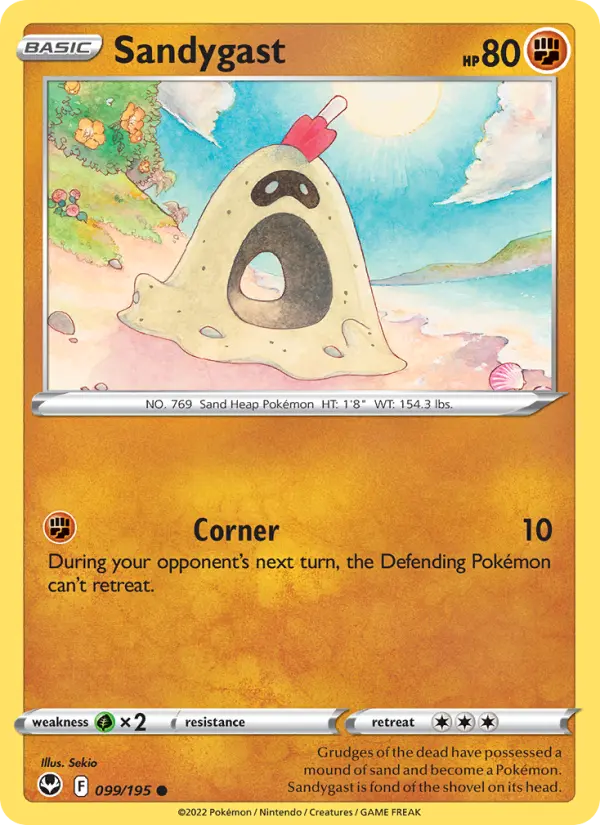
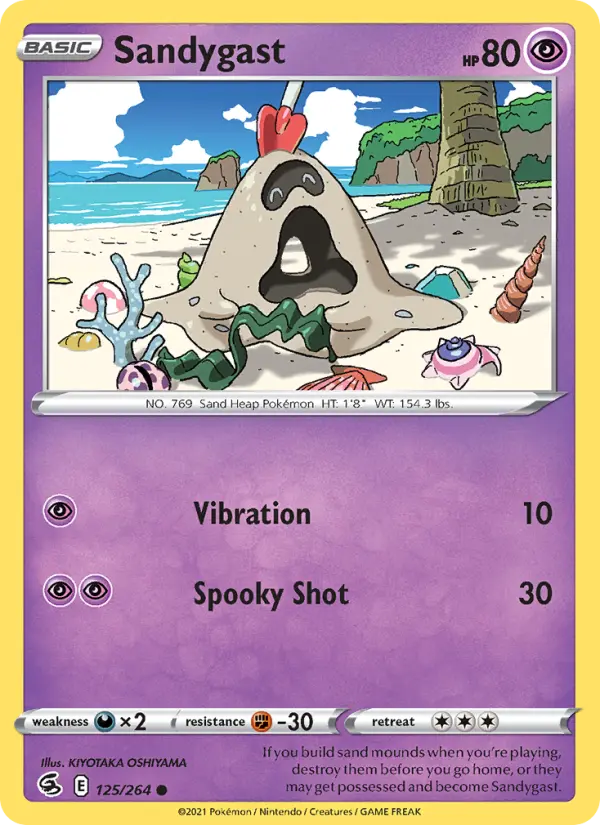
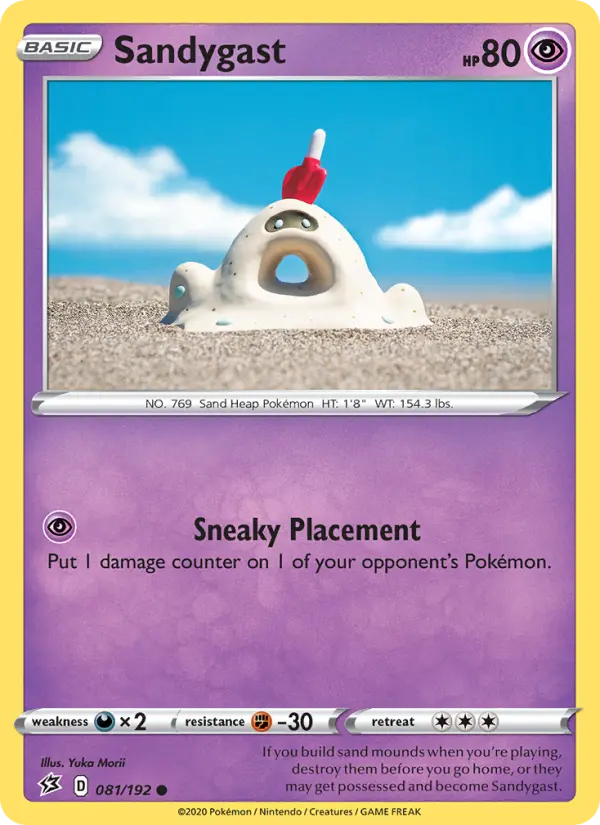
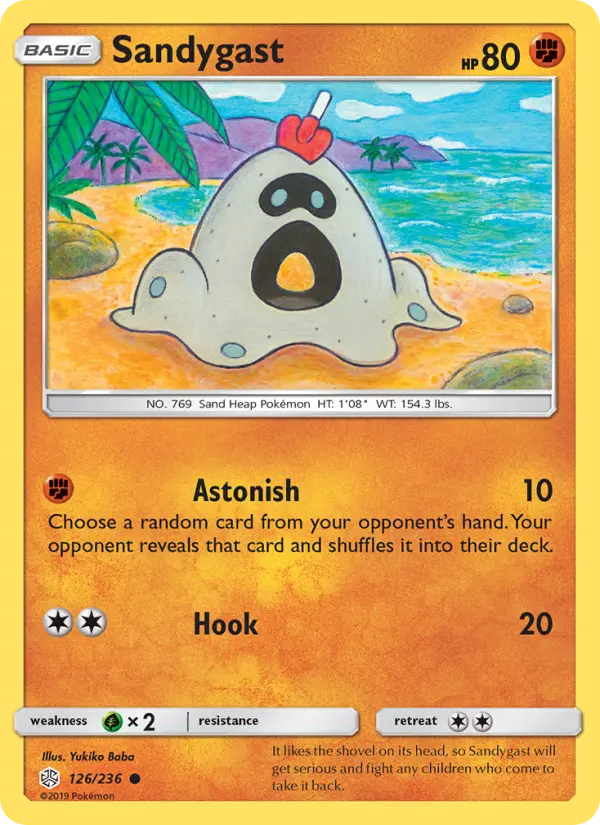
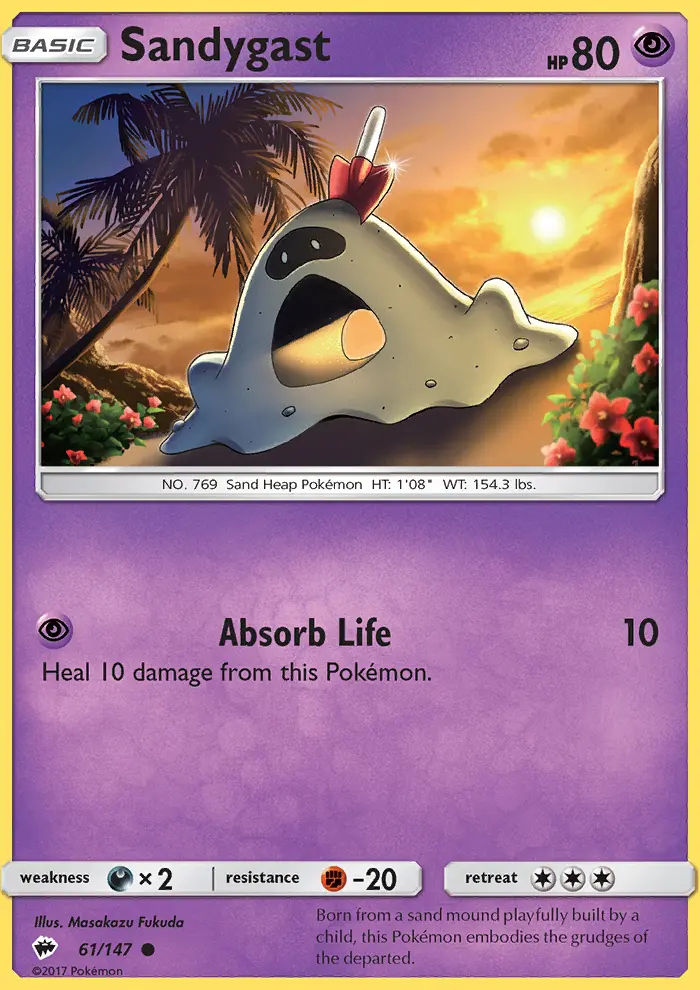
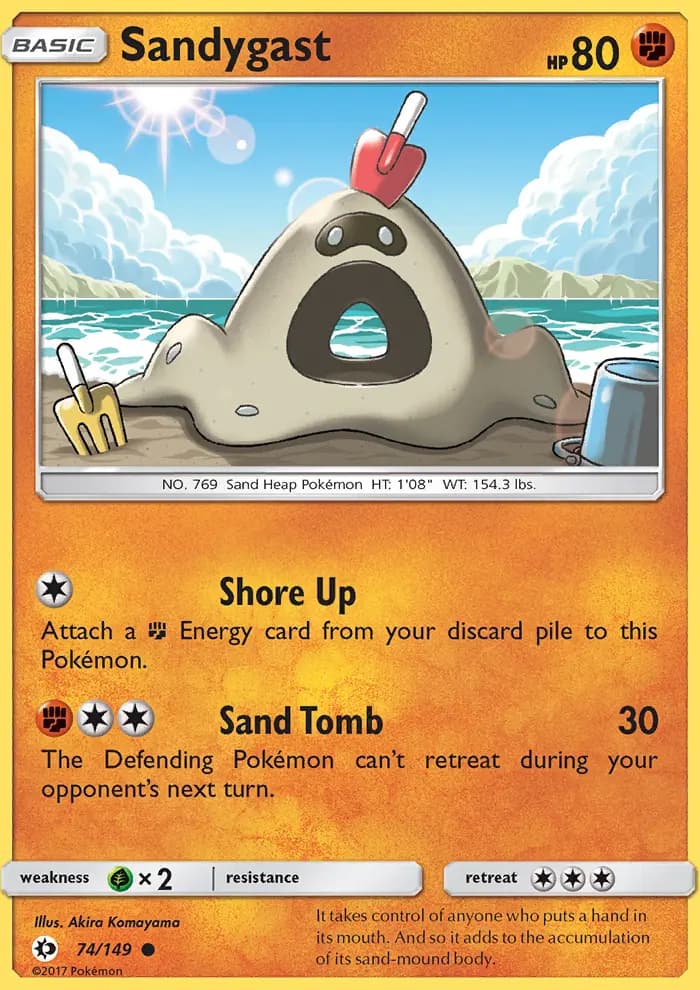
Sandygast
Generation VII · #0769 — Sand Heap Pokémon
As a Generation VII ghost/ground-type, Sandygast leans on water compaction to cover what its raw numbers don't, particularly on the hp side. With a National Pokédex number of #769, Sandygast represents a fascinating intersection of supernatural horror and beachside mystery, earning its reputation as a local legend in the Alola region where children dare one another to test their courage by placing their hands into its mouth-like opening. Despite its ominous origins, Sandygast is not a particularly aggressive Pokémon by nature; rather, it is a slow-moving creature that has evolved a unique form of manipulation to ensure its survival and growth.
Editor's Take
Sandygast's line ends in Palossand, whose Water Compaction raising Defense two stages when hit by Water is one of the most specific defensive abilities in the game.
Base Stats
Height
0.5m
Weight
70.0kg
Category
Sand Heap Pokémon
Gender
Male 50% / Female 50%
Color
brown
Shape
squiggle
Abilities
Raises this Pokémon's Defense by two stages when it's hit by a Water move.
Increases evasion to 1.25× during a sandstorm. Protects against sandstorm damage.

Sandygast Biology & Physical Characteristics
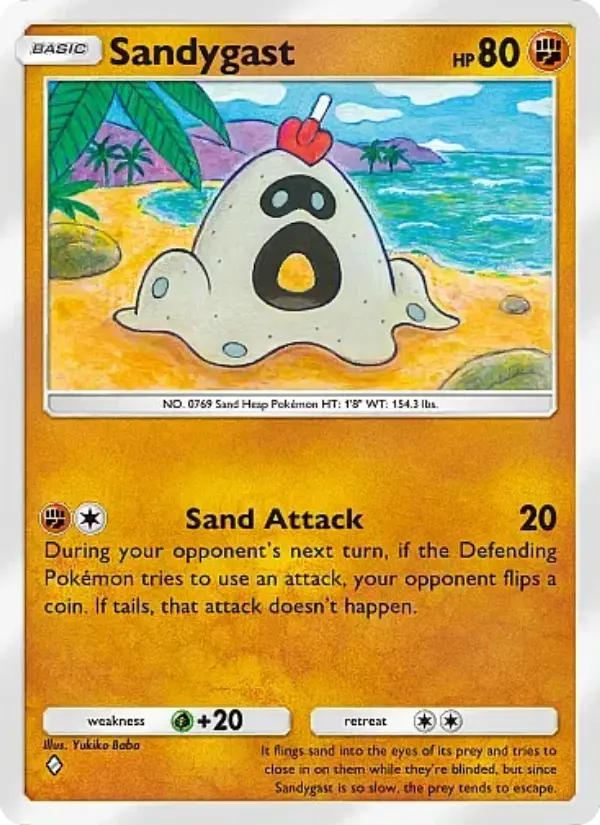
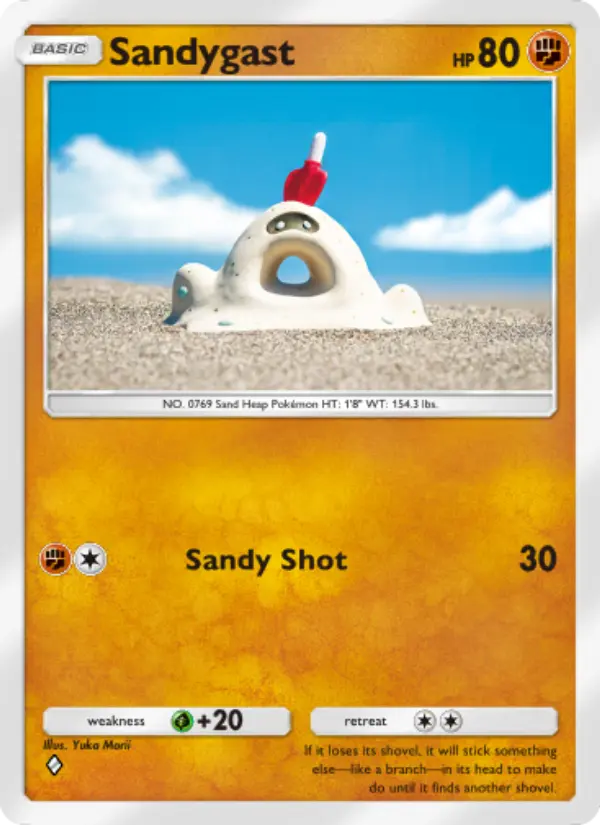
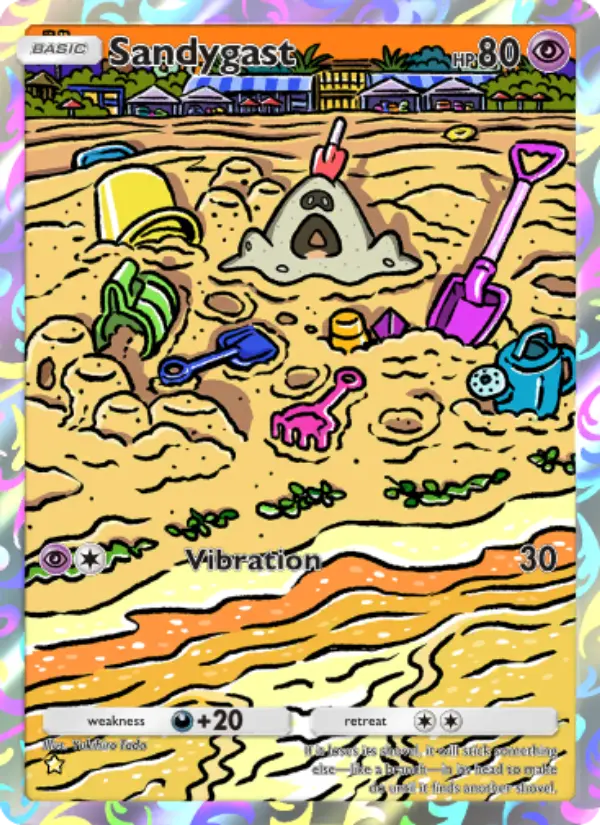
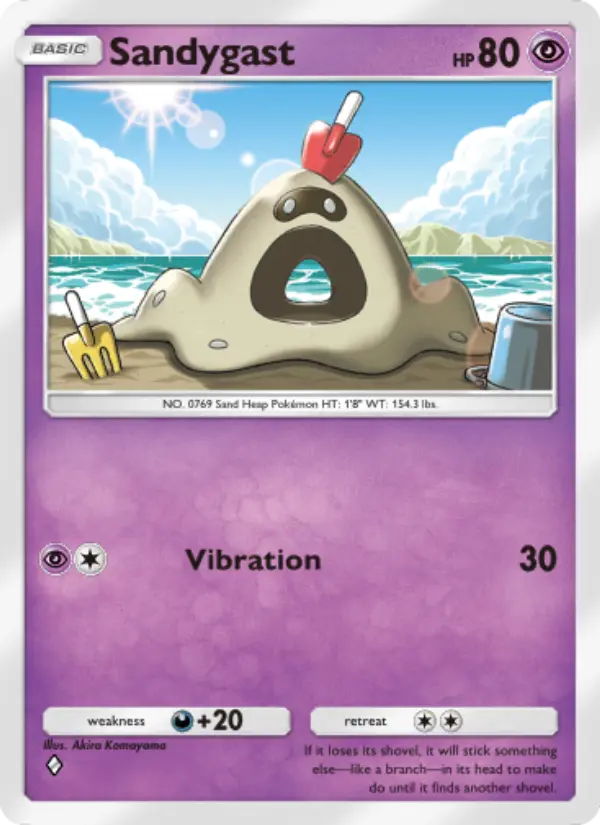
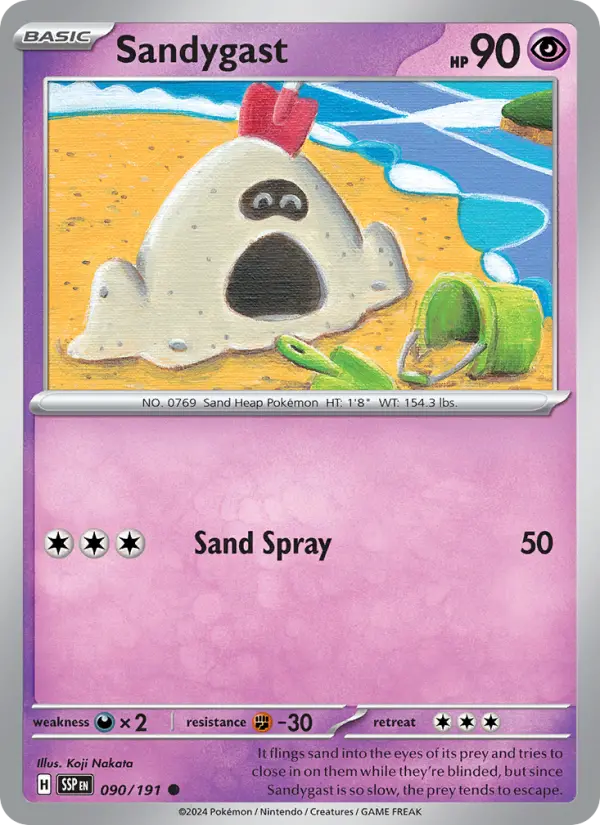
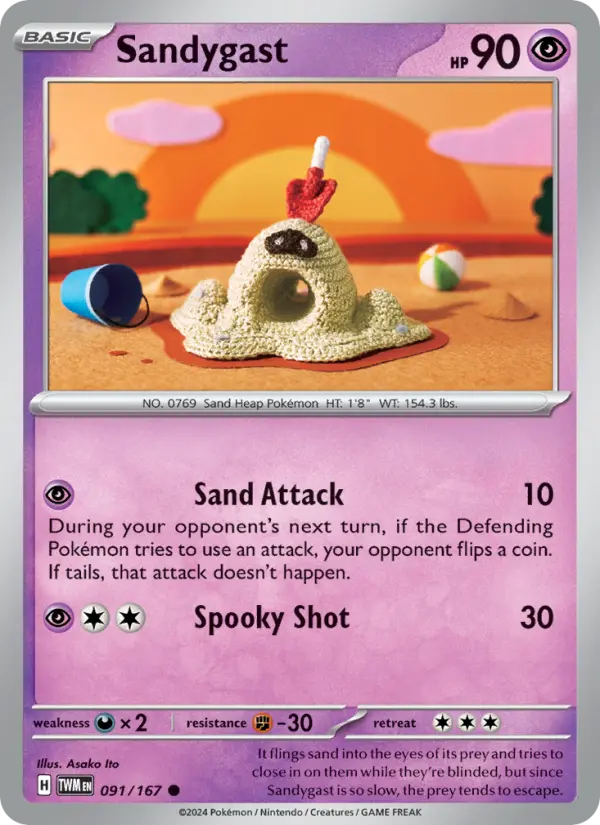
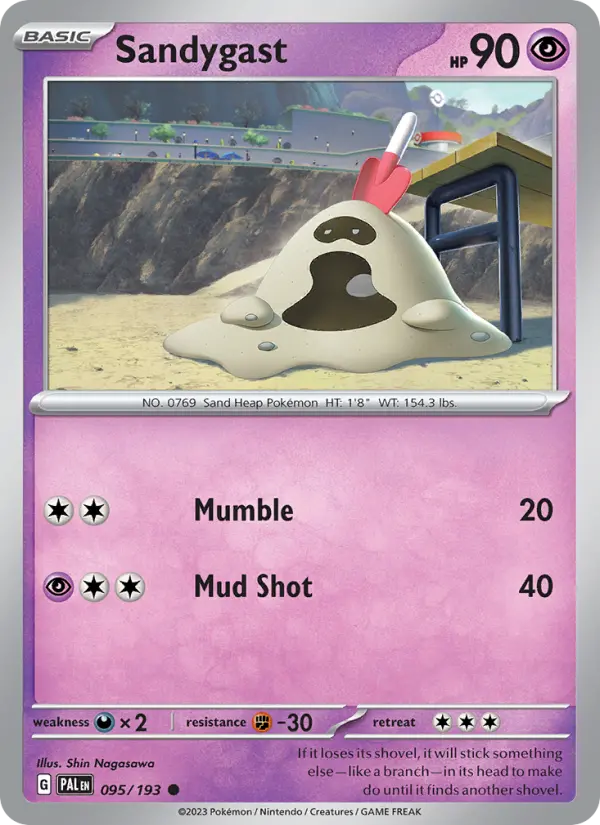
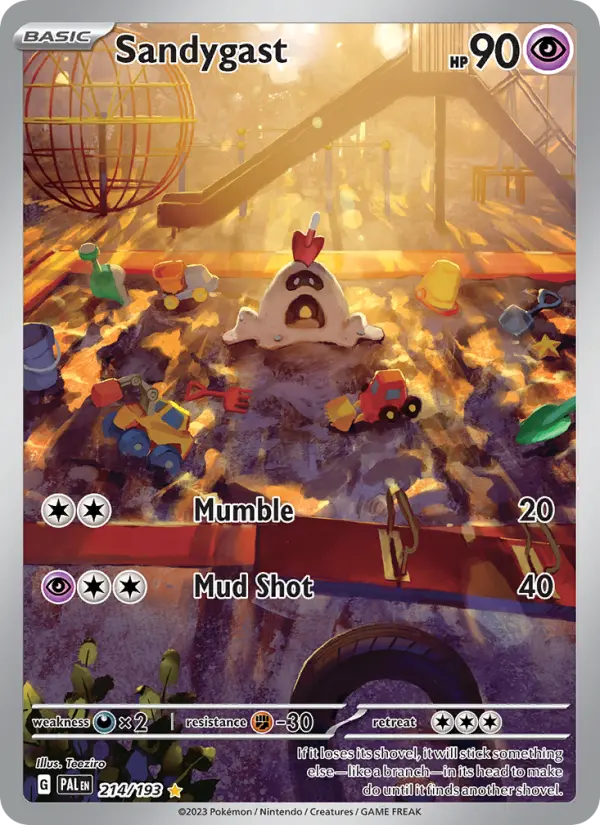
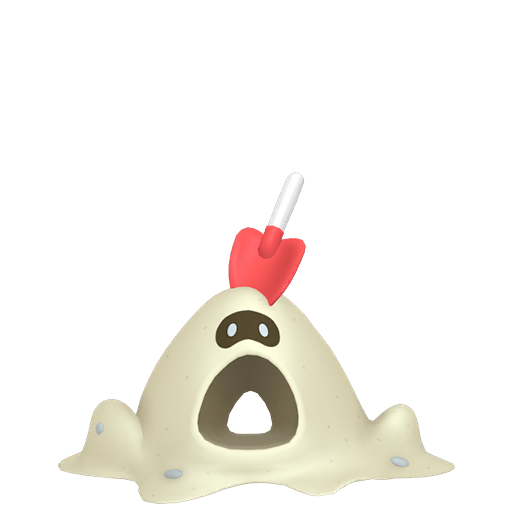
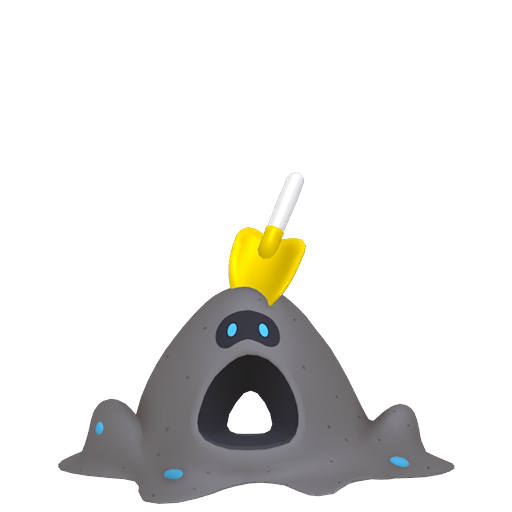
Sandygast is composed primarily of compacted whitish sand studded with gray pebbles, forming a roughly cylindrical mound approximately 0.5 meters in height but surprisingly dense at 70.0 kilograms. Its most distinctive feature is the prominent red shovel with a white handle that protrudes blade-first from the apex of its body, which Sandygast guards jealously and will become combative if anyone attempts to remove it. A tunnel runs through the center of its form, functioning as both a mouth and a conduit for its supernatural abilities, while two pebbles set into a shallow depression above this opening serve as its eyes, giving it a perpetually watchful expression. On either side of its main body are smaller mounds that resemble stubby arms, providing minimal mobility but enough dexterity to interact with its environment. The Ghost/Ground typing reflects its dual nature as both a spectral entity and a terrestrial sand-based creature, granting it a complex set of type resistances and immunities that make it unique among Pokémon.
Pokedex Numbers
Training
Breeding
Sandygast Breeding, Gender Ratio & Egg Groups
Sandygast reproduces through standard Pokémon breeding mechanics and exhibits a perfectly balanced gender ratio of 50% male and 50% female, with no gender-based differences in appearance or statistics. The species belongs to the Amorphous egg group, a classification typically reserved for gelatinous, gaseous, or otherwise non-defined bodied Pokémon, which makes sense given Sandygast's composition as a semi-sentient sand mound rather than a creature with a traditional vertebrate structure. With a base friendship value of 70, Sandygast is reasonably receptive to bonding with trainers, though its otherworldly nature and hunger for expansion may create some friction in trainer-Pokémon relationships. The species has a hatch counter of 15 cycles, equating to approximately 3,600 to 3,855 steps before a Sandygast egg hatches, placing it in the moderate range for incubation times. A Sandygast egg obtained through breeding will hatch into another Sandygast, as the species does not have a pre-evolution form, making it one of the few Ghost-type Pokémon that can be raised from the earliest stages of development.
Sprites




Held Items
Spell Tag
type-enhancement
Held: Ghost-Type moves from holder do 20% more damage.
Cost: 1000
Spell Tag
type-enhancement
Held: Ghost-Type moves from holder do 20% more damage.
Cost: 1000
Spell Tag
type-enhancement
Held: Ghost-Type moves from holder do 20% more damage.
Cost: 1000
Spell Tag
type-enhancement
Held: Ghost-Type moves from holder do 20% more damage.
Cost: 1000
TMs & HMs
tm03
crystal
tm03
gold silver
tm05
lets go pikachu lets go eevee
tm06
yellow
tm06
gold silver
tm06
red blue
tm06
crystal
tm06
emerald
tm06
firered leafgreen
tm06
diamond pearl
tm06
platinum
tm06
ruby sapphire
tm06
colosseum
tm06
black 2 white 2
tm06
xd
tm06
black white
tm06
heartgold soulsilver
tm06
omega ruby alpha sapphire
tm06
ultra sun ultra moon
tm06
sun moon
+541 more TMs/HMs
Sandygast's Evolution Chain


Sandygast Evolution, Mega Evolution & Special Forms
Sandygast undergoes a single evolutionary stage, transforming into Palossand when it reaches level 42. This evolution represents a significant increase in size and power, with Palossand growing substantially larger and more imposing than its diminutive predecessor. The evolution process reflects Sandygast's core mechanic of accumulating sand through its parasitic influence—by level 42, it has presumably gathered enough material and absorbed enough of others' life force to undergo a metamorphosis into its more formidable evolved form. Palossand maintains the same Ghost/Ground typing and continues to possess the same signature abilities, including the unique Water Compaction ability that raises Defense by two stages when struck by Water-type moves, making the evolution line particularly valuable in competitive environments where Water-type threats are prevalent. Both Sandygast and Palossand are notable for being the only known Pokémon capable of learning the move Shore Up, a healing move that restores the user's HP and increases Defense during sandstorm conditions, further emphasizing the family's connection to sand-based environments and sand-boosting strategies.
Where to Find
Hano Beach
alola
+1 more
Alola Route 15
alola
Sandygast Behaviour and Natural Habitat
Sandygast inhabits beaches throughout the Alola region, where it demonstrates a peculiar and unsettling behavior pattern centered around growth and acquisition. The Pokémon possesses the supernatural ability to take control of anyone who places their hand into its mouth, compelling them under its mental influence to gather additional sand and add it to its body, making this a form of involuntary expansion rather than independent growth. This parasitic relationship has made Sandygast both a source of fascination and fear among Alolan children, as demonstrated by the local custom of testing one's courage by placing a hand in its mouth—a tradition that, while seemingly innocuous, actually serves to expand Sandygast's form at the expense of the test-taker's free will. The Pokédex entries suggest that Sandygast's control is persistent and insidious; those who grab its shovel or insert their hand into its mouth find themselves compelled to contribute to its growth. Additionally, Sandygast attacks by flinging sand into the eyes of potential prey, though its extremely low base Speed of 15 means that most targets manage to escape before it can close the distance, making it more of a nuisance than a genuine threat to most creatures.
Pokedex Entries
Born from a sand mound playfully built by a child, this Pokémon embodies the grudges of the departed.
It likes the shovel on its head, so Sandygast will get serious and fight any children who come to take it back.
It takes control of anyone who puts a hand in its mouth. And so it adds to the accumulation of its sand-mound body.
If you build sand mounds when you’re playing, destroy them before you go home, or they may get possessed and become Sandygast.
Grudges of the dead have possessed a mound of sand and become a Pokémon. Sandygast is fond of the shovel on its head.
Sandygast mainly inhabits beaches. It takes control of anyone who puts their hand into its mouth, forcing them to make its body bigger.
Sandygast Name Origin & Design Inspiration
The name Sandygast is a straightforward portmanteau of 'sandy' and 'ghast,' with 'ghast' derived from 'aghast,' conveying both its sandy composition and its ghostly, horror-adjacent nature. The Japanese name スナバァ (Sunaba) combines スナ (suna, meaning sand) with the suffix バァ, creating a name that emphasizes its earthen origin while maintaining a slightly ominous tone. The design itself draws inspiration from children's beach activities—specifically the simple sand mounds that children build while playing—but subverts this innocent concept by imbuing it with supernatural malevolence and the ability to absorb and control living beings. The shovel embedded in its head serves as both a practical element (representing the tools used to build sand mounds) and a symbolic anchor point, functioning as a kind of core or vulnerability that defines the Pokémon's identity. The tunnel-like mouth is evocative of both the holes children dig in sand and the ominous maw of a supernatural entity, creating a visual metaphor for the duality between innocence and danger that permeates Sandygast's entire concept.
Learnable Moves
Sandygast can learn 72 moves:
Move | Type | Cat. | Power | Acc. | PP |
|---|---|---|---|---|---|
| absorb | grass | Special | 20 | 100 | 25 |
| after you | normal | Status | — | — | 15 |
| amnesia | psychic | Status | — | — | 20 |
| ancient power | rock | Special | 60 | 100 | 5 |
| astonish | ghost | Physical | 30 | 100 | 15 |
| attract | normal | Status | — | 100 | 15 |
| block | normal | Status | — | — | 5 |
| brine | water | Special | 65 | 100 | 10 |
| bulldoze | ground | Physical | 60 | 100 | 20 |
| chilling water | water | Special | 50 | 100 | 20 |
| confide | normal | Status | — | — | 20 |
| confuse ray | ghost | Status | — | 100 | 10 |
| curse | ghost | Status | — | — | 10 |
| destiny bond | ghost | Status | — | — | 5 |
| double team | normal | Status | — | — | 15 |
| earth power | ground | Special | 90 | 100 | 10 |
| earthquake | ground | Physical | 100 | 100 | 10 |
| endure | normal | Status | — | — | 10 |
| energy ball | grass | Special | 90 | 100 | 10 |
| facade | normal | Physical | 70 | 100 | 20 |
| flash cannon | steel | Special | 80 | 100 | 10 |
| fling | dark | Physical | — | 100 | 10 |
| frustration | normal | Physical | — | 100 | 20 |
| giga drain | grass | Special | 75 | 100 | 10 |
| gravity | psychic | Status | — | — | 5 |
| harden | normal | Status | — | — | 30 |
| hex | ghost | Special | 65 | 100 | 10 |
| hidden power | normal | Special | 60 | 100 | 15 |
| hypnosis | psychic | Status | — | 60 | 20 |
| imprison | psychic | Status | — | — | 10 |
| infestation | bug | Special | 20 | 100 | 20 |
| iron defense | steel | Status | — | — | 15 |
| mega drain | grass | Special | 40 | 100 | 15 |
| mud shot | ground | Special | 55 | 95 | 15 |
| mud slap | ground | Special | 20 | 100 | 10 |
| night shade | ghost | Special | — | 100 | 15 |
| pain split | normal | Status | — | — | 20 |
| poltergeist | ghost | Physical | 110 | 90 | 5 |
| protect | normal | Status | — | — | 10 |
| psychic | psychic | Special | 90 | 100 | 10 |
| rain dance | water | Status | — | — | 5 |
| recycle | normal | Status | — | — | 10 |
| rest | psychic | Status | — | — | 5 |
| return | normal | Physical | — | 100 | 20 |
| rock polish | rock | Status | — | — | 20 |
| rock slide | rock | Physical | 75 | 90 | 10 |
| rock tomb | rock | Physical | 60 | 95 | 15 |
| role play | psychic | Status | — | — | 10 |
| round | normal | Special | 60 | 100 | 15 |
| sand attack | ground | Status | — | 100 | 15 |
| sand tomb | ground | Physical | 35 | 85 | 15 |
| sandstorm | rock | Status | — | — | 10 |
| scary face | normal | Status | — | 100 | 10 |
| scorching sands | ground | Special | 70 | 100 | 10 |
| shadow ball | ghost | Special | 80 | 100 | 15 |
| shore up | ground | Status | — | — | 5 |
| skill swap | psychic | Status | — | — | 10 |
| sleep talk | normal | Status | — | — | 10 |
| sludge bomb | poison | Special | 90 | 100 | 10 |
| snore | normal | Special | 50 | 100 | 15 |
| spit up | normal | Special | — | 100 | 10 |
| spite | ghost | Status | — | 100 | 10 |
| stealth rock | rock | Status | — | — | 20 |
| stockpile | normal | Status | — | — | 20 |
| stone edge | rock | Physical | 100 | 80 | 5 |
| substitute | normal | Status | — | — | 10 |
| sunny day | fire | Status | — | — | 5 |
| swagger | normal | Status | — | 85 | 15 |
| swallow | normal | Status | — | — | 10 |
| tera blast | normal | Special | 80 | 100 | 10 |
| toxic | poison | Status | — | 90 | 10 |
| trick | psychic | Status | — | 100 | 10 |
Sandygast Competitive Battle Guide
In terms of competitive use, Sandygast occupies an interesting niche despite its relatively low base stats total of 320. Its most valuable competitive asset is its signature ability Water Compaction, which raises Defense by two stages whenever it is struck by a Water-type move, allowing it to function as a potential tank against Water-type attackers if given proper support. With a respectable base Defense of 80 and a Special Attack of 70, Sandygast can wall certain threats while maintaining offensive presence, though its pitiful base Speed of 15 means it will almost always move last in any given turn, requiring careful team building and strategic play. The hidden ability Sand Veil provides an alternative competitive option, increasing evasion to 1.25 times during sandstorm conditions and granting immunity to sandstorm damage, making it valuable in sand-based team compositions. Sandygast's movepool includes useful options like Shore Up for recovery, Curse for stat manipulation, Shadow Ball for consistent STAB damage, and Earth Power for Ground-type coverage. However, its extremely low Speed and modest offensive stats mean that Sandygast typically sees more use as a specialized wall or support Pokémon rather than as a primary attacker, with most competitive players preferring to evolve it into Palossand for improved stats and battlefield presence.
Commonly Asked Questions About Sandygast
What type is Sandygast?
Sandygast is a ghost and ground type Pokemon.
What does Sandygast evolve into?
Sandygast evolves into palossand.
What are Sandygast's weaknesses?
Sandygast is weak to ghost, water, grass, ice and dark type moves.
Does Sandygast evolve by trading?
No — Sandygast evolves entirely through leveling up, with no trade required at any stage.
Where can I find Sandygast?
Sandygast can be found in hano beach (alola) and alola route 15 (alola).
Sandygast Cultural Impact & Franchise History
Sandygast has made a significant cultural impact within the Pokémon franchise as one of the most memorable and disturbing Pokémon introduced in Generation VII, largely due to the dark undertones of its Pokédex entries and lore. The concept of a Pokémon born from grudges and decay has resonated with fans who appreciate the franchise's willingness to explore genuinely unsettling themes, transforming what could be a simple beach-themed creature into something genuinely eerie and memorable. The tradition mentioned in Alolan lore of testing courage by placing one's hand into Sandygast's mouth has become iconic within fan communities, often referenced as one of the most disturbing rituals in Pokémon worldbuilding. Additionally, the detail about Sandygast obsessively replacing its lost shovel with whatever objects it can find—branches, flags, or other items—has endeared the species to fans who appreciate the subtle world-building that suggests Sandygast possesses a form of personality and attachment despite its parasitic nature. Sandygast's appearance in the anime and various Pokémon media has further cemented its status as a fan favorite, particularly among players who enjoy Ghost-type Pokémon for their supernatural intrigue and darker aesthetic.
Where to Find Sandygast in Every Pokémon Game
Sandygast is available primarily in beach and coastal environments throughout the Alola region, making its first appearance in Pokémon Sun and Moon (Generation VII) where it holds the Local Pokédex number #186 in the Alola dex. It continues to appear in Pokémon Ultra Sun and Ultra Moon with Local Pokédex number #225, maintaining its status as a region-exclusive Pokémon tied to Alola's sandy shores and beaches. The species was later made available in newer generations through subsequent remakes and expansions—it appears in Pokémon Sword and Shield as part of the Isle of Armor DLC with Local Pokédex number #133, and in Pokémon Scarlet and Violet with Local Pokédex number #322, demonstrating the developers' commitment to making it accessible to trainers across multiple generations. Its capture rate of 140 indicates moderate catchability, placing it slightly above average for wild encounters, and its base happiness of 70 means that newly caught Sandygast respond reasonably well to trainer care. While Sandygast is not found in the wild in every generation, its consistent availability across major Gen VII titles and its inclusion in later regional Pokédexes ensure that most dedicated trainers can obtain one without excessive difficulty, making it an accessible option for those looking to add a Ghost/Ground type to their team.