Pancham
Generation VI · #0674 — Playful Pokémon
Pancham's profile is easy to undersell: 0.6 m, 8 kg, and a fighting typing that doesn't scream power — until you look at its Attack of 82. At 0.6 m and 8.0 kg, its build reflects a specialist role rather than a generalist one. Despite its diminutive stature, Pancham possesses a base Attack stat of 82, which serves as its strongest offensive attribute and forms the foundation of its battling capability. The Pokémon's total base stat pool of 348 reflects its role as an early-stage evolutionary form, with balanced but unspectacular defenses and notably low Special Attack and Speed statistics that suggest it is designed for physical combat rather than special abilities or swift actions.
Editor's Take
Pancham evolves into Pangoro only with a Dark-type in the party at level 32, which is one of the more obscure conditions Gen 6 introduced.
Base Stats
Height
0.6m
Weight
8.0kg
Category
Playful Pokémon
Gender
Male 50% / Female 50%
Color
white
Shape
upright
Abilities
Strengthens punch-based moves to 1.2× their power.
Bypasses targets' abilities if they could hinder or prevent a move.
Lets the Pokémon's normal and fighting moves hit ghost Pokémon.

Pancham Biology & Physical Characteristics
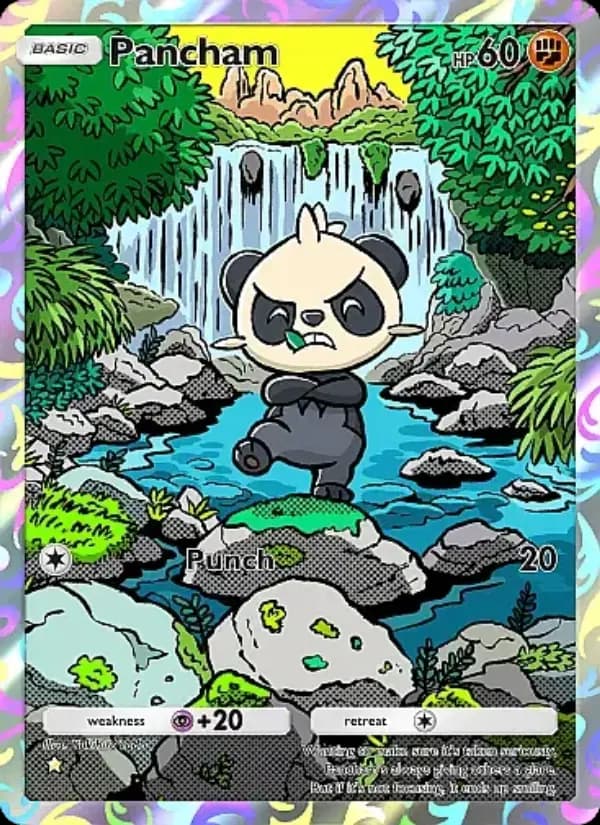
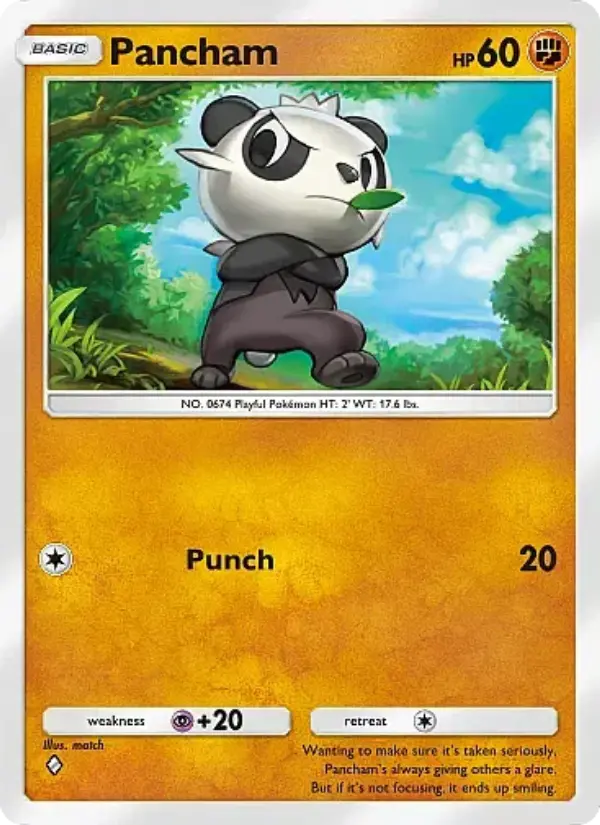
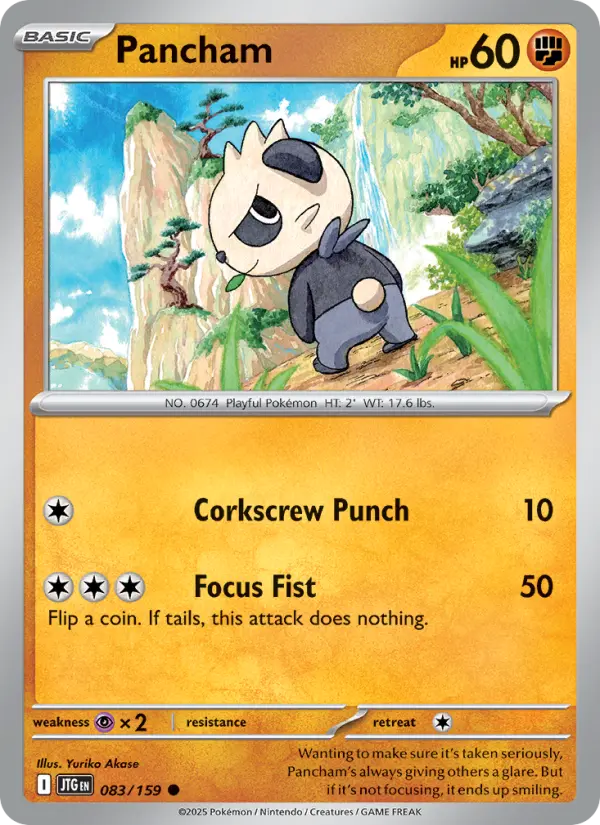
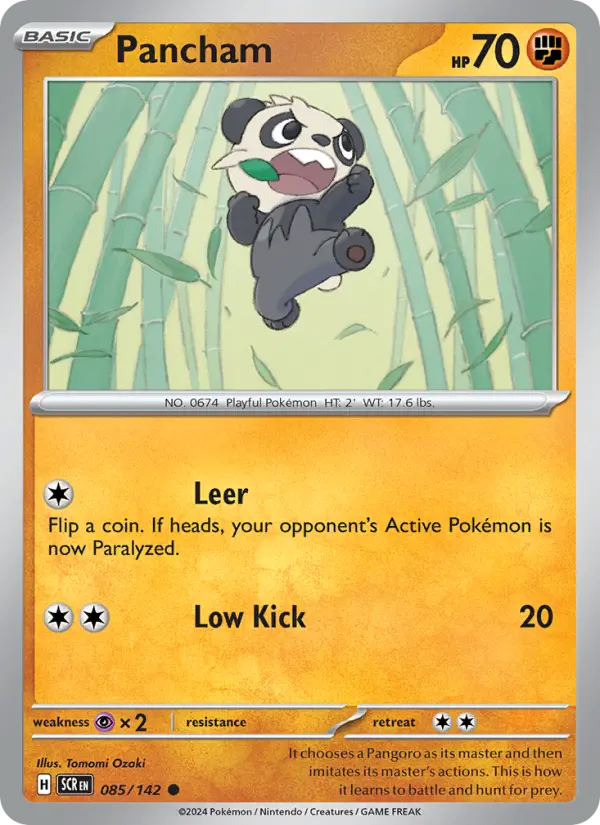
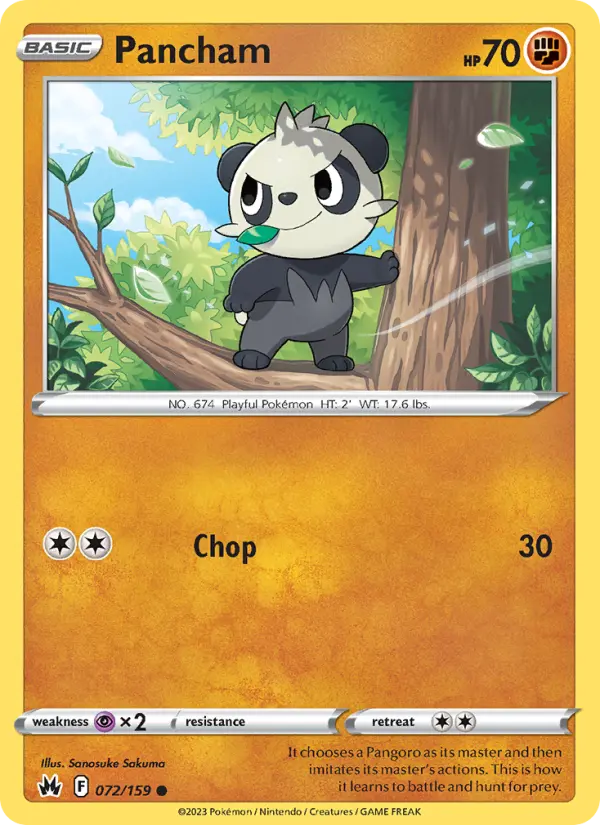
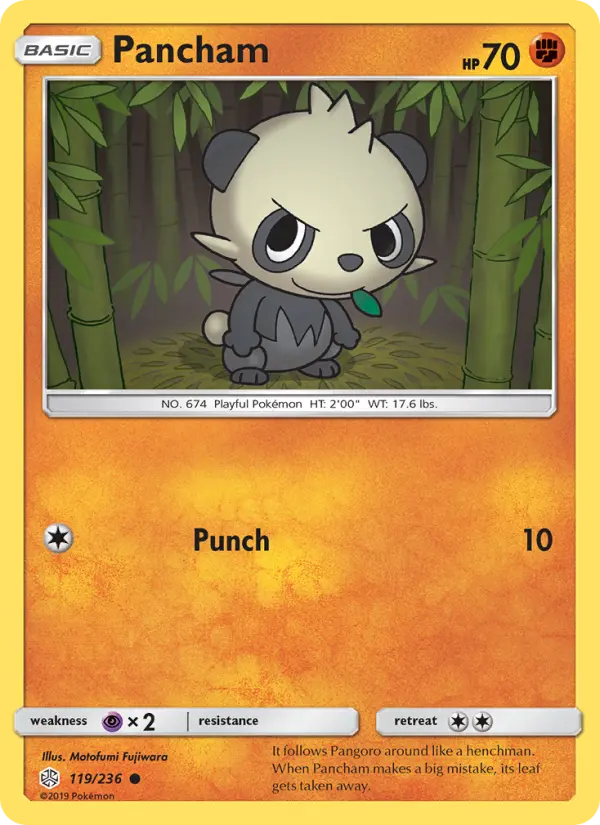
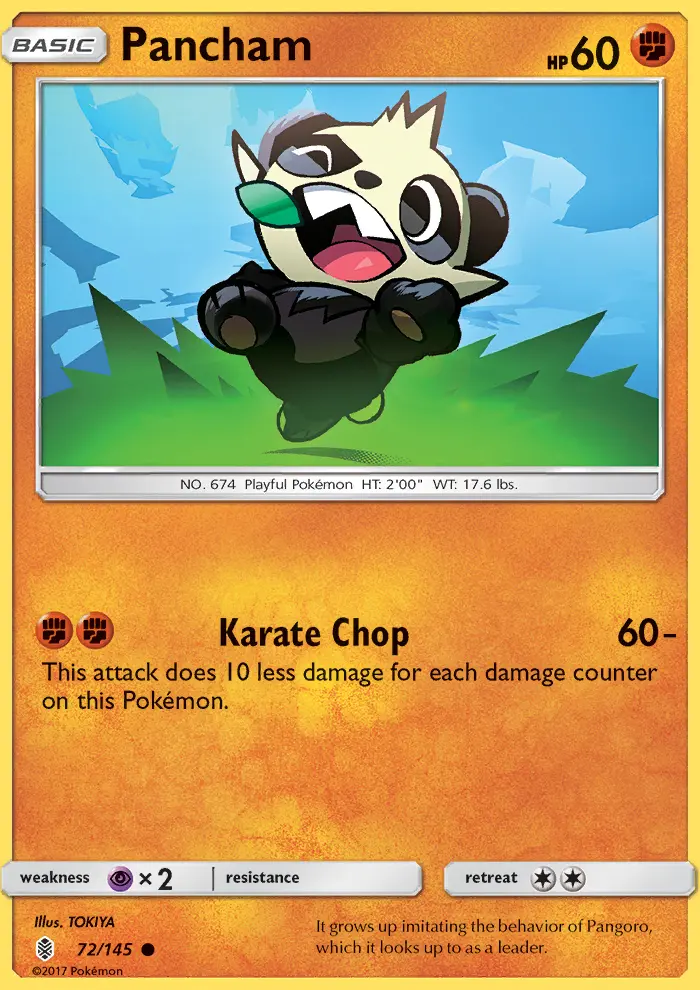
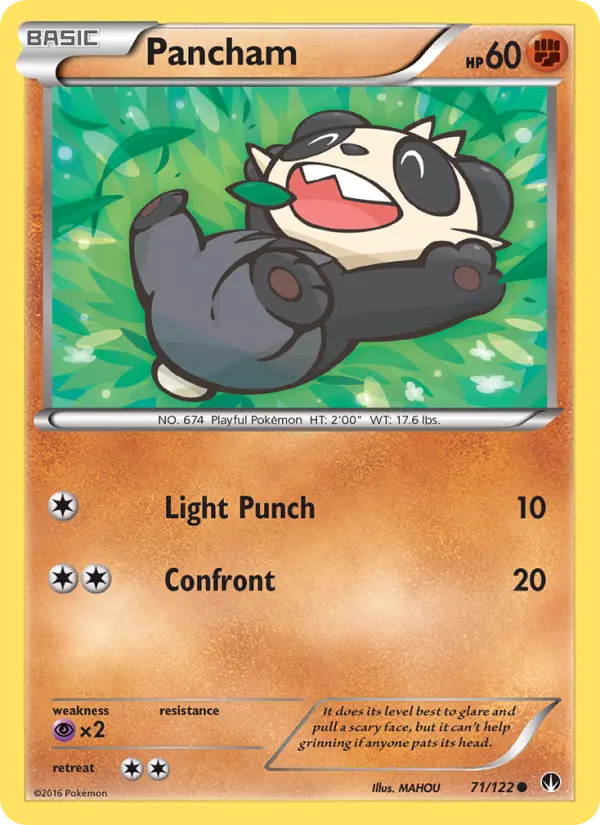
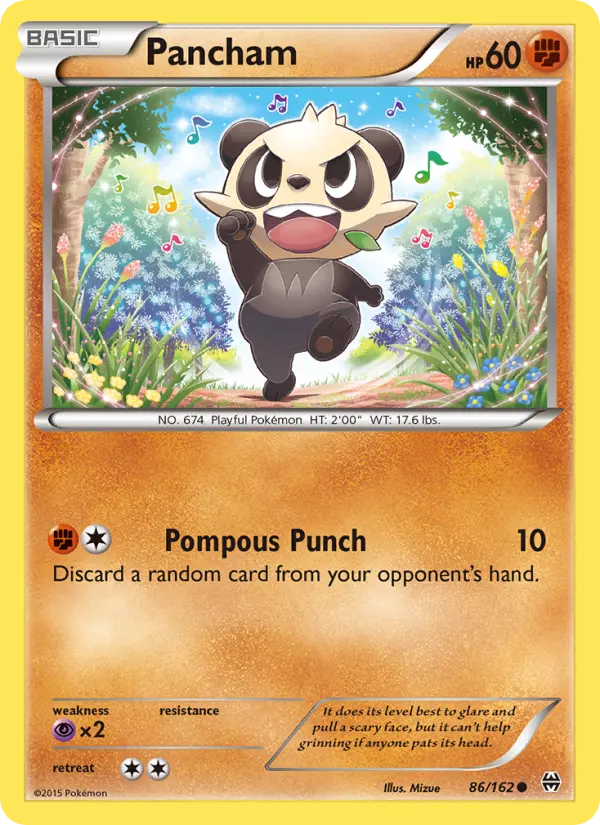
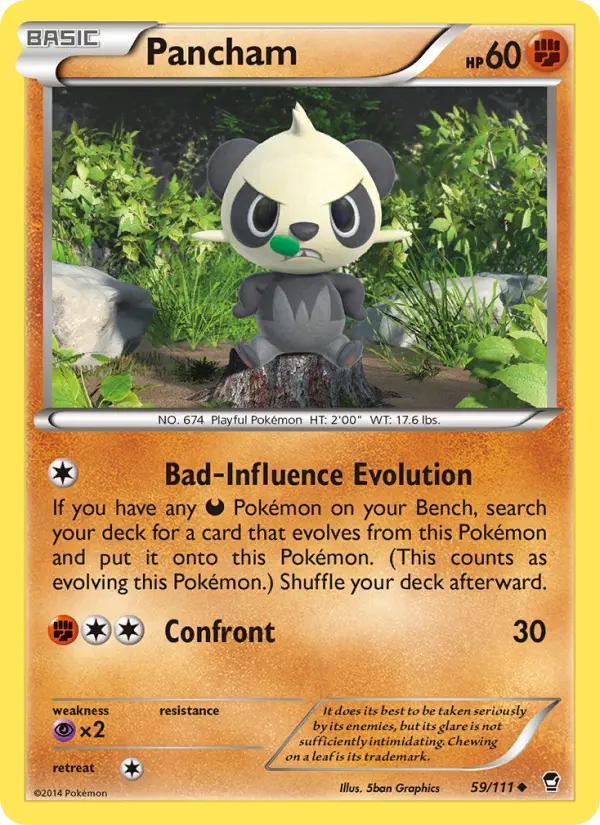
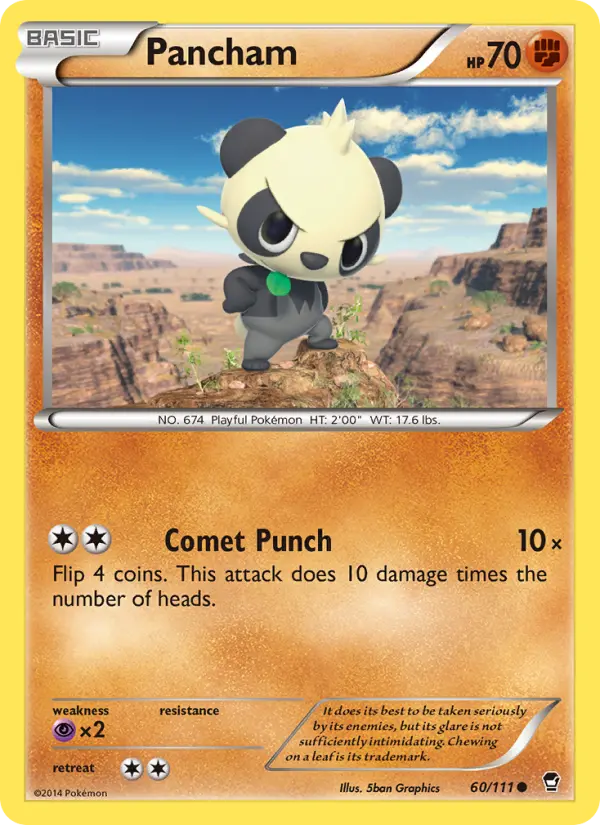
Pancham is a bipedal, mammalian Pokémon bearing a striking resemblance to a young panda, featuring a white head and short, puffy tail contrasted against a black upper body and dark gray lower body, where these colors meet to form a distinctive three-pointed pattern on its chest. Its face includes a triangular black nose, rounded black ears, prominent black circles around its eyes, and characteristic tufts of fur crowning its head and adorning each cheek, creating an appearance that attempts to convey seriousness but often fails due to its youthful features. The most iconic aspect of Pancham's biology is the small, green leaf it constantly carries in its mouth—a trait with no functional purpose beyond an effort to look cool and intimidating, as confirmed by multiple Pokédex entries. Each of its paws contains three digits, and its black hind feet feature small, dark brown circular pads on their soles, providing grip for its ground-based movement and combat maneuvers.
Pokedex Numbers
Training
Breeding
Pancham Breeding, Gender Ratio & Egg Groups
There's no gender skew here: Pancham breeds at an even 50% male / 50% female rate. The species belongs to both the Ground and Human-Like egg groups, making it compatible with an unusually broad range of breeding partners and allowing for diverse movepool inheritance possibilities through egg moves. With a base friendship value of 70 (in Generations VI and VII, later adjusted in subsequent generations), Pancham demonstrates moderate loyalty to its Trainer from the moment of capture or hatching, and this friendship can be readily increased through proper care, battle participation, and item usage. The species hatches from eggs after 25 cycles, which translates to approximately 6,169 to 6,425 steps, positioning it as a relatively quick hatcher compared to many other Pokémon. The catch rate of 220 reflects a moderately easy capture probability, making Pancham accessible to players early in their journey, and the species' availability in multiple game versions ensures that both genders are easily obtainable for breeding purposes, enabling players to establish sustainable populations or transfer desirable genetic traits through successive generations.
Sprites






Held Items
Mental Herb
held-items
Held: Consumed to cure infatuation. Gen V: Also removes Taunt, Encore, Torment, Disable, and Cursed Body.
Cost: 4000
Mental Herb
held-items
Held: Consumed to cure infatuation. Gen V: Also removes Taunt, Encore, Torment, Disable, and Cursed Body.
Cost: 4000
Mental Herb
held-items
Held: Consumed to cure infatuation. Gen V: Also removes Taunt, Encore, Torment, Disable, and Cursed Body.
Cost: 4000
Mental Herb
held-items
Held: Consumed to cure infatuation. Gen V: Also removes Taunt, Encore, Torment, Disable, and Cursed Body.
Cost: 4000
Mental Herb
held-items
Held: Consumed to cure infatuation. Gen V: Also removes Taunt, Encore, Torment, Disable, and Cursed Body.
Cost: 4000
Mental Herb
held-items
Held: Consumed to cure infatuation. Gen V: Also removes Taunt, Encore, Torment, Disable, and Cursed Body.
Cost: 4000
Mental Herb
held-items
Held: Consumed to cure infatuation. Gen V: Also removes Taunt, Encore, Torment, Disable, and Cursed Body.
Cost: 4000
Mental Herb
held-items
Held: Consumed to cure infatuation. Gen V: Also removes Taunt, Encore, Torment, Disable, and Cursed Body.
Cost: 4000
TMs & HMs
tm00
sword shield
tm01
yellow
tm01
red blue
tm01
platinum
tm01
emerald
tm01
diamond pearl
tm01
firered leafgreen
tm01
ruby sapphire
tm01
xd
tm01
colosseum
tm01
heartgold soulsilver
tm01
ultra sun ultra moon
tm01
sun moon
tm01
blue japan
tm01
red green japan
tm01
sword shield
tm02
lets go pikachu lets go eevee
tm03
yellow
tm03
red blue
tm03
lets go pikachu lets go eevee
+748 more TMs/HMs
Pancham's Evolution Chain


Pancham Evolution, Mega Evolution & Special Forms
Pancham evolves into Pangoro, a significantly more powerful Fighting/Dark-type Pokémon, but only under a specific and unusual condition: the trainer must have a Dark-type Pokémon in their active party when Pancham reaches level 32. This evolution mechanic represents one of Pokémon's most thematic evolution requirements, as Pancham's transformation mirrors its character development—it gains the darkness and toughness it admires in Pangoro through exposure and proximity to Dark-type energy. The evolution typically occurs during the mid-game portion of Generation VI titles, allowing players to develop a strategic duo or team composition that incorporates both the playful precursor and its menacing evolved form. Upon evolution, Pancham gains a significant stat boost across nearly all categories, with particularly notable improvements in Attack, Special Attack, and Special Defense, transforming it into a legitimate competitive threat. Unlike many other Pokémon, Pancham has no Mega Evolution, but its evolution into Pangoro itself represents a dramatic power spike that fulfills the species' narrative of maturation and the acquisition of genuine strength.
Where to Find
Kalos Route 5
kalos
+3 more
Alola Route 17
alola
+1 more
Alola Route 10
alola
+1 more
Alola Route 11
alola
+1 more
Pancham Behaviour and Natural Habitat
Pancham demonstrates a notably playful and mischievous personality that often undermines its attempts at intimidation, making it unsuitable for inexperienced Trainers according to Pokédex records. The species idolizes Pangoro, viewing it as a leader and role model, and actively imitates its evolved form's behavior in order to learn how to battle and hunt for prey effectively. In its desperation to be taken seriously by opponents, Pancham stares intensely and attempts to pull scary facial expressions, yet invariably ends up grinning if distracted or patted on the head—a behavioral contradiction that reveals its fundamentally good-natured disposition. The relationship between Pancham and Pangoro is particularly telling: when Pancham makes significant mistakes, Pangoro will confiscate its signature leaf as a form of correction and discipline, suggesting a mentor-mentee dynamic within the species' social structure. Pancham's habitat preferences align with its Ground and Human-Like egg groups, indicating it thrives in terrestrial environments and areas with human influence.
Pokedex Entries
It does its best to be taken seriously by its enemies, but its glare is not sufficiently intimidating. Chewing on a leaf is its trademark.
It does its level best to glare and pull a scary face, but it can’t help grinning if anyone pats its head.
It does its best to be taken seriously by its enemies, but its glare is not sufficiently intimidating. Chewing on a leaf is its trademark.
It does its level best to glare and pull a scary face, but it can’t help grinning if anyone pats its head.
It grows up imitating the behavior of Pangoro, which it looks up to as a leader.
It follows Pangoro around like a henchman. When Pancham makes a big mistake, its leaf gets taken away.
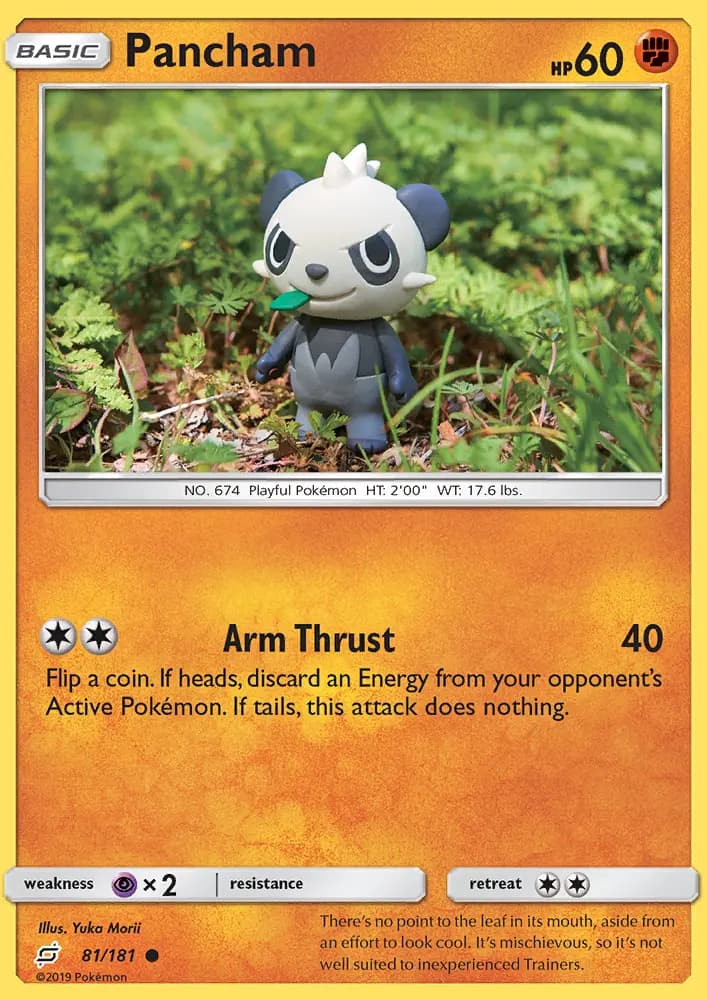
There’s no point to the leaf in its mouth, aside from an effort to look cool. It’s mischievous, so it’s not well suited to inexperienced Trainers.
It’s desperate to intimidate its opponents. Be nice and pretend to be scared if you catch it glaring at you intensely.
It chooses a Pangoro as its master and then imitates its master’s actions. This is how it learns to battle and hunt for prey.
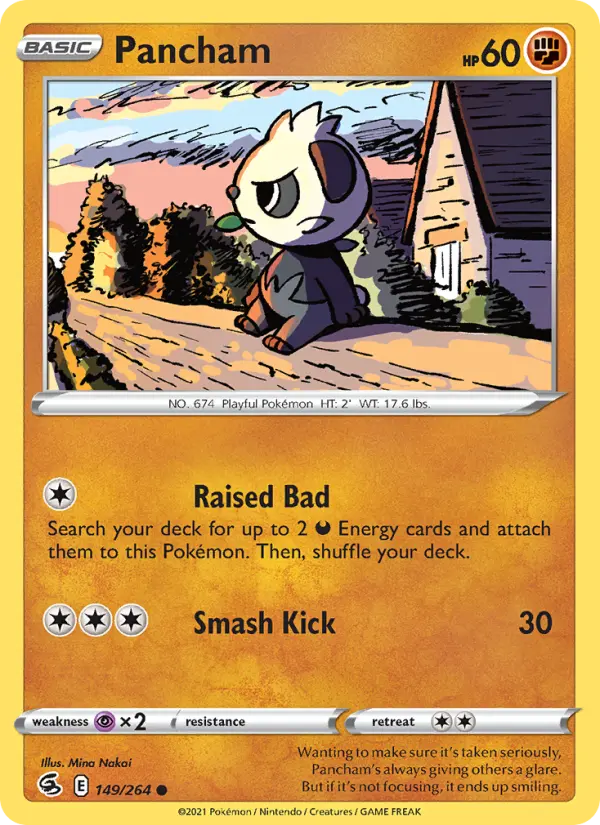
Wanting to make sure it’s taken seriously, Pancham’s always giving others a glare. But if it’s not focusing, it ends up smiling.
Pancham Name Origin & Design Inspiration
Pancham's name traces back to a combination of 'panda' and 'champ,' reflecting both its appearance as a young panda and its aspirational desire to be a champion fighter, despite its current inability to achieve that status convincingly. The Japanese name, Yancham, comes from 'yancha,' meaning mischievous or naughty, which perfectly encapsulates the Pokémon's playful and troublemaking nature that contrasts with its attempts at seriousness. The design philosophy behind Pancham embraces a deliberate comedic contradiction—it is visually inspired by giant pandas, animals known for their gentleness and cuteness, yet classified as a Fighting-type Pokémon associated with combat and aggression. The green leaf in its mouth serves as both a design element that distinguishes it from traditional panda representations and a symbolic prop representing its immaturity and the gap between its aspirations and reality. This design choice echoes real-world young animals that often engage in play-fighting and mock combat as preparation for adulthood, making Pancham's appearance and behavior remarkably cohesive with its developmental stage within the Pangoro evolutionary line.
Learnable Moves
Pancham can learn 91 moves:
Move | Type | Cat. | Power | Acc. | PP |
|---|---|---|---|---|---|
| aerial ace | flying | Physical | 60 | — | 20 |
| arm thrust | fighting | Physical | 15 | 100 | 20 |
| attract | normal | Status | — | 100 | 15 |
| block | normal | Status | — | — | 5 |
| body slam | normal | Physical | 85 | 100 | 15 |
| brick break | fighting | Physical | 75 | 100 | 15 |
| bulk up | fighting | Status | — | — | 20 |
| bulldoze | ground | Physical | 60 | 100 | 20 |
| circle throw | fighting | Physical | 60 | 90 | 10 |
| coaching | fighting | Status | — | — | 10 |
| comet punch | normal | Physical | 18 | 85 | 15 |
| confide | normal | Status | — | — | 20 |
| covet | normal | Physical | 60 | 100 | 25 |
| crunch | dark | Physical | 80 | 100 | 15 |
| cut | normal | Physical | 50 | 95 | 30 |
| dark pulse | dark | Special | 80 | 100 | 15 |
| dig | ground | Physical | 80 | 100 | 10 |
| double team | normal | Status | — | — | 15 |
| drain punch | fighting | Physical | 75 | 100 | 10 |
| dual chop | dragon | Physical | 40 | 90 | 15 |
| echoed voice | normal | Special | 40 | 100 | 15 |
| endeavor | normal | Physical | — | 100 | 5 |
| endure | normal | Status | — | — | 10 |
| entrainment | normal | Status | — | 100 | 15 |
| facade | normal | Physical | 70 | 100 | 20 |
| false swipe | normal | Physical | 40 | 100 | 40 |
| fire punch | fire | Physical | 75 | 100 | 15 |
| fling | dark | Physical | — | 100 | 10 |
| focus punch | fighting | Physical | 150 | 100 | 20 |
| foul play | dark | Physical | 95 | 100 | 15 |
| frustration | normal | Physical | — | 100 | 20 |
| grass knot | grass | Special | — | 100 | 20 |
| gunk shot | poison | Physical | 120 | 80 | 5 |
| helping hand | normal | Status | — | — | 20 |
| hidden power | normal | Special | 60 | 100 | 15 |
| hyper voice | normal | Special | 90 | 100 | 10 |
| ice punch | ice | Physical | 75 | 100 | 15 |
| iron head | steel | Physical | 80 | 100 | 15 |
| karate chop | fighting | Physical | 50 | 100 | 25 |
| knock off | dark | Physical | 65 | 100 | 20 |
| lash out | dark | Physical | 75 | 100 | 5 |
| leer | normal | Status | — | 100 | 30 |
| low kick | fighting | Physical | — | 100 | 20 |
| low sweep | fighting | Physical | 65 | 100 | 20 |
| me first | normal | Status | — | — | 20 |
| mega kick | normal | Physical | 120 | 75 | 5 |
| mega punch | normal | Physical | 80 | 85 | 20 |
| parting shot | dark | Status | — | 100 | 20 |
| payback | dark | Physical | 50 | 100 | 10 |
| power trip | dark | Physical | 20 | 100 | 10 |
| power up punch | fighting | Physical | 40 | 100 | 20 |
| protect | normal | Status | — | — | 10 |
| quash | dark | Status | — | 100 | 15 |
| quick guard | fighting | Status | — | — | 15 |
| rain dance | water | Status | — | — | 5 |
| rest | psychic | Status | — | — | 5 |
| retaliate | normal | Physical | 70 | 100 | 5 |
| return | normal | Physical | — | 100 | 20 |
| roar | normal | Status | — | — | 20 |
| rock slide | rock | Physical | 75 | 90 | 10 |
| rock smash | fighting | Physical | 40 | 100 | 15 |
| rock tomb | rock | Physical | 60 | 95 | 15 |
| round | normal | Special | 60 | 100 | 15 |
| secret power | normal | Physical | 70 | 100 | 20 |
| seismic toss | fighting | Physical | — | 100 | 20 |
| shadow claw | ghost | Physical | 70 | 100 | 15 |
| sky uppercut | fighting | Physical | 85 | 90 | 15 |
| slash | normal | Physical | 70 | 100 | 20 |
| sleep talk | normal | Status | — | — | 10 |
| sludge bomb | poison | Special | 90 | 100 | 10 |
| snatch | dark | Status | — | — | 10 |
| snore | normal | Special | 50 | 100 | 15 |
| spite | ghost | Status | — | 100 | 10 |
| stone edge | rock | Physical | 100 | 80 | 5 |
| storm throw | fighting | Physical | 60 | 100 | 10 |
| strength | normal | Physical | 80 | 100 | 15 |
| substitute | normal | Status | — | — | 10 |
| sunny day | fire | Status | — | — | 5 |
| superpower | fighting | Physical | 120 | 100 | 5 |
| surf | water | Special | 90 | 100 | 15 |
| swagger | normal | Status | — | 85 | 15 |
| swords dance | normal | Status | — | — | 20 |
| tackle | normal | Physical | 40 | 100 | 35 |
| taunt | dark | Status | — | 100 | 20 |
| thunder punch | electric | Physical | 75 | 100 | 15 |
| torment | dark | Status | — | 100 | 15 |
| toxic | poison | Status | — | 90 | 10 |
| uproar | normal | Special | 90 | 100 | 10 |
| vital throw | fighting | Physical | 70 | — | 10 |
| work up | normal | Status | — | — | 30 |
| zen headbutt | psychic | Physical | 80 | 90 | 15 |
Pancham Competitive Battle Guide
Judged by competitive standards, Pancham operates as a niche physical attacker with respectable offensive power but significant limitations that restrict its viability in higher-tier environments. Its 82 Attack stat forms the cornerstone of any competitive set, and when paired with the Iron Fist ability, punch-based moves gain a 1.2x power multiplier, effectively amplifying attacks like Close Combat, Ice Punch, and Thunder Punch to threatening levels that exploit specific defensive weaknesses. The Mold Breaker ability provides an alternative niche, allowing Pancham to bypass problematic opponent abilities that would otherwise negate its offensive strategy, though this utility rarely compensates for its poor Speed stat of 43, which typically results in Pancham moving last in competitive scenarios and necessitating priority moves or external speed support. Pancham's defensive stats are likewise underwhelming, with Defense at 62 and Special Defense at 48, leaving it vulnerable to common attacking types and forcing it to rely on offensive momentum to succeed rather than defensive durability. The hidden ability Scrappy allows Normal and Fighting moves to affect Ghost-type Pokémon, providing coverage against a type that would otherwise wall Pancham entirely, yet even with this advantage, Pancham's evolutionary form Pangoro generally serves competitive purposes better, relegating Pancham to occasional use in early-game formats or lower competitive tiers.
Commonly Asked Questions About Pancham
What type is Pancham?
Pancham is a fighting type Pokemon.
What does Pancham evolve into?
Pancham evolves into pangoro.
What are Pancham's weaknesses?
Pancham is weak to flying, psychic and fairy type moves.
Does Pancham evolve by trading?
No — Pancham evolves entirely through leveling up, with no trade required at any stage.
Where can I find Pancham?
Pancham can be found in kalos route 5 (kalos), alola route 17 (alola) and alola route 10 (alola) and 1 other locations.
Pancham Cultural Impact & Franchise History
Pancham achieved significant cultural prominence through its prominent anime appearance as Serena's main Pokémon companion in the XY series, where the character's bond with her Pancham developed into one of the franchise's memorable trainer-Pokémon relationships. The Pokémon's design—a cute, well-intentioned creature struggling to be taken seriously—resonated with audiences and established Pancham as a fan-favorite Generation VI addition, particularly among players who appreciated its humorous characterization and underdog aesthetic. The species has appeared in various Pokémon media, including the Pokémon Detective Pikachu film, further cementing its place in mainstream franchise visibility and introducing it to audiences beyond dedicated game players. Pancham's struggle to appear intimidating despite its inherent cheerfulness has made it a relatable character for audiences of all ages, reflecting universal experiences of trying to meet expectations while maintaining authenticity. The Pokémon's association with the Kalos region, the first generation to introduce three-dimensional graphics, makes Pancham emblematic of the franchise's technological evolution and its embrace of more expressive character animation, which fully showcases the species' charming personality and amusing facial expressions.
Where to Find Pancham in Every Pokémon Game
Pancham was introduced in Generation VI and has maintained consistent availability across most major Pokémon games released since X and Y, appearing in the Kalos Pokédex as #091 in the Central Kalos region. In the Alola region games, Pancham appears as #0220 in the standard Sun and Moon Pokédex and #0284 in the expanded Ultra Sun and Ultra Moon Pokédex, demonstrating its integration into the franchise's newer generations. The species remains available in Sword and Shield with National Pokédex number #0111, and it continues to be present in more recent titles, confirming its status as a stable part of the modern Pokémon roster. Players can obtain Pancham through wild encounters in grassy areas and forests throughout multiple game versions, with specific encounter rates and availability varying by game title and region progression. Pancham is also available through breeding, trading, and various distribution events, making it readily accessible to players who may have missed it in the wild or prefer to obtain specific natures and individual values through controlled breeding methods. The species' broad availability across generations ensures that players regardless of their preferred game version can experience Pancham's charming personality and add it to their teams, and its presence in Pokémon Legends: Z-A confirms its continued relevance in future mainline titles.