Pangoro
Generation VI · #0675 — Daunting Pokémon
Pangoro is a fighting/dark-type Pokémon whose attack — 124 at base — does more to define its role than its overall spread does. With a combined stat total of 495, Pangoro's most notable attribute is its exceptional Attack stat of 124, making it one of the more formidable physical attackers in its generation. Its abilities—Iron Fist, Mold Breaker, and the hidden ability Scrappy—provide versatile options for trainers seeking to maximize their team's effectiveness in battle. The temperament of Pangoro is as distinctive as its appearance, embodying a contradiction that defines its character. Despite possessing a volatile and cantankerous nature that makes it quick to anger and prone to settling disputes through physical confrontation, Pangoro demonstrates a strong moral compass when it comes to defending the weak. This Pokémon refuses to tolerate bullying and shows genuine kindness toward those it considers companions, making it a respected figure among trainers who value both strength and character. The Pokédex entries across multiple games consistently emphasize Pangoro's incredible physical prowess, with accounts of it being capable of snapping telephone poles and reducing dump trucks to scrap metal with a single punch.
Editor's Take
Pangoro's Fighting/Dark typing with 124 base Attack and Scrappy hitting Ghosts is a genuinely good offensive package on a Pokémon with 58 base Speed.
Base Stats
Height
2.1m
Weight
136.0kg
Category
Daunting Pokémon
Gender
Male 50% / Female 50%
Color
white
Shape
humanoid
Abilities
Strengthens punch-based moves to 1.2× their power.
Bypasses targets' abilities if they could hinder or prevent a move.
Lets the Pokémon's normal and fighting moves hit ghost Pokémon.

Pangoro Biology & Physical Characteristics
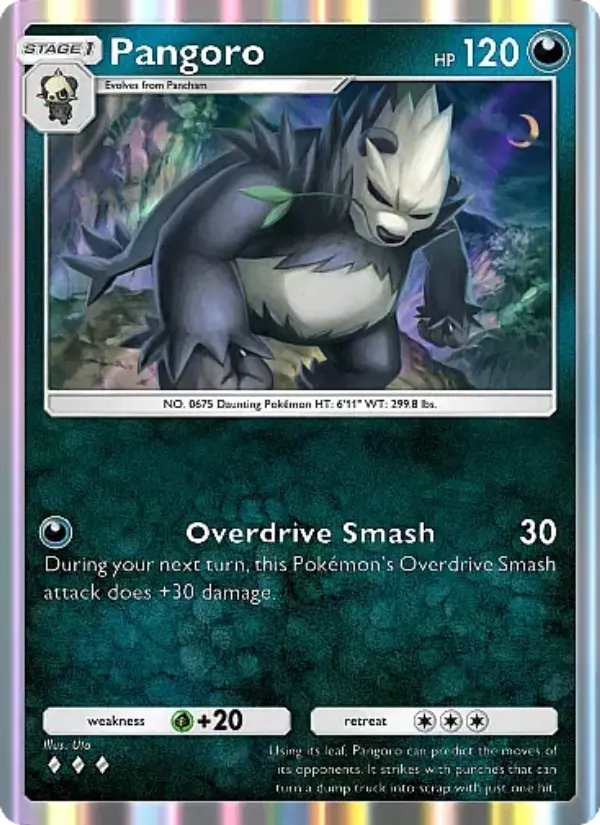
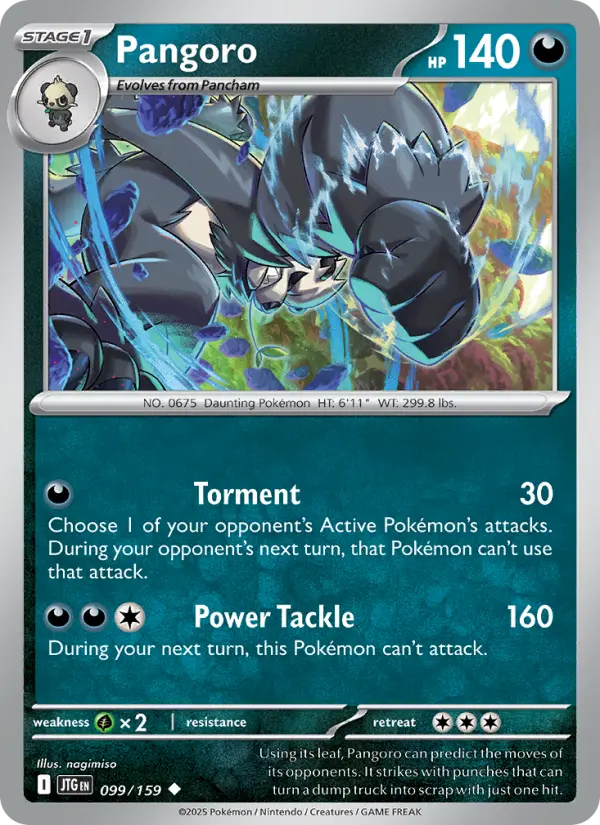
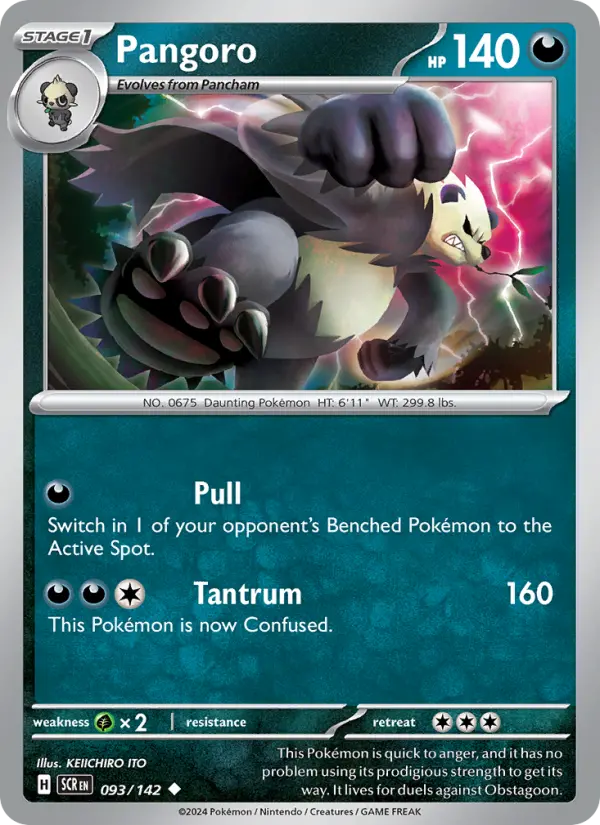
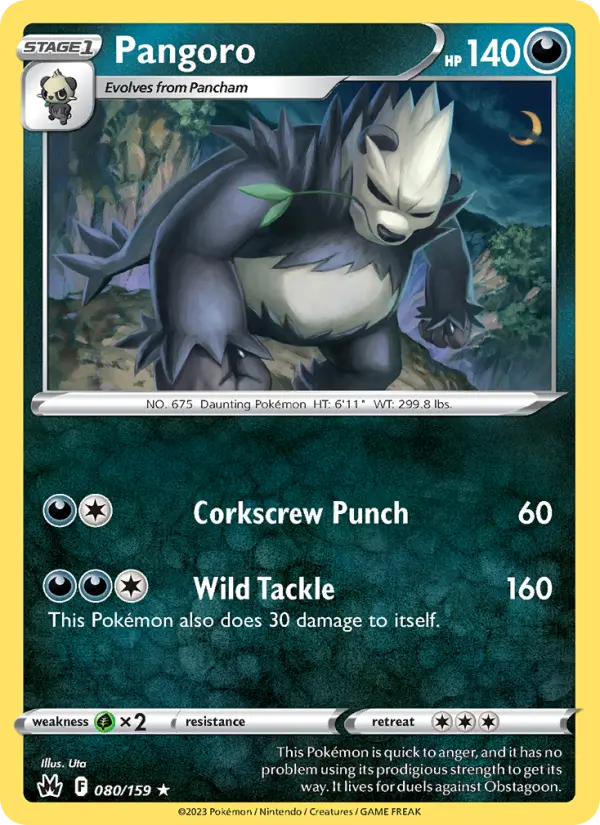
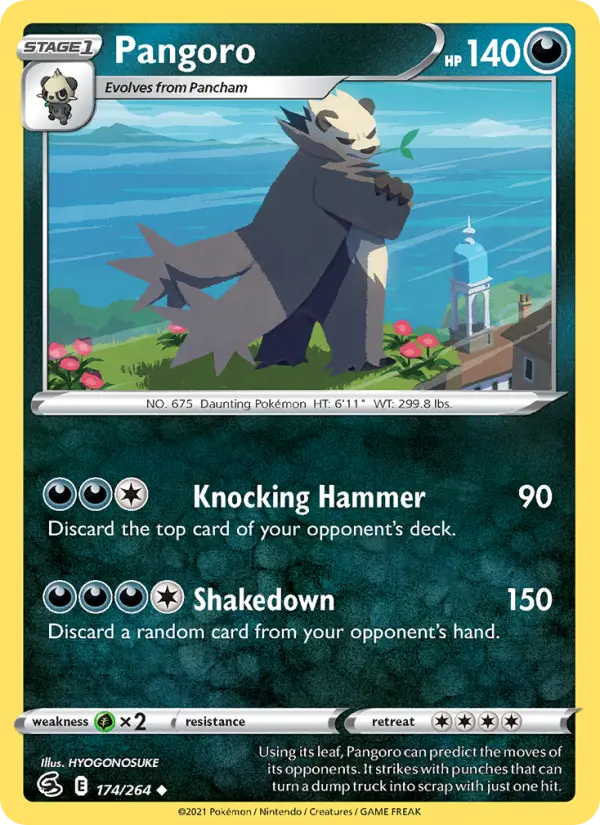
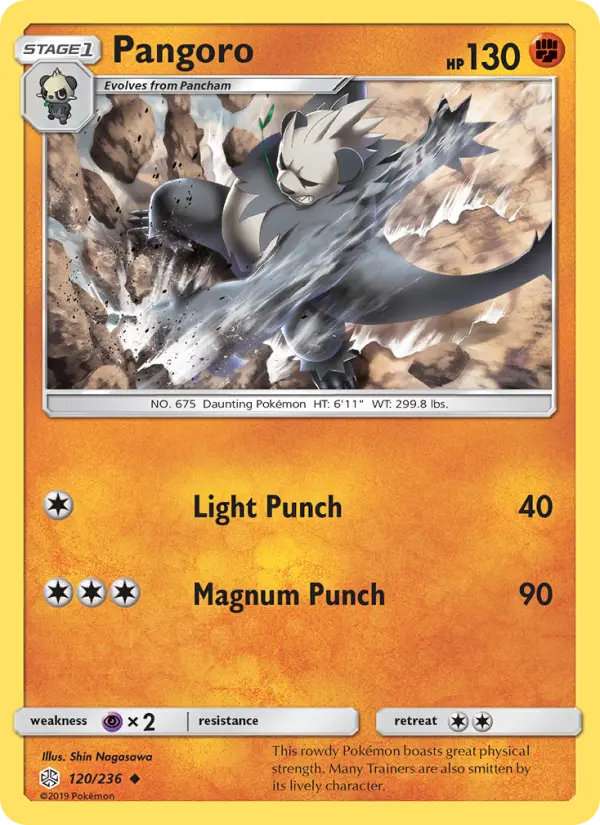
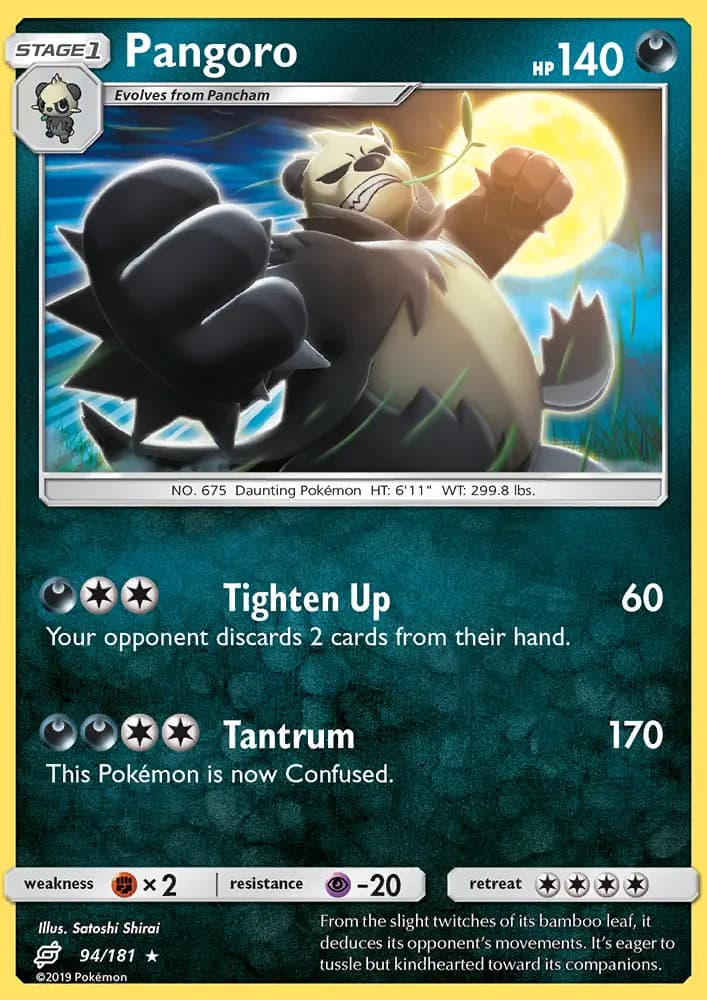
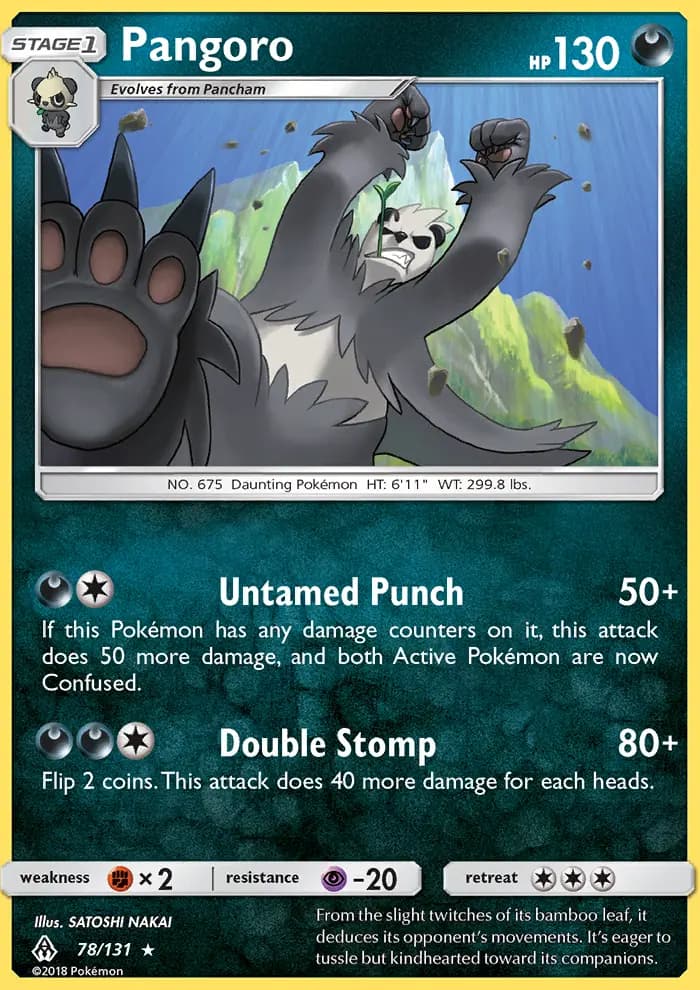
Pangoro is a large, bipedal Pokémon that bears a striking resemblance to a humanoid panda bear, though its coloration and build distinguish it as something far more formidable than its adorable pre-evolution. Its body features a stocky frame with a pronounced round belly and characteristically short legs supporting its considerable weight, while its arms are disproportionately long and muscular, ending in three-fingered paws equipped with sharp black claws. The creature's fur pattern is particularly distinctive: thick white fur covers its head and belly, while dark gray fur dominates its lower body, chest, arms, and back, creating an appearance reminiscent of wearing a long coat and trousers. A flowing cape of dark gray fur hangs dramatically down its back, further enhancing this sophisticated yet intimidating silhouette. One of Pangoro's most characteristic features is the thin-stemmed bamboo shoot with two leaves that it perpetually carries in its mouth. This is not merely a quirk of appearance but serves a critical sensory function, allowing Pangoro to detect minute vibrations and movements of its surroundings through the leaf's sensitivity. Its face is marked by a blunt snout with a triangular black nose, small rounded ears, and distinctive prominent fangs protruding from its lower jaw. The most striking facial feature is a pair of thick black semicircles positioned under its brow ridge, which effectively conceal its eyes and contribute to its intimidating countenance. This robust physiological structure, combined with its muscular development, makes Pangoro appear as a force of nature incarnate—a design that successfully conveys both the panda's natural charm and a warrior's unrelenting might.
Pokedex Numbers
Training
Breeding
Pangoro Breeding, Gender Ratio & Egg Groups
Pangoro has one of the simplest gender ratios in the game — a flat 50/50. This even distribution reflects the species' status as a standard Pokémon line without gender-specific characteristics or evolutionary branches. The breeding compatibility of Pangoro extends through two egg groups: the Field group and the Human-Like group, providing trainers with diverse breeding options and cross-breeding possibilities that can introduce valuable moves or abilities to offspring. With a base happiness value of 70 in Generations VI and VII (reduced to 50 in later generations), Pangoro begins with moderate affection toward its trainer, though dedicated trainers can increase this through consistent care, positive interactions, and successful battles. The breeding mechanics for Pangoro are notably straightforward, with eggs hatching after 25 cycles, translating to approximately 6,169 to 6,425 steps in-game depending on various factors. This moderate hatch time places Pangoro in the middle range of breeding convenience, making it neither particularly time-consuming nor especially quick to produce offspring. The dual egg group membership means Pangoro can breed with a wide variety of Pokémon, opening possibilities for creative breeding strategies. Trainers seeking to breed competitive Pangoro specimens can take advantage of move tutors and breeding chains to pass down powerful moves from other Pokémon in these egg groups, potentially creating offspring with enhanced movesets beyond what Pangoro would naturally learn through leveling. The gender-neutral nature of breeding in modern games means trainers have flexibility in pairing Pangoro with compatible partners regardless of sex.
Sprites






Held Items
Mental Herb
held-items
Held: Consumed to cure infatuation. Gen V: Also removes Taunt, Encore, Torment, Disable, and Cursed Body.
Cost: 4000
Mental Herb
held-items
Held: Consumed to cure infatuation. Gen V: Also removes Taunt, Encore, Torment, Disable, and Cursed Body.
Cost: 4000
Mental Herb
held-items
Held: Consumed to cure infatuation. Gen V: Also removes Taunt, Encore, Torment, Disable, and Cursed Body.
Cost: 4000
Mental Herb
held-items
Held: Consumed to cure infatuation. Gen V: Also removes Taunt, Encore, Torment, Disable, and Cursed Body.
Cost: 4000
Mental Herb
held-items
Held: Consumed to cure infatuation. Gen V: Also removes Taunt, Encore, Torment, Disable, and Cursed Body.
Cost: 4000
Mental Herb
held-items
Held: Consumed to cure infatuation. Gen V: Also removes Taunt, Encore, Torment, Disable, and Cursed Body.
Cost: 4000
Mental Herb
held-items
Held: Consumed to cure infatuation. Gen V: Also removes Taunt, Encore, Torment, Disable, and Cursed Body.
Cost: 4000
Mental Herb
held-items
Held: Consumed to cure infatuation. Gen V: Also removes Taunt, Encore, Torment, Disable, and Cursed Body.
Cost: 4000
TMs & HMs
tm00
sword shield
tm01
yellow
tm01
red blue
tm01
platinum
tm01
emerald
tm01
diamond pearl
tm01
firered leafgreen
tm01
ruby sapphire
tm01
black white
tm01
black 2 white 2
tm01
xd
tm01
colosseum
tm01
heartgold soulsilver
tm01
ultra sun ultra moon
tm01
omega ruby alpha sapphire
tm01
sun moon
tm01
x y
tm01
blue japan
tm01
red green japan
tm01
sword shield
+920 more TMs/HMs
Pangoro's Evolution Chain


Pangoro Evolution, Mega Evolution & Special Forms
Pangoro evolves from Pancham at level 32, but with a crucial condition that emphasizes the importance of team composition and trainer choice in the Pokémon world. Unlike most evolutions that occur automatically upon reaching a certain level, Pangoro's evolution requires that the player has a Dark-type Pokémon in their active party when Pancham reaches level 32. This unique evolution mechanic serves as a narrative device reflecting Pangoro's dual-type nature and the idea that Pancham develops into its more aggressive, daunting form only when exposed to the influence of darkness. The requirement encourages trainers to build diverse and thoughtful teams rather than relying on a single powerful creature, adding a layer of strategic team-building to what might otherwise be a straightforward evolution. This evolution condition has interesting implications for gameplay and lore alike. From a mechanical perspective, it means trainers cannot simply level-grind a Pancham to 32 without planning ahead, forcing them to consider their team composition and potentially teaching them about the importance of type diversity. From a narrative standpoint, the requirement suggests that Pangoro's transformation into a more powerful and aggressive fighter is directly tied to Dark-type influence, perhaps representing a conscious choice to embrace a more ruthless fighting style or the internalization of darker instincts. The evolution itself is visually dramatic, with Pancham's cute, panda-like features giving way to Pangoro's more imposing, anthropomorphic form that emphasizes musculature and presence. Currently, Pangoro has no Mega Evolution form, distinguishing it from some of its contemporaries and keeping it grounded as a standard evolutionary line without additional transformation mechanics.
Where to Find
Alola Route 11
alola
+1 more
Alola Route 10
alola
+1 more
Alola Route 17
alola
+1 more
Pangoro Behaviour and Natural Habitat
Pangoro exhibits a personality as layered and complex as its dual typing suggests. In battle, it transforms into a berserker of tremendous force, charging ahead with reckless abandon and showing no concern for the damage it sustains during combat. This aggressive battle philosophy stems from its unwavering confidence in its physical superiority and its conviction that direct confrontation is the only honest way to resolve disputes. However, outside of combat, Pangoro reveals a more nuanced character—it is fiercely protective of those it considers weaker, actively intervening against bullying and refusing to tolerate cruelty toward defenseless individuals. This creates an interesting dichotomy where Pangoro uses its considerable strength as both a tool for aggression and a shield for protection. The habitat preferences of Pangoro are not extensively detailed in official sources, but the species appears to be most commonly found in mountainous and forested regions. Notably, Pangoro has a particular affinity for engaging in duels with Obstagoon, suggesting it may inhabit areas where both species overlap or at least travel through varied terrain. The bamboo leaf it carries indicates some connection to bamboo forests or at least regions where such vegetation grows, similar to its pre-evolution Pancham. Trainers seeking to recruit Pangoro must be prepared for an unconventional recruitment process: rather than attempting to catch a wild specimen through traditional means, those who wish to become Pangoro's trainer have no choice but to engage it in combat and prove their worth through direct physical confrontation. This requirement for a trainer to 'converse with their fists' demonstrates Pangoro's philosophy that respect and relationships must be earned through strength and determination.
Pokedex Entries
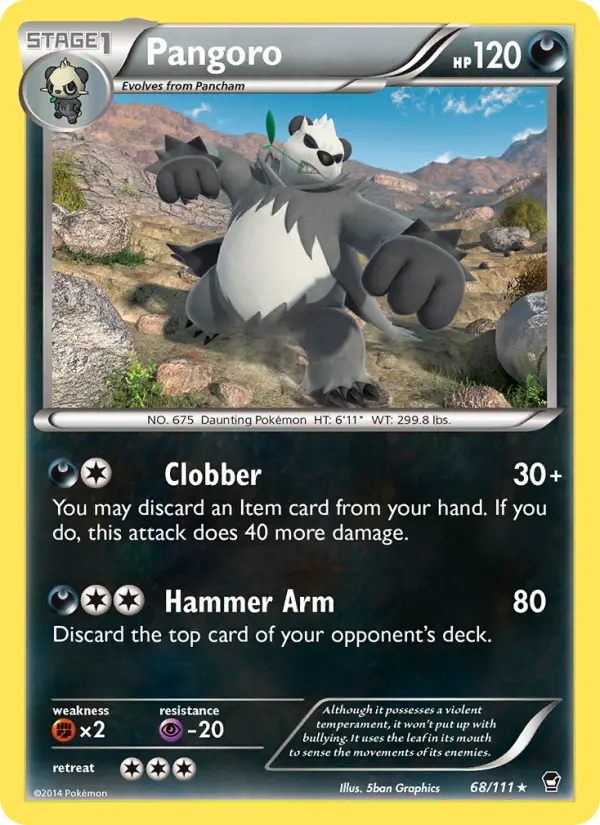
Although it possesses a violent temperament, it won’t put up with bullying. It uses the leaf in its mouth to sense the movements of its enemies.
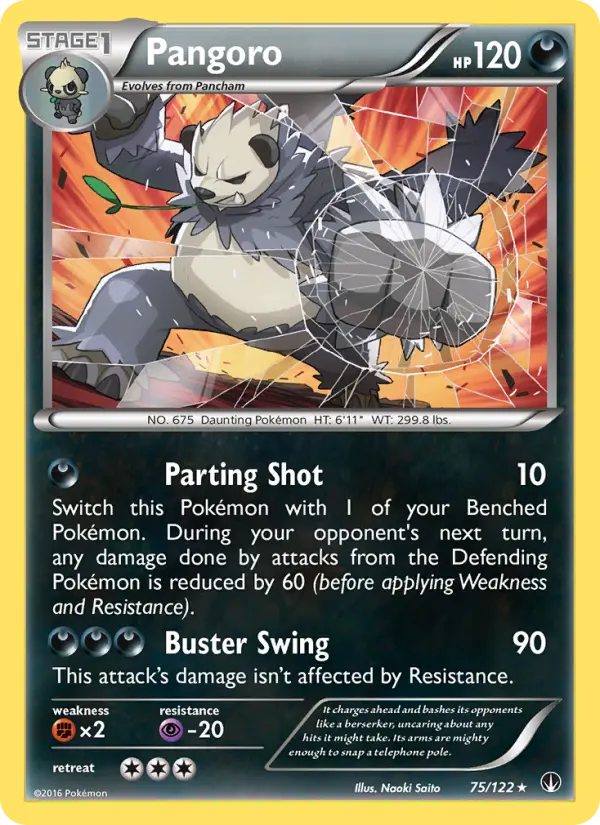
It charges ahead and bashes its opponents like a berserker, uncaring about any hits it might take. Its arms are mighty enough to snap a telephone pole.
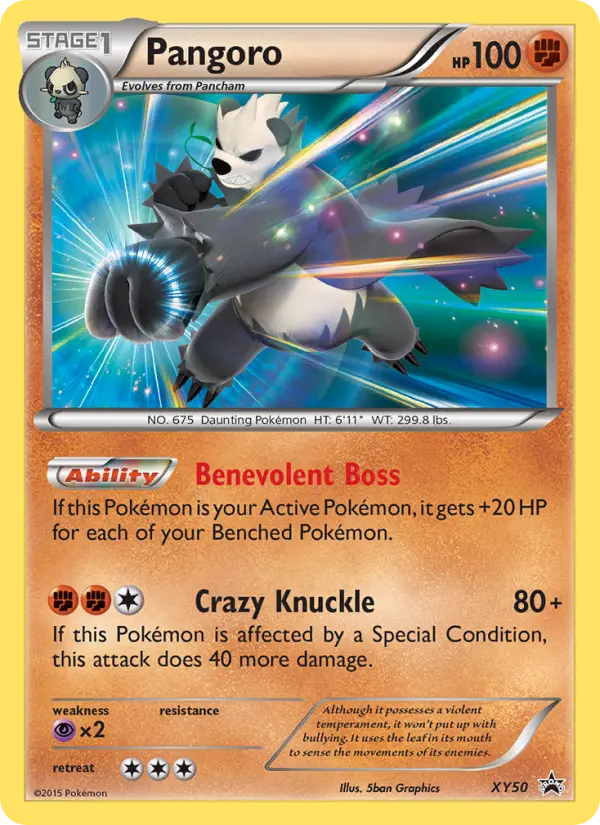
Although it possesses a violent temperament, it won’t put up with bullying. It uses the leaf in its mouth to sense the movements of its enemies.
It charges ahead and bashes its opponents like a berserker, uncaring about any hits it might take. Its arms are mighty enough to snap a telephone pole.
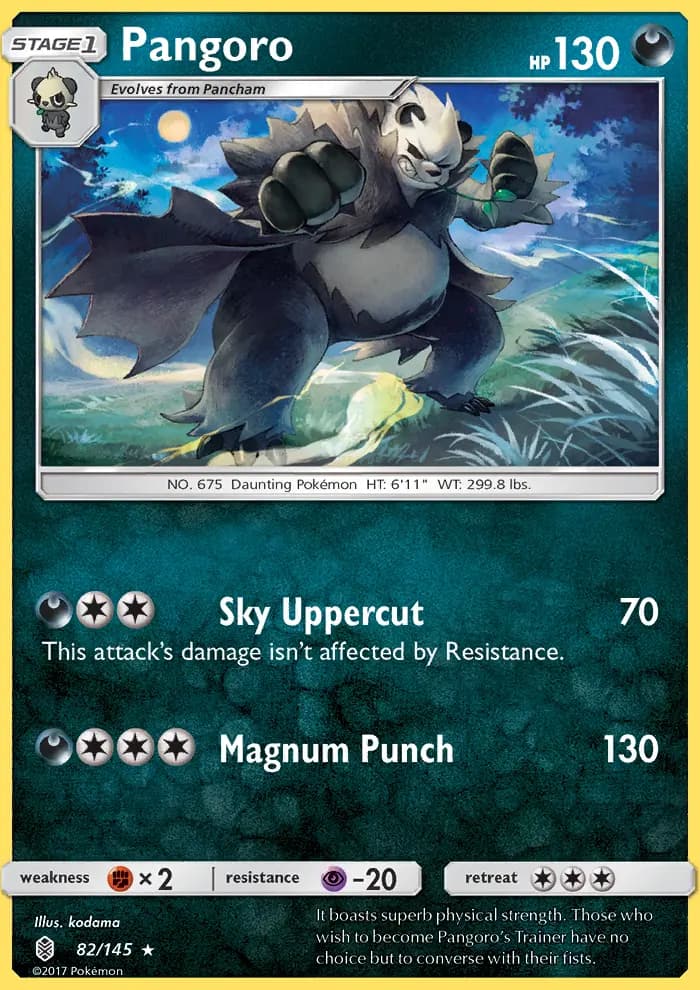
It boasts superb physical strength. Those who wish to become Pangoro’s Trainer have no choice but to converse with their fists.
This rowdy Pokémon boasts great physical strength. Many Trainers are also smitten by its lively character.
From the slight twitches of its bamboo leaf, it deduces its opponent’s movements. It’s eager to tussle but kindhearted toward its companions.
Pangoro is the type to talk with its fists. It doesn’t say much as it pummels opponents with enough force to send a dump truck flying.
This Pokémon is quick to anger, and it has no problem using its prodigious strength to get its way. It lives for duels against Obstagoon.
Using its leaf, Pangoro can predict the moves of its opponents. It strikes with punches that can turn a dump truck into scrap with just one hit.
Pangoro Name Origin & Design Inspiration
The Japanese name Goronda and English name Pangoro both derive from clear linguistic roots that reflect the Pokémon's essence. Pangoro combines 'panda' with 'oro,' a Spanish word meaning 'gold' or potentially referring to 'loro' (parrot), though the most straightforward interpretation connects it to the panda base with an emphasis on its value and strength. Goronda appears to blend 'gorilla' with 'panda,' capturing the essence of a creature that combines the cuddliness of a panda with the raw power and aggressive nature of a great ape. The name elegantly encapsulates the duality of this Pokémon—outwardly appearing as a large panda but possessing the ferocity and strength more commonly associated with primates. The design philosophy behind Pangoro reflects a deliberate subversion of expectations. Pandas, in real-world perception and popular culture, are typically represented as gentle, endearing creatures—symbols of conservation and peace. By taking this iconography and transforming it into a powerful, aggressive fighting-type Pokémon capable of incredible destruction, the designers created a creature that challenges preconceptions. The addition of the Dark type further emphasizes this transformation from cute to menacing. The bamboo leaf motif carries symbolic weight as well, serving as a connection to traditional Chinese and Japanese aesthetics while also grounding the Pokémon in a sense of natural heritage. The humanoid proportions and clothing-like pattern of fur suggest a martial artist or warrior archetype, positioning Pangoro as a creature that has transcended its cute origins through training, discipline, and a connection to darker impulses—much like how a martial artist develops power through dedication.
Learnable Moves
Pangoro can learn 112 moves:
Move | Type | Cat. | Power | Acc. | PP |
|---|---|---|---|---|---|
| aerial ace | flying | Physical | 60 | — | 20 |
| arm thrust | fighting | Physical | 15 | 100 | 20 |
| attract | normal | Status | — | 100 | 15 |
| beat up | dark | Physical | — | 100 | 10 |
| block | normal | Status | — | — | 5 |
| body slam | normal | Physical | 85 | 100 | 15 |
| brick break | fighting | Physical | 75 | 100 | 15 |
| bulk up | fighting | Status | — | — | 20 |
| bulldoze | ground | Physical | 60 | 100 | 20 |
| bullet punch | steel | Physical | 40 | 100 | 30 |
| circle throw | fighting | Physical | 60 | 90 | 10 |
| close combat | fighting | Physical | 120 | 100 | 5 |
| coaching | fighting | Status | — | — | 10 |
| comet punch | normal | Physical | 18 | 85 | 15 |
| confide | normal | Status | — | — | 20 |
| covet | normal | Physical | 60 | 100 | 25 |
| crunch | dark | Physical | 80 | 100 | 15 |
| cut | normal | Physical | 50 | 95 | 30 |
| dark pulse | dark | Special | 80 | 100 | 15 |
| darkest lariat | dark | Physical | 85 | 100 | 10 |
| dig | ground | Physical | 80 | 100 | 10 |
| double team | normal | Status | — | — | 15 |
| dragon claw | dragon | Physical | 80 | 100 | 15 |
| drain punch | fighting | Physical | 75 | 100 | 10 |
| dual chop | dragon | Physical | 40 | 90 | 15 |
| earthquake | ground | Physical | 100 | 100 | 10 |
| echoed voice | normal | Special | 40 | 100 | 15 |
| embargo | dark | Status | — | 100 | 15 |
| endeavor | normal | Physical | — | 100 | 5 |
| endure | normal | Status | — | — | 10 |
| entrainment | normal | Status | — | 100 | 15 |
| facade | normal | Physical | 70 | 100 | 20 |
| false swipe | normal | Physical | 40 | 100 | 40 |
| fire punch | fire | Physical | 75 | 100 | 15 |
| fling | dark | Physical | — | 100 | 10 |
| focus blast | fighting | Special | 120 | 70 | 5 |
| focus energy | normal | Status | — | — | 30 |
| focus punch | fighting | Physical | 150 | 100 | 20 |
| foul play | dark | Physical | 95 | 100 | 15 |
| frustration | normal | Physical | — | 100 | 20 |
| giga impact | normal | Physical | 150 | 90 | 5 |
| grass knot | grass | Special | — | 100 | 20 |
| gunk shot | poison | Physical | 120 | 80 | 5 |
| hammer arm | fighting | Physical | 100 | 90 | 10 |
| helping hand | normal | Status | — | — | 20 |
| hidden power | normal | Special | 60 | 100 | 15 |
| hone claws | dark | Status | — | — | 15 |
| hyper beam | normal | Special | 150 | 90 | 5 |
| hyper voice | normal | Special | 90 | 100 | 10 |
| ice punch | ice | Physical | 75 | 100 | 15 |
| infestation | bug | Special | 20 | 100 | 20 |
| iron head | steel | Physical | 80 | 100 | 15 |
| karate chop | fighting | Physical | 50 | 100 | 25 |
| knock off | dark | Physical | 65 | 100 | 20 |
| laser focus | normal | Status | — | — | 30 |
| lash out | dark | Physical | 75 | 100 | 5 |
| leer | normal | Status | — | 100 | 30 |
| low kick | fighting | Physical | — | 100 | 20 |
| low sweep | fighting | Physical | 65 | 100 | 20 |
| mega kick | normal | Physical | 120 | 75 | 5 |
| mega punch | normal | Physical | 80 | 85 | 20 |
| night slash | dark | Physical | 70 | 100 | 15 |
| outrage | dragon | Physical | 120 | 100 | 10 |
| parting shot | dark | Status | — | 100 | 20 |
| payback | dark | Physical | 50 | 100 | 10 |
| poison jab | poison | Physical | 80 | 100 | 20 |
| power up punch | fighting | Physical | 40 | 100 | 20 |
| protect | normal | Status | — | — | 10 |
| quash | dark | Status | — | 100 | 15 |
| rain dance | water | Status | — | — | 5 |
| rest | psychic | Status | — | — | 5 |
| retaliate | normal | Physical | 70 | 100 | 5 |
| return | normal | Physical | — | 100 | 20 |
| revenge | fighting | Physical | 60 | 100 | 10 |
| reversal | fighting | Physical | — | 100 | 15 |
| roar | normal | Status | — | — | 20 |
| rock slide | rock | Physical | 75 | 90 | 10 |
| rock smash | fighting | Physical | 40 | 100 | 15 |
| rock tomb | rock | Physical | 60 | 95 | 15 |
| round | normal | Special | 60 | 100 | 15 |
| scary face | normal | Status | — | 100 | 10 |
| secret power | normal | Physical | 70 | 100 | 20 |
| shadow claw | ghost | Physical | 70 | 100 | 15 |
| sky uppercut | fighting | Physical | 85 | 90 | 15 |
| slash | normal | Physical | 70 | 100 | 20 |
| sleep talk | normal | Status | — | — | 10 |
| sludge bomb | poison | Special | 90 | 100 | 10 |
| snarl | dark | Special | 55 | 95 | 15 |
| snatch | dark | Status | — | — | 10 |
| snore | normal | Special | 50 | 100 | 15 |
| spite | ghost | Status | — | 100 | 10 |
| stomping tantrum | ground | Physical | 75 | 100 | 10 |
| stone edge | rock | Physical | 100 | 80 | 5 |
| strength | normal | Physical | 80 | 100 | 15 |
| substitute | normal | Status | — | — | 10 |
| sunny day | fire | Status | — | — | 5 |
| superpower | fighting | Physical | 120 | 100 | 5 |
| surf | water | Special | 90 | 100 | 15 |
| swagger | normal | Status | — | 85 | 15 |
| swords dance | normal | Status | — | — | 20 |
| tackle | normal | Physical | 40 | 100 | 35 |
| taunt | dark | Status | — | 100 | 20 |
| thief | dark | Physical | 60 | 100 | 25 |
| throat chop | dark | Physical | 80 | 100 | 15 |
| thunder punch | electric | Physical | 75 | 100 | 15 |
| torment | dark | Status | — | 100 | 15 |
| toxic | poison | Status | — | 90 | 10 |
| uproar | normal | Special | 90 | 100 | 10 |
| vital throw | fighting | Physical | 70 | — | 10 |
| work up | normal | Status | — | — | 30 |
| x scissor | bug | Physical | 80 | 100 | 15 |
| zen headbutt | psychic | Physical | 80 | 90 | 15 |
Pangoro Competitive Battle Guide
Within competitive battling, Pangoro serves as a formidable physical attacker with an impressive Attack stat of 124, positioning it among the stronger attackers available to trainers. Its ability to learn punch-based moves makes the Iron Fist ability particularly valuable, as it boosts these moves to 1.2 times their normal power—a significant damage multiplier that can turn close battles in Pangoro's favor. The move pool available to Pangoro is respectable, including powerful options like Close Combat, Earthquake, Crunch, and Stone Edge, providing excellent coverage against a diverse range of opponents. The Mold Breaker hidden ability offers an alternative strategy, allowing Pangoro to ignore opponent abilities that would otherwise provide defensive benefits, making it capable of breaking through defensive walls that rely on abilities like Regenerator or Filter. However, Pangoro's competitiveness is tempered by several notable limitations. With a Speed stat of only 58, Pangoro is relatively slow and will often find itself moving second in exchanges, a disadvantage that forces trainers to rely on careful team building and speed control through priority moves or speed-reducing moves like Trick Room. Its defenses are middling at best, with Defense and Special Defense stats of 78 and 71 respectively, meaning Pangoro struggles to switch into attacks and often needs to press the offensive advantage before taking heavy damage. The Special Attack stat of 69 is disappointingly low, limiting Pangoro's utility outside of physical moves. Despite these drawbacks, Pangoro occupies a respectable niche in formats where physical offense dominates the metagame, and its type coverage combined with raw attacking power makes it a worthwhile consideration for trainers seeking a dedicated physical attacker. The availability of Pangoro in various Pokédex entries across different games and the relative ease of obtaining it in most titles means it remains a viable option for competitive builders of moderate skill levels.
Commonly Asked Questions About Pangoro
What type is Pangoro?
Pangoro is a fighting and dark type Pokemon.
What does Pangoro evolve from?
Pangoro evolved from pancham.
What are Pangoro's weaknesses?
Pangoro is weak to fighting, flying, psychic and fairy type moves.
Where can I find Pangoro?
Pangoro can be found in alola route 11 (alola), alola route 10 (alola) and alola route 17 (alola).
Pangoro Cultural Impact & Franchise History
Pangoro has developed a notable presence within Pokémon culture, particularly as a beloved fighting-type representative that appeals to trainers who appreciate both aesthetic appeal and combat prowess. The species gained significant visibility through its introduction in Generation VI alongside the Kalos region, where it became a notable part of the regional ecosystem and appeared in various trainer parties. Its unique evolution condition has made Pangoro somewhat iconic among players who engage with the deeper mechanics of the Pokémon world, as it represents a design philosophy that rewards thoughtful team composition and engagement with game systems rather than simple level-grinding. The character's design—combining adorable panda elements with martial artist aesthetics—has made it appealing across diverse demographics, from competitive players appreciating its combat capabilities to casual fans enjoying its visual charm. Beyond the games themselves, Pangoro has appeared in various Pokémon media including the trading card game, animated series appearances, and merchandise. Its role in the broader Pokémon universe as a proud martial artist and defender of the weak aligns well with popular tropes in Asian media and fighting game culture, giving it cultural resonance beyond just game mechanics. The Pokédex entry describing trainers needing to 'converse with their fists' to recruit Pangoro has become a memorable and quotable aspect of the species, encapsulating its philosophy in a way that has resonated with fans. In competitive circles, Pangoro remains a respected if not dominant force, representing the kind of honest physical prowess that appeals to trainers who prefer direct, straightforward battle strategies over gimmicks or complex setups.
Where to Find Pangoro in Every Pokémon Game
Pangoro's availability varies significantly depending on the Pokémon game version and generation, with the species becoming progressively more accessible as new generations and remakes have been released. In its debut generation, Pokémon X and Y, Pangoro can be obtained relatively early by catching a Pancham in the Kalos region and leveling it to 32 with a Dark-type Pokémon in the party, providing players access to this powerful fighting-type before the late game. Subsequent games have maintained Pangoro's availability in various ways: in Pokémon Sun and Moon, it appears in the Alola regional Pokédex, in Sword and Shield it's present in the Galar Pokédex, and it continues to be available in modern titles. The species can be caught with a capture rate of 65, which is moderately favorable, making it neither particularly difficult nor trivially easy to capture in the wild. For players seeking Pangoro outside of its native regions, breeding Pancham after obtaining Pangoro is a viable strategy, as the offspring will hatch as Pancham with the ability to evolve under the proper conditions. Pokédex entries across generations show local number assignments in various regional Pokédexes, such as #0092 in the Central Kalos region, #0221 in the Alola region, and #0112 in the Galar region, indicating consistent availability as a notable regional species. The species is also available in competitive online trading and battling systems, allowing players who don't have access to Pangoro in their specific game version to acquire one through trades with other players. Additionally, Pangoro appears in Pokémon Legends: Z-A, the upcoming Generation IX remake set in an expanded Kalos region, indicating its continued relevance and availability in the series' future titles. The relative ease of obtaining Pancham followed by simple evolution conditions means Pangoro remains accessible to most players regardless of their specific game version or geographic location.