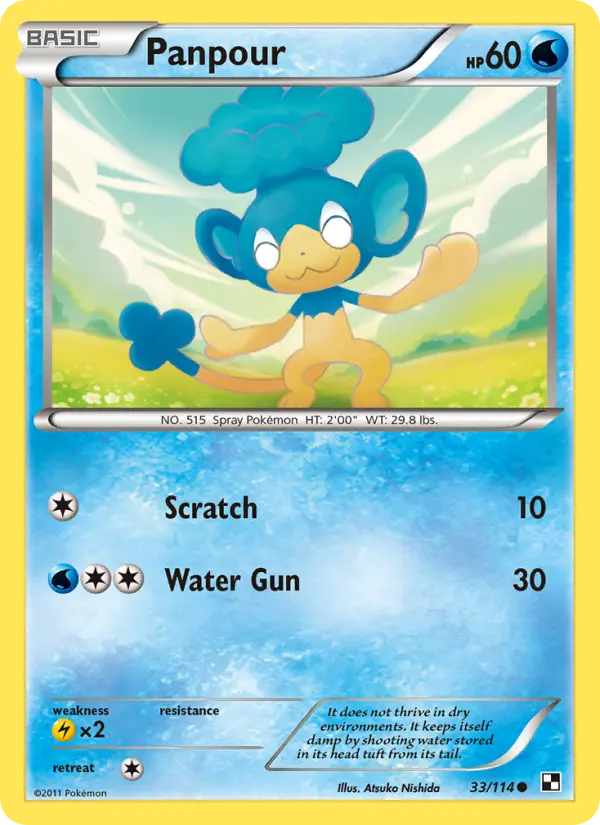
Panpour
Generation V · #0515 — Spray Pokémon
Panpour entered the roster in Generation V as a water-type, and what's stuck since is less its typing than its gluttony ability. It measures 0.6 m and 13.5 kg, dimensions that pair with that stat lean in noticeable ways. This small but distinctive Pokémon measures just 0.6 meters in height and weighs 13.5 kilograms, making it an accessible starter option for trainers beginning their journey in the Unova region. Panpour's most distinctive feature is the nutrient-rich water stored within the tuft atop its head, a biological marvel that allows it to sustain both itself and the plant life around it, making it an important symbiotic partner in its native ecosystems.
Editor's Take
Panpour completes a trio whose main purpose was covering the first gym's type, and none of the three ever found a role beyond that single battle.
Base Stats
Height
0.6m
Weight
13.5kg
Category
Spray Pokémon
Gender
Male 87.5% / Female 12.5%
Color
blue
Shape
upright
Abilities
Makes the Pokémon eat any held Berry triggered by low HP below 1/2 its max HP.
Strengthens water moves to inflict 1.5× damage at 1/3 max HP or less.
Panpour Biology & Physical Characteristics
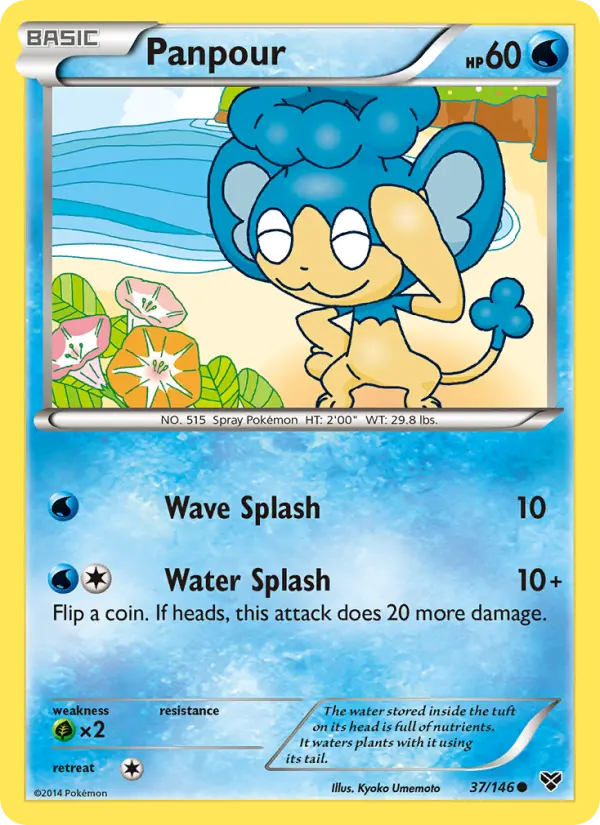
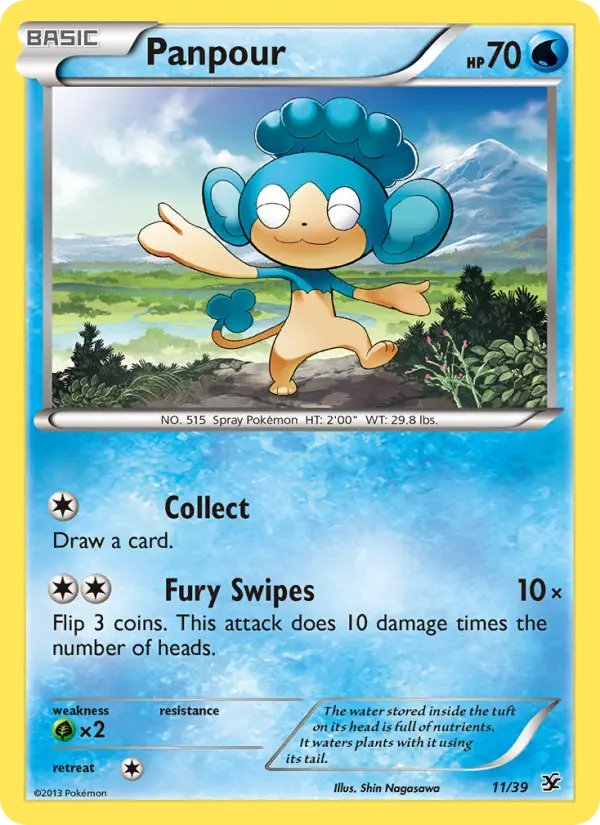
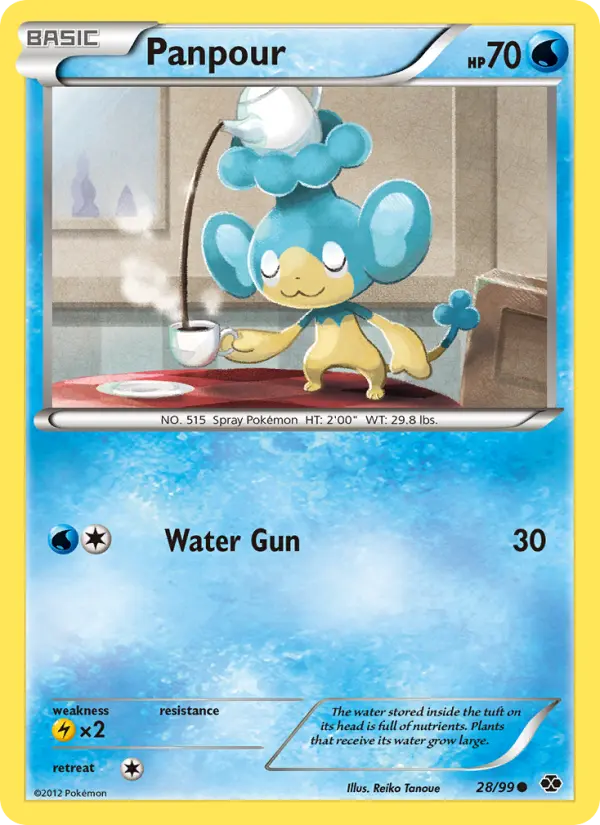
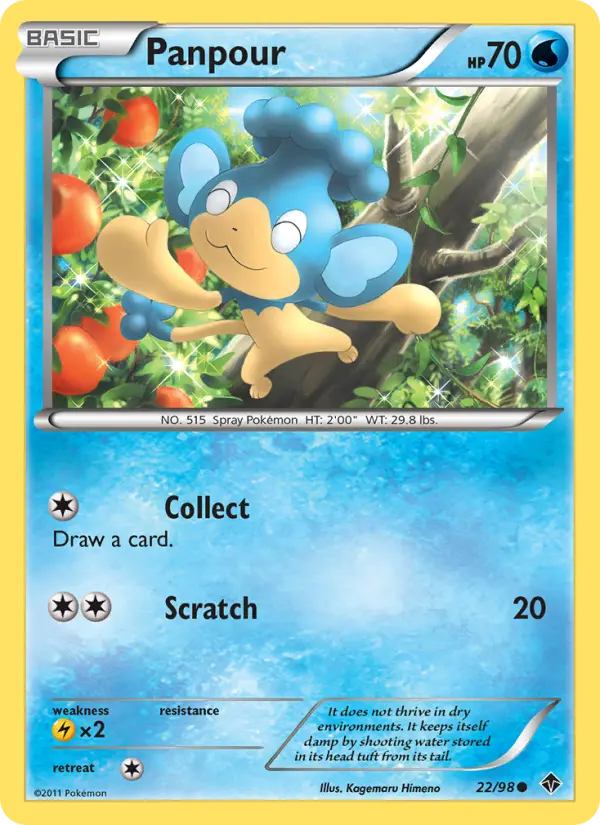
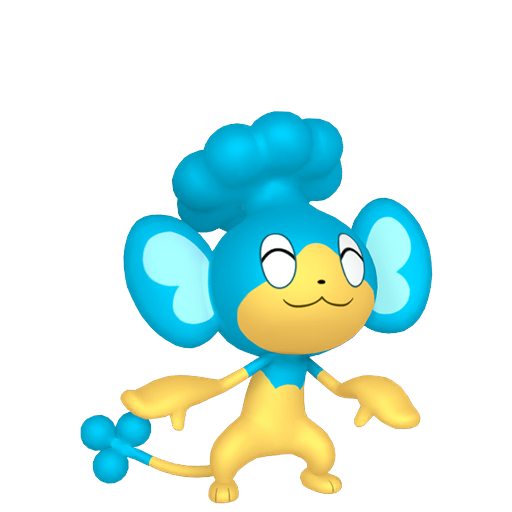
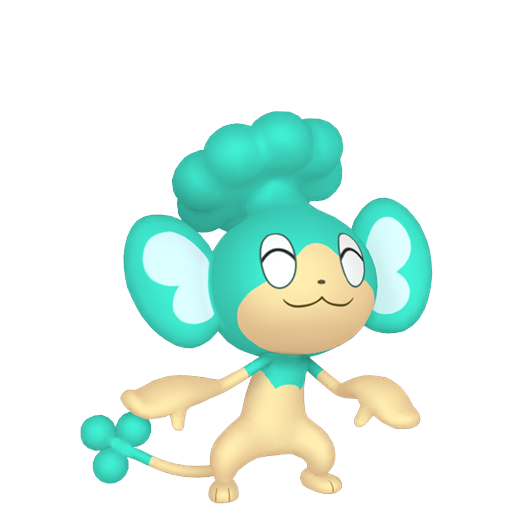
Panpour is a simian Pokémon with a striking blue and cream coloration scheme that reflects its aquatic nature. Its most prominent feature is the puffy, wave-like crest crowning its head, which serves as a living water reservoir containing nutrient-dense liquid crucial to its survival and ecological role. The Pokémon possesses large ears with light blue inner surfaces, perpetually closed oval eyes, and a diminutive black nose that gives it an innocent, endearing expression. A frilled blue feature adorns its neck and upper shoulders, while its muzzle, lower body, and comparatively thin forelimbs display cream-colored fur. Its hands lack traditional fingers save for a single thumb on each, and its feet are small with three toes each. The most remarkable anatomical feature is Panpour's long tail, which terminates in a distinctive clover-shaped tip and serves as the primary mechanism for distributing water from its head crest. This tail-based water distribution system allows Panpour to maintain moisture levels in dry conditions or deliberately irrigate surrounding vegetation.
Pokedex Numbers
Training
Breeding
Panpour Breeding, Gender Ratio & Egg Groups
Panpour exhibits a significant gender bias toward males, with approximately 88% of the population being male compared to just 13% female, a ratio that creates practical implications for breeding strategies. This extreme sexual dimorphism in population distribution may reflect ecological specialization or evolutionary pressures specific to Panpour's water-dependent lifestyle. The species belongs to the Field Egg Group, which encompasses a diverse array of terrestrial and semi-aquatic Pokémon, providing trainers with moderate breeding flexibility when planning competitive lineups or casual offspring. With a hatch counter of 20 cycles, Panpour eggs require considerable time investment to nurture, equivalent to approximately 4,884 to 5,140 steps in-game before hatching. The species maintains a medium growth rate, indicating neither accelerated nor delayed advancement through experience levels compared to standard Pokémon development timelines. A base friendship of 70 demonstrates that Panpour offspring are reasonably receptive to their trainers from inception, facilitating smoother integration into teams and easing the training process for newly hatched individuals.
Sprites




Held Items
Oran Berry
medicine
Held: Consumed at 1/2 max HP to recover 10 HP.
Cost: 80
Oran Berry
medicine
Held: Consumed at 1/2 max HP to recover 10 HP.
Cost: 80
Oran Berry
medicine
Held: Consumed at 1/2 max HP to recover 10 HP.
Cost: 80
Oran Berry
medicine
Held: Consumed at 1/2 max HP to recover 10 HP.
Cost: 80
Rindo Berry
type-protection
Held: Consumed when struck by a super-effective Grass-type attack to halve the damage.
Cost: 80
Rindo Berry
type-protection
Held: Consumed when struck by a super-effective Grass-type attack to halve the damage.
Cost: 80
Rindo Berry
type-protection
Held: Consumed when struck by a super-effective Grass-type attack to halve the damage.
Cost: 80
Rindo Berry
type-protection
Held: Consumed when struck by a super-effective Grass-type attack to halve the damage.
Cost: 80
TMs & HMs
tm01
platinum
tm01
emerald
tm01
diamond pearl
tm01
firered leafgreen
tm01
ruby sapphire
tm01
black white
tm01
black 2 white 2
tm01
xd
tm01
colosseum
tm01
heartgold soulsilver
tm01
ultra sun ultra moon
tm01
omega ruby alpha sapphire
tm01
sun moon
tm01
x y
tm02
lets go pikachu lets go eevee
tm03
ruby sapphire
tm03
platinum
tm03
firered leafgreen
tm03
heartgold soulsilver
tm03
diamond pearl
+635 more TMs/HMs


Panpour Evolution, Mega Evolution & Special Forms
Panpour undergoes a straightforward evolution into Simipour when exposed to a Water Stone, a condition that reflects the Pokémon's inherent water affinity and represents its maturation into a more powerful aquatic specialist. This evolution does not involve any form change or alternative evolution path, distinguishing it from some other Generation V Pokémon that offer multiple evolutionary branches. The evolution process mirrors that of its elemental monkey counterparts, Pansage evolving into Simisage with a Leaf Stone and Pansear into Simisear with a Fire Stone, establishing a consistent thematic pattern across the elemental monkey trio. Upon evolution, Panpour develops into Simipour, which maintains its Water typing while gaining increased base stats across multiple categories, particularly in Special Attack and Speed, enhancing its capability as both an offensive force and swift combatant. The evolutionary relationship between Panpour and Simipour represents a natural progression from a nurturing, ecosystem-focused creature to a more aggressive and powerful water manipulator.
Where to Find
Dreamyard
unova
Pinwheel Forest
unova
+1 more
Lostlorn Forest
unova
+1 more
Santalune Forest
kalos
Panpour Behaviour and Natural Habitat
Panpour demonstrates a strong dependency on aquatic environments, as reflected in multiple Pokédex entries noting that it does not thrive in dry conditions and actively maintains its hydration by regularly spraying water from its tail. The Pokémon is primarily found near freshwater sources such as rivers, streams, and wetlands, where it plays a vital ecological role as a plant nurturer. By distributing the nutrient-rich water stored in its head crest through its tail, Panpour promotes the growth of surrounding vegetation, earning it a reputation among local ecosystems as a beneficial presence. This behavior suggests a level of environmental awareness and benevolence uncommon among basic-stage Pokémon. The species exhibits moderate sociability and a base friendship value of 70, indicating that individuals are reasonably receptive to bonding with trainers, though they may require patience and understanding of their aquatic lifestyle preferences. Panpour's relatively high base speed of 64 suggests an active, agile demeanor befitting an arboreal and aquatic dweller.
Pokedex Entries
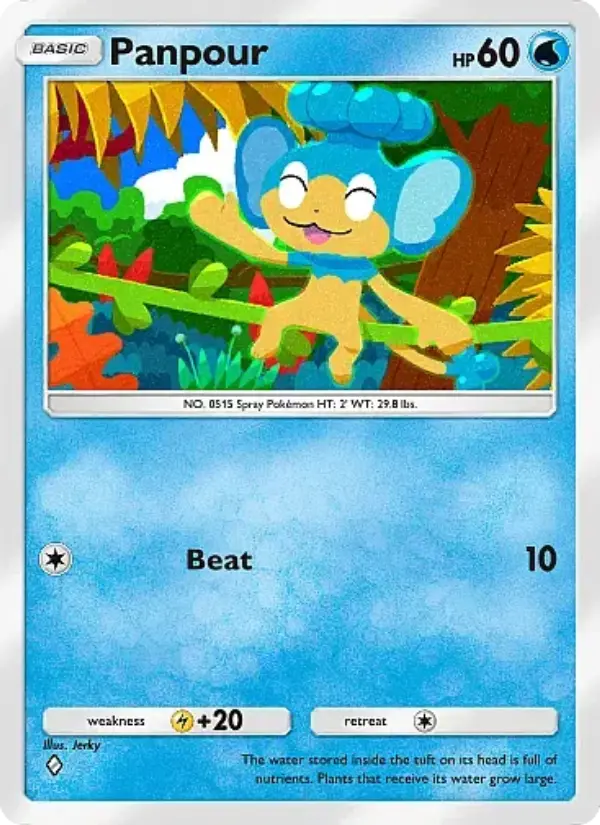
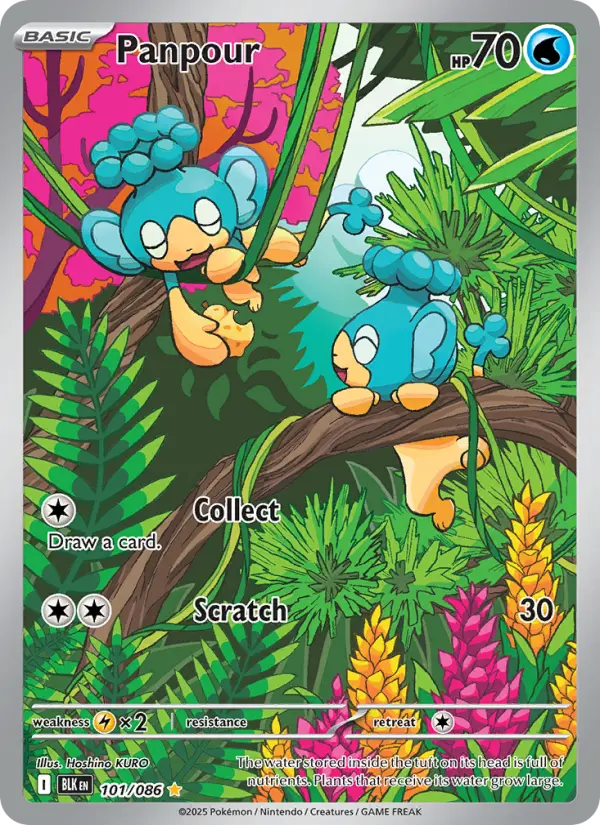
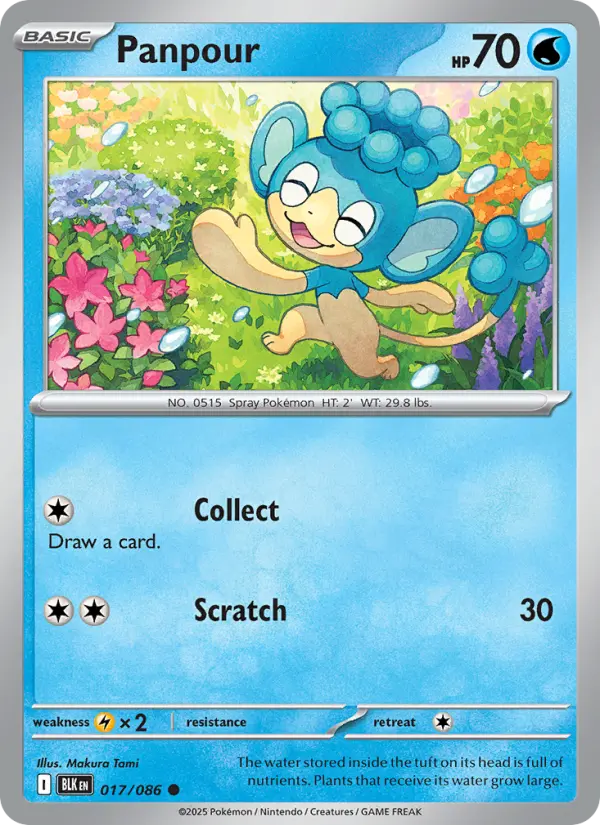
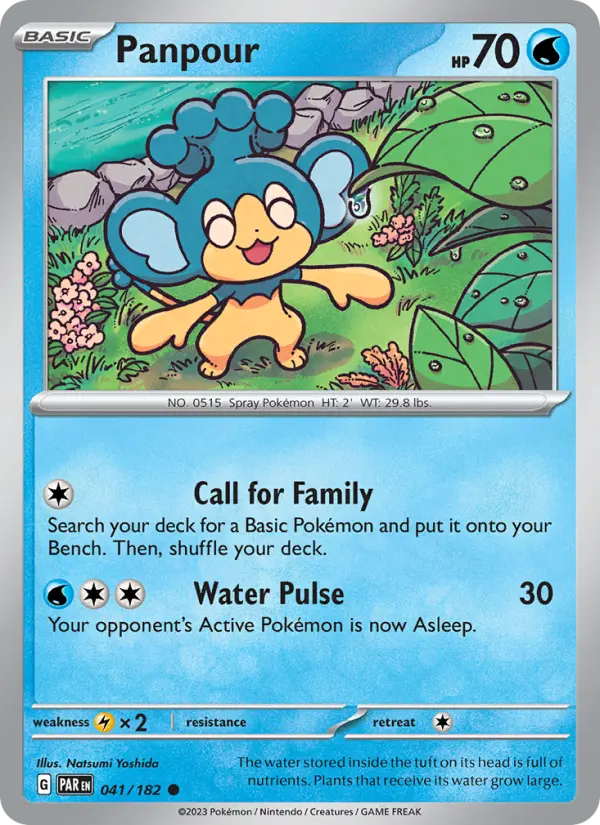
The water stored inside the tuft on its head is full of nutrients. Plants that receive its water grow large.
The water stored inside the tuft on its head is full of nutrients. It waters plants with it using its tail.
It does not thrive in dry environments. It keeps itself damp by shooting water stored in its head tuft from its tail.
The water stored inside the tuft on its head is full of nutrients. It waters plants with it using its tail.
The water stored inside the tuft on its head is full of nutrients. Plants that receive its water grow large.
The water stored inside the tuft on its head is full of nutrients. It waters plants with it using its tail.
The water stored inside the tuft on its head is full of nutrients. Plants that receive its water grow large.
Panpour Name Origin & Design Inspiration
Panpour's name origin lies in a combination of 'pan' (suggesting an onomatopoeia for water or the prefix denoting universality) and 'pour,' directly referencing the Pokémon's primary characteristic of spraying and pouring water. The Japanese name, Hiyappu, combines elements suggesting coolness or chill with a simian sound, reflecting both its water association and primate inspiration. Panpour's design draws heavily from capuchin and other small primates, incorporating their characteristic body structure, hand shape, and expressive facial features while overlaying distinctly aquatic elements. The wave-like crest atop its head may be inspired by water imagery or the flowing manes of certain aquatic mammals, creating a visual metaphor for the creature's liquid storage capability. The clover-shaped tail tip adds an element of whimsy and charm to the design while providing functional purpose as a water-dispensing appendage. The color palette of blue and cream mirrors traditional water-type aesthetics while maintaining distinction from the grass-type Pansage and fire-type Pansear, ensuring visual cohesion across the elemental monkey trio while preserving individual identity.
Learnable Moves
Panpour can learn 74 moves:
Move | Type | Cat. | Power | Acc. | PP |
|---|---|---|---|---|---|
| acrobatics | flying | Physical | 55 | 100 | 15 |
| aqua ring | water | Status | — | — | 20 |
| aqua tail | water | Physical | 90 | 90 | 10 |
| astonish | ghost | Physical | 30 | 100 | 15 |
| attract | normal | Status | — | 100 | 15 |
| bite | dark | Physical | 60 | 100 | 25 |
| blizzard | ice | Special | 110 | 70 | 5 |
| brine | water | Special | 65 | 100 | 10 |
| confide | normal | Status | — | — | 20 |
| covet | normal | Physical | 60 | 100 | 25 |
| crunch | dark | Physical | 80 | 100 | 15 |
| cut | normal | Physical | 50 | 95 | 30 |
| dig | ground | Physical | 80 | 100 | 10 |
| disarming voice | fairy | Special | 40 | — | 15 |
| dive | water | Physical | 80 | 100 | 10 |
| double team | normal | Status | — | — | 15 |
| endeavor | normal | Physical | — | 100 | 5 |
| facade | normal | Physical | 70 | 100 | 20 |
| fling | dark | Physical | — | 100 | 10 |
| focus punch | fighting | Physical | 150 | 100 | 20 |
| frustration | normal | Physical | — | 100 | 20 |
| fury swipes | normal | Physical | 18 | 80 | 15 |
| gastro acid | poison | Status | — | 100 | 10 |
| grass knot | grass | Special | — | 100 | 20 |
| gunk shot | poison | Physical | 120 | 80 | 5 |
| hail | ice | Status | — | — | 10 |
| helping hand | normal | Status | — | — | 20 |
| hidden power | normal | Special | 60 | 100 | 15 |
| hone claws | dark | Status | — | — | 15 |
| hydro pump | water | Special | 110 | 80 | 5 |
| ice beam | ice | Special | 90 | 100 | 10 |
| ice punch | ice | Physical | 75 | 100 | 15 |
| icy wind | ice | Special | 55 | 95 | 15 |
| iron tail | steel | Physical | 100 | 75 | 15 |
| knock off | dark | Physical | 65 | 100 | 20 |
| leer | normal | Status | — | 100 | 30 |
| lick | ghost | Physical | 30 | 100 | 30 |
| low kick | fighting | Physical | — | 100 | 20 |
| low sweep | fighting | Physical | 65 | 100 | 20 |
| mud sport | ground | Status | — | — | 15 |
| nasty plot | dark | Status | — | — | 20 |
| natural gift | normal | Physical | — | 100 | 15 |
| payback | dark | Physical | 50 | 100 | 10 |
| play nice | normal | Status | — | — | 20 |
| protect | normal | Status | — | — | 10 |
| rain dance | water | Status | — | — | 5 |
| recycle | normal | Status | — | — | 10 |
| rest | psychic | Status | — | — | 5 |
| return | normal | Physical | — | 100 | 20 |
| rock smash | fighting | Physical | 40 | 100 | 15 |
| rock tomb | rock | Physical | 60 | 95 | 15 |
| role play | psychic | Status | — | — | 10 |
| round | normal | Special | 60 | 100 | 15 |
| scald | water | Special | 80 | 100 | 15 |
| scratch | normal | Physical | 40 | 100 | 35 |
| secret power | normal | Physical | 70 | 100 | 20 |
| shadow claw | ghost | Physical | 70 | 100 | 15 |
| sleep talk | normal | Status | — | — | 10 |
| snore | normal | Special | 50 | 100 | 15 |
| substitute | normal | Status | — | — | 10 |
| surf | water | Special | 90 | 100 | 15 |
| swagger | normal | Status | — | 85 | 15 |
| taunt | dark | Status | — | 100 | 20 |
| thief | dark | Physical | 60 | 100 | 25 |
| tickle | normal | Status | — | 100 | 20 |
| torment | dark | Status | — | 100 | 15 |
| toxic | poison | Status | — | 90 | 10 |
| uproar | normal | Special | 90 | 100 | 10 |
| water gun | water | Special | 40 | 100 | 25 |
| water pledge | water | Special | 80 | 100 | 10 |
| water pulse | water | Special | 60 | 100 | 20 |
| water sport | water | Status | — | — | 15 |
| waterfall | water | Physical | 80 | 100 | 15 |
| work up | normal | Status | — | — | 30 |
Panpour Competitive Battle Guide
Panpour's competitive viability is significantly limited by its modest combined stat total of 316, distributed relatively evenly across most categories with notable concentrations in Speed (64) and Attack/Special Attack (53 each). The Pokémon functions primarily as an early-game water-type option in the Unova region, seldom appearing in higher-tier competitive formats due to its basic-stage limitations and accessibility only upon evolution to Simipour for genuinely competitive applications. Its ability selection offers two distinct strategic approaches: Gluttony, which triggers automatic consumption of held Berries when HP drops below half maximum, and the hidden ability Torrent, which amplifies Water-type move damage to 1.5x potency when remaining HP falls to one-third or less. In casual and competitive contexts, the Torrent ability generally proves more strategically valuable, offering significant offensive scaling in clutch moments. Panpour's movepool includes reliable Water-type coverage such as Water Gun and Bubble Beam at early levels, progressing to more powerful options like Hydro Pump upon evolution. Despite its limitations, Panpour serves admirably as an accessible introduction to water-type mechanics for newer players and provides foundation-building experience before evolving into Simipour.
Commonly Asked Questions About Panpour
What type is Panpour?
Panpour is a water type Pokemon.
What does Panpour evolve into?
Panpour evolves into simipour.
What are Panpour's weaknesses?
Panpour is weak to grass and electric type moves.
Does Panpour evolve by trading?
No — Panpour evolves entirely through leveling up, with no trade required at any stage.
Where can I find Panpour?
Panpour can be found in dreamyard (unova), pinwheel forest (unova) and lostlorn forest (unova) and 1 other locations.
Panpour Cultural Impact & Franchise History
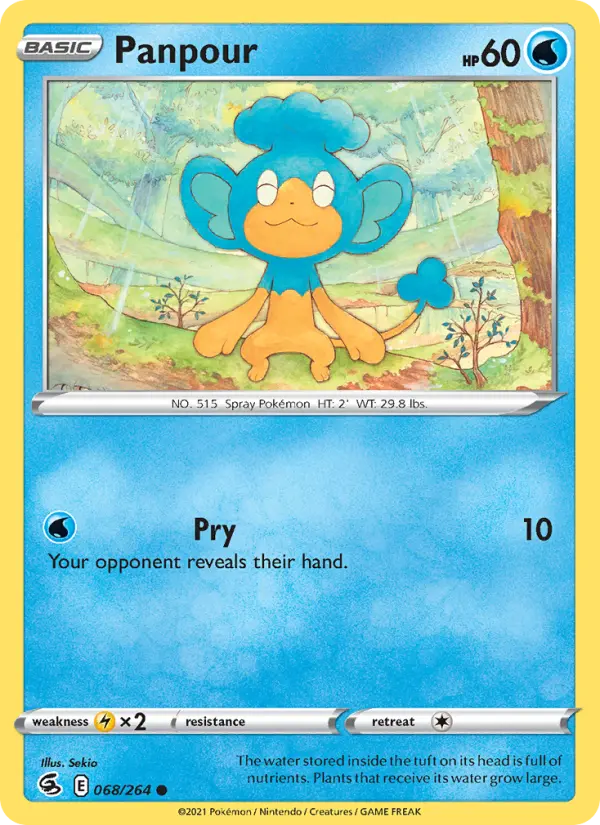
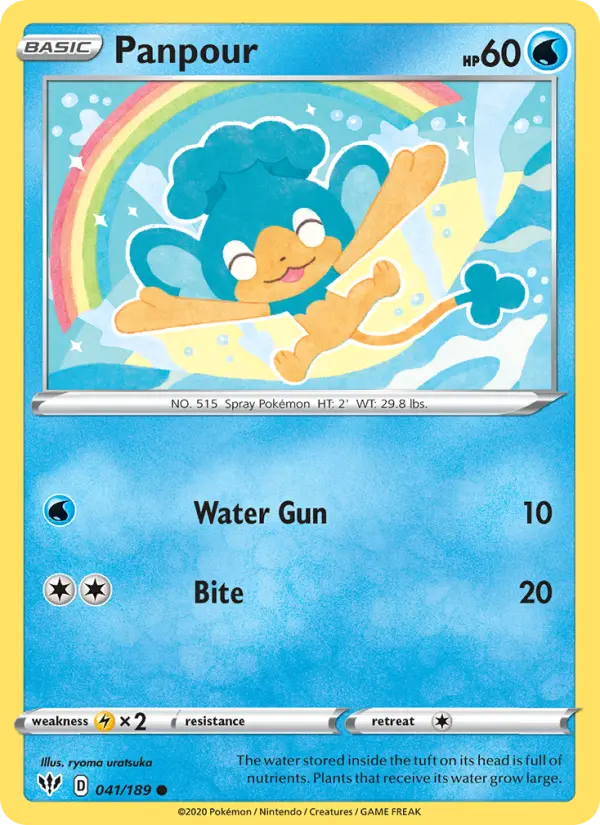
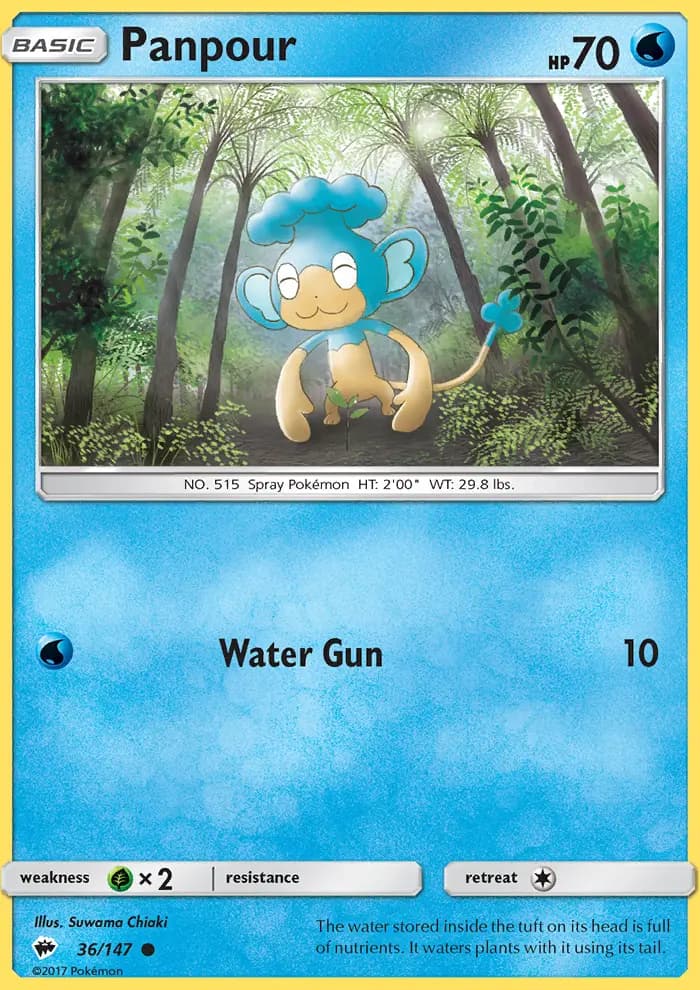
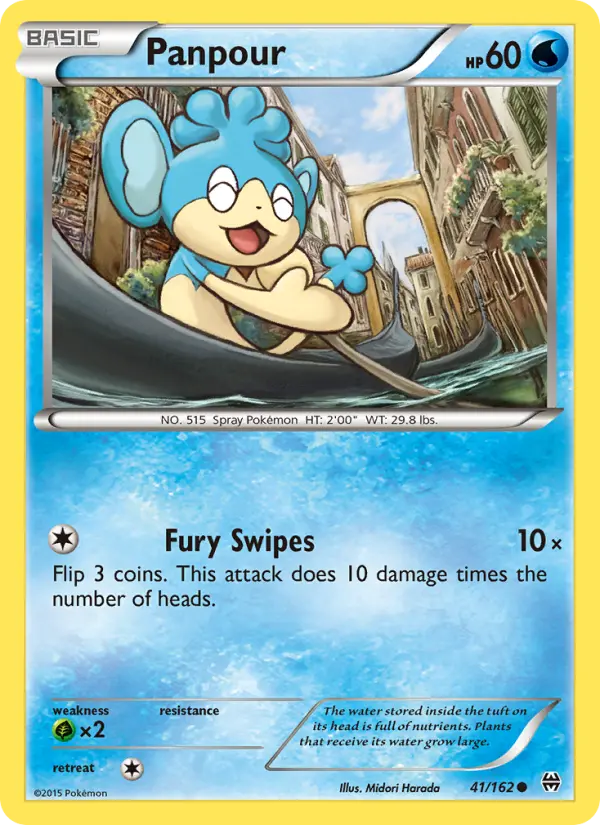
Panpour, as a member of the iconic elemental monkey trio, secured a lasting place in Pokémon cultural consciousness despite being part of Generation V's deliberate effort to create recognizable archetypal Pokémon. The creature has appeared in various animated series episodes, most notably as Cress's primary water-type Pokémon in the Unova region anime arc, where it demonstrated the species' loyalty and capability in structured battles. Goh's Panpour in more recent anime seasons introduced the species to new audiences, maintaining its relevance across multiple generations of the franchise. The elemental monkey trio as a collective concept resonates with players due to their accessibility, thematic coherence, and representative nature as starter-adjacent creatures not obtained through traditional professor-gifted methods. Panpour's design, emphasizing symbiotic environmental relationship and nurturing behavior, appeals to trainers seeking Pokémon that embody positive ecological values. The species has maintained consistent representation in merchandise, trading card games, and competitive communities, though often overshadowed by more statistically powerful water types. Its unique position as the nurturing water specialist distinguishes it from other aquatic Pokémon and contributes to its enduring appeal among players who value thematic consistency and biological plausibility.
Where to Find Panpour in Every Pokémon Game
Panpour was originally introduced in Generation V and made available to players within the Unova region as an unevolved water-type option found near aquatic locations throughout Black, White, Black 2, and White 2. In these games, Panpour appeared as Pokédex #021 in standard Black and White releases and #041 in the Unova Pokédex for Black 2 and White 2 versions, with capture rate of 190 indicating moderate obtainability through standard encounters. The species has appeared consistently across subsequent generations, including appearances in X and Y (Pokédex #0033 in Central Kalos) and Omega Ruby and Alpha Sapphire, maintaining its status as an accessible water-type for trainers progressing through established game narratives. Distribution expanded significantly through later generations, with Panpour appearing in Sword and Shield and other modern titles, though specific availability varies by game version and post-game content access. Beyond main-series games, Panpour has been featured in side games, promotional distributions through the Pokémon Global Link platform, and has maintained consistent presence in trading card game releases throughout multiple eras. Players seeking Panpour in contemporary titles should consult version-specific location data and availability calendars, as distribution methods have evolved substantially from Generation V's direct encounter-based mechanics to more sophisticated digital distribution systems.