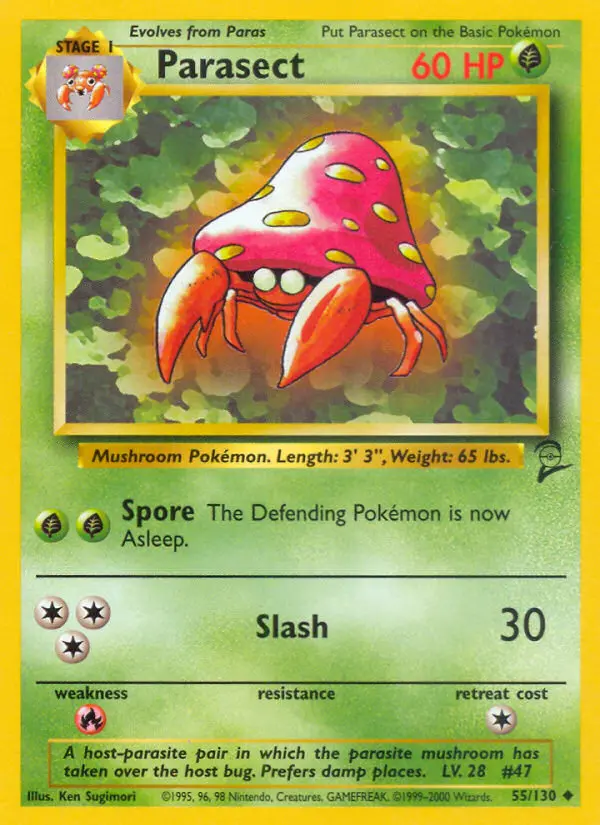
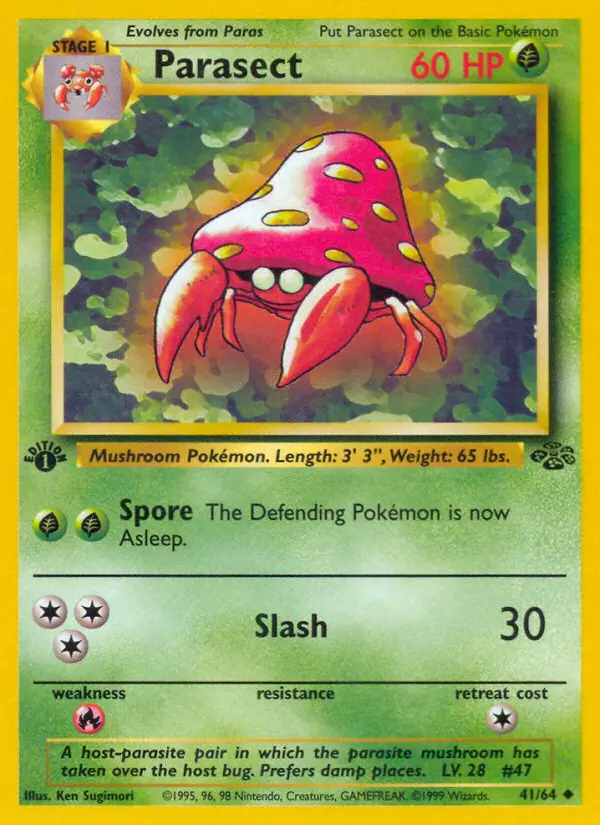
Parasect
Generation I · #0047 — Mushroom Pokémon
At 1 m and 29.5 kg, Parasect doesn't look like much on paper, but its effect spore ability shapes how it actually plays more than its size suggests. It measures 1.0 m and 29.5 kg, dimensions that pair with that stat lean in noticeable ways. What makes Parasect particularly intriguing is the nature of its existence: the insectoid host body has been almost entirely taken over by the parasitic mushroom growing on its back, creating a unique symbiotic—or perhaps parasitic—relationship that defines its entire biology and behavior. The creature's signature characteristic is that removing the mushroom causes the bug to stop moving entirely, raising profound questions about which organism is truly in control.
Editor's Take
Parasect being a bug controlled by the fungus on its back is the darkest piece of Gen 1 flavour text after Cubone, and the quad Fire weakness is the reason nobody gets to enjoy it.
Base Stats
Height
1.0m
Weight
29.5kg
Category
Mushroom Pokémon
Gender
Male 50% / Female 50%
Color
red
Shape
armor
Habitat
forest
Abilities
Has a 30% chance of inflcting either paralysis, poison, or sleep on attacking Pokémon on contact.
Causes 1/8 max HP in damage each turn during strong sunlight, but heals for 1/8 max HP during rain. Increases damage from fire moves to 1.25×, but absorbs water moves, healing for 1/4 max HP.
Prevents self destruct, explosion, and aftermath from working while the Pokémon is in battle.

Parasect Biology & Physical Characteristics
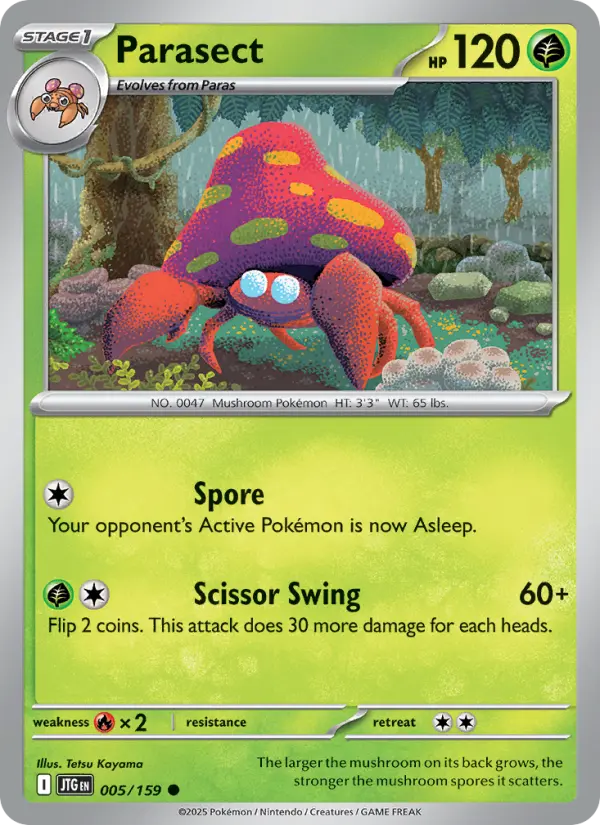
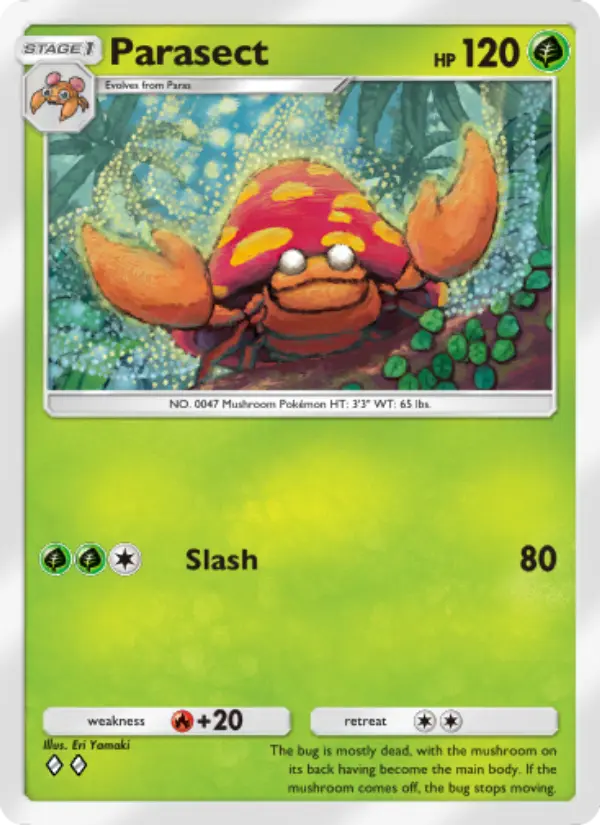
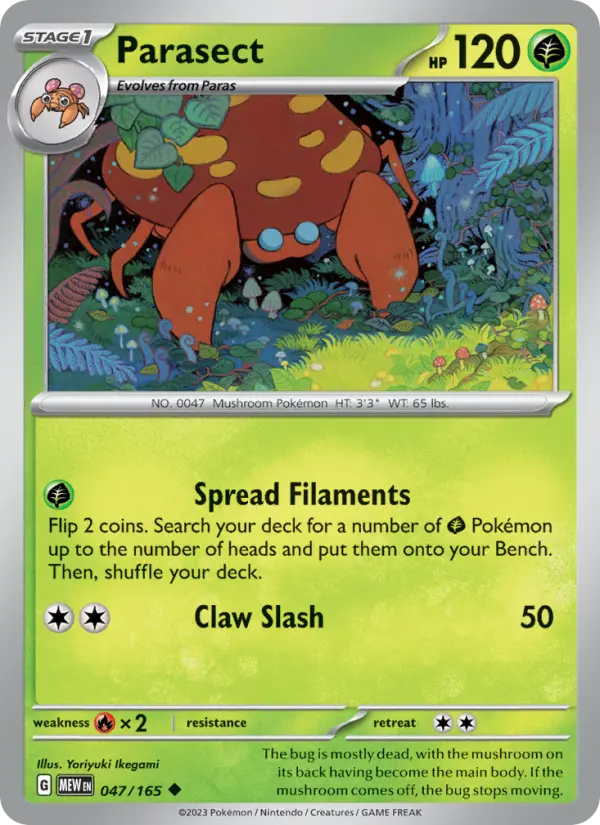
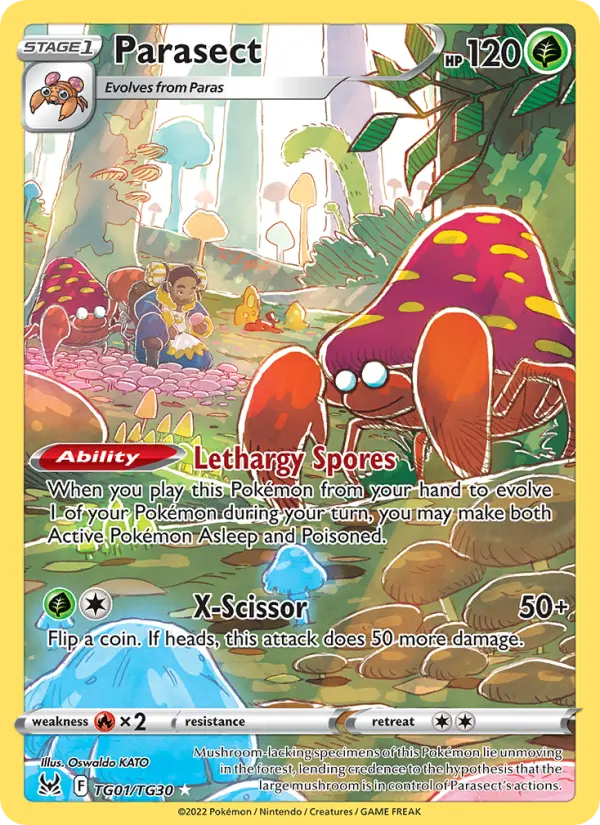
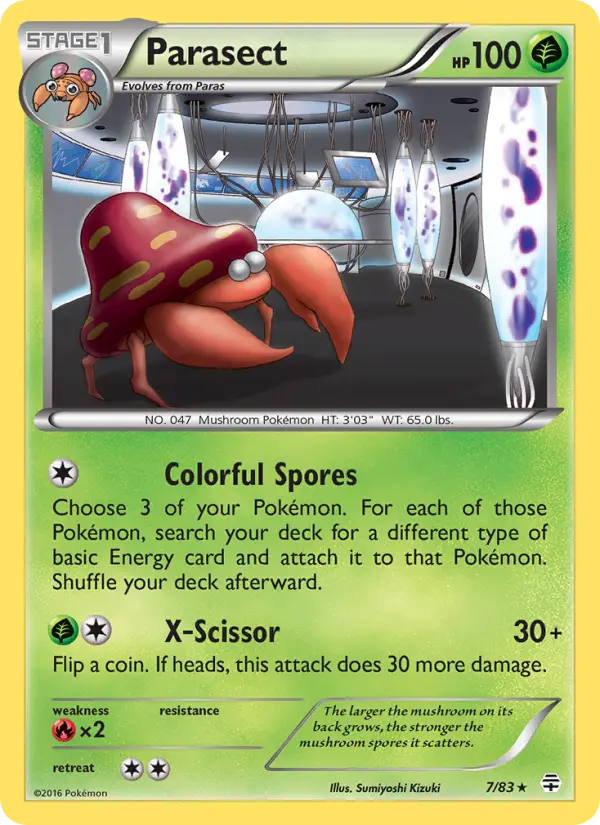
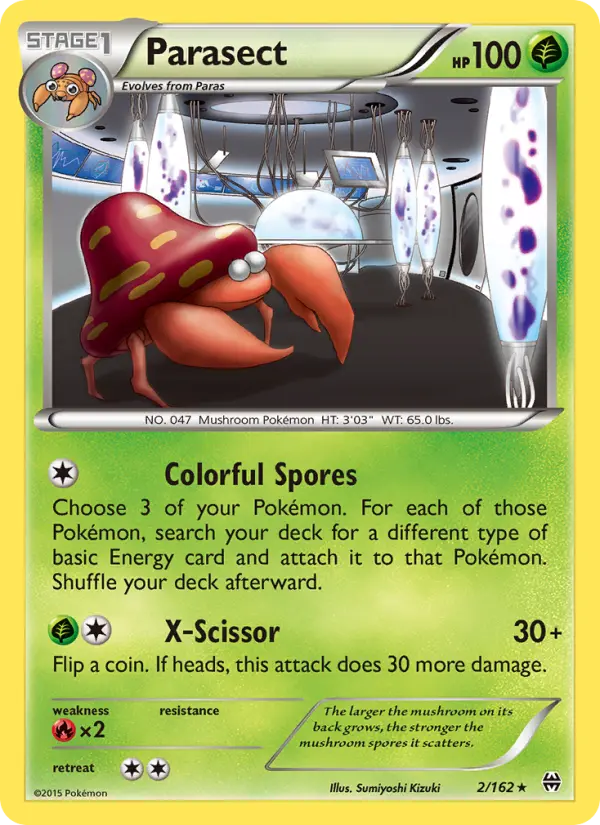
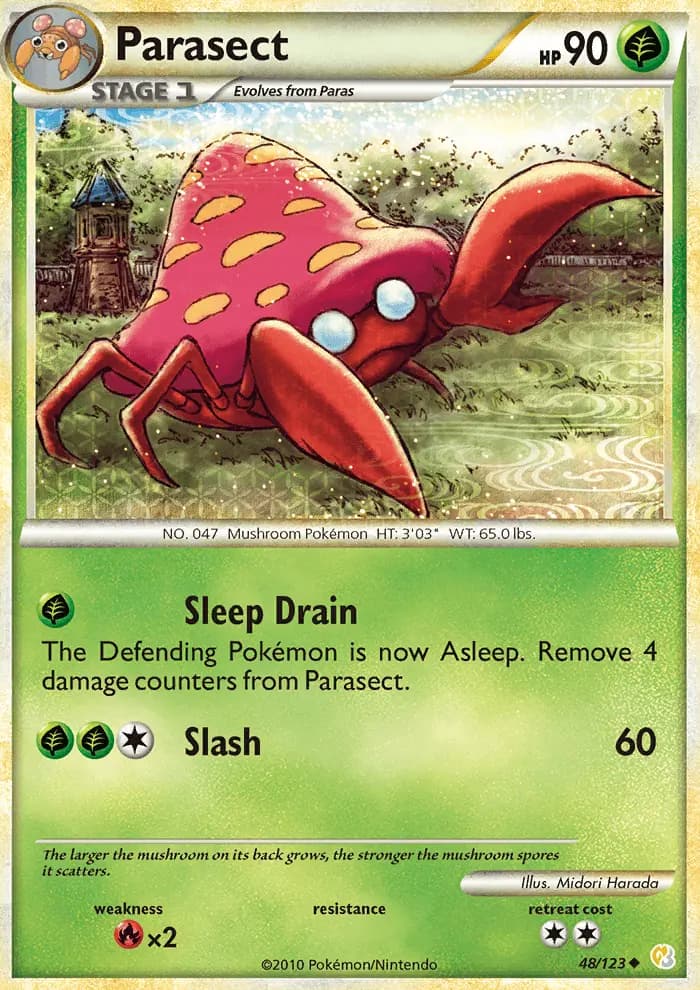
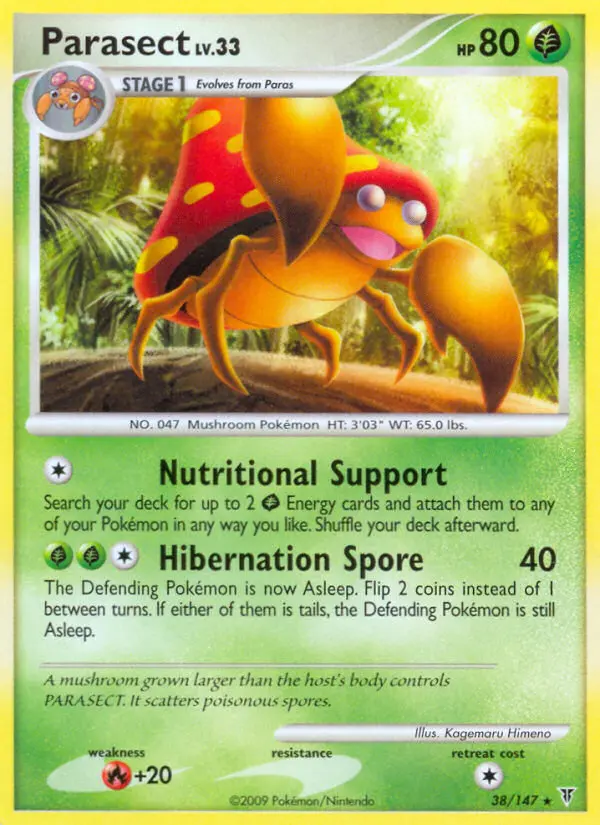
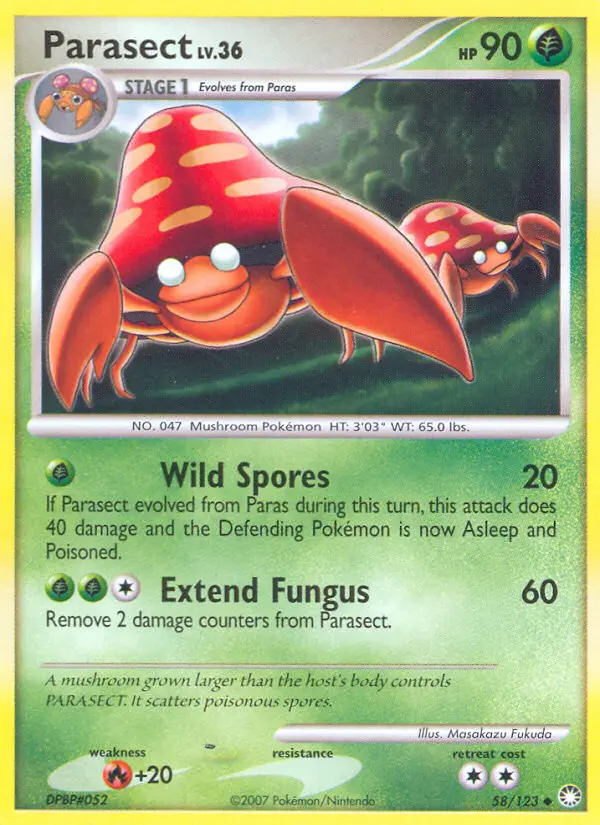
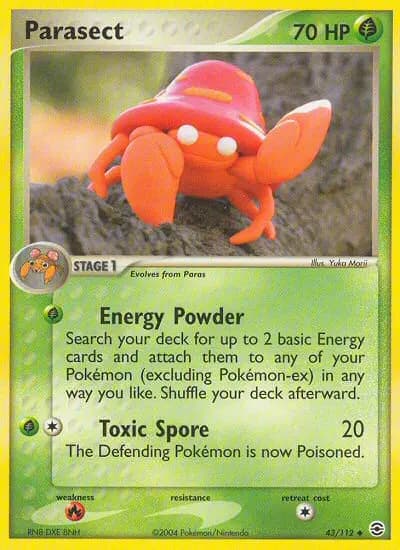
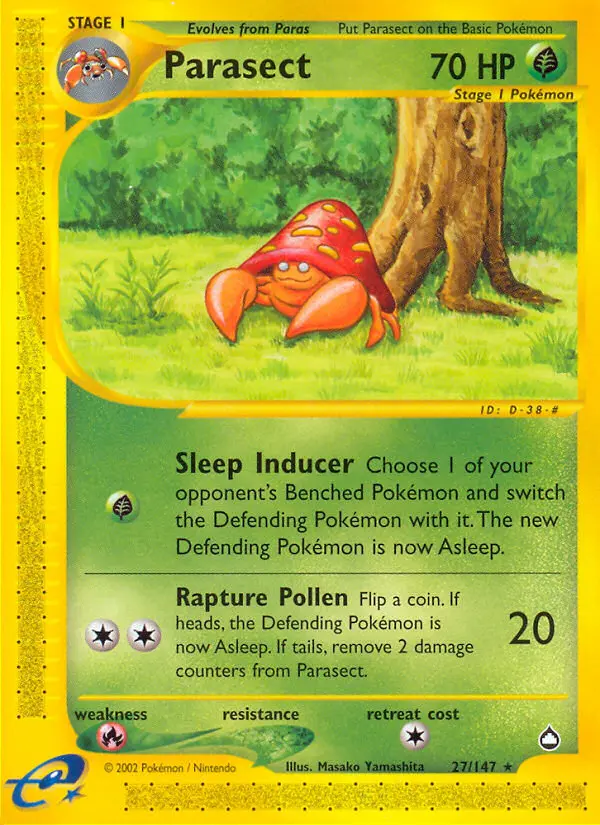
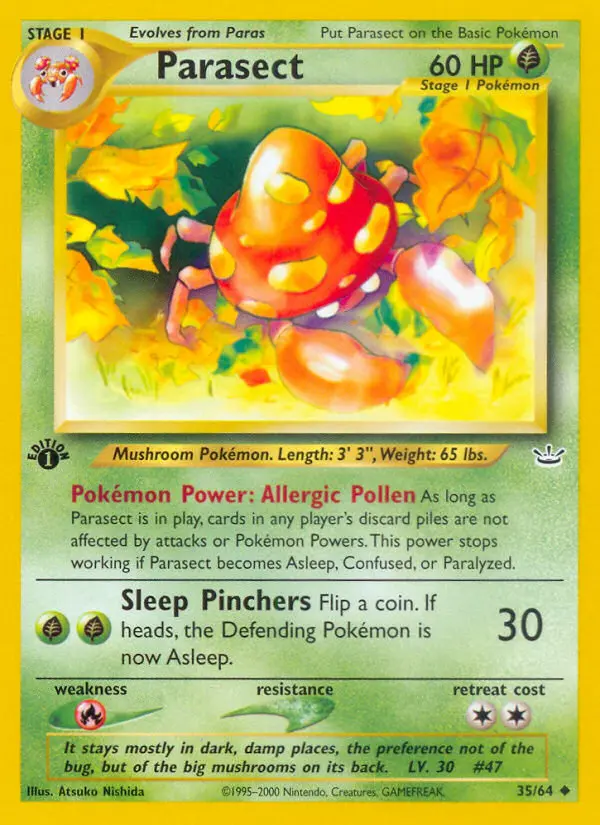
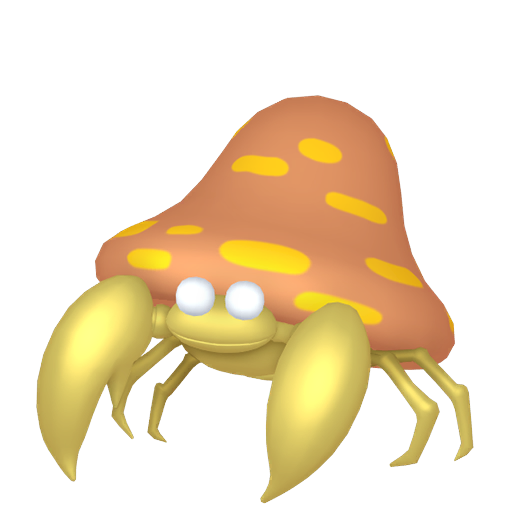
Parasect is an orange, insectoid Pokémon whose body has been fundamentally transformed by the massive mushroom cap that dominates its back. The creature possesses a small head with pure white eyes and a segmented body that is largely obscured by the fungal growth, with three pairs of legs where the foremost pair have evolved into large, powerful pincers. The mushroom itself is a striking red cap covered in yellow spots, representing the fully-matured tochukaso fungus that has completely parasitized the original bug host. According to multiple Pokédex entries across generations, the insect has been drained of nearly all its energy and nutrients, leading to the haunting conclusion that the mushroom—not the bug—is the true dominant organism. Specimens lacking their mushroom lie completely motionless in forests, providing concrete evidence that the fungus controls all voluntary movement and cognitive functions of the host body. The creature's biology is so dependent on humidity and darkness that it thrives exclusively in damp forest environments where fungal growth is optimal.
Pokedex Numbers
Training
Breeding
Parasect Breeding, Gender Ratio & Egg Groups
Parasect maintains a perfectly balanced gender ratio with 50% male and 50% female distribution, allowing for equal breeding opportunities regardless of the trainer's preference. The species belongs to the Bug and Grass egg groups, making it compatible with a diverse range of Pokémon for breeding purposes and allowing breeders to create hybrid offspring with various type combinations. With a base friendship value of 70, Parasect is reasonably easy to bond with, responding well to standard care and affection from trainers. The egg hatching process requires 20 cycles, equivalent to approximately 4,884 to 5,140 steps, placing it in the moderate range for breeding efficiency—faster than many legendary and pseudo-legendary Pokémon but slower than early-route creatures. The species exhibits a medium-fast growth rate, meaning Parasect reaches level 100 relatively quickly compared to slow-growth Pokémon like Dragonite or Metagross, but not as rapidly as fast-growth creatures like Golem. When breeding Parasect, trainers should note that the offspring will inherit the parent's potential for either of its standard abilities (Effect Spore or Dry Skin), with the hidden ability Damp being rarer and requiring specific breeding conditions or capture circumstances to obtain.
Sprites





Held Items
Big Mushroom
loot
Fire Red and Leaf Green: Trade for prior Level-up moves. Sell for 2500 Pokédollars, or to Hungry Maid for 5000 Pokédollars.
Cost: 5000
Big Mushroom
loot
Fire Red and Leaf Green: Trade for prior Level-up moves. Sell for 2500 Pokédollars, or to Hungry Maid for 5000 Pokédollars.
Cost: 5000
Big Mushroom
loot
Fire Red and Leaf Green: Trade for prior Level-up moves. Sell for 2500 Pokédollars, or to Hungry Maid for 5000 Pokédollars.
Cost: 5000
Big Mushroom
loot
Fire Red and Leaf Green: Trade for prior Level-up moves. Sell for 2500 Pokédollars, or to Hungry Maid for 5000 Pokédollars.
Cost: 5000
Big Mushroom
loot
Fire Red and Leaf Green: Trade for prior Level-up moves. Sell for 2500 Pokédollars, or to Hungry Maid for 5000 Pokédollars.
Cost: 5000
Big Mushroom
loot
Fire Red and Leaf Green: Trade for prior Level-up moves. Sell for 2500 Pokédollars, or to Hungry Maid for 5000 Pokédollars.
Cost: 5000
Big Mushroom
loot
Fire Red and Leaf Green: Trade for prior Level-up moves. Sell for 2500 Pokédollars, or to Hungry Maid for 5000 Pokédollars.
Cost: 5000
Big Mushroom
loot
Fire Red and Leaf Green: Trade for prior Level-up moves. Sell for 2500 Pokédollars, or to Hungry Maid for 5000 Pokédollars.
Cost: 5000
Big Mushroom
loot
Fire Red and Leaf Green: Trade for prior Level-up moves. Sell for 2500 Pokédollars, or to Hungry Maid for 5000 Pokédollars.
Cost: 5000
Big Mushroom
loot
Fire Red and Leaf Green: Trade for prior Level-up moves. Sell for 2500 Pokédollars, or to Hungry Maid for 5000 Pokédollars.
Cost: 5000
Big Mushroom
loot
Fire Red and Leaf Green: Trade for prior Level-up moves. Sell for 2500 Pokédollars, or to Hungry Maid for 5000 Pokédollars.
Cost: 5000
Big Mushroom
loot
Fire Red and Leaf Green: Trade for prior Level-up moves. Sell for 2500 Pokédollars, or to Hungry Maid for 5000 Pokédollars.
Cost: 5000
Big Mushroom
loot
Fire Red and Leaf Green: Trade for prior Level-up moves. Sell for 2500 Pokédollars, or to Hungry Maid for 5000 Pokédollars.
Cost: 5000
Big Mushroom
loot
Fire Red and Leaf Green: Trade for prior Level-up moves. Sell for 2500 Pokédollars, or to Hungry Maid for 5000 Pokédollars.
Cost: 5000
Big Mushroom
loot
Fire Red and Leaf Green: Trade for prior Level-up moves. Sell for 2500 Pokédollars, or to Hungry Maid for 5000 Pokédollars.
Cost: 5000
Big Mushroom
loot
Fire Red and Leaf Green: Trade for prior Level-up moves. Sell for 2500 Pokédollars, or to Hungry Maid for 5000 Pokédollars.
Cost: 5000
Big Mushroom
loot
Fire Red and Leaf Green: Trade for prior Level-up moves. Sell for 2500 Pokédollars, or to Hungry Maid for 5000 Pokédollars.
Cost: 5000
Big Mushroom
loot
Fire Red and Leaf Green: Trade for prior Level-up moves. Sell for 2500 Pokédollars, or to Hungry Maid for 5000 Pokédollars.
Cost: 5000
Big Mushroom
loot
Fire Red and Leaf Green: Trade for prior Level-up moves. Sell for 2500 Pokédollars, or to Hungry Maid for 5000 Pokédollars.
Cost: 5000
Big Mushroom
loot
Fire Red and Leaf Green: Trade for prior Level-up moves. Sell for 2500 Pokédollars, or to Hungry Maid for 5000 Pokédollars.
Cost: 5000
Balm Mushroom
loot
Sell to Hungry Maid for 25000 Pokédollars.
Cost: 15000
Balm Mushroom
loot
Sell to Hungry Maid for 25000 Pokédollars.
Cost: 15000
Balm Mushroom
loot
Sell to Hungry Maid for 25000 Pokédollars.
Cost: 15000
Balm Mushroom
loot
Sell to Hungry Maid for 25000 Pokédollars.
Cost: 15000
Tiny Mushroom
loot
Fire Red and Leaf Green: Trade two for prior Level-up moves. Sell for 250 Pokédollars, or to Hungry Maid for 500 Pokédollars.
Cost: 500
Tiny Mushroom
loot
Fire Red and Leaf Green: Trade two for prior Level-up moves. Sell for 250 Pokédollars, or to Hungry Maid for 500 Pokédollars.
Cost: 500
Tiny Mushroom
loot
Fire Red and Leaf Green: Trade two for prior Level-up moves. Sell for 250 Pokédollars, or to Hungry Maid for 500 Pokédollars.
Cost: 500
Tiny Mushroom
loot
Fire Red and Leaf Green: Trade two for prior Level-up moves. Sell for 250 Pokédollars, or to Hungry Maid for 500 Pokédollars.
Cost: 500
Tiny Mushroom
loot
Fire Red and Leaf Green: Trade two for prior Level-up moves. Sell for 250 Pokédollars, or to Hungry Maid for 500 Pokédollars.
Cost: 500
Tiny Mushroom
loot
Fire Red and Leaf Green: Trade two for prior Level-up moves. Sell for 250 Pokédollars, or to Hungry Maid for 500 Pokédollars.
Cost: 500
Tiny Mushroom
loot
Fire Red and Leaf Green: Trade two for prior Level-up moves. Sell for 250 Pokédollars, or to Hungry Maid for 500 Pokédollars.
Cost: 500
Tiny Mushroom
loot
Fire Red and Leaf Green: Trade two for prior Level-up moves. Sell for 250 Pokédollars, or to Hungry Maid for 500 Pokédollars.
Cost: 500
Tiny Mushroom
loot
Fire Red and Leaf Green: Trade two for prior Level-up moves. Sell for 250 Pokédollars, or to Hungry Maid for 500 Pokédollars.
Cost: 500
Tiny Mushroom
loot
Fire Red and Leaf Green: Trade two for prior Level-up moves. Sell for 250 Pokédollars, or to Hungry Maid for 500 Pokédollars.
Cost: 500
Tiny Mushroom
loot
Fire Red and Leaf Green: Trade two for prior Level-up moves. Sell for 250 Pokédollars, or to Hungry Maid for 500 Pokédollars.
Cost: 500
Tiny Mushroom
loot
Fire Red and Leaf Green: Trade two for prior Level-up moves. Sell for 250 Pokédollars, or to Hungry Maid for 500 Pokédollars.
Cost: 500
Tiny Mushroom
loot
Fire Red and Leaf Green: Trade two for prior Level-up moves. Sell for 250 Pokédollars, or to Hungry Maid for 500 Pokédollars.
Cost: 500
Tiny Mushroom
loot
Fire Red and Leaf Green: Trade two for prior Level-up moves. Sell for 250 Pokédollars, or to Hungry Maid for 500 Pokédollars.
Cost: 500
Tiny Mushroom
loot
Fire Red and Leaf Green: Trade two for prior Level-up moves. Sell for 250 Pokédollars, or to Hungry Maid for 500 Pokédollars.
Cost: 500
Tiny Mushroom
loot
Fire Red and Leaf Green: Trade two for prior Level-up moves. Sell for 250 Pokédollars, or to Hungry Maid for 500 Pokédollars.
Cost: 500
Tiny Mushroom
loot
Fire Red and Leaf Green: Trade two for prior Level-up moves. Sell for 250 Pokédollars, or to Hungry Maid for 500 Pokédollars.
Cost: 500
Tiny Mushroom
loot
Fire Red and Leaf Green: Trade two for prior Level-up moves. Sell for 250 Pokédollars, or to Hungry Maid for 500 Pokédollars.
Cost: 500
Tiny Mushroom
loot
Fire Red and Leaf Green: Trade two for prior Level-up moves. Sell for 250 Pokédollars, or to Hungry Maid for 500 Pokédollars.
Cost: 500
Tiny Mushroom
loot
Fire Red and Leaf Green: Trade two for prior Level-up moves. Sell for 250 Pokédollars, or to Hungry Maid for 500 Pokédollars.
Cost: 500
Tiny Mushroom
loot
Fire Red and Leaf Green: Trade two for prior Level-up moves. Sell for 250 Pokédollars, or to Hungry Maid for 500 Pokédollars.
Cost: 500
Tiny Mushroom
loot
Fire Red and Leaf Green: Trade two for prior Level-up moves. Sell for 250 Pokédollars, or to Hungry Maid for 500 Pokédollars.
Cost: 500
Big Mushroom
loot
Fire Red and Leaf Green: Trade for prior Level-up moves. Sell for 2500 Pokédollars, or to Hungry Maid for 5000 Pokédollars.
Cost: 5000
Big Mushroom
loot
Fire Red and Leaf Green: Trade for prior Level-up moves. Sell for 2500 Pokédollars, or to Hungry Maid for 5000 Pokédollars.
Cost: 5000
TMs & HMs
tm01
black white
tm01
black 2 white 2
tm01
lets go pikachu lets go eevee
tm01
omega ruby alpha sapphire
tm01
x y
tm02
crystal
tm02
gold silver
tm03
yellow
tm03
crystal
tm03
gold silver
tm03
red blue
tm03
blue japan
tm03
red green japan
tm05
lets go pikachu lets go eevee
tm06
yellow
tm06
gold silver
tm06
red blue
tm06
crystal
tm06
emerald
tm06
firered leafgreen
+660 more TMs/HMs
Parasect's Evolution Chain


Parasect Evolution, Mega Evolution & Special Forms
Parasect evolves from Paras upon reaching level 24, marking a significant transformation in the creature's appearance and capabilities. Unlike many evolutions that represent growth and development, Parasect's evolution is more accurately described as the final stage of parasitic takeover, where the mushroom reaches full maturity and completely dominates the host insect. The base stats shift dramatically from Paras's more balanced distribution to Parasect's emphasis on physical attack, which increases from 70 to 95—a substantial 25-point jump that reflects the enhanced physical capabilities granted by the fully-grown fungus. Meanwhile, defensive stats improve modestly (Defense rising from 55 to 80 and Special Defense from 55 to 80), while HP remains relatively low at 60 and Speed drops to an abysmal 30, the lowest point in its stat spread. This evolution pattern mirrors the biological reality described in Pokédex entries: as the mushroom grows larger and more dominant, the host becomes increasingly immobile and dependent, sacrificing speed for sheer physical power. Parasect does not receive a Mega Evolution, remaining in its final form throughout all contemporary games, though its abilities and movepool have been refined across generations to reflect its status as a mature, fully-parasitized organism.
Where to Find
Cerulean Cave
kanto
+32 more
Kanto Safari Zone
kanto
+11 more
Mt Silver
johto
+3 more
Alola Route 11
alola
Parasect Behaviour and Natural Habitat
Parasect exhibits complex social behavior that revolves around resource acquisition for its fungal parasite. These Pokémon are known to infest large trees en masse, with entire swarms working in coordination to drain nutrients from the lower trunks and roots until the tree dies completely, at which point the collective swarm moves to another suitable host tree in a remarkable display of organized foraging. The creature has also been documented engaging in territorial disputes with Shiinotic, another mushroom-based Pokémon, suggesting that despite being controlled by fungal matter, Parasect maintains competitive instincts and strategic thinking—though whether this originates from the bug or mushroom remains mysterious. Parasect prefers predominantly dark, damp places, a preference that clearly originates from the mushroom's requirements rather than the original bug's nature. The toxic spores scattered from its mushroom cap serve both offensive and medicinal purposes; in certain regions like China, these spores are harvested, steeped, and boiled down to create herbal medicines, making Parasect a valuable source of natural pharmaceutical compounds.
Pokedex Entries
A host-parasite pair in which the parasite mushroom has taken over the host bug. Prefers damp places.
The bug host is drained of energy by the mushrooms on its back. They appear to do all the thinking.
It stays mostly in dark, damp places, the preference not of the bug, but of the big mush rooms on its back.
The larger the mushroom on its back grows, the stronger the mush room spores it scatters.
When nothing's left to extract from the bug, the mushrooms on its back leave spores on the bug's egg.
PARASECT is known to infest large trees en masse and drain nutrients from the lower trunk and roots. When an infested tree dies, they move onto another tree all at once.
PARASECT are known to infest the roots of large trees en masse and drain nutrients. When an infested tree dies, they move onto another tree all at once.
It scatters toxic spores from the mushroom cap. In China, the spores are used as herbal medicine.
A host-parasite pair in which the parasite mushroom has taken over the host bug. Prefers damp places.
A mushroom grown larger than the host’s body controls PARASECT. It scatters poisonous spores.
It is controlled by a mushroom grown larger than the bug body. It is said to prefer damp places.
It stays mostly in dark, damp places, the preference not of the bug, but of the big mushroom on its back.
The larger the mushroom on its back grows, the stronger the mushroom spores it scatters.
A mushroom grown larger than the host’s body controls Parasect. It scatters poisonous spores.
A mushroom grown larger than the host’s body controls Parasect. It scatters poisonous spores.
A mushroom grown larger than the host’s body controls Parasect. It scatters poisonous spores.
The larger the mushroom on its back grows, the stronger the mushroom spores it scatters.
Parasect is known to infest large trees en masse and drain nutrients from the lower trunk and roots. When an infested tree dies, they move onto another tree all at once.
Parasect is known to infest large trees en masse and drain nutrients from the lower trunk and roots. When an infested tree dies, they move onto another tree all at once.
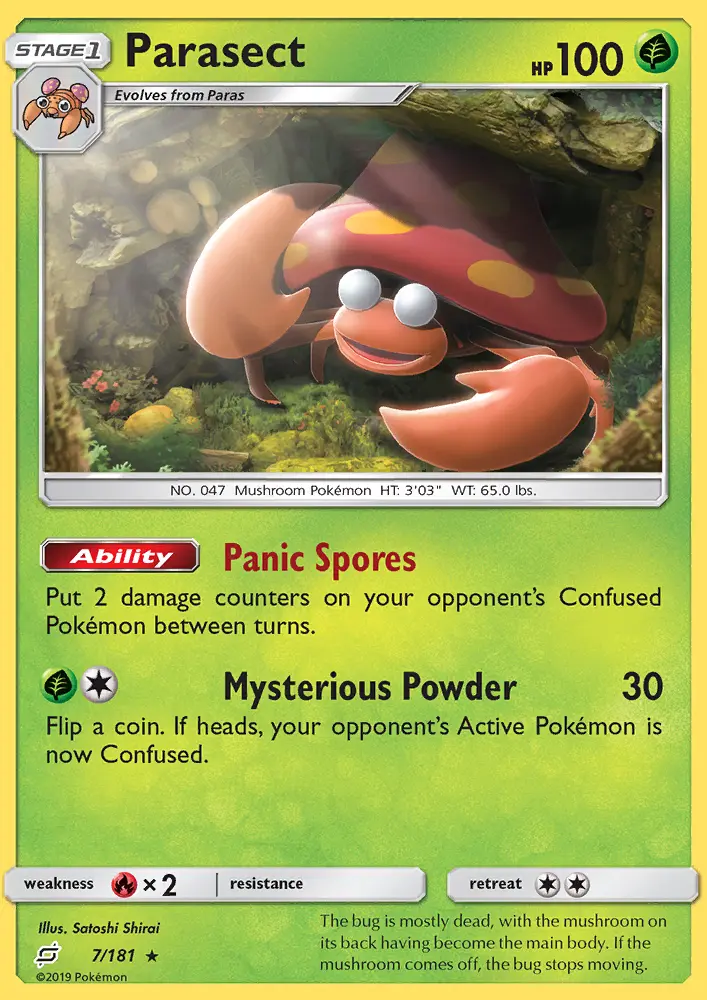
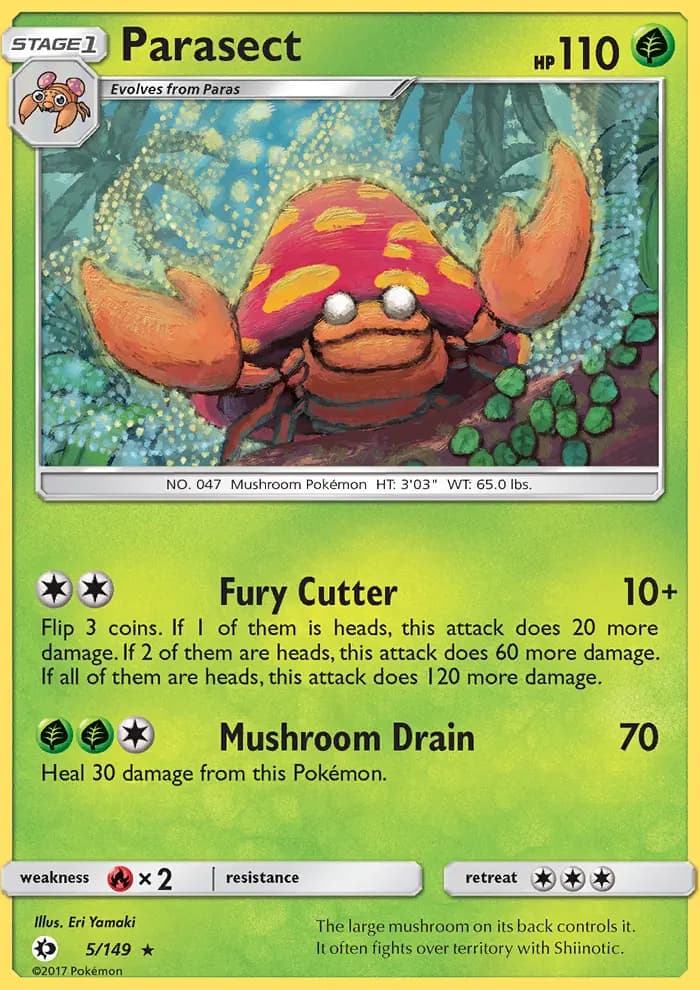
The large mushroom on its back controls it. It often fights over territory with Shiinotic.
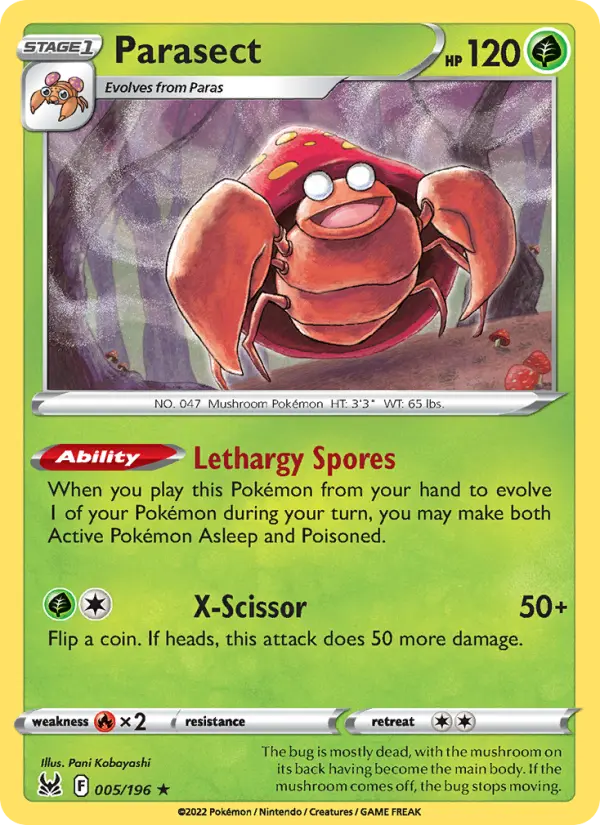
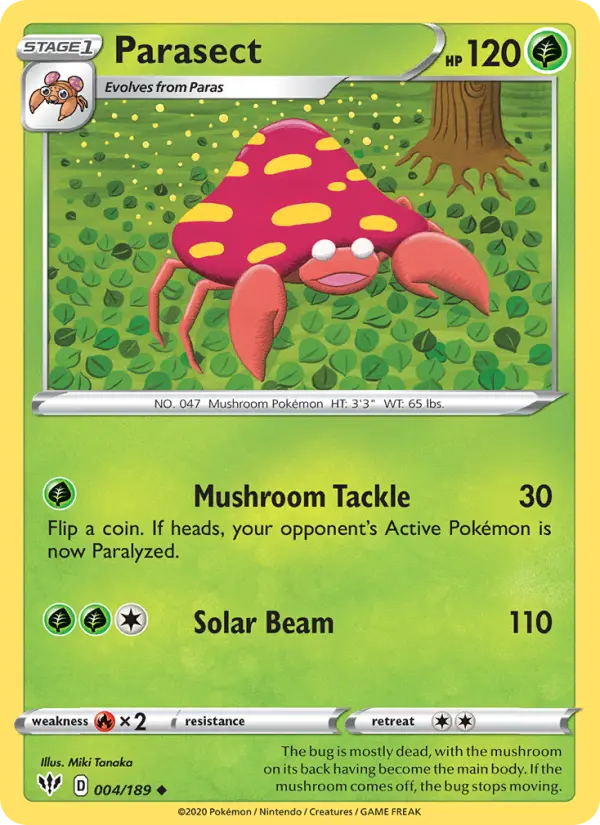
The bug is mostly dead, with the mushroom on its back having become the main body. If the mushroom comes off, the bug stops moving.
It scatters toxic spores from its mushroom cap. Once harvested, these spores can be steeped and boiled down to prepare herbal medicines.
Its poisonous spores are also used in traditional medicine. Apparently, spores produced in Alola are not of very good quality.
The bug host is drained of energy by the mushroom on its back. The mushroom appears to do all the thinking.
Mushroom-lacking specimens of this Pokémon lie unmoving in the forest, lending credence to the hypothesis that the large mushroom is in control of Parasect's actions.
Parasect Name Origin & Design Inspiration
The name Parasect is a straightforward portmanteau of 'parasite' and 'insect,' directly reflecting the Pokémon's parasitic nature and origin as a bug-type creature. In Japanese, it is called Parasect (パラセクト), maintaining the same linguistic structure across both languages. The design itself draws heavy inspiration from real-world parasitic fungi, particularly Ophiocordyceps unilateralis, the famous zombie-ant fungus that controls ant behavior to maximize spore dispersal—a phenomenon that inspired much of Parasect's biological concept in the original games. The visual design cleverly uses the contrast between the small, orange insectoid body and the dominantly large red mushroom cap with yellow spots to convey the complete takeover of the host organism. The creature's pincers, inherited from its Paras evolution, represent one of the few remaining features clearly belonging to the original bug host, while everything else has been visually subsumed by or modified to serve the fungal parasite. This design philosophy makes Parasect immediately recognizable and communicates its unique ecological niche more effectively than conventional Pokémon designs that represent creatures in evolutionary harmony rather than parasitic domination.
Learnable Moves
Parasect can learn 80 moves:
Move | Type | Cat. | Power | Acc. | PP |
|---|---|---|---|---|---|
| absorb | grass | Special | 20 | 100 | 25 |
| aerial ace | flying | Physical | 60 | — | 20 |
| after you | normal | Status | — | — | 15 |
| aromatherapy | grass | Status | — | — | 5 |
| attract | normal | Status | — | 100 | 15 |
| bide | normal | Physical | — | — | 10 |
| body slam | normal | Physical | 85 | 100 | 15 |
| brick break | fighting | Physical | 75 | 100 | 15 |
| bug bite | bug | Physical | 60 | 100 | 20 |
| bullet seed | grass | Physical | 25 | 100 | 30 |
| captivate | normal | Status | — | 100 | 20 |
| confide | normal | Status | — | — | 20 |
| counter | fighting | Physical | — | 100 | 20 |
| cross poison | poison | Physical | 70 | 100 | 20 |
| curse | ghost | Status | — | — | 10 |
| cut | normal | Physical | 50 | 95 | 30 |
| dig | ground | Physical | 80 | 100 | 10 |
| double team | normal | Status | — | — | 15 |
| double edge | normal | Physical | 120 | 100 | 15 |
| endure | normal | Status | — | — | 10 |
| energy ball | grass | Special | 90 | 100 | 10 |
| facade | normal | Physical | 70 | 100 | 20 |
| false swipe | normal | Physical | 40 | 100 | 40 |
| flash | normal | Status | — | 100 | 20 |
| frustration | normal | Physical | — | 100 | 20 |
| fury cutter | bug | Physical | 40 | 95 | 20 |
| fury swipes | normal | Physical | 18 | 80 | 15 |
| giga drain | grass | Special | 75 | 100 | 10 |
| giga impact | normal | Physical | 150 | 90 | 5 |
| grass knot | grass | Special | — | 100 | 20 |
| growth | normal | Status | — | — | 20 |
| headbutt | normal | Physical | 70 | 100 | 15 |
| hidden power | normal | Special | 60 | 100 | 15 |
| hone claws | dark | Status | — | — | 15 |
| hyper beam | normal | Special | 150 | 90 | 5 |
| knock off | dark | Physical | 65 | 100 | 20 |
| leech life | bug | Physical | 80 | 100 | 10 |
| leech seed | grass | Status | — | 90 | 10 |
| light screen | psychic | Status | — | — | 30 |
| mega drain | grass | Special | 40 | 100 | 15 |
| mimic | normal | Status | — | — | 10 |
| natural gift | normal | Physical | — | 100 | 15 |
| nature power | normal | Status | — | — | 20 |
| poison powder | poison | Status | — | 75 | 35 |
| protect | normal | Status | — | — | 10 |
| rage | normal | Physical | 20 | 100 | 20 |
| rage powder | bug | Status | — | — | 20 |
| reflect | psychic | Status | — | — | 20 |
| rest | psychic | Status | — | — | 5 |
| return | normal | Physical | — | 100 | 20 |
| rock smash | fighting | Physical | 40 | 100 | 15 |
| round | normal | Special | 60 | 100 | 15 |
| scratch | normal | Physical | 40 | 100 | 35 |
| screech | normal | Status | — | 85 | 40 |
| secret power | normal | Physical | 70 | 100 | 20 |
| seed bomb | grass | Physical | 80 | 100 | 15 |
| skull bash | normal | Physical | 130 | 100 | 10 |
| slash | normal | Physical | 70 | 100 | 20 |
| sleep powder | grass | Status | — | 75 | 15 |
| sleep talk | normal | Status | — | — | 10 |
| sludge bomb | poison | Special | 90 | 100 | 10 |
| snore | normal | Special | 50 | 100 | 15 |
| solar beam | grass | Special | 120 | 100 | 10 |
| spore | grass | Status | — | 100 | 15 |
| string shot | bug | Status | — | 95 | 40 |
| struggle bug | bug | Special | 50 | 100 | 20 |
| stun spore | grass | Status | — | 75 | 30 |
| substitute | normal | Status | — | — | 10 |
| sunny day | fire | Status | — | — | 5 |
| swagger | normal | Status | — | 85 | 15 |
| sweet scent | normal | Status | — | 100 | 20 |
| swords dance | normal | Status | — | — | 20 |
| synthesis | grass | Status | — | — | 5 |
| take down | normal | Physical | 90 | 85 | 20 |
| thief | dark | Physical | 60 | 100 | 25 |
| throat chop | dark | Physical | 80 | 100 | 15 |
| toxic | poison | Status | — | 90 | 10 |
| venoshock | poison | Special | 65 | 100 | 10 |
| worry seed | grass | Status | — | 100 | 10 |
| x scissor | bug | Physical | 80 | 100 | 15 |
Parasect Competitive Battle Guide
Parasect occupies a unique niche in competitive Pokémon despite its mediocre total stat allocation of 405, primarily due to its interesting ability combinations and access to the move Spore. With an Attack stat of 95, Parasect hits noticeably harder than many competitors in lower competitive tiers, making it a viable threat in formats like Little Cup (using its pre-evolution Paras) and competitive formats where restrictions limit team building options. The Effect Spore ability provides valuable utility by inflicting paralysis, poison, or sleep on opposing Pokémon that make contact at a 30% rate, functioning as both offensive pressure and defensive deterrent against physical attackers. Dry Skin, the standard second ability, offers weather-dependent utility: healing Parasect for one-eighth of its maximum HP during rain while dealing equivalent damage during intense sunlight, and providing critical coverage by absorbing Water-type moves for quarter-HP healing while increasing Fire-type damage taken to 1.25 times. The hidden ability Damp prevents self-destruct and explosion-based strategies, which can be crucial in specific metagames. However, Parasect's abysmal Speed stat of 30 severely limits its competitive viability in faster-paced formats, requiring extensive Speed investment or trick room support to function effectively, making it best suited for slower, more defensive team compositions or niche strategies that leverage its ability effects rather than direct offensive pressure.
Commonly Asked Questions About Parasect
What type is Parasect?
Parasect is a bug and grass type Pokemon.
What does Parasect evolve from?
Parasect evolved from paras.
What are Parasect's weaknesses?
Parasect is weak to flying, poison, rock, bug, fire and ice type moves.
Where can I find Parasect?
Parasect can be found in cerulean cave (kanto), kanto safari zone (kanto) and mt silver (johto) and 1 other locations.
Parasect Cultural Impact & Franchise History
Parasect holds a peculiar place in Pokémon culture as the subject of philosophical discussion and dark speculation within the fan community. The creature's nature as a host-parasite entity has inspired countless fan theories and discussions about which organism truly constitutes the 'Pokémon,' with some players arguing that removing the mushroom doesn't kill Parasect but rather uncovers the true insect host beneath, while others contend that the fungus alone represents the actual entity. This existential ambiguity has made Parasect a favorite subject of fan fiction, artwork, and analysis within the broader Pokémon community, particularly among players interested in body horror themes or biological parasitism concepts. The Pokédex entries describing the mushroom's complete control over the host body have been referenced in horror-themed fan communities and analyzed by players examining the darker implications of the Pokémon world. In competitive circles, Parasect is fondly remembered by longtime players as one of the original Generation I Bug-type options, though often considered overshadowed by more popular choices like Scyther or Butterfree. The medicinal properties of Parasect's spores, mentioned in Chinese Pokédex entries, have also influenced how some players and content creators view the species, positioning it as a valuable resource for human civilization within Pokémon lore rather than simply a wild creature to be captured and battled.
Where to Find Parasect in Every Pokémon Game
Parasect is readily available throughout the Pokémon franchise, with its pre-evolution Paras appearing as a catchable species in numerous games and regions. In the original Red and Blue versions, Paras can be encountered in various grass patches and caves, allowing players to catch it and evolve it to Parasect by level 24. The species maintains consistent availability across most mainline games, appearing in the Kanto region in FireRed and LeafGreen, and in multiple generations' regional Pokédexes, though its specific encounter rates and locations vary by game. In Pokémon Let's Go Pikachu and Eevee, Parasect is available as a wild encounter and through evolution of Paras, maintaining its Generation I accessibility in the remakes. The species appears in Pokémon Legends: Arceus with its own Pokédex entry, providing yet another method for modern players to obtain one. For players in contemporary games, Parasect may be obtained through breeding Paras, trading with other players, or utilizing Pokémon Home to transfer specimens from older generations. The creature's relatively high catch rate of 75 combined with its moderate encounter rates in most games makes it one of the more accessible Bug/Grass-type Pokémon for new players seeking to diversify their teams or complete their Pokédex, though its somewhat forgettable competitive performance means many seasoned players overlook it in favor of more optimized choices.