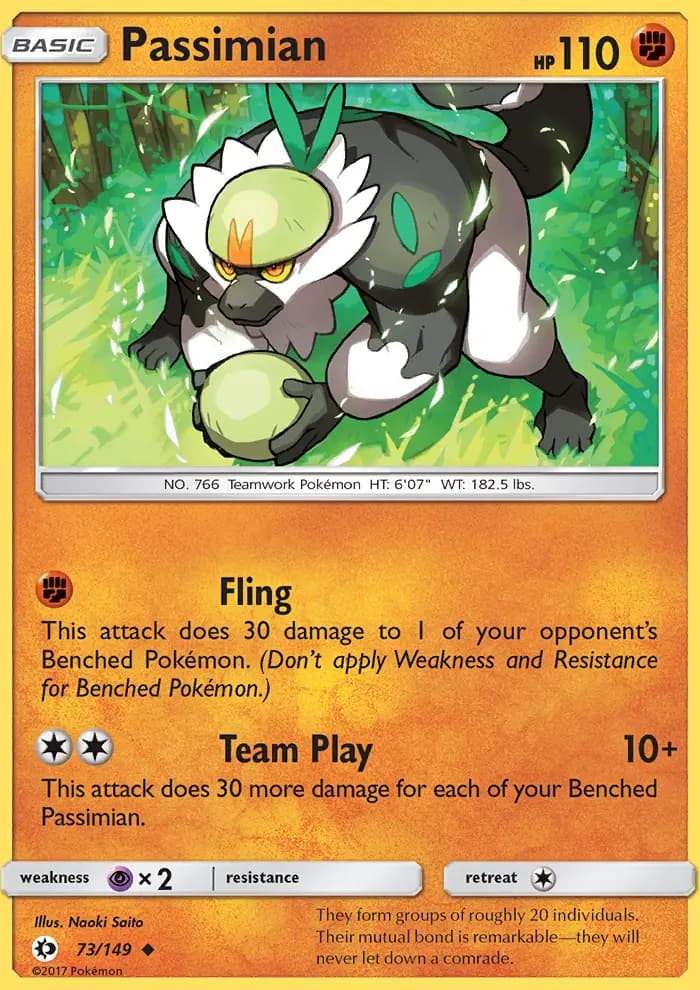
Passimian
Generation VII · #0766 — Teamwork Pokémon
At 2 m and 82.8 kg, Passimian doesn't look like much on paper, but its receiver ability shapes how it actually plays more than its size suggests. Unlike many Pokémon that operate independently or in pairs, Passimian has evolved an intricate societal system centered around organized troops of roughly 20 to 30 individuals, each member contributing to the group's survival through assigned roles and responsibilities. The species represents a unique counterpart to Oranguru, another Generation VII Pokémon, creating a fascinating duality within Alola's ecosystem. With a overall stat sum of 490 and a slow growth rate, Passimian rewards patient trainers who understand the value of strategic team composition and coordinated battle tactics.
Editor's Take
Passimian is the version counterpart to Oranguru and the considerably less interesting half, with Receiver copying a fainted ally's ability being a much narrower trick than Instruct.
Base Stats
Height
2.0m
Weight
82.8kg
Category
Teamwork Pokémon
Gender
Male 50% / Female 50%
Color
white
Shape
upright
Abilities
When an ally faints, this Pokémon gains its Ability.
Raises Attack two stages upon having any stat lowered.
Passimian Biology & Physical Characteristics
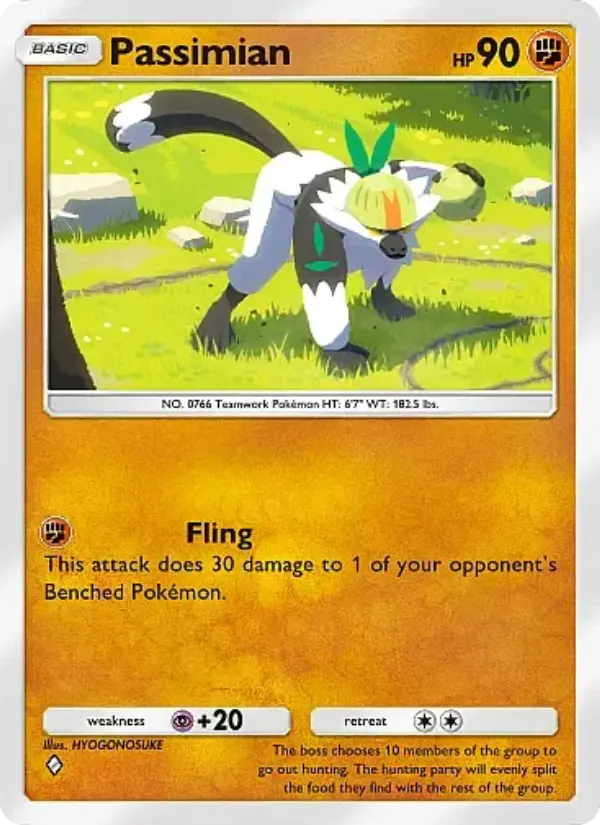
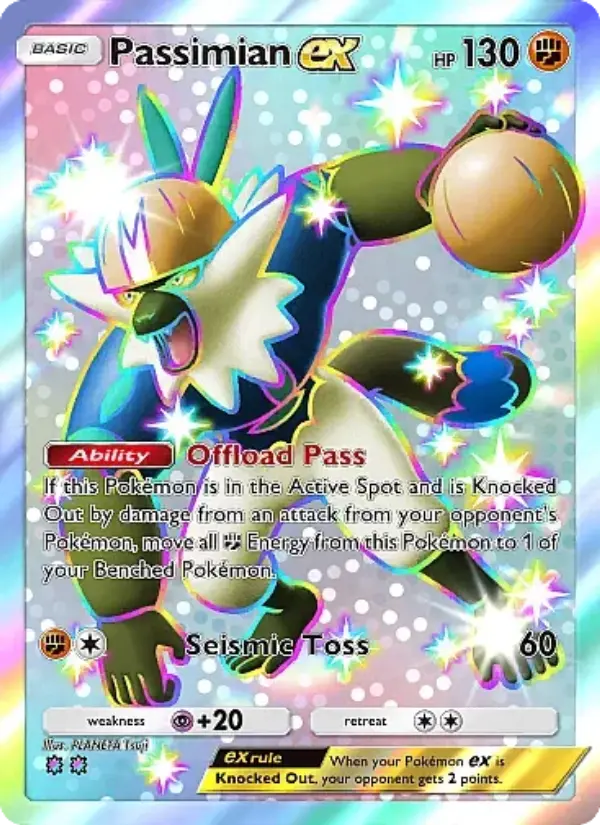
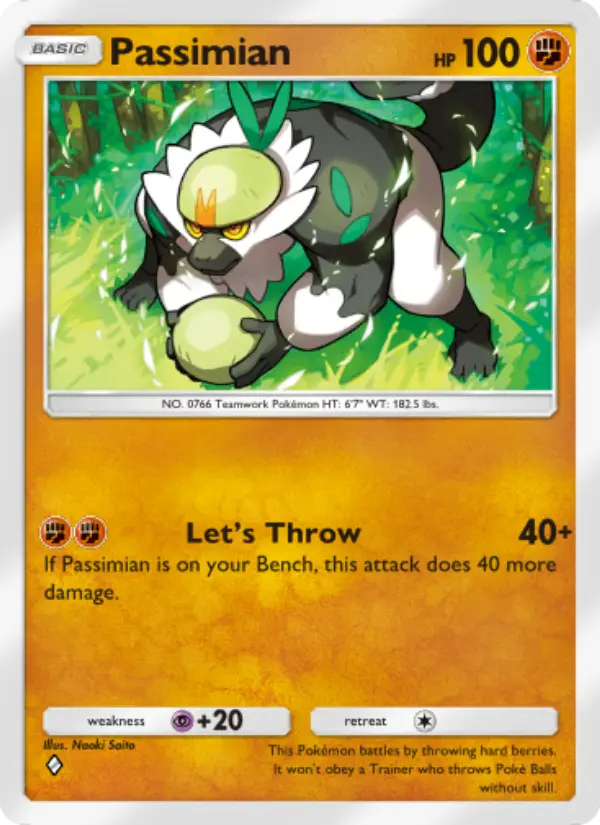
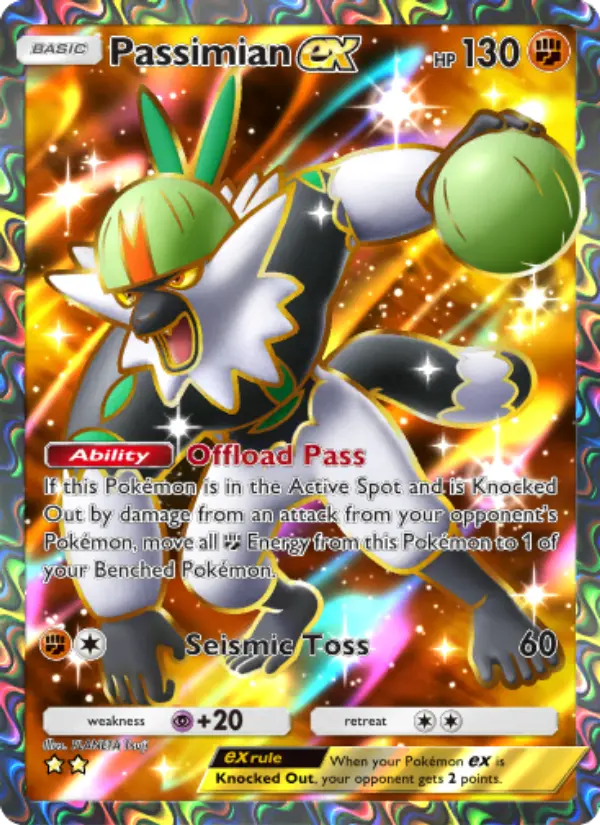
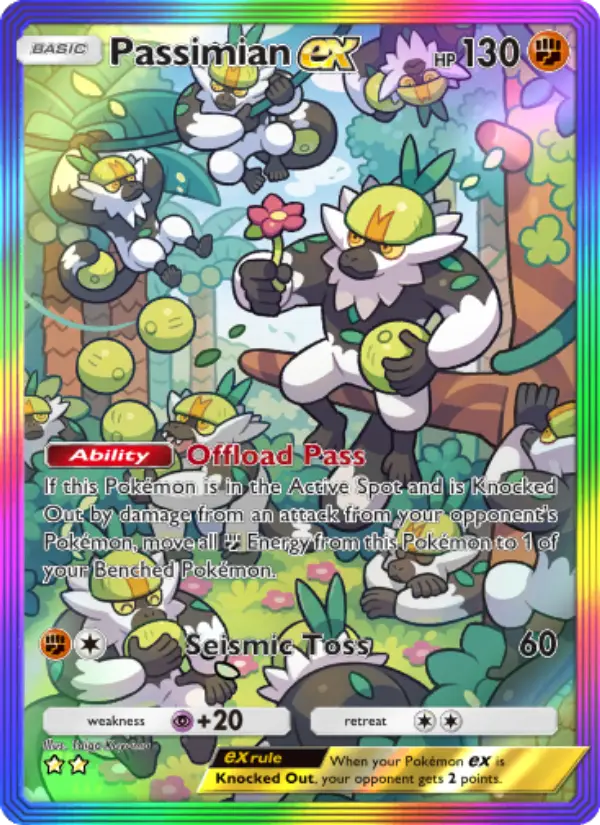
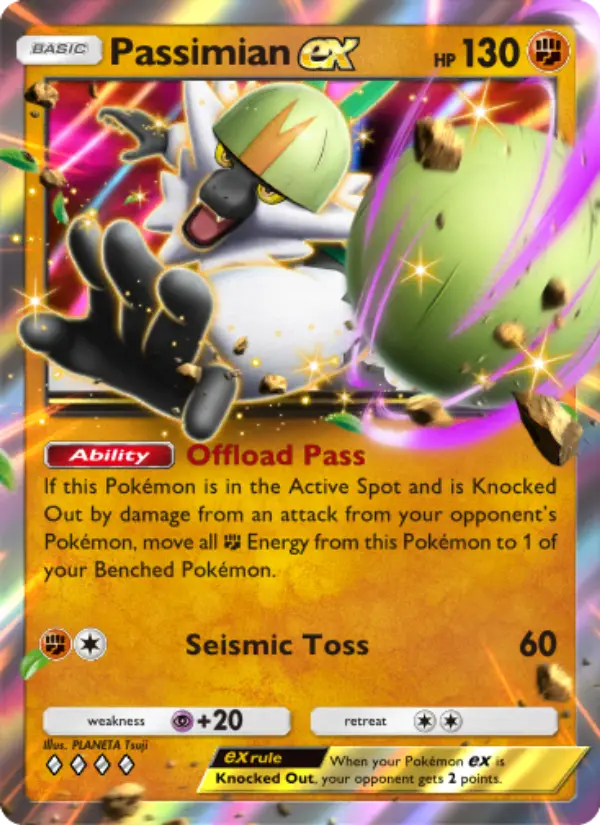
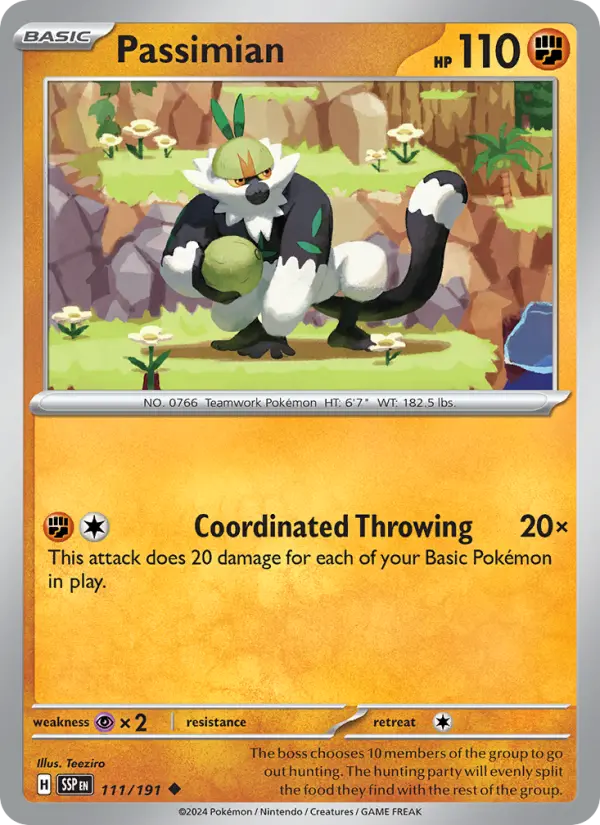
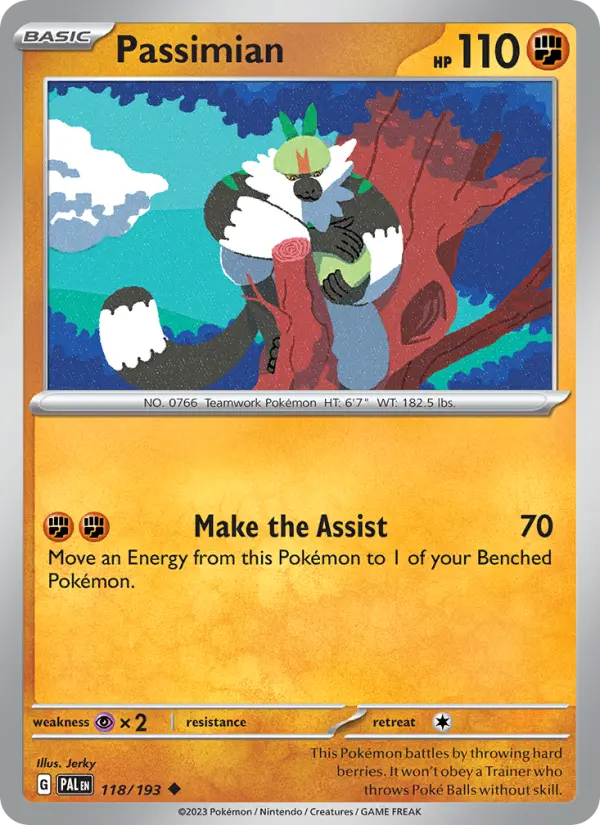
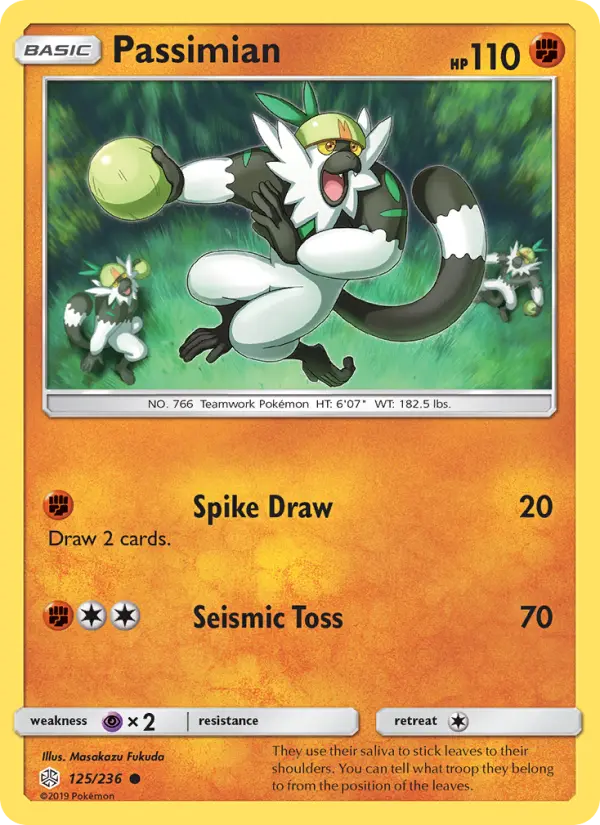
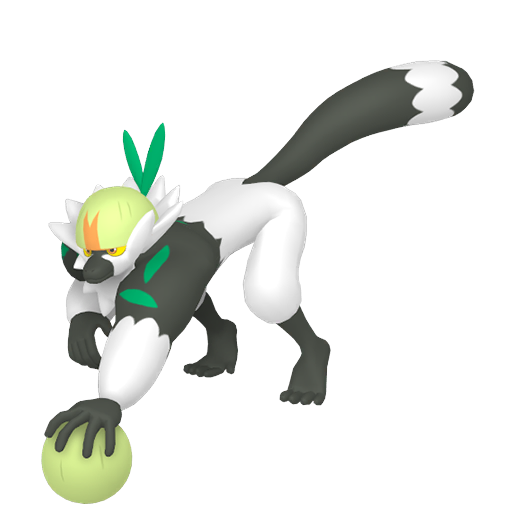
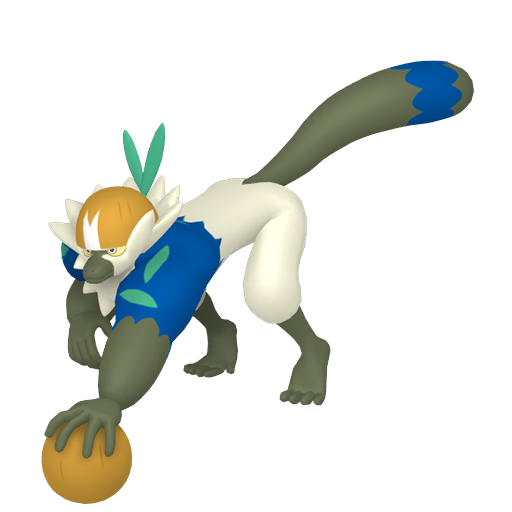
Passimian is a striking black-and-white Pokémon that resembles a powerfully built lemur, dominated by crisp white fur across most of its body, with contrasting black coloring on its muzzle, upper body, hands, feet, ankles, and tail—the latter featuring a distinctive wavy white ring near its tip. The most notable facial feature is the longer fur around its head and face, which forms numerous small clumps particularly prominent on the crown and beneath the chin, creating an almost dignified appearance. Atop its head rests a pale green helmet resembling half of a coconut shell, decorated with a small orange blaze on the front and two upright leaves extending from the back, giving the species an almost warrior-like aesthetic. Its yellow sclerae and reddish-orange irises are partially visible beneath this headwear, lending an intelligent expression to its gaze. Passimian characteristically carries large berries resembling green coconuts and adorns its shoulders and chest with leaves affixed using its saliva, with both the color and position of these leaves serving as visual identification markers for different troops, allowing for easy distinction between rival groups.
Pokedex Numbers
Training
Breeding
Passimian Breeding, Gender Ratio & Egg Groups
Half of all Passimian are male, half are female — no skew to plan around, allowing for consistent and equally probable breeding outcomes regardless of parental gender combinations. The species belongs to the Field egg group, a relatively common classification that facilitates breeding compatibility with numerous other Pokémon species across multiple generations. Breeding Passimian requires considerable patience, as the species operates under a slow growth rate classification and necessitates twenty egg cycles—approximately 4,884 to 5,140 steps—before a freshly hatched Passimian emerges from its egg ready for training and integration into a trainer's team. The base friendship value of 70 indicates that newly hatched Passimian begin with moderate affection toward their trainer, requiring consistent interaction and care to maximize loyalty and improve obedience in battle situations. This breeding framework encourages trainers who invest in Passimian to commit to long-term development strategies, rewarding patience with a fully-bonded and powerful Fighting-type companion capable of supporting diverse team compositions.
Sprites




TMs & HMs
tm00
sword shield
tm01
yellow
tm01
red blue
tm01
platinum
tm01
emerald
tm01
diamond pearl
tm01
firered leafgreen
tm01
ruby sapphire
tm01
xd
tm01
colosseum
tm01
heartgold soulsilver
tm01
ultra sun ultra moon
tm01
sun moon
tm01
blue japan
tm01
red green japan
tm01
sword shield
tm02
lets go pikachu lets go eevee
tm03
crystal
tm03
gold silver
tm05
red blue
+719 more TMs/HMs
Passimian Evolution, Mega Evolution & Special Forms
Passimian has no pre-evolution and no evolution, existing as a standalone evolutionary line with no branching paths, mega evolutions, or regional variants documented across any generation. This static evolutionary status contrasts sharply with the majority of Pokémon encountered in Generation VII and subsequent games, positioning Passimian as a complete and fully-formed species from the moment of its introduction. Despite lacking traditional evolution mechanics, the species achieves tremendous diversity through its social structure and troop-based dynamics, where individual Passimian within the same species can exhibit significant behavioral and strategic differences based on their designated role within their respective troops. The lack of evolution has not hindered the species' viability or cultural relevance, as Passimian maintains compelling competitive utility and thematic consistency throughout successive generations from Generation VII through the most recent Pokémon games.
Where to Find
Lush Jungle
alola
+5 more
Passimian Behaviour and Natural Habitat
Living in organized troops of 20 to 30 individuals, Passimian exhibits remarkable cooperative behavior centered around a hierarchical leadership structure where a dominant boss selects ten of the strongest members to undertake food-gathering expeditions. This selected hunting party actively searches for berries, which serve as both the species' primary diet and its preferred weaponry in combat, with the recovered food then equitably distributed among all troop members, reinforcing the collective survival mechanism that defines the species. The boss maintains authority not only through strength but through skill in berry throwing—the individual capable of projecting a berry the farthest earns and retains leadership status, making physical prowess and precision essential traits. Passimian troops establish territorial claims over productive berry-producing trees and frequently enter territorial disputes with Ambipom populations, engaging in competitive battles that historically result in roughly equal victory ratios. The boss of each troop implements systematic training regimens designed to enhance individual coordination abilities and improve each member's proficiency in berry handling and combat techniques, ensuring that tactical knowledge transfers across generations. During these training sessions and hunts, the species employs dual-strategy berry warfare, hurling hard berries as offensive projectiles to inflict damage while simultaneously deploying soft berries to obscure opponent vision and create tactical confusion.
Pokedex Entries
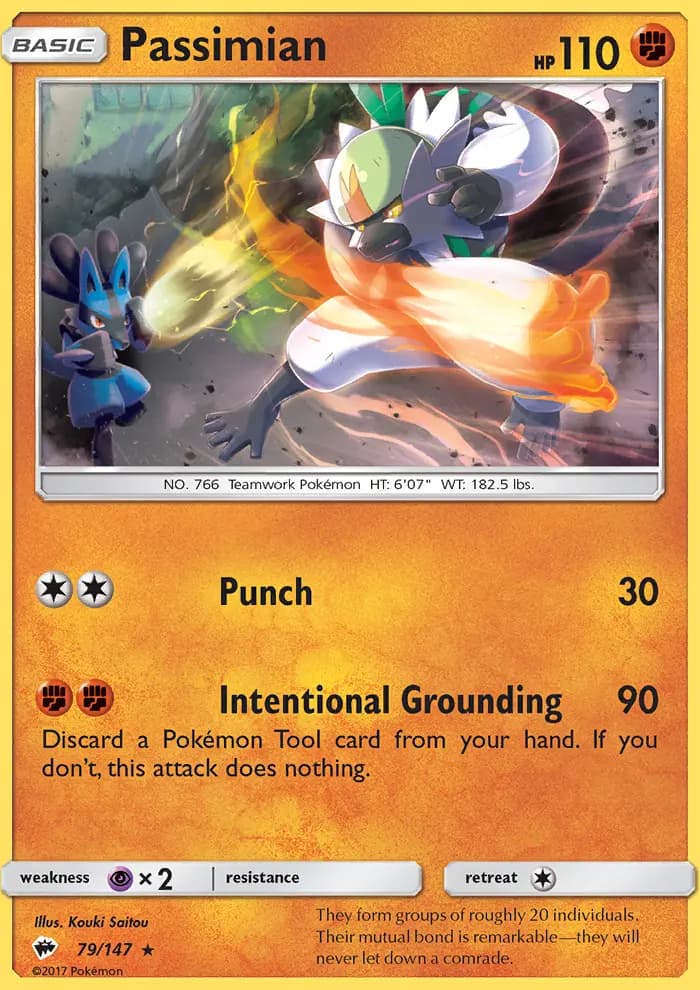
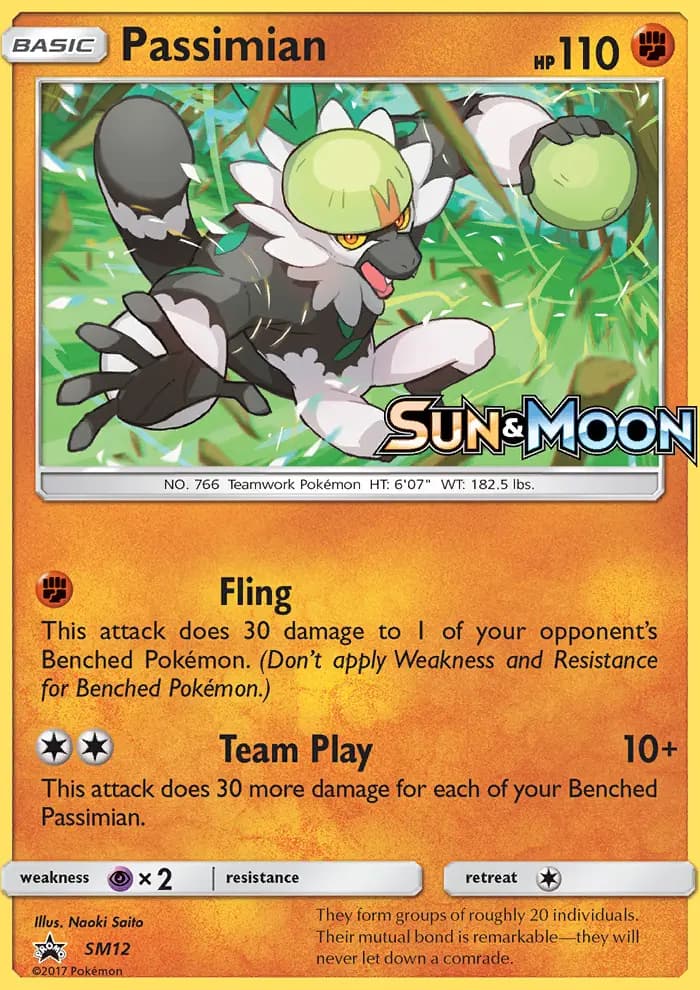
They form groups of roughly 20 individuals. Their mutual bond is remarkable—they will never let down a comrade.
They use their saliva to stick leaves to their shoulders. You can tell what troop they belong to from the position of the leaves.
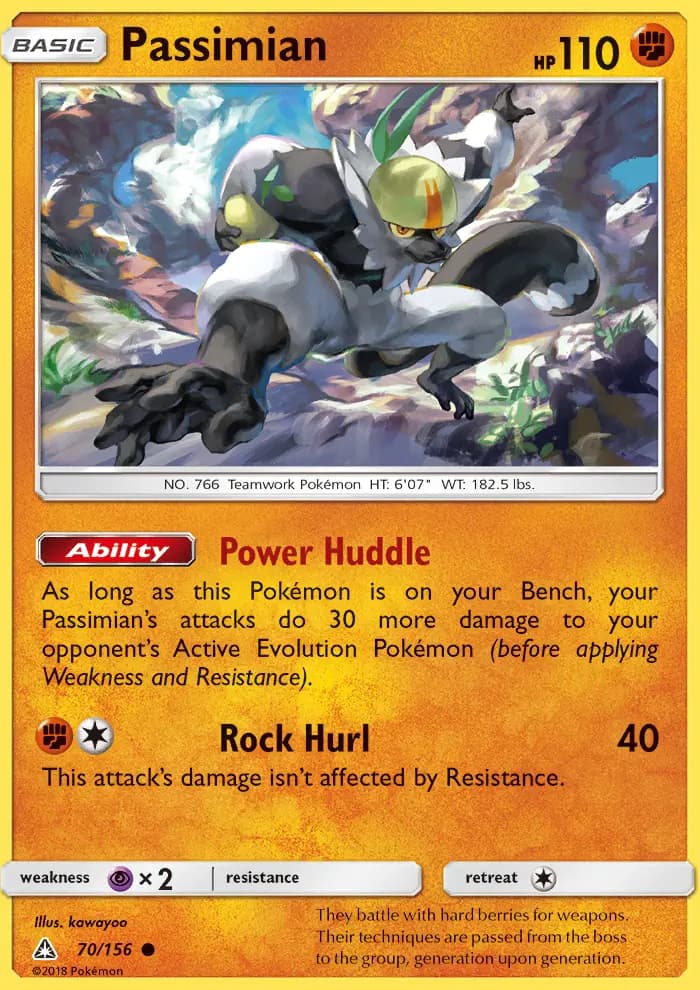
They battle with hard berries for weapons. Their techniques are passed from the boss to the group, generation upon generation.
Berries are its weapons as well as the staple of its diet. The one that can throw a berry the farthest is the boss of the troop.
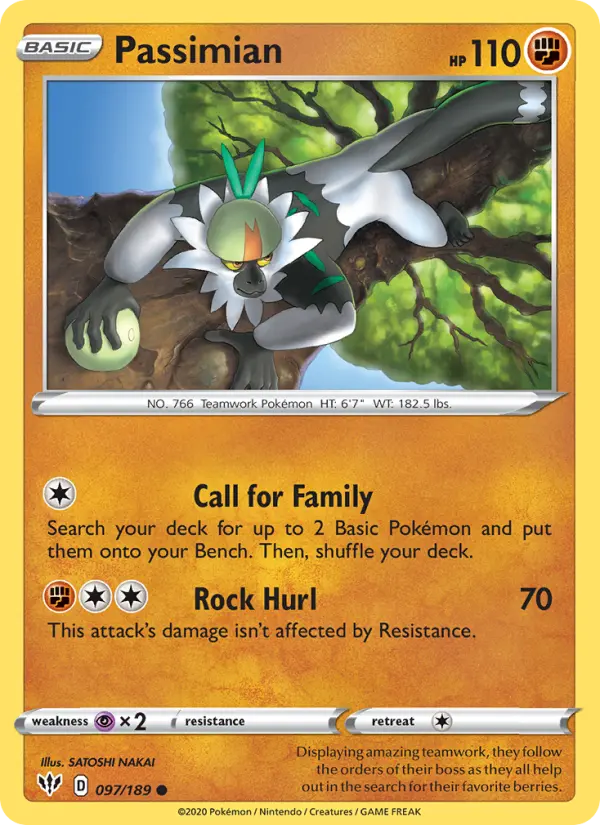
Displaying amazing teamwork, they follow the orders of their boss as they all help out in the search for their favorite berries.
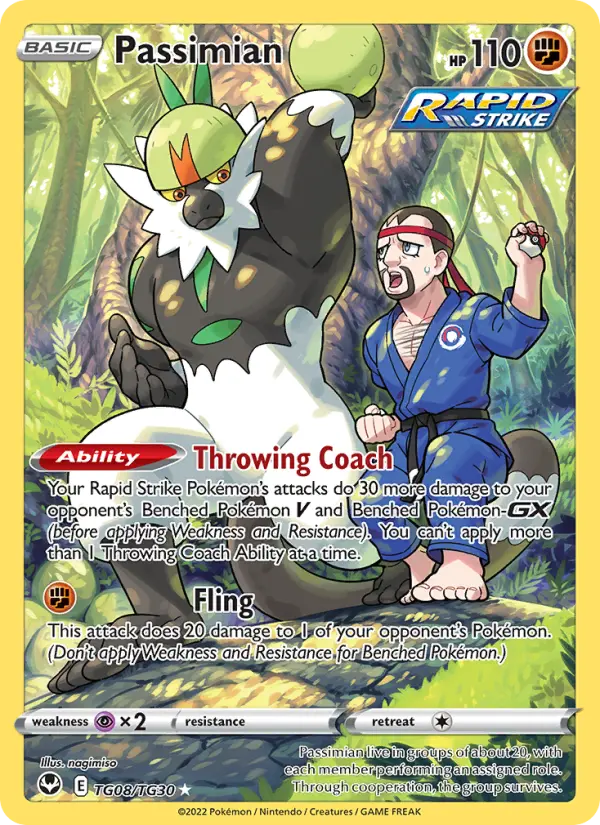
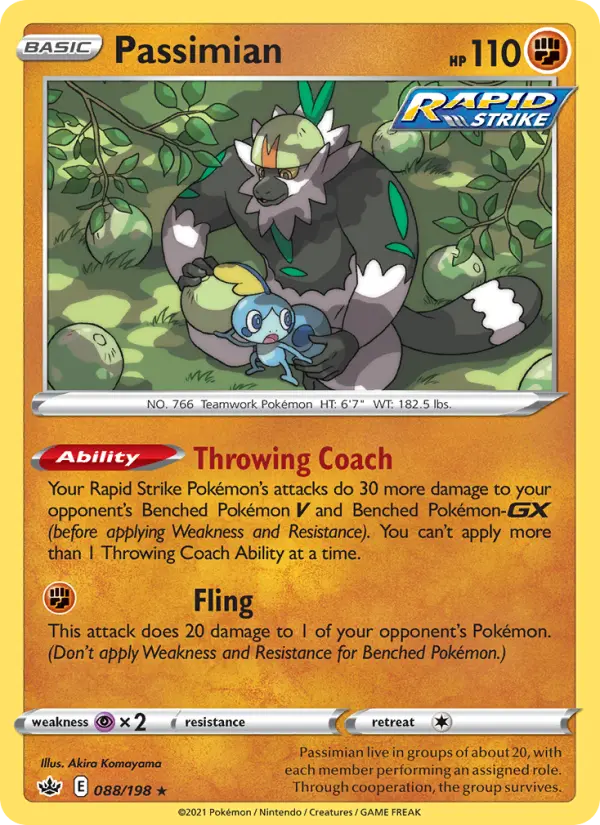
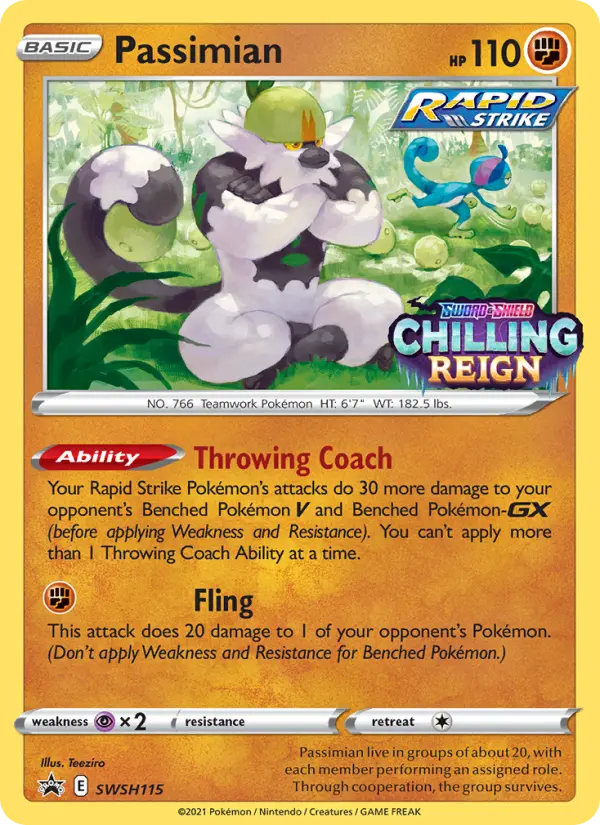
Passimian live in groups of about 20, with each member performing an assigned role. Through cooperation, the group survives.
Passimian Name Origin & Design Inspiration
Passimian's name traces to 'passion' or 'passionate' combined with 'primate,' perfectly encapsulating the species' intense team-focused nature and lemur-like appearance, while its Japanese name, Nagetukesaru, literally translates to 'throwing monkey,' directly referencing its signature berry-throwing combat methodology. The design philosophy centers on creating a primate Pokémon that embodies organized warfare and collective strategy, drawing inspiration from real-world primates like lemurs that exhibit complex social hierarchies and cooperative behaviors. The coconut-shell helmet and saliva-affixed leaves represent clever environmental integration—Passimian utilizes resources from its surroundings to create markers and protective gear, demonstrating resourcefulness alongside teamwork. The monochromatic black-and-white coloration contrasts sharply with the vibrant green helmet and orange blazon, creating visual distinction that allows trainers to immediately recognize the species while the customizable leaf patterns serve as an in-game representation of individual troop identity and diversity. The overall aesthetic presents Passimian as simultaneously primitive in its berry-based technology and surprisingly sophisticated in its organizational structures, bridging the gap between wild Pokémon and intelligent, coordinated societies.
Learnable Moves
Passimian can learn 91 moves:
Move | Type | Cat. | Power | Acc. | PP |
|---|---|---|---|---|---|
| acrobatics | flying | Physical | 55 | 100 | 15 |
| aerial ace | flying | Physical | 60 | — | 20 |
| assurance | dark | Physical | 60 | 100 | 10 |
| attract | normal | Status | — | 100 | 15 |
| baton pass | normal | Status | — | — | 40 |
| beat up | dark | Physical | — | 100 | 10 |
| bestow | normal | Status | — | — | 15 |
| block | normal | Status | — | — | 5 |
| body slam | normal | Physical | 85 | 100 | 15 |
| brick break | fighting | Physical | 75 | 100 | 15 |
| brutal swing | dark | Physical | 60 | 100 | 20 |
| bulk up | fighting | Status | — | — | 20 |
| bulldoze | ground | Physical | 60 | 100 | 20 |
| chilling water | water | Special | 50 | 100 | 20 |
| close combat | fighting | Physical | 120 | 100 | 5 |
| coaching | fighting | Status | — | — | 10 |
| confide | normal | Status | — | — | 20 |
| counter | fighting | Physical | — | 100 | 20 |
| curse | ghost | Status | — | — | 10 |
| double team | normal | Status | — | — | 15 |
| double edge | normal | Physical | 120 | 100 | 15 |
| drain punch | fighting | Physical | 75 | 100 | 10 |
| earthquake | ground | Physical | 100 | 100 | 10 |
| electroweb | electric | Special | 55 | 95 | 15 |
| endeavor | normal | Physical | — | 100 | 5 |
| endure | normal | Status | — | — | 10 |
| energy ball | grass | Special | 90 | 100 | 10 |
| facade | normal | Physical | 70 | 100 | 20 |
| feint | normal | Physical | 30 | 100 | 10 |
| fling | dark | Physical | — | 100 | 10 |
| focus blast | fighting | Special | 120 | 70 | 5 |
| focus energy | normal | Status | — | — | 30 |
| focus punch | fighting | Physical | 150 | 100 | 20 |
| frustration | normal | Physical | — | 100 | 20 |
| giga impact | normal | Physical | 150 | 90 | 5 |
| grass knot | grass | Special | — | 100 | 20 |
| gunk shot | poison | Physical | 120 | 80 | 5 |
| gyro ball | steel | Physical | — | 100 | 5 |
| hidden power | normal | Special | 60 | 100 | 15 |
| hyper beam | normal | Special | 150 | 90 | 5 |
| iron head | steel | Physical | 80 | 100 | 15 |
| iron tail | steel | Physical | 100 | 75 | 15 |
| knock off | dark | Physical | 65 | 100 | 20 |
| laser focus | normal | Status | — | — | 30 |
| leer | normal | Status | — | 100 | 30 |
| low kick | fighting | Physical | — | 100 | 20 |
| low sweep | fighting | Physical | 65 | 100 | 20 |
| mega kick | normal | Physical | 120 | 75 | 5 |
| mega punch | normal | Physical | 80 | 85 | 20 |
| pain split | normal | Status | — | — | 20 |
| payback | dark | Physical | 50 | 100 | 10 |
| protect | normal | Status | — | — | 10 |
| quick attack | normal | Physical | 40 | 100 | 30 |
| quick guard | fighting | Status | — | — | 15 |
| rain dance | water | Status | — | — | 5 |
| rest | psychic | Status | — | — | 5 |
| retaliate | normal | Physical | 70 | 100 | 5 |
| return | normal | Physical | — | 100 | 20 |
| revenge | fighting | Physical | 60 | 100 | 10 |
| reversal | fighting | Physical | — | 100 | 15 |
| rock slide | rock | Physical | 75 | 90 | 10 |
| rock smash | fighting | Physical | 40 | 100 | 15 |
| rock tomb | rock | Physical | 60 | 95 | 15 |
| round | normal | Special | 60 | 100 | 15 |
| scary face | normal | Status | — | 100 | 10 |
| seed bomb | grass | Physical | 80 | 100 | 15 |
| seismic toss | fighting | Physical | — | 100 | 20 |
| shadow ball | ghost | Special | 80 | 100 | 15 |
| shock wave | electric | Special | 60 | — | 20 |
| sleep talk | normal | Status | — | — | 10 |
| smack down | rock | Physical | 50 | 100 | 15 |
| snatch | dark | Status | — | — | 10 |
| snore | normal | Special | 50 | 100 | 15 |
| substitute | normal | Status | — | — | 10 |
| sunny day | fire | Status | — | — | 5 |
| superpower | fighting | Physical | 120 | 100 | 5 |
| swagger | normal | Status | — | 85 | 15 |
| tackle | normal | Physical | 40 | 100 | 35 |
| take down | normal | Physical | 90 | 85 | 20 |
| taunt | dark | Status | — | 100 | 20 |
| tera blast | normal | Special | 80 | 100 | 10 |
| thief | dark | Physical | 60 | 100 | 25 |
| thrash | normal | Physical | 120 | 100 | 10 |
| toxic | poison | Status | — | 90 | 10 |
| trailblaze | grass | Physical | 50 | 100 | 20 |
| u turn | bug | Physical | 70 | 100 | 20 |
| upper hand | fighting | Physical | 65 | 100 | 15 |
| uproar | normal | Special | 90 | 100 | 10 |
| vacuum wave | fighting | Special | 40 | 100 | 30 |
| vital throw | fighting | Physical | 70 | — | 10 |
| work up | normal | Status | — | — | 30 |
Passimian Competitive Battle Guide
In competitive battling, Passimian operates as a physical attacker with exceptional offensive capability, boasting a base Attack stat of 120 paired with a solid base HP of 100, creating a bulky physical threat capable of delivering substantial damage while sustaining moderate punishment. The species' base Defense of 90 provides reasonable physical bulk, while its Speed stat of 80 allows for middling turn order manipulation—fast enough to outspeed many defensive threats but requiring careful team building and EV optimization to function optimally in competitive environments where faster metagame staples frequently dictate momentum. Passimian's special statistics are deliberately weak, with a base Special Attack of just 40 and Special Defense of 60, clearly establishing the species as a physical-focused combatant that struggles against special wall threats and special attackers, necessitating careful team synergy and defensive support. The species' primary ability, Receiver, provides exceptional utility in double and triple battles by granting Passimian access to its ally's ability upon fainting, enabling clever switch mechanics and ability inheritance strategies that create unexpected defensive and offensive opportunities. Its hidden ability, Defiant, offers an aggressive alternative that boosts Attack by two stages whenever any stat is lowered, capitalizing on the prevalence of competitive stat-manipulation moves and abilities to transform opponent strategies into offensive advantages. Passimian's movepool emphasizes physical Fighting-type moves alongside utility options, though limited special move coverage requires careful move selection and team building to address its glaring coverage weaknesses, particularly against Flying-type Pokémon that resist its primary STAB moves.
Commonly Asked Questions About Passimian
What type is Passimian?
Passimian is a fighting type Pokemon.
What does Passimian evolve from?
Passimian does not evolve.
What are Passimian's weaknesses?
Passimian is weak to flying, psychic and fairy type moves.
Where can I find Passimian?
Passimian can be found in lush jungle (alola).
Passimian Cultural Impact & Franchise History
Passimian has emerged as a beloved and culturally significant Pokémon within the broader franchise, capturing trainers' imaginations through its unique emphasis on teamwork, cooperation, and organized social structures that resonate with human values of community and collective achievement. The species' prominent appearance in the Pokémon Sun and Moon games and subsequent media has established it as an iconic representative of Alola's distinctive ecosystem, embodying the island region's emphasis on natural harmony and interconnected relationships between Pokémon communities. In the anime series, Passimian's depictions showcase the species' remarkable coordination abilities and tactical sophistication, with particular attention to episodes such as SM064 that explore troop dynamics and individual variation within the species, including the discovery of alternative leaf color variants among different populations. The species has inspired substantial creative engagement within the Pokémon fan community, generating artwork, fiction, and competitive team discussions that celebrate its mechanical distinctiveness and thematic coherence. Passimian's emphasis on cooperation rather than individual achievement or evolution provides a refreshing philosophical counterpoint to many Pokémon that prioritize personal growth and transformation, offering trainers an alternative perspective on team building and competitive engagement that values synergy and collective strategy.
Where to Find Passimian in Every Pokémon Game
Passimian was originally introduced in Generation VII and can be encountered in Pokémon Sun and Moon as well as Ultra Sun and Ultra Moon, where it appears in the Alola Pokédex with numbers 0177 and 0216 respectively, establishing its regional association with the Hawaiian-inspired tropical setting. The species continues to be available across subsequent generations, appearing in Pokémon Sword and Shield with National Pokédex number 0343 and a base experience yield of 172, alongside inclusion in the Isle of Armor DLC content where trainers can encounter wild populations or breed for competitive specimens. In Pokémon Scarlet and Violet, Passimian maintains availability with Pokédex number 0314, continuing its tradition of appearing across modern Nintendo Switch-based games while retaining its status as a Fighting-type specialist capable of supporting diverse team compositions. The species maintains a catch rate of 45, indicating moderate difficulty in capturing wild specimens, with professional trainers typically requiring ultra balls or status effect application for reliable capture during early-game encounters when Passimian populations are first encountered. Passimian can be bred by trainers possessing compatible male and female specimens, with eggs requiring patient incubation through the twenty-cycle hatching period before producing new Passimian ready for immediate team integration or long-term competitive training and EV optimization.