Wimpod
Generation VII · #0767 — Turn Tail Pokémon
Wimpod, known as the Turn Tail Pokémon, is a Bug/Water-type Pokémon introduced in Generation VII that embodies the archetype of a naturally timid creature despite possessing surprising utility. With a National Pokédex number of #767, this small arthropod stands merely 0.5 meters tall and weighs only 12.0 kilograms, making it one of the lighter Pokémon available in its generation. Despite its diminutive stature and cowardly demeanor, Wimpod plays an important ecological role as nature's cleaner, consuming anything edible it encounters including garbage and rotten matter. Its defining characteristic is the Wimp Out ability, which automatically switches the Pokémon out of battle when its HP drops below half, perfectly encapsulating its fearful nature while providing unique strategic applications in competitive play.
Editor's Take
Wimpod's Wimp Out forcing it to flee at half health makes it one of the few Pokémon actively designed to run away, and Golisopod inherits the problem.
Base Stats
Height
0.5m
Weight
12.0kg
Category
Turn Tail Pokémon
Gender
Male 50% / Female 50%
Color
gray
Shape
tentacles
Abilities
This Pokémon automatically switches out when its HP drops below half.

Wimpod Biology & Physical Characteristics
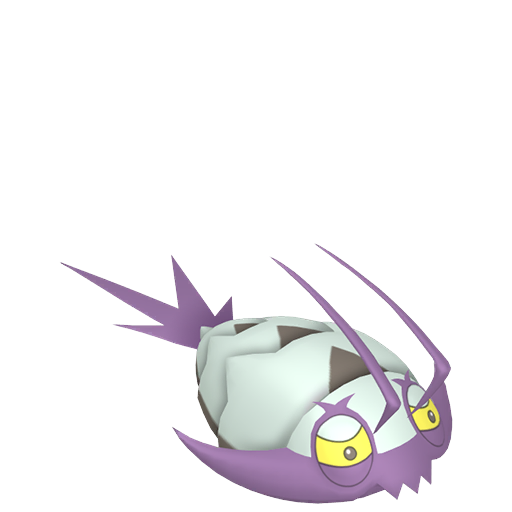
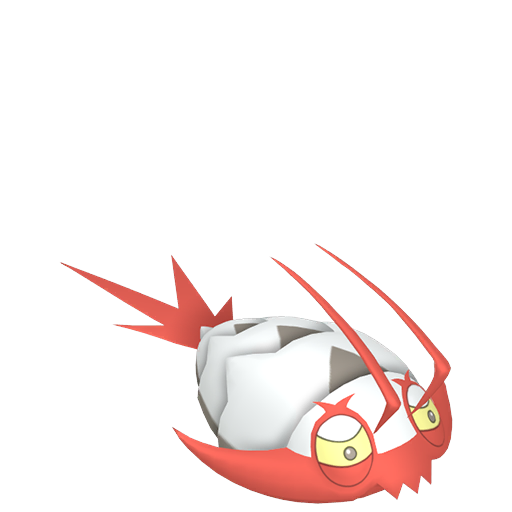
Wimpod is a small arthropod Pokémon whose body structure reflects its aquatic and terrestrial lifestyle. Its main body is purple in coloration and is protected by four distinct silver plates: one covering half its head while leaving room for its large yellow eyes, and three overlapping plates along its back, each marked with a single black triangle in the center. The Pokémon possesses eight short legs on its underside that enable its characteristic rapid movement, along with a long, prickly tail that aids in balance and water navigation. Two curved spikes extend from each side of its head, bending backward, while flat antennae extend over its back. Its upper eyelids feature additional metallic plating, and distinctive eyelash-like extensions frame its prominent yellow eyes. When threatened, Wimpod secretes a poisonous liquid from glands within its body, a defensive mechanism that serves both as a deterrent and a warning signal to other creatures. The flailing motion of its eight legs during rapid movement creates a sparkling, clean path in its wake, evidence of the microscopic debris and contaminants it collects and processes as it forages.
Pokedex Numbers
Training
Breeding
Wimpod Breeding, Gender Ratio & Egg Groups
Wimpod's population splits evenly by gender, 50% each way, allowing for reliable breeding regardless of the parent gender combination. It belongs to both the Bug and Water 3 egg groups, providing diverse breeding options with compatible Pokémon from either group. The species has a base friendship value of 70, indicating a naturally amicable disposition toward trainers, which can be beneficial when raising offspring. Wimpod has a relatively short egg hatch counter of 20 cycles, translating to approximately 4,884 to 5,140 steps before a Wimpod egg hatches, making it moderately quick to breed compared to other Pokémon. Its medium growth rate applies to experience gain, neither accelerating nor decelerating development excessively compared to other species. The breeding compatibility through both the Bug and Water 3 egg groups opens substantial strategic possibilities for trainers seeking to breed Wimpod with complementary move pools or natures inherited from diverse parental Pokémon. The species' relatively high catch rate of 90 in the wild means that obtaining both male and female individuals for breeding purposes is considerably easier than with rarer Pokémon.
Sprites




TMs & HMs
tm02
lets go pikachu lets go eevee
tm04
gold silver
tm04
crystal
tm05
lets go pikachu lets go eevee
tm06
yellow
tm06
gold silver
tm06
red blue
tm06
crystal
tm06
emerald
tm06
firered leafgreen
tm06
diamond pearl
tm06
platinum
tm06
ruby sapphire
tm06
colosseum
tm06
black 2 white 2
tm06
xd
tm06
black white
tm06
heartgold soulsilver
tm06
omega ruby alpha sapphire
tm06
ultra sun ultra moon
+351 more TMs/HMs
Wimpod's Evolution Chain


Wimpod Evolution, Mega Evolution & Special Forms
Wimpod evolves into Golisopod upon reaching level 30, transforming from a timid, diminutive scavenger into a formidable warrior Pokémon. This evolution represents a dramatic shift in both physical form and temperament, as Golisopod is an aggressive, battle-ready Pokémon that stands 1.9 meters tall and weighs 108 kilograms—nearly exponentially larger than its pre-evolved form. The transformation is so profound that even the Pokédex entries reflect Golisopod's fierce nature in stark contrast to Wimpod's cowardly disposition. While Wimpod and its evolved form share the same Bug/Water typing, Golisopod gains significantly improved stats across the board, particularly in Attack and Defense, allowing it to function as a legitimate competitive threat. The evolution process sometimes results in evolved Wimpod occasionally accompanying their unevolved form in the wild, though such instances are rare. No Mega Evolution or Gigantamax form exists for this evolutionary line, keeping the focus on the dramatic natural evolution at level 30.
Where to Find
Alola Route 8
alola
+1 more
Poni Breaker Coast
alola
+1 more
Poni Wilds
alola
Dividing Peak Tunnel
alola
Wimpod Behaviour and Natural Habitat
Wimpod exhibits extremely cowardly behavior, being naturally wary of both loud noises and sudden movements, yet paradoxically displaying curiosity toward stationary people and Pokémon. These Pokémon gather in swarms across their habitats, which range from beaches to the seafloor, where they maintain constant vigilance for potential threats. The moment danger is detected, they scatter in all directions with remarkable speed, their legs whirring at high velocities as they flee. Despite their fearful nature, Wimpod are compulsive scavengers and foragers, gleefully consuming anything edible regardless of its condition or age. They will pick up coins, pearls, and other valuable objects found on the ground or seabed, storing them as they move about their territory. This habit makes them highly valued as natural cleaners in coastal ecosystems, as the ground near their nests remains perpetually clean and free of organic debris. However, their tendency to collect shiny objects sometimes puts them at risk from other Pokémon like Murkrow and Meowth, who pursue them hoping to steal their finds.
Pokedex Entries
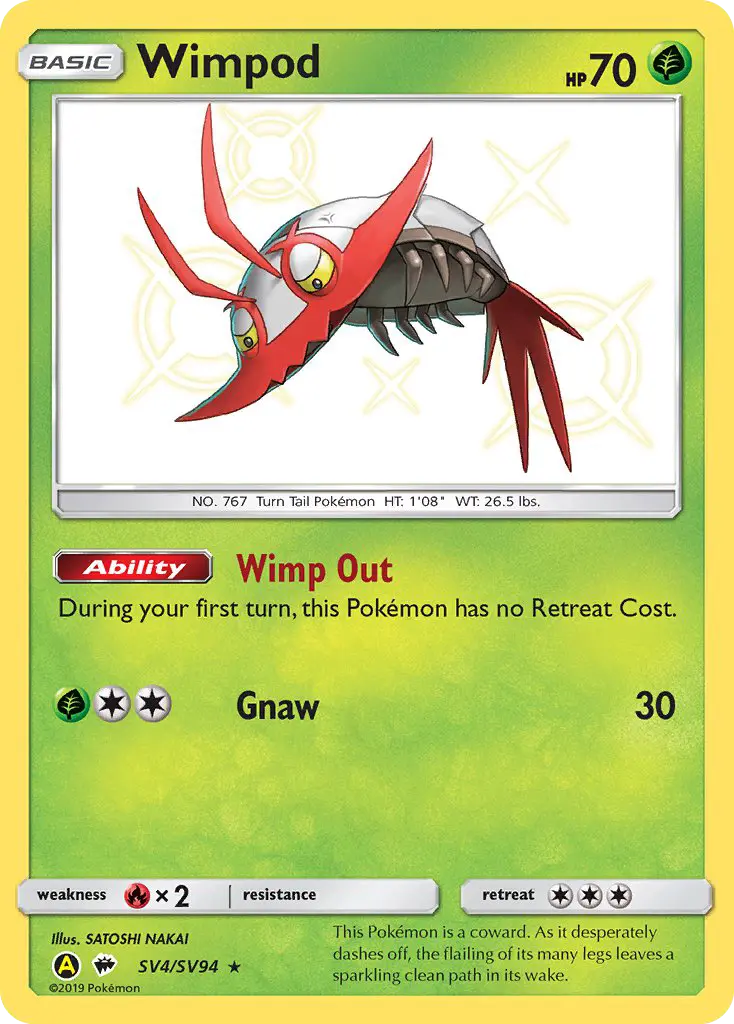
This Pokémon is a coward. As it desperately dashes off, the flailing of its many legs leaves a sparkling clean path in its wake.
It will pick up anything it finds on the ground. Sometimes it finds coins, so Murkrow and Meowth will go after it.
Its habitat varies from beaches to seabeds. A natural scavenger, it will gleefully chow down on anything edible, no matter how rotten.
An astonishingly cowardly Pokémon, Wimpod will whir its legs at high speeds to run away if anything comes near it.
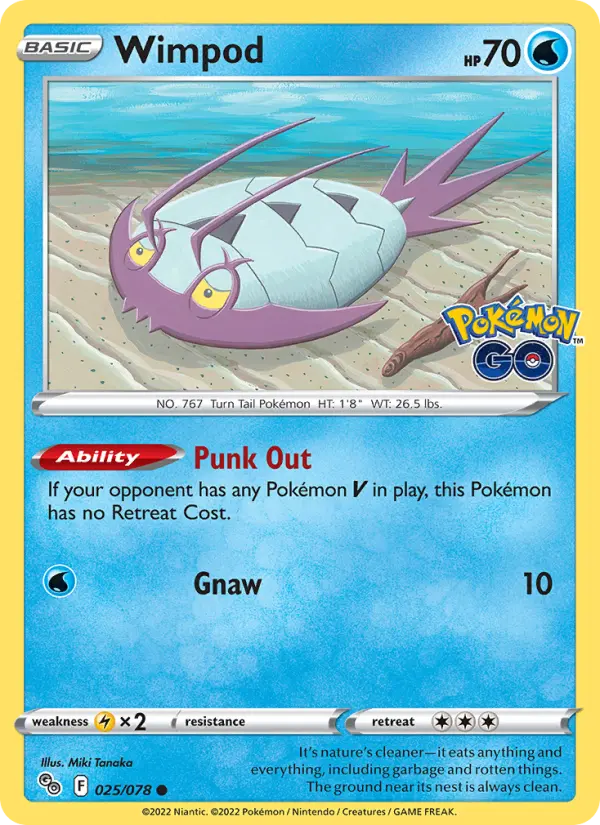
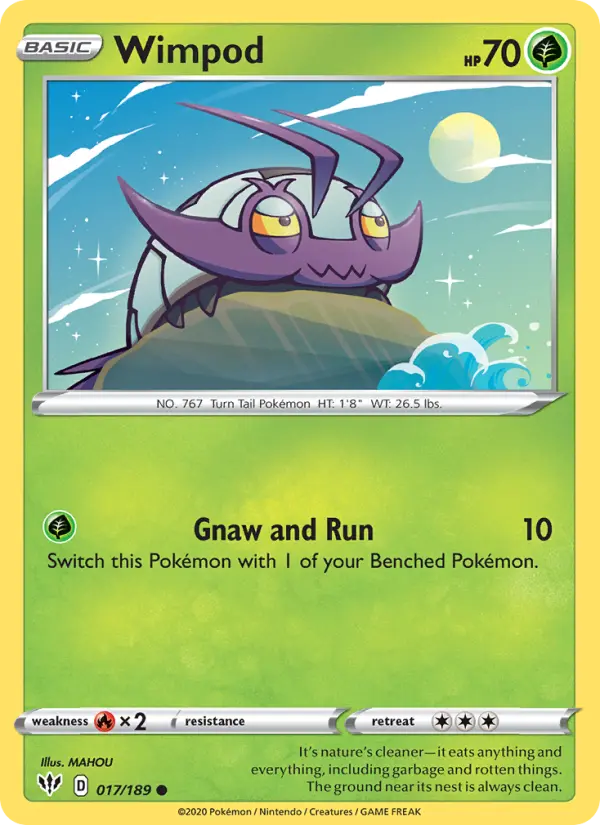
It’s nature’s cleaner—it eats anything and everything, including garbage and rotten things. The ground near its nest is always clean.
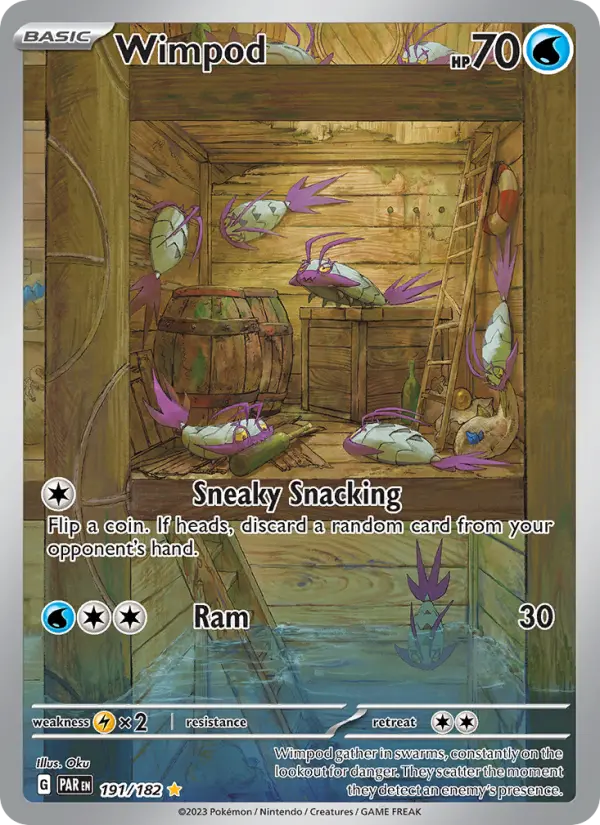
Wimpod gather in swarms, constantly on the lookout for danger. They scatter the moment they detect an enemy’s presence.
Wimpod Name Origin & Design Inspiration
Wimpod's name origin lies in the English words 'wimp' and 'pod,' the latter referring to the protective carapace or shell-like structures characteristic of arthropods and crustaceans. In Japanese, it is known as Kosokumushi (コソクムシ), combining 'kosoku' (meaning fast or high-speed) and 'mushi' (insect), emphasizing its rapid escape behavior. The design draws inspiration from crustaceans such as isopods—small, armor-plated arthropods found in marine and coastal environments—while incorporating insectile features that justify its Bug-type classification. The silver plating across its body reflects the metallic coloration seen in certain isopod species, while the eight legs and overall body structure evoke isopod anatomy. The poisonous secretion and defensive behavior mirror the chemical defense mechanisms employed by various arthropods in nature. The name 'Turn Tail' as its species designation perfectly encapsulates its defining characteristic: the tendency to flee instantly when confronted with danger, embodying the concept of a cowardly creature that turns and runs rather than standing its ground.
Learnable Moves
Wimpod can learn 38 moves:
Move | Type | Cat. | Power | Acc. | PP |
|---|---|---|---|---|---|
| aqua jet | water | Physical | 40 | 100 | 20 |
| assurance | dark | Physical | 60 | 100 | 10 |
| attract | normal | Status | — | 100 | 15 |
| bug buzz | bug | Special | 90 | 100 | 10 |
| confide | normal | Status | — | — | 20 |
| defense curl | normal | Status | — | — | 40 |
| double team | normal | Status | — | — | 15 |
| endure | normal | Status | — | — | 10 |
| facade | normal | Physical | 70 | 100 | 20 |
| frustration | normal | Physical | — | 100 | 20 |
| hail | ice | Status | — | — | 10 |
| harden | normal | Status | — | — | 30 |
| hidden power | normal | Special | 60 | 100 | 15 |
| leech life | bug | Physical | 80 | 100 | 10 |
| metal claw | steel | Physical | 50 | 95 | 35 |
| mud shot | ground | Special | 55 | 95 | 15 |
| protect | normal | Status | — | — | 10 |
| rain dance | water | Status | — | — | 5 |
| rest | psychic | Status | — | — | 5 |
| return | normal | Physical | — | 100 | 20 |
| rollout | rock | Physical | 30 | 90 | 20 |
| round | normal | Special | 60 | 100 | 15 |
| sand attack | ground | Status | — | 100 | 15 |
| scald | water | Special | 80 | 100 | 15 |
| screech | normal | Status | — | 85 | 40 |
| skitter smack | bug | Physical | 70 | 90 | 10 |
| sleep talk | normal | Status | — | — | 10 |
| snore | normal | Special | 50 | 100 | 15 |
| spikes | ground | Status | — | — | 20 |
| struggle bug | bug | Special | 50 | 100 | 20 |
| substitute | normal | Status | — | — | 10 |
| surf | water | Special | 90 | 100 | 15 |
| swagger | normal | Status | — | 85 | 15 |
| swift | normal | Special | 60 | — | 20 |
| taunt | dark | Status | — | 100 | 20 |
| toxic | poison | Status | — | 90 | 10 |
| waterfall | water | Physical | 80 | 100 | 15 |
| wide guard | rock | Status | — | — | 10 |
Wimpod Competitive Battle Guide
Competitively, Wimpod occupies an extremely niche role despite its defining Wimp Out ability, which automatically forces a switch when HP drops below 50%. With a pitifully low total stat allocation of only 230, distributed among terrible offensive stats (35 Attack and 20 Special Attack) and mediocre defenses (40 Defense and 30 Special Defense), Wimpod lacks the survivability or damage output necessary for serious competitive play. Its only notable stat is Speed, sitting at a respectable base 80, but this speed advantage means little when the Pokémon cannot reliably damage opponents or survive incoming attacks. The Wimp Out ability, while mechanically interesting, functions better as a gimmick than a competitive strategy since forcing a switch provides little advantage if the incoming Pokémon faces similar threats. Most competitive players view Wimpod as a joke entry or a nuzlocke challenge rather than a legitimate team option. However, the Pokémon gains approximately 26 base stat points across the board upon evolution to Golisopod, which transforms it into a much more viable competitive threat with decent Attack and Speed stats. For trainers seeking to use Bug/Water-type Pokémon competitively, the evolution line is best approached by planning around Golisopod's superior statistics while viewing Wimpod as merely a stepping stone.
Commonly Asked Questions About Wimpod
What type is Wimpod?
Wimpod is a bug and water type Pokemon.
What does Wimpod evolve into?
Wimpod evolves into golisopod.
What are Wimpod's weaknesses?
Wimpod is weak to flying, rock and electric type moves.
Does Wimpod evolve by trading?
No — Wimpod evolves entirely through leveling up, with no trade required at any stage.
Where can I find Wimpod?
Wimpod can be found in alola route 8 (alola), poni breaker coast (alola) and poni wilds (alola) and 1 other locations.
Wimpod Cultural Impact & Franchise History
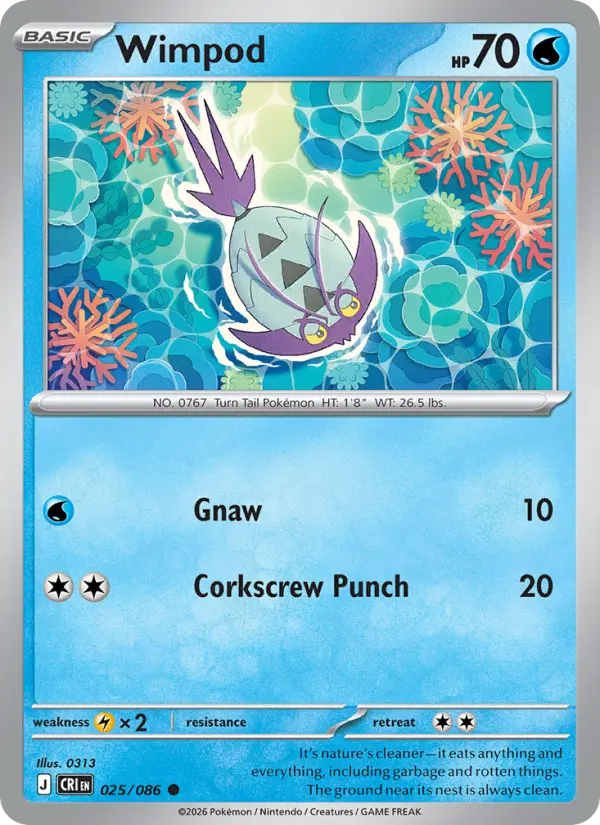
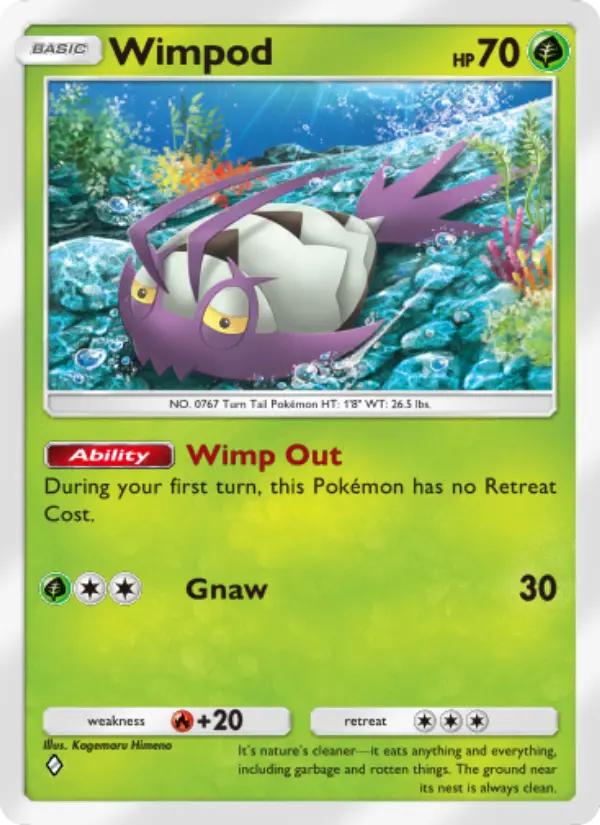
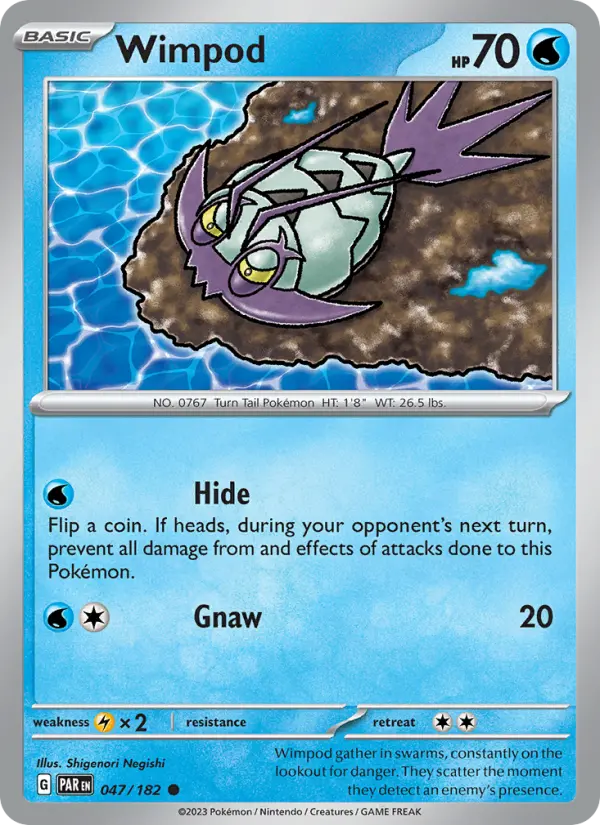
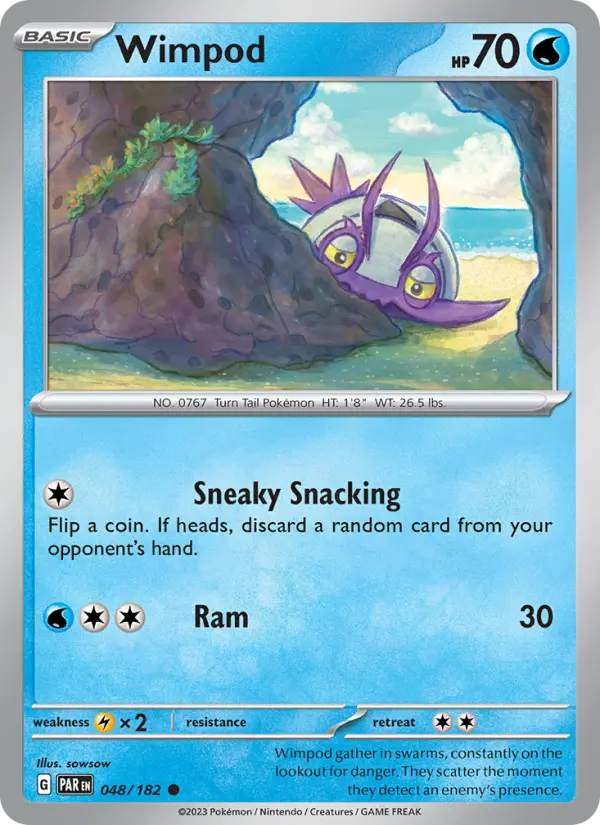
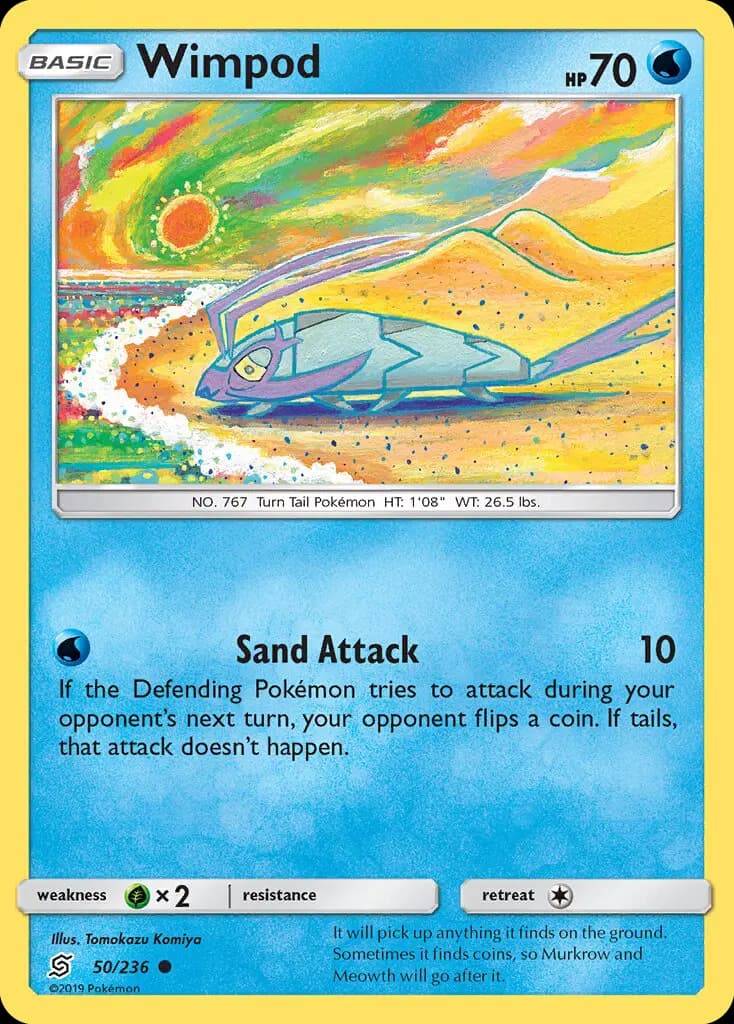
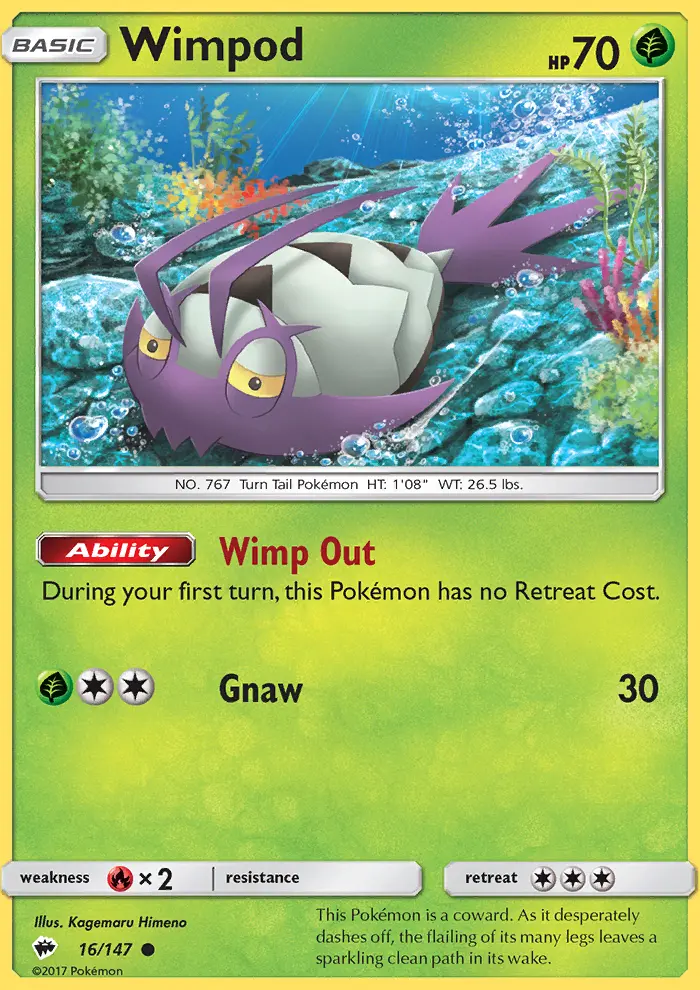
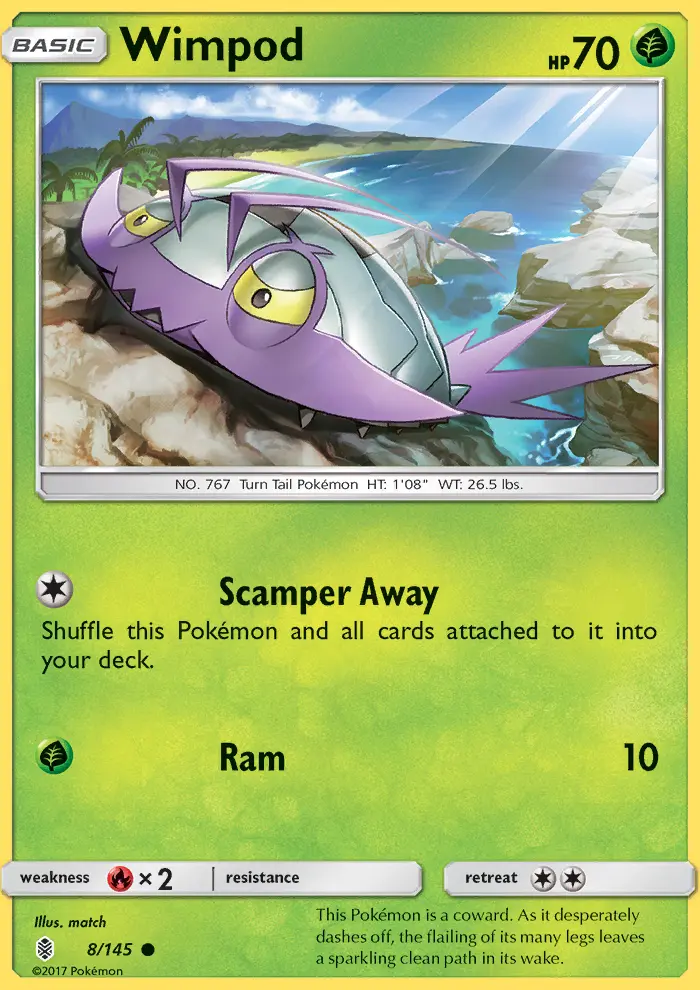
Wimpod has achieved modest cultural recognition within the broader Pokémon franchise, primarily as the embodiment of comedic cowardice and fearfulness. Its exaggerated scaredy-cat personality resonates with audiences seeking Pokémon that subvert traditional battle-ready expectations, positioning it alongside other famously weak or timid creatures. The species appears in various Pokémon media including the animated series, where its panicked behavior and tendency to flee provide comedic moments. Trading card game releases feature Wimpod with artwork emphasizing its nervous demeanor and frantic leg-flailing escape sequences. Among competitive communities, Wimpod serves as a humorous reference point—players occasionally reference 'wimping out' when describing forced switches or tactical retreats in battle. Its evolution into the aggressive Golisopod creates a compelling narrative arc frequently discussed in community forums and strategy guides, illustrating how even the most cowardly creatures possess latent potential for transformation. Casual players appreciate Wimpod for its charming, non-threatening design and its role as nature's cleanup crew, themes that appear in educational Pokédex entries emphasizing ecological balance. The species' scavenger nature has inspired creative trainer backstories and team compositions centered around themes of cleanliness, collection, and redemption.
Where to Find Wimpod in Every Pokémon Game
Wimpod was introduced in Generation VII games Pokémon Sun and Moon and remains available in subsequent Alola region games Ultra Sun and Ultra Moon, where it maintains local Pokédex numbers 0182 and 0221 respectively. The species is obtainable in Pokémon Sword and Shield with local Pokédex number 0232, as well as in the Isle of Armor DLC with number 0124. In these generation eight titles, Wimpod can be encountered in appropriate water and beach environments. The Pokémon appears in Pokémon Let's Go Pikachu and Let's Go Eevee with considerable availability in coastal areas. Its inclusion in Pokémon Legends: Arceus provides another avenue for capture, though with different mechanics reflecting that game's research-focused approach. Wimpod appears in Pokémon Scarlet and Violet with availability in aquatic biomes across the Paldea region. For players seeking to obtain Wimpod, the species' high catch rate of 90 ensures relatively easy capture in the wild without requiring specialized balls or extensive preparation. The species is commonly available in breeding and trading communities, making it accessible to players who prefer not to hunt for it in the wild. Its role as a low-level encounter in most games where it appears means trainers can obtain Wimpod early in their adventure and raise it to evolve into the more competitive Golisopod.