Phantump
Generation VI · #0708 — Stump Pokémon
Weighing 7 kg and standing 0.4 m, Phantump carries its ghost/grass typing into battle with a stat spread that leans hardest into Attack. Standing 0.4 m tall and weighing 7.0 kg, it's built around a distinct combination of ghost traits that shapes how it performs both in the wild and in battle. This tragic backstory contrasts starkly with Phantump's actual behavior: rather than being malevolent, these small Pokémon attempt to make friends with lost people by imitating the voices of children, though their well-intentioned efforts often lead wanderers deeper into the forest. With a cumulative stat total of just 309, Phantump occupies the niche of an early-game Ghost/Grass Pokémon, boasting a respectable Attack stat of 70 while maintaining reasonable bulk through its Defense and Special Defense stats of 48 and 60 respectively. The species is notable for being the only Pokémon alongside its evolution, Trevenant, capable of learning the exclusive move Forest's Curse, cementing its role as a unique addition to the Kalos region's ecosystem.
Editor's Take
Phantump's Pokédex entry about being the spirit of a child lost in the forest is one of the darkest in the series, and Trevenant's Harvest is genuinely useful.
Base Stats
Height
0.4m
Weight
7.0kg
Category
Stump Pokémon
Gender
Male 50% / Female 50%
Color
brown
Shape
arms
Abilities
Cures any major status ailment upon switching out.
Reveals an opponent's held item upon entering battle.
Has a 50% chance of restoring a used Berry after each turn if the Pokémon has held no items in the meantime.

Phantump Biology & Physical Characteristics
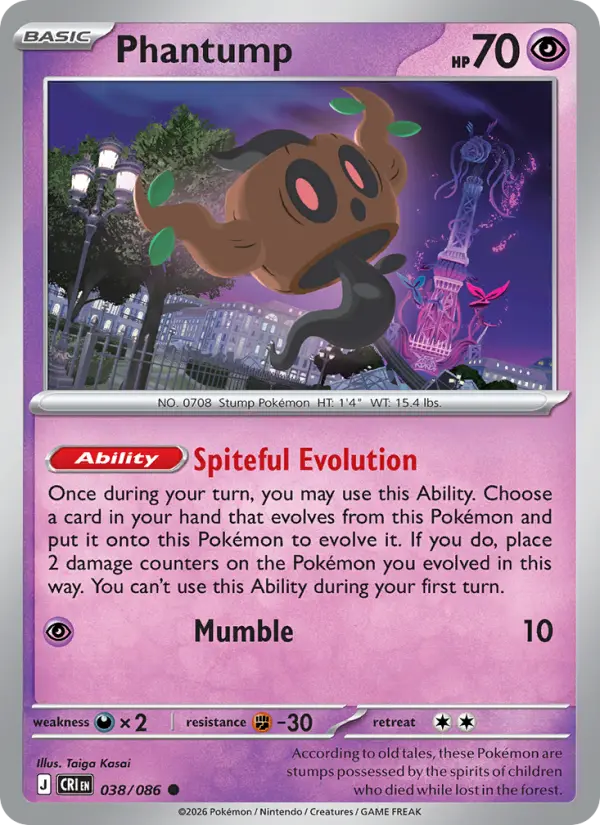
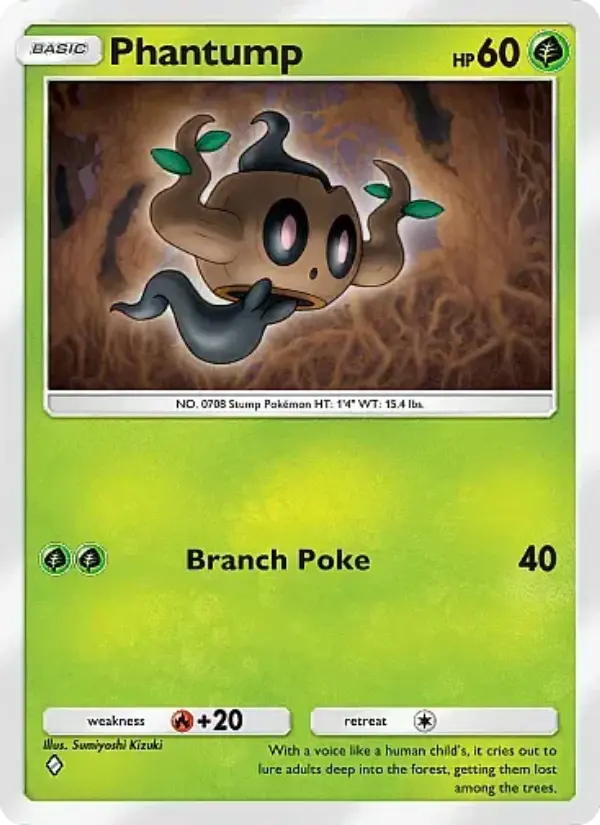
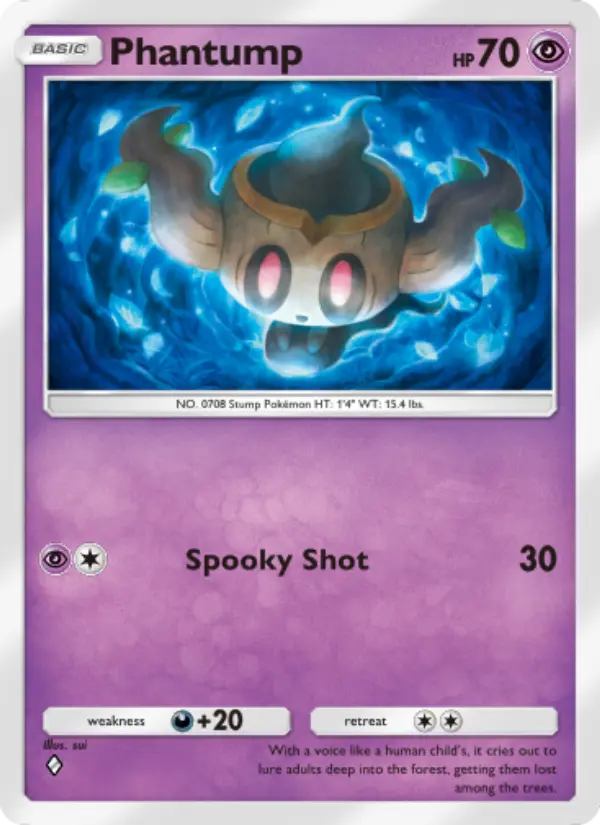
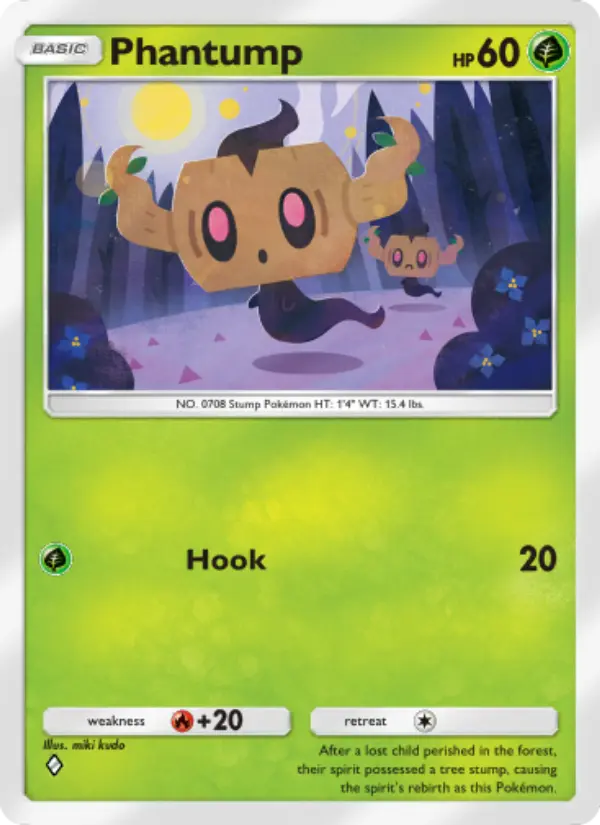
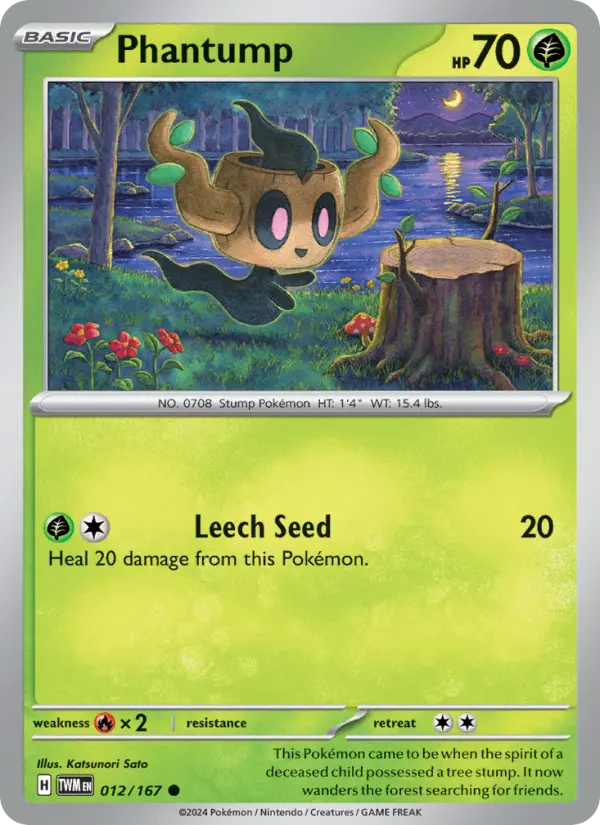
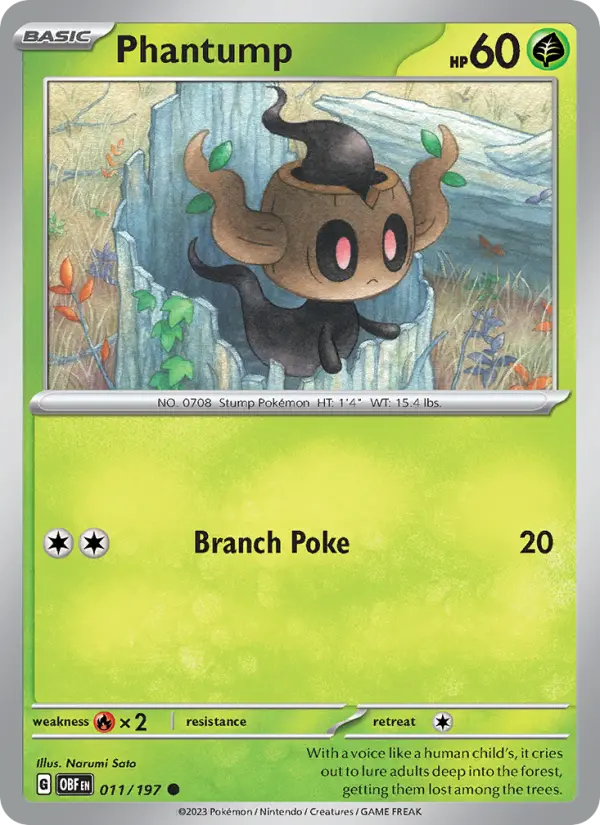
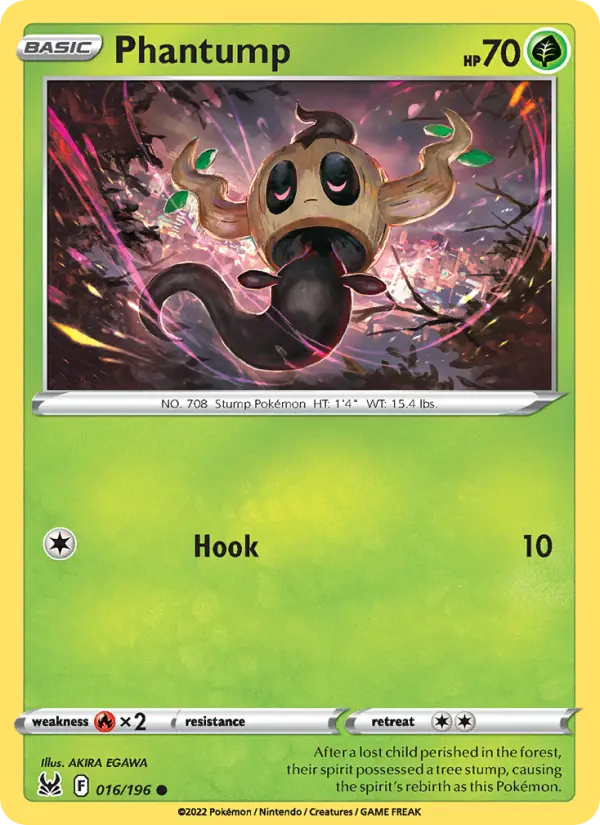
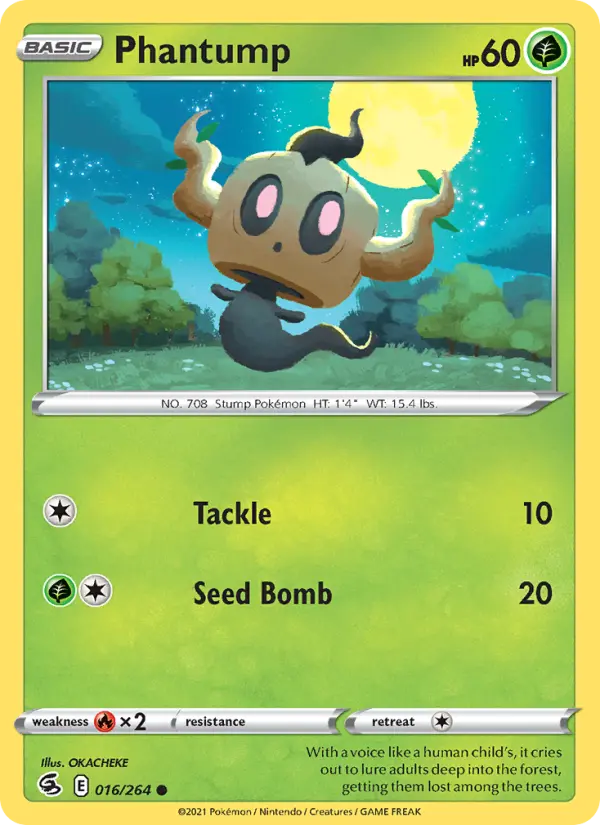
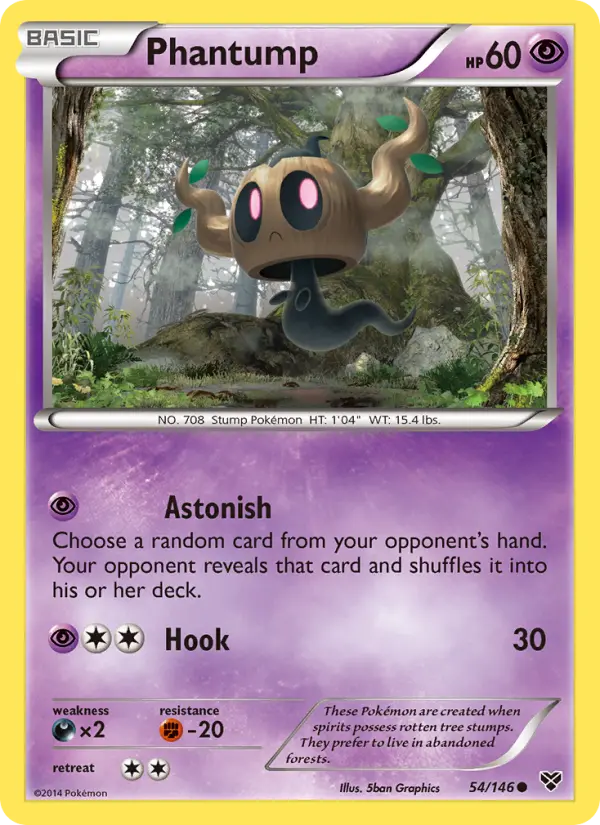
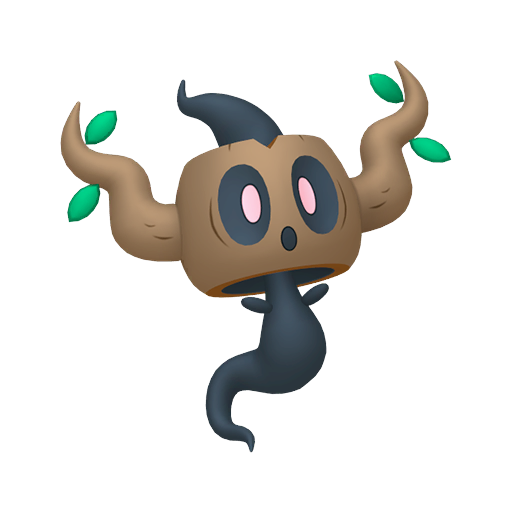
Phantump's physical form is a haunting fusion of the spectral and botanical. Its body consists of a wispy, black gaseous substance that barely contains physical form, crowned by a small brownish tree stump serving as its head. Two wavy branches extend from either side of this stump, each adorned with small green leaves near their tips—these leaves are far from merely decorative, as Pokédex entries reveal that brewing them creates a curative infusion capable of treating any illness. The Pokémon's face is rendered visible through two red eyes peering through holes in the stump, with its mouth appearing as a simple opening on the stump itself. This diminutive creature stands only 0.4 meters tall and weighs a mere 7.0 kilograms, making it one of the lighter Ghost-type Pokémon despite its ethereal composition. The design brilliantly captures the essence of spiritual possession—the tree stump serving as a vessel for the ghost inhabiting it, the black wispy form representing the spectral entity itself. The presence of healing leaves on its crown further emphasizes the duality of Phantump's nature: simultaneously a tragic phantom and a source of medicinal benefit to those who encounter it.
Pokedex Numbers
Training
Breeding
Phantump Breeding, Gender Ratio & Egg Groups
Phantump reproduces through the Grass and Amorphous egg groups, classifications that reflect its dual nature as both a botanical entity and a spectral being. The species exhibits a perfect 50% male to 50% female gender ratio, a balanced distribution that suggests the spirits possessing tree stumps show no gender preference, or that gender itself becomes somewhat abstract when a spirit inhabits an inanimate object. Phantump has a base friendship value of 70, indicating that these Pokémon are reasonably amenable to companionship with trainers, befitting their nature as creatures attempting to forge connections despite their tragic origins. The species features a notably high catch rate of 120, making it relatively easy to encounter and recruit into a trainer's team—this accessibility is fitting for an early-game Pokémon that players might encounter in the forests of Kalos during the early stages of their adventure. Phantump's eggs hatch after approximately 20 cycles, translating to roughly 4,884 to 5,140 steps of travel, a standard hatching period that makes breeding these Pokémon manageable for dedicated trainers. The Amorphous egg group connection it shares with Pokémon like Gastly, Misdreavus, and Spiritomb indicates that phantom entities can interbreed despite their spectral nature, suggesting that reproduction among ghost-types operates under different biological principles than conventional life. This combination of traits makes Phantump accessible to new players while rewarding breeders who seek to maximize individual values and create optimized teams.
Sprites





TMs & HMs
tm03
crystal
tm03
gold silver
tm05
lets go pikachu lets go eevee
tm06
yellow
tm06
gold silver
tm06
red blue
tm06
crystal
tm06
emerald
tm06
firered leafgreen
tm06
diamond pearl
tm06
platinum
tm06
ruby sapphire
tm06
colosseum
tm06
black 2 white 2
tm06
xd
tm06
black white
tm06
heartgold soulsilver
tm06
omega ruby alpha sapphire
tm06
ultra sun ultra moon
tm06
sun moon
+666 more TMs/HMs
Phantump's Evolution Chain


Phantump Evolution, Mega Evolution & Special Forms
Phantump undergoes a remarkable transformation upon evolution into Trevenant, one of the few Pokémon whose evolution is triggered by trading rather than natural level progression or environmental conditions. This trade-based evolution mechanic reflects the Pokédex lore suggesting that Phantump requires the bond and journey shared between trainer and Pokémon to achieve its full potential. Upon trading, Phantump evolves into Trevenant, a significantly larger and more formidable Ghost/Grass-type that stands 1.5 meters tall and weighs 71.0 kilograms—a dramatic increase in both presence and power. Trevenant's base stats improve across the board, particularly in Attack, which increases from 70 to 110, and in Special Defense, rising from 60 to 85, transforming the fragile sapling into a sturdy protector of forests. The evolution also grants access to new movepool options and the signature move Forest's Curse, which both Phantump and Trevenant can learn. This evolution represents not merely physical maturation but a spiritual transformation, as if the trade itself—an exchange of bond and trust between trainer and Pokémon—provides the strength necessary for the ghost within the stump to achieve its full form. Trevenant becomes a guardian figure, standing as a towering sentinel of the forest where its smaller form once wandered as a lonely spirit.
Where to Find
Kalos Route 16
kalos
+1 more
Memorial Hill
alola
+1 more
Tapu Village
alola
Phantump Behaviour and Natural Habitat
Phantump inhabits abandoned and desolate forests where human presence has long since faded, environments that seem to echo with loneliness and loss. These Pokémon are most active in locations where the forest has reclaimed human spaces, where moss-covered stumps and decaying wood dominate the landscape. Their vocalizations are distinctly unsettling, described as either eerie screams or perfect imitations of a lost child's voice—a behavior that perfectly encapsulates their paradoxical nature. According to the Pokédex, Phantump cries sound like eerie screams that cause people to become hopelessly lost deep in the forest, yet the entries consistently note that this is an attempt at friendship rather than malice. This tragic behavioral pattern suggests that Phantump, possessing the memories or instincts of lost children, unconsciously recreate their own experiences by calling to adults, hoping to establish connection but inadvertently dooming their new acquaintances to the same fate they suffered. The species demonstrates a preference for the deepest, most isolated sections of forests, avoiding areas of active human civilization. Despite their reputation as omens of danger, Phantump are not inherently aggressive and show no desire to harm those they encounter—their danger lies purely in the consequences of following their plaintive calls into unforgiving wilderness.
Pokedex Entries
These Pokémon are created when spirits possess rotten tree stumps. They prefer to live in abandoned forests.
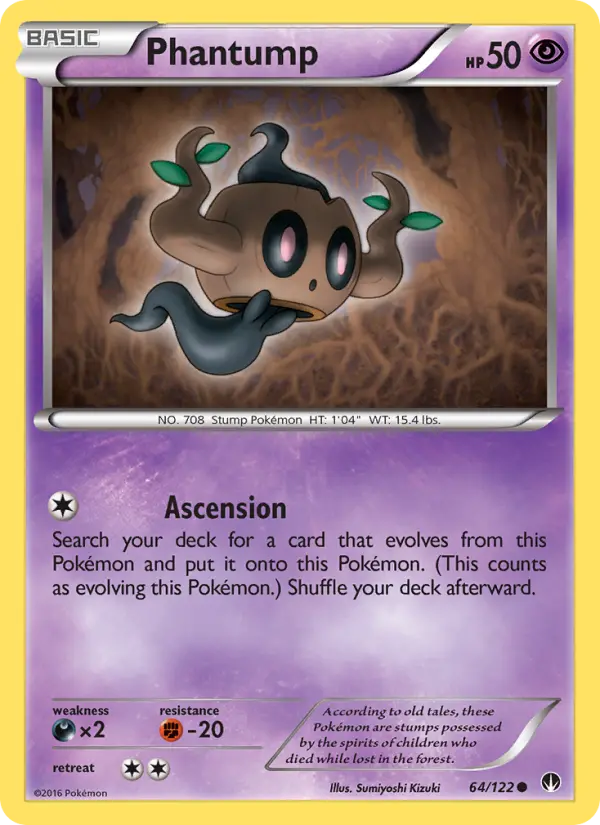
According to old tales, these Pokémon are stumps possessed by the spirits of children who died while lost in the forest.
These Pokémon are created when spirits possess rotten tree stumps. They prefer to live in abandoned forests.
According to old tales, these Pokémon are stumps possessed by the spirits of children who died while lost in the forest.
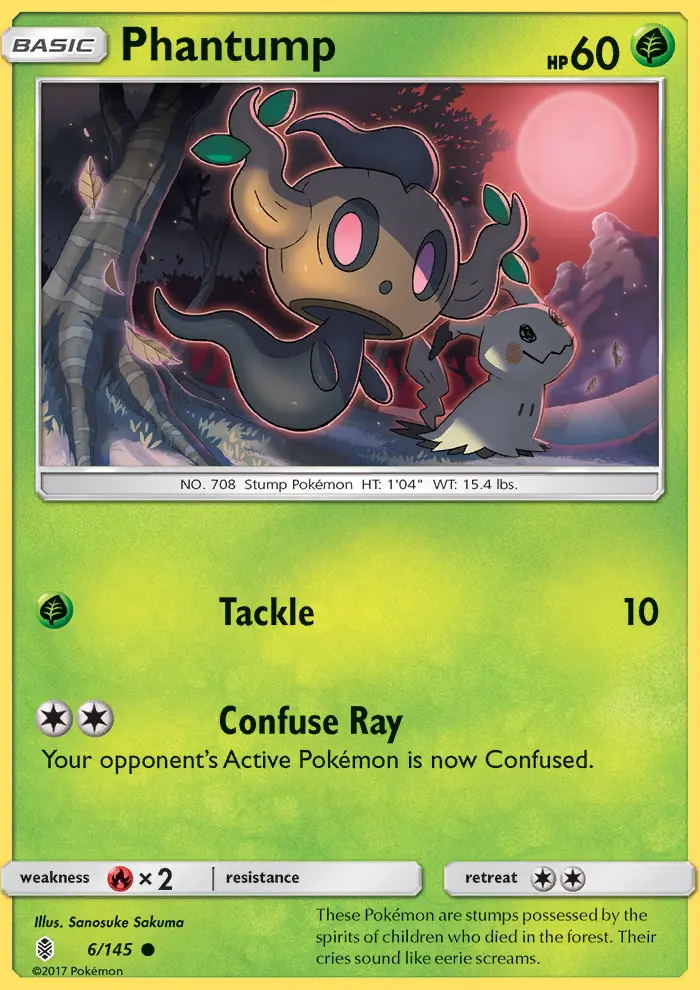
These Pokémon are stumps possessed by the spirits of children who died in the forest. Their cries sound like eerie screams.
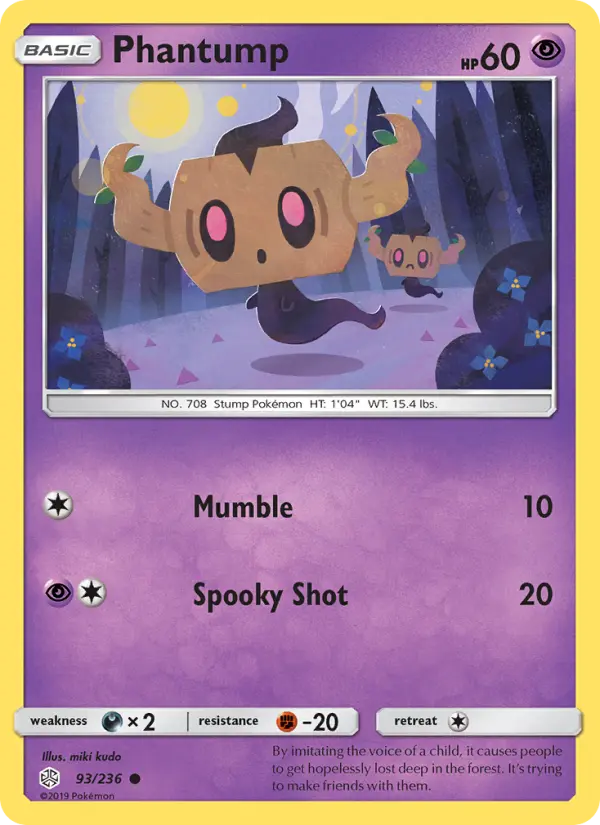
By imitating the voice of a child, it causes people to get hopelessly lost deep in the forest. It’s trying to make friends with them.
According to legend, medicine to cure any illness can be made by plucking the green leaves on its head, brewing them, and boiling down the liquid.
An unknown spirit came to lodge in a tree stump, creating this Pokémon. A cure-all can be made from an infusion of its green leaves.
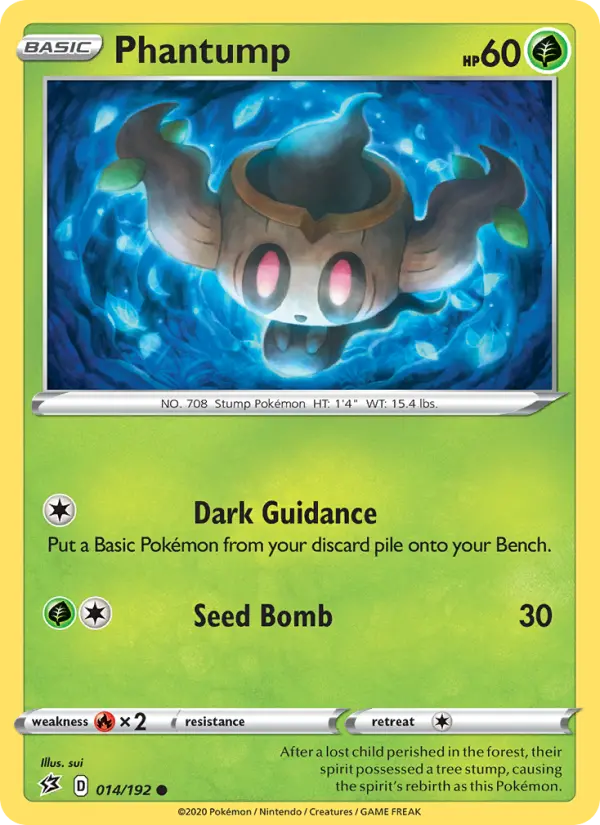
After a lost child perished in the forest, their spirit possessed a tree stump, causing the spirit’s rebirth as this Pokémon.
With a voice like a human child’s, it cries out to lure adults deep into the forest, getting them lost among the trees.
Phantump Name Origin & Design Inspiration
Phantump's name derives from a clever fusion of 'phantom' and 'stump,' immediately communicating both its ghostly nature and its physical form as a possessed tree stump. The Japanese name, Bokurei, combines 'boku' (wood) with 'rei' (spirit), perfectly encapsulating the species' central concept in just two syllables. Game Freak's design team created Phantump as a deliberate spiritual successor to earlier Ghost-type Pokémon like Gastly and Haunter, but with a distinctly botanical twist that connects it thematically to Grass-types such as Exeggcute and Foongus. The visual design draws inspiration from folklore surrounding will-o'-the-wisps and forest spirits found across European and Asian traditions—particularly the concept of tsukumogami from Japanese mythology, where inanimate objects gain spirits after existing for a hundred years. The tree stump choice is particularly poignant given that stumps represent endings and loss, the remnants of once-tall trees, making them the perfect vessel for the spirits of lost children. The ethereal black body with subtle wisping effects conveys the supernatural without being grotesque, while the placement of the red eyes creates an expression that is simultaneously pitiful and eerie. The healing leaves adorning its branches transform the design from purely melancholic to one that offers hope and restoration, suggesting that even tragedy can produce beneficial outcomes.
Learnable Moves
Phantump can learn 84 moves:
Move | Type | Cat. | Power | Acc. | PP |
|---|---|---|---|---|---|
| ally switch | psychic | Status | — | — | 15 |
| astonish | ghost | Physical | 30 | 100 | 15 |
| attract | normal | Status | — | 100 | 15 |
| bestow | normal | Status | — | — | 15 |
| branch poke | grass | Physical | 40 | 100 | 40 |
| bulldoze | ground | Physical | 60 | 100 | 20 |
| confide | normal | Status | — | — | 20 |
| confuse ray | ghost | Status | — | 100 | 10 |
| curse | ghost | Status | — | — | 10 |
| cut | normal | Physical | 50 | 95 | 30 |
| dark pulse | dark | Special | 80 | 100 | 15 |
| destiny bond | ghost | Status | — | — | 5 |
| dig | ground | Physical | 80 | 100 | 10 |
| disable | normal | Status | — | 100 | 20 |
| double team | normal | Status | — | — | 15 |
| dream eater | psychic | Special | 100 | 100 | 15 |
| endure | normal | Status | — | — | 10 |
| energy ball | grass | Special | 90 | 100 | 10 |
| facade | normal | Physical | 70 | 100 | 20 |
| feint attack | dark | Physical | 60 | — | 20 |
| forest’s curse | grass | Status | — | 100 | 20 |
| foul play | dark | Physical | 95 | 100 | 15 |
| frustration | normal | Physical | — | 100 | 20 |
| giga drain | grass | Special | 75 | 100 | 10 |
| grass knot | grass | Special | — | 100 | 20 |
| grassy glide | grass | Physical | 55 | 100 | 20 |
| grassy terrain | grass | Status | — | — | 10 |
| growth | normal | Status | — | — | 20 |
| grudge | ghost | Status | — | — | 5 |
| hex | ghost | Special | 65 | 100 | 10 |
| hidden power | normal | Special | 60 | 100 | 15 |
| horn leech | grass | Physical | 75 | 100 | 10 |
| imprison | psychic | Status | — | — | 10 |
| ingrain | grass | Status | — | — | 20 |
| lash out | dark | Physical | 75 | 100 | 5 |
| leech seed | grass | Status | — | 90 | 10 |
| magic coat | psychic | Status | — | — | 15 |
| magical leaf | grass | Special | 60 | — | 20 |
| nature power | normal | Status | — | — | 20 |
| night shade | ghost | Special | — | 100 | 15 |
| pain split | normal | Status | — | — | 20 |
| phantom force | ghost | Physical | 90 | 100 | 10 |
| poison jab | poison | Physical | 80 | 100 | 20 |
| poltergeist | ghost | Physical | 110 | 90 | 5 |
| power up punch | fighting | Physical | 40 | 100 | 20 |
| protect | normal | Status | — | — | 10 |
| psych up | normal | Status | — | — | 10 |
| psychic | psychic | Special | 90 | 100 | 10 |
| rain dance | water | Status | — | — | 5 |
| reflect | psychic | Status | — | — | 20 |
| rest | psychic | Status | — | — | 5 |
| return | normal | Physical | — | 100 | 20 |
| rock slide | rock | Physical | 75 | 90 | 10 |
| rock smash | fighting | Physical | 40 | 100 | 15 |
| role play | psychic | Status | — | — | 10 |
| round | normal | Special | 60 | 100 | 15 |
| safeguard | normal | Status | — | — | 25 |
| secret power | normal | Physical | 70 | 100 | 20 |
| seed bomb | grass | Physical | 80 | 100 | 15 |
| shadow ball | ghost | Special | 80 | 100 | 15 |
| shadow claw | ghost | Physical | 70 | 100 | 15 |
| skill swap | psychic | Status | — | — | 10 |
| skitter smack | bug | Physical | 70 | 90 | 10 |
| sleep talk | normal | Status | — | — | 10 |
| snore | normal | Special | 50 | 100 | 15 |
| solar beam | grass | Special | 120 | 100 | 10 |
| spite | ghost | Status | — | 100 | 10 |
| strength | normal | Physical | 80 | 100 | 15 |
| substitute | normal | Status | — | — | 10 |
| sucker punch | dark | Physical | 70 | 100 | 5 |
| sunny day | fire | Status | — | — | 5 |
| swagger | normal | Status | — | 85 | 15 |
| tackle | normal | Physical | 40 | 100 | 35 |
| telekinesis | psychic | Status | — | — | 15 |
| tera blast | normal | Special | 80 | 100 | 10 |
| thief | dark | Physical | 60 | 100 | 25 |
| toxic | poison | Status | — | 90 | 10 |
| trailblaze | grass | Physical | 50 | 100 | 20 |
| trick | psychic | Status | — | 100 | 10 |
| trick room | psychic | Status | — | — | 5 |
| venom drench | poison | Status | — | 100 | 20 |
| will o wisp | fire | Status | — | 85 | 15 |
| wood hammer | grass | Physical | 120 | 100 | 15 |
| worry seed | grass | Status | — | 100 | 10 |
Phantump Competitive Battle Guide
From a competitive standpoint, Phantump occupies a precarious position as a weak early-game Pokémon with limited utility at higher tiers of competitive play. Its cumulative stat total of 309 is distributed in ways that create a jack-of-all-trades, master-of-none profile—the 70 Attack stat provides some offensive presence, while a Special Defense of 60 offers moderate survivability against special attackers, but neither stat reaches the threshold needed for consistent competitive success. However, Phantump's ability options provide genuine strategic value that partially compensates for its statistical limitations. Natural Cure allows it to purge major status conditions upon switching out, a utility that can disrupt opponents' strategies in casual or lower-tier competitive formats, while Frisk provides valuable scouting information by revealing an opponent's held item upon entry. The hidden ability Harvest offers intriguing possibilities for defensive builds, restoring consumed Berries with a 50% chance each turn, potentially enabling Phantump to stall opponents through repeated healing. Competitive players primarily value Phantump not for its direct competitive viability but for its potential as a breeding stock for its far superior evolution, Trevenant, which reaches competitive viability in formats like UU and RU with its superior bulk and Attack stat. Phantump's movepool includes solid coverage options inherited through leveling and breeding, though its Speed stat of 38 ensures it will almost always move last, a significant disadvantage in competitive speed tiers where priorities like Quick Attack and Aqua Jet dominate.
Commonly Asked Questions About Phantump
What type is Phantump?
Phantump is a ghost and grass type Pokemon.
What does Phantump evolve into?
Phantump evolves into trevenant.
What are Phantump's weaknesses?
Phantump is weak to flying, ghost, fire, ice and dark type moves.
Does Phantump evolve by trading?
No — Phantump evolves entirely through leveling up, with no trade required at any stage.
Where can I find Phantump?
Phantump can be found in kalos route 16 (kalos), memorial hill (alola) and tapu village (alola).
Phantump Cultural Impact & Franchise History
Phantump has resonated with Pokémon fans since its introduction in Generation VI, primarily due to its deeply unsettling origin story that stands in stark contrast to most Pokémon's relatively neutral or positive lore. The concept of a Pokémon being the actual spirit of a deceased child transformed into a creature seeking companionship struck a nerve with the fanbase, spawning countless pieces of fan art, fiction, and philosophical discussions about the moral implications of capturing and battling what are technically children's spirits. The Pokédex entries' dark atmosphere—particularly the Ultra Sun entry describing how Phantump imitates children's voices to lure people into the forest, juxtaposed with the revelation that this is an attempt at friendship—exemplifies Generation VI's willingness to explore tragic themes within the traditionally lighter Pokémon narrative. Online communities have debated whether trainers are morally justified in capturing Phantump given its nature, with some arguing that offering companionship to a lonely spirit is a form of salvation rather than exploitation. The species has become a gateway for discussions about representation of grief and loss in media aimed at younger audiences, as Phantump manages to be simultaneously tragic and hopeful—a small ghost longing for connection despite its horrific circumstances. Fan communities have embraced Phantump as a symbol of acceptance and finding beauty in darkness, with the species frequently featured in analyses of Pokémon games' most emotionally complex designs.
Where to Find Phantump in Every Pokémon Game
Phantump was introduced in Generation VI and has maintained significant availability across most mainline Pokémon games since its debut. Players can capture Phantump in Pokémon X and Y within the Mountain Kalos area as the local Pokédex number 061, making it an accessible mid-game encounter for trainers progressing through the Kalos region. The species appears prominently in the Generation VII games, Pokémon Sun and Moon, where it occupies Alola Pokédex number 196, and in the enhanced remakes Ultra Sun and Ultra Moon at number 250, appearing in various forest environments throughout the archipelago. Subsequent generations have continued to feature Phantump, with appearances in Pokémon Sword and Shield (Pokédex 338), Pokémon Legends: Arceus (Pokédex 182), and the Crown Tundra DLC (Pokédex 33), maintaining its status as a consistently available Pokémon across multiple regions. In the most recent generation, Pokémon Scarlet and Violet includes Phantump as Pokédex 68 in the Teal Mask DLC, ensuring the species remains accessible to modern players. Phantump's high catch rate of 120 makes it relatively easy to capture once encountered, and its reasonable base happiness of 70 means newly caught specimens bond relatively quickly with trainers. The species' availability across so many games and regions reflects its position as a quintessential Generation VI addition that has earned its place in the broader Pokémon ecosystem, allowing trainers across multiple generations to experience its tragic yet hopeful narrative.