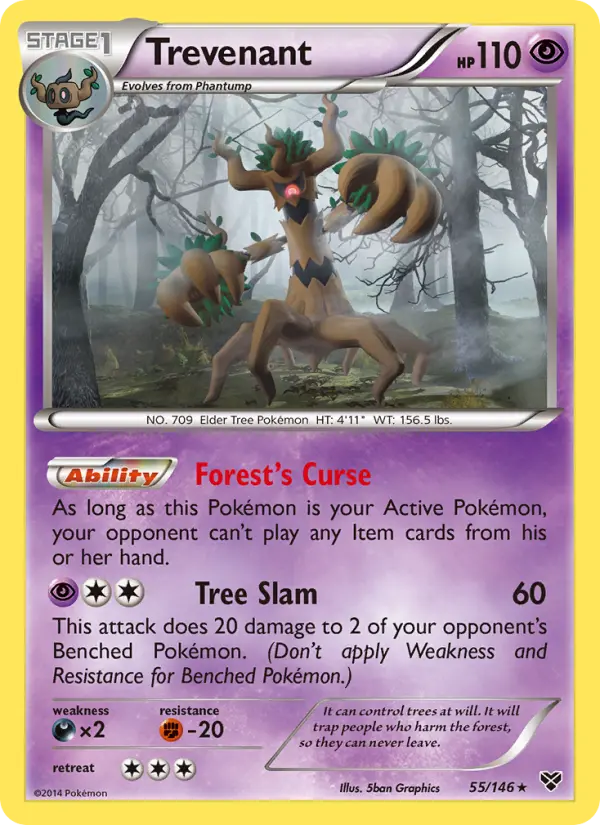
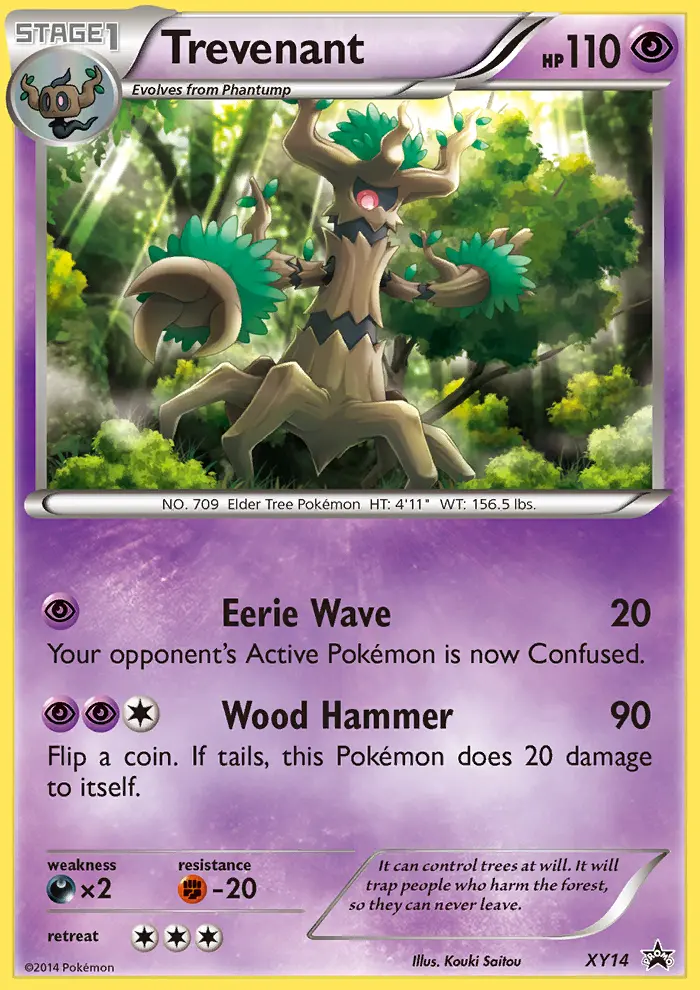
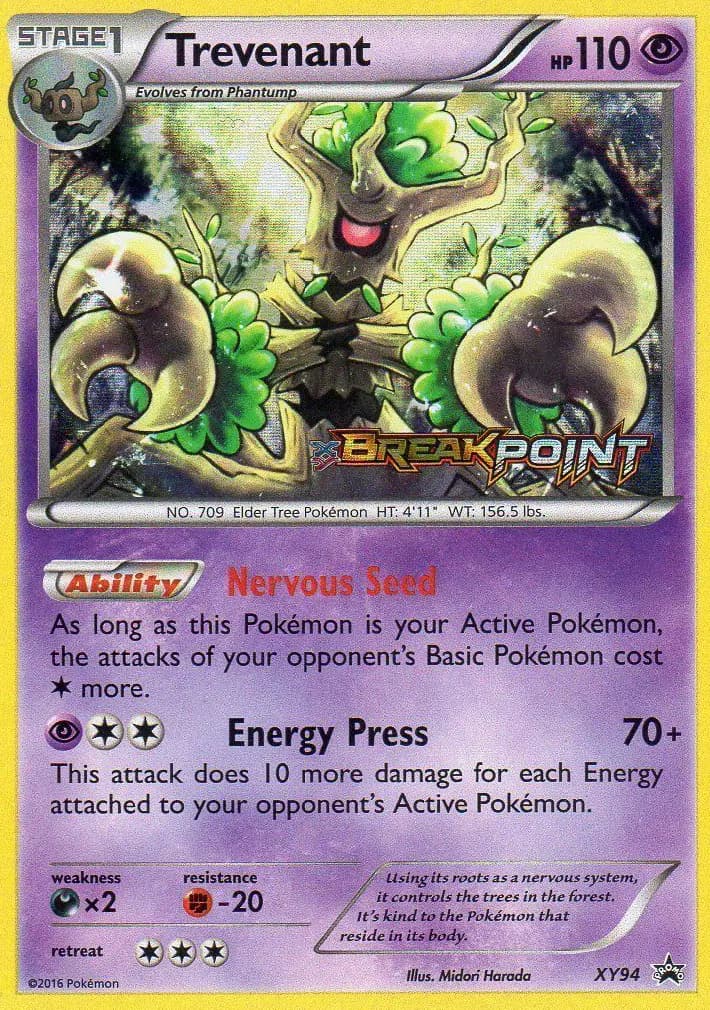
Trevenant
Generation VI · #0709 — Elder Tree Pokémon
Among ghost/grass-type Pokémon, Trevenant stands out for a stat line that pushes hardest into attack. Standing at 1.5 meters tall and weighing 71.0 kilograms, Trevenant serves as a guardian of woodlands, wielding dominion over the trees through supernatural means. Its total base stat value of 474 reflects a creature built for strategic physical offense rather than raw speed, with an Attack stat of 110 that distinguishes it as a formidable force in battle. Beyond its combat capabilities, Trevenant carries profound lore as a forest protector that will curse those who dare to harm trees, making it a Pokémon both respected and feared within its ecosystem.
Editor's Take
Trevenant's Harvest recycling berries plus Natural Cure options and Horn Leech draining HP makes it a genuinely self-sufficient Grass/Ghost type.
Base Stats
Height
1.5m
Weight
71.0kg
Category
Elder Tree Pokémon
Gender
Male 50% / Female 50%
Color
brown
Shape
tentacles
Abilities
Cures any major status ailment upon switching out.
Reveals an opponent's held item upon entering battle.
Has a 50% chance of restoring a used Berry after each turn if the Pokémon has held no items in the meantime.

Trevenant Biology & Physical Characteristics
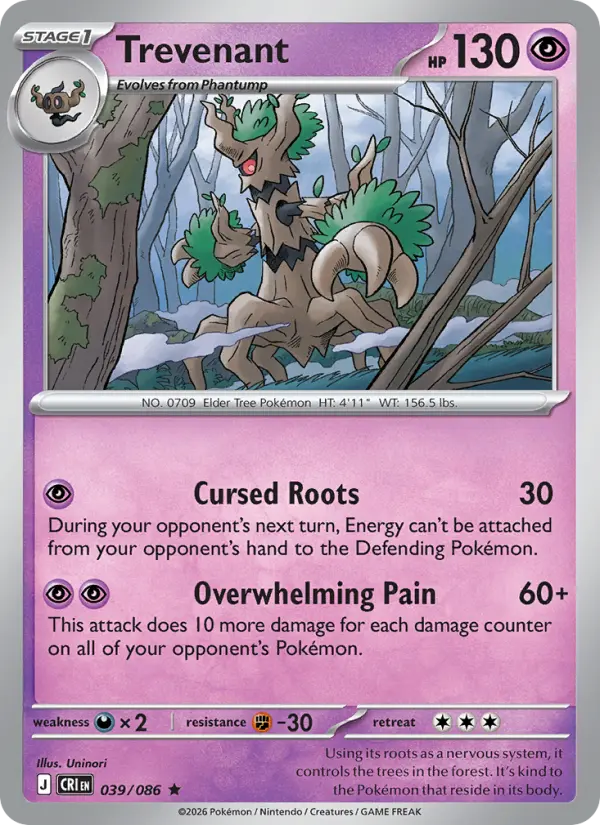
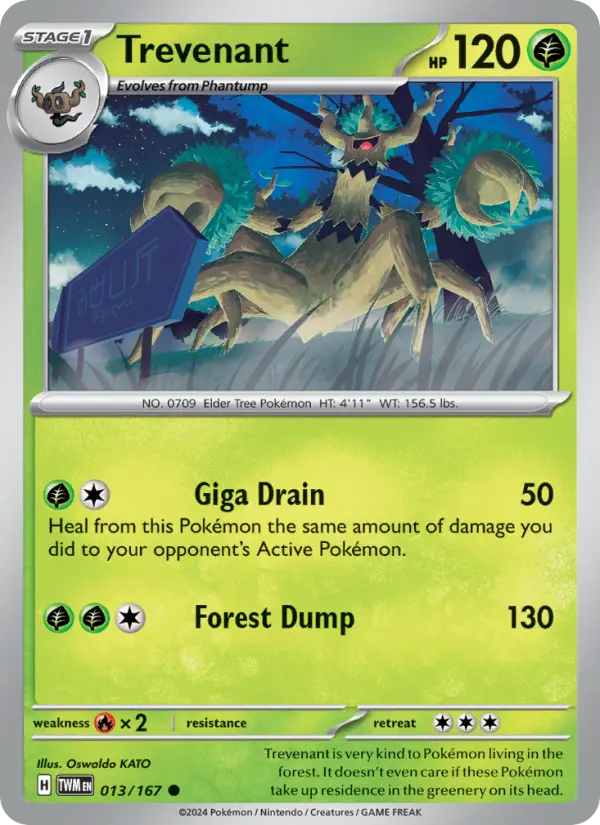
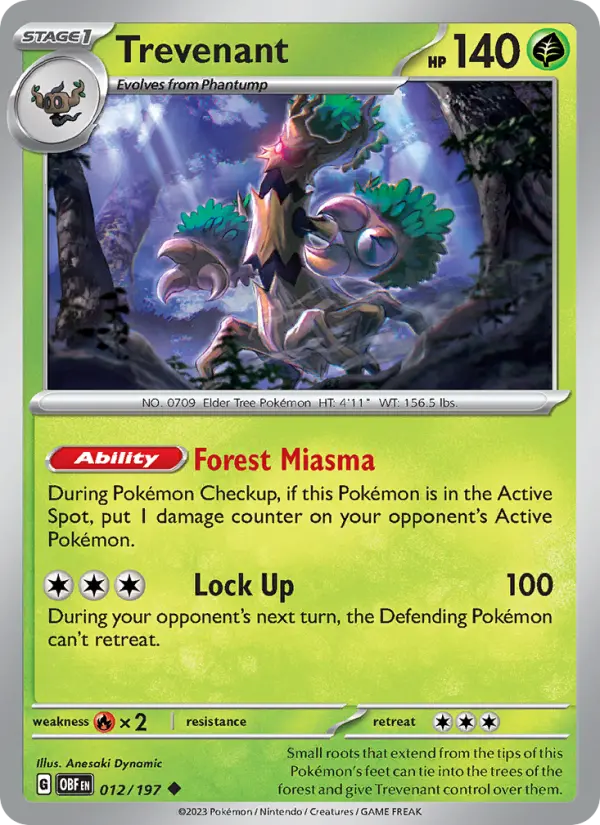
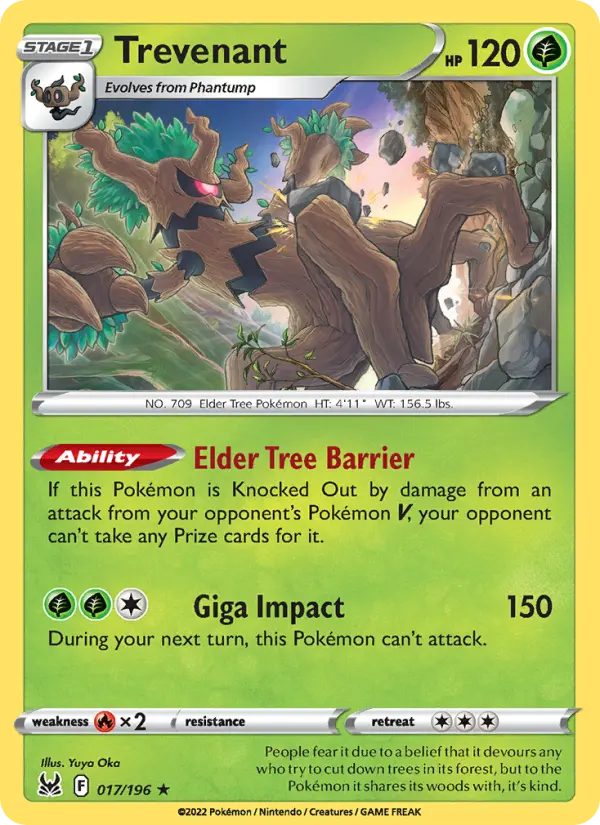
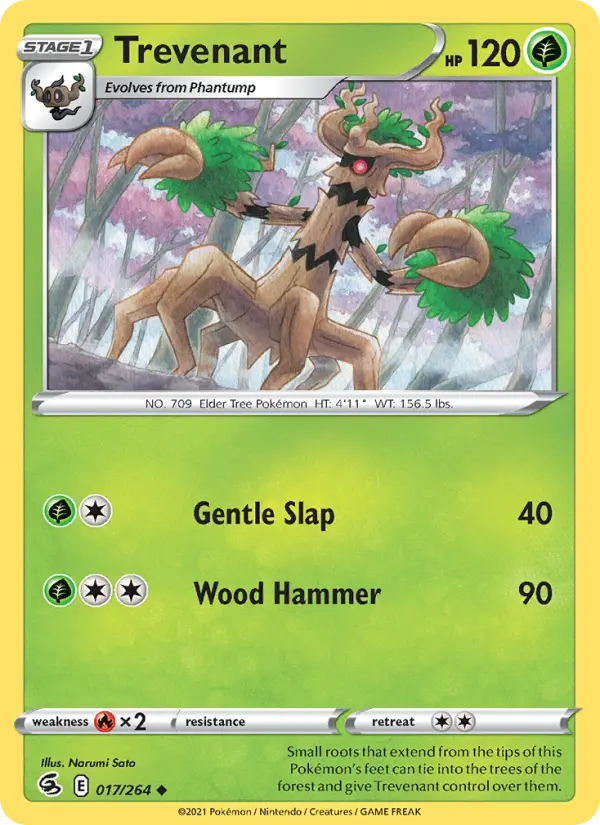
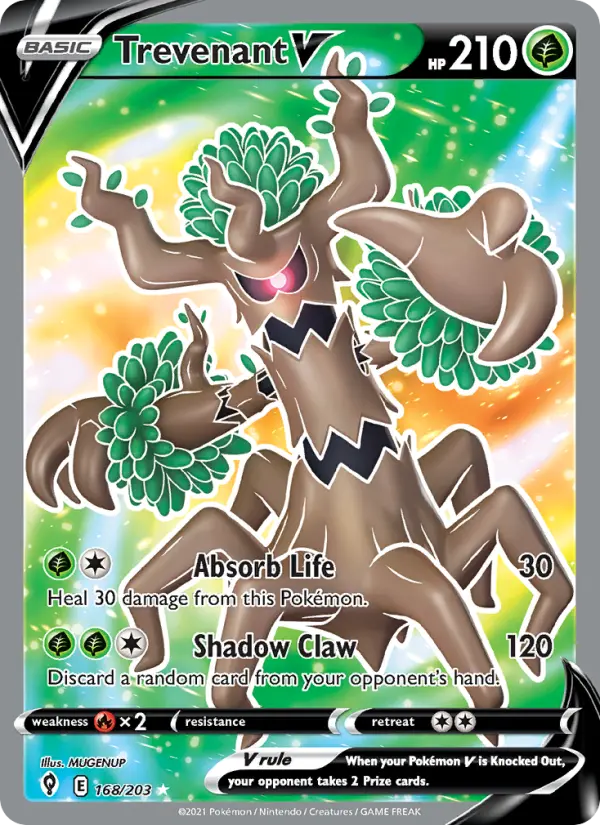
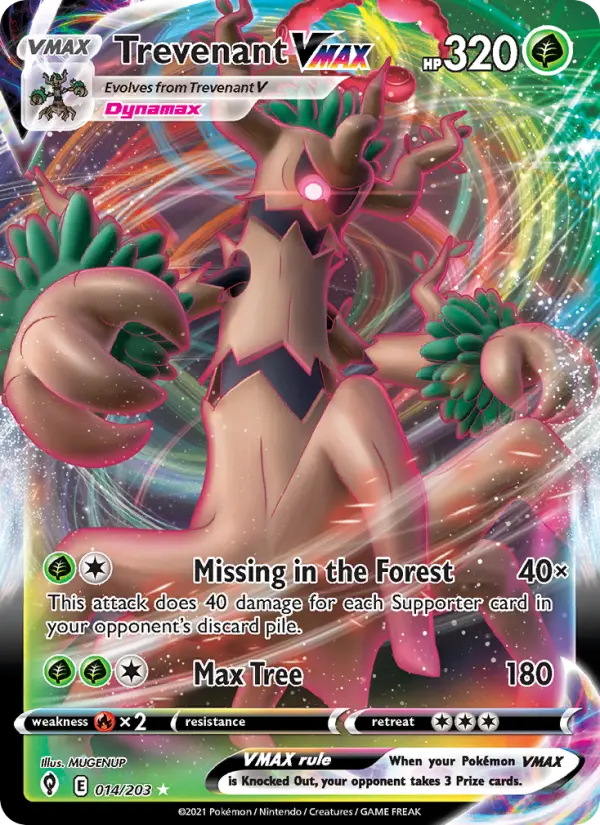
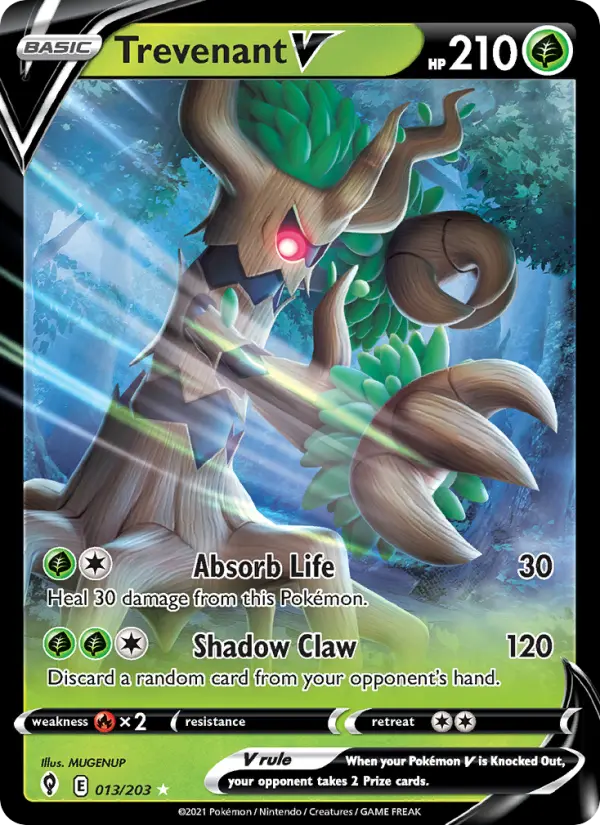
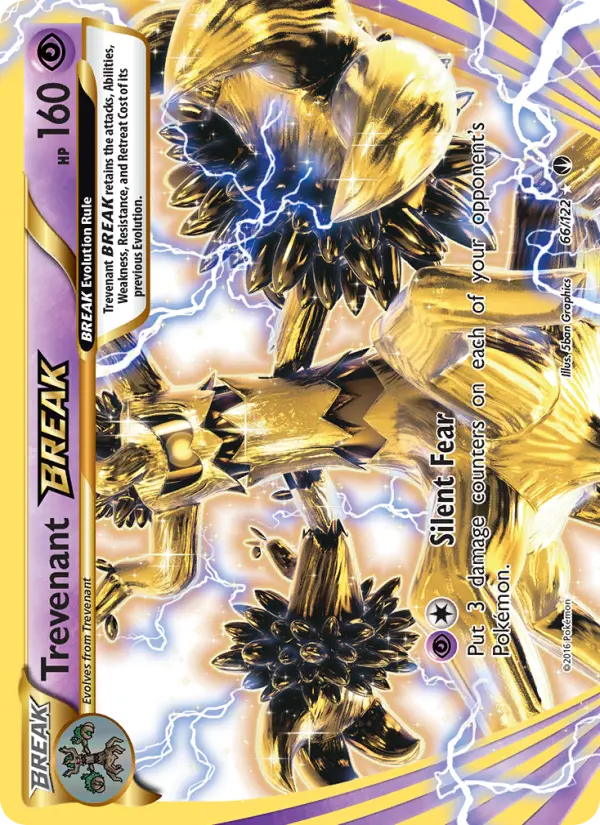
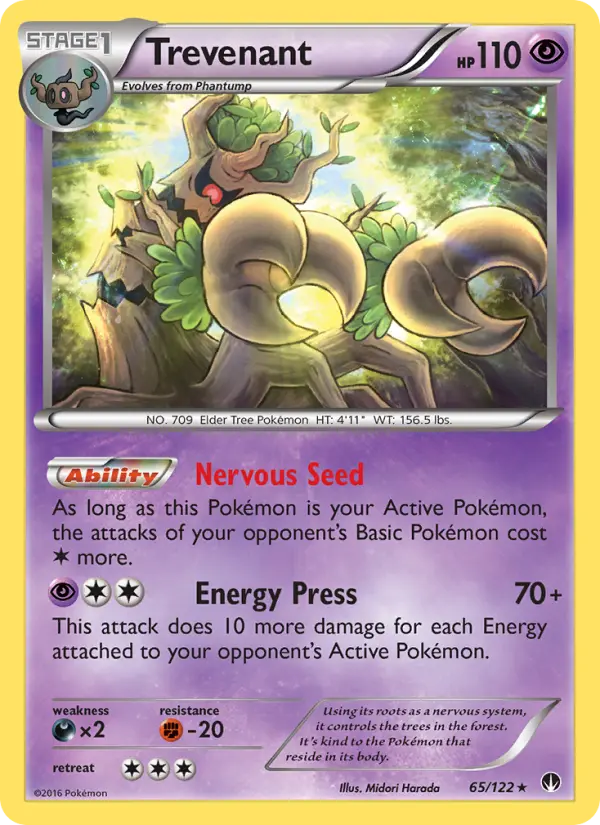
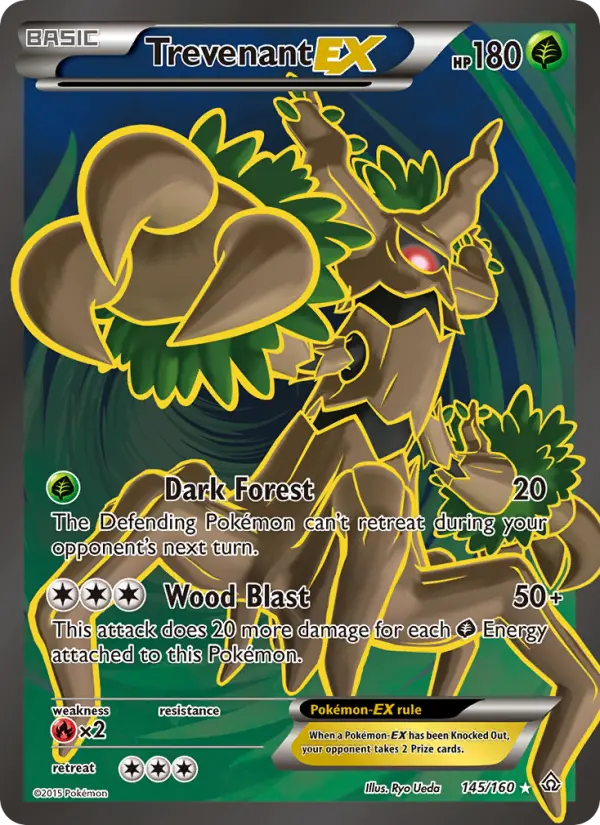
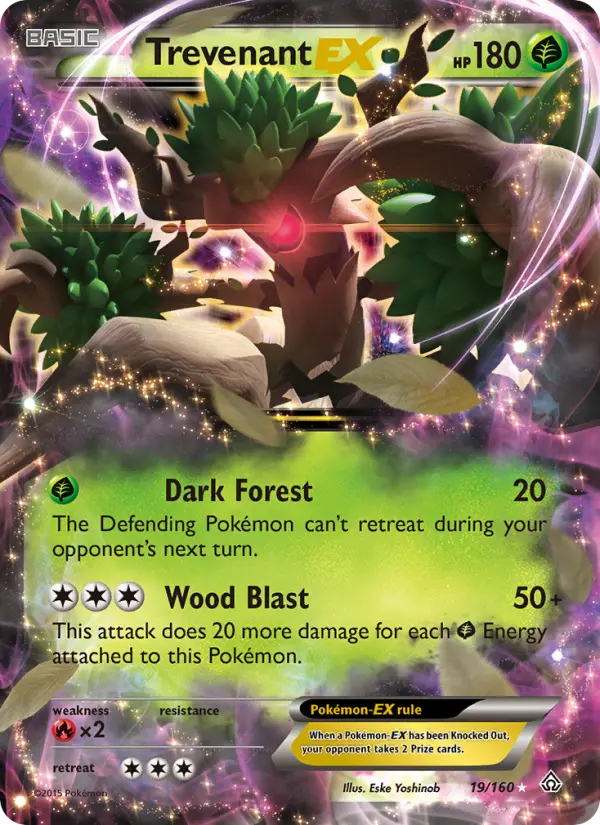
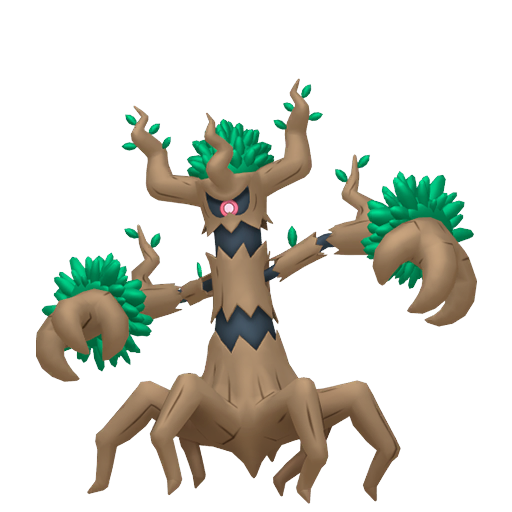
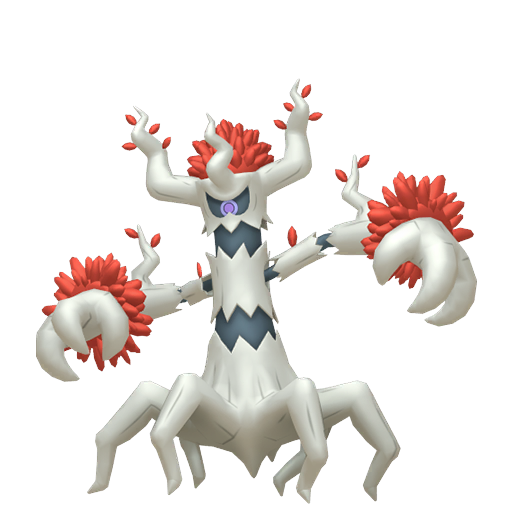
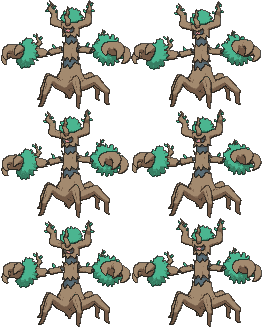
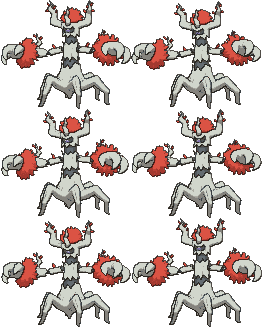
Trevenant's physiology is a masterwork of spectral arboriculture, featuring a slender frame composed of dark, shadowy material visible through gaps in its tree-like exterior. Its most distinctive feature is the crimson eye visible through a hollow in its upper trunk, which glows with an eerie intelligence. Two curved, horn-like branches adorned with vibrant green leaves crown its head, while smaller branches sprout from its forehead and elbows, giving it an ancient, gnarled appearance. Rather than legs, Trevenant possesses six root-like appendages similar to spider legs, which it uses to navigate and, more importantly, to interface with the forest ecosystem. The creature's body plan cleverly mirrors the Japanese kanji for 'tree' (木), reinforcing its connection to the natural world. With three claw-like fingers on each of its branch-arms, wreathed in cuffs of verdant leaves, Trevenant cuts an imposing silhouette. Its most extraordinary ability lies in using its roots as a neural network, allowing it to communicate with and control other trees across vast distances, effectively making it the consciousness of the forest itself.
Pokedex Numbers
Training
Breeding
Trevenant Breeding, Gender Ratio & Egg Groups
Gender-wise, Trevenant is an even 50/50 split between males and females. With a base happiness of 70, Trevenant shows moderate friendliness toward trainers, requiring genuine bonding and care to fully appreciate its complex nature. The species belongs to both the Plant and Amorphous egg groups, making it compatible with a surprisingly diverse range of breeding partners that can produce Phantump offspring. The gestation period spans 20 egg cycles, equivalent to approximately 4,884 to 5,140 steps, placing it in the moderate range for breeding timeframes. This breeding compatibility reflects Trevenant's liminal status between plant and spectral life—the Plant egg group acknowledges its botanical heritage, while the Amorphous group recognizes the ghostly, formless essence that defines its supernatural nature. Trainers breeding Trevenant can take advantage of its ability to inherit moves through breeding chains, allowing for customized movesets that enhance its natural predispositions toward physical attacks and status manipulation.
Sprites


TMs & HMs
tm01
black white
tm01
black 2 white 2
tm01
omega ruby alpha sapphire
tm01
x y
tm03
crystal
tm03
gold silver
tm04
emerald
tm04
firered leafgreen
tm04
ruby sapphire
tm04
diamond pearl
tm04
xd
tm04
heartgold soulsilver
tm04
black white
tm04
colosseum
tm04
platinum
tm04
sun moon
tm04
ultra sun ultra moon
tm04
x y
tm04
omega ruby alpha sapphire
tm04
black 2 white 2
+799 more TMs/HMs
Trevenant Evolution, Mega Evolution & Special Forms
Trevenant evolves from Phantump through a trade with another trainer, a mechanic that emphasizes the supernatural nature of its transformation. When a Phantump is traded, the spectral energies binding the forest spirit strengthen, causing it to mature from a small, timid creature into the commanding Elder Tree Pokémon. This evolution represents not merely physical growth but a spiritual ascension, as the young Phantump—merely haunting a single tree—becomes Trevenant, capable of controlling entire forests through its root network. The trade-based evolution reflects a thematic element present in many Ghost-type Pokémon, where separation from one trainer and bonding with another triggers profound changes. This mechanism adds a layer of narrative depth, suggesting that Trevenant's power emerges through the act of being valued and transferred between trainers who recognize its potential. The evolution itself does not alter Trevenant's typing but significantly enhances its stats, particularly its Attack, which increases from Phantump's 70 to a commanding 110, enabling it to become a formidable physical attacker.
Where to Find
Kalos Route 20
kalos
+3 more
Poke Pelago
alola
+3 more
Trevenant Behaviour and Natural Habitat
Trevenant dwells within ancient forests where it establishes itself as the supreme guardian and custodian of the woodland realm. It is intrinsically kind to Pokémon that reside within its body or share its forest home, offering them shelter and protection within its bark and branches. However, this benevolence transforms into something far more sinister toward those who threaten the forest's integrity. According to various Pokédex entries across generations, Trevenant will trap anyone foolish enough to harm the woodland, ensuring they can never escape, and it allegedly devours those who attempt to fell trees in forests where it dwells—though whether this represents literal consumption or metaphorical cursing remains a subject of scholarly debate. Lumberjacks who must venture into Trevenant-inhabited forests strategically bring Fire-type Pokémon, which Trevenant despises, as a deterrent against the forest guardian's wrath. This deep-seated aversion to Fire suggests an existential conflict between the creature's wooden composition and those creatures that embody destructive flame, making such partnerships a necessary evil for those seeking to harvest timber.
Pokedex Entries
It can control trees at will. It will trap people who harm the forest, so they can never leave.
Using its roots as a nervous system, it controls the trees in the forest. It’s kind to the Pokémon that reside in its body.
It can control trees at will. It will trap people who harm the forest, so they can never leave.
Using its roots as a nervous system, it controls the trees in the forest. It’s kind to the Pokémon that reside in its body.
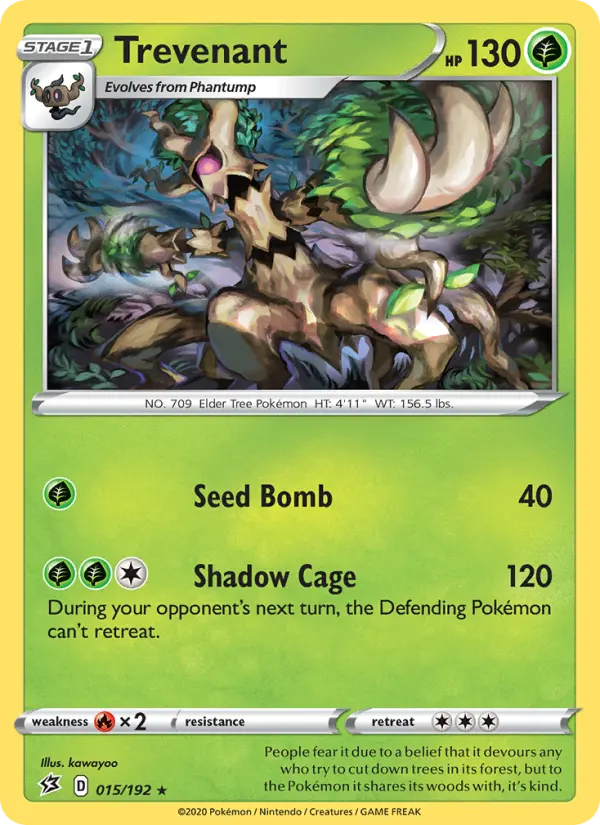
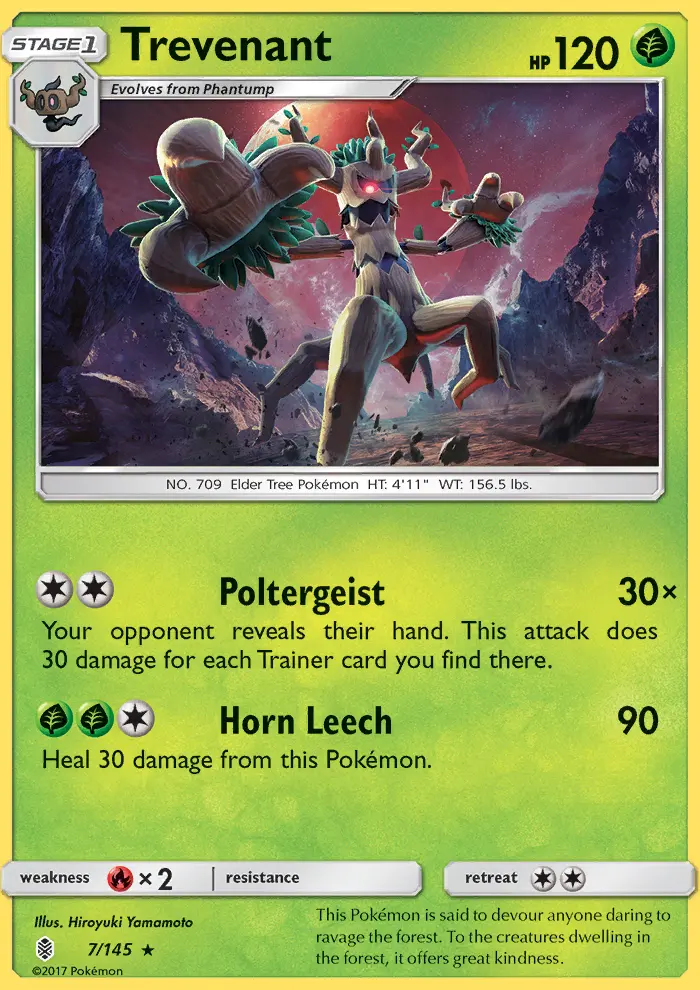
This Pokémon is said to devour anyone daring to ravage the forest. To the creatures dwelling in the forest, it offers great kindness.
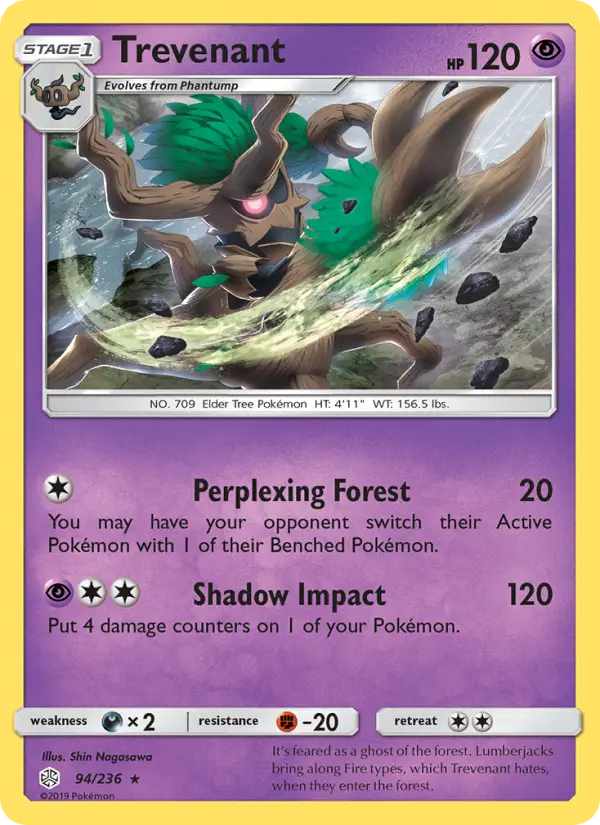
It’s feared as a ghost of the forest. Lumberjacks bring along Fire types, which Trevenant hates, when they enter the forest.
Through its roots, it exerts control over other trees. A deadly curse falls upon anyone cutting down trees in forests where Trevenant dwell.
This Pokémon controls trees via roots stretching from its feet, and it will attack anyone that dares to ravage the forest.
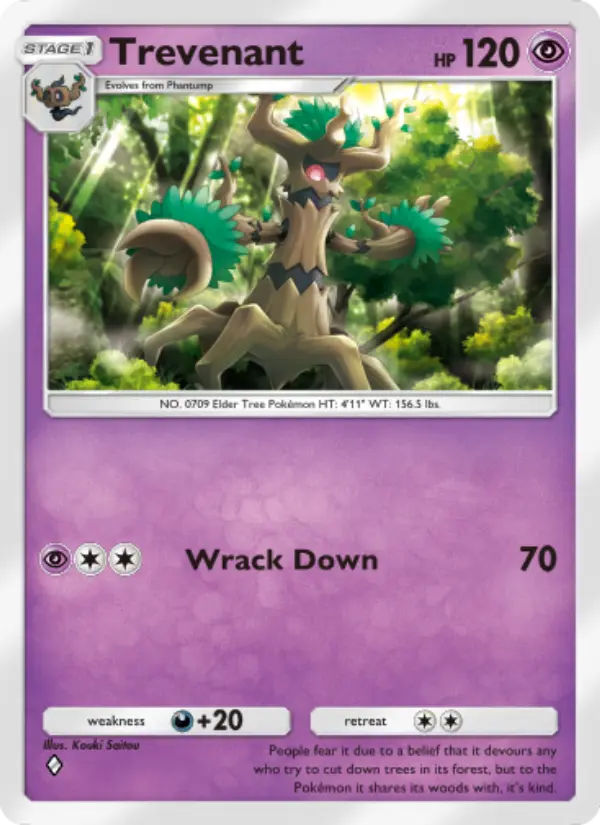
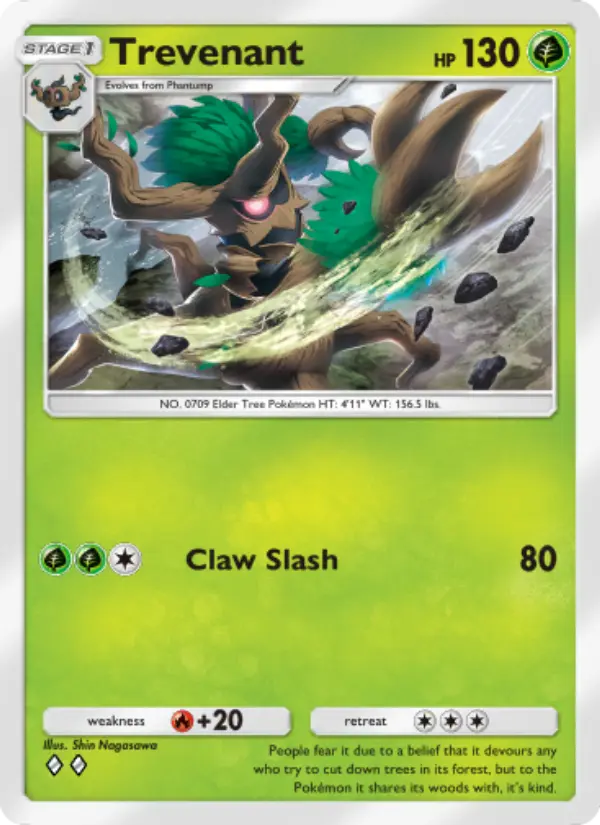
People fear it due to a belief that it devours any who try to cut down trees in its forest, but to the Pokémon it shares its woods with, it’s kind.
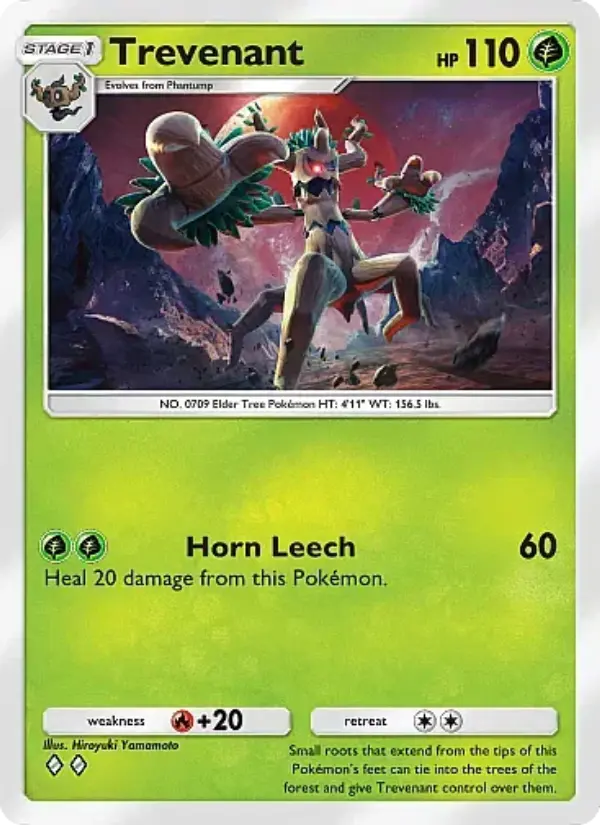
Small roots that extend from the tips of this Pokémon’s feet can tie into the trees of the forest and give Trevenant control over them.
Trevenant Name Origin & Design Inspiration
The name Trevenant combines 'tree' and 'revenant'—a supernatural being that returns from the dead—perfectly capturing its dual nature as both a botanical entity and a ghostly specter. In Japanese, it is called Ohrot (オーロット), a name derived from 'aurochs,' an extinct wild ox, combined with the sound of trees, creating a moniker that speaks to its ancient, primal forest authority. The creature's design draws inspiration from traditional folklore surrounding dryads, tree spirits, and forest guardians across multiple cultural traditions, synthesizing these mythological concepts into a Pokémon form. Its visual structure, with the horn-like branches and gnarled limbs, evokes ancient, weathered trees that have stood for centuries, while the ghostly shadow visible within its frame suggests the spiritual essence animating the wood. The red eye serves as the focal point of its awareness, a single burning gaze that pierces through the forest gloom. The choice of the Ghost/Grass typing elegantly reflects this duality—Grass representing its tangible botanical form, Ghost representing the supernatural consciousness that animates and controls it, creating a perfect elemental expression of what Trevenant fundamentally is.
Learnable Moves
Trevenant can learn 99 moves:
Move | Type | Cat. | Power | Acc. | PP |
|---|---|---|---|---|---|
| ally switch | psychic | Status | — | — | 15 |
| astonish | ghost | Physical | 30 | 100 | 15 |
| attract | normal | Status | — | 100 | 15 |
| block | normal | Status | — | — | 5 |
| branch poke | grass | Physical | 40 | 100 | 40 |
| brutal swing | dark | Physical | 60 | 100 | 20 |
| bulldoze | ground | Physical | 60 | 100 | 20 |
| burning jealousy | fire | Special | 70 | 100 | 5 |
| calm mind | psychic | Status | — | — | 20 |
| confide | normal | Status | — | — | 20 |
| confuse ray | ghost | Status | — | 100 | 10 |
| curse | ghost | Status | — | — | 10 |
| cut | normal | Physical | 50 | 95 | 30 |
| dark pulse | dark | Special | 80 | 100 | 15 |
| destiny bond | ghost | Status | — | — | 5 |
| dig | ground | Physical | 80 | 100 | 10 |
| disable | normal | Status | — | 100 | 20 |
| double team | normal | Status | — | — | 15 |
| drain punch | fighting | Physical | 75 | 100 | 10 |
| dream eater | psychic | Special | 100 | 100 | 15 |
| earthquake | ground | Physical | 100 | 100 | 10 |
| endure | normal | Status | — | — | 10 |
| energy ball | grass | Special | 90 | 100 | 10 |
| facade | normal | Physical | 70 | 100 | 20 |
| feint attack | dark | Physical | 60 | — | 20 |
| focus blast | fighting | Special | 120 | 70 | 5 |
| forest’s curse | grass | Status | — | 100 | 20 |
| foul play | dark | Physical | 95 | 100 | 15 |
| frustration | normal | Physical | — | 100 | 20 |
| giga drain | grass | Special | 75 | 100 | 10 |
| giga impact | normal | Physical | 150 | 90 | 5 |
| grass knot | grass | Special | — | 100 | 20 |
| grassy glide | grass | Physical | 55 | 100 | 20 |
| grassy terrain | grass | Status | — | — | 10 |
| growth | normal | Status | — | — | 20 |
| haze | ice | Status | — | — | 30 |
| hex | ghost | Special | 65 | 100 | 10 |
| hidden power | normal | Special | 60 | 100 | 15 |
| hone claws | dark | Status | — | — | 15 |
| horn leech | grass | Physical | 75 | 100 | 10 |
| hyper beam | normal | Special | 150 | 90 | 5 |
| imprison | psychic | Status | — | — | 10 |
| ingrain | grass | Status | — | — | 20 |
| knock off | dark | Physical | 65 | 100 | 20 |
| lash out | dark | Physical | 75 | 100 | 5 |
| leaf storm | grass | Special | 130 | 90 | 5 |
| leech seed | grass | Status | — | 90 | 10 |
| magic coat | psychic | Status | — | — | 15 |
| magical leaf | grass | Special | 60 | — | 20 |
| nature power | normal | Status | — | — | 20 |
| night shade | ghost | Special | — | 100 | 15 |
| pain split | normal | Status | — | — | 20 |
| phantom force | ghost | Physical | 90 | 100 | 10 |
| poison jab | poison | Physical | 80 | 100 | 20 |
| poltergeist | ghost | Physical | 110 | 90 | 5 |
| power up punch | fighting | Physical | 40 | 100 | 20 |
| protect | normal | Status | — | — | 10 |
| psych up | normal | Status | — | — | 10 |
| psychic | psychic | Special | 90 | 100 | 10 |
| psychic noise | psychic | Special | 75 | 100 | 10 |
| rain dance | water | Status | — | — | 5 |
| reflect | psychic | Status | — | — | 20 |
| rest | psychic | Status | — | — | 5 |
| return | normal | Physical | — | 100 | 20 |
| rock slide | rock | Physical | 75 | 90 | 10 |
| rock smash | fighting | Physical | 40 | 100 | 15 |
| role play | psychic | Status | — | — | 10 |
| round | normal | Special | 60 | 100 | 15 |
| safeguard | normal | Status | — | — | 25 |
| scary face | normal | Status | — | 100 | 10 |
| secret power | normal | Physical | 70 | 100 | 20 |
| seed bomb | grass | Physical | 80 | 100 | 15 |
| shadow ball | ghost | Special | 80 | 100 | 15 |
| shadow claw | ghost | Physical | 70 | 100 | 15 |
| skill swap | psychic | Status | — | — | 10 |
| skitter smack | bug | Physical | 70 | 90 | 10 |
| sleep talk | normal | Status | — | — | 10 |
| snore | normal | Special | 50 | 100 | 15 |
| solar beam | grass | Special | 120 | 100 | 10 |
| spite | ghost | Status | — | 100 | 10 |
| strength | normal | Physical | 80 | 100 | 15 |
| substitute | normal | Status | — | — | 10 |
| sucker punch | dark | Physical | 70 | 100 | 5 |
| sunny day | fire | Status | — | — | 5 |
| swagger | normal | Status | — | 85 | 15 |
| tackle | normal | Physical | 40 | 100 | 35 |
| take down | normal | Physical | 90 | 85 | 20 |
| telekinesis | psychic | Status | — | — | 15 |
| tera blast | normal | Special | 80 | 100 | 10 |
| thief | dark | Physical | 60 | 100 | 25 |
| toxic | poison | Status | — | 90 | 10 |
| trailblaze | grass | Physical | 50 | 100 | 20 |
| trick | psychic | Status | — | 100 | 10 |
| trick room | psychic | Status | — | — | 5 |
| venom drench | poison | Status | — | 100 | 20 |
| will o wisp | fire | Status | — | 85 | 15 |
| wood hammer | grass | Physical | 120 | 100 | 15 |
| worry seed | grass | Status | — | 100 | 10 |
| x scissor | bug | Physical | 80 | 100 | 15 |
Trevenant Competitive Battle Guide
Assessing its battle viability, Trevenant excels as a physical attacker and utility Pokémon, leveraging its impressive Attack stat of 110 paired with decent bulk afforded by its HP of 85 and Special Defense of 82. Its Speed stat of 56 is noticeably low, making it unsuitable for outpacing opponents, but this weakness is frequently mitigated through priority move strategies or careful team support. Its three standard abilities offer distinct strategic advantages: Natural Cure allows it to switch out and cure status conditions, making it invaluable against teams relying on status-based strategies like Toxic or Thunder Wave; Frisk reveals an opponent's held item upon entry, providing crucial information that informs switching and tactical decisions; and Harvest, its hidden ability, restores a consumed Berry after each turn, enabling Trevenant to gain incremental recovery and passive advantage. The combination of solid Attack and good defenses, coupled with access to moves like Leech Seed, Shadow Claw, Wood Hammer, and Curse, allows Trevenant to function as either a bulky physical sweeper or a disruptive tank depending on its EV distribution and moveset. Its Ghost/Grass typing provides useful resistances to Water, Grass, and Electric moves, though it suffers from common weaknesses to Fire, Ice, Flying, and Dark-type moves that competitive teams frequently exploit.
Commonly Asked Questions About Trevenant
What type is Trevenant?
Trevenant is a ghost and grass type Pokemon.
What does Trevenant evolve into?
Trevenant does not evolve.
What are Trevenant's weaknesses?
Trevenant is weak to flying, ghost, fire, ice and dark type moves.
Where can I find Trevenant?
Trevenant can be found in kalos route 20 (kalos) and poke pelago (alola).
Trevenant Cultural Impact & Franchise History
Trevenant has achieved significant recognition within Pokémon culture, particularly among trainers who appreciate environmental themes and folklore-inspired designs. Its role as a forest guardian has resonated with audiences interested in conservation narratives, making it a symbolic favorite among those who interpret Pokémon through an ecological lens. The species appears prominently in various Pokémon media, including animated series and films, often portrayed with the gravitas and wisdom befitting an ancient forest spirit. Trevenant's design has inspired fan art, competitive communities, and strategic discussions across multiple generations since its introduction. Its status as a protective, nature-aligned Pokémon has led to it becoming a mascot figure within fan communities focused on grass-type Pokémon and ghost-type enthusiasts alike. The trade-evolution mechanic strengthened its cultural significance by representing the transferable bonds between trainers, adding narrative depth that resonated with players experiencing the social aspects of the games. Additionally, Trevenant's appearance in Pokémon UNITE and other spin-off titles has maintained its relevance across the broader Pokémon ecosystem.
Where to Find Trevenant in Every Pokémon Game
Trevenant is widely available across numerous Pokémon generations and titles, first appearing in Generation VI's Pokémon X and Y as a native Kalosian Pokémon. In X and Y, it occupied position #0062 in the Mountain Kalos local Pokédex, reflecting its significance to that region's environmental narrative. It subsequently appeared in the Alola region's Pokédex as entry #0197 in Sun and Moon and #0251 in Ultra Sun and Ultra Moon, confirming its presence across multiple continental ecosystems. The species was included in Generation VIII's Pokémon Sword and Shield as Pokédex entry #0339, with additional availability through the Crown Tundra DLC as #0034. The Galar region's Pokédex in Sword and Shield provided significant access during that generation's competitive season. More recently, Trevenant appeared in the Galar region of Pokémon Legends: Z-A as #0183, and in Pokémon Scarlet and Violet's Paldea region, with the Teal Mask DLC listing it as Pokédex entry #0069. Its consistent inclusion across multiple generations reflects its status as a core species, accessible to players through normal gameplay progression, trading, and various post-game content areas. The species' capture rate of 60 makes it moderately difficult to catch in the wild, requiring standard Poké Balls and typical capture strategies rather than specialized methods.