Scolipede
Generation V · #0545 — Megapede Pokémon
Few bug/poison-type Pokémon pair poison point with a stat lean toward speed quite like Scolipede does. The species evolves from Whirlipede starting at level 30, continuing the progression of the Venipede evolutionary line that began in Generation V's Unova region.
Editor's Take
Scolipede's Speed Boost plus Baton Pass was strong enough that the whole strategy got banned rather than the Pokémon, which is a rare compliment to a Bug type nobody rates.
Base Stats
Height
2.5m
Weight
200.5kg
Category
Megapede Pokémon
Gender
Male 50% / Female 50%
Color
red
Shape
armor
Abilities
Has a 30% chance of poisoning attacking Pokémon on contact.
Strengthens bug moves to inflict 1.5× damage at 1/3 max HP or less.
Raises Speed one stage after each turn.

Scolipede Biology & Physical Characteristics
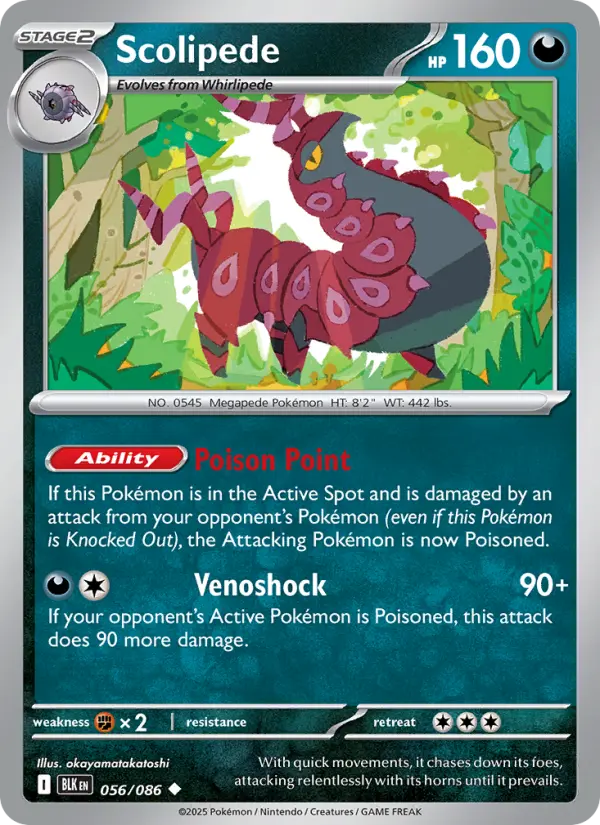
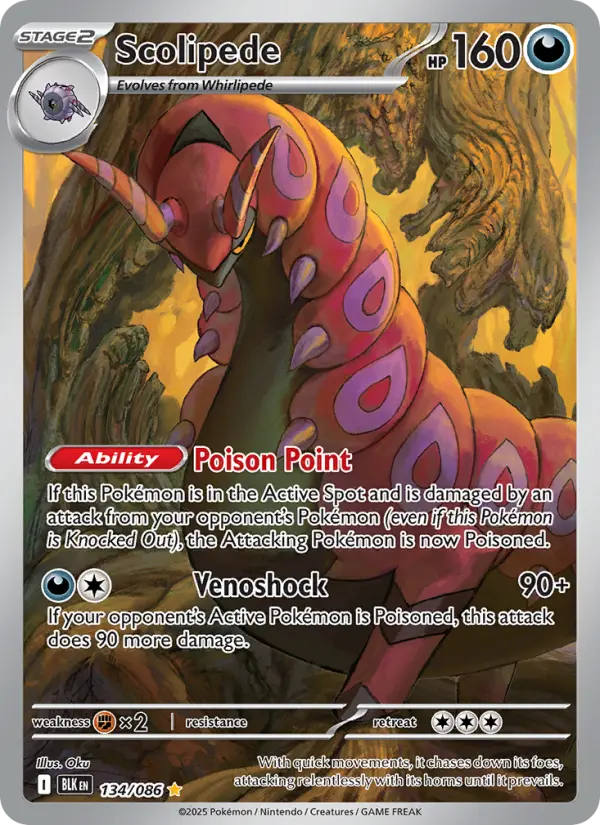
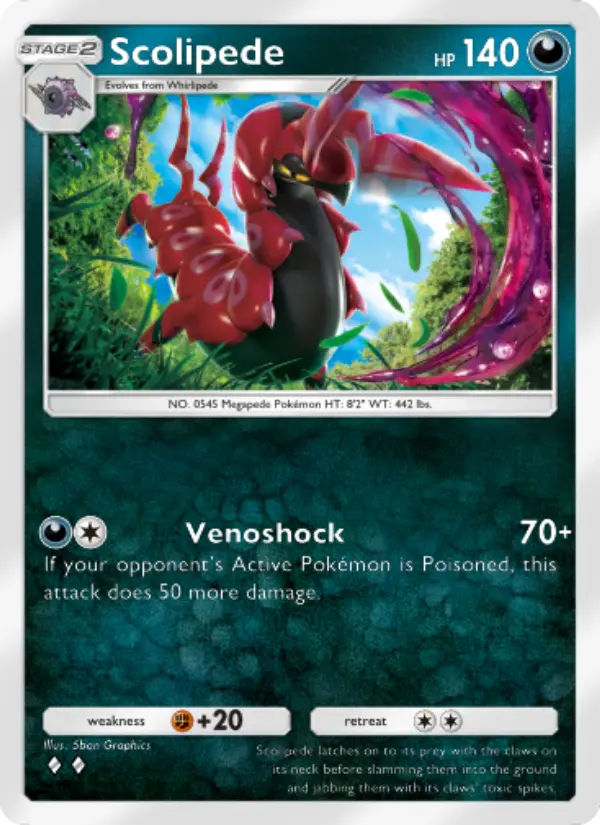
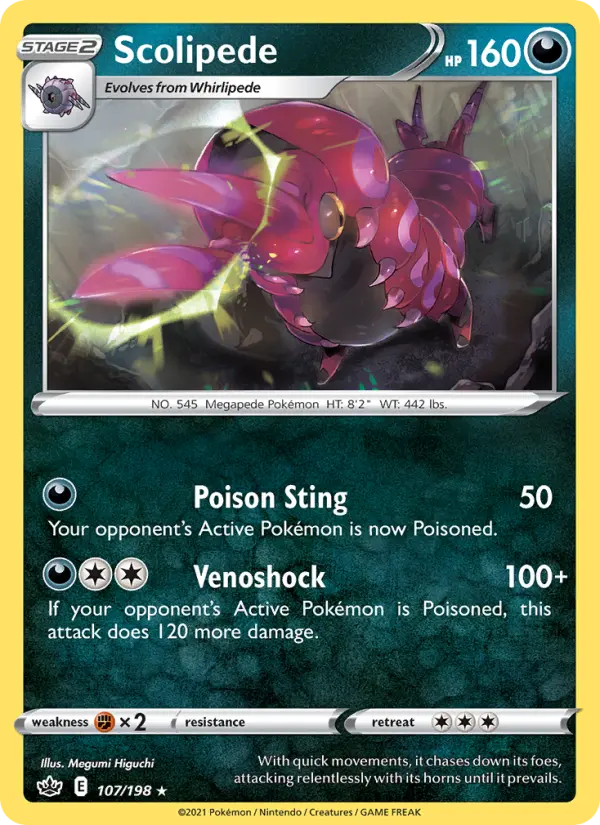
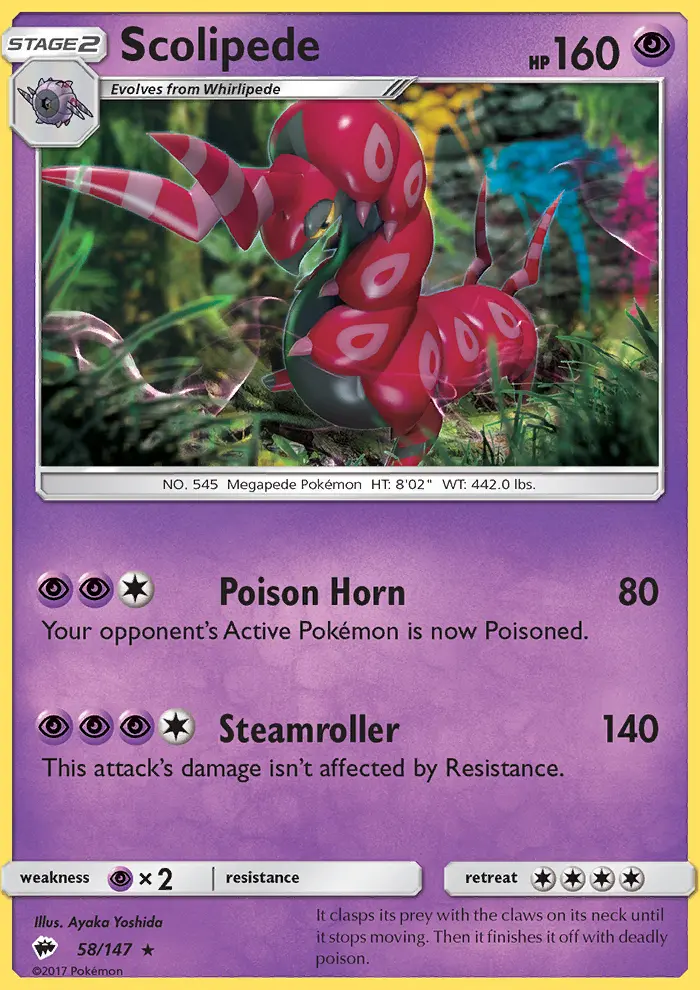
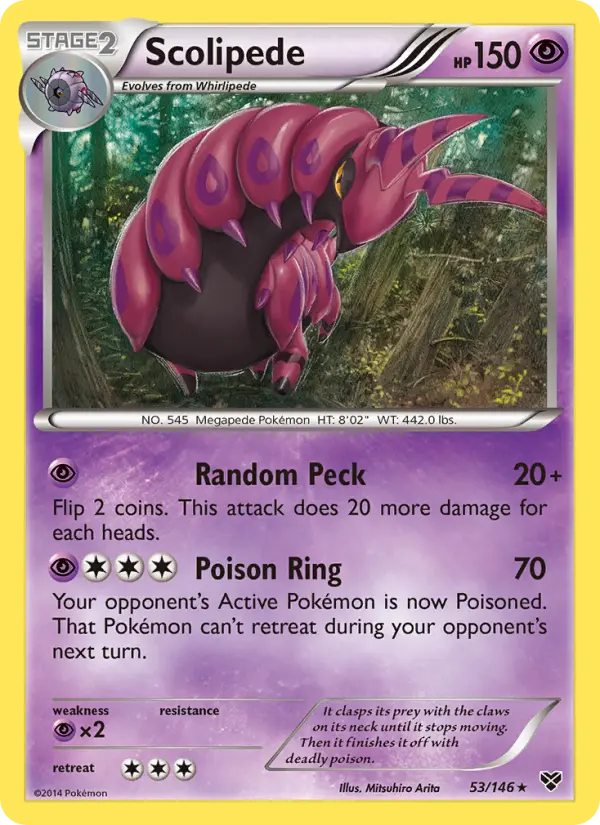
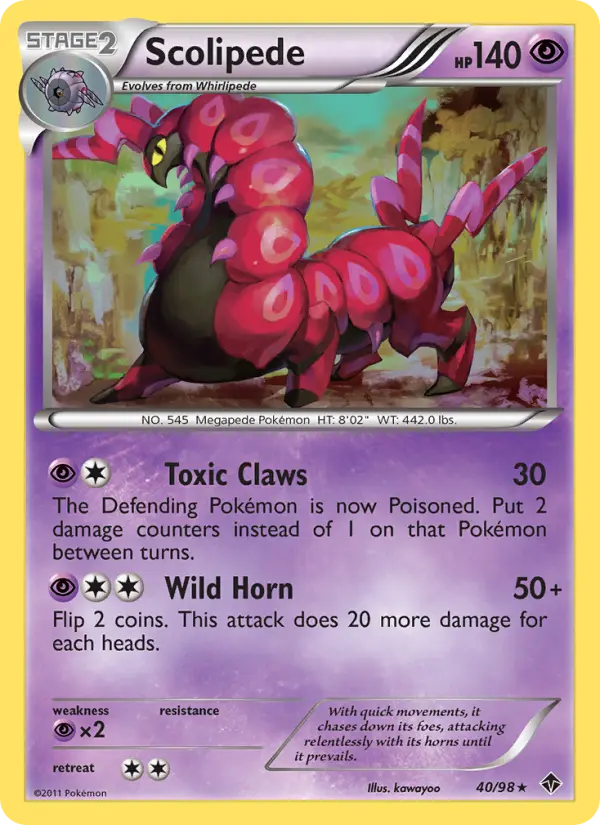
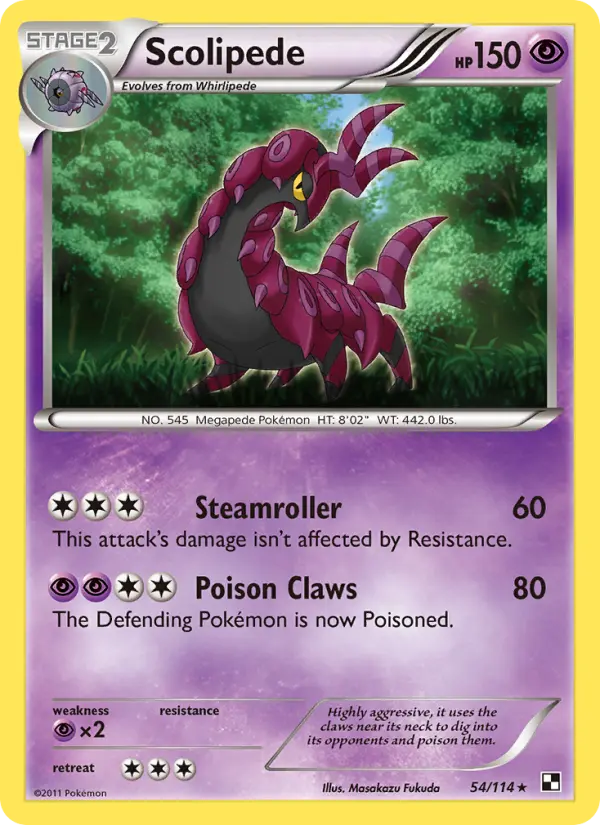
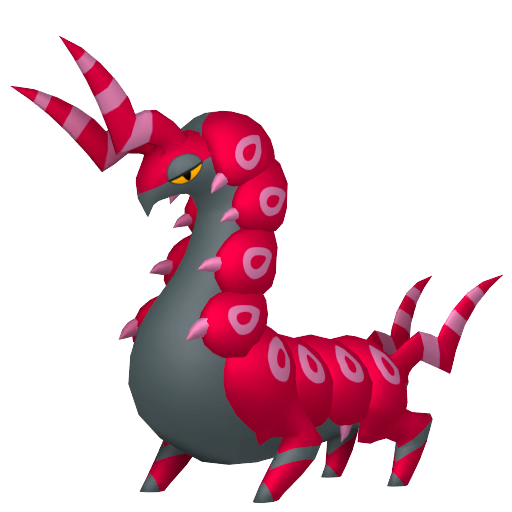
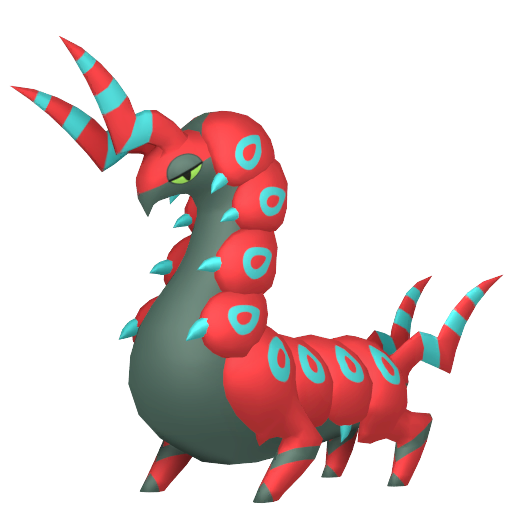
Scolipede's physical form is a remarkable adaptation of centipede anatomy, featuring a segmented body that is predominantly dark magenta in coloration, contrasted by a smooth, dark gray underside that runs along its ventral surface. The creature's most distinctive features are its long, slightly bent horns that extend from both its head and rear, decorated with distinctive purple bands and complemented by teardrop-shaped purple rings marking each body segment along its sides. Its most dangerous feature is the four pairs of short, toxic claws located on the body segments comprising its neck region—these specialized appendages are evolved specifically for injecting poison into prey. The four hind legs are noticeably longer, thicker, and more widely spaced than the front legs, each adorned with curved dark gray bands around the middle, providing the muscular foundation necessary for its exceptional speed of 112 base points. This anatomical design reflects perfect predatory specialization, with every physical characteristic serving either predatory function or venom delivery.
Pokedex Numbers
Training
Breeding
Scolipede Breeding, Gender Ratio & Egg Groups
Scolipede exhibits a perfectly balanced gender distribution with 50% male and 50% female specimens occurring in nature, allowing for straightforward breeding without gender-specific complications. The species belongs exclusively to the Bug Egg Group, meaning it can only breed with other Pokémon sharing this egg classification, limiting breeding partner options to other bug-type species and select Pokémon that share bug group membership. With a base friendship value of 70, Scolipede shows moderate affinity toward trainers, requiring consistent positive interaction and care to develop stronger bonds, though this relatively neutral starting point means dedicated trainers can establish deep connections through gameplay. The species requires 20 egg cycles to hatch from its egg state, translating to approximately 4,884 to 5,140 steps of gameplay before a new Venipede emerges, making it a moderately time-intensive breeding project for trainers seeking perfect individual values or specific movesets.
Sprites



Held Items
Pecha Berry
medicine
Held: Consumed when poisoned to cure poison.
Cost: 80
Pecha Berry
medicine
Held: Consumed when poisoned to cure poison.
Cost: 80
Poison Barb
type-enhancement
Held: Poison-Type moves from holder do 20% more damage.
Cost: 1000
Poison Barb
type-enhancement
Held: Poison-Type moves from holder do 20% more damage.
Cost: 1000
Poison Barb
type-enhancement
Held: Poison-Type moves from holder do 20% more damage.
Cost: 1000
Poison Barb
type-enhancement
Held: Poison-Type moves from holder do 20% more damage.
Cost: 1000
Poison Barb
type-enhancement
Held: Poison-Type moves from holder do 20% more damage.
Cost: 1000
Poison Barb
type-enhancement
Held: Poison-Type moves from holder do 20% more damage.
Cost: 1000
Poison Barb
type-enhancement
Held: Poison-Type moves from holder do 20% more damage.
Cost: 1000
Poison Barb
type-enhancement
Held: Poison-Type moves from holder do 20% more damage.
Cost: 1000
Poison Barb
type-enhancement
Held: Poison-Type moves from holder do 20% more damage.
Cost: 1000
Poison Barb
type-enhancement
Held: Poison-Type moves from holder do 20% more damage.
Cost: 1000
Poison Barb
type-enhancement
Held: Poison-Type moves from holder do 20% more damage.
Cost: 1000
Poison Barb
type-enhancement
Held: Poison-Type moves from holder do 20% more damage.
Cost: 1000
TMs & HMs
tm03
yellow
tm03
red blue
tm03
blue japan
tm04
gold silver
tm03
red green japan
tm04
crystal
tm05
lets go pikachu lets go eevee
tm06
yellow
tm06
gold silver
tm06
red blue
tm06
crystal
tm06
emerald
tm06
firered leafgreen
tm06
diamond pearl
tm06
platinum
tm06
ruby sapphire
tm06
colosseum
tm06
black 2 white 2
tm06
xd
tm06
black white
+615 more TMs/HMs
Scolipede's Evolution Chain


Scolipede Evolution, Mega Evolution & Special Forms
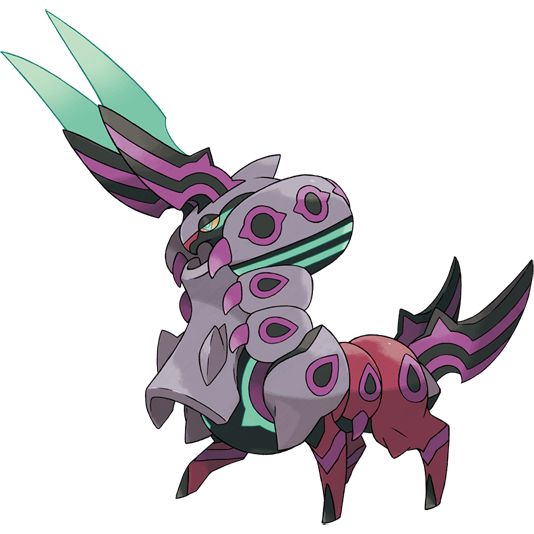
Scolipede evolves from Whirlipede when the latter reaches level 30, continuing the three-stage evolution line that begins with Venipede at the earliest stages of development. The evolution represents a dramatic transformation from Whirlipede's compact, spinning form into a more aggressive, horizontally-oriented predator with expanded offensive capabilities, particularly in Attack power which increases substantially. In later generations, Scolipede gained the capacity to Mega Evolve into Mega Scolipede using the Scolipite mega stone, an enhancement introduced in Pokémon Legends: Z-A that significantly boosts its physical attributes. Mega Scolipede experiences dramatic stat improvements, with its Attack rising from a base 100 to an impressive 140, its Defense increasing from 89 to 149, and its Special Attack climbing from 55 to 75, resulting in a total base stat of 585—a 100-point increase from its standard form. The mega evolution maintains the creature's bug and poison typing, but its ability changes to Cacophony, providing protection against sound-based moves during Mega Evolution.
Where to Find
Pinwheel Forest
unova
Scolipede Behaviour and Natural Habitat
According to Pokédex entries, Scolipede is described as highly aggressive and relentless once engaged in combat, refusing to concede victory until its opponent is thoroughly subdued. The creature inhabits lush forests where it hunts with remarkable speed and agility, chasing down its foes with quick, decisive movements before attacking relentlessly with its powerful horns until prevailing completely. Scolipede's hunting methodology is particularly savage and efficient—it grasps prey using the toxic claws positioned near its neck, holding them immobile through sheer strength and venom saturation. Once the prey ceases resistance, Scolipede delivers a finishing blow by slamming its victim into the ground, simultaneously injecting it with deadly poison accumulated in its specialized neck glands. This combination of physical aggression and chemical weaponry makes Scolipede an apex predator within its ecological niche, with few forest-dwelling creatures capable of withstanding its assault.
Pokedex Entries
With quick movements, it chases down its foes, attacking relentlessly with its horns until it prevails.
It clasps its prey with the claws on its neck until it stops moving. Then it finishes it off with deadly poison.
Highly aggressive, it uses the claws near its neck to dig into its opponents and poison them.
It clasps its prey with the claws on its neck until it stops moving. Then it finishes it off with deadly poison.
With quick movements, it chases down its foes, attacking relentlessly with its horns until it prevails.
It clasps its prey with the claws on its neck until it stops moving. Then it finishes it off with deadly poison.
With quick movements, it chases down its foes, attacking relentlessly with its horns until it prevails.
Scolipede latches on to its prey with the claws on its neck before slamming them into the ground and jabbing them with its claws’ toxic spikes.
Scolipede engage in fierce territorial battles with Centiskorch. At the end of one of these battles, the victor makes a meal of the loser.
Scolipede Name Origin & Design Inspiration
Scolipede's name origin lies in a combination of 'scolopendra,' the scientific genus name for centipedes, and 'millipede,' reflecting its multi-segmented arthropod inspiration. The Japanese name 'Pendror' similarly references centipede terminology while maintaining phonetic appeal. The design philosophy emphasizes predatory efficiency through a blend of insectoid characteristics and reptilian aggression, with its segmented magenta body and prominent horns creating a distinctly alien appearance that nonetheless feels grounded in real arthropod anatomy. The purple coloration pattern, including the decorative bands on horns and segments, suggests evolutionary development specifically for intimidation and species recognition rather than camouflage. The creature's proportions deliberately emphasize its threatening nature—its raised front half, aggressive horn placement, and powerful rear legs all contribute to a silhouette that communicates danger and dynamism, making Scolipede one of Generation V's most visually distinctive Bug-type designs.
Learnable Moves
Scolipede can learn 71 moves:
Move | Type | Cat. | Power | Acc. | PP |
|---|---|---|---|---|---|
| agility | psychic | Status | — | — | 30 |
| aqua tail | water | Physical | 90 | 90 | 10 |
| assurance | dark | Physical | 60 | 100 | 10 |
| attract | normal | Status | — | 100 | 15 |
| baton pass | normal | Status | — | — | 40 |
| bug bite | bug | Physical | 60 | 100 | 20 |
| bulldoze | ground | Physical | 60 | 100 | 20 |
| confide | normal | Status | — | — | 20 |
| cross poison | poison | Physical | 70 | 100 | 20 |
| cut | normal | Physical | 50 | 95 | 30 |
| defense curl | normal | Status | — | — | 40 |
| dig | ground | Physical | 80 | 100 | 10 |
| double team | normal | Status | — | — | 15 |
| double edge | normal | Physical | 120 | 100 | 15 |
| earthquake | ground | Physical | 100 | 100 | 10 |
| endeavor | normal | Physical | — | 100 | 5 |
| endure | normal | Status | — | — | 10 |
| facade | normal | Physical | 70 | 100 | 20 |
| frustration | normal | Physical | — | 100 | 20 |
| giga impact | normal | Physical | 150 | 90 | 5 |
| gyro ball | steel | Physical | — | 100 | 5 |
| hex | ghost | Special | 65 | 100 | 10 |
| hidden power | normal | Special | 60 | 100 | 15 |
| hyper beam | normal | Special | 150 | 90 | 5 |
| infestation | bug | Special | 20 | 100 | 20 |
| iron defense | steel | Status | — | — | 15 |
| iron tail | steel | Physical | 100 | 75 | 15 |
| megahorn | bug | Physical | 120 | 85 | 10 |
| payback | dark | Physical | 50 | 100 | 10 |
| pin missile | bug | Physical | 25 | 95 | 20 |
| poison jab | poison | Physical | 80 | 100 | 20 |
| poison sting | poison | Physical | 15 | 100 | 35 |
| poison tail | poison | Physical | 50 | 100 | 25 |
| protect | normal | Status | — | — | 10 |
| pursuit | dark | Physical | 40 | 100 | 20 |
| rest | psychic | Status | — | — | 5 |
| return | normal | Physical | — | 100 | 20 |
| rock climb | normal | Physical | 90 | 85 | 20 |
| rock slide | rock | Physical | 75 | 90 | 10 |
| rock smash | fighting | Physical | 40 | 100 | 15 |
| rock tomb | rock | Physical | 60 | 95 | 15 |
| rollout | rock | Physical | 30 | 90 | 20 |
| round | normal | Special | 60 | 100 | 15 |
| screech | normal | Status | — | 85 | 40 |
| secret power | normal | Physical | 70 | 100 | 20 |
| signal beam | bug | Special | 75 | 100 | 15 |
| skitter smack | bug | Physical | 70 | 90 | 10 |
| sleep talk | normal | Status | — | — | 10 |
| sludge bomb | poison | Special | 90 | 100 | 10 |
| smart strike | steel | Physical | 70 | — | 10 |
| snatch | dark | Status | — | — | 10 |
| snore | normal | Special | 50 | 100 | 15 |
| solar beam | grass | Special | 120 | 100 | 10 |
| spikes | ground | Status | — | — | 20 |
| steamroller | bug | Physical | 65 | 100 | 20 |
| steel roller | steel | Physical | 130 | 100 | 5 |
| stomping tantrum | ground | Physical | 75 | 100 | 10 |
| strength | normal | Physical | 80 | 100 | 15 |
| struggle bug | bug | Special | 50 | 100 | 20 |
| substitute | normal | Status | — | — | 10 |
| sunny day | fire | Status | — | — | 5 |
| superpower | fighting | Physical | 120 | 100 | 5 |
| swagger | normal | Status | — | 85 | 15 |
| swords dance | normal | Status | — | — | 20 |
| take down | normal | Physical | 90 | 85 | 20 |
| throat chop | dark | Physical | 80 | 100 | 15 |
| toxic | poison | Status | — | 90 | 10 |
| toxic spikes | poison | Status | — | — | 20 |
| venom drench | poison | Status | — | 100 | 20 |
| venoshock | poison | Special | 65 | 100 | 10 |
| x scissor | bug | Physical | 80 | 100 | 15 |
Scolipede Competitive Battle Guide
In terms of competitive use, Scolipede functions as a physical attacker and speed sweeper, leveraging its base 112 Speed stat to outpace most threats in the metagame while its base 100 Attack delivers significant damage output with appropriate moves and held items. Its offensive typing of Bug/Poison, while not exceptional offensively, provides adequate coverage options through moves like Poison Powder, X-Scissor, and Earthquake for broader threat coverage across common defensive types. The hidden ability Speed Boost represents Scolipede's most competitive asset, increasing its Speed stat by one stage every turn, potentially allowing it to snowball throughout a battle as it outpaces even naturally faster opponents while maintaining offensive pressure. Standard competitive sets emphasize physical attacks coupled with protective moves like Protect to safely trigger Speed Boost accumulation, while abilities like Poison Point provide passive damage accumulation through contact-based poison application. However, Scolipede's relatively modest defensive stats of 89 Defense and 69 Special Defense limit its longevity against special attackers, and its Special Attack of 55 makes special moves unreliable, forcing it into a strict physical attacker role that experienced opponents can exploit with well-chosen defensive Pokémon.
Commonly Asked Questions About Scolipede
What type is Scolipede?
Scolipede is a bug and poison type Pokemon.
What does Scolipede evolve from?
Scolipede evolved from whirlipede that evolved from venipede.
What are Scolipede's weaknesses?
Scolipede is weak to flying, rock, fire and psychic type moves.
Where can I find Scolipede?
Scolipede can be found in pinwheel forest (unova).
Scolipede Cultural Impact & Franchise History
Scolipede emerged as a notable Pokémon during Generation V's introduction to the Unova region, establishing itself as a recognizable Bug-type representative throughout the Pokémon competitive community and casual player base. The species gained particular attention among players who appreciate unconventional creature designs, as its segmented centipede form offers visual distinctiveness compared to more humanoid or traditionally cute Pokémon that dominate the franchise's mainstream appeal. Within the anime and trading card game communities, Scolipede maintained a niche presence, appearing in various battle scenarios and collectible cards that showcased its aggressive predatory nature. The introduction of Mega Evolution in Generation VI further elevated Scolipede's cultural relevance, giving previously overlooked Pokémon species renewed competitive viability and renewed fan interest through spectacular visual mega transformations. In competitive Pokémon circles, Scolipede's Speed Boost hidden ability generated strategic discussion about optimal damage output timing, making it a subject of competitive analysis despite never achieving tier-one metagame dominance compared to other sweepers.
Where to Find Scolipede in Every Pokémon Game
Scolipede's availability varies significantly across different Pokémon game generations and regions, first becoming obtainable in Generation V's Black and White where it holds a local Pokédex number of #0051, appearing in lush forest environments appropriate to its habitat preferences. In Black 2 and White 2, it received a different local Pokédex assignment of #0045, maintaining availability through standard wild encounters and evolution of Whirlipede specimens. X and Y introduced Scolipede to the Central Kalos region with local number #0122, improving accessibility for players in the Kalos region, while subsequent games including Sword and Shield's Isle of Armor expansion (#0076) continued supporting this species through diverse game availability. Players seeking to obtain Scolipede typically must catch Venipede in early-game areas and train it through two evolution stages, or locate Whirlipede in later-game wild encounters, though later generations with expanded Pokédex distributions made acquisition increasingly convenient. The species maintains consistently modest catch rate of 45, meaning only about 11.9% of encounters with a standard Poké Ball result in successful capture of wild specimens, requiring either multiple attempts or strategic use of specialized Poké Balls for efficient training.