Whirlipede
Generation V · #0544 — Curlipede Pokémon
At 1.2 m and 58.5 kg, Whirlipede doesn't look like much on paper, but its poison point ability shapes how it actually plays more than its size suggests.
Editor's Take
Whirlipede is a cocoon stage that still gets Speed Boost, which makes it considerably more useful than most middle stages built on the same template.
Base Stats
Height
1.2m
Weight
58.5kg
Category
Curlipede Pokémon
Gender
Male 50% / Female 50%
Color
gray
Shape
ball
Abilities
Has a 30% chance of poisoning attacking Pokémon on contact.
Strengthens bug moves to inflict 1.5× damage at 1/3 max HP or less.
Raises Speed one stage after each turn.

Whirlipede Biology & Physical Characteristics
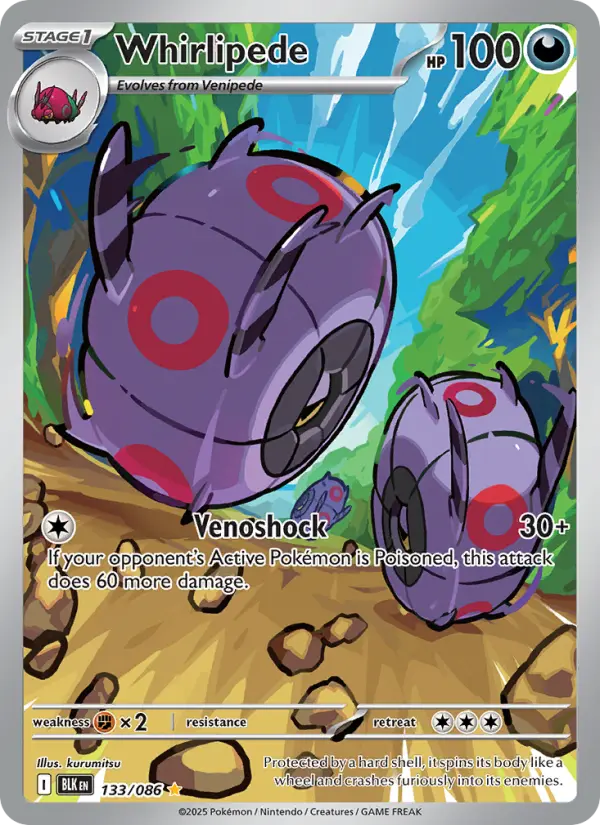
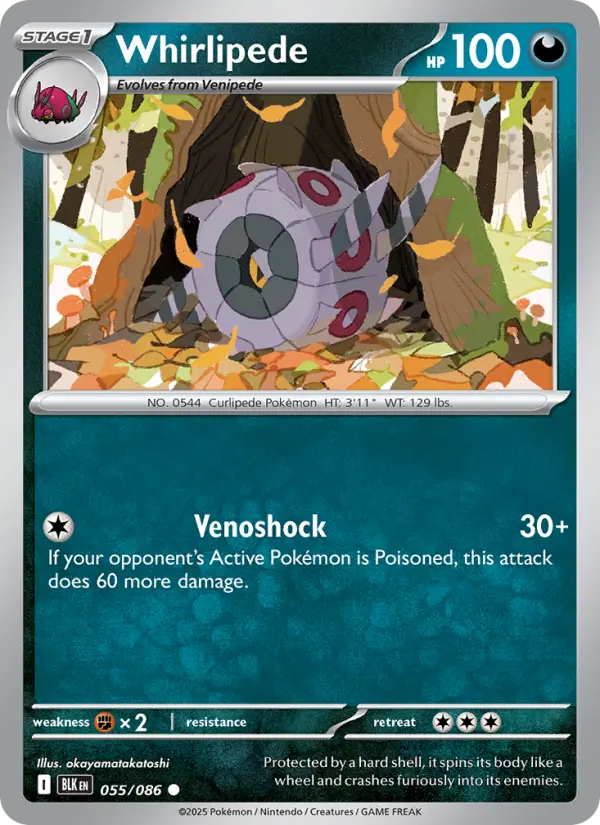
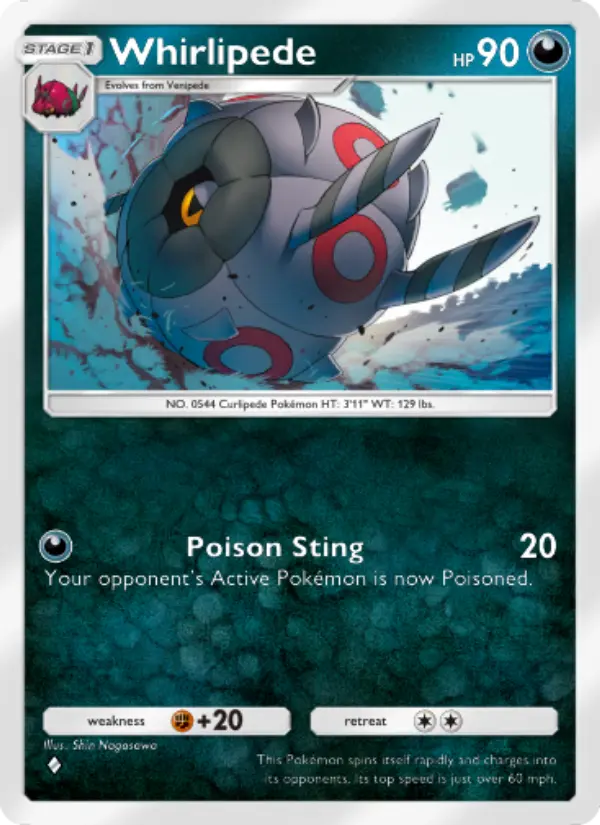
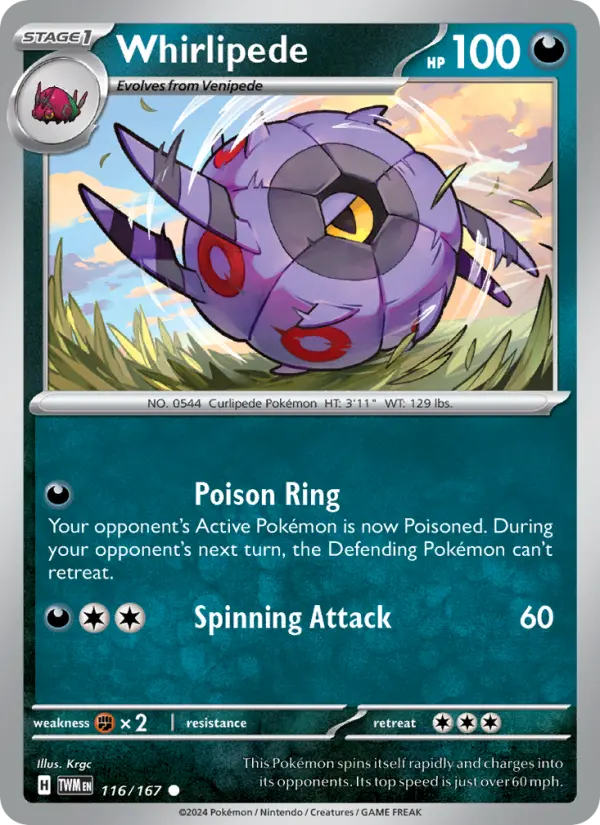
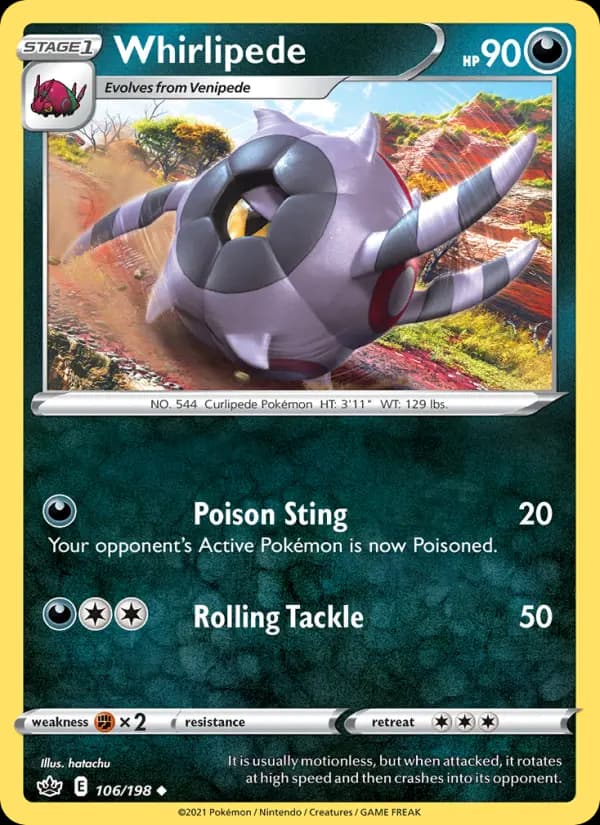
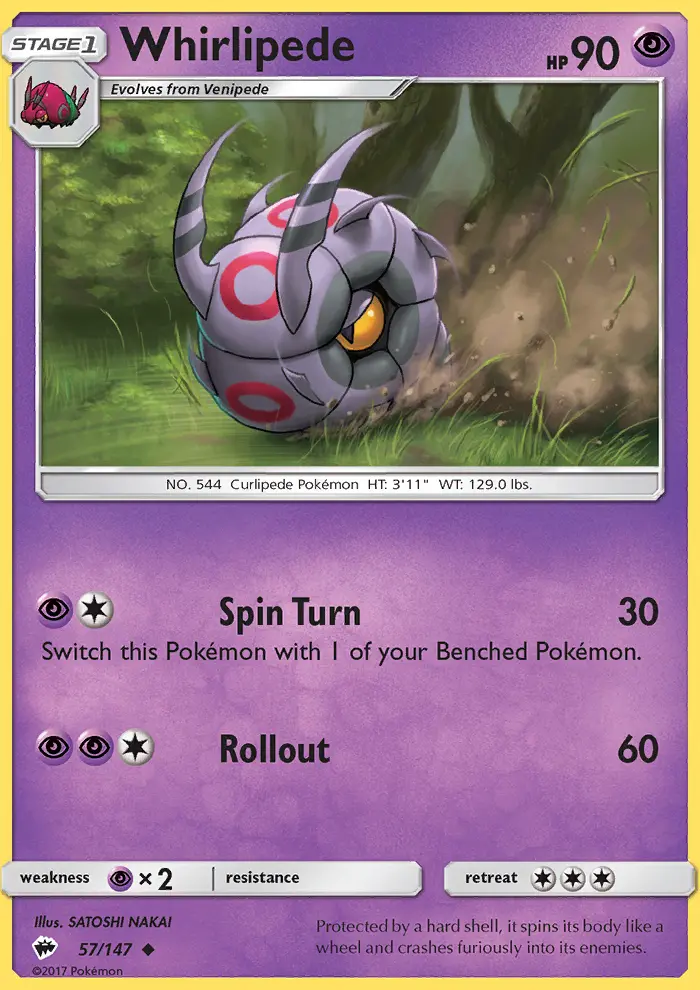
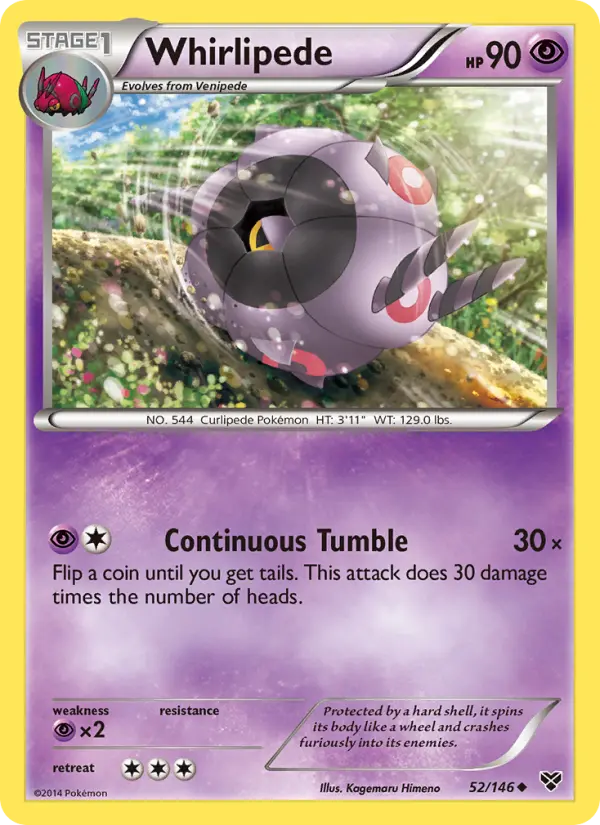
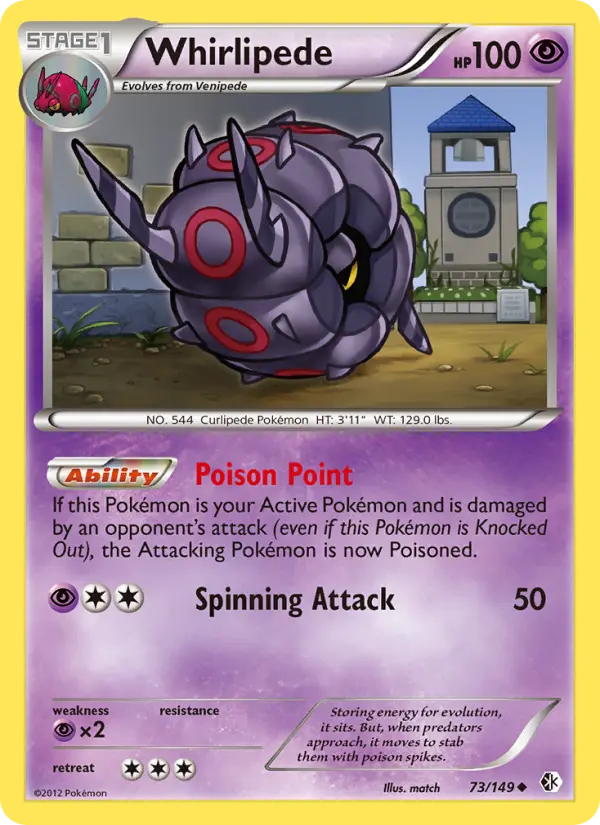
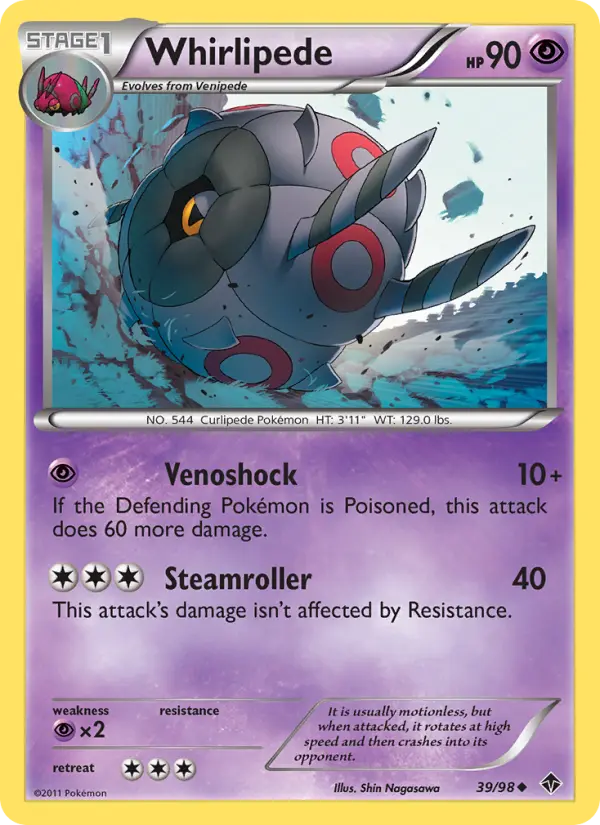
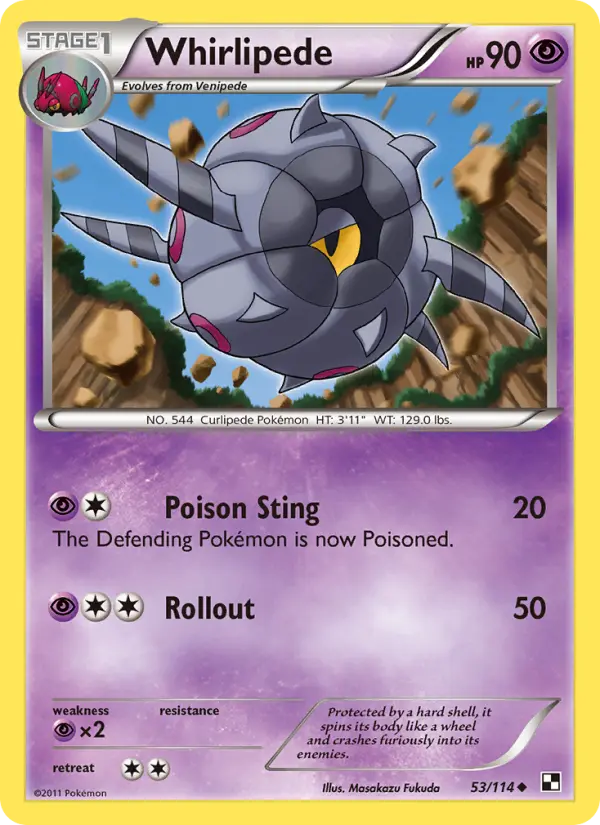
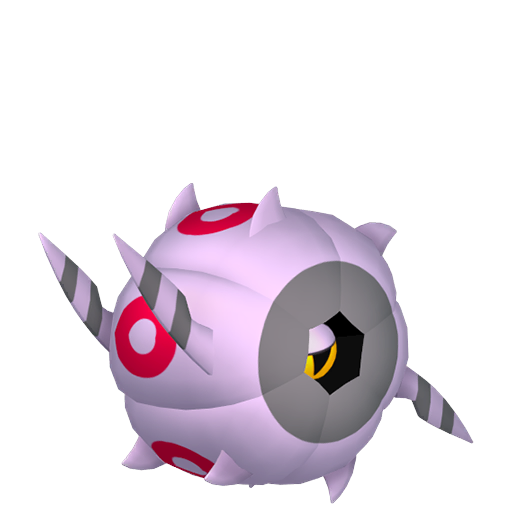
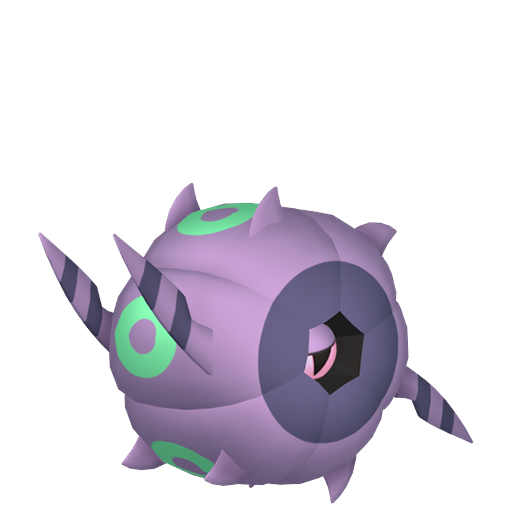
Whirlipede is an insectoid Pokémon encased in a distinctive hard, segmented shell that serves as both armor and weapon. Its body features a purple coloration with red rings positioned in the middle of each segment, framed by darker gray borders that circle the creature's open center where its eyes are visible. Protruding from its body are four horn-like purple feelers with dark gray stripes—two pairs positioned at opposite ends, with one pair extending upward from its front and the other pointing downward from its lower rear. Flanking either side of each shell segment are two poisonous barbs that serve as primary offensive tools when the Pokémon enters combat. The creature's face reveals slitted pupils within yellow sclerae, framed by thick gray eyelids that give it a somewhat menacing appearance. This morphology represents an intermediate design between the more worm-like Venipede and the legs-developed Scolipede, with Whirlipede's shell becoming progressively more defined and armored compared to its pre-evolved form.
Pokedex Numbers
Training
Breeding
Whirlipede Breeding, Gender Ratio & Egg Groups
Whirlipede exhibits an even gender ratio, with exactly 50% of individuals being male and 50% female, allowing for flexible breeding strategies and team composition choices for trainers seeking either gender. The species belongs to the Bug egg group, meaning it can only breed with other Bug-type Pokémon or with Ditto, a common limitation that restricts its breeding pool and makes obtaining specific natures or IVs somewhat more challenging than for more versatile egg groups. Female Whirlipede are required to produce eggs when breeding with compatible male Pokémon, though male Whirlipede can breed with Ditto regardless of the Pokémon's gender. The species possesses a base friendship value of 70 (in Generations 5-7; this was changed in later generations), indicating moderate but not exceptional bonding potential with trainers who raise them from Venipede. Whirlipede typically hatches from eggs after approximately 15 egg cycles, which translates to roughly 3,599-3,855 steps of in-game walking, making it a relatively standard hatching duration that encourages patient, dedicated breeders. The ease of obtaining Whirlipede through breeding makes it accessible for competitive players seeking optimal specimens, though the Bug egg group limitation means that breeding for perfect stats requires careful partner selection.
Sprites




Held Items
Pecha Berry
medicine
Held: Consumed when poisoned to cure poison.
Cost: 80
Pecha Berry
medicine
Held: Consumed when poisoned to cure poison.
Cost: 80
Poison Barb
type-enhancement
Held: Poison-Type moves from holder do 20% more damage.
Cost: 1000
Poison Barb
type-enhancement
Held: Poison-Type moves from holder do 20% more damage.
Cost: 1000
Poison Barb
type-enhancement
Held: Poison-Type moves from holder do 20% more damage.
Cost: 1000
Poison Barb
type-enhancement
Held: Poison-Type moves from holder do 20% more damage.
Cost: 1000
Poison Barb
type-enhancement
Held: Poison-Type moves from holder do 20% more damage.
Cost: 1000
Poison Barb
type-enhancement
Held: Poison-Type moves from holder do 20% more damage.
Cost: 1000
Poison Barb
type-enhancement
Held: Poison-Type moves from holder do 20% more damage.
Cost: 1000
Poison Barb
type-enhancement
Held: Poison-Type moves from holder do 20% more damage.
Cost: 1000
Poison Barb
type-enhancement
Held: Poison-Type moves from holder do 20% more damage.
Cost: 1000
Poison Barb
type-enhancement
Held: Poison-Type moves from holder do 20% more damage.
Cost: 1000
Poison Barb
type-enhancement
Held: Poison-Type moves from holder do 20% more damage.
Cost: 1000
Poison Barb
type-enhancement
Held: Poison-Type moves from holder do 20% more damage.
Cost: 1000
TMs & HMs
tm04
gold silver
tm04
crystal
tm05
lets go pikachu lets go eevee
tm06
yellow
tm06
gold silver
tm06
red blue
tm06
crystal
tm06
emerald
tm06
firered leafgreen
tm06
diamond pearl
tm06
platinum
tm06
ruby sapphire
tm06
colosseum
tm06
black 2 white 2
tm06
xd
tm06
black white
tm06
heartgold soulsilver
tm06
omega ruby alpha sapphire
tm06
ultra sun ultra moon
tm06
sun moon
+388 more TMs/HMs
Whirlipede's Evolution Chain


Whirlipede Evolution, Mega Evolution & Special Forms
Whirlipede occupies the middle position in a straightforward three-stage Bug/Poison evolution line that defines much of Generation V's Bug-type representation. It evolves from Venipede upon reaching level 22, a threshold that marks the juvenile creature's transition toward greater defensive capability and physical hardening. At level 30, Whirlipede undergoes its final evolution into Scolipede, a considerably faster and more offensively-oriented centipede Pokémon that trades some of Whirlipede's defensive bulk for dramatically improved Speed and Attack statistics. This evolution line exemplifies a common design philosophy where each stage becomes progressively more dangerous and dynamic—Venipede is venomous but relatively harmless, Whirlipede is a defensive barrier with limited mobility, and Scolipede becomes a swift, lance-wielding cavalry unit. The evolutionary progression also reflects the Pokémon's maturation process, with each form representing different life stages in a centipede's development. Whirlipede's position as the middle evolution makes it somewhat less popular than its stronger final form, yet it serves an important ecological and gameplay niche for trainers who prefer balanced, wall-oriented team members during their journey through Unova.
Where to Find
Pinwheel Forest
unova
+9 more
Lostlorn Forest
unova
+1 more
Whirlipede Behaviour and Natural Habitat
Whirlipede is characterized as a generally motionless Pokémon that spends much of its time in a sedentary state, storing energy reserves necessary for its upcoming evolution into Scolipede. However, despite this otherwise passive demeanor, Whirlipede is well-known for its aggressively defensive nature when threatened. When predators approach or when it is directly attacked, this Pokémon rapidly springs into action, rotating its body at high speed like a spinning wheel before crashing furiously into opponents with devastating force. According to Pokédex entries, Whirlipede can achieve speeds of approximately 60 miles per hour during these rotational charges, allowing it to deliver powerful collisions despite its relatively low base Speed stat. When threatened, it uses its poisonous spikes to stab approaching threats, making it an unpleasant target despite its sedentary appearance. This duality of behavior—peaceful conservation followed by explosive aggression—makes Whirlipede an unpredictable and formidable creature that commands respect from both predators and potential trainers.
Pokedex Entries
Protected by a hard shell, it spins its body like a wheel and crashes furiously into its enemies.
Storing energy for evolution, it sits. But, when predators approach, it moves to stab them with poison spikes.
It is usually motionless, but when attacked, it rotates at high speed and then crashes into its opponent.
Protected by a hard shell, it spins its body like a wheel and crashes furiously into its enemies.
It is usually motionless, but when attacked, it rotates at high speed and then crashes into its opponent.
Protected by a hard shell, it spins its body like a wheel and crashes furiously into its enemies.
It is usually motionless, but when attacked, it rotates at high speed and then crashes into its opponent.
This Pokémon spins itself rapidly and charges into its opponents. Its top speed is just over 60 mph.
Whirlipede protects itself with a sturdy shell and poisonous spikes while it stores up the energy it’ll need for evolution.
Whirlipede Name Origin & Design Inspiration
The name Whirlipede combines 'whirl,' describing its characteristic spinning motion, with 'centipede,' the many-legged arthropod that serves as its biological inspiration. The Japanese name Wheega likely derives from 'wheel' and perhaps a reference to its rotating combat technique, maintaining the rotational theme across languages. The Pokédex classification as the 'Curlipede Pokémon' emphasizes both the curled, compact nature of its shell design and its centipede ancestry. Visually, Whirlipede's design represents a synthesis of a defensive wheel or spinning top with an arthropod body, creating a Pokémon that appears simultaneously like an armored scroll or coiled spring and a protective, spiky insect. The purple and red coloration scheme distinguishes it from the greener Venipede while foreshadowing the more vibrant Scolipede, establishing clear visual differentiation across the evolution line. The prominent poisonous spikes that protrude from its shell directly reference the real-world venomous capabilities of certain centipede species, while the horn-like feelers serve both sensory and combat functions, demonstrating practical design choices rooted in actual arthropod morphology.
Learnable Moves
Whirlipede can learn 49 moves:
Move | Type | Cat. | Power | Acc. | PP |
|---|---|---|---|---|---|
| agility | psychic | Status | — | — | 30 |
| attract | normal | Status | — | 100 | 15 |
| bug bite | bug | Physical | 60 | 100 | 20 |
| confide | normal | Status | — | — | 20 |
| defense curl | normal | Status | — | — | 40 |
| double team | normal | Status | — | — | 15 |
| double edge | normal | Physical | 120 | 100 | 15 |
| endeavor | normal | Physical | — | 100 | 5 |
| endure | normal | Status | — | — | 10 |
| facade | normal | Physical | 70 | 100 | 20 |
| frustration | normal | Physical | — | 100 | 20 |
| gyro ball | steel | Physical | — | 100 | 5 |
| hex | ghost | Special | 65 | 100 | 10 |
| hidden power | normal | Special | 60 | 100 | 15 |
| infestation | bug | Special | 20 | 100 | 20 |
| iron defense | steel | Status | — | — | 15 |
| payback | dark | Physical | 50 | 100 | 10 |
| pin missile | bug | Physical | 25 | 95 | 20 |
| poison jab | poison | Physical | 80 | 100 | 20 |
| poison sting | poison | Physical | 15 | 100 | 35 |
| poison tail | poison | Physical | 50 | 100 | 25 |
| protect | normal | Status | — | — | 10 |
| pursuit | dark | Physical | 40 | 100 | 20 |
| rest | psychic | Status | — | — | 5 |
| return | normal | Physical | — | 100 | 20 |
| rock climb | normal | Physical | 90 | 85 | 20 |
| rock smash | fighting | Physical | 40 | 100 | 15 |
| rollout | rock | Physical | 30 | 90 | 20 |
| round | normal | Special | 60 | 100 | 15 |
| screech | normal | Status | — | 85 | 40 |
| secret power | normal | Physical | 70 | 100 | 20 |
| signal beam | bug | Special | 75 | 100 | 15 |
| skitter smack | bug | Physical | 70 | 90 | 10 |
| sleep talk | normal | Status | — | — | 10 |
| sludge bomb | poison | Special | 90 | 100 | 10 |
| snore | normal | Special | 50 | 100 | 15 |
| solar beam | grass | Special | 120 | 100 | 10 |
| spikes | ground | Status | — | — | 20 |
| steamroller | bug | Physical | 65 | 100 | 20 |
| steel roller | steel | Physical | 130 | 100 | 5 |
| struggle bug | bug | Special | 50 | 100 | 20 |
| substitute | normal | Status | — | — | 10 |
| sunny day | fire | Status | — | — | 5 |
| swagger | normal | Status | — | 85 | 15 |
| take down | normal | Physical | 90 | 85 | 20 |
| toxic | poison | Status | — | 90 | 10 |
| toxic spikes | poison | Status | — | — | 20 |
| venom drench | poison | Status | — | 100 | 20 |
| venoshock | poison | Special | 65 | 100 | 10 |
Whirlipede Competitive Battle Guide
Looking at its competitive profile, Whirlipede occupies a niche role as a defensive wall with notably high Defense (99) and respectable Special Defense (79), giving it a bulky profile that can absorb significant punishment from physical and mixed attackers. However, its abysmal offensive stats—with base Attack and Special Attack of 55 and 40 respectively—make it unsuitable for offensive strategies, relegating it to purely defensive or support-oriented roles. Its ability to learn Toxic through level-up at level 36 provides utility, allowing it to apply status condition pressure on opposing teams by poisoning defensive threats that would otherwise wall its limited offensive potential. The hidden ability Speed Boost offers interesting possibilities in extended battles, as each turn grants a Speed stage increase, potentially transforming the sluggish centipede into a faster threat over time. However, Whirlipede's slow base Speed of 47 means it rarely moves first in competitive scenarios without significant investment, and its limited movepool restricts its tactical flexibility compared to other defensive Bug-types. Most competitive players opt for Scolipede's superior Speed and offensive capabilities, making Whirlipede a rare sight at high levels of competitive play, though it may occasionally appear in Doubles format where its defensive nature and lack of passive damage can be leveraged strategically.
Commonly Asked Questions About Whirlipede
What type is Whirlipede?
Whirlipede is a bug and poison type Pokemon.
What does Whirlipede evolve into?
Whirlipede evolves into scolipede.
What are Whirlipede's weaknesses?
Whirlipede is weak to flying, rock, fire and psychic type moves.
Does Whirlipede evolve by trading?
No — Whirlipede evolves entirely through leveling up, with no trade required at any stage.
Where can I find Whirlipede?
Whirlipede can be found in pinwheel forest (unova) and lostlorn forest (unova).
Whirlipede Cultural Impact & Franchise History
Whirlipede maintains a moderate presence in Pokémon media and fan communities, though it ranks lower in popularity compared to many other Generation V Bug-types like Scizor or Heracross. Within the anime series, Whirlipede has appeared in various episodes featuring Bug-type specialists and Unova gym leaders, though it rarely receives significant character development or memorable battles that would cement its cultural significance. The Pokémon's unique rotational combat mechanism—spinning like a wheel and charging into opponents—provides distinctive visual appeal that resonates with fans seeking unconventional, mechanically-inspired Pokémon designs that blur the line between biological and mechanical creatures. Trading card game representations of Whirlipede have occasionally featured in Bug-type focused decks, though the character's middling competitive viability in the TCG mirrors its position in video game metagames. Online fan communities and artwork often appreciate Whirlipede's aesthetic as an interesting middle ground between the worm-like Venipede and the centipede-like Scolipede, with the defensive, patient nature implied by its Pokédex entries inspiring creative interpretations in fan fiction and role-playing communities.
Where to Find Whirlipede in Every Pokémon Game
Whirlipede became available to players beginning in Generation V, where it appeared as Pokédex entry #050 in Pokémon Black and White and entry #044 in the updated Pokédex of Black 2 and White 2, reflecting its presence in the Unova region. The species can be obtained by catching Venipede in early-game locations such as Route 1 and evolving it to level 22, making it accessible to players relatively early in their adventures through Unova. In subsequent generations, Whirlipede's availability has expanded to include appearances in X and Y (Central Kalos Pokédex entry #121), Omega Ruby and Alpha Sapphire, Sword and Shield (Isle of Armor entry #075), and the upcoming Legends: Z-A. The species' relatively high catch rate of 120 makes obtaining specimens with decent stats straightforward even when encountered in the wild. Breeding remains an accessible method for obtaining Whirlipede with optimal natures and individual values, as trainers can breed Scolipede with compatible partners or use Ditto to produce Venipede eggs. While Whirlipede itself appears less frequently in post-game or endgame content compared to its evolutionary relatives, its consistent availability throughout the Pokédex and presence in multiple regional games ensures that dedicated trainers can reliably obtain and utilize the species regardless of which generation they're currently playing.