Venipede
Generation V · #0543 — Centipede Pokémon
Few bug/poison-type Pokémon pair poison point with a stat lean toward defense quite like Venipede does. Despite these modest dimensions, Venipede compensates with surprising tenacity and a potent poison delivery system, making it a remarkable specimen for early-game Bug-type enthusiasts. Its availability with a catch rate of 255 makes it one of the easiest Pokémon to capture in its native Unova region, offering trainers an accessible entry point into Bug-type training.
Editor's Take
Venipede's line ends in Scolipede with Speed Boost, and the Baton Pass strategy built around it was strong enough that the strategy rather than the Pokémon got banned.
Base Stats
Height
0.4m
Weight
5.3kg
Category
Centipede Pokémon
Gender
Male 50% / Female 50%
Color
red
Shape
armor
Abilities
Has a 30% chance of poisoning attacking Pokémon on contact.
Strengthens bug moves to inflict 1.5× damage at 1/3 max HP or less.
Raises Speed one stage after each turn.

Venipede Biology & Physical Characteristics
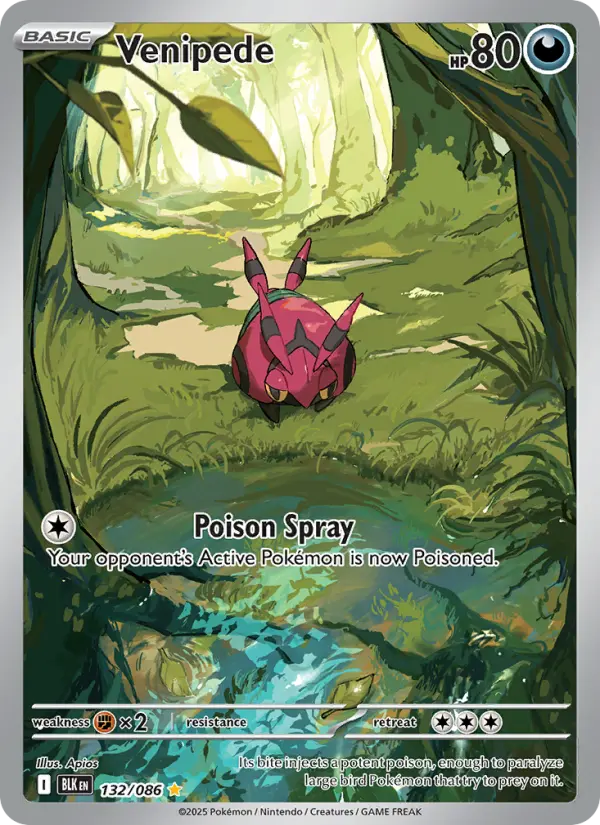
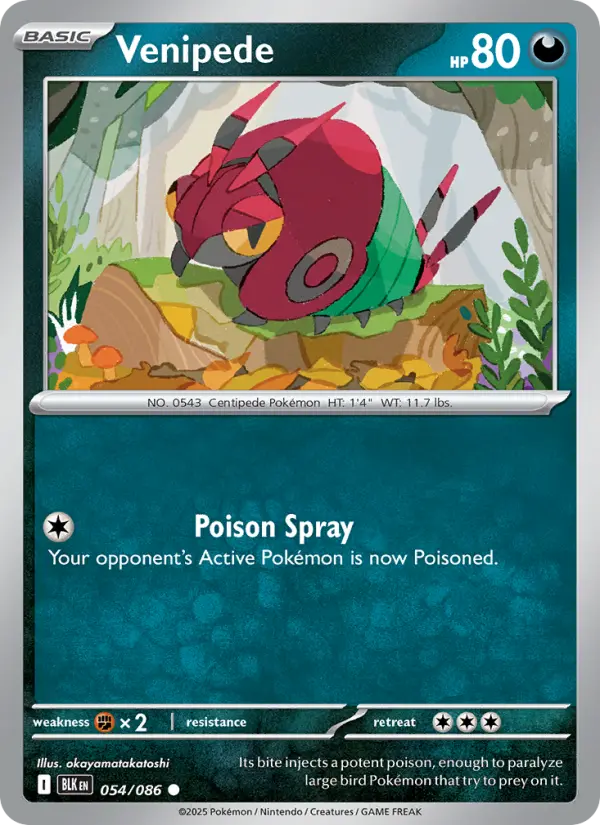
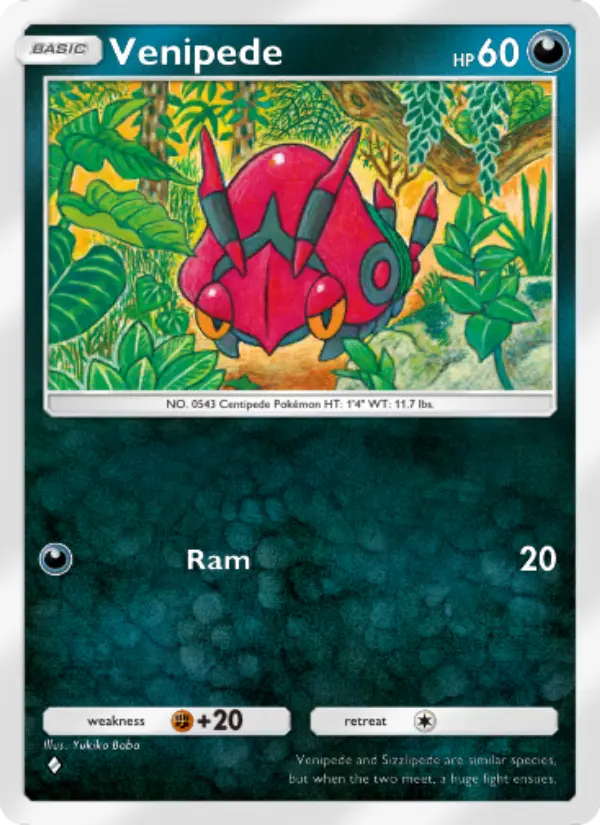
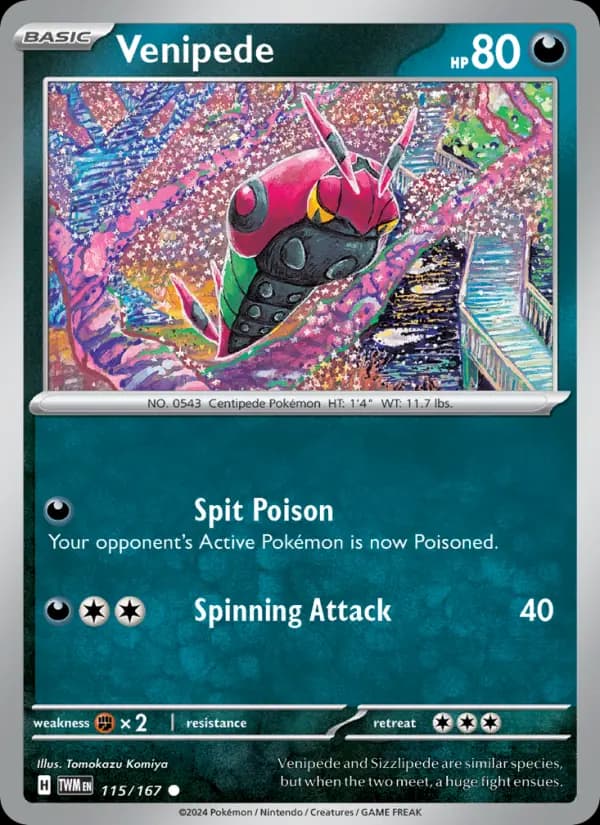
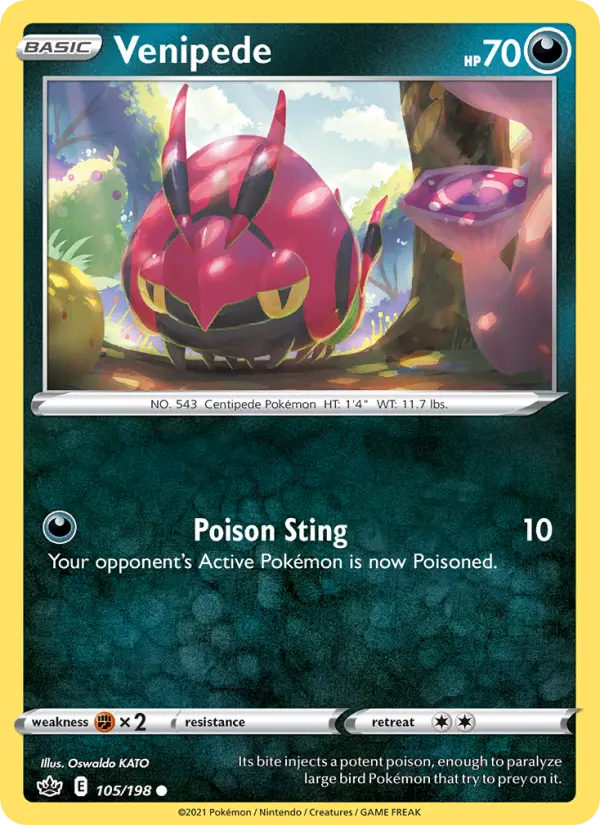
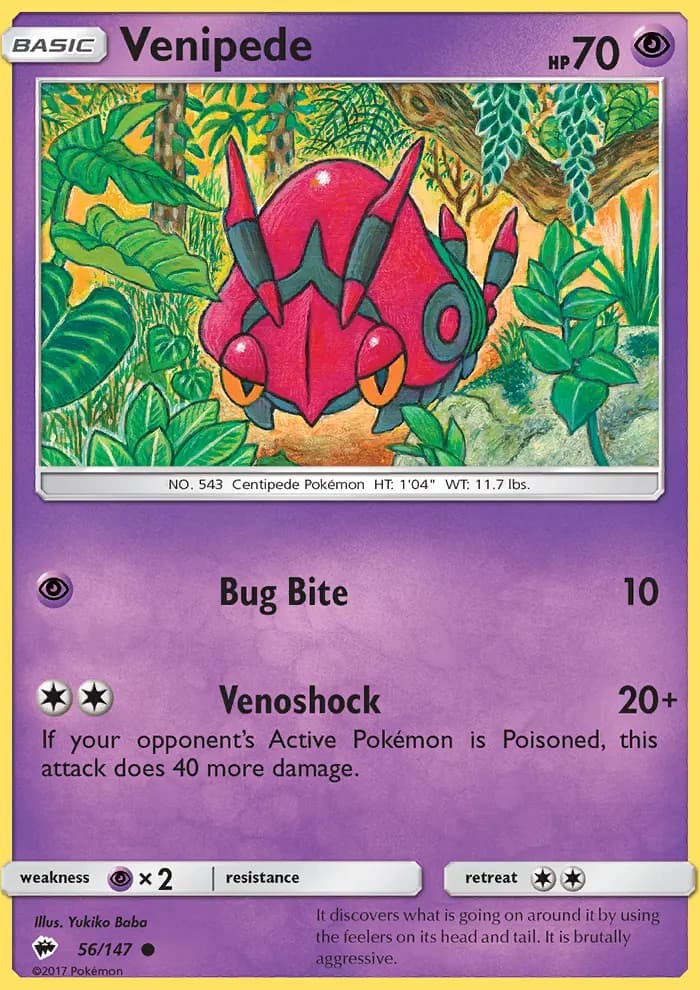
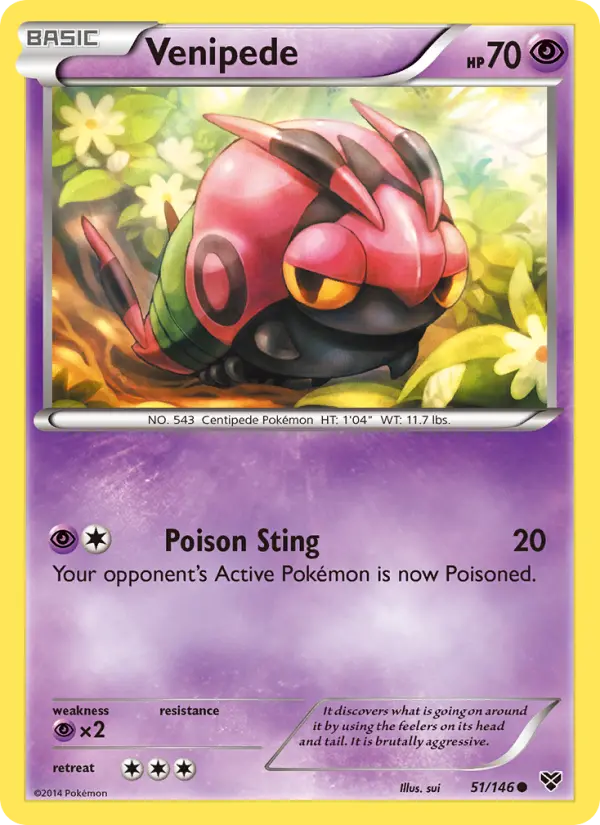
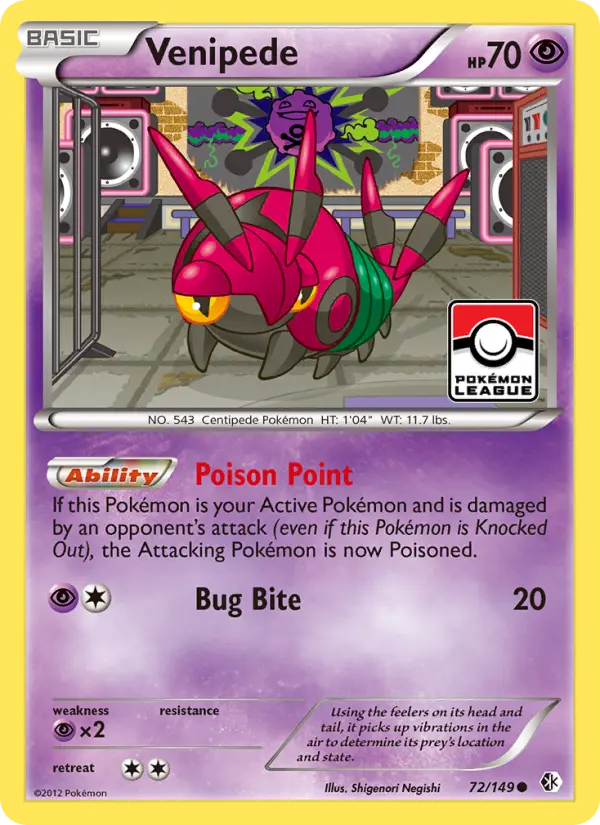
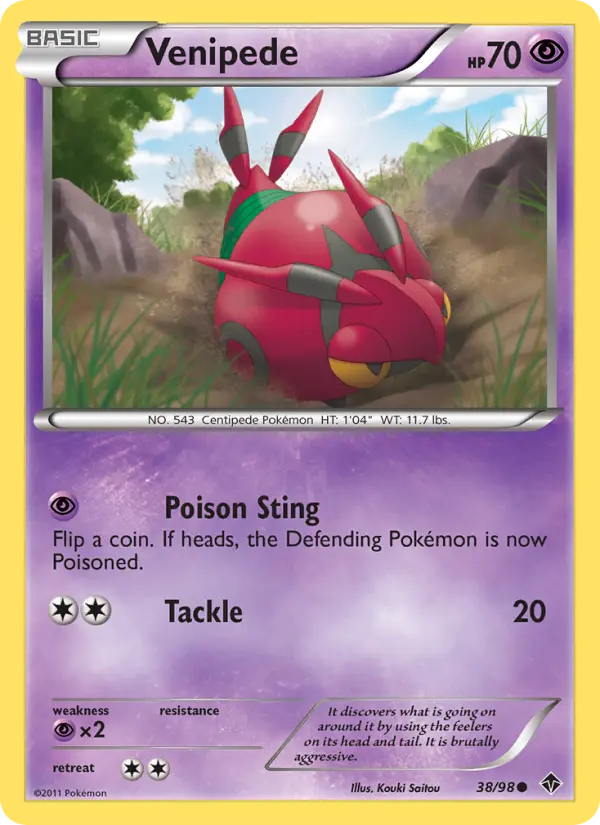
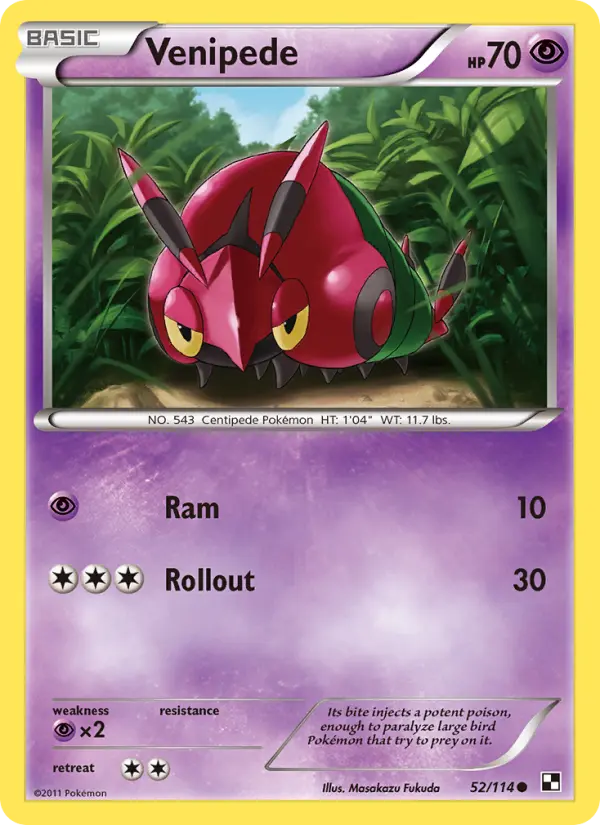
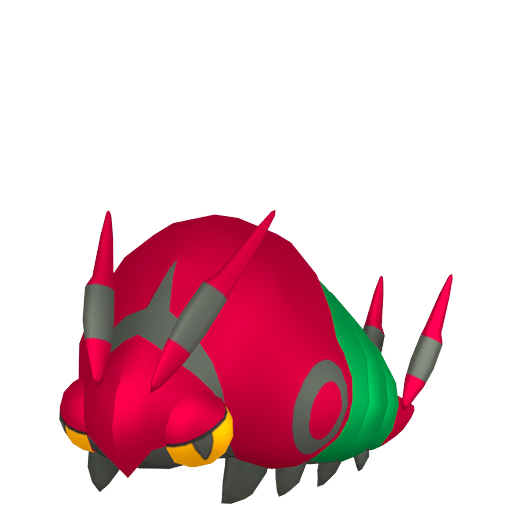
Venipede's physiology reflects its insectoid origins with a segmented dark green abdomen supported by four pairs of stubby black legs that provide stability despite its aggressive disposition. The creature's upper body displays a distinctive magenta thorax and head adorned with striking black markings, including rings around its shoulders, bands encircling its antennae, and an inverted 'Y' pattern on its neck. A prominent ridge splits the top half of its head, culminating in a pointed tip, while its lower jaw is colored black and houses fangs renowned for their highly venomous properties. The most remarkable sensory features are the two short, black-banded feelers extending from its hindquarters, which work in conjunction with its antennae to detect vibrations in the air and perceive its surroundings. These feelers are critical to Venipede's hunting strategy, allowing it to pinpoint prey locations and assess their condition even in darkness or obscured environments.
Pokedex Numbers
Training
Breeding
Venipede Breeding, Gender Ratio & Egg Groups
Venipede has one of the simplest gender ratios in the game — a flat 50/50. With a base friendship value of 70 in Generations V through VII (reduced to 50 in later generations), Venipede develops moderate affection toward its trainer through standard interaction, facilitating a reasonable breeding cycle without extensive friendship grinding. The species belongs solely to the Bug egg group, meaning Venipede can only breed with other Bug-type Pokémon or creatures sharing the Bug classification in their breeding groups. The hatching time of 15 egg cycles translates to approximately 3,599 to 3,855 steps, making it a reasonably quick hatch compared to many other Pokémon species. Trainers breeding for competitive Venipede can pass down movepool coverage from compatible Bug-type parents, potentially acquiring moves like Toxic or Pin Missile before reaching their natural learning levels.
Sprites




Held Items
Pecha Berry
medicine
Held: Consumed when poisoned to cure poison.
Cost: 80
Pecha Berry
medicine
Held: Consumed when poisoned to cure poison.
Cost: 80
Poison Barb
type-enhancement
Held: Poison-Type moves from holder do 20% more damage.
Cost: 1000
Poison Barb
type-enhancement
Held: Poison-Type moves from holder do 20% more damage.
Cost: 1000
Poison Barb
type-enhancement
Held: Poison-Type moves from holder do 20% more damage.
Cost: 1000
Poison Barb
type-enhancement
Held: Poison-Type moves from holder do 20% more damage.
Cost: 1000
Poison Barb
type-enhancement
Held: Poison-Type moves from holder do 20% more damage.
Cost: 1000
Poison Barb
type-enhancement
Held: Poison-Type moves from holder do 20% more damage.
Cost: 1000
Poison Barb
type-enhancement
Held: Poison-Type moves from holder do 20% more damage.
Cost: 1000
Poison Barb
type-enhancement
Held: Poison-Type moves from holder do 20% more damage.
Cost: 1000
Poison Barb
type-enhancement
Held: Poison-Type moves from holder do 20% more damage.
Cost: 1000
Poison Barb
type-enhancement
Held: Poison-Type moves from holder do 20% more damage.
Cost: 1000
Poison Barb
type-enhancement
Held: Poison-Type moves from holder do 20% more damage.
Cost: 1000
Poison Barb
type-enhancement
Held: Poison-Type moves from holder do 20% more damage.
Cost: 1000
TMs & HMs
tm04
gold silver
tm04
crystal
tm05
lets go pikachu lets go eevee
tm06
yellow
tm06
gold silver
tm06
red blue
tm06
crystal
tm06
emerald
tm06
firered leafgreen
tm06
diamond pearl
tm06
platinum
tm06
ruby sapphire
tm06
colosseum
tm06
black 2 white 2
tm06
xd
tm06
black white
tm06
heartgold soulsilver
tm06
omega ruby alpha sapphire
tm06
ultra sun ultra moon
tm06
sun moon
+390 more TMs/HMs
Venipede's Evolution Chain


Venipede Evolution, Mega Evolution & Special Forms
Venipede initiates a linear two-stage evolutionary progression that fundamentally transforms its combat capabilities and physical form. At level 22, Venipede evolves into Whirlipede, a more defensive form that adopts a coiled posture emphasizing its segmented structure. The evolutionary chain culminates at level 30 with Scolipede, a dramatic metamorphosis that grants the creature a sleeker, more aggressive appearance alongside significantly enhanced offensive and speed statistics. While Venipede's base stats total only 260 with modest distributions favoring defense and speed, Scolipede's final form receives substantial boosts to Attack, Special Defense, and Speed, transforming it into a viable competitive threat. This evolutionary trajectory represents the classic Bug-type progression from vulnerable juvenile to formidable predator, with each stage reflecting increasing mastery over its venomous capabilities and locomotion.
Where to Find
Lostlorn Forest
unova
+9 more
Pinwheel Forest
unova
+1 more
Unova Route 20
unova
Alola Route 4
alola
Venipede Behaviour and Natural Habitat
Venipede is renowned for its brutally aggressive temperament, a trait that belies its modest stature and early-stage evolutionary status. The Pokédex entries consistently emphasize that this creature is willing to engage in combat with larger Pokémon and tends to attack prey without thoroughly considering the potential consequences of its actions, displaying an almost reckless combativeness. Particularly notable is Venipede's contentious relationship with Sizzlipede, a related Fire-type centipede species with which it frequently engages in territorial disputes. Its bite injects a potent poison powerful enough to paralyze even large bird Pokémon that might attempt to prey upon it, serving as a defensive mechanism against natural predators. In terms of habitat, Venipede thrives in the diverse ecosystems of Unova, where it hunts small insects and Pokémon using its sophisticated sensory apparatus to locate meals while avoiding larger threats.
Pokedex Entries
Its bite injects a potent poison, enough to paralyze large bird Pokémon that try to prey on it.
Using the feelers on its head and tail, it picks up vibrations in the air to determine its prey’s location and state.
It discovers what is going on around it by using the feelers on its head and tail. It is brutally aggressive.
It discovers what is going on around it by using the feelers on its head and tail. It is brutally aggressive.
Its bite injects a potent poison, enough to paralyze large bird Pokémon that try to prey on it.
It discovers what is going on around it by using the feelers on its head and tail. It is brutally aggressive.
Its bite injects a potent poison, enough to paralyze large bird Pokémon that try to prey on it.
Venipede and Sizzlipede are similar species, but when the two meet, a huge fight ensues.
Its fangs are highly venomous. If this Pokémon finds prey it thinks it can eat, it leaps for them without any thought of how things might turn out.
Venipede Name Origin & Design Inspiration
Venipede's name originates from a straightforward combination of 'venomous' and 'centipede,' perfectly encapsulating its dual nature as a poisonous multi-legged creature. The Japanese designation 'Fushide' (フシデ) derives from 'fushi' meaning joints or segments and 'shide,' an alternative reading of centipede, emphasizing the articulated nature of its body structure. The design itself draws clear inspiration from real-world centipedes, particularly the distinctive segmentation, multiple legs, and aggressive predatory behavior characteristic of the arthropod class. However, Game Freak incorporated fantastical elements such as the prominent magenta coloration, the ridge-topped head structure, and the specialized feelers that exceed typical centipede anatomy. This blend of naturalistic inspiration with imaginative embellishment creates a creature that feels simultaneously alien and recognizable, maintaining the Bug-type identity while introducing memorable design elements that distinguish Venipede from other early-game insects.
Learnable Moves
Venipede can learn 52 moves:
Move | Type | Cat. | Power | Acc. | PP |
|---|---|---|---|---|---|
| agility | psychic | Status | — | — | 30 |
| attract | normal | Status | — | 100 | 15 |
| bite | dark | Physical | 60 | 100 | 25 |
| bug bite | bug | Physical | 60 | 100 | 20 |
| confide | normal | Status | — | — | 20 |
| defense curl | normal | Status | — | — | 40 |
| double team | normal | Status | — | — | 15 |
| double edge | normal | Physical | 120 | 100 | 15 |
| endeavor | normal | Physical | — | 100 | 5 |
| endure | normal | Status | — | — | 10 |
| facade | normal | Physical | 70 | 100 | 20 |
| frustration | normal | Physical | — | 100 | 20 |
| fury cutter | bug | Physical | 40 | 95 | 20 |
| gyro ball | steel | Physical | — | 100 | 5 |
| hex | ghost | Special | 65 | 100 | 10 |
| hidden power | normal | Special | 60 | 100 | 15 |
| infestation | bug | Special | 20 | 100 | 20 |
| iron defense | steel | Status | — | — | 15 |
| payback | dark | Physical | 50 | 100 | 10 |
| pin missile | bug | Physical | 25 | 95 | 20 |
| poison jab | poison | Physical | 80 | 100 | 20 |
| poison sting | poison | Physical | 15 | 100 | 35 |
| poison tail | poison | Physical | 50 | 100 | 25 |
| protect | normal | Status | — | — | 10 |
| pursuit | dark | Physical | 40 | 100 | 20 |
| rest | psychic | Status | — | — | 5 |
| return | normal | Physical | — | 100 | 20 |
| rock climb | normal | Physical | 90 | 85 | 20 |
| rock smash | fighting | Physical | 40 | 100 | 15 |
| rollout | rock | Physical | 30 | 90 | 20 |
| round | normal | Special | 60 | 100 | 15 |
| screech | normal | Status | — | 85 | 40 |
| secret power | normal | Physical | 70 | 100 | 20 |
| signal beam | bug | Special | 75 | 100 | 15 |
| skitter smack | bug | Physical | 70 | 90 | 10 |
| sleep talk | normal | Status | — | — | 10 |
| sludge bomb | poison | Special | 90 | 100 | 10 |
| snore | normal | Special | 50 | 100 | 15 |
| solar beam | grass | Special | 120 | 100 | 10 |
| spikes | ground | Status | — | — | 20 |
| steamroller | bug | Physical | 65 | 100 | 20 |
| steel roller | steel | Physical | 130 | 100 | 5 |
| struggle bug | bug | Special | 50 | 100 | 20 |
| substitute | normal | Status | — | — | 10 |
| sunny day | fire | Status | — | — | 5 |
| swagger | normal | Status | — | 85 | 15 |
| take down | normal | Physical | 90 | 85 | 20 |
| toxic | poison | Status | — | 90 | 10 |
| toxic spikes | poison | Status | — | — | 20 |
| twineedle | bug | Physical | 25 | 100 | 20 |
| venom drench | poison | Status | — | 100 | 20 |
| venoshock | poison | Special | 65 | 100 | 10 |
Venipede Competitive Battle Guide
Venipede's competitive viability is severely limited by its modest cumulative stat total of 260, with particularly low Attack (45) and Special Attack (30) values that severely constrain offensive potential even after evolution. Its most valuable base stat is Speed at 57, allowing it to outspeed many early-game Pokémon and establish momentum in lower-tier formats. The access to three distinct abilities—Poison Point, Swarm, and the hidden Speed Boost—provides flexibility in team building; Speed Boost is particularly notable for progressively increasing Speed each turn, potentially making Venipede a viable sweeper with Scolipede's evolved form. Poison Point offers defensive utility by potentially poisoning attacking Pokémon on contact, while Swarm strengthens Bug-type moves to 1.5x damage when Venipede's HP drops to one-third or lower. In competitive contexts, Venipede is primarily encountered in lower-tier formats like Little Cup, where its stat distribution becomes more relevant and its access to moves like Infestation, Poison Jab, and Pin Missile provides legitimate offensive coverage.
Commonly Asked Questions About Venipede
What type is Venipede?
Venipede is a bug and poison type Pokemon.
What does Venipede evolve into?
Venipede evolves into whirlipede, then into scolipede.
What are Venipede's weaknesses?
Venipede is weak to flying, rock, fire and psychic type moves.
Does Venipede evolve by trading?
No — Venipede evolves entirely through leveling up, with no trade required at any stage.
Where can I find Venipede?
Venipede can be found in lostlorn forest (unova), pinwheel forest (unova) and unova route 20 (unova) and 1 other locations.
Venipede Cultural Impact & Franchise History
While Venipede lacks the iconic status of earlier-generation Bug types like Butterfree or Beedrill, it occupies an important position in Pokémon's generational diversity as part of the ambitious Generation V roster introduced in Black and White. Its design philosophy—showcasing the franchise's commitment to creating regionally distinct Pokémon—contributed to the mixed but ultimately appreciative reception of Unova's native Pokédex. Venipede's aggressive personality and venomous nature have inspired fan art and creative interpretations exploring the darker, more predatory aspects of Bug-type Pokémon ecology. The species appears in various Pokémon multimedia including the trading card game, where its relatively common status in early-generation Unova sets reflects its accessibility in the games. Though it hasn't achieved mainstream recognition comparable to mascot Pokémon, Venipede maintains steady appreciation within dedicated Bug-type enthusiast communities who value its unique design and evolutionary potential.
Where to Find Venipede in Every Pokémon Game
Venipede's remarkable catch rate of 255 makes it exceptionally common throughout the Unova region, appearing with high encounter frequency in multiple early-game locations. In Pokémon Black and White, Venipede is available as a common Pokémon in grassy areas, with National Pokédex number 543 corresponding to its designation as one of the foundational species players encounter during their initial journey. In Black 2 and White 2, it maintains accessibility with Local Pokédex number 043, ensuring consistent availability across the Unova remakes. Subsequent generations have made Venipede available through various methods: in Generation VI (X and Y), it appears in Central Kalos with Local Pokédex number 120; in Generation VIII (Sword and Shield), it's accessible in the Isle of Armor DLC; and it returns in Generation IX's Pokémon Legends: Z-A as Local Pokédex number 068. The species' consistent availability across multiple generations and regions reflects its utility as an accessible Bug-type option for players seeking to round out their team composition without requiring extensive hunting or trading.