Spearow
Generation I · #0021 — Tiny Bird Pokémon
Trainers who write off Spearow on looks alone are missing that its Speed of 70 is genuinely one of the higher marks among normal/flying-type Pokémon. Despite its small stature—standing just 0.3 meters tall and weighing a mere 2.0 kilograms—this diminutive avian possesses remarkable agility and territorial determination. With a overall stat sum of 262, Spearow emphasizes speed as its primary strength, boasting a base Speed stat of 70 that allows it to outmaneuver many early-game opponents. The species is highly catchable with a catch rate of 255, making it an excellent addition to any trainer's roster, and maintains a base happiness of 70, suggesting a naturally amicable disposition toward trainers who capture it.
Editor's Take
Spearow's line is the aggressive counterpart to Pidgey, and Fearow's Drill Peck arriving early made it the better practical choice in Gen 1 despite Pidgeot getting all the box art.
Base Stats
Height
0.3m
Weight
2.0kg
Category
Tiny Bird Pokémon
Gender
Male 50% / Female 50%
Color
brown
Shape
wings
Habitat
rough-terrain
Abilities
Prevents accuracy from being lowered.
Strengthens critical hits to inflict 3× damage rather than 2×.

Spearow Biology & Physical Characteristics
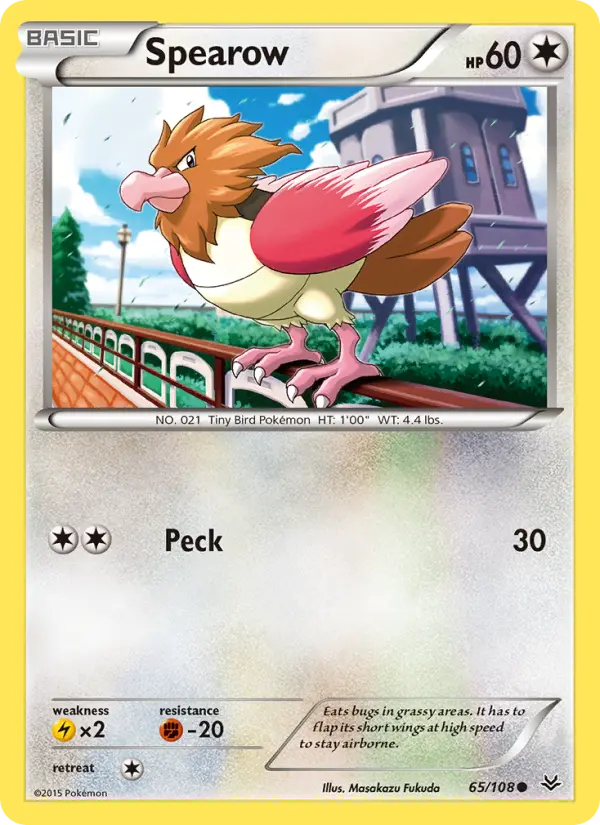
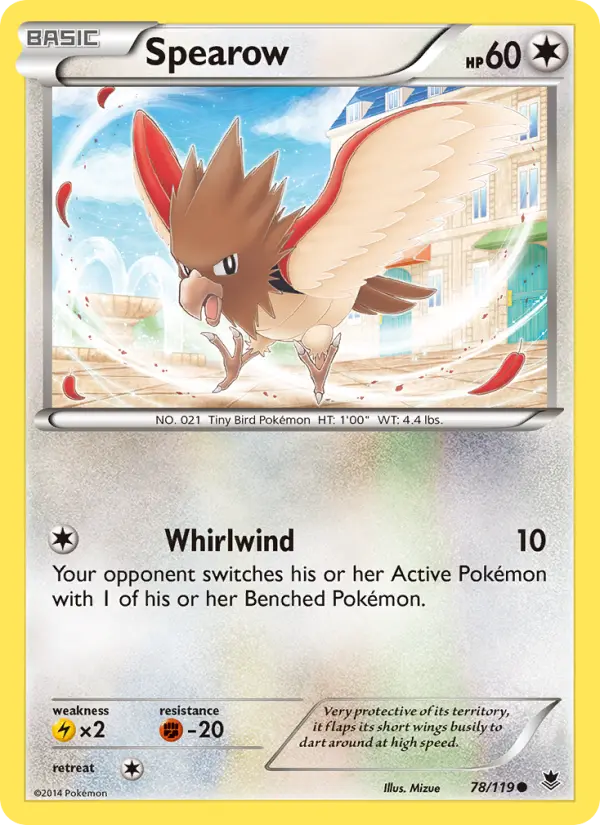
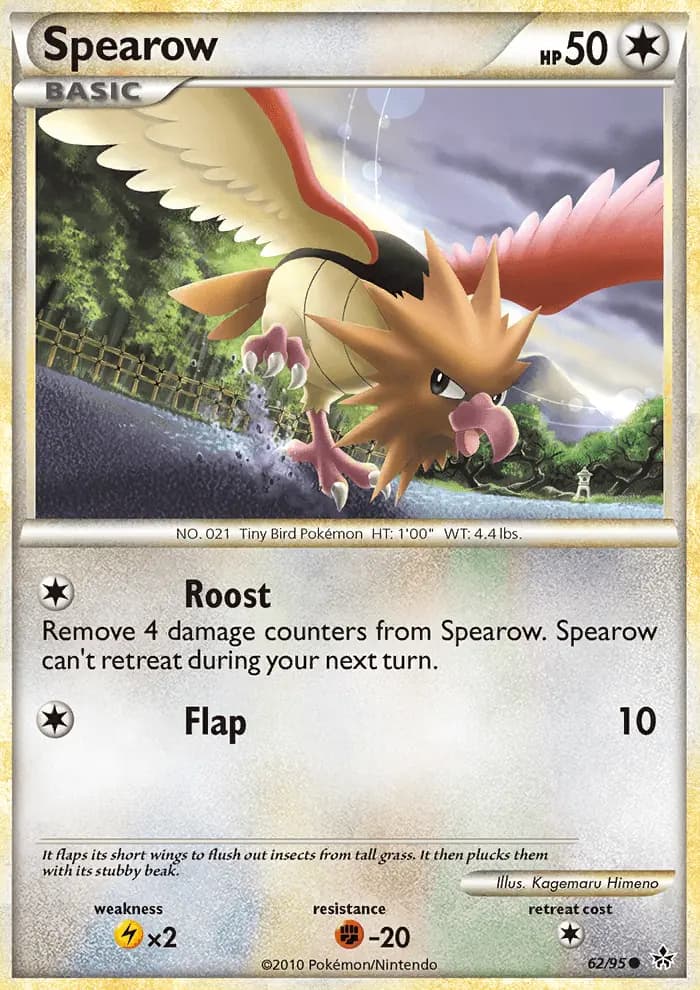
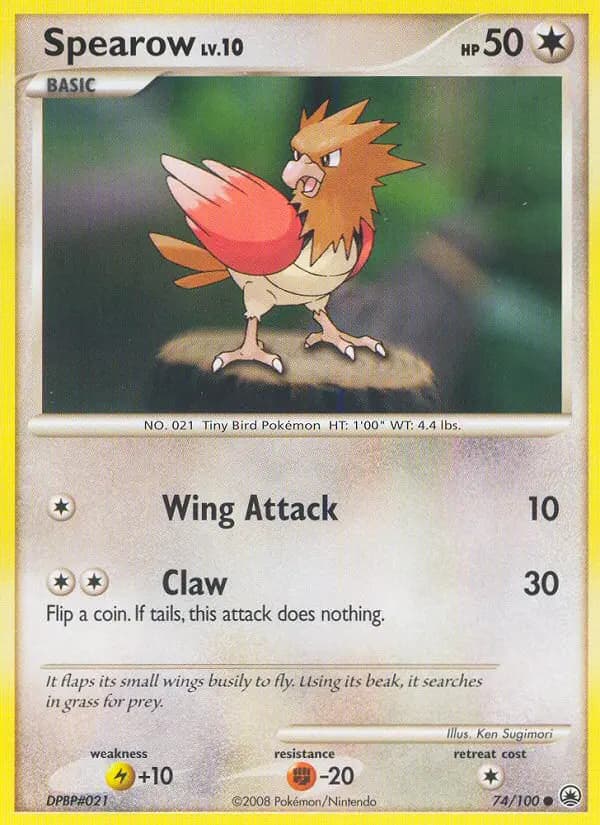
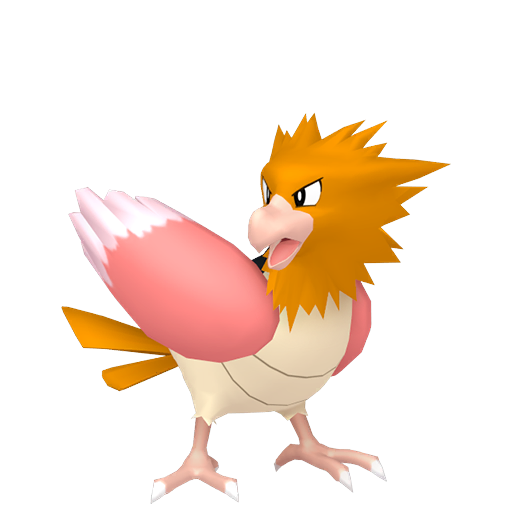
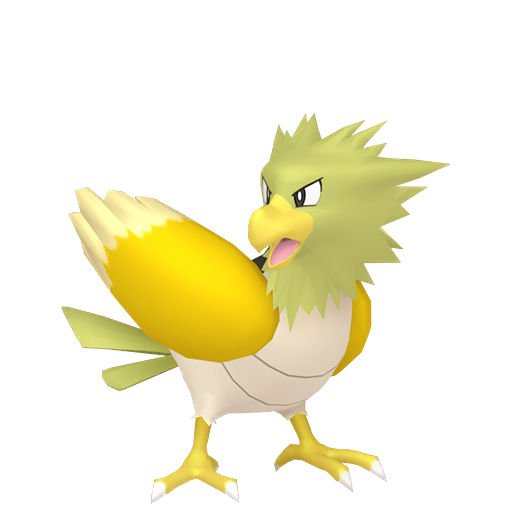
Spearow is a small avian Pokémon characterized by rough, brown plumage concentrated on its head and three distinctive brown tail feathers. Its narrow, dark brown eyes contain white pupils that pierce through its small frame, while a short, hooked beak with a light pink coloration serves as its primary tool for hunting and interaction. The wing feathers display a striking pinkish-red hue with lighter tips, contrasting beautifully against its beige underside marked by two thin, horizontal stripes. Black feathers cover its back, providing natural camouflage in many environments, while its light pink feet feature an unusual arrangement of two toes in front and one in back, adapted for perching and gripping. Despite its frail appearance with base Defense and Special Defense stats of only 30 and 31 respectively, Spearow possesses a deceptively resilient constitution, with a base HP of 40 that allows it to withstand moderate early-game attacks. Its base Attack stat of 60, while modest, enables it to deal respectable damage with physical moves, particularly utilizing its high Speed stat of 70 to strike first in most encounters.
Pokedex Numbers
Training
Breeding
Spearow Breeding, Gender Ratio & Egg Groups
Spearow has one of the simplest gender ratios in the game — a flat 50/50. The species belongs to the Flying egg group, meaning it can breed with other Flying-type Pokémon as well as certain other compatible species, expanding breeding options for trainers seeking to develop competitive movesets or desired natures. With a base happiness value of 70, Spearow demonstrates a naturally cooperative disposition toward trainers, making it easier to raise affection levels through regular interaction and care compared to species with lower friendship values. The egg cycle counter of 15 indicates a relatively moderate hatch time—between 3,599 and 3,855 steps—making Spearow a reasonable choice for trainers willing to invest time in breeding projects without excessive patience requirements. When breeding, offspring inherit standard movesets but can inherit moves from father Pokémon not normally learned through leveling, a mechanic that has made Spearow relevant even as newer flying-types with superior stats have emerged. The medium growth rate shared by Spearow means it progresses at a standard pace, requiring no exceptional leveling considerations compared to slow or fast growth rate species.
Sprites




Held Items
Sharp Beak
type-enhancement
Held: Flying-Type moves from holder do 20% more damage.
Cost: 1000
Sharp Beak
type-enhancement
Held: Flying-Type moves from holder do 20% more damage.
Cost: 1000
Sharp Beak
type-enhancement
Held: Flying-Type moves from holder do 20% more damage.
Cost: 1000
Sharp Beak
type-enhancement
Held: Flying-Type moves from holder do 20% more damage.
Cost: 1000
Sharp Beak
type-enhancement
Held: Flying-Type moves from holder do 20% more damage.
Cost: 1000
Sharp Beak
type-enhancement
Held: Flying-Type moves from holder do 20% more damage.
Cost: 1000
Sharp Beak
type-enhancement
Held: Flying-Type moves from holder do 20% more damage.
Cost: 1000
Sharp Beak
type-enhancement
Held: Flying-Type moves from holder do 20% more damage.
Cost: 1000
TMs & HMs
tm01
lets go pikachu lets go eevee
tm01
ultra sun ultra moon
tm01
sun moon
tm02
yellow
tm02
red blue
tm02
crystal
tm02
gold silver
tm02
blue japan
tm02
red green japan
tm03
crystal
tm03
gold silver
tm04
yellow
tm04
red blue
tm04
red green japan
tm04
blue japan
tm05
lets go pikachu lets go eevee
tm06
yellow
tm06
gold silver
tm06
red blue
tm06
crystal
+467 more TMs/HMs
Spearow's Evolution Chain


Spearow Evolution, Mega Evolution & Special Forms
Spearow evolves into the more powerful Fearow when it reaches level 20, a transformation that represents a significant power increase for trainers looking to enhance their flying-type arsenal. This evolution is straightforward and requires no special items or conditions beyond meeting the level requirement, making it a reliable progression for early-game team building. Upon evolution, Fearow gains improved base stats across the board, with particularly notable increases in Attack, Defense, and Speed, transforming from a fragile speedster into a more well-rounded flying-type combatant. The evolutionary line does not possess a Mega Evolution variant, as Spearow and Fearow predate the introduction of Mega Evolution mechanics in Generation VI. This lineage represents one of the straightforward single-evolution progressions that defined early Pokémon design philosophy, contrasting with the more complex evolutionary branching systems introduced in later generations. The evolution from Spearow to Fearow marks a transition from a utility flyer suitable for travel and insect-hunting to a legitimate aerial combatant capable of engaging stronger opponents.
Where to Find
Kanto Route 3
kanto
+64 more
Kanto Route 23
kanto
+11 more
Kanto Route 16
kanto
+11 more
Kanto Route 4
kanto
+58 more
Kanto Route 22
kanto
+44 more
Kanto Route 17
kanto
+9 more
Kanto Route 11
kanto
+15 more
Kanto Route 10
kanto
+33 more
Kanto Route 18
kanto
+11 more
Kanto Route 9
kanto
+38 more
Johto Route 46
johto
+44 more
Johto Route 30
johto
+11 more
Johto Route 42
johto
+42 more
Johto Route 29
johto
+11 more
Johto Route 32
johto
+11 more
Johto Route 43
johto
+11 more
Johto Route 31
johto
+11 more
Johto Route 44
johto
+18 more
Johto Route 33
johto
+30 more
Johto Route 45
johto
+18 more
+17 more locations in other games
Spearow Behaviour and Natural Habitat
Spearow's behavior is defined by its fierce territorial nature and remarkable vocalization abilities. The species is known to produce an extraordinarily loud cry that can be heard over half a mile away, serving as a warning system to alert other Spearow of approaching danger. According to Pokédex entries, when this high, keening cry echoes repeatedly through an area, it signals that the species is actively warning one another of threats. This vocalization is not merely defensive; Spearow uses its loud cries to maintain territory boundaries and establish dominance within its range. The species hunts for insects by flying low over grassy areas and using its beak to search through tall grass, flushing out prey before plucking them with its stubby beak. Naturally found in open habitats with warm climates such as desolate wastelands and fields, Spearow is most active during daylight hours when insect populations are abundant. Despite its ineptitude at flying at great heights or covering long distances, Spearow compensates by flying at exceptionally high speeds to protect its territory, flapping its short wings at incredible rates to maintain altitude and maneuverability. In the anime, Spearow has been revealed to possess black-and-white vision, and the species exhibits pack behavior, with multiple Spearow coordinating their movements when threatened.
Pokedex Entries
Eats bugs in grassy areas. It has to flap its short wings at high speed to stay airborne.
Inept at flying high. However, it can fly around very fast to protect its ter ritory.
It flaps its short wings to flush out insects from tall grass. It then plucks them with its stubby beak.
Very protective of its territory, it flaps its short wings busily to dart around at high speed.
To protect its territory, it flies around ceaselessly, making high- pitched cries.
SPEAROW has a very loud cry that can be heard over half a mile away. If its high, keening cry is heard echoing all around, it is a sign that they are warning each other of danger.
Its loud cry can be heard over half a mile away. If its high, keening cry is heard echoing all around, it is a sign that they are warning each other of danger.
It busily flits around here and there. Even if it is frail, it can be a tough foe that uses MIRROR MOVE.
Eats bugs in grassy areas. It has to flap its short wings at high speed to stay airborne.
It flaps its small wings busily to fly. Using its beak, it searches in grass for prey.
It flaps its short wings to flush out insects from tall grass. It then plucks them with its stubby beak.
Very protective of its territory, it flaps its short wings busily to dart around at high speed.
It flaps its small wings busily to fly. Using its beak, it searches in grass for prey.
It flaps its small wings busily to fly. Using its beak, it searches in grass for prey.
Very protective of its territory, it flaps its short wings busily to dart around at high speed.
Eats bugs in grassy areas. It has to flap its short wings at high speed to stay airborne.
Spearow has a very loud cry that can be heard over half a mile away. If its high, keening cry is heard echoing all around, it is a sign that they are warning each other of danger.
Its short wings make it inept at flying. It moves about hurriedly and pecks at Bug-type Pokémon in the tall grass.
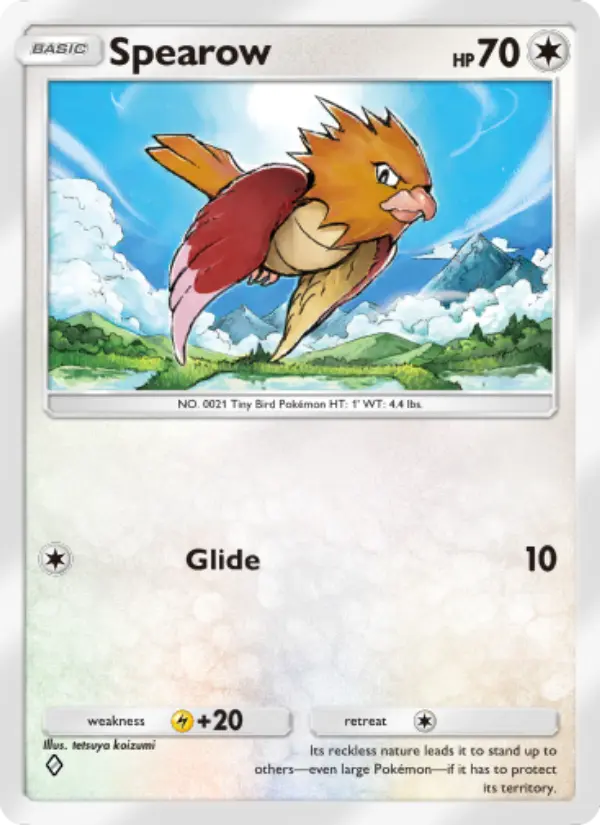
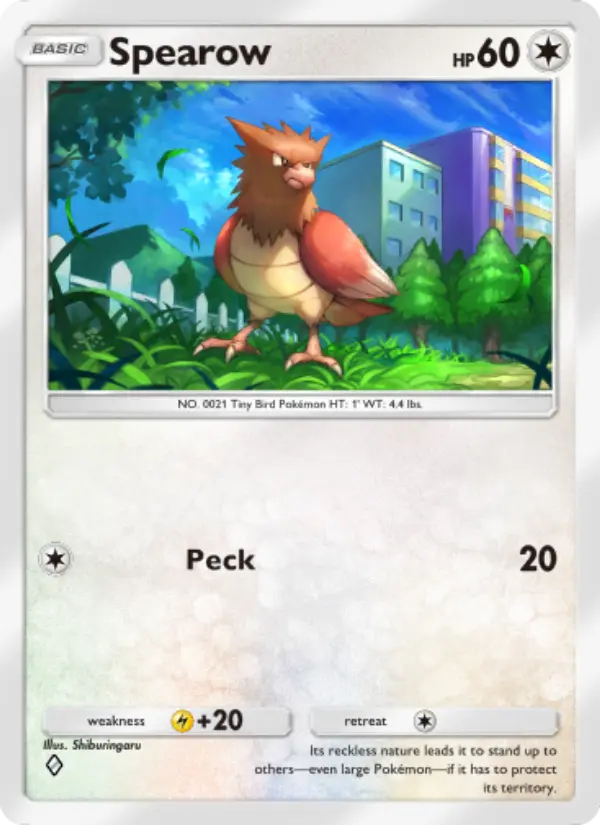
Its reckless nature leads it to stand up to others—even large Pokémon—if it has to protect its territory.
Farmers whose fields are troubled by bug Pokémon appreciate Spearow for its vigorous appetite and look after it.
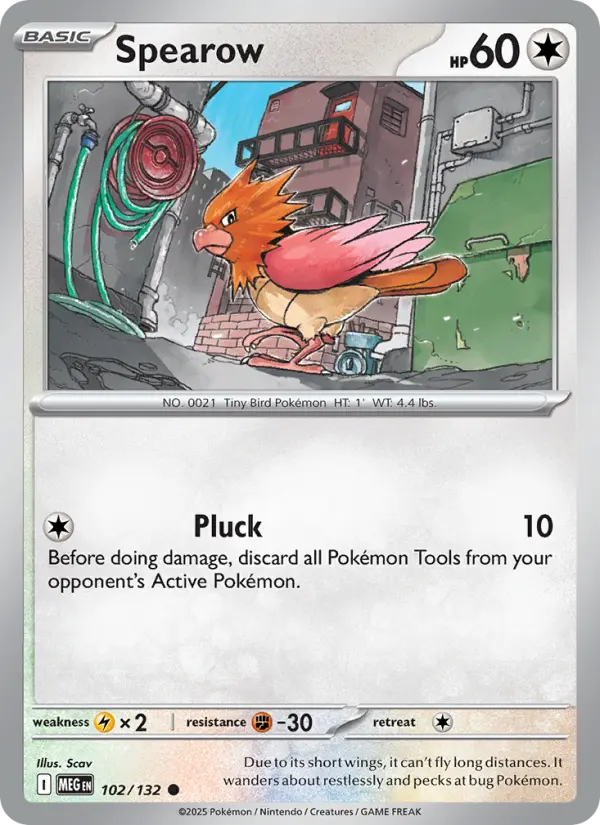
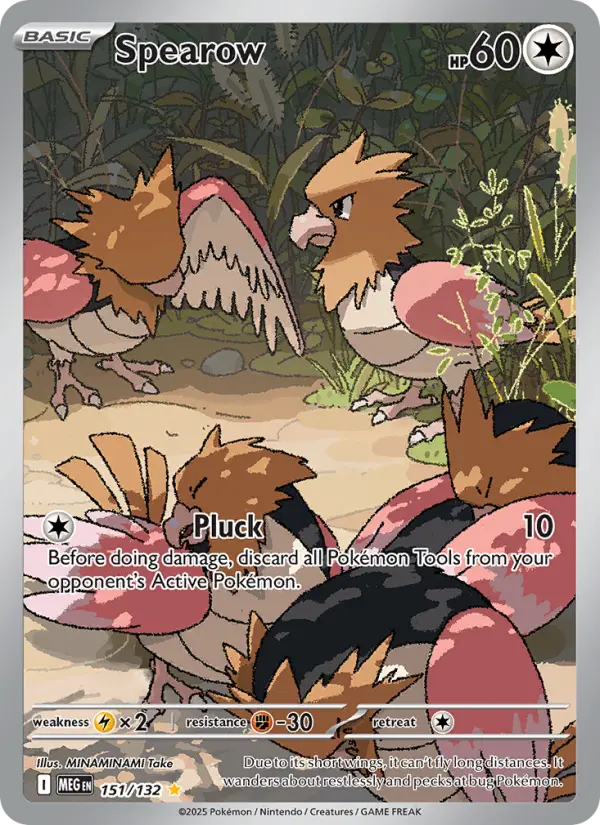
Due to its short wings, it can’t fly long distances. It wanders about restlessly and pecks at bug Pokémon.
Inept at flying high. However, it can fly around very fast to protect its territory.
Spearow Name Origin & Design Inspiration
Spearow's name can be traced to combining 'spear,' referencing its pointed beak and aggressive, piercing demeanor, with 'sparrow,' indicating its avian classification and general resemblance to small songbirds. The Japanese designation オニスズメ (Onisuzume) combines 'oni' (demon or ogre, suggesting ferocity despite small size) with 'suzume' (sparrow), emphasizing the species' surprisingly aggressive nature masked by its diminutive appearance. Visually, Spearow draws inspiration from real-world sparrows and small raptors, incorporating design elements from both songbirds and predatory avians—a duality reflected in its dual Normal/Flying typing and contrasting behavioral traits. The pink beak and wing coloration provide distinctive visual markers that differentiate Spearow from generic sparrow designs, while the brown head plumage and structured tail feathers invoke the appearance of classical ornithological illustrations. Its design effectively communicates the species' role as a territorial, aggressive flyer despite its small stature, a design philosophy carried through to its evolution Fearow, which simply exaggerates these proportions and intensity.
Learnable Moves
Spearow can learn 69 moves:
Move | Type | Cat. | Power | Acc. | PP |
|---|---|---|---|---|---|
| aerial ace | flying | Physical | 60 | — | 20 |
| agility | psychic | Status | — | — | 30 |
| air cutter | flying | Special | 60 | 95 | 25 |
| assurance | dark | Physical | 60 | 100 | 10 |
| astonish | ghost | Physical | 30 | 100 | 15 |
| attract | normal | Status | — | 100 | 15 |
| bide | normal | Physical | — | — | 10 |
| captivate | normal | Status | — | 100 | 20 |
| confide | normal | Status | — | — | 20 |
| curse | ghost | Status | — | — | 10 |
| defog | flying | Status | — | — | 15 |
| detect | fighting | Status | — | — | 5 |
| double team | normal | Status | — | — | 15 |
| double edge | normal | Physical | 120 | 100 | 15 |
| drill peck | flying | Physical | 80 | 100 | 20 |
| drill run | ground | Physical | 80 | 95 | 10 |
| echoed voice | normal | Special | 40 | 100 | 15 |
| endure | normal | Status | — | — | 10 |
| facade | normal | Physical | 70 | 100 | 20 |
| false swipe | normal | Physical | 40 | 100 | 40 |
| feather dance | flying | Status | — | 100 | 15 |
| feint attack | dark | Physical | 60 | — | 20 |
| fly | flying | Physical | 90 | 95 | 15 |
| focus energy | normal | Status | — | — | 30 |
| frustration | normal | Physical | — | 100 | 20 |
| fury attack | normal | Physical | 15 | 85 | 20 |
| growl | normal | Status | — | 100 | 40 |
| headbutt | normal | Physical | 70 | 100 | 15 |
| heat wave | fire | Special | 95 | 90 | 10 |
| hidden power | normal | Special | 60 | 100 | 15 |
| leer | normal | Status | — | 100 | 30 |
| mimic | normal | Status | — | — | 10 |
| mirror move | flying | Status | — | — | 20 |
| mud slap | ground | Special | 20 | 100 | 10 |
| natural gift | normal | Physical | — | 100 | 15 |
| ominous wind | ghost | Special | 60 | 100 | 5 |
| peck | flying | Physical | 35 | 100 | 35 |
| pluck | flying | Physical | 60 | 100 | 20 |
| protect | normal | Status | — | — | 10 |
| pursuit | dark | Physical | 40 | 100 | 20 |
| quick attack | normal | Physical | 40 | 100 | 30 |
| rage | normal | Physical | 20 | 100 | 20 |
| rain dance | water | Status | — | — | 5 |
| razor wind | normal | Special | 80 | 100 | 10 |
| rest | psychic | Status | — | — | 5 |
| return | normal | Physical | — | 100 | 20 |
| roost | flying | Status | — | — | 5 |
| round | normal | Special | 60 | 100 | 15 |
| scary face | normal | Status | — | 100 | 10 |
| secret power | normal | Physical | 70 | 100 | 20 |
| sky attack | flying | Physical | 140 | 90 | 5 |
| sleep talk | normal | Status | — | — | 10 |
| snore | normal | Special | 50 | 100 | 15 |
| steel wing | steel | Physical | 70 | 90 | 25 |
| substitute | normal | Status | — | — | 10 |
| sunny day | fire | Status | — | — | 5 |
| swagger | normal | Status | — | 85 | 15 |
| swift | normal | Special | 60 | — | 20 |
| tailwind | flying | Status | — | — | 15 |
| take down | normal | Physical | 90 | 85 | 20 |
| thief | dark | Physical | 60 | 100 | 25 |
| toxic | poison | Status | — | 90 | 10 |
| tri attack | normal | Special | 80 | 100 | 10 |
| twister | dragon | Special | 40 | 100 | 20 |
| u turn | bug | Physical | 70 | 100 | 20 |
| uproar | normal | Special | 90 | 100 | 10 |
| whirlwind | normal | Status | — | — | 20 |
| wing attack | flying | Physical | 60 | 100 | 35 |
| work up | normal | Status | — | — | 30 |
Spearow Competitive Battle Guide
Assessing its battle viability, Spearow is generally considered a niche choice for early-generation or restricted tournament formats where only Generation I Pokémon are permitted, though it is largely outclassed by more specialized flying-types in standard competitive environments. Its base Speed stat of 70 provides reasonable priority in early-game matchups, allowing it to outspeed many comparable Pokémon of similar levels and deliver first-strike advantage. The Keen Eye ability prevents opponents from lowering Spearow's accuracy through moves like Sand Attack or Sweet Scent, providing utility in matches against accuracy-focused strategies. However, its signature Hidden Ability, Sniper, offers more offensive potential by increasing critical hit damage from 1.5x to 3x, transforming moves like Aerial Ace and Drill Peck into devastating attacks when critical hits land. Spearow's movepool includes valuable early-game coverage moves such as Peck, Fury Attack, and Mirror Move, with later generations adding access to moves like Brave Bird through breeding or tutoring. The species' weakness to Electric, Rock, and Ice-type moves—particularly problematic given Spearow's low Defense stats—limits its viability against common competitive threats. In competitive play, Spearow is typically reserved for novelty teams, early-game team building exercises, or specialized formats celebrating Generation I Pokémon, where its Speed and Keen Eye ability provide legitimate strategic value.
Commonly Asked Questions About Spearow
What type is Spearow?
Spearow is a normal and flying type Pokemon.
What does Spearow evolve into?
Spearow evolves into fearow.
What are Spearow's weaknesses?
Spearow is weak to rock, electric and ice type moves.
Does Spearow evolve by trading?
No — Spearow evolves entirely through leveling up, with no trade required at any stage.
Where can I find Spearow?
Spearow can be found in kanto route 3 (kanto), kanto route 23 (kanto) and kanto route 16 (kanto) and 34 other locations.
Spearow Cultural Impact & Franchise History
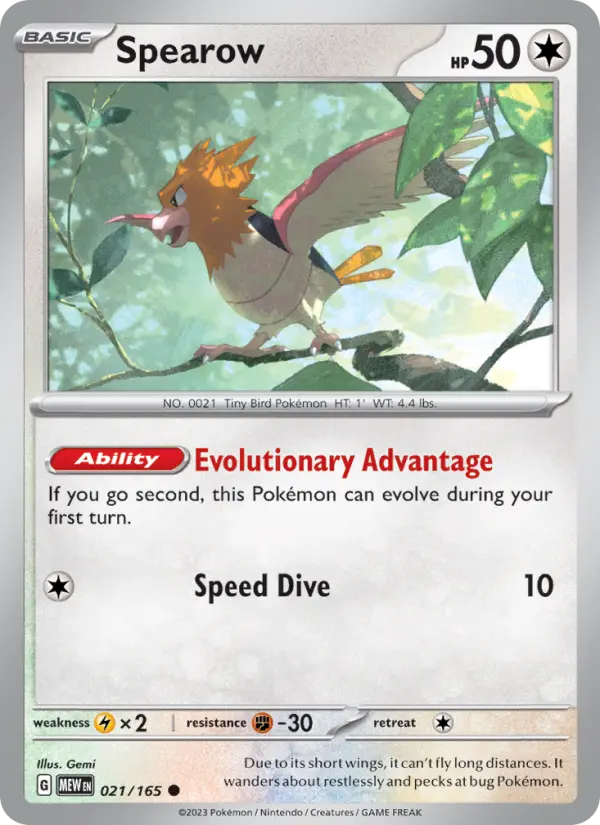
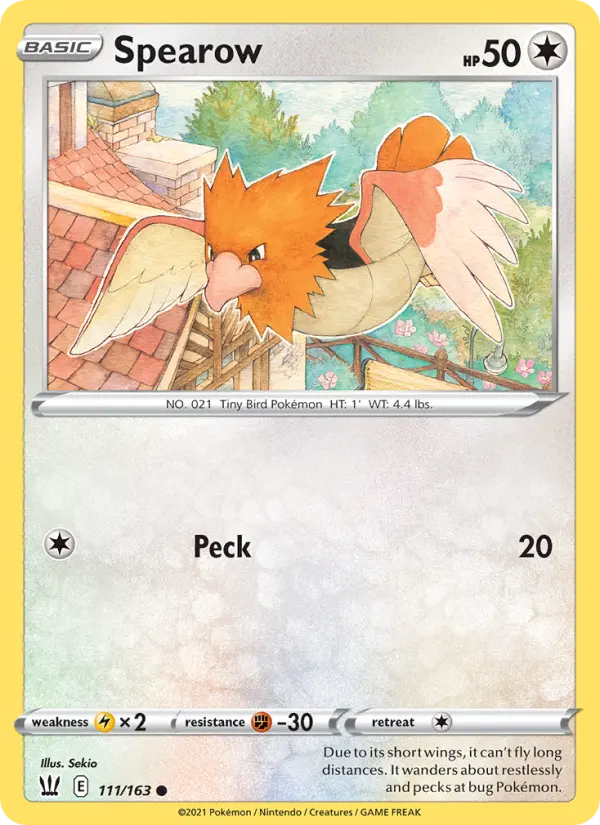
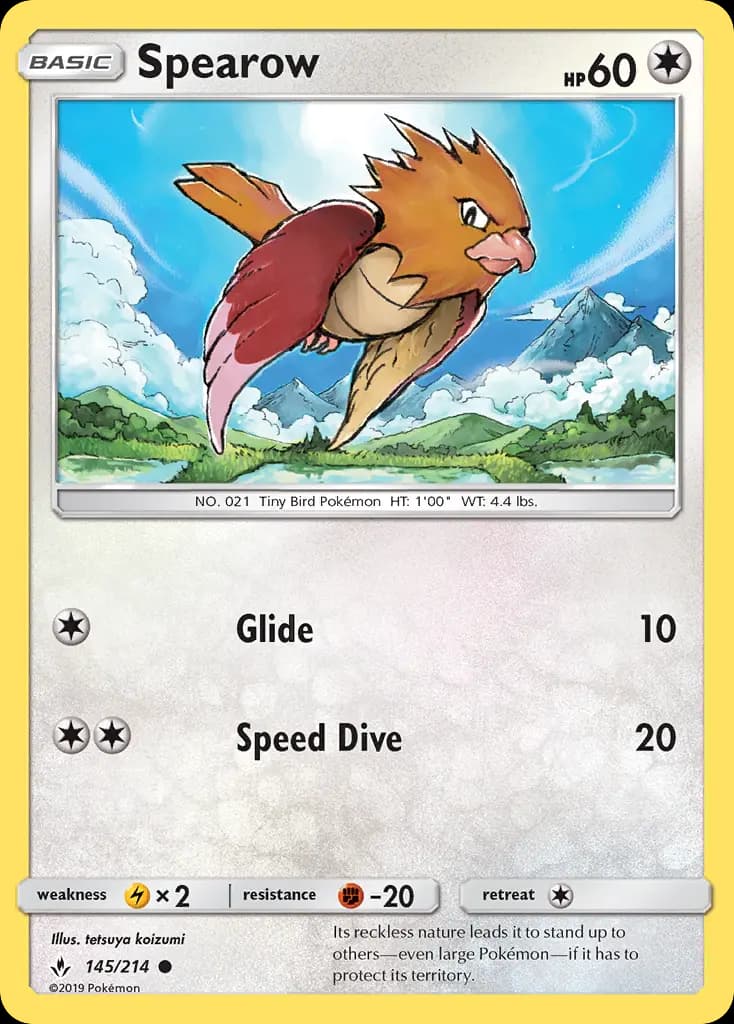
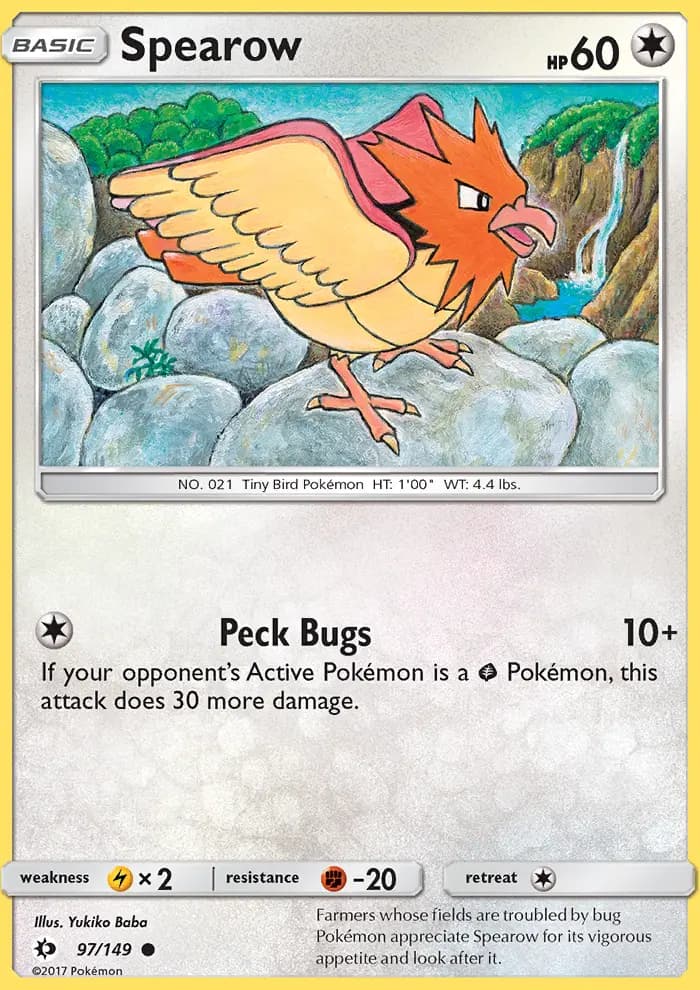
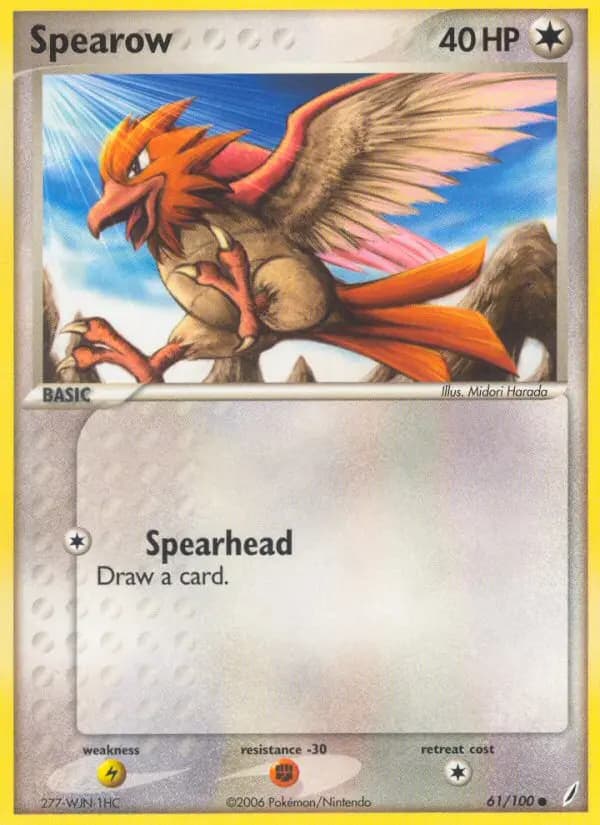
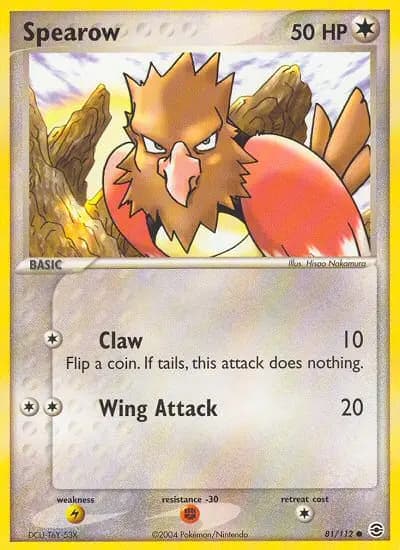
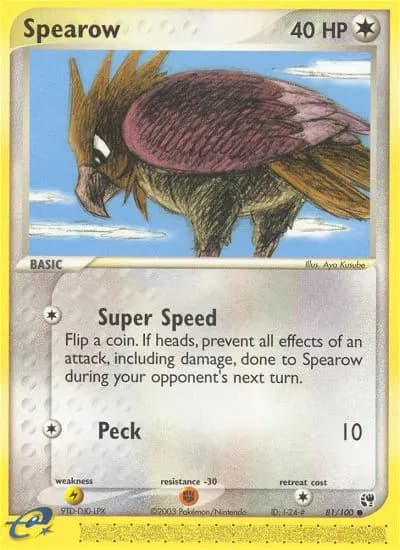
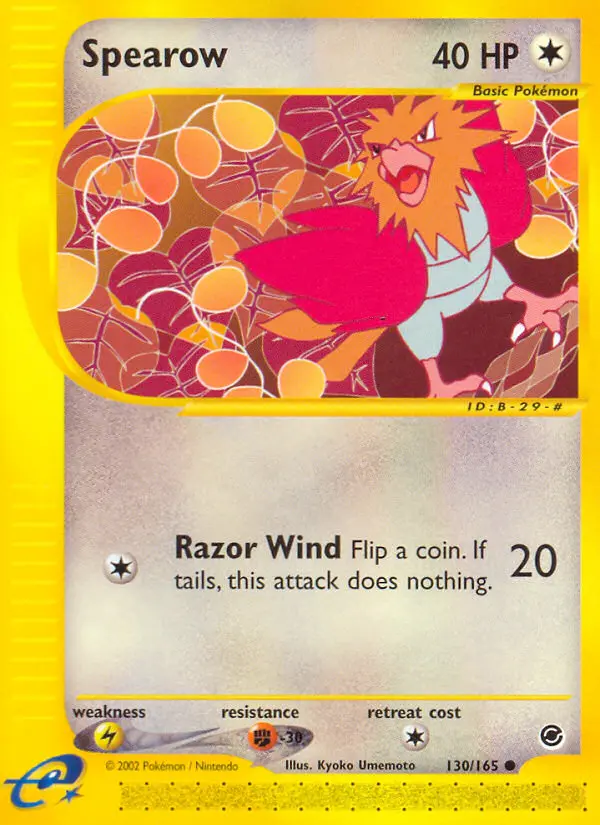
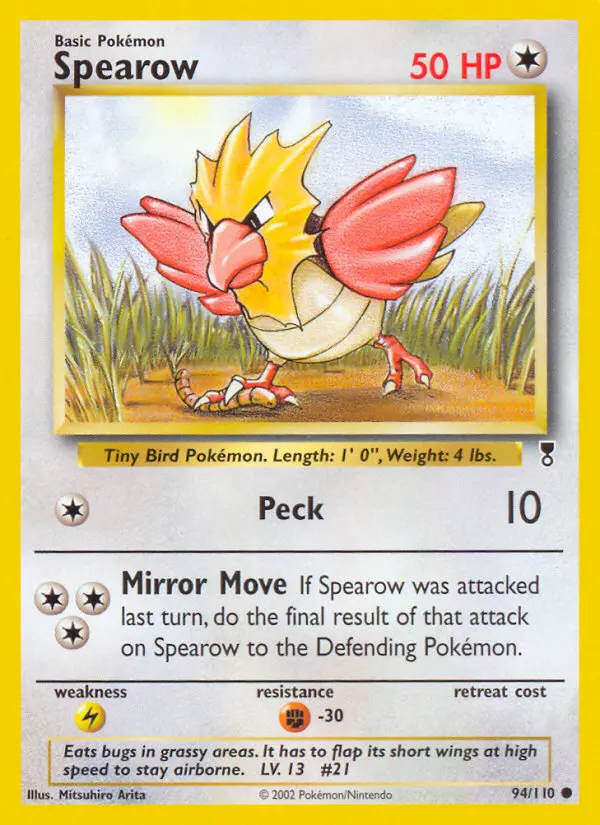
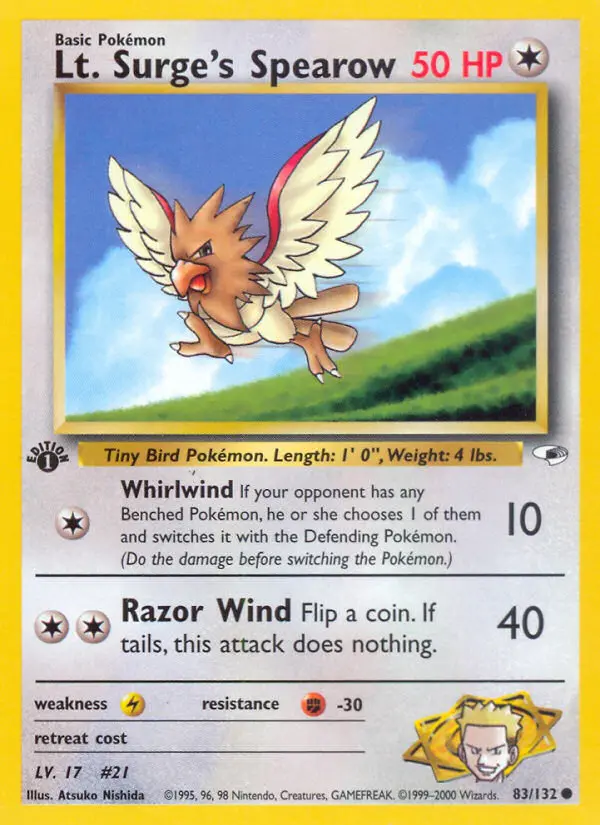
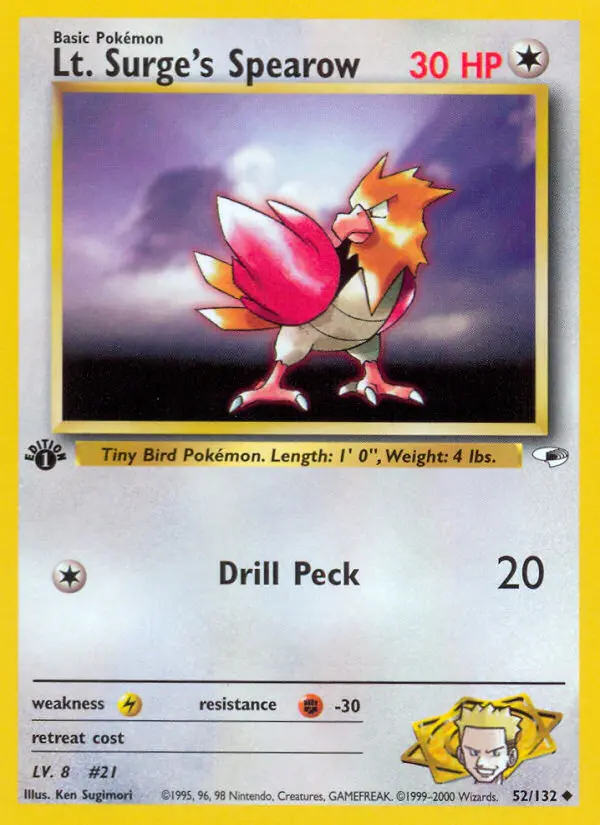
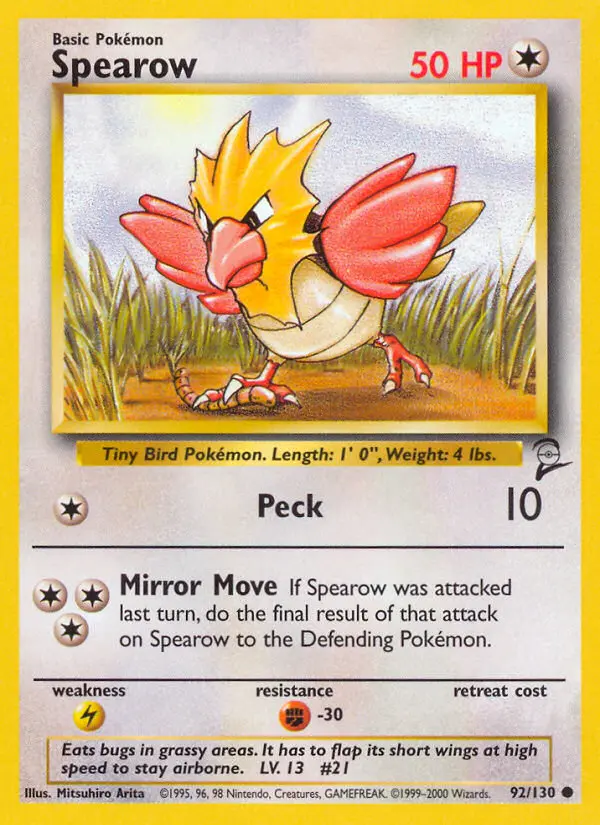
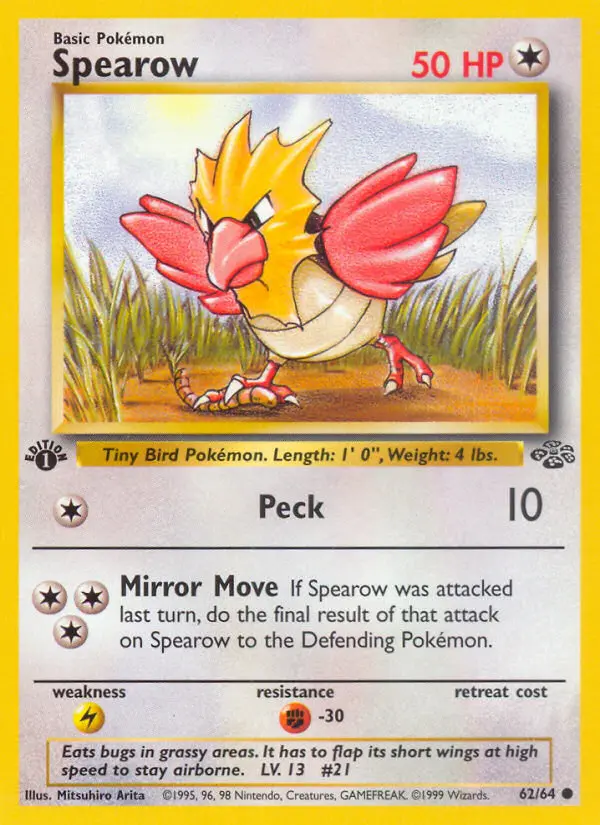
Spearow achieved significant cultural prominence through its appearance in the first episode of the Pokémon anime series, where a flock of agitated Spearow chases Ash Ketchum and Pikachu across an entire field, establishing the species as iconic to franchise canon. This iconic scene created an indelible association between Spearow and the early-game experience, with the species representing both the beauty and danger of wild Pokémon in their natural habitats. The species has since appeared consistently across Pokémon media, manga adaptations, and the trading card game, maintaining relevance as a recognizable early-generation Pokémon symbol. In trading card games, Spearow has appeared on numerous cards across multiple generations and expansion sets, with the species' aggressive nature frequently reflected in card mechanics emphasizing speed or critical damage potential. The memorable anime encounter contributed to Spearow's popularity among longtime Pokémon fans despite its competitive limitations, with the species representing the foundational generation of Pokémon that established the franchise's aesthetic and gameplay philosophy. Cultural discussions of Spearow often focus on the species' remarkable vocal abilities and territorial aggression, frequently referenced as justification for why Spearow packs are so dangerous despite individual members being small and frail.
Where to Find Spearow in Every Pokémon Game
Spearow's availability has varied significantly across generations and game regions, though the species has maintained consistent presence throughout the franchise's major installments. In the original Generation I games (Red, Blue, and Yellow), Spearow appears as Pokédex number 21 in the Kanto region, available in early-game areas such as Route 16, Route 17, and Route 18 in Red and Blue versions, with modified availability in Yellow version where capture rates differed. In Generation II (Gold, Silver, and Crystal), Spearow received National Pokédex number 21 but became local number 13 in the Johto Pokédex, available in early routes through the Johto region with similar accessibility to the original games. FireRed and LeafGreen remakes maintained Spearow's accessibility as an early-game encounter, while HeartGold and SoulSilver preserved its appearance in Johto region early-game encounters. In later generations, Spearow's availability has fluctuated with game progression; it appears in the Mountain Kalos area of Pokémon X and Y (as local number 109), within the Alola Pokédex in Sun and Moon versions, and in Let's Go Pikachu and Let's Go Eevee as a returning Generation I species. The species' availability across handheld and console games has made it consistently accessible to trainers from the franchise's inception through modern iterations, though availability windows vary by specific games and post-game content availability. Its catchability is virtually guaranteed for players exploring early-game areas, making Spearow one of the most accessible flying-type Pokémon for new trainers beginning their journeys.