Raticate
Generation I · #0020 — Mouse Pokémon
Among Normal-type Pokémon, Raticate ranks #31 for Speed among all 160 Normal-type Pokémon. At 0.7 m and 18.5 kg, its build reflects a specialist role rather than a generalist one. Standing at 0.7 meters tall and weighing 18.5 kilograms, Raticate maintains a compact build while gaining substantially in combat capability. The species gained additional regional representation with the introduction of Alolan Raticate in Generation VII, which adopts a Dark/Normal typing and reflects the environmental adaptation of Pokémon species to different regions. Raticate's consistent catch rate of 127 and moderate base happiness of 70 make it an accessible catch for players early in their journey, while its medium-fast experience growth rate ensures steady progression toward competitive viability.
Editor's Take
Raticate is the archetypal early-route evolution that stops scaling around the third gym, and the Alolan variant giving it Dark typing and actual bulk is the more interesting version of the same Pokémon.
Base Stats
Height
0.7m
Weight
18.5kg
Category
Mouse Pokémon
Gender
Male 50% / Female 50%
Color
brown
Shape
quadruped
Habitat
grassland
Abilities
Ensures success fleeing from wild battles.
Increases Attack to 1.5× with a major status ailment.
Strengthens physical moves to inflict 1.5× damage, but decreases their accuracy to 0.8×.

Raticate Biology & Physical Characteristics
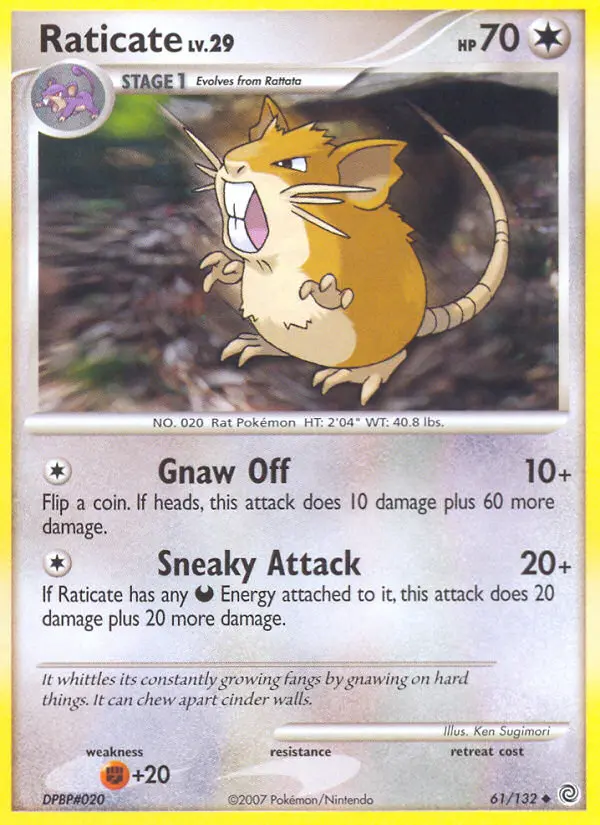
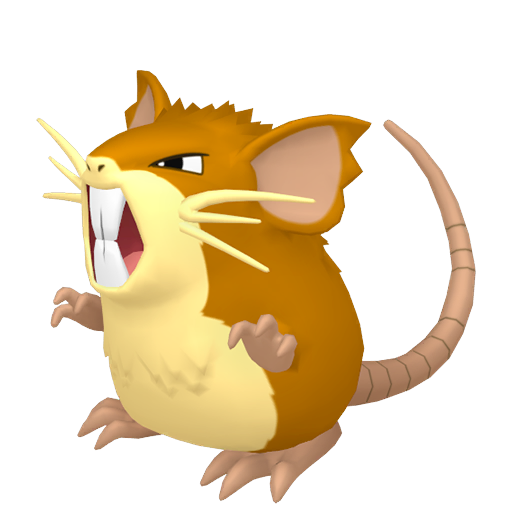
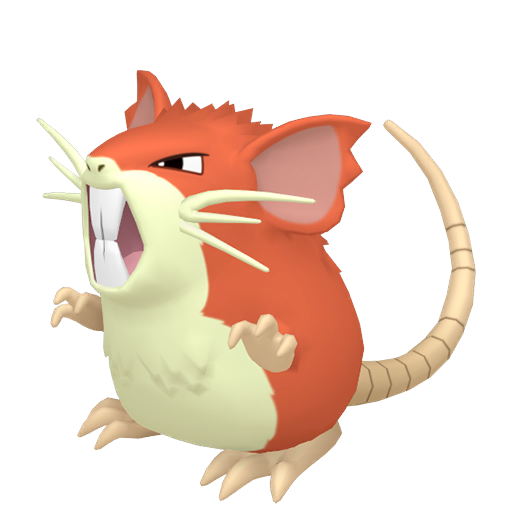
Raticate is a large, quadrupedal rodent Pokémon with a distinctly tawny coloration across its body, complemented by a cream-colored underside that provides visual contrast. The species is characterized by its most prominent features: large, constantly-growing incisors that serve as its primary offensive tools, and a set of three sensitive whiskers on each side of its face that function as crucial balance and sensory organs. According to multiple Pokédex entries, these whiskers are so vital to Raticate's equilibrium that the creature becomes noticeably slower if they are severed, highlighting the intricate connection between physical anatomy and behavioral capability. Raticate possesses narrow black eyes positioned for keen awareness, ears with distinctly ragged edges and dark interiors, short arms with three-fingered hands, and most notably, webbed hind feet with three toes that grant it surprising aquatic capability. Its long, scaly tail extends behind the body, providing additional balance and serving as a recognizable silhouette. The constant growth of its incisors necessitates continuous gnawing on hard materials like rocks, logs, and unfortunately, the wooden structures of human habitations, making it both a marvel of rodent biology and a potential household menace.
Pokedex Numbers
Training
Breeding
Raticate Breeding, Gender Ratio & Egg Groups
Raticate exhibits a perfectly balanced gender ratio with exactly 50 percent male and 50 percent female specimens occurring naturally in the population, ensuring equal breeding potential regardless of desired offspring gender. The species belongs to the Field Egg Group, the most common breeding classification among terrestrial and mammalian Pokémon, which grants it broad compatibility with numerous other Pokémon species for breeding purposes. Reproduction of Raticate requires 15 egg cycles to complete, translating to approximately 3,599 to 3,855 steps before a Rattata egg hatches, positioning the species as relatively quick to breed compared to legendary or pseudo-legendary Pokémon. The base happiness value of 70 indicates that Raticate individuals are moderately content creatures, though not inherently affectionate, suggesting that trainers must invest effort into building rapport with the species beyond simple capture. This moderate baseline happiness affects egg move availability and breeding efficiency, as Pokémon with higher friendship values breed more quickly. Female Raticate can be distinguished from males by their somewhat shorter whiskers, a subtle sexual dimorphism that provides visual identification without requiring detailed statistical examination, though this difference is marginal and not immediately obvious to casual observers.
Sprites




Held Items
Oran Berry
medicine
Held: Consumed at 1/2 max HP to recover 10 HP.
Cost: 80
Oran Berry
medicine
Held: Consumed at 1/2 max HP to recover 10 HP.
Cost: 80
Sitrus Berry
medicine
Held: Consumed at 1/2 max HP to recover 1/4 max HP.
Cost: 80
Sitrus Berry
medicine
Held: Consumed at 1/2 max HP to recover 1/4 max HP.
Cost: 80
Chilan Berry
type-protection
Held: Consumed when struck by a Normal-type attack to halve the damage.
Cost: 80
Chilan Berry
type-protection
Held: Consumed when struck by a Normal-type attack to halve the damage.
Cost: 80
Chilan Berry
type-protection
Held: Consumed when struck by a Normal-type attack to halve the damage.
Cost: 80
Chilan Berry
type-protection
Held: Consumed when struck by a Normal-type attack to halve the damage.
Cost: 80
Chilan Berry
type-protection
Held: Consumed when struck by a Normal-type attack to halve the damage.
Cost: 80
Chilan Berry
type-protection
Held: Consumed when struck by a Normal-type attack to halve the damage.
Cost: 80
Chilan Berry
type-protection
Held: Consumed when struck by a Normal-type attack to halve the damage.
Cost: 80
Oran Berry
medicine
Held: Consumed at 1/2 max HP to recover 10 HP.
Cost: 80
Oran Berry
medicine
Held: Consumed at 1/2 max HP to recover 10 HP.
Cost: 80
Sitrus Berry
medicine
Held: Consumed at 1/2 max HP to recover 1/4 max HP.
Cost: 80
Sitrus Berry
medicine
Held: Consumed at 1/2 max HP to recover 1/4 max HP.
Cost: 80
Chilan Berry
type-protection
Held: Consumed when struck by a Normal-type attack to halve the damage.
Cost: 80
Chilan Berry
type-protection
Held: Consumed when struck by a Normal-type attack to halve the damage.
Cost: 80
Chilan Berry
type-protection
Held: Consumed when struck by a Normal-type attack to halve the damage.
Cost: 80
Chilan Berry
type-protection
Held: Consumed when struck by a Normal-type attack to halve the damage.
Cost: 80
Chilan Berry
type-protection
Held: Consumed when struck by a Normal-type attack to halve the damage.
Cost: 80
Chilan Berry
type-protection
Held: Consumed when struck by a Normal-type attack to halve the damage.
Cost: 80
Chilan Berry
type-protection
Held: Consumed when struck by a Normal-type attack to halve the damage.
Cost: 80
TMs & HMs
tm01
lets go pikachu lets go eevee
tm01
ultra sun ultra moon
tm01
sun moon
tm02
crystal
tm02
gold silver
tm02
lets go pikachu lets go eevee
tm03
yellow
tm03
crystal
tm03
gold silver
tm03
red blue
tm03
blue japan
tm03
red green japan
tm05
ruby sapphire
tm05
emerald
tm05
gold silver
tm05
crystal
tm05
diamond pearl
tm05
black white
tm05
platinum
tm05
heartgold soulsilver
+747 more TMs/HMs
Regional & Special Forms
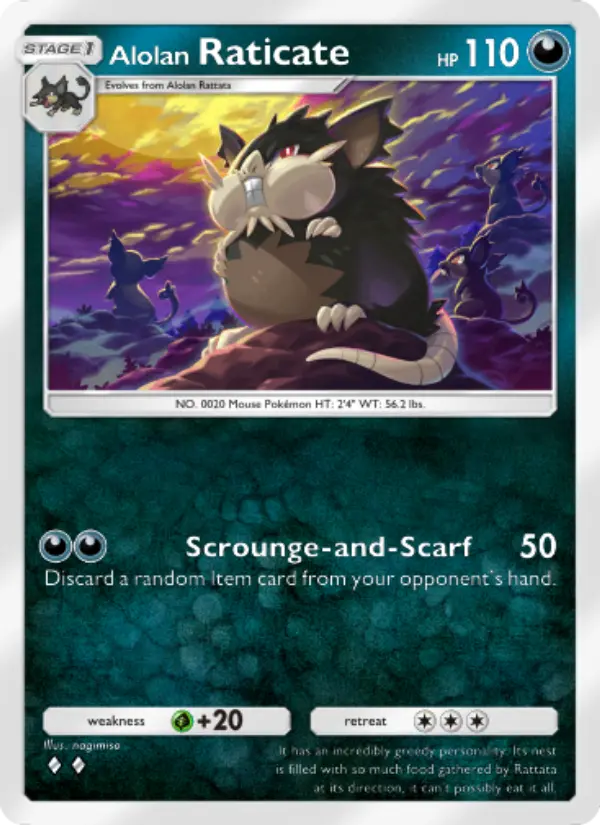
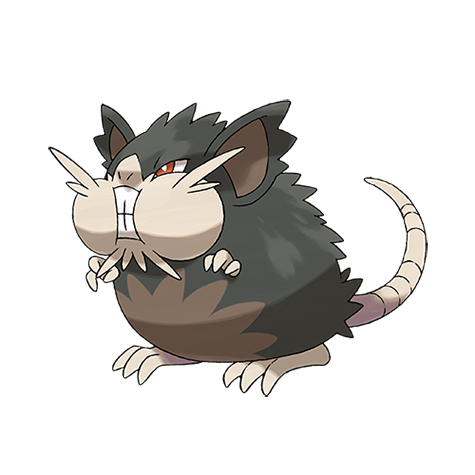
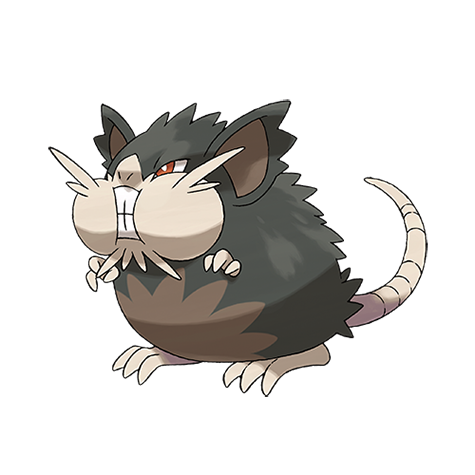
Raticate also has 2 related forms: Alolan Raticate and Totem Alolan Raticate.
Gender Differences
This Pokémon has visible differences between male and female forms.
Raticate's Evolution Chain


Raticate Evolution, Mega Evolution & Special Forms
Raticate evolves from Rattata at level 20, representing a straightforward evolution without branching paths or special conditions in the standard form. This evolution is purely mechanical in nature, triggered by gaining sufficient experience rather than items, specific stats, or environmental factors. The evolution process sees Rattata transform into a more robust, combat-capable creature, with notable increases to its Attack stat (from 56 to 81) and Speed stat (from 72 to 97), while other statistics experience more modest increases. The Alolan regional variant of Raticate follows a divergent evolutionary path, requiring that the creature be an Alolan Rattata and specifically evolve during nighttime conditions at level 20, adding an environmental element absent from the standard form's evolution. This nighttime requirement reflects the Alolan Raticate's Dark-type secondary typing and represents the species' darker, more nocturnal behavioral tendencies in that region. Unlike many later-generation Pokémon, neither the standard Raticate nor its Alolan form can Mega Evolve, though the Alolan form's adjusted stat distribution (75 HP, 71 Attack, 70 Defense, 40 Special Attack, 80 Special Defense, 77 Speed) reflects a more defensive and specially resilient approach compared to the speedy, physically offensive standard form.
Where to Find
Kanto Route 18
kanto
+13 more
Kanto Sea Route 21
kanto
+7 more
Kanto Route 17
kanto
+17 more
Kanto Route 16
kanto
+13 more
Pokemon Mansion
kanto
+31 more
Kanto Route 9
kanto
+37 more
Kanto Route 11
kanto
+3 more
Kanto Route 10
kanto
+23 more
Kanto Route 7
kanto
+11 more
Kanto Route 27
kanto
+17 more
Kanto Route 26
kanto
+28 more
Union Cave
johto
+6 more
Tohjo Falls
johto
+4 more
Burned Tower
johto
+7 more
Johto Route 38
johto
+12 more
Johto Route 39
johto
+10 more
Mt Mortar
johto
+29 more
Kanto Route 4
kanto
+4 more
Kanto Route 6
kanto
+1 more
Johto Route 42
johto
+12 more locations in other games
Raticate Behaviour and Natural Habitat
Raticate demonstrates a disposition considerably more aggressive and volatile than its diminutive size might suggest, with Pokédex entries cautioning trainers against allowing their hands to approach the creature's face, as it possesses the capacity to bite clean through flesh with startling ferocity. The species' webbed hind feet enable it to function as a capable swimmer, allowing it to hunt for prey in rivers and navigate aquatic environments with surprising proficiency. This aquatic adaptation is particularly pronounced in the Alola region, where historical accounts indicate that Raticate populations utilized their swimming abilities to traverse from island to island, effectively island-hopping to escape predators and establish new territories. Beyond its aggressive nature, Raticate maintains a pragmatic survival instinct, particularly evident through its signature ability Run Away, which ensures successful escape from wild battles when the creature determines retreat is the optimal strategy. The species inhabits environments ranging from urban settlements to natural waterways, where its omnivorous appetite and opportunistic feeding habits allow it to exploit whatever food sources are available, whether through active hunting or scavenging.
Pokedex Entries
It uses its whis kers to maintain its balance. It apparently slows down if they are cut off.
Its hind feet are webbed. They act as flippers, so it can swim in rivers and hunt for prey.
Gnaws on anything with its tough fangs. It can even topple concrete buildings by gnaw ing on them.
Its whiskers help it to maintain balance. Its fangs never stop grow ing, so it gnaws to pare them down.
The webs on its hind legs enable it to cross rivers. It search es wide areas for food.
RATICATE’s sturdy fangs grow steadily. To keep them ground down, it gnaws on rocks and logs. It may even chew on the walls of houses.
A RATICATE’s sturdy fangs grow steadily. To keep them ground down, it gnaws on rocks and logs. It may even chew on the walls of houses.
Its rear feet have three toes each. They are webbed, enabling it to swim across rivers.
It uses its whiskers to maintain its balance. It apparently slows down if they are cut off.
It whittles its constantly growing fangs by gnawing on hard things. It can chew apart cinder walls.
Gnaws on anything with its tough fangs. It can even topple concrete buildings by gnawing on them.
Its whiskers help it to maintain balance. Its fangs never stop growing, so it gnaws to pare them down.
It whittles its constantly growing fangs by gnawing on hard things. It can chew apart cinder walls.
With its long fangs, this surprisingly violent Pokémon can gnaw away even thick concrete with ease.
It whittles its constantly growing fangs by gnawing on hard things. It can chew apart cinder walls.
The webs on its hind legs enable it to cross rivers. It searches wide areas for food.
Raticate’s sturdy fangs grow steadily. To keep them ground down, it gnaws on rocks and logs. It may even chew on the walls of houses.
Raticate’s sturdy fangs grow steadily. To keep them ground down, it gnaws on rocks and logs. It may even chew on the walls of houses.
Its hind feet are webbed, so it’s a strong swimmer. It can cross rivers and sometimes even oceans.
People say that it fled from its enemies by using its small webbed hind feet to swim from island to island in Alola.
Its disposition is far more violent than its looks would suggest. Don’t let your hand get too close to its face, as it could bite your hand clean off.
Its whiskers are essential for maintaining its balance. No matter how friendly you are, it will get angry and bite you if you touch its whiskers.
Its hind feet are webbed. They act as flippers, so it can swim in rivers and hunt for prey.
Raticate Name Origin & Design Inspiration
Raticate's design draws heavily from real-world rat biology, particularly the urban rat and brown rat species that have become synonymous with rodent pests in human civilization. The design emphasizes the distinctive characteristics that make rats simultaneously feared and fascinating: the prominent front incisors that continue growing throughout the creature's life, the sensitive whiskers used for navigation and sensory input, and the webbed feet that hint at aquatic capability. The name 'Raticate' appears to be a straightforward portmanteau of 'rat' and the Latin suffix '-icate,' which denotes a state or condition, effectively translating to 'rat-like' or 'very much a rat.' In Japanese, the species is called Ratta, an even more direct reference to its rodent nature. The design philosophy emphasizes practicality over stylization—Raticate appears as a legitimate evolutionary improvement upon Rattata, with more robust proportions, sharper features, and an overall impression of predatory competence. The Alolan form, conversely, incorporates darker coloration and a stockier build, with design elements reflecting adaptation to a tropical island environment where Raticate became an apex predator among rodent-type Pokémon, abandoning its scavenging generalist lifestyle for a more specialized, nocturnal hunter existence.
Learnable Moves
Raticate can learn 82 moves:
Move | Type | Cat. | Power | Acc. | PP |
|---|---|---|---|---|---|
| assurance | dark | Physical | 60 | 100 | 10 |
| attract | normal | Status | — | 100 | 15 |
| bide | normal | Physical | — | — | 10 |
| bite | dark | Physical | 60 | 100 | 25 |
| blizzard | ice | Special | 110 | 70 | 5 |
| body slam | normal | Physical | 85 | 100 | 15 |
| bubble beam | water | Special | 65 | 100 | 20 |
| captivate | normal | Status | — | 100 | 20 |
| charge beam | electric | Special | 50 | 90 | 10 |
| confide | normal | Status | — | — | 20 |
| counter | fighting | Physical | — | 100 | 20 |
| covet | normal | Physical | 60 | 100 | 25 |
| crunch | dark | Physical | 80 | 100 | 15 |
| curse | ghost | Status | — | — | 10 |
| cut | normal | Physical | 50 | 95 | 30 |
| defense curl | normal | Status | — | — | 40 |
| dig | ground | Physical | 80 | 100 | 10 |
| double team | normal | Status | — | — | 15 |
| double edge | normal | Physical | 120 | 100 | 15 |
| endeavor | normal | Physical | — | 100 | 5 |
| endure | normal | Status | — | — | 10 |
| facade | normal | Physical | 70 | 100 | 20 |
| focus energy | normal | Status | — | — | 30 |
| frustration | normal | Physical | — | 100 | 20 |
| fury swipes | normal | Physical | 18 | 80 | 15 |
| giga impact | normal | Physical | 150 | 90 | 5 |
| grass knot | grass | Special | — | 100 | 20 |
| headbutt | normal | Physical | 70 | 100 | 15 |
| hidden power | normal | Special | 60 | 100 | 15 |
| hyper beam | normal | Special | 150 | 90 | 5 |
| hyper fang | normal | Physical | 80 | 90 | 15 |
| ice beam | ice | Special | 90 | 100 | 10 |
| icy wind | ice | Special | 55 | 95 | 15 |
| iron tail | steel | Physical | 100 | 75 | 15 |
| laser focus | normal | Status | — | — | 30 |
| last resort | normal | Physical | 140 | 100 | 5 |
| mimic | normal | Status | — | — | 10 |
| mud slap | ground | Special | 20 | 100 | 10 |
| natural gift | normal | Physical | — | 100 | 15 |
| pluck | flying | Physical | 60 | 100 | 20 |
| protect | normal | Status | — | — | 10 |
| pursuit | dark | Physical | 40 | 100 | 20 |
| quick attack | normal | Physical | 40 | 100 | 30 |
| rage | normal | Physical | 20 | 100 | 20 |
| rain dance | water | Status | — | — | 5 |
| rest | psychic | Status | — | — | 5 |
| return | normal | Physical | — | 100 | 20 |
| roar | normal | Status | — | — | 20 |
| rock smash | fighting | Physical | 40 | 100 | 15 |
| scary face | normal | Status | — | 100 | 10 |
| secret power | normal | Physical | 70 | 100 | 20 |
| shadow ball | ghost | Special | 80 | 100 | 15 |
| shock wave | electric | Special | 60 | — | 20 |
| skull bash | normal | Physical | 130 | 100 | 10 |
| sleep talk | normal | Status | — | — | 10 |
| sludge bomb | poison | Special | 90 | 100 | 10 |
| snore | normal | Special | 50 | 100 | 15 |
| stomping tantrum | ground | Physical | 75 | 100 | 10 |
| strength | normal | Physical | 80 | 100 | 15 |
| substitute | normal | Status | — | — | 10 |
| sucker punch | dark | Physical | 70 | 100 | 5 |
| sunny day | fire | Status | — | — | 5 |
| super fang | normal | Physical | — | 90 | 10 |
| swagger | normal | Status | — | 85 | 15 |
| swift | normal | Special | 60 | — | 20 |
| swords dance | normal | Status | — | — | 20 |
| tackle | normal | Physical | 40 | 100 | 35 |
| tail whip | normal | Status | — | 100 | 30 |
| take down | normal | Physical | 90 | 85 | 20 |
| taunt | dark | Status | — | 100 | 20 |
| thief | dark | Physical | 60 | 100 | 25 |
| throat chop | dark | Physical | 80 | 100 | 15 |
| thunder | electric | Special | 110 | 70 | 10 |
| thunder wave | electric | Status | — | 90 | 20 |
| thunderbolt | electric | Special | 90 | 100 | 15 |
| toxic | poison | Status | — | 90 | 10 |
| u turn | bug | Physical | 70 | 100 | 20 |
| uproar | normal | Special | 90 | 100 | 10 |
| water gun | water | Special | 40 | 100 | 25 |
| wild charge | electric | Physical | 90 | 100 | 15 |
| work up | normal | Status | — | — | 30 |
| zen headbutt | psychic | Physical | 80 | 90 | 15 |
Raticate Competitive Battle Guide
Raticate occupies a surprisingly viable niche in competitive battling despite its modest combined stat total of 413, primarily through its exceptional 97 base Speed, which places it in the upper echelon of naturally fast Pokémon without requiring Speed-boosting natures or investment. Its 81 base Attack, while respectable rather than exceptional, combines effectively with its access to priority moves and broad physical move pool to deliver consistent offensive pressure. The species' three ability options provide distinct competitive advantages: Run Away enables risk-free scouting and switching in lower-tier formats, Guts transforms status conditions into offensive boons through 1.5× Attack multiplication, and the hidden ability Hustle increases physical move damage to 1.5× at the cost of reduced accuracy to 0.8×. This Hustle variant creates an interesting skill-based strategy where players must manage accuracy-versus-power tradeoffs, particularly with moves like Close Combat and Earthquake that already possess excellent coverage. Raticate's moderate defenses (60 Defense, 70 Special Defense) mean it functions as a fragile sweeper that must prioritize speed and offensive output rather than sustained tanking, making Choice Scarf builds and Life Orb configurations popular choices. The Alolan variant, with its Dark typing and different ability distribution including Gluttony and hidden ability Thick Fat, pursues a somewhat different competitive angle, gaining immunity to Ghost-type moves and resistance to Dark-type attacks while sacrificing the exceptional Speed of its standard form in exchange for improved bulk.
Commonly Asked Questions About Raticate
What type is Raticate?
Raticate is a normal type Pokemon.
What does Raticate evolve from?
Raticate evolved from rattata.
What are Raticate's weaknesses?
Raticate is weak to fighting type moves.
Where can I find Raticate?
Raticate can be found in kanto route 18 (kanto), kanto sea route 21 (kanto) and kanto route 17 (kanto) and 29 other locations.
Raticate Cultural Impact & Franchise History
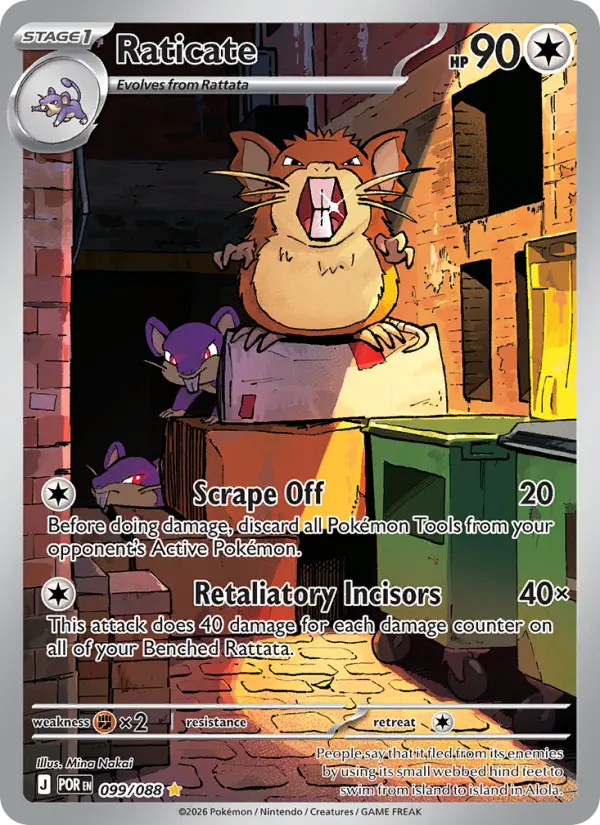
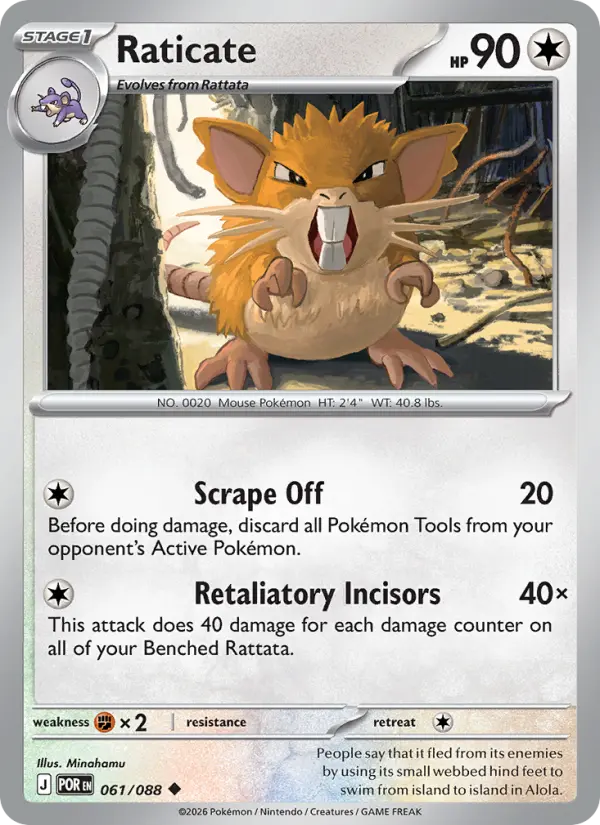
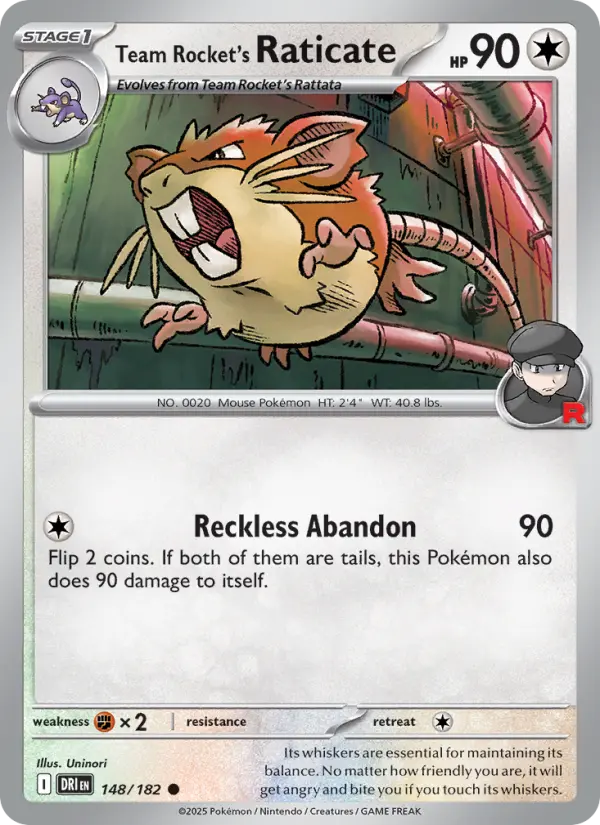
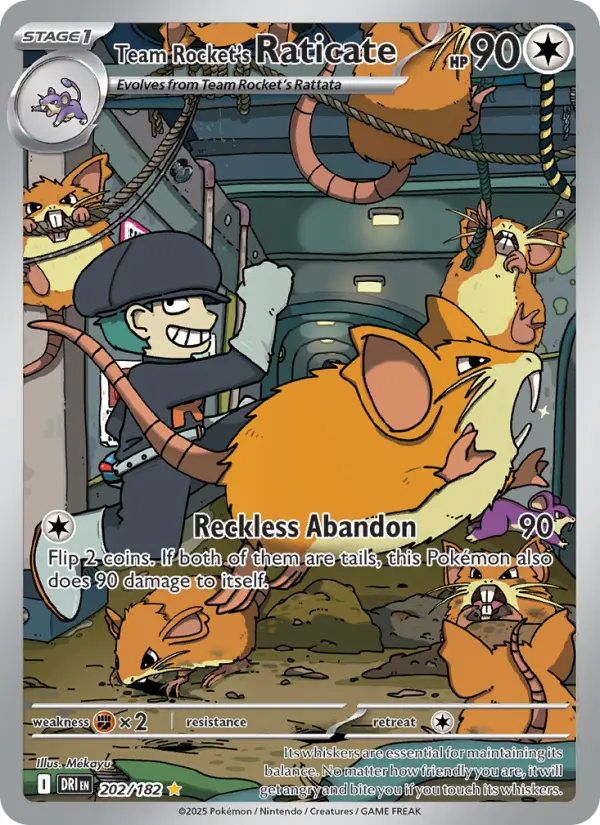
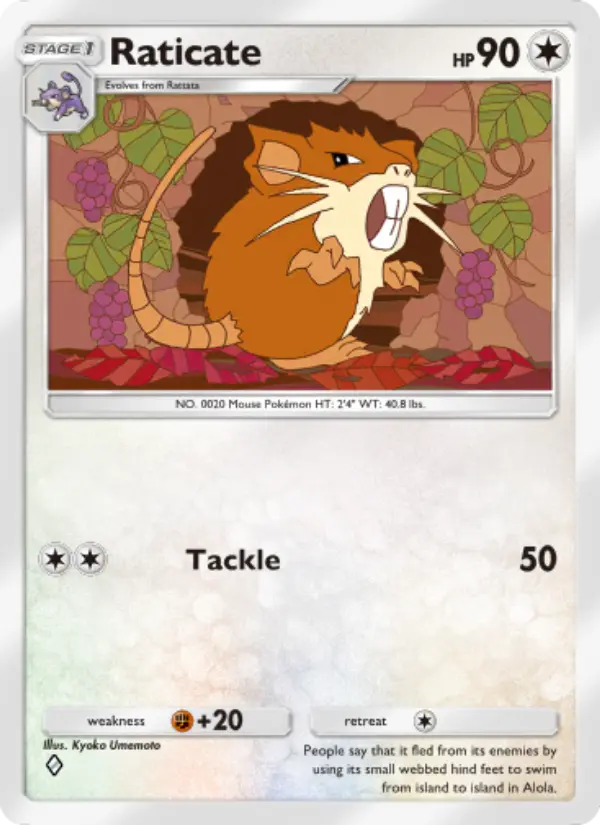
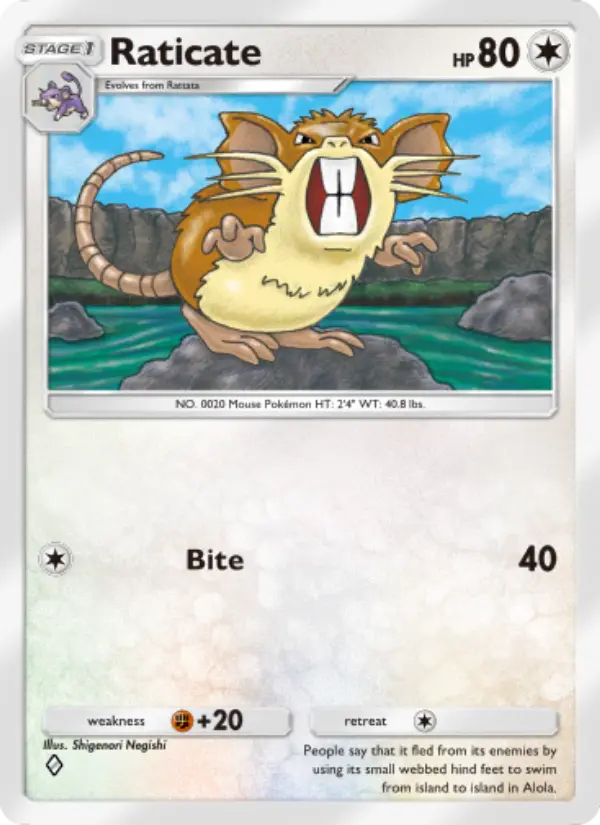
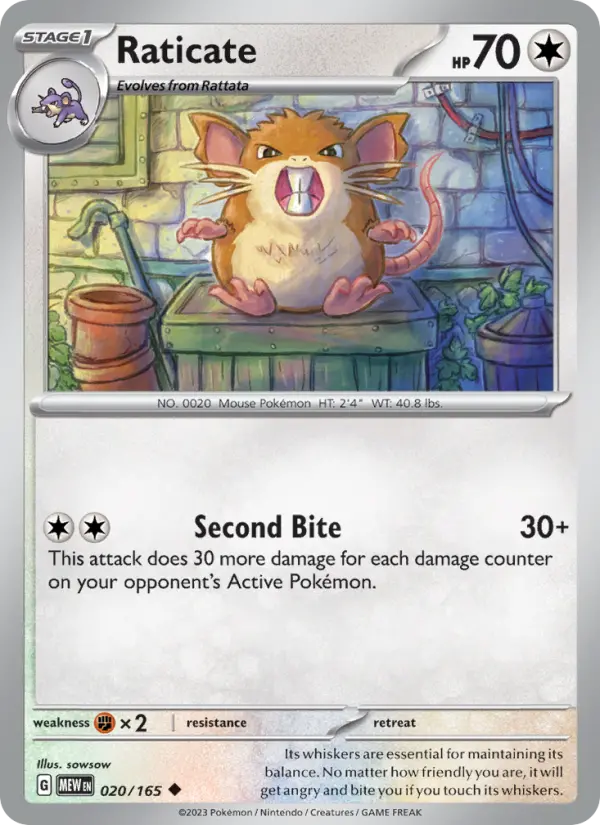
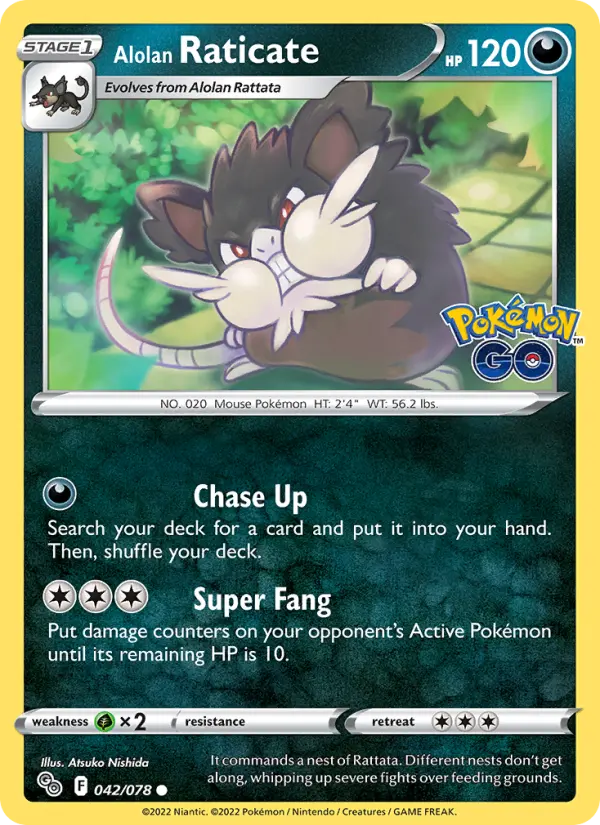
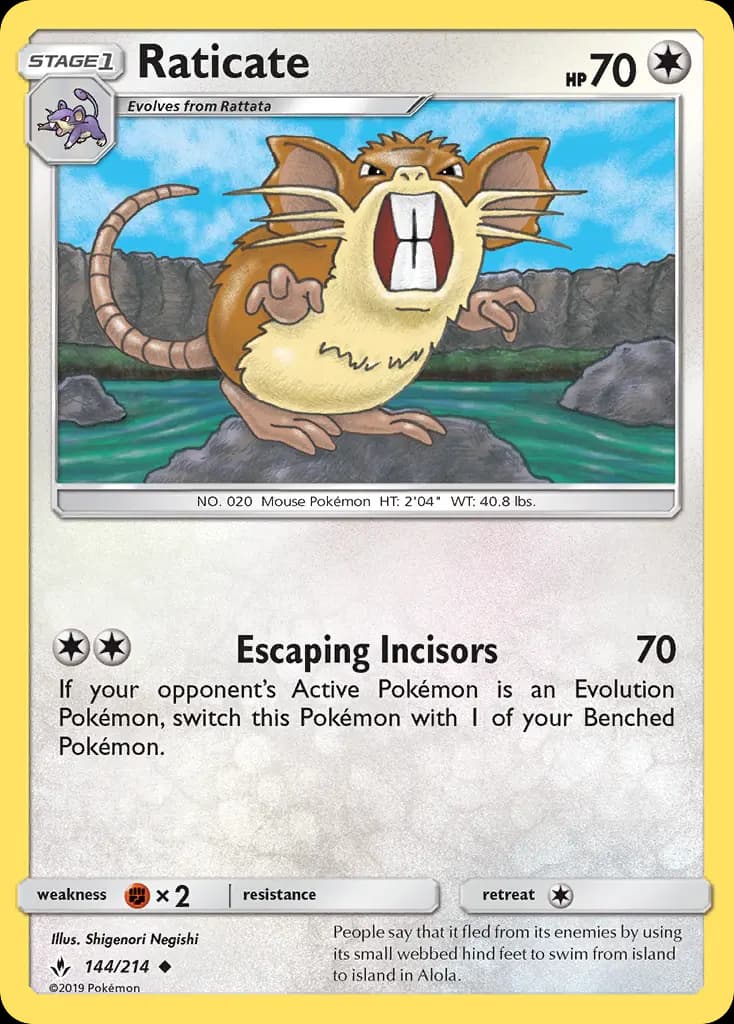
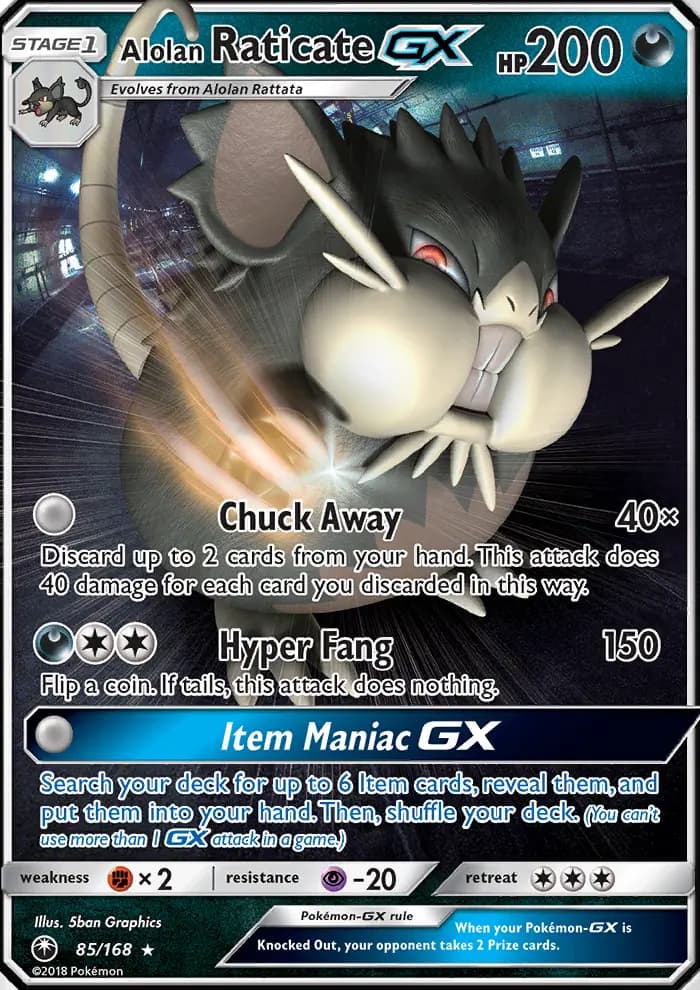
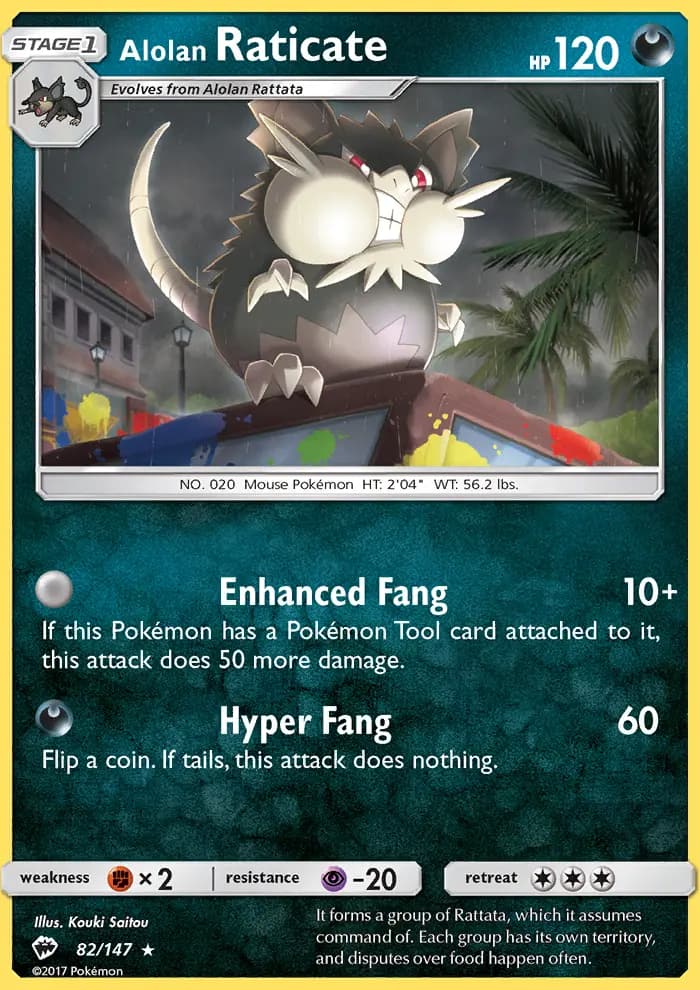
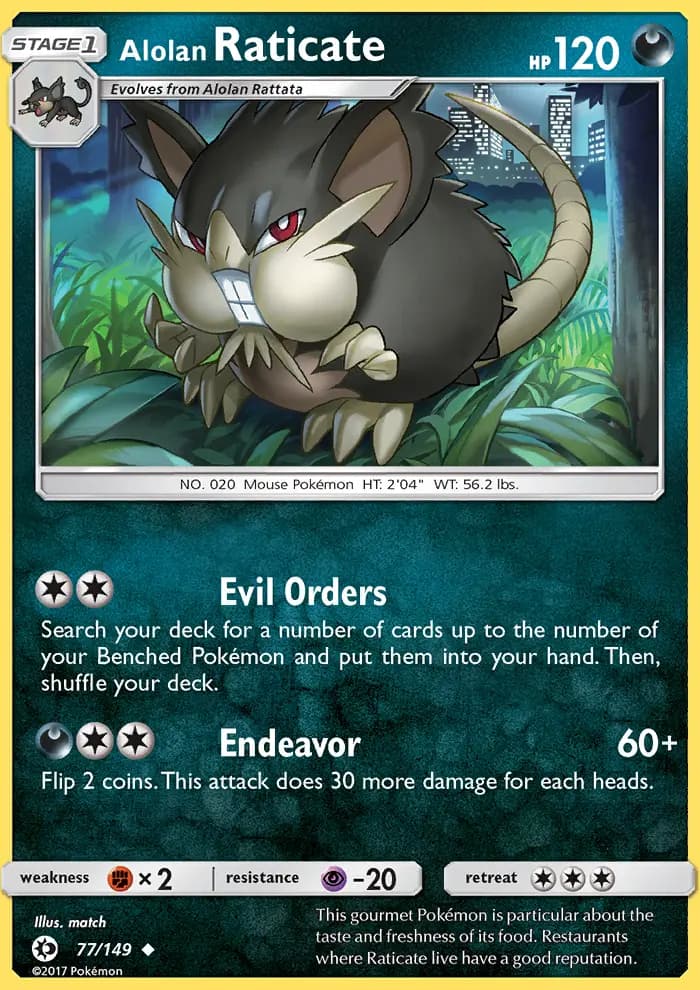
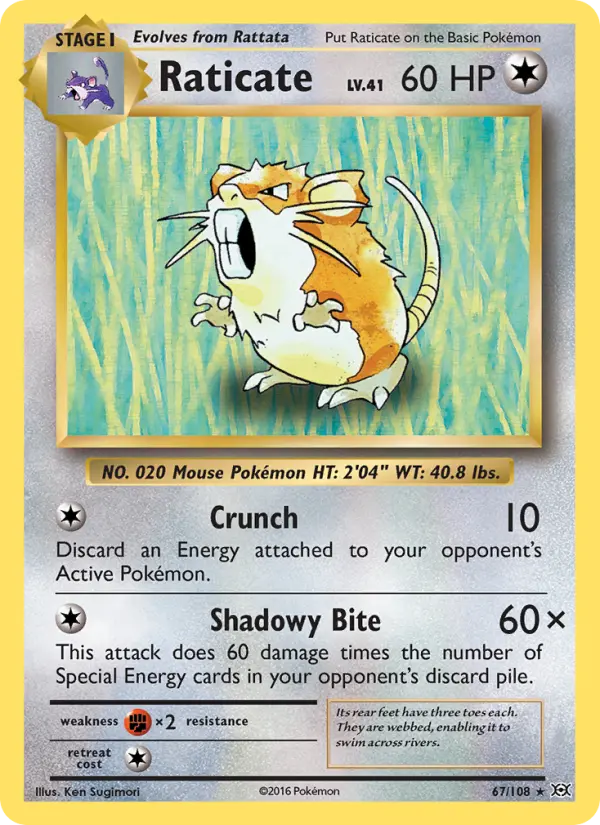
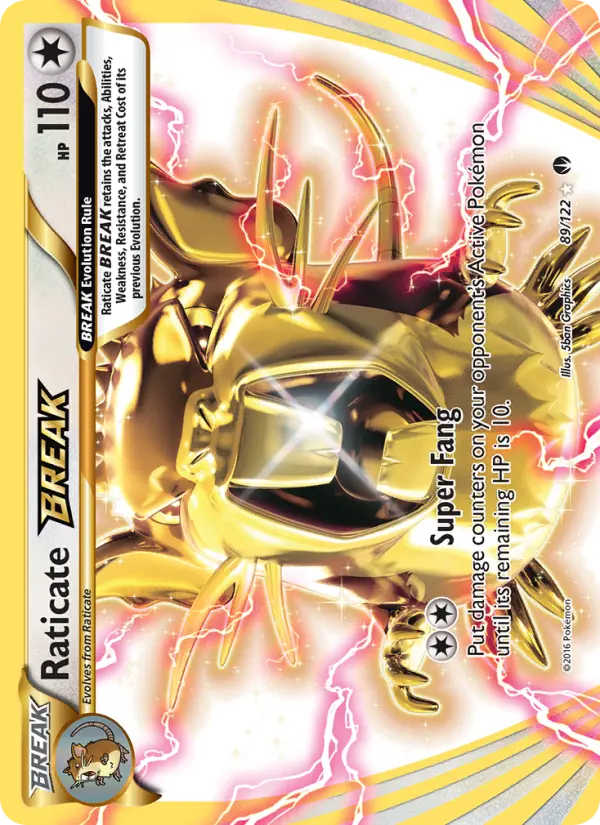
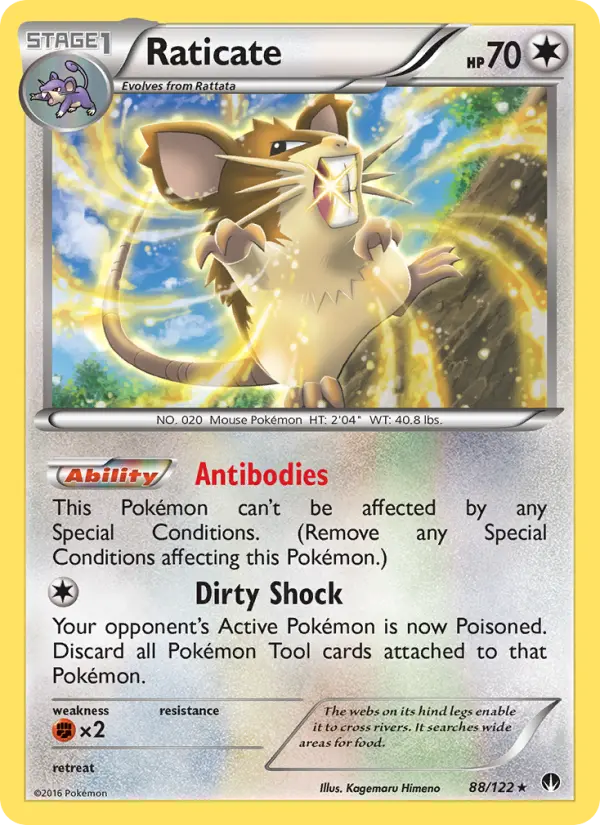
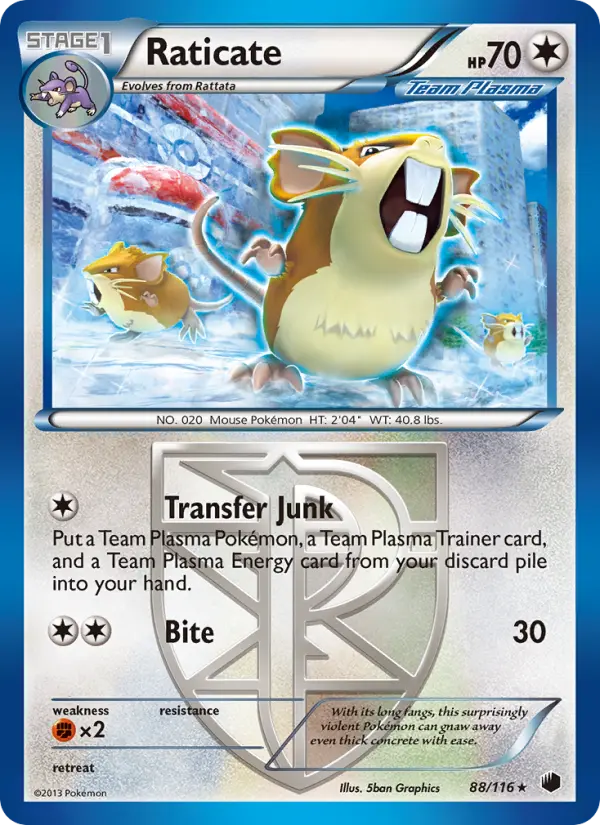
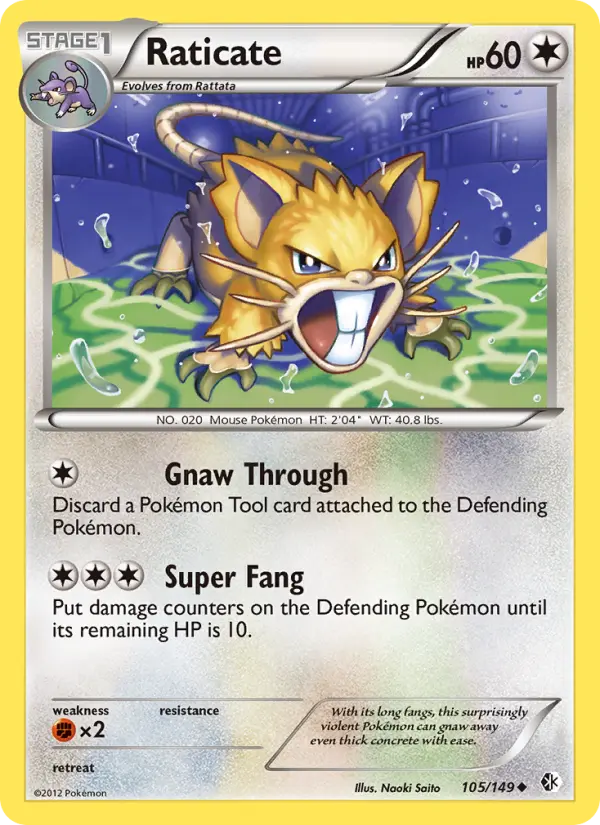
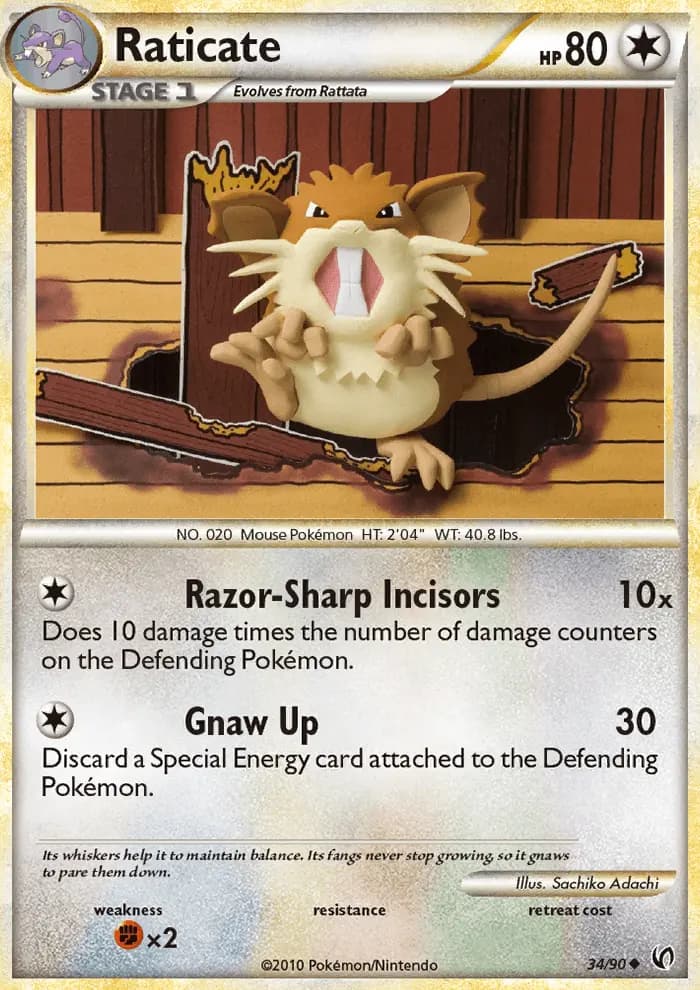
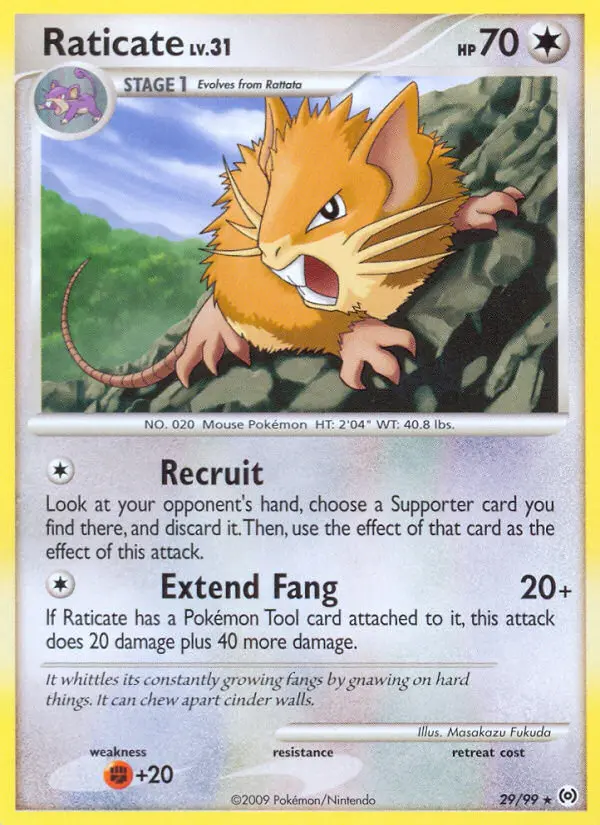
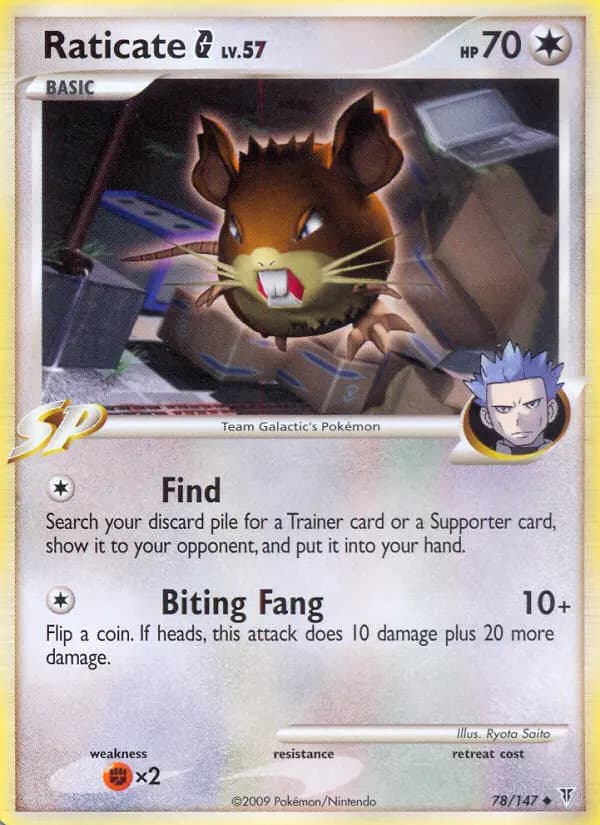
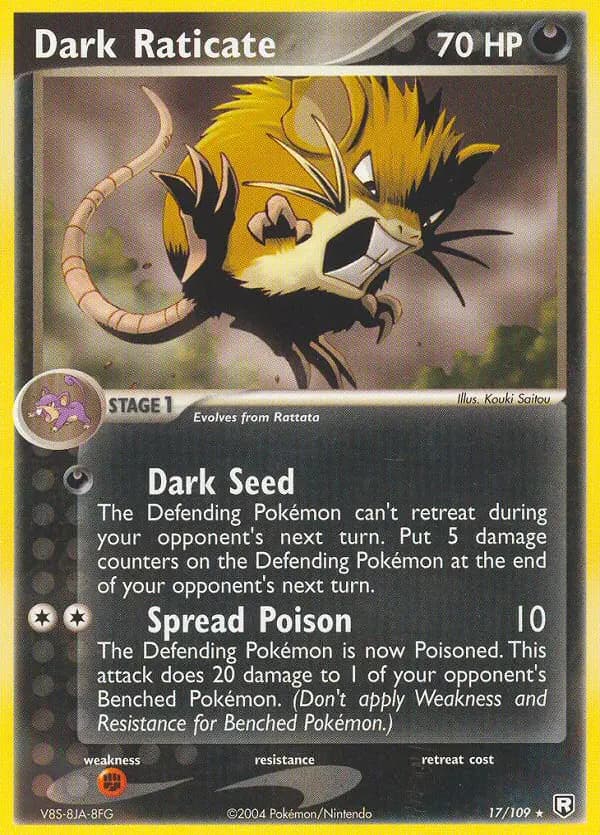
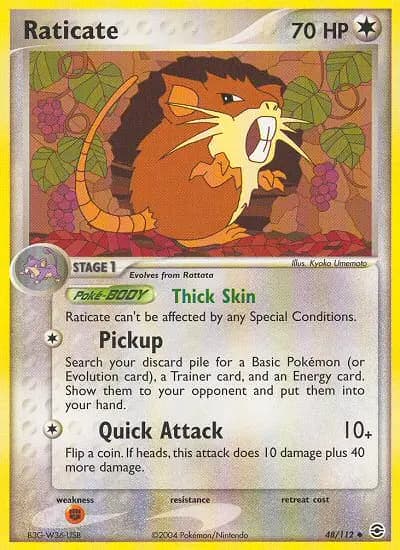
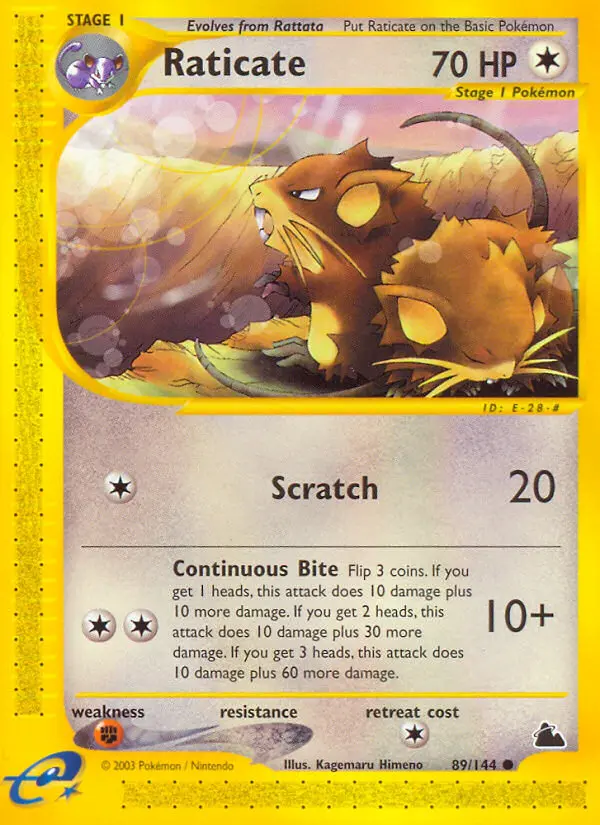
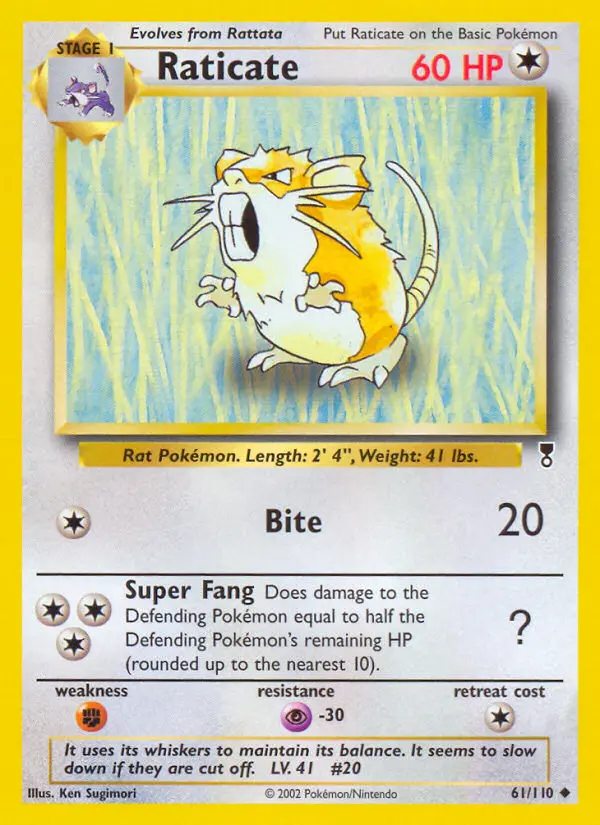
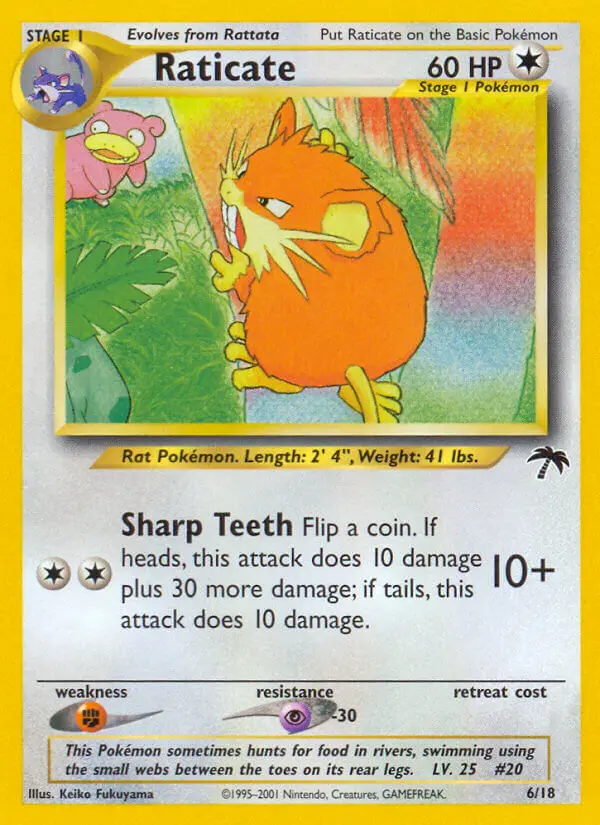
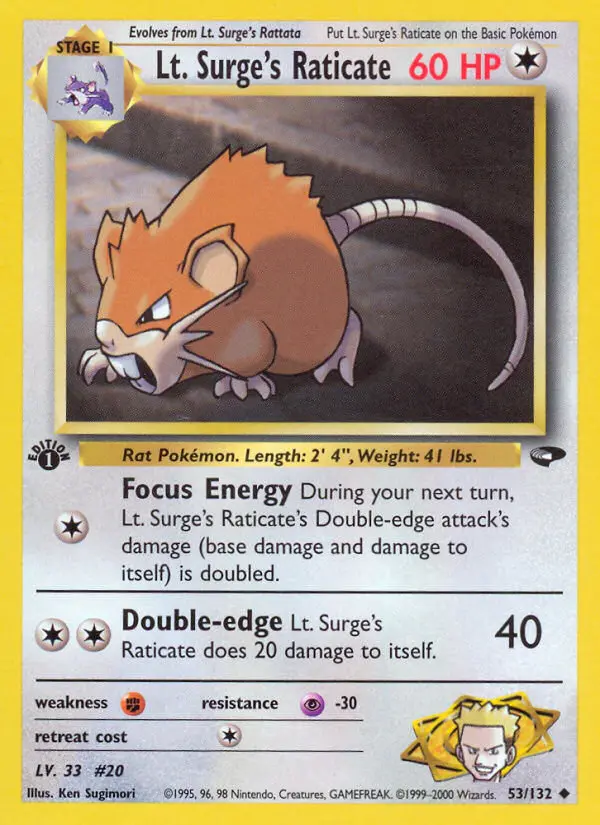
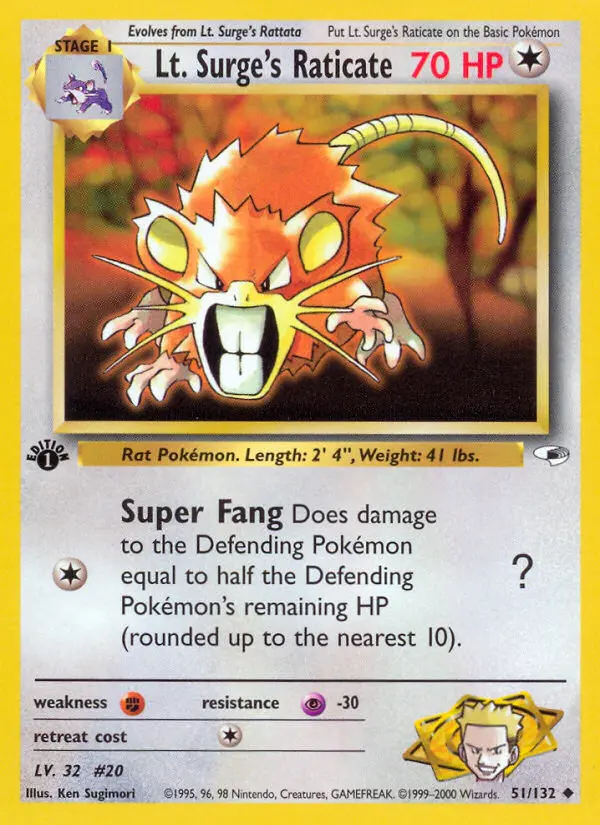
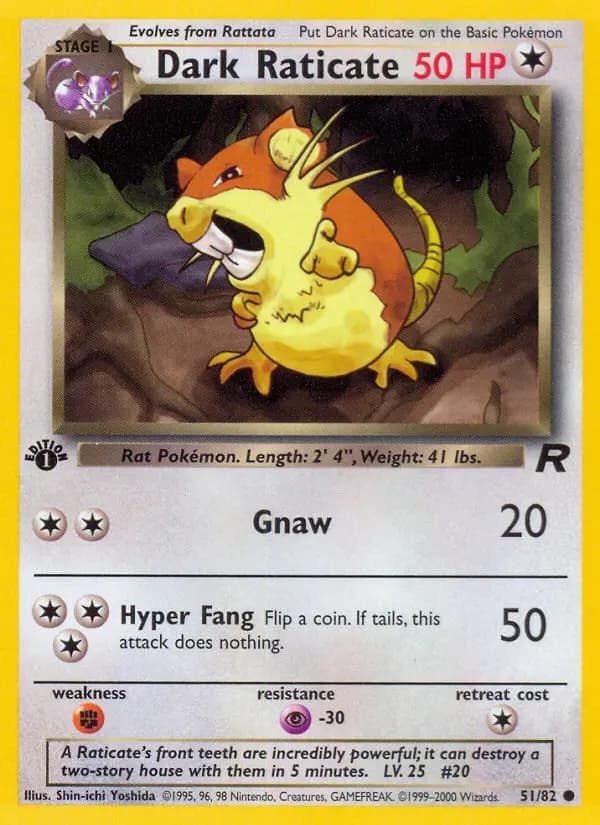
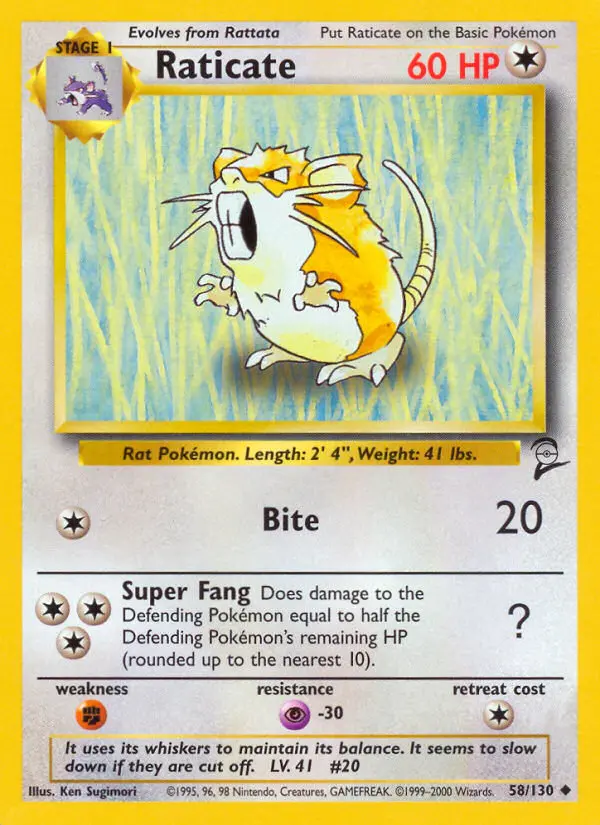
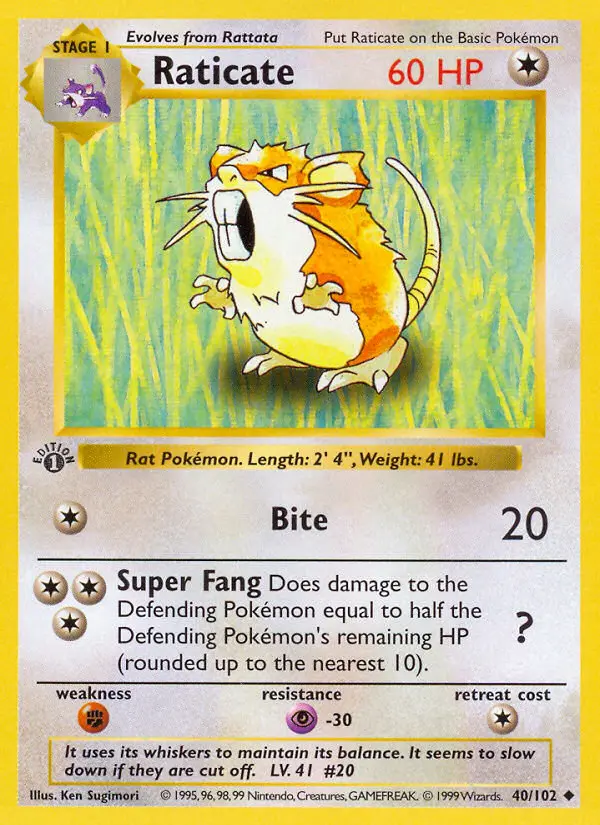
Raticate has maintained consistent presence within Pokémon media since the franchise's inception, appearing extensively in the animated series as both a common wild encounter and featured Pokémon in trainer teams. The creature's association with the early game and its practical accessibility have made it a staple in casual player teams, establishing it as one of the earliest memorable evolutions that players experience during their initial journey through the Kanto region. In the Pokémon Trading Card Game, Raticate has received multiple card iterations across different eras, sometimes receiving competitive support and alternative artwork that highlights its rodent characteristics and aggressive nature. The species represents a specific design philosophy within Pokémon that celebrates the mundane and practical aspects of monster capturing—Raticate is neither mythical nor legendary, neither particularly rare nor exceptionally powerful, yet it remains compelling through its straightforward competence and pragmatic design. Its Alolan form gained particular cultural significance when introduced in Generation VII, representing the first major regional variant of an early-game rodent and demonstrating that even foundational Pokémon species could receive innovative redesigns that maintained core identity while exploring radical type and behavioral changes. Within competitive communities, Raticate occasionally emerges as a surprise viable option, generating discussion about underrated Pokémon and demonstrating that tournament success doesn't require the most imposing stat totals.
Where to Find Raticate in Every Pokémon Game
Raticate's availability varies significantly across the mainline Pokémon games, reflecting its status as an early-game encounter species that features prominently in the original Kanto games but becomes increasingly marginal in later generations. In Pokémon Red, Blue, and Yellow, Raticate appears relatively early as an evolution of commonly encountered Rattata, positioning it as an accessible addition to beginner trainers' teams in the opening routes of Kanto. Across subsequent generations, the species typically appears in areas corresponding to earlier game segments or through specific encounter methods, though some generations omit it entirely from the regional Pokédex until post-game content becomes available. Pokémon Let's Go Pikachu and Eevee restore Raticate to prominence as a Kanto-region native with reasonable availability, allowing players to obtain evolved Raticate through relatively straightforward gameplay. The Alolan variant became available with Pokémon Sun and Moon, appearing in the Alola region Pokédex as a native species that trainers could encounter and catch during their adventure, though specific encounter locations vary between day and night due to the species' nocturnal inclinations. Throughout all generations where it appears, Raticate maintains a base catch rate of 127, classified as relatively easy to capture, making it an excellent choice for players seeking to expand their team without excessive grinding. The species' presence in mystery gifts, special distributions, and competitive rental teams further expands its availability beyond traditional wild encounters, ensuring that motivated players can obtain Raticate regardless of which game version they possess.