Starly
Generation IV · #0396 — Starling Pokémon
Among normal/flying-type Pokémon, Starly stands out for a stat line that pushes hardest into hp. Standing 0.3 m tall and weighing 2.0 kg, it's built around a distinct combination of normal traits that shapes how it performs both in the wild and in battle. Despite its diminutive stature—standing just 0.3 meters tall and weighing a mere 2.0 kilograms—Starly possesses a surprising amount of strength and determination. With a overall stat sum of 245, it demonstrates balanced growth potential, though it requires careful training and leveling to reach its full potential. Starly's most distinctive trait is its incredible work ethic and gregarious nature, as it forms large flocks with other members of its species to overcome individual weaknesses through collective strength.
Editor's Take
Starly's line ends in Staraptor with Reckless-boosted Brave Bird, and it is the first regional bird that was genuinely a top-tier choice rather than an early-game placeholder.
Base Stats
Height
0.3m
Weight
2.0kg
Category
Starling Pokémon
Gender
Male 50% / Female 50%
Color
brown
Shape
wings
Abilities
Prevents accuracy from being lowered.
Strengthens recoil moves to 1.2× their power.

Starly Biology & Physical Characteristics
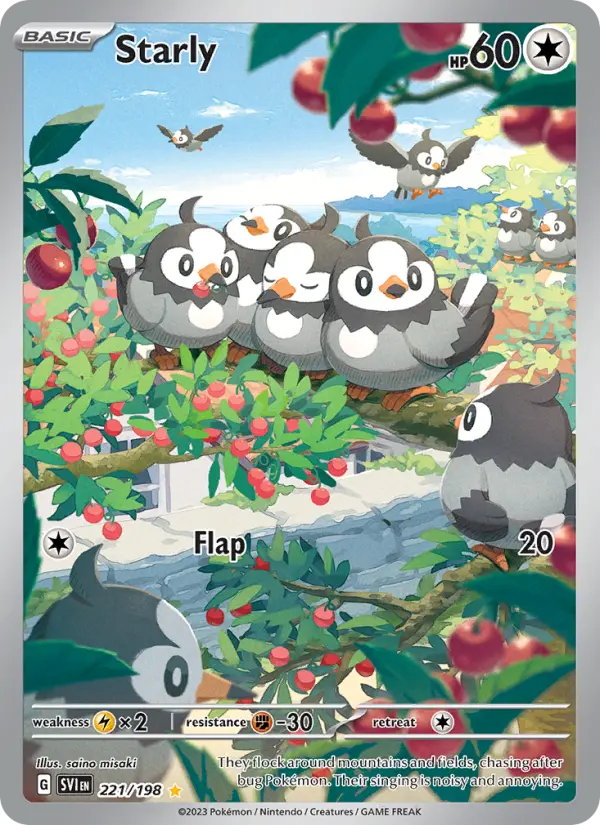
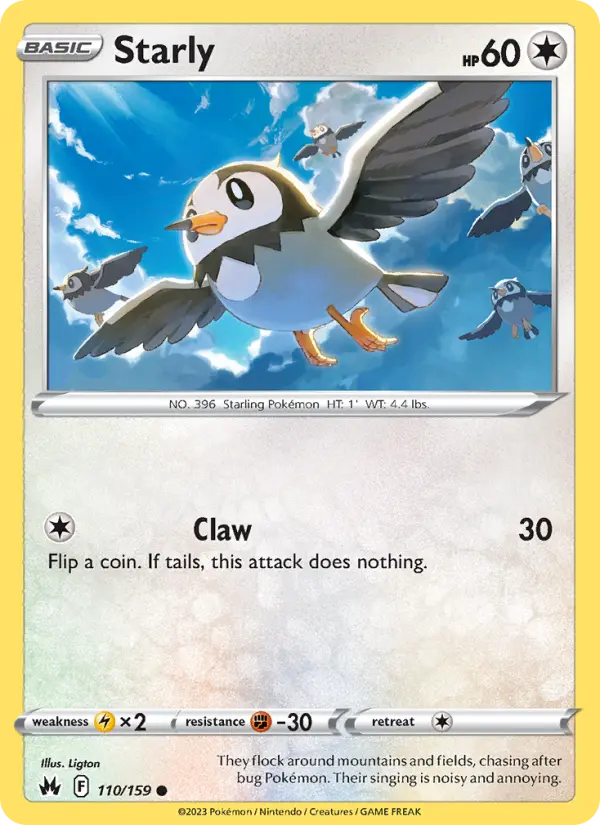
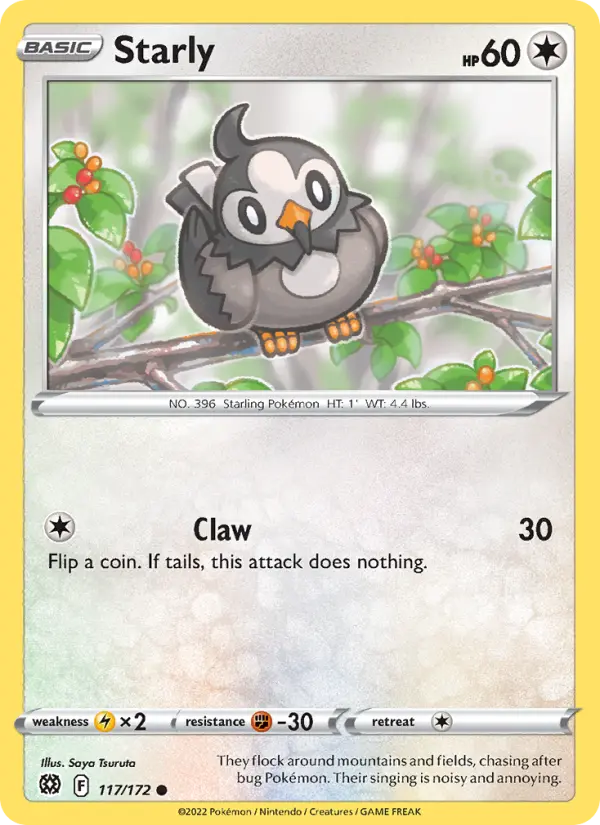
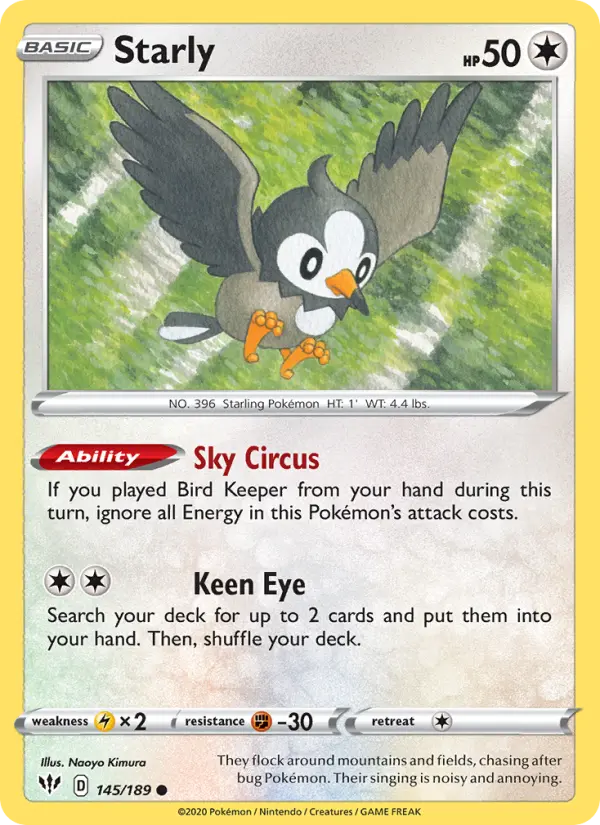
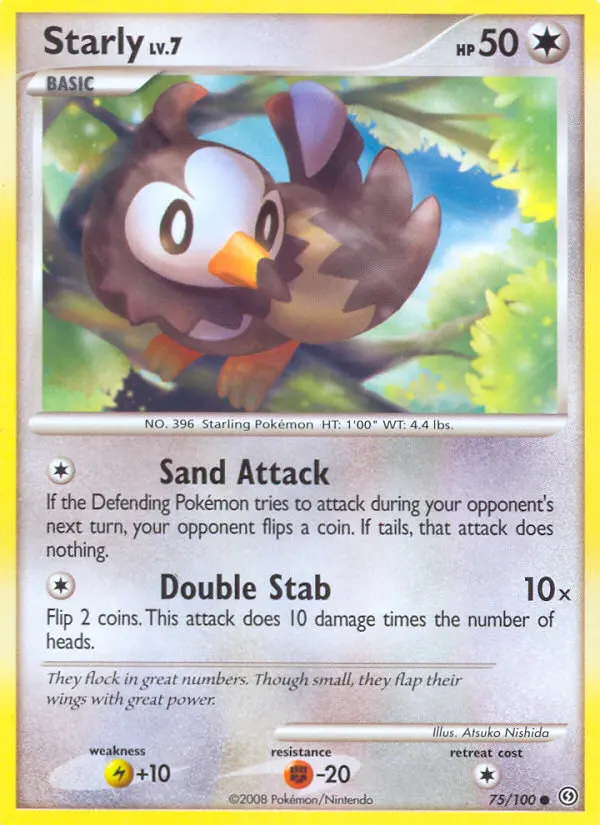
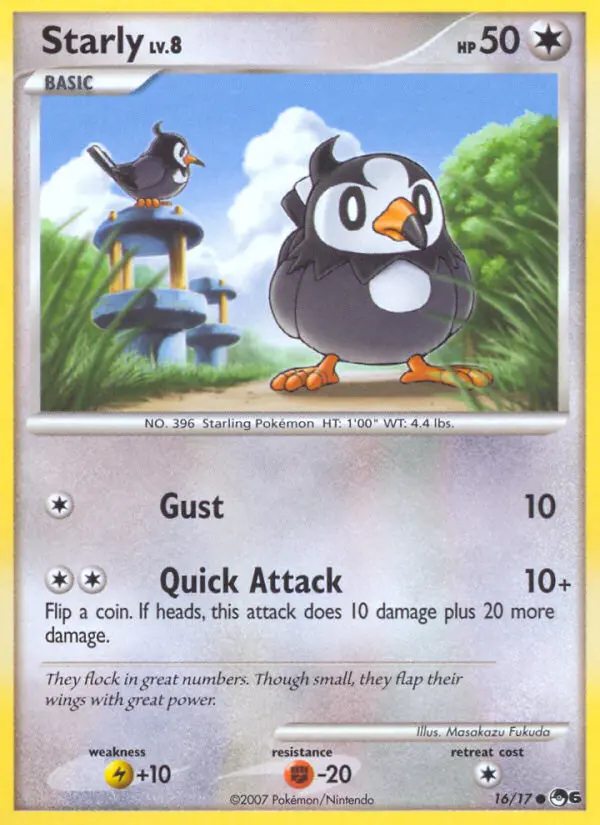
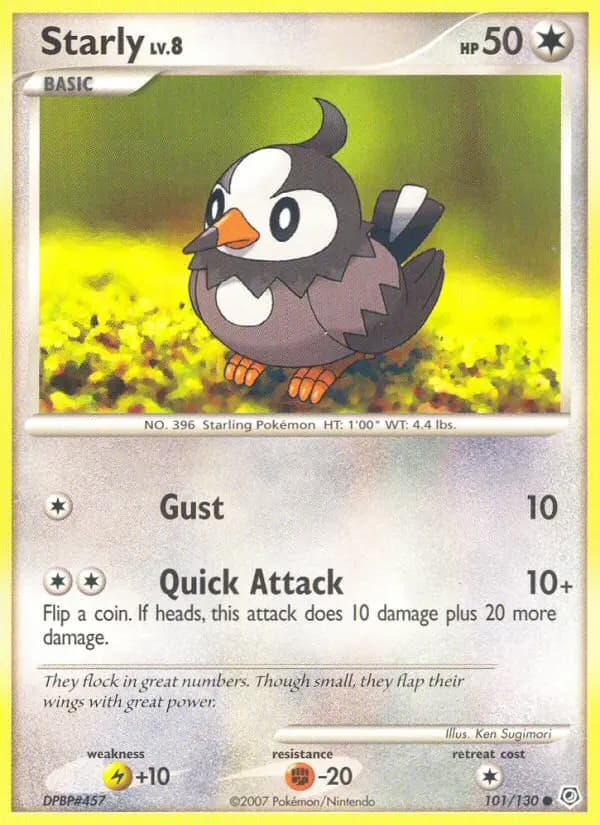
Starly is a small avian Pokémon distinguished by its grayish-brown plumage and striking facial markings. Its most recognizable feature is a prominent white mask-like marking across its face, with a smaller upper portion on females, coupled with a distinctive white spot on its chest. The crown of its head and the lower halves of its wings are jet black, contrasting sharply with its lighter coloring. Its long, orange beak features a black tip, and its oval black eyes contain bright white pupils that convey alertness and intensity. A characteristic tuft of feathers curls backward over the top of its head, and a small, pointed ruff encircles its neck, giving it an almost ruffled appearance. Starly possesses two prominent black tail feathers with a single white feather positioned between them, and its feet are orange with the typical avian structure of three forward-facing toes and one rear toe. Despite its small frame, Starly's wings pack remarkable power, capable of delivering strikes that cause injuries lasting up to a week according to Legends: Arceus entries.
Pokedex Numbers
Training
Breeding
Starly Breeding, Gender Ratio & Egg Groups
Starly exhibits a perfectly balanced gender distribution, with exactly 50 percent male and 50 percent female individuals in wild populations. This equal ratio is reflected consistently across all games where Starly appears, making it equally easy to encounter either gender in the field. The species belongs to the Flying egg group, meaning it can only breed with other Pokémon in that classification, limiting its breeding options but ensuring compatibility with other avian Pokémon species. Sexual dimorphism is present in Starly's design, though subtle—female Starly have a slightly smaller upper portion of their white facial mask compared to males, a detail that requires close observation to notice. Starly has a base happiness value of 70, indicating moderate friendliness with trainers, and has a hatch time of 15 egg cycles, which translates to approximately 3,599 to 3,855 steps required to hatch a Starly egg. This relatively quick hatch time makes Starly-line breeding projects relatively accessible to players interested in obtaining competitive specimens.
Sprites


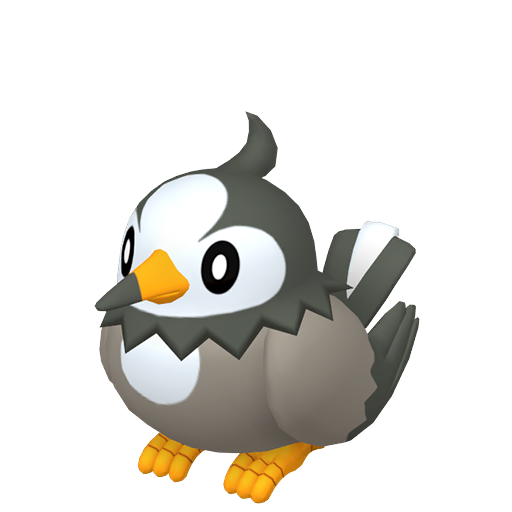
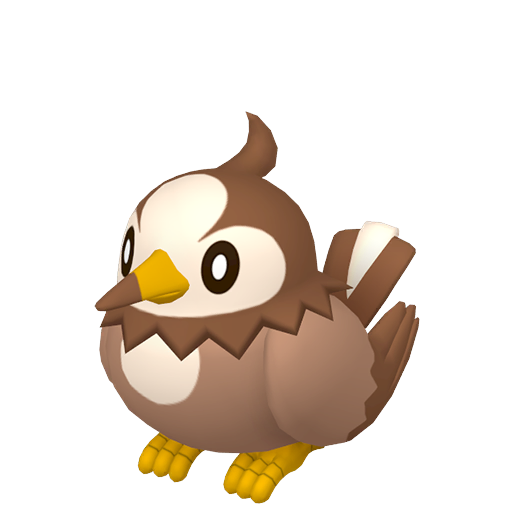


Held Items
Yache Berry
type-protection
Held: Consumed when struck by a super-effective Ice-type attack to halve the damage.
Cost: 80
Yache Berry
type-protection
Held: Consumed when struck by a super-effective Ice-type attack to halve the damage.
Cost: 80
Yache Berry
type-protection
Held: Consumed when struck by a super-effective Ice-type attack to halve the damage.
Cost: 80
Yache Berry
type-protection
Held: Consumed when struck by a super-effective Ice-type attack to halve the damage.
Cost: 80
Yache Berry
type-protection
Held: Consumed when struck by a super-effective Ice-type attack to halve the damage.
Cost: 80
Yache Berry
type-protection
Held: Consumed when struck by a super-effective Ice-type attack to halve the damage.
Cost: 80
Yache Berry
type-protection
Held: Consumed when struck by a super-effective Ice-type attack to halve the damage.
Cost: 80
Yache Berry
type-protection
Held: Consumed when struck by a super-effective Ice-type attack to halve the damage.
Cost: 80
Yache Berry
type-protection
Held: Consumed when struck by a super-effective Ice-type attack to halve the damage.
Cost: 80
TMs & HMs
tm01
ultra sun ultra moon
tm01
sun moon
tm03
lets go pikachu lets go eevee
tm04
yellow
tm04
red blue
tm04
red green japan
tm04
blue japan
tm05
lets go pikachu lets go eevee
tm06
yellow
tm06
gold silver
tm06
red blue
tm06
crystal
tm06
emerald
tm06
firered leafgreen
tm06
diamond pearl
tm06
platinum
tm06
ruby sapphire
tm06
colosseum
tm06
black 2 white 2
tm06
xd
+454 more TMs/HMs
Gender Differences
This Pokémon has visible differences between male and female forms.
Starly's Evolution Chain


Starly Evolution, Mega Evolution & Special Forms
Starly begins its evolutionary journey at level 14, transforming into Staravia, a slightly larger and more formidable Flying/Normal-type. This first evolution grants improvements to Starly's physical and special stats, though the species remains relatively fragile. The true transformation occurs at level 34, when Staravia evolves into Staraptor, a fully realized aerial predator with dramatically enhanced stats and considerably improved competitive viability. Staraptor gains access to new move types and abilities that make it a formidable presence in battle, including the exclusive move Close Combat, which combines its Normal and Fighting-type offensive capabilities. The evolutionary line demonstrates a clear progression from a weak, flock-dependent creature to an independent, powerful hunter—a thematic arc reflected in the increasing solitary capability of each stage. This three-stage line, like the early-game bird Pokémon of previous generations, serves as an excellent stepping stone for trainers developing their teams in Sinnoh and other regions.
Where to Find
Sinnoh Route 202
sinnoh
+28 more
Lake Verity
sinnoh
+44 more
Sinnoh Route 212
sinnoh
Sinnoh Route 209
sinnoh
Sinnoh Route 204
sinnoh
+23 more
Sinnoh Route 203
sinnoh
+20 more
Sinnoh Route 201
sinnoh
+38 more
Great Marsh
sinnoh
+21 more
Starly Behaviour and Natural Habitat
Starly's behavior is fundamentally shaped by its weakness as an individual creature. Because they are inherently frail when alone, Starly congregates in large flocks in mountains and fields, finding safety and strength in numbers. These assemblies represent the species' primary survival strategy, allowing them to hunt insects and protect themselves from larger predators. However, this gregarious behavior comes with a notable downside: as Pokédex entries from multiple generations consistently note, Starly will begin to bicker and quarrel if their flock grows too large, suggesting natural limits to their group cohesion. The species is known for its loud, strident vocalizations, which various Pokédex entries describe as noisy and annoying, though these calls likely serve important communicative functions within their flocks. Starly actively hunts bug Pokémon in their natural habitats, using their powerful wings to pursue and capture prey despite their small size.
Pokedex Entries
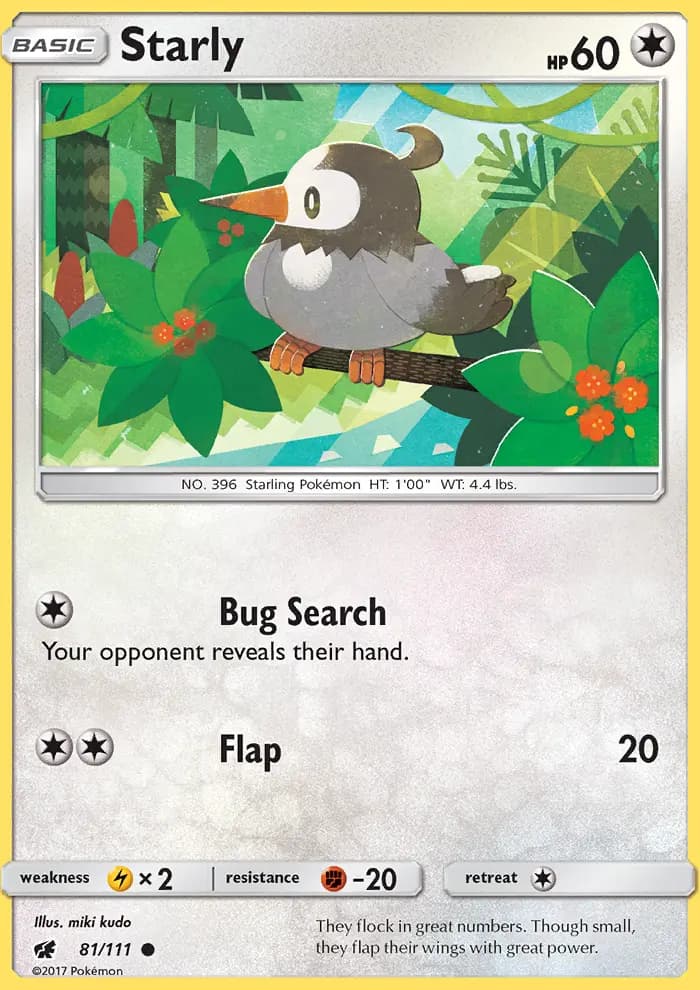
They flock in great numbers. Though small, they flap their wings with great power.
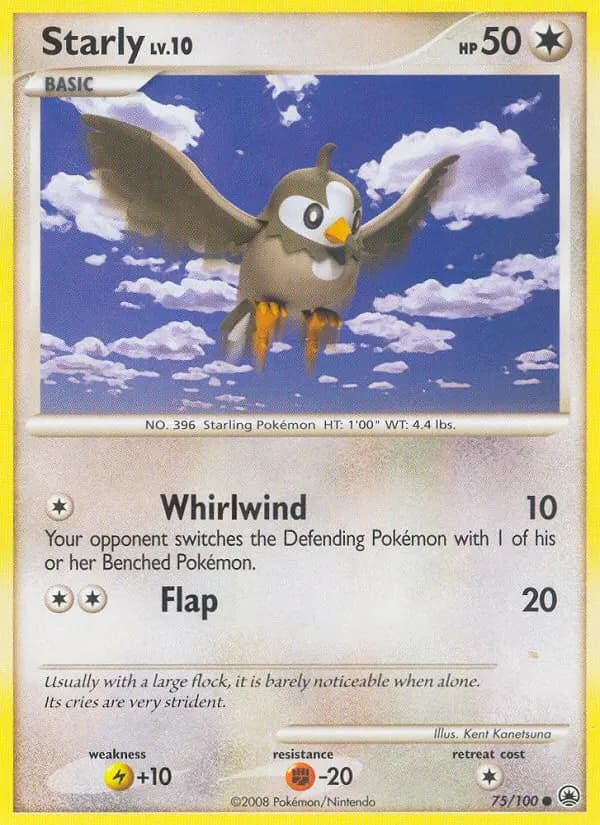
Usually with a large flock, it is barely noticeable when alone. Its cries are very strident.
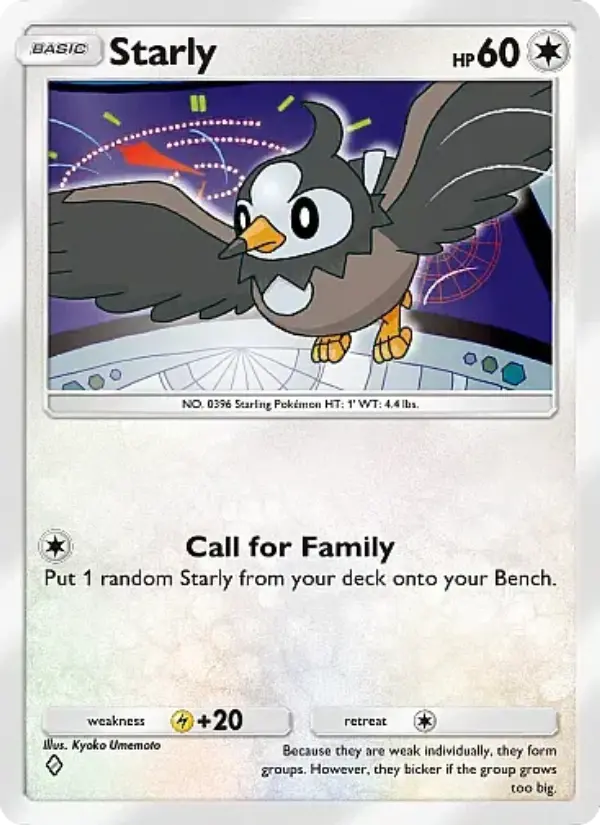
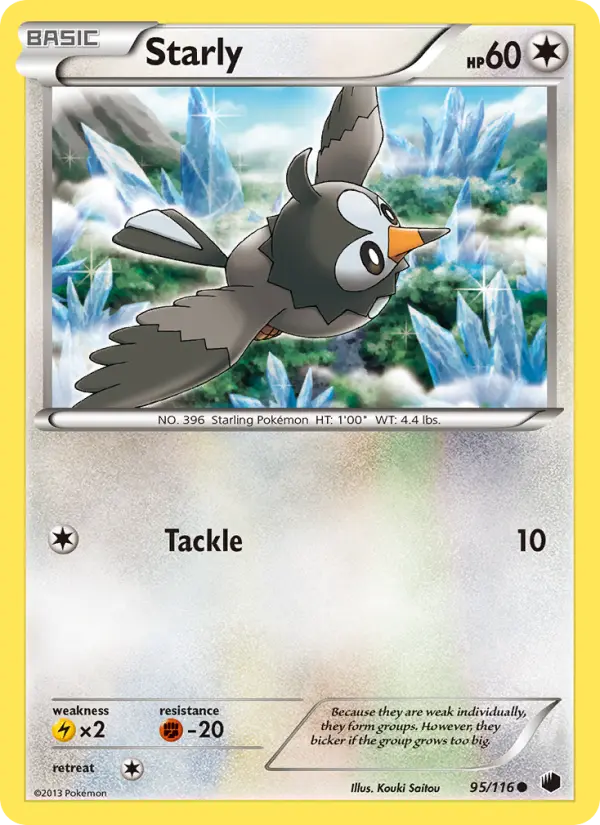
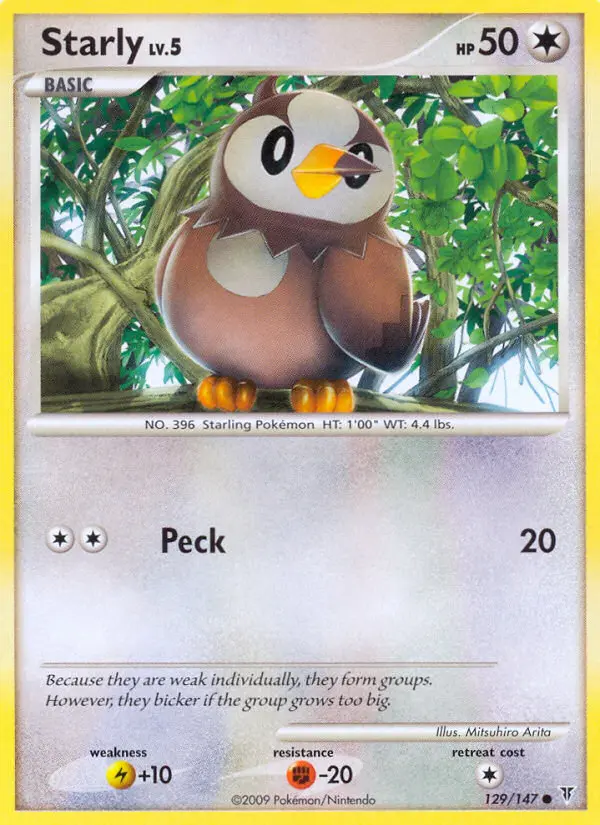
Because they are weak individually, they form groups. However, they bicker if the group grows too big.
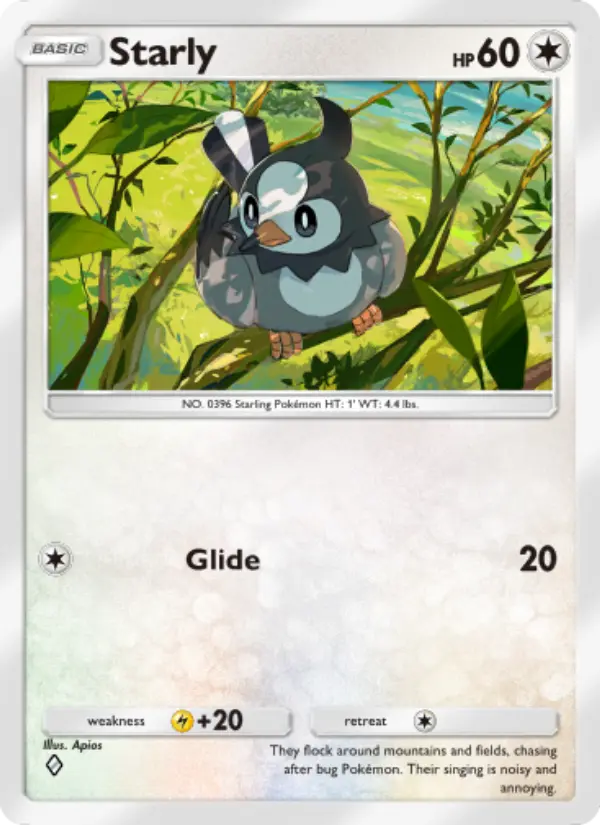
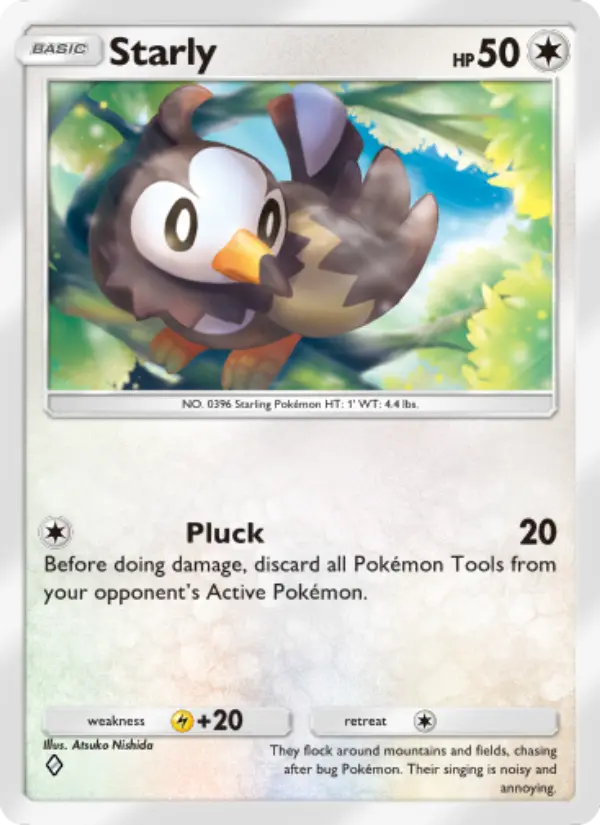
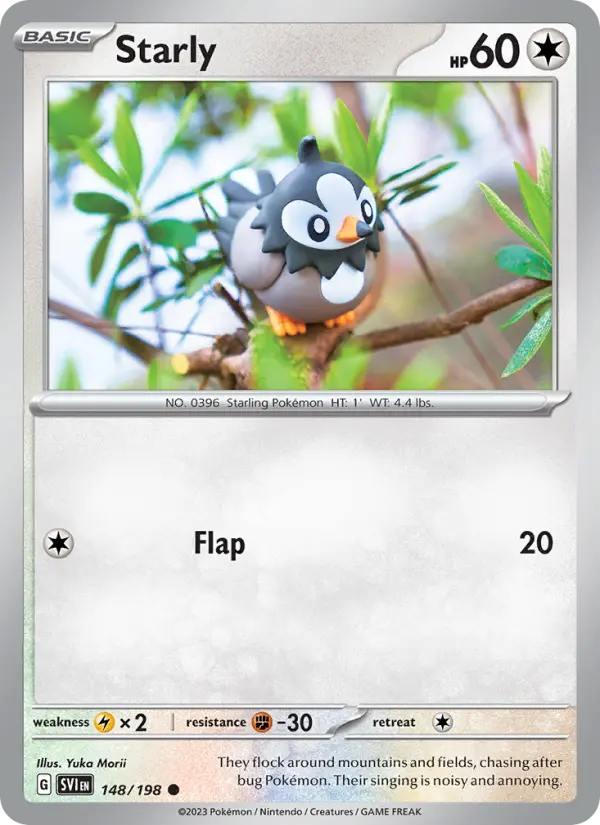
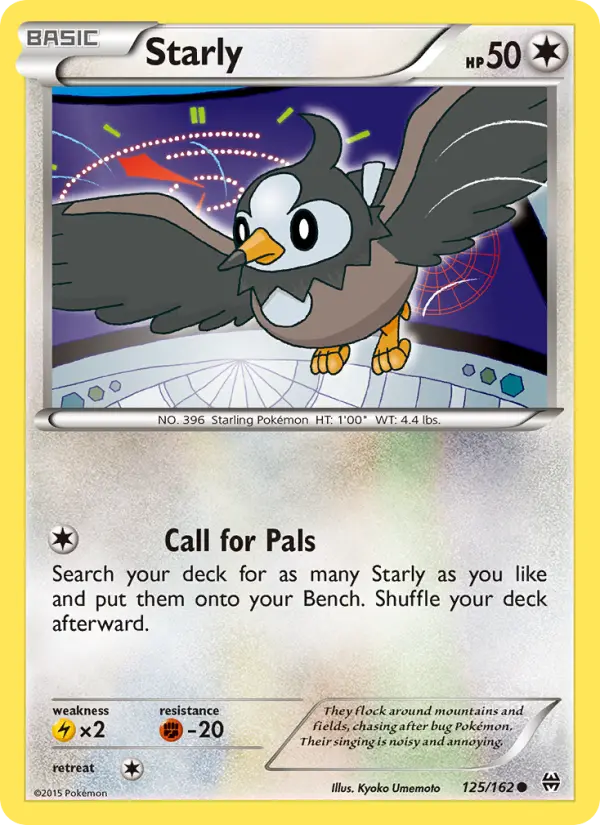
They flock around mountains and fields, chasing after bug Pokémon. Their singing is noisy and annoying.
Because they are weak individually, they form groups. However, they bicker if the group grows too big.
Because they are weak individually, they form groups. However, they bicker if the group grows too big.
They flock in great numbers. Though small, they flap their wings with great power.
They flock around mountains and fields, chasing after bug Pokémon. Their singing is noisy and annoying.
They flock in great numbers. Though small, they flap their wings with great power.
They flock around mountains and fields, chasing after bug Pokémon. Their singing is noisy and annoying.
They live in the fields and mountains, gathering in large flocks. Their cries are quite obnoxious. Though small, their wings are strong—a strike from them leaves pain that persists for a week.
Starly Name Origin & Design Inspiration
Starly's design draws obvious inspiration from real-world starlings, small passerine birds known for their gregarious nature and tendency to form massive coordinated flocks. The name 'Starly' is a straightforward portmanteau of 'starling' and the diminutive '-ly' suffix, emphasizing its small stature. Its Japanese name, Mukkuru, may derive from 'muku' (to pluck) or similar onomatopoeia related to chirping or crying sounds. The white facial mask and chest marking evoke the distinctive plumage patterns of certain starling species, while the overall color scheme of browns, blacks, and whites creates a naturalistic appearance that grounds the design in avian reality. The curled tuft of feathers on its head gives it a somewhat endearing, almost crest-like appearance that differentiates it from purely realistic bird designs. Its orange beak and feet add warm color accents that make the design more visually appealing while maintaining biological plausibility.
Learnable Moves
Starly can learn 67 moves:
Move | Type | Cat. | Power | Acc. | PP |
|---|---|---|---|---|---|
| acrobatics | flying | Physical | 55 | 100 | 15 |
| aerial ace | flying | Physical | 60 | — | 20 |
| agility | psychic | Status | — | — | 30 |
| air cutter | flying | Special | 60 | 95 | 25 |
| air slash | flying | Special | 75 | 95 | 15 |
| astonish | ghost | Physical | 30 | 100 | 15 |
| attract | normal | Status | — | 100 | 15 |
| brave bird | flying | Physical | 120 | 100 | 15 |
| captivate | normal | Status | — | 100 | 20 |
| confide | normal | Status | — | — | 20 |
| defog | flying | Status | — | — | 15 |
| detect | fighting | Status | — | — | 5 |
| double team | normal | Status | — | — | 15 |
| double edge | normal | Physical | 120 | 100 | 15 |
| dual wingbeat | flying | Physical | 40 | 90 | 10 |
| echoed voice | normal | Special | 40 | 100 | 15 |
| endeavor | normal | Physical | — | 100 | 5 |
| endure | normal | Status | — | — | 10 |
| facade | normal | Physical | 70 | 100 | 20 |
| feather dance | flying | Status | — | 100 | 15 |
| final gambit | fighting | Special | — | 100 | 5 |
| fly | flying | Physical | 90 | 95 | 15 |
| foresight | normal | Status | — | — | 40 |
| frustration | normal | Physical | — | 100 | 20 |
| fury attack | normal | Physical | 15 | 85 | 20 |
| giga impact | normal | Physical | 150 | 90 | 5 |
| growl | normal | Status | — | 100 | 40 |
| gust | flying | Special | 40 | 100 | 35 |
| heat wave | fire | Special | 95 | 90 | 10 |
| helping hand | normal | Status | — | — | 20 |
| hidden power | normal | Special | 60 | 100 | 15 |
| hurricane | flying | Special | 110 | 70 | 10 |
| mirror move | flying | Status | — | — | 20 |
| mud slap | ground | Special | 20 | 100 | 10 |
| natural gift | normal | Physical | — | 100 | 15 |
| ominous wind | ghost | Special | 60 | 100 | 5 |
| pluck | flying | Physical | 60 | 100 | 20 |
| protect | normal | Status | — | — | 10 |
| pursuit | dark | Physical | 40 | 100 | 20 |
| quick attack | normal | Physical | 40 | 100 | 30 |
| rain dance | water | Status | — | — | 5 |
| rest | psychic | Status | — | — | 5 |
| return | normal | Physical | — | 100 | 20 |
| revenge | fighting | Physical | 60 | 100 | 10 |
| roost | flying | Status | — | — | 5 |
| round | normal | Special | 60 | 100 | 15 |
| sand attack | ground | Status | — | 100 | 15 |
| secret power | normal | Physical | 70 | 100 | 20 |
| sleep talk | normal | Status | — | — | 10 |
| snore | normal | Special | 50 | 100 | 15 |
| steel wing | steel | Physical | 70 | 90 | 25 |
| substitute | normal | Status | — | — | 10 |
| sunny day | fire | Status | — | — | 5 |
| swagger | normal | Status | — | 85 | 15 |
| swift | normal | Special | 60 | — | 20 |
| tackle | normal | Physical | 40 | 100 | 35 |
| tailwind | flying | Status | — | — | 15 |
| take down | normal | Physical | 90 | 85 | 20 |
| tera blast | normal | Special | 80 | 100 | 10 |
| thief | dark | Physical | 60 | 100 | 25 |
| toxic | poison | Status | — | 90 | 10 |
| twister | dragon | Special | 40 | 100 | 20 |
| u turn | bug | Physical | 70 | 100 | 20 |
| uproar | normal | Special | 90 | 100 | 10 |
| whirlwind | normal | Status | — | — | 20 |
| wing attack | flying | Physical | 60 | 100 | 35 |
| work up | normal | Status | — | — | 30 |
Starly Competitive Battle Guide
From a competitive standpoint, Starly's limited utility stems directly from its base stats, which total only 245 points distributed unevenly across its stat categories. Its speed of 60 is respectable for an early-game Pokémon, allowing it to outpace many similarly-leveled creatures, while its attack stat of 55 provides modest physical striking power. However, its defenses are uniformly weak at 30 each for both defense and special defense, and its special attack of 30 makes special moves extremely ineffectual. The competitive metagame largely skips Starly in favor of training directly to Staravia or Staraptor, which offer significantly improved stat distributions. Its two available abilities—Keen Eye, which prevents accuracy reduction, and the hidden ability Reckless, which boosts recoil moves to 1.2 times their power—provide some strategic options, though neither transforms Starly into a viable competitive choice. In formats like Little Cup, which restricts teams to unevolved Pokémon, Starly remains underwhelming compared to stronger Flying-type alternatives such as Doduo or even the early Normal-type options available to trainers.
Commonly Asked Questions About Starly
What type is Starly?
Starly is a normal and flying type Pokemon.
What does Starly evolve into?
Starly evolves into staravia, then into staraptor.
What are Starly's weaknesses?
Starly is weak to rock, electric and ice type moves.
Does Starly evolve by trading?
No — Starly evolves entirely through leveling up, with no trade required at any stage.
Where can I find Starly?
Starly can be found in sinnoh route 202 (sinnoh), lake verity (sinnoh) and sinnoh route 212 (sinnoh) and 5 other locations.
Starly Cultural Impact & Franchise History
Starly holds considerable cultural significance as one of the earliest avian Pokémon encountered in the Sinnoh region, serving as a staple of the early-game experience for countless trainers. In the anime, Ash Ketchum famously captured a Starly early in the Diamond & Pearl series, and this particular Starly became a beloved member of his team, evolving first into Staravia and eventually reaching its final form as Staraptor. This prominent anime appearance greatly elevated Starly's recognition among fans and cemented its position in popular Pokémon culture. The species also appears as one of three selectable partner Pokémon in Pokémon Ranger: Shadows of Almia, alongside Pachirisu and Munchlax, introducing the species to players of the Ranger spin-off series. Starly's design has influenced how Game Freak approaches early-game bird Pokémon in subsequent generations, with its balance of weakness and potential serving as a template for trainers' first flying-type encounters. The species has been featured in various media adaptations, trading card game releases, and merchandise, maintaining steady relevance within the broader Pokémon franchise despite its limited competitive applications.
Where to Find Starly in Every Pokémon Game
Starly is widely available throughout the Pokémon series, appearing in numerous games across multiple generations since its introduction in Generation IV. In Diamond and Pearl, Starly is one of the earliest Pokémon trainers can encounter, appearing in routes 101 and 202 as a common encounter. This early availability continues through Platinum, where it remains accessible in the early game. In later generations, Starly appears in Pokémon X and Y within Coastal Kalos, and in Brilliant Diamond and Shining Pearl as a Sinnoh native species. The species also appears in Pokémon Legends: Arceus, where it inhabits the fields and mountains of ancient Sinnoh, and in Pokémon Scarlet and Violet with its Pokédex number adjusted to 097. The extremely high catch rate of 255—the maximum possible—ensures that trainers can capture Starly with standard Poké Balls with minimal difficulty, even when encountered at low health. This accessibility makes Starly an ideal choice for trainers seeking early experience and development opportunities, though most competitive players and veterans quickly transition to its evolved forms for more practical battle applications.