Vibrava
Generation III · #0329 — Vibration Pokémon
Vibrava's profile is easy to undersell: 1.1 m, 15.3 kg, and a ground/dragon typing that doesn't scream power — until you look at its HP of 50.
Editor's Take
Vibrava is one of the weakest middle stages in the series with a base stat total of 340, and waiting until level 45 for Flygon is a genuinely painful stretch.
Base Stats
Height
1.1m
Weight
15.3kg
Category
Vibration Pokémon
Gender
Male 50% / Female 50%
Color
green
Shape
bug-wings
Habitat
rough-terrain
Abilities
Evades ground moves.
Vibrava Biology & Physical Characteristics
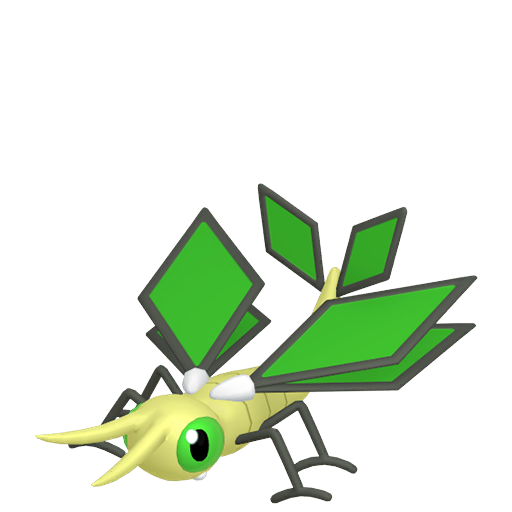
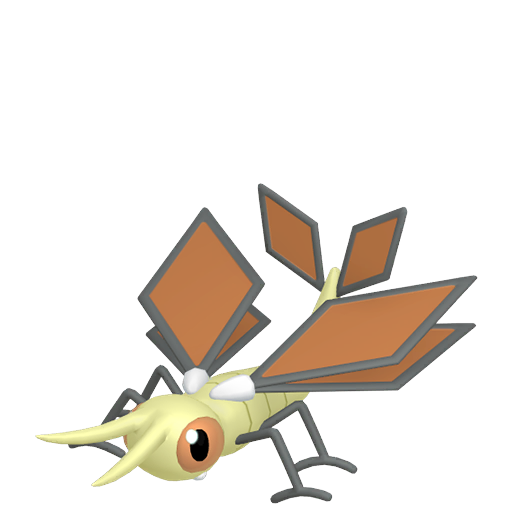
Vibrava exhibits a striking insectoid morphology that clearly reflects its dragonfly-inspired design, featuring a small head crowned with two yellow antennae and prominent green, bulging eyes with distinctive black oval pupils. Its most defining characteristic is its four rhombus-shaped green wings with black edges, which remain underdeveloped compared to the fully-formed wings of its final evolution, Flygon. The creature's skinny yellow body is supported by four thin black legs with delicate feet, while its tail terminates in similar rhombus-shaped patterns that echo its wing design. According to multiple Pokédex entries, Vibrava's wings have not yet completed their growth process, which directly impacts its aerial capabilities and combat strategy. Rather than achieving sustained flight like Flygon, Vibrava has adapted to use its developing wings for an entirely different purpose: generating powerful ultrasonic waves through rapid vibration. These ultrasonic waves are potent enough to induce severe headaches in humans and serve as Vibrava's primary hunting mechanism. As a saprotroph, Vibrava employs a unique feeding strategy where it first renders prey unconscious through these sonic attacks before secreting stomach acid to dissolve its meal, consuming prey daily as part of its developmental nutrition needed to promote wing growth.
Pokedex Numbers
Training
Breeding
Vibrava Breeding, Gender Ratio & Egg Groups
Vibrava exhibits a perfectly balanced gender distribution with a 50% male to 50% female ratio, ensuring that trainers have equal opportunity to breed either gender without artificial preference. The species belongs to both the Bug and Dragon egg groups, a dual classification that reflects its hybrid nature as a creature transitioning between insectoid characteristics and draconic potential. This dual egg group placement provides breeders with interesting cross-breeding possibilities, as Vibrava can be mated with a wide variety of partners from either group, creating opportunities for move pool diversity and strategic offspring development. The egg hatching process requires 20 cycles to complete, translating to approximately 4,884 to 5,140 steps of travel, placing Vibrava's breeding timeline in the moderate range compared to other Pokémon. The base friendship value of 70 for caught Vibrava indicates a naturally friendly disposition toward trainers, though this value has remained consistent across generations until Generation VIII when game mechanics underwent significant revision. For breeders seeking to develop competitive Vibrava or prepare specimens for evolution into Flygon, understanding these breeding parameters proves essential, as careful selection of parent Pokémon from both egg groups can yield offspring with superior individual values and desired move combinations that expand Vibrava's tactical applications in team composition.
Sprites


TMs & HMs
tm01
lets go pikachu lets go eevee
tm02
emerald
tm02
crystal
tm02
firered leafgreen
tm02
ruby sapphire
tm02
gold silver
tm02
black white
tm02
heartgold soulsilver
tm02
platinum
tm02
colosseum
tm02
diamond pearl
tm02
black 2 white 2
tm02
sun moon
tm02
omega ruby alpha sapphire
tm02
x y
tm02
xd
tm02
ultra sun ultra moon
tm05
lets go pikachu lets go eevee
tm06
yellow
tm06
gold silver
+685 more TMs/HMs
Vibrava's Evolution Chain


Vibrava Evolution, Mega Evolution & Special Forms
Vibrava represents the critical middle stage of one of Generation III's most rewarding evolutionary progressions, evolving from the ground-type Trapinch at level 35 and subsequently evolving into the powerful Flygon at level 45. This relatively short level gap between evolutions emphasizes the rapid developmental pace of this line during its mid-stage maturation. The evolution from Trapinch to Vibrava marks the species' acquisition of its Dragon typing alongside its inherited Ground type, fundamentally altering its type matchups and strategic applications in battle. As Vibrava approaches level 45 and prepares for its transformation into Flygon, trainers witness a Pokémon at the threshold of aerial mastery—its wings have grown substantially more capable but not yet reached their full potential. The evolutionary chain demonstrates a clear biological progression: Trapinch serves as the larval, ground-bound stage; Vibrava represents the metamorphic transition period where insectoid characteristics remain prominent while draconic potential awakens; and Flygon embodies the fully realized aerial predator with wings developed to their complete potential. This evolutionary trajectory makes Vibrava an excellent training partner for players seeking to understand the life cycle of desert-dwelling creatures, as it visibly bridges the gap between subterranean existence and aerial dominance, with its ultrasonic wave generation serving as a natural bridge between Trapinch's ground-based attacks and Flygon's aerial assault capabilities.
Where to Find
Sinnoh Route 228
sinnoh
+1 more
Reversal Mountain
unova
+1 more
Vibrava Behaviour and Natural Habitat
Vibrava is fundamentally a desert-dwelling Pokémon, thriving in the arid environments where it evolved from Trapinch and where it continues to hunt until reaching the level required for its final transformation. The species exhibits fascinating behavioral patterns centered around its unique sleep cycles, with observations indicating four distinct sleep styles: Roosting Sleep, Hovering Sleep, Wing-Vibrating Sleep, and Atop-Belly Sleep. Interestingly, Vibrava typically folds its wings during sleep but occasionally rests with wings spread, a behavior believed to maintain the precision of its wing movements for optimal ultrasonic wave generation. This meticulous attention to wing maintenance reflects the critical developmental stage Vibrava occupies in its evolutionary journey. In the desert environment, Vibrava exhibits predatory behavior that demonstrates remarkable ecological adaptation, preserving captured prey in the hot sands for later consumption—a strategy that shows planning and environmental awareness. The species' reliance on ultrasonic waves as both a hunting and communication tool suggests sophisticated neurological development, with its ability to produce such powerful sonic vibrations that human explorers in desert regions have reported experiencing severe headaches, a testament to the intensity of these biological soundwaves.
Pokedex Entries
To make prey faint, VIBRAVA generates ultrasonic waves by vigorously making its two wings vibrate. This POKéMON’s ultrasonic waves are so powerful, they can bring on headaches in people.
VIBRAVA’s wings have not yet completed the process of growing. Rather than flying long distances, they are more useful for generating ultrasonic waves by vibrating.
It looses ultrasonic waves by rubbing its wings together. Since a VIBRAVA’s wings are still in the process of growing, it can only fly short distances.
It generates ultrasonic waves by violently flapping its wings. After making its prey faint, it melts the prey with acid.
It violently shudders its wings, generating ultrasonic waves to induce headaches in people.
It vibrates its wings vigorously, creating ultrasonic waves that cause serious headaches.
It violently shudders its wings, generating ultrasonic waves to induce headaches in people.
The ultrasonic waves it generates by rubbing its two wings together cause severe headaches.
The ultrasonic waves it generates by rubbing its two wings together cause severe headaches.
It generates ultrasonic waves by violently flapping its wings. After making its prey faint, it melts the prey with acid.
To make prey faint, Vibrava generates ultrasonic waves by vigorously making its two wings vibrate. This Pokémon’s ultrasonic waves are so powerful, they can bring on headaches in people.
Vibrava’s wings have not yet completed the process of growing. Rather than flying long distances, they are more useful for generating ultrasonic waves by vibrating.
Rather than using its underdeveloped wings for flight, it rubs them together, producing ultrasonic waves to attack its enemies.
It vibrates its wings to generate ultrasonic waves, causing its prey to faint. Then it buries the prey alive in the sand to preserve it.
To help make its wings grow, it dissolves quantities of prey in its digestive juices and guzzles them down every day.
It vibrates its wings to send out odd sound waves. Trainers who are with it need earplugs.
The ultrasonic waves it generates by rubbing its two wings together cause severe headaches.
To help make its wings grow, it dissolves quantities of prey in its digestive juices and guzzles them down every day.
Vibrava Name Origin & Design Inspiration
Vibrava's name elegantly combines the concepts of vibration and the musical term 'brava,' reflecting both its mechanical ability to vibrate its wings for ultrasonic generation and the dramatic nature of its evolutionary transformation. The Japanese name, ビブラーバ (Vibrava), employs the same conceptual foundation, with 'vibu' deriving from vibration and the suffix suggesting movement and energy. The dragonfly inspiration is unmistakable in Vibrava's physical structure, from its transparent, geometrically-shaped wings to its elongated body and compound-like eyes, placing it firmly within the tradition of insect-inspired Pokémon design that emphasizes biological authenticity. The rhombus wing pattern and tail markings create visual harmony that guides the eye through the creature's body, while the yellow and green coloration scheme provides effective camouflage in desert environments where yellows blend with sand and greens suggest the sparse desert vegetation. What distinguishes Vibrava's design from a simple dragonfly derivative is the deliberate incorporation of draconic elements—the Dragon typing is subtly suggested through the angular wing shapes and the mythical quality imparted by its glowing eyes and formidable presence despite its small stature. The underdeveloped nature of its wings serves as a visual metaphor for its evolutionary stage, with feathering edges that appear less defined than those of fully-matured creatures, creating an aesthetic bridge between Trapinch's terrestrial form and Flygon's polished aerial physiology.
Learnable Moves
Vibrava can learn 93 moves:
Move | Type | Cat. | Power | Acc. | PP |
|---|---|---|---|---|---|
| aerial ace | flying | Physical | 60 | — | 20 |
| air cutter | flying | Special | 60 | 95 | 25 |
| air slash | flying | Special | 75 | 95 | 15 |
| astonish | ghost | Physical | 30 | 100 | 15 |
| attract | normal | Status | — | 100 | 15 |
| bide | normal | Physical | — | — | 10 |
| bite | dark | Physical | 60 | 100 | 25 |
| body slam | normal | Physical | 85 | 100 | 15 |
| boomburst | normal | Special | 140 | 100 | 10 |
| bug bite | bug | Physical | 60 | 100 | 20 |
| bug buzz | bug | Special | 90 | 100 | 10 |
| bulldoze | ground | Physical | 60 | 100 | 20 |
| captivate | normal | Status | — | 100 | 20 |
| confide | normal | Status | — | — | 20 |
| crunch | dark | Physical | 80 | 100 | 15 |
| defog | flying | Status | — | — | 15 |
| dig | ground | Physical | 80 | 100 | 10 |
| double team | normal | Status | — | — | 15 |
| double edge | normal | Physical | 120 | 100 | 15 |
| draco meteor | dragon | Special | 130 | 90 | 5 |
| dragon breath | dragon | Special | 60 | 100 | 20 |
| dragon claw | dragon | Physical | 80 | 100 | 15 |
| dragon pulse | dragon | Special | 85 | 100 | 10 |
| dragon rush | dragon | Physical | 100 | 75 | 10 |
| dragon tail | dragon | Physical | 60 | 90 | 10 |
| dual wingbeat | flying | Physical | 40 | 90 | 10 |
| earth power | ground | Special | 90 | 100 | 10 |
| earthquake | ground | Physical | 100 | 100 | 10 |
| endure | normal | Status | — | — | 10 |
| facade | normal | Physical | 70 | 100 | 20 |
| feint | normal | Physical | 30 | 100 | 10 |
| feint attack | dark | Physical | 60 | — | 20 |
| first impression | bug | Physical | 90 | 100 | 10 |
| fissure | ground | Physical | — | 30 | 5 |
| flail | normal | Physical | — | 100 | 15 |
| fly | flying | Physical | 90 | 95 | 15 |
| focus energy | normal | Status | — | — | 30 |
| frustration | normal | Physical | — | 100 | 20 |
| fury cutter | bug | Physical | 40 | 95 | 20 |
| giga drain | grass | Special | 75 | 100 | 10 |
| giga impact | normal | Physical | 150 | 90 | 5 |
| gust | flying | Special | 40 | 100 | 35 |
| headbutt | normal | Physical | 70 | 100 | 15 |
| heat wave | fire | Special | 95 | 90 | 10 |
| hidden power | normal | Special | 60 | 100 | 15 |
| hyper beam | normal | Special | 150 | 90 | 5 |
| laser focus | normal | Status | — | — | 30 |
| mimic | normal | Status | — | — | 10 |
| mud shot | ground | Special | 55 | 95 | 15 |
| mud slap | ground | Special | 20 | 100 | 10 |
| natural gift | normal | Physical | — | 100 | 15 |
| ominous wind | ghost | Special | 60 | 100 | 5 |
| outrage | dragon | Physical | 120 | 100 | 10 |
| protect | normal | Status | — | — | 10 |
| quick attack | normal | Physical | 40 | 100 | 30 |
| rest | psychic | Status | — | — | 5 |
| return | normal | Physical | — | 100 | 20 |
| rock slide | rock | Physical | 75 | 90 | 10 |
| rock smash | fighting | Physical | 40 | 100 | 15 |
| rock tomb | rock | Physical | 60 | 95 | 15 |
| roost | flying | Status | — | — | 5 |
| round | normal | Special | 60 | 100 | 15 |
| sand attack | ground | Status | — | 100 | 15 |
| sand tomb | ground | Physical | 35 | 85 | 15 |
| sandstorm | rock | Status | — | — | 10 |
| scorching sands | ground | Special | 70 | 100 | 10 |
| screech | normal | Status | — | 85 | 40 |
| secret power | normal | Physical | 70 | 100 | 20 |
| signal beam | bug | Special | 75 | 100 | 15 |
| silver wind | bug | Special | 60 | 100 | 5 |
| sleep talk | normal | Status | — | — | 10 |
| snore | normal | Special | 50 | 100 | 15 |
| solar beam | grass | Special | 120 | 100 | 10 |
| sonic boom | normal | Special | — | 90 | 20 |
| stealth rock | rock | Status | — | — | 20 |
| steel wing | steel | Physical | 70 | 90 | 25 |
| stone edge | rock | Physical | 100 | 80 | 5 |
| strength | normal | Physical | 80 | 100 | 15 |
| struggle bug | bug | Special | 50 | 100 | 20 |
| substitute | normal | Status | — | — | 10 |
| sunny day | fire | Status | — | — | 5 |
| superpower | fighting | Physical | 120 | 100 | 5 |
| supersonic | normal | Status | — | 55 | 20 |
| swagger | normal | Status | — | 85 | 15 |
| swift | normal | Special | 60 | — | 20 |
| tailwind | flying | Status | — | — | 15 |
| take down | normal | Physical | 90 | 85 | 20 |
| tera blast | normal | Special | 80 | 100 | 10 |
| throat chop | dark | Physical | 80 | 100 | 15 |
| toxic | poison | Status | — | 90 | 10 |
| twister | dragon | Special | 40 | 100 | 20 |
| u turn | bug | Physical | 70 | 100 | 20 |
| uproar | normal | Special | 90 | 100 | 10 |
Vibrava Competitive Battle Guide
In competitive battling, Vibrava occupies a niche position as a transitional Pokémon primarily used by trainers in early competitive formats or lower-tier competitions before accessing Flygon's substantially superior stat distribution. With a aggregate stat total of 340 spread across Attack (70) and Speed (70) as its only above-average offensive attributes, Vibrava struggles to compete with fully evolved threats in standard competitive play. Its special defense and special attack both languish at 50, while its HP and physical defense sit similarly low at 50 and 50 respectively, creating a fragile physical profile that demands careful team building and defensive support. However, Vibrava's Levitate ability provides crucial utility by granting immunity to ground-type moves and hazard damage from entry hazards like Stealth Rock and Spikes, an advantage that can prove decisive in matches where ground coverage is prevalent. The species' dual Ground/Dragon typing grants interesting resistances and offensive coverage, with moves like Earthquake and Dragon Claw forming a reliable attacking core, though Vibrava's mediocre special attack limits its ability to effectively utilize special-based Dragon moves. Trainers seeking to use Vibrava competitively are generally better served by advancing to Flygon at level 45, where massively improved stats and superior movepool access create a genuinely threatening combatant. Nevertheless, in formats like Little Cup or other restricted tier competitive play, Vibrava can serve as a viable option with appropriate support, utilizing its speed tier and type coverage to secure unexpected victories against unprepared opponents.
Commonly Asked Questions About Vibrava
What type is Vibrava?
Vibrava is a ground and dragon type Pokemon.
What does Vibrava evolve into?
Vibrava evolves into flygon.
What are Vibrava's weaknesses?
Vibrava is weak to ice, dragon and fairy type moves.
Does Vibrava evolve by trading?
No — Vibrava evolves entirely through leveling up, with no trade required at any stage.
Where can I find Vibrava?
Vibrava can be found in sinnoh route 228 (sinnoh) and reversal mountain (unova).
Vibrava Cultural Impact & Franchise History
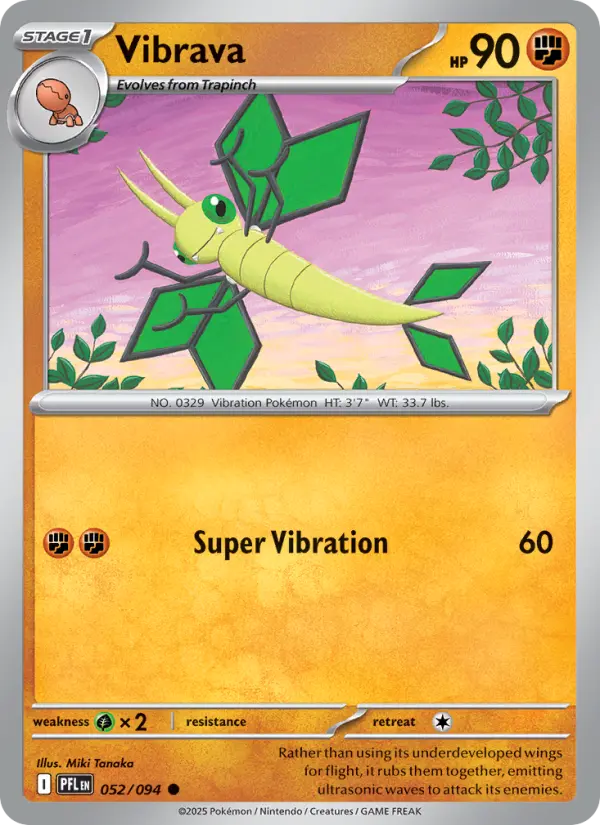
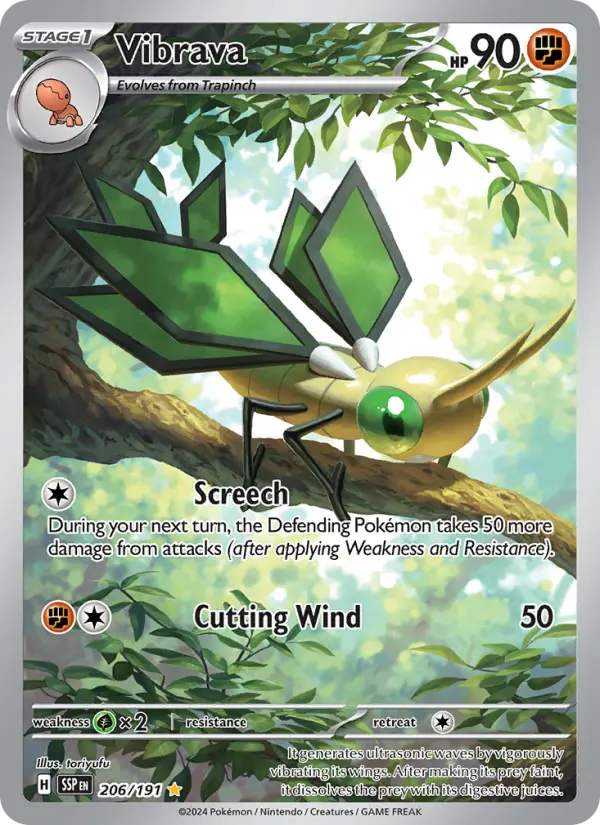
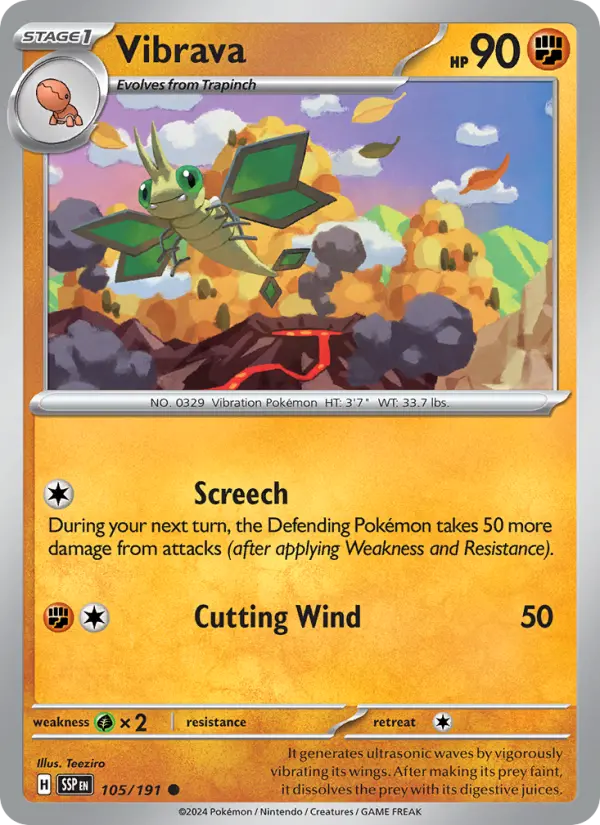
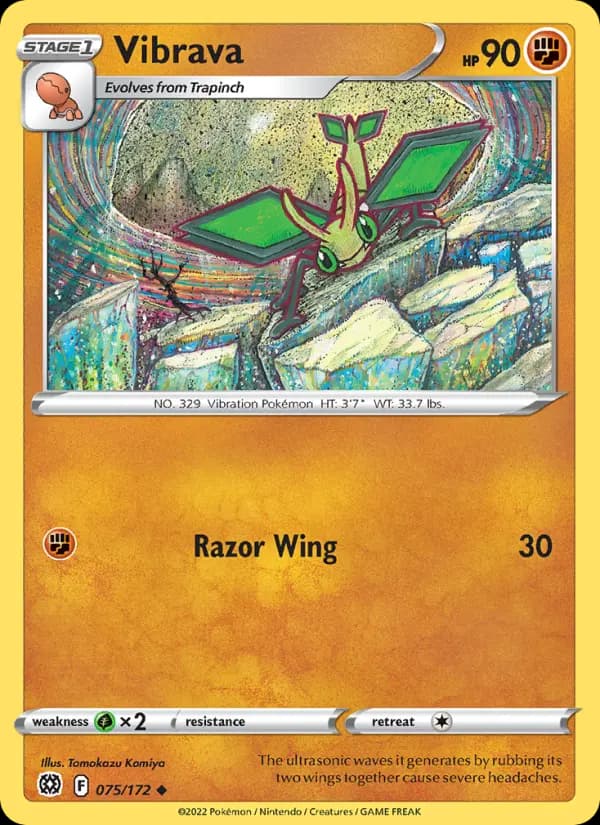
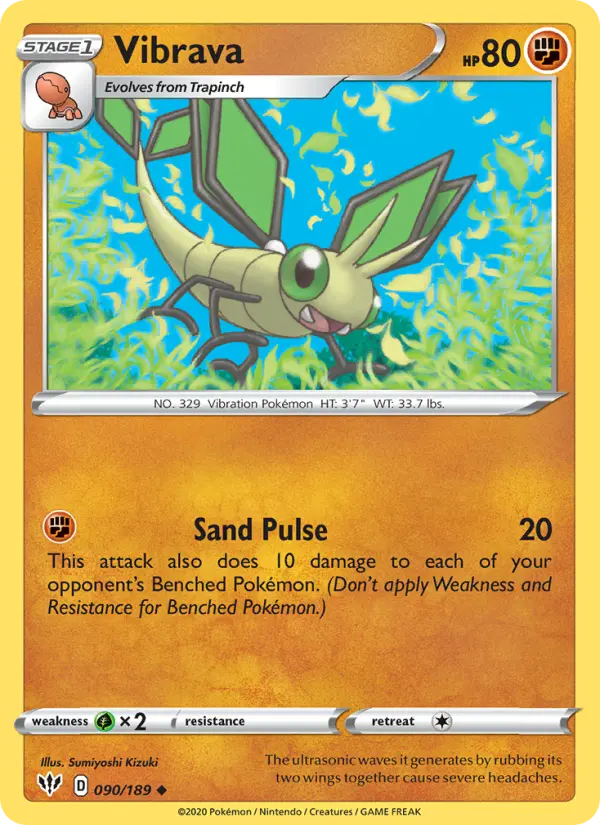
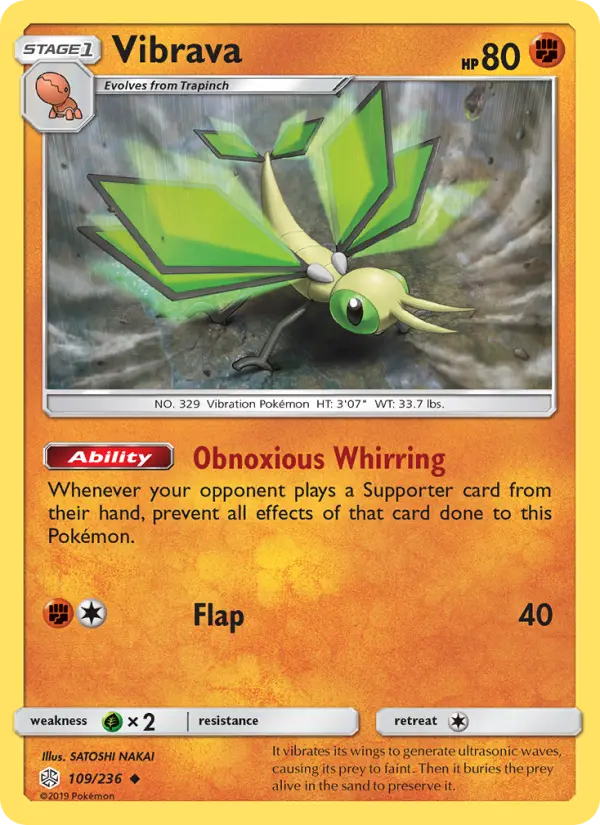
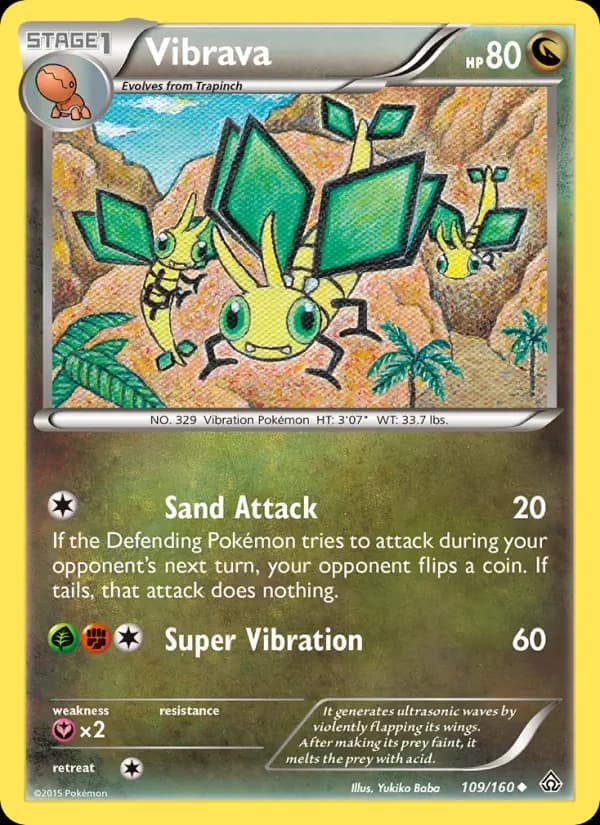
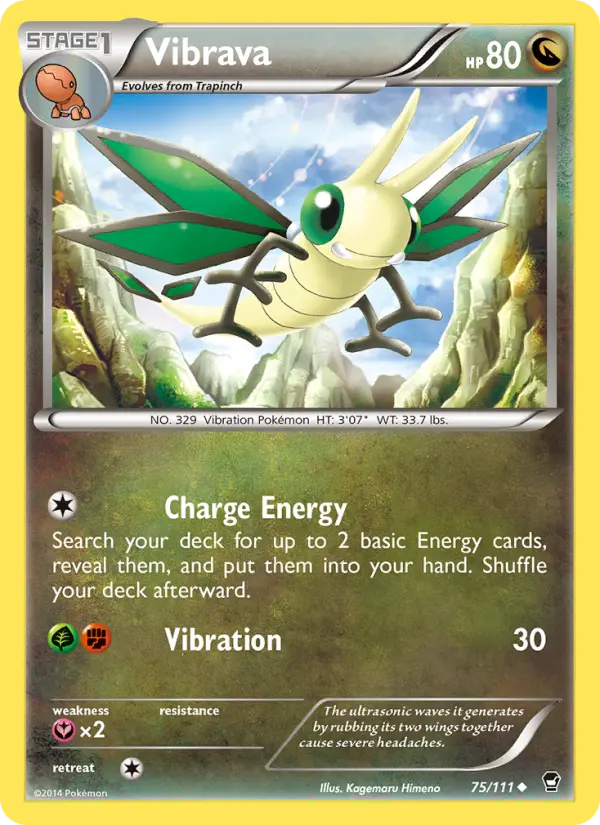
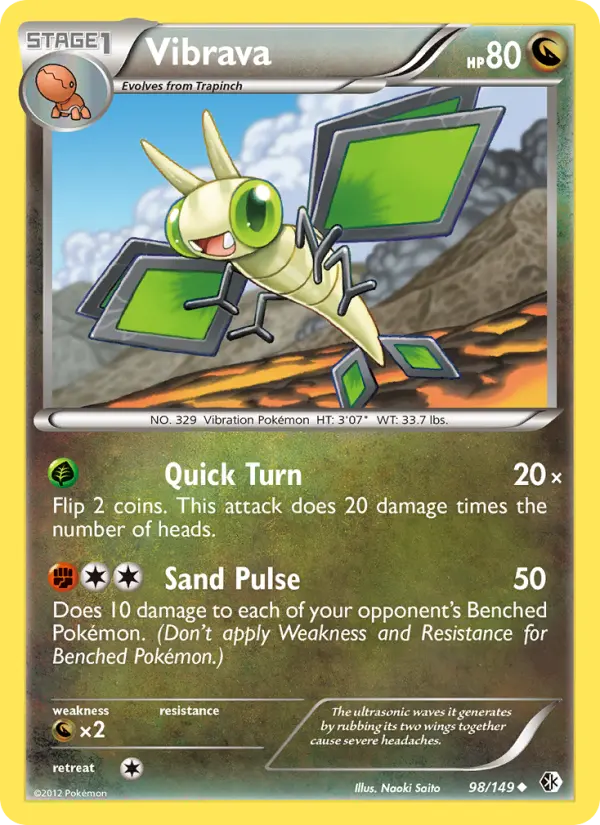
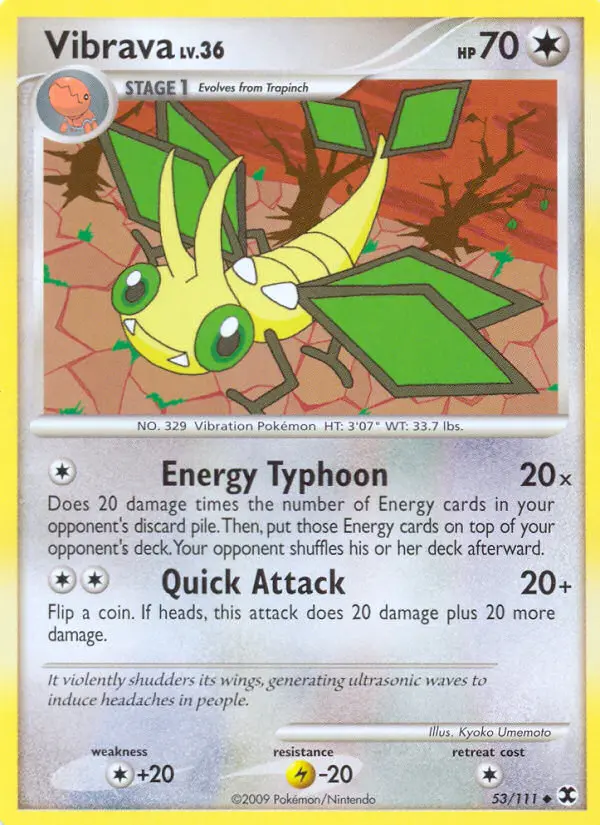
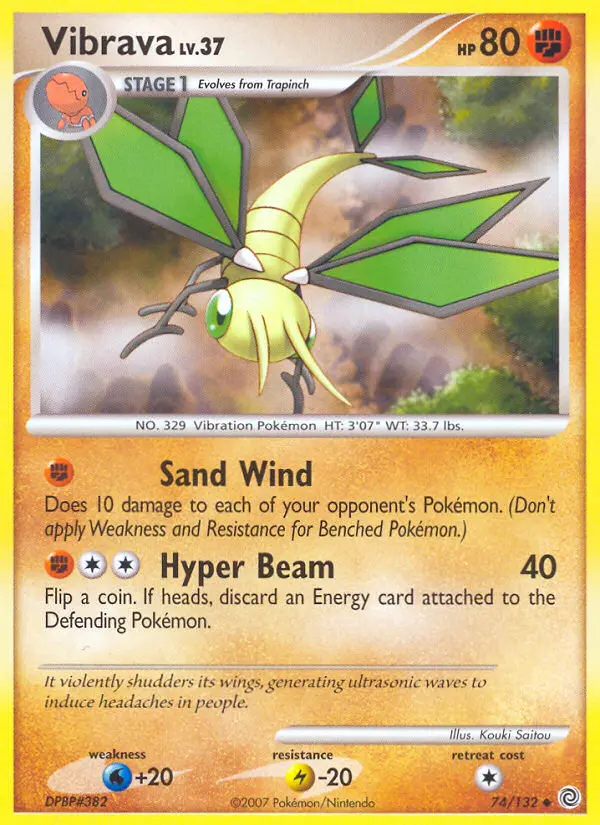
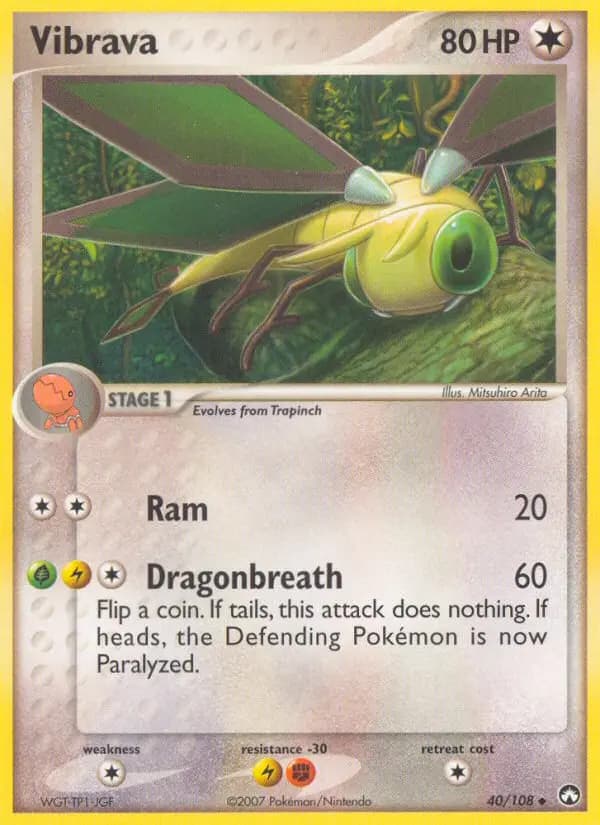
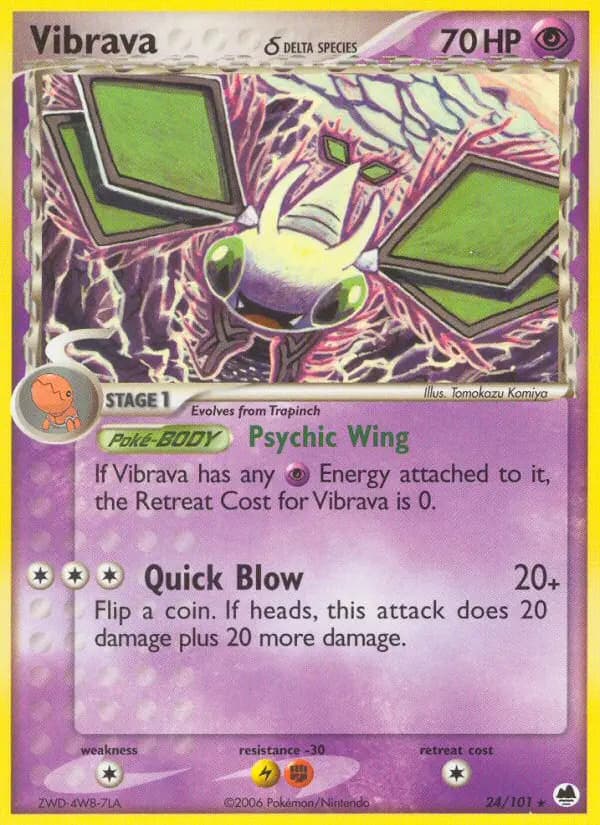
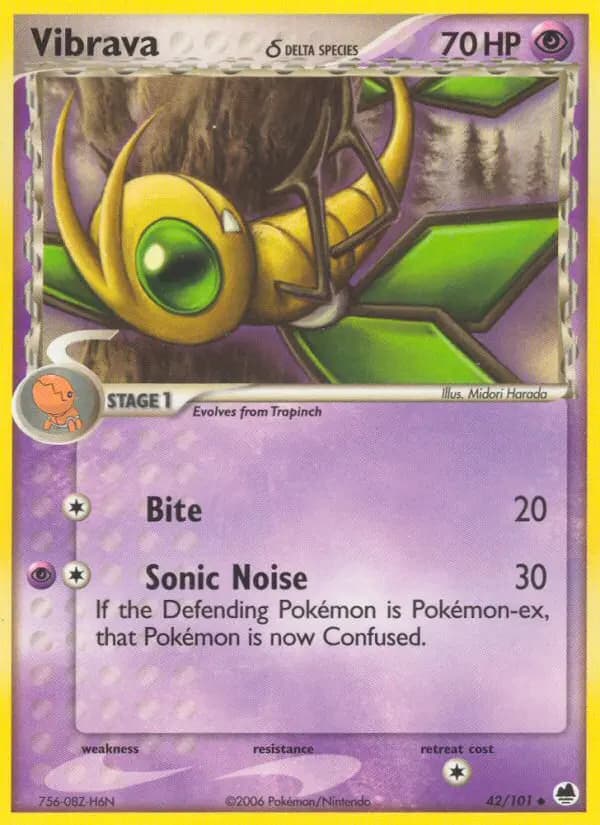
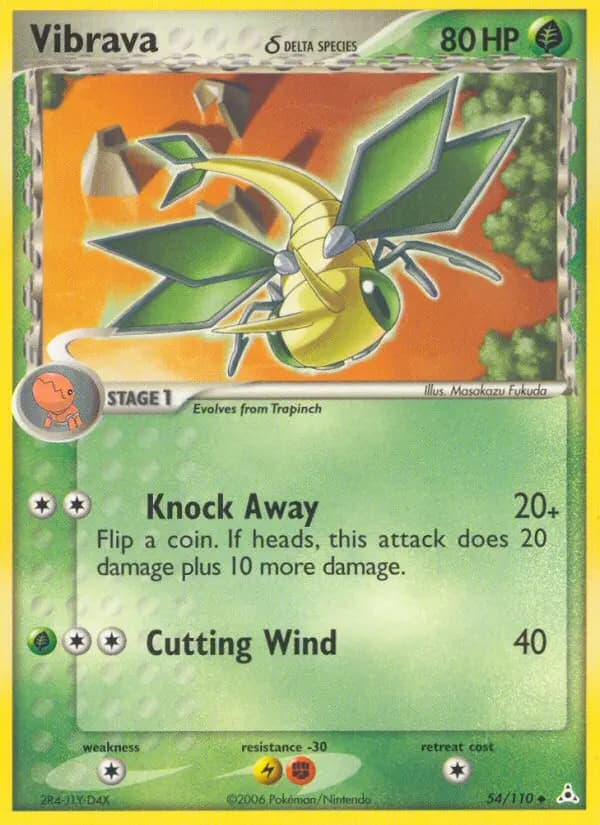
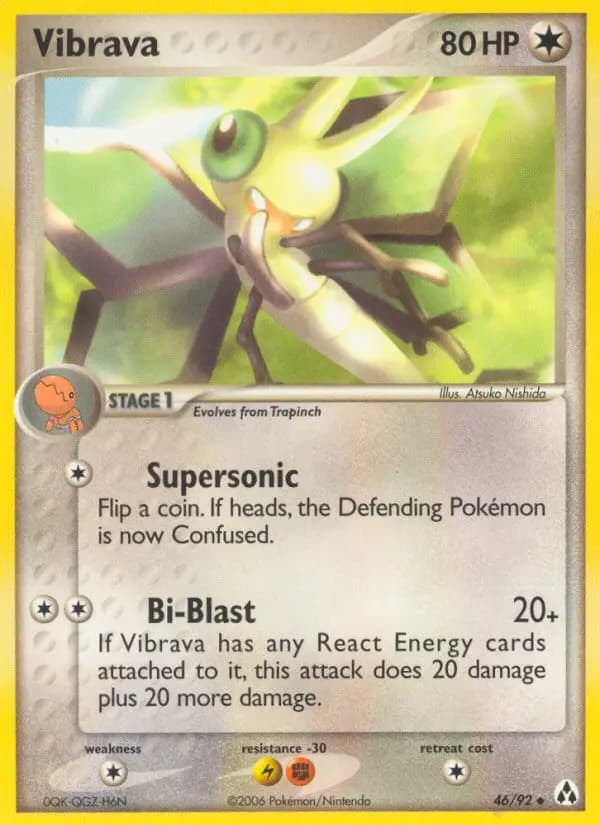
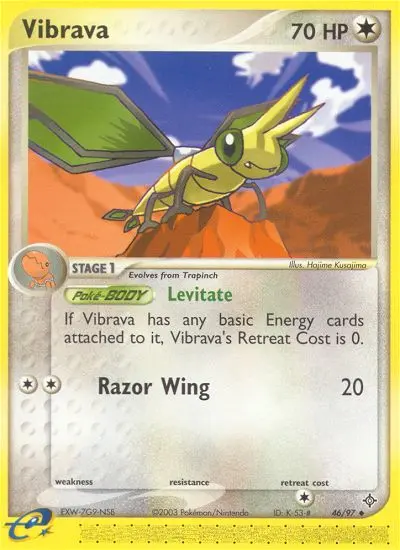
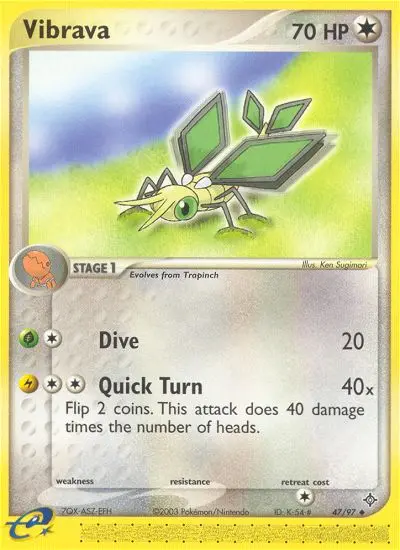
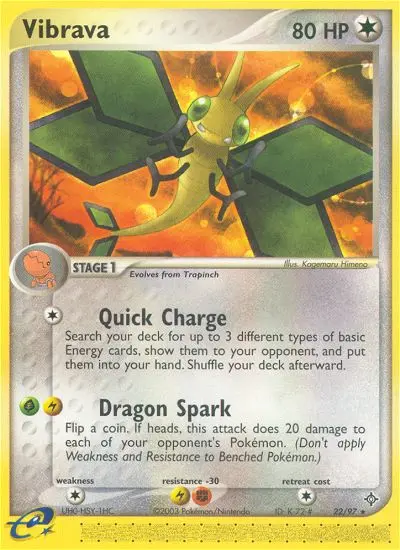
Vibrava has maintained modest but consistent presence within Pokémon media and fan culture since its introduction in Generation III, benefiting from association with the beloved Flygon evolutionary line that has cultivated a dedicated following across multiple game generations. The species frequently appears in Pokémon anime episodes featuring desert environments and desert-dwelling characters, establishing it as an iconic representation of arid biome Pokémon alongside Trapinch and Flygon. Within the trading card game, Vibrava has received periodic card support across various expansion sets, though it typically remains overshadowed by its more statistically impressive evolved form. Fan communities have developed particular affection for Vibrava as a representation of biological transformation and potential, with its unique ultrasonic wave generation mechanism inspiring artwork and fan fiction exploring the developmental biology of Pokémon. The creature's appearance in Pokémon Sword and Shield and subsequent games has maintained its visibility in contemporary Pokémon culture, with newer generations discovering Vibrava as they progress through their own journeys. Within competitive communities, Vibrava serves primarily as a stepping stone in discussions of Flygon's viability, though niche communities exploring lower-tier competitive formats occasionally showcase creative Vibrava strategies that surprise players expecting immediate evolution to its more powerful form.
Where to Find Vibrava in Every Pokémon Game
Vibrava's availability varies significantly across different Pokémon game generations and titles, reflecting its position as a mid-stage evolution that requires deliberate leveling progression rather than direct capture in most regions. In the original Generation III games (Ruby, Sapphire, and Emerald), players encounter Vibrava in desert areas after evolving their Trapinch, with the Hoenn regional Pokédex listing it as entry 117. Subsequent games including FireRed, LeafGreen, Diamond, Pearl, and Platinum maintained Vibrava's accessibility through natural progression of the Trapinch evolutionary line, though direct wild encounters remain uncommon. In Generation V's Black and White titles, Vibrava received new regional numbering while maintaining availability through the evolutionary chain, though the species became less prominently featured in later-game encounters. HeartGold and SoulSilver, the Generation IV remakes, included Vibrava within Johto and Kanto regional Pokédexes, allowing players to develop the species throughout their adventure. Modern generation titles including X and Y, Sun and Moon, Sword and Shield, and Scarlet and Violet have continued to feature Vibrava as an available Pokémon, though its presence often remains relegated to specific desert or mountain regions befitting its species characteristics. Players seeking to obtain Vibrava most efficiently should focus on catching Trapinch in their respective games' desert habitats and leveling the creature to level 35, ensuring reliable access to this fascinating middle-evolution stage. Alternatively, breeding captured Trapinch and evolving the resulting offspring provides another pathway to obtaining Vibrava specimens with optimal individual values for competitive or collection purposes.