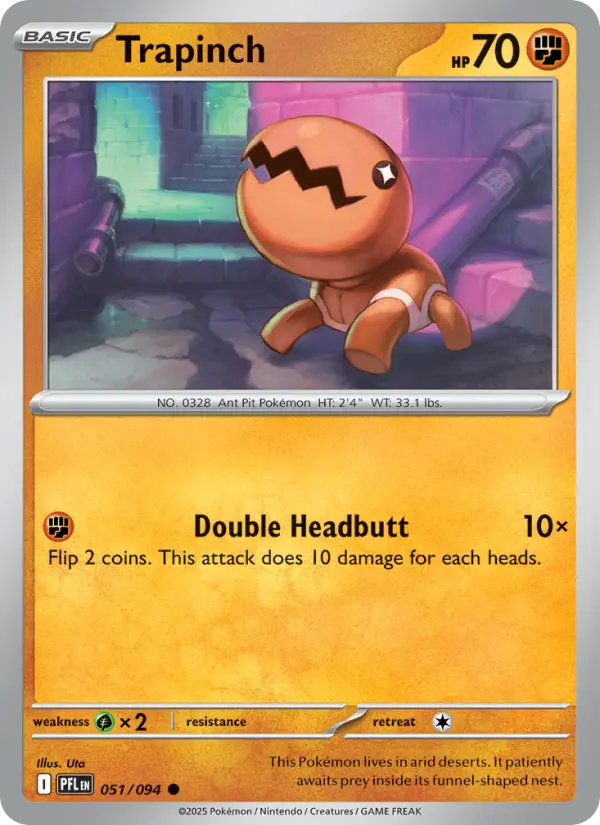
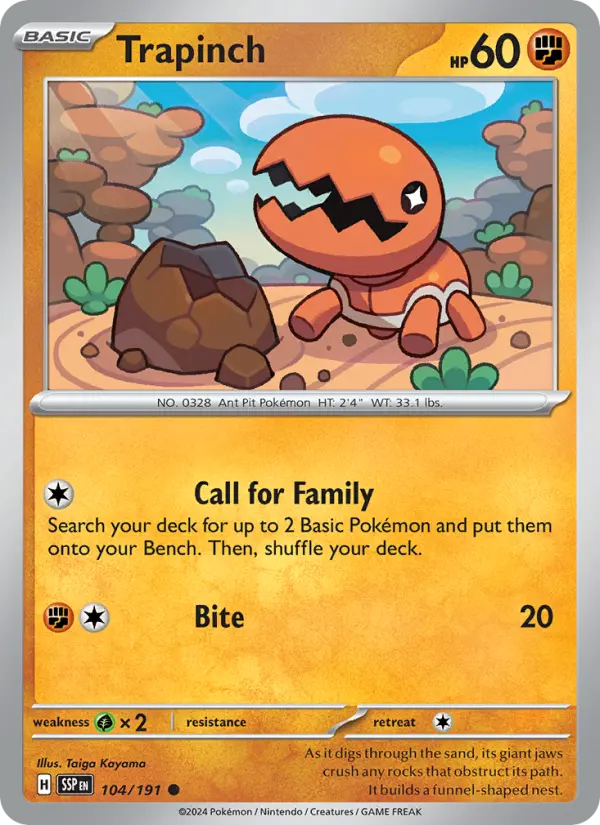
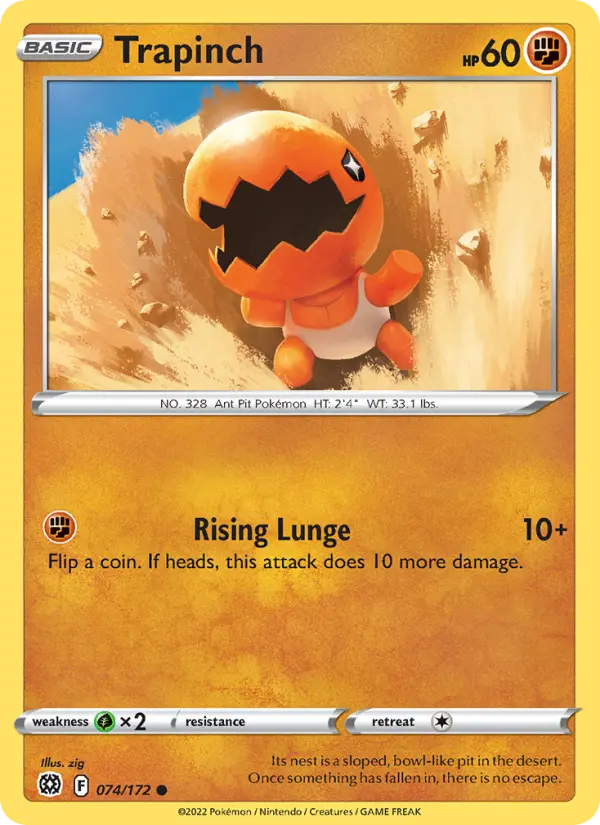
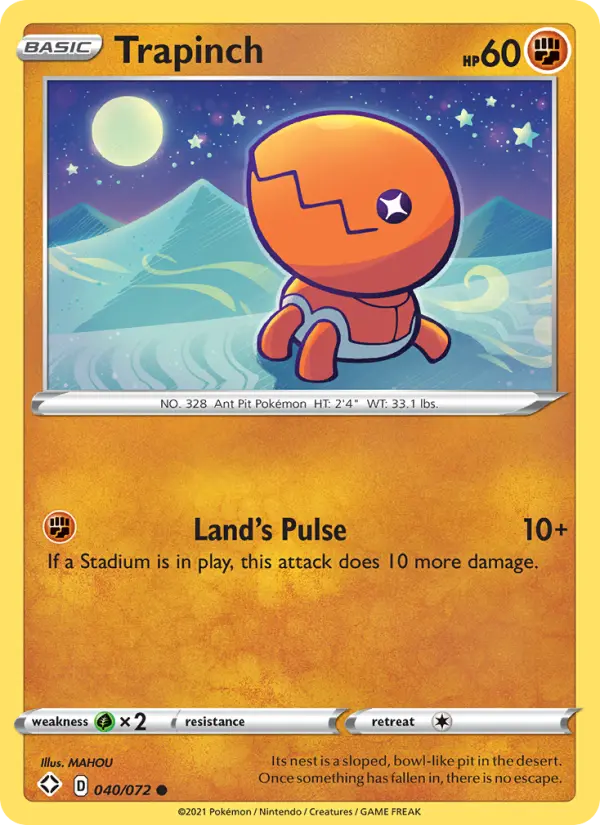
Trapinch
Generation III · #0328 — Ant Pit Pokémon
Trapinch is a ground-type Pokémon whose hp — 50 at base — does more to define its role than its overall spread does. Standing at just 0.7 meters tall and weighing 15 kilograms, this small but mighty Pokémon belies its true strength through its disproportionately large jaws capable of crushing boulders. With a cumulative stat total of 290 and an exceptionally high Attack stat of 100 for its stage of evolution, Trapinch demonstrates remarkable offensive potential that stands in sharp contrast to its other statistical deficiencies. Its capture rate of 255 makes it one of the easiest Pokémon to catch in the wild, reflecting its non-legendary status and role as an accessible entry-level Pokémon for trainers exploring desert regions.
Editor's Take
Trapinch has 100 base Attack and 10 base Speed, which is one of the most extreme stat contrasts in the game before evolution corrects it entirely.
Base Stats
Height
0.7m
Weight
15.0kg
Category
Ant Pit Pokémon
Gender
Male 50% / Female 50%
Color
brown
Shape
armor
Habitat
rough-terrain
Abilities
Prevents Attack from being lowered by other Pokémon.
Prevents opponents from fleeing or switching out. Eluded by flying-types and Pokémon in the air.
Strengthens moves with extra effects to 1.3× their power, but prevents their extra effects.

Trapinch Biology & Physical Characteristics
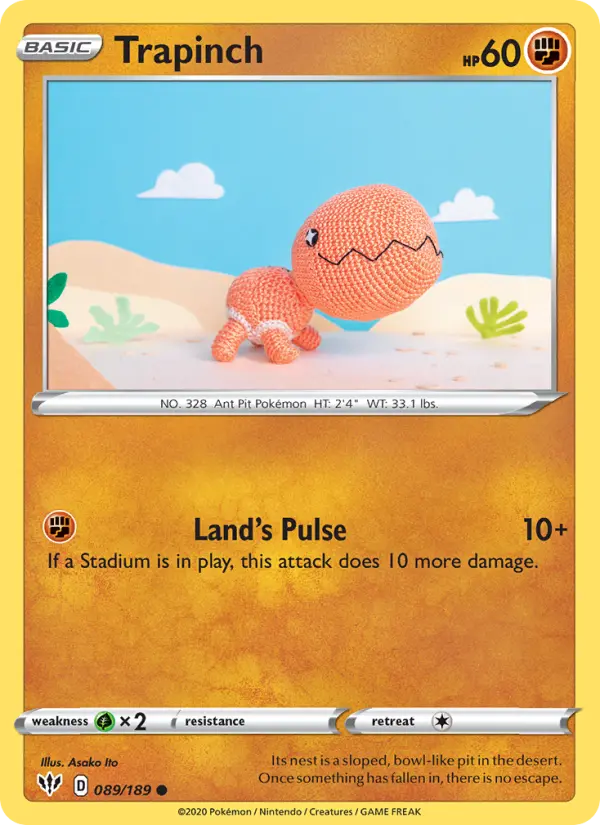
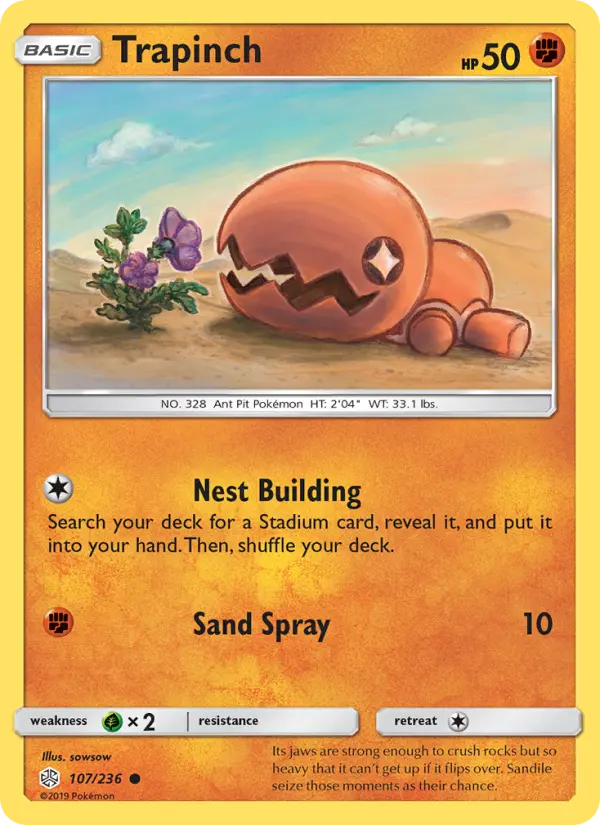
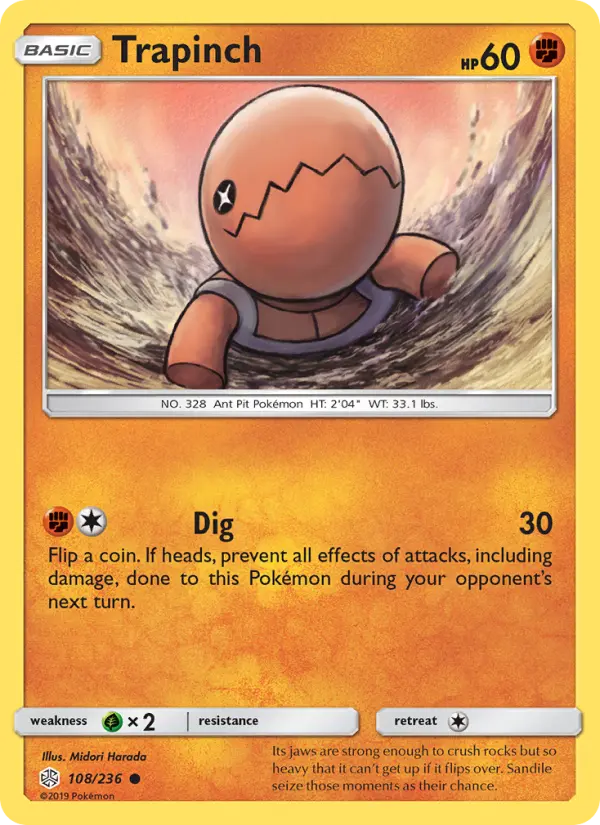
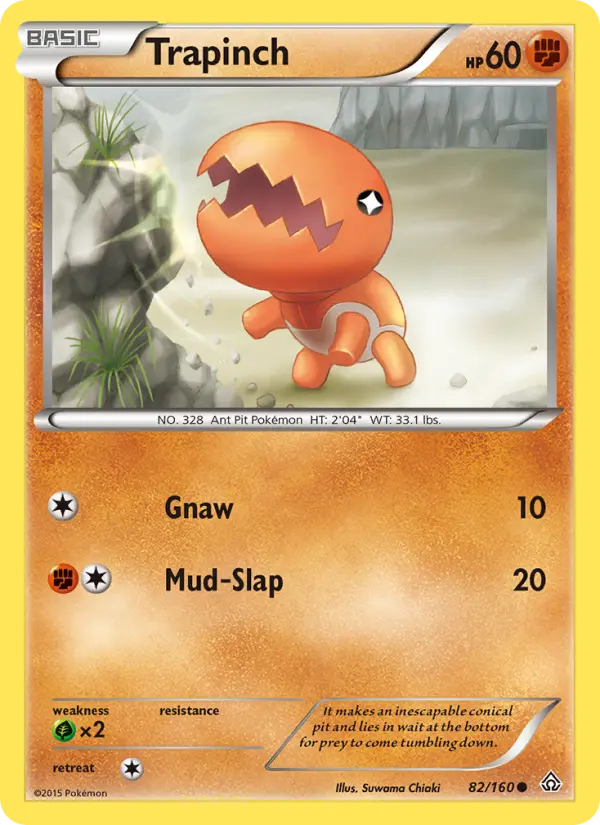
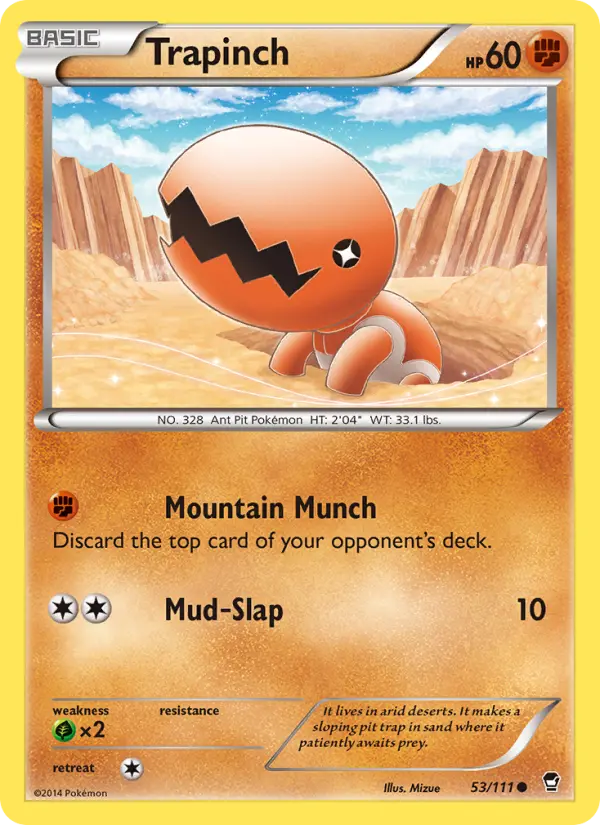
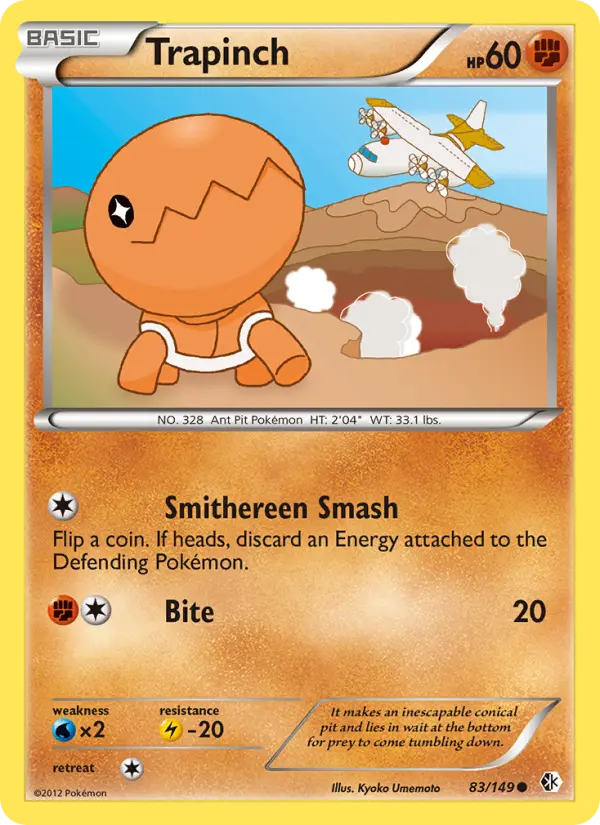
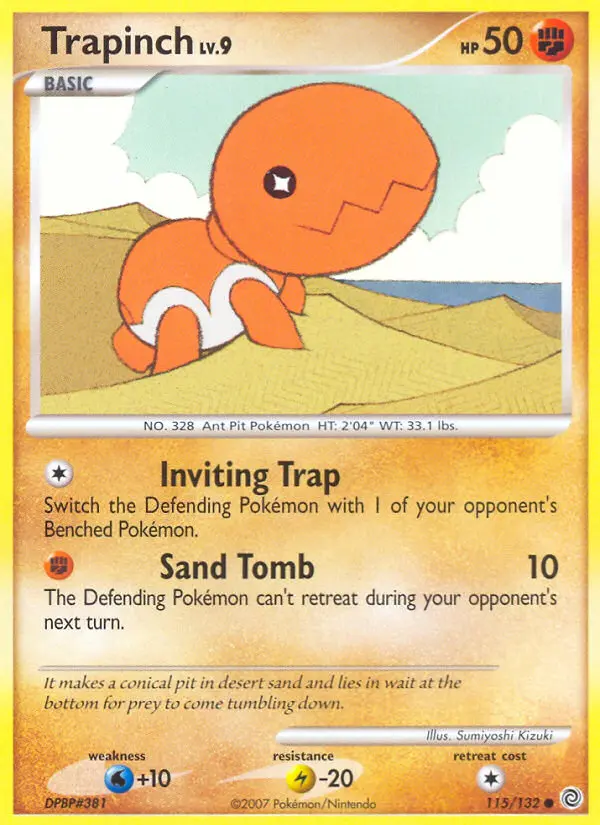
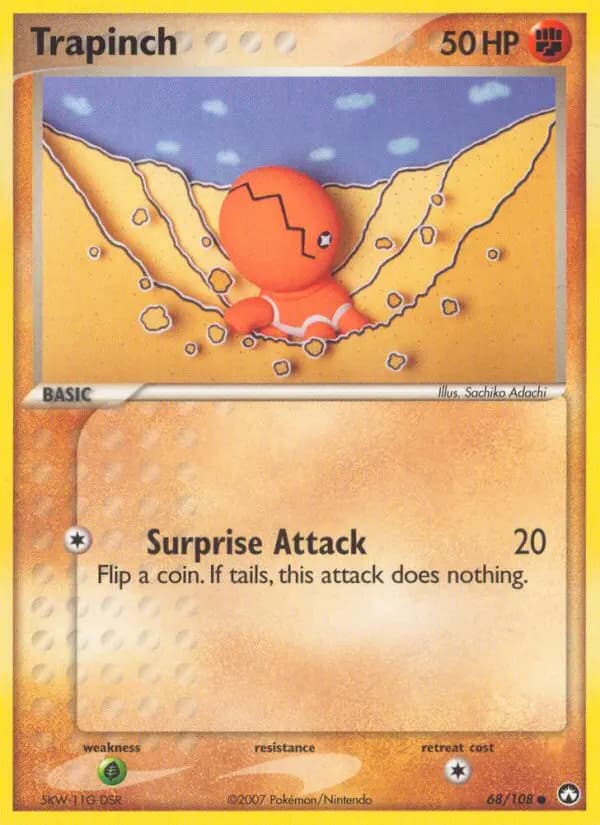
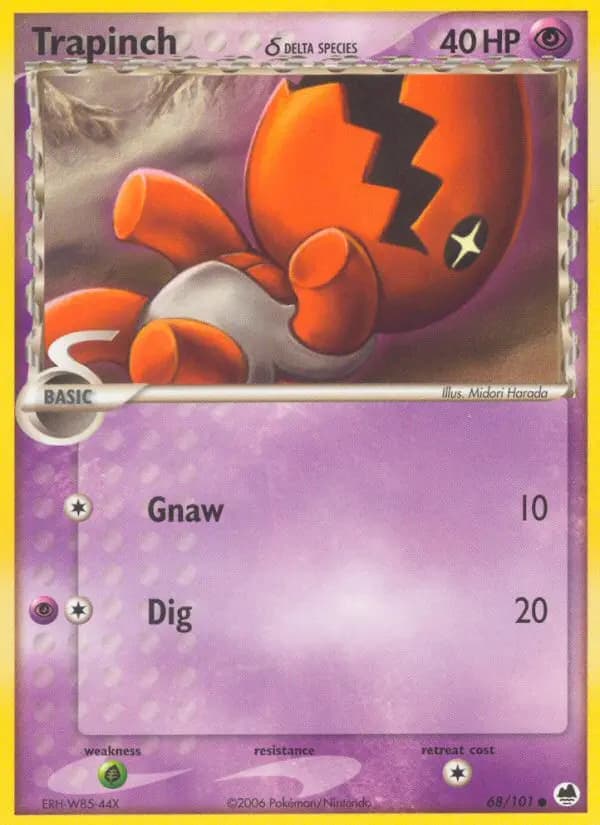
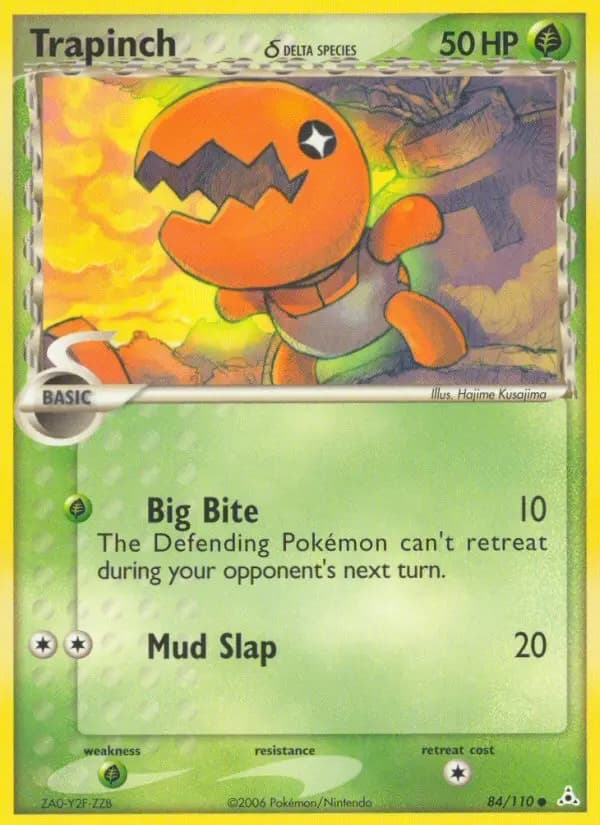
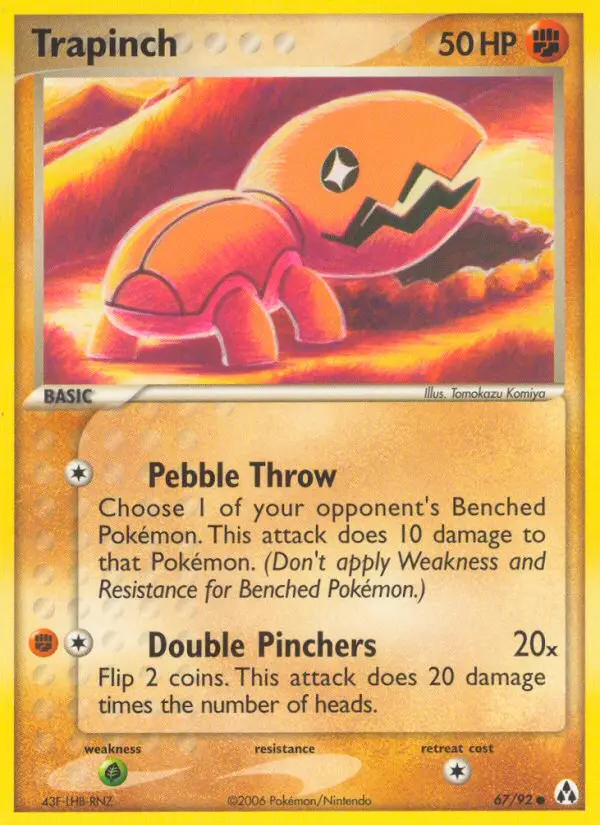
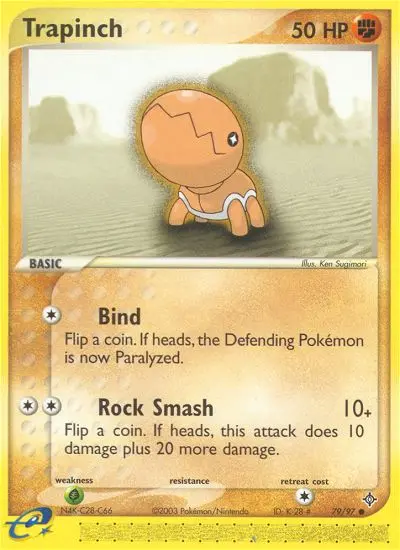
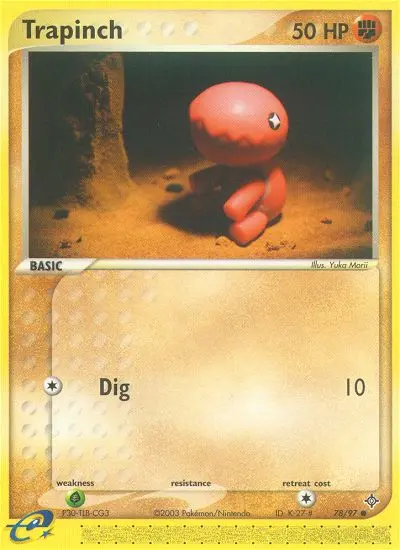
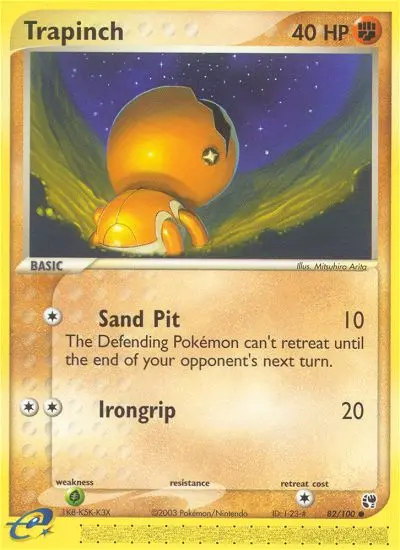
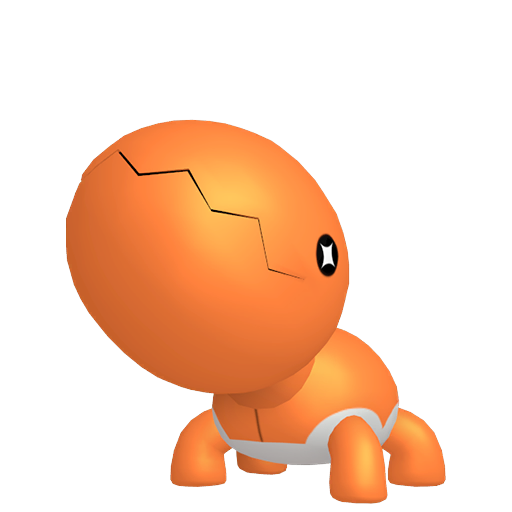
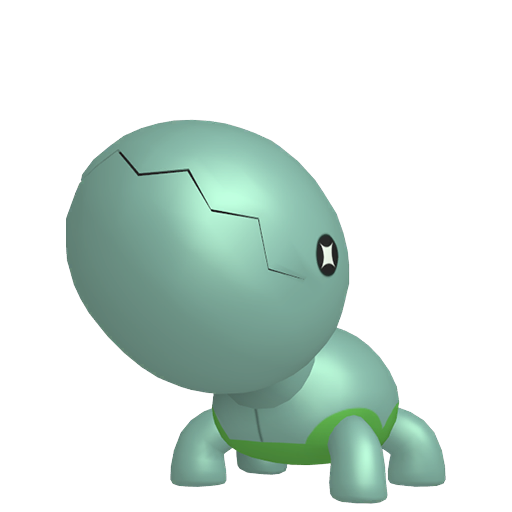
Trapinch presents a distinctly insectoid appearance, featuring an orange, rounded body with a notable white underside and four stubby legs that seem almost comically small relative to its proportions. The most striking feature is its enormous head, which dominates its frame and houses powerful mandibles lined with a distinctive zigzagging mouth. Its small black eyes, marked with characteristic twinkle-shaped pupils, reflect an intelligence belied by its diminutive size. The Pokédex entries across multiple generations consistently emphasize the crushing power of its jaws, noting that they are strong enough to pulverize boulders as the creature tunnels through desert sand. A peculiar physiological quirk that makes Trapinch vulnerable is its difficulty in righting itself if it tips over onto its back, a consequence of its oversized cranium compared to its compact body. This vulnerability has been noted as a natural weakness that leaves Trapinch defenseless against terrestrial predators such as Sandile, adding an interesting layer of realism to the species' survival challenges.
Pokedex Numbers
Training
Breeding
Trapinch Breeding, Gender Ratio & Egg Groups
Half of all Trapinch are male, half are female — no skew to plan around, making it equally likely for trainers to encounter either sex in the wild or to breed specimens of their preferred gender. The species belongs to both the Bug and Dragon egg groups, a dual classification that reflects its insectoid appearance and eventual Dragon-type evolution, opening diverse breeding possibilities with numerous compatible Pokémon across both groups. This egg group membership is particularly significant because it allows trainers to breed Trapinch with a wide variety of Pokémon to pass down egg moves and beneficial genetics, enhancing competitive viability from its earliest stages. The base happiness value of 70 (with some variation across generations, listed as 50 in more recent sources) indicates that Trapinch bonds reasonably well with its trainer through standard interaction and care, though it is not among the most affectionate species. The hatch counter of 20 cycles translates to approximately 4,884 to 5,140 steps, requiring moderate investment from the player to hatch from an egg compared to more demanding species, making it accessible for players interested in breeding projects without prohibitive time investment. The medium-slow experience growth rate means that Trapinch reaches its evolution thresholds at a measured pace, giving trainers ample opportunity to bond with and train their specimen before it transforms.
Sprites




Held Items
Soft Sand
type-enhancement
Held: Ground-Type moves from holder do 20% more damage.
Cost: 1000
Soft Sand
type-enhancement
Held: Ground-Type moves from holder do 20% more damage.
Cost: 1000
Soft Sand
type-enhancement
Held: Ground-Type moves from holder do 20% more damage.
Cost: 1000
Soft Sand
type-enhancement
Held: Ground-Type moves from holder do 20% more damage.
Cost: 1000
Soft Sand
type-enhancement
Held: Ground-Type moves from holder do 20% more damage.
Cost: 1000
Soft Sand
type-enhancement
Held: Ground-Type moves from holder do 20% more damage.
Cost: 1000
Soft Sand
type-enhancement
Held: Ground-Type moves from holder do 20% more damage.
Cost: 1000
Soft Sand
type-enhancement
Held: Ground-Type moves from holder do 20% more damage.
Cost: 1000
Soft Sand
type-enhancement
Held: Ground-Type moves from holder do 20% more damage.
Cost: 1000
Soft Sand
type-enhancement
Held: Ground-Type moves from holder do 20% more damage.
Cost: 1000
Soft Sand
type-enhancement
Held: Ground-Type moves from holder do 20% more damage.
Cost: 1000
Soft Sand
type-enhancement
Held: Ground-Type moves from holder do 20% more damage.
Cost: 1000
Soft Sand
type-enhancement
Held: Ground-Type moves from holder do 20% more damage.
Cost: 1000
Soft Sand
type-enhancement
Held: Ground-Type moves from holder do 20% more damage.
Cost: 1000
Soft Sand
type-enhancement
Held: Ground-Type moves from holder do 20% more damage.
Cost: 1000
Soft Sand
type-enhancement
Held: Ground-Type moves from holder do 20% more damage.
Cost: 1000
Soft Sand
type-enhancement
Held: Ground-Type moves from holder do 20% more damage.
Cost: 1000
Soft Sand
type-enhancement
Held: Ground-Type moves from holder do 20% more damage.
Cost: 1000
Soft Sand
type-enhancement
Held: Ground-Type moves from holder do 20% more damage.
Cost: 1000
Soft Sand
type-enhancement
Held: Ground-Type moves from holder do 20% more damage.
Cost: 1000
Soft Sand
type-enhancement
Held: Ground-Type moves from holder do 20% more damage.
Cost: 1000
Soft Sand
type-enhancement
Held: Ground-Type moves from holder do 20% more damage.
Cost: 1000
TMs & HMs
tm01
lets go pikachu lets go eevee
tm02
crystal
tm02
gold silver
tm05
lets go pikachu lets go eevee
tm06
yellow
tm06
gold silver
tm06
red blue
tm06
crystal
tm06
emerald
tm06
firered leafgreen
tm06
diamond pearl
tm06
platinum
tm06
ruby sapphire
tm06
colosseum
tm06
black 2 white 2
tm06
xd
tm06
black white
tm06
heartgold soulsilver
tm06
omega ruby alpha sapphire
tm06
ultra sun ultra moon
+523 more TMs/HMs
Trapinch's Evolution Chain


Trapinch Evolution, Mega Evolution & Special Forms
Trapinch occupies the crucial first position in a three-stage evolutionary line that represents one of the most dramatic transformations in the Pokémon universe. At level 35, Trapinch evolves into Vibrava, a Pokémon that gains the Dragon type and develops the ability to hover above the ground on vibrating wings, fundamentally altering its mobility and combat potential. The subsequent evolution at level 45 produces Flygon, the final form that retains the Ground and Dragon typing while achieving full aerial capability and significantly enhanced stats across the board. This evolution chain is notable for its thematic progression from a ground-bound ambush predator into a versatile flying combatant, mirroring the natural metamorphosis seen in insects like antlions, which transition from flightless larval forms to winged adult insects. The stat distribution shifts dramatically across the line, with Trapinch's exceptional Attack stat of 100 eventually being balanced by improved Special Attack and Speed in Flygon. Many trainers specifically seek out Trapinch in the early game precisely because of this promising evolutionary line, knowing that their patience in training this modest creature will be rewarded with a powerful dragon-type once both evolution thresholds are cleared.
Where to Find
Hoenn Route 111
hoenn
+6 more
Mirage Tower
hoenn
+3 more
Sinnoh Route 228
sinnoh
+1 more
Reversal Mountain
unova
+3 more
Desert Resort
unova
+1 more
Kalos Route 13
kalos
+5 more
Haina Desert
alola
+1 more
Trapinch Behaviour and Natural Habitat
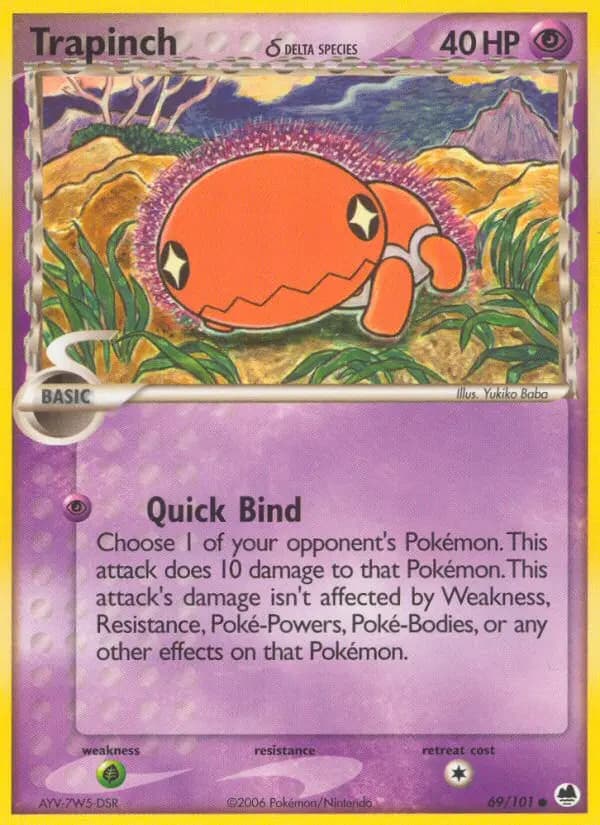
Trapinch is endemic to arid desert environments, where it has evolved a sophisticated hunting strategy based on patience and environmental manipulation rather than active pursuit. The Pokémon constructs its characteristic bowl-shaped or conical pit trap in desert sand, with multiple Pokédex sources describing how it digs these inescapable snares and waits patiently at the bottom for unsuspecting prey to tumble down into the trap. Once prey enters this funnel-shaped nest, escape becomes impossible, making Trapinch an efficient and economical hunter. Remarkably, the species demonstrates exceptional physiological adaptation to its harsh habitat, capable of surviving an entire week without access to food or water—a remarkable endurance that reflects the scarce resources of desert ecosystems. When night falls, Trapinch buries itself beneath the sand to sleep, a behavior that provides protection from nocturnal predators and temperature fluctuations. This behavioral pattern of creating elaborate traps and settling into patient ambush demonstrates a level of intelligence and planning uncommon in Pokémon, suggesting that Trapinch's seemingly simple lifestyle masks a complex understanding of predator-prey dynamics.
Pokedex Entries
TRAPINCH’s nest is a sloped, bowl-like pit dug in sand. This POKéMON patiently waits for prey to tumble down the pit. Its giant jaws have enough strength to crush even boulders.
TRAPINCH is a patient hunter. It digs an inescapable pit in a desert and waits for its prey to come tumbling down. This POKéMON can go a whole week without access to any water.
Its big jaws crunch through boulders. Because its head is so big, it has a hard time getting back upright if it tips over onto its back.
It lives in arid deserts. It makes a sloping pit trap in sand where it patiently awaits prey.
It makes a conical pit in desert sand and lies in wait at the bottom for prey to come tumbling down.
Its nest is a sloped, bowl-like pit in the desert. Once something has fallen in, there is no escape.
It makes a conical pit in desert sand and lies in wait at the bottom for prey to come tumbling down.
It makes an inescapable conical pit and lies in wait at the bottom for prey to come tumbling down.
It lives in arid deserts. It makes a sloping pit trap in sand where it patiently awaits prey.
It makes an inescapable conical pit and lies in wait at the bottom for prey to come tumbling down.
Trapinch’s nest is a sloped, bowl-like pit dug in sand. This Pokémon patiently waits for prey to tumble down the pit. Its giant jaws have enough strength to crush even boulders.
Trapinch is a patient hunter. It digs an inescapable pit in a desert and waits for its prey to come tumbling down. This Pokémon can go a whole week without access to any water.
It can live for a week without eating a thing. It waits patiently at the bottom of its nest for prey to appear.
Its jaws are strong enough to crush rocks but so heavy that it can’t get up if it flips over. Sandile seize those moments as their chance.
As it digs through the sand, its giant jaws crush any rocks that obstruct its path. It builds a funnel-shaped nest.
It builds nests that double as traps, lying in wait for its prey to get caught. When night falls, it digs itself a spot beneath the sand to sleep.
Its nest is a sloped, bowl-like pit in the desert. Once something has fallen in, there is no escape.
It makes an inescapable conical pit and lies in wait at the bottom for prey to come tumbling down.
Trapinch Name Origin & Design Inspiration
Trapinch's name traces to a combination of 'trap' and 'antlion,' directly referencing the insect that inspired its design and behavioral patterns. This etymology is reinforced by the Japanese designation 'Nuckrar,' which itself appears to reference the antlion (known as 'nukera' in Japanese) and their characteristic pit-trapping behavior. The design itself is a masterclass in form following function: the oversized mandibles serve as both the creature's primary tool for excavating its pit traps and its lethal weapon in combat, while the sturdy body and short legs are optimized for burrowing rather than sprinting. The orange coloration with white underside provides desert camouflage, allowing the Pokémon to blend into sandy terrain when partially buried. The genus designation 'Ant Pit Pokémon' explicitly acknowledges its dual nature as an insect-inspired creature that constructs and inhabits pit traps similar to those of antlion larvae. This grounded biological approach to Pokémon design—where the creature's appearance, abilities, and behavior all coherently reflect a real-world animal and ecological niche—represents some of Generation III's strongest conceptual work and helps explain why Trapinch has remained a beloved Pokémon across multiple generations.
Learnable Moves
Trapinch can learn 63 moves:
Move | Type | Cat. | Power | Acc. | PP |
|---|---|---|---|---|---|
| astonish | ghost | Physical | 30 | 100 | 15 |
| attract | normal | Status | — | 100 | 15 |
| bide | normal | Physical | — | — | 10 |
| bite | dark | Physical | 60 | 100 | 25 |
| body slam | normal | Physical | 85 | 100 | 15 |
| bug bite | bug | Physical | 60 | 100 | 20 |
| bulldoze | ground | Physical | 60 | 100 | 20 |
| captivate | normal | Status | — | 100 | 20 |
| confide | normal | Status | — | — | 20 |
| crunch | dark | Physical | 80 | 100 | 15 |
| dig | ground | Physical | 80 | 100 | 10 |
| double team | normal | Status | — | — | 15 |
| double edge | normal | Physical | 120 | 100 | 15 |
| earth power | ground | Special | 90 | 100 | 10 |
| earthquake | ground | Physical | 100 | 100 | 10 |
| endure | normal | Status | — | — | 10 |
| facade | normal | Physical | 70 | 100 | 20 |
| feint | normal | Physical | 30 | 100 | 10 |
| feint attack | dark | Physical | 60 | — | 20 |
| first impression | bug | Physical | 90 | 100 | 10 |
| fissure | ground | Physical | — | 30 | 5 |
| flail | normal | Physical | — | 100 | 15 |
| focus energy | normal | Status | — | — | 30 |
| frustration | normal | Physical | — | 100 | 20 |
| fury cutter | bug | Physical | 40 | 95 | 20 |
| giga drain | grass | Special | 75 | 100 | 10 |
| gust | flying | Special | 40 | 100 | 35 |
| headbutt | normal | Physical | 70 | 100 | 15 |
| hidden power | normal | Special | 60 | 100 | 15 |
| hyper beam | normal | Special | 150 | 90 | 5 |
| laser focus | normal | Status | — | — | 30 |
| mimic | normal | Status | — | — | 10 |
| mud shot | ground | Special | 55 | 95 | 15 |
| mud slap | ground | Special | 20 | 100 | 10 |
| natural gift | normal | Physical | — | 100 | 15 |
| protect | normal | Status | — | — | 10 |
| quick attack | normal | Physical | 40 | 100 | 30 |
| rest | psychic | Status | — | — | 5 |
| return | normal | Physical | — | 100 | 20 |
| rock slide | rock | Physical | 75 | 90 | 10 |
| rock smash | fighting | Physical | 40 | 100 | 15 |
| rock tomb | rock | Physical | 60 | 95 | 15 |
| round | normal | Special | 60 | 100 | 15 |
| sand attack | ground | Status | — | 100 | 15 |
| sand tomb | ground | Physical | 35 | 85 | 15 |
| sandstorm | rock | Status | — | — | 10 |
| scorching sands | ground | Special | 70 | 100 | 10 |
| secret power | normal | Physical | 70 | 100 | 20 |
| signal beam | bug | Special | 75 | 100 | 15 |
| sleep talk | normal | Status | — | — | 10 |
| snore | normal | Special | 50 | 100 | 15 |
| solar beam | grass | Special | 120 | 100 | 10 |
| stealth rock | rock | Status | — | — | 20 |
| stone edge | rock | Physical | 100 | 80 | 5 |
| strength | normal | Physical | 80 | 100 | 15 |
| struggle bug | bug | Special | 50 | 100 | 20 |
| substitute | normal | Status | — | — | 10 |
| sunny day | fire | Status | — | — | 5 |
| superpower | fighting | Physical | 120 | 100 | 5 |
| swagger | normal | Status | — | 85 | 15 |
| take down | normal | Physical | 90 | 85 | 20 |
| tera blast | normal | Special | 80 | 100 | 10 |
| toxic | poison | Status | — | 90 | 10 |
Trapinch Competitive Battle Guide
Looking at its competitive profile, Trapinch occupies an interesting niche as a pure physical attacker with respectable offensive prowess for the early game metagame, though its competitive viability diminishes significantly in higher-tier formats. Its base Attack stat of 100 is genuinely impressive for a first-stage Pokémon, allowing it to deal consistent physical damage with moves like Earthquake once it learns them, and its Ground typing provides valuable offensive coverage against Electric, Fire, Poison, and Rock types. The Arena Trap ability deserves particular attention in competitive contexts, as it prevents opponents from switching out or fleeing, effectively locking in unfavorable matchups and enabling strategic advantage in specific team compositions, though Flying types and airborne Pokémon evade this restriction. However, Trapinch's severe speed deficiency with a base Speed stat of just 10 makes it critically vulnerable to faster opponents, guaranteeing that it will move last in virtually all competitive encounters—a liability that becomes increasingly problematic at higher levels of play. The Hidden Ability Sheer Force, which amplifies moves with secondary effects to 1.3× their power while removing those effects, theoretically provides an alternative competitive avenue, though Trapinch's limited movepool restricts its practical application. Most competitive players view Trapinch as a stepping stone to Vibrava and ultimately Flygon, where the evolutionary benefits provide the bulk and Speed necessary for genuine competitive threat, making Trapinch itself better suited to casual play, in-game progression, and lower-tier format experimentation.
Commonly Asked Questions About Trapinch
What type is Trapinch?
Trapinch is a ground type Pokemon.
What does Trapinch evolve into?
Trapinch evolves into vibrava, then into flygon.
What are Trapinch's weaknesses?
Trapinch is weak to water, grass and ice type moves.
Does Trapinch evolve by trading?
No — Trapinch evolves entirely through leveling up, with no trade required at any stage.
Where can I find Trapinch?
Trapinch can be found in hoenn route 111 (hoenn), mirage tower (hoenn) and sinnoh route 228 (sinnoh) and 4 other locations.
Trapinch Cultural Impact & Franchise History
Trapinch has cultivated a dedicated following within the Pokémon community, earning recognition as one of the most charming and characterful early-game Pokémon despite—or perhaps because of—its humble appearance and seemingly simple design. The creature's design inspiration from the antlion has resonated with trainers who appreciate the show's capacity to ground Pokémon concepts in genuine natural history, making it a subject of educational interest and admiration among biology enthusiasts. In the Pokémon anime, Trapinch has received meaningful representation, most notably through Goh's Trapinch, which has appeared prominently in the Sword and Shield series, introducing the species to new generations of viewers and reinforcing its cultural presence. The evolutionary line from Trapinch to Flygon has become iconic precisely because it represents the possibility of transformation and growth—narratively powerful concepts that resonate with the core themes of Pokémon training and development. Fan communities have created extensive artwork, fiction, and analysis celebrating Trapinch's design philosophy and ecological niche, with appreciation particularly directed toward how the species embodies patience and strategy as survival mechanisms. Merchandise featuring Trapinch has remained relatively consistent across generations, and the creature frequently appears in Pokémon merchandising and promotional materials aimed at celebrating the broader appeal of Generation III, cementing its status as a memorable, if not flagship, member of the Pokédex.
Where to Find Trapinch in Every Pokémon Game
Trapinch's availability has varied significantly across generations, though it has maintained consistent presence as a desert-dwelling Pokémon in its native habitat. In the Generation III originating games—Ruby, Sapphire, and Emerald—Trapinch appears in the Hoenn Pokédex as entry #116 and can be encountered in desert areas, making it accessible to players who explore these biomes. Subsequent generations have relocated Trapinch to various regional Pokédexes: it appears in Black 2 and White 2, the X and Y games (specifically in Mountain Kalos), Omega Ruby and Alpha Sapphire (as expected in the expanded Hoenn region), and later in Sun and Moon as part of the expanded Alola Pokédex. More recent games including Sword and Shield continue to feature Trapinch availability, typically in desert or arid biome areas that thematically match its environmental preferences. The exceptionally high capture rate of 255—the maximum possible—reflects Trapinch's accessibility as a non-rare encounter, ensuring that trainers seeking this species will encounter little difficulty in adding it to their collections once they reach appropriate desert environments. Players interested in breeding Trapinch for competitive purposes or shiny variants will find the species readily available in most modern games, though players in some regions may need to trade or use Pokémon Bank services to transfer specimens between game generations if breeding opportunities are limited in their current version.