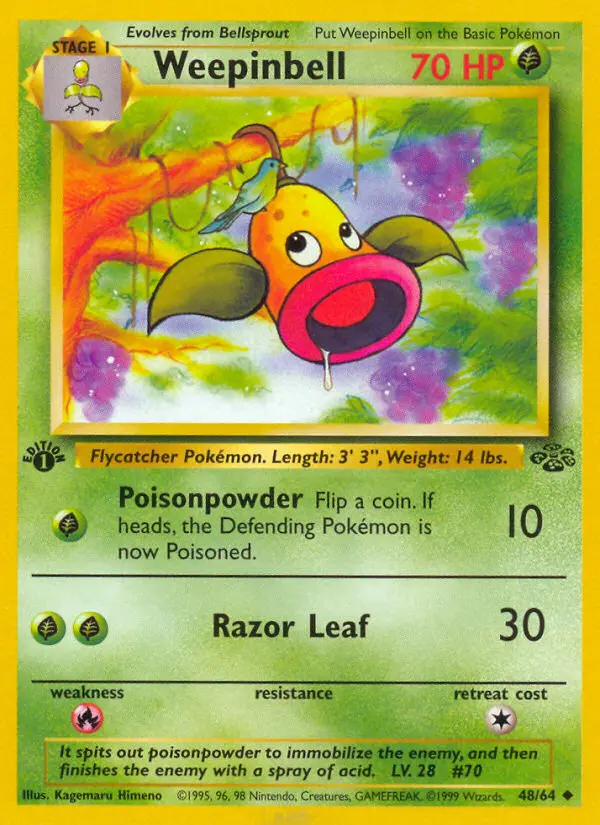
Weepinbell
Generation I · #0070 — Flycatcher Pokémon
Weepinbell's chlorophyll ability is the first thing worth knowing about it — everything else, from its grass/poison typing to its build, follows from how that ability gets used. The species benefits from the Chlorophyll ability, which doubles its Speed during strong sunlight, making it particularly effective in sun-based competitive teams, while its hidden ability Gluttony allows it to consume held Berries more eagerly when its health drops below half capacity.
Editor's Take
Weepinbell is a stage you pass through on the way to a Victreebel most people never wanted, and the line's whole existence is a version-exclusive counterweight to Oddish.
Base Stats
Height
1.0m
Weight
6.4kg
Category
Flycatcher Pokémon
Gender
Male 50% / Female 50%
Color
green
Shape
blob
Habitat
forest
Abilities
Doubles Speed during strong sunlight.
Makes the Pokémon eat any held Berry triggered by low HP below 1/2 its max HP.

Weepinbell Biology & Physical Characteristics
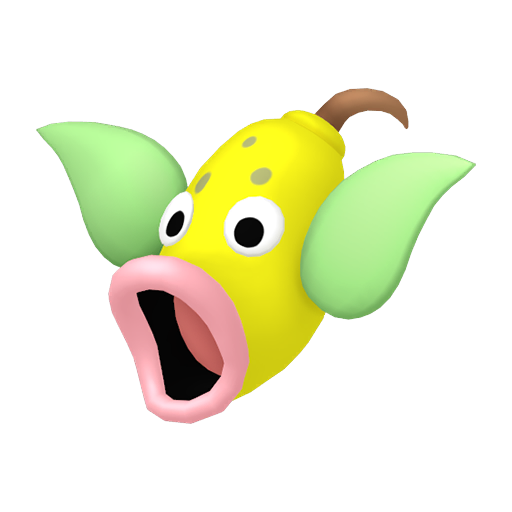
Weepinbell's physical form is a masterpiece of evolutionary adaptation, featuring a distinctive bell-shaped yellow body that closely mimics the appearance of a carnivorous pitcher plant. Above its pair of circular, innocent-looking eyes sit three small green spots that serve as camouflage, while a brown, hook-shaped stem crowns its head like a botanical crown. Most striking are the large green leaves flanking each side of its body, which function as razor-sharp cutting implements capable of slicing through prey that proves too large for consumption. The creature possesses a wide, gaping mouth with distinctive pink lips that opens to reveal its deadly arsenal—the ability to spray poisonous powder from within to immobilize unsuspecting prey before dissolving them with potent internal acids. Remarkably, Weepinbell's own tissues remain unharmed by these corrosive acids because the Pokémon continuously secretes a neutralizing fluid that acts as internal protection, a biological adaptation that speaks to millions of years of evolutionary refinement. This unique biochemistry was first documented in the Gold version Pokédex and remains one of the species' most scientifically intriguing characteristics.
Pokedex Numbers
Training
Breeding
Weepinbell Breeding, Gender Ratio & Egg Groups
Weepinbell exhibits a perfectly balanced gender distribution, with exactly 50 percent of wild-caught specimens being male and 50 percent female, a characteristic that makes breeding programs straightforward and predictable for dedicated trainers. The species belongs to the Grass egg group, meaning compatible breeding partners include other Grass-type Pokémon and any others sharing this egg classification. Eggs produced from breeding programs hatch relatively quickly by Pokémon standards, requiring approximately 20 cycles of travel—translating to roughly 4,884 to 5,140 steps—before the offspring emerges from its shell. Newly hatched Weepinbell enter the world with a base friendship value of 70, indicating a moderate positive disposition toward their trainer from birth, though this friendliness value can increase through positive interactions, battles, and care. The species maintains a medium-slow growth rate, meaning Weepinbell requires more experience points than fast-growing Pokémon to advance through levels, balancing its potent offensive statistics with a more gradual progression curve that prevents it from becoming overwhelming in early-game scenarios. For competitive breeding purposes, careful IV and nature selection becomes crucial when developing Weepinbell for specific roles, particularly if the trainer intends to leverage the hidden Gluttony ability rather than the standard Chlorophyll option.
Sprites





TMs & HMs
tm01
lets go pikachu lets go eevee
tm02
crystal
tm02
gold silver
tm03
yellow
tm03
crystal
tm03
gold silver
tm03
red blue
tm03
blue japan
tm03
red green japan
tm05
lets go pikachu lets go eevee
tm06
yellow
tm06
gold silver
tm06
red blue
tm06
crystal
tm06
emerald
tm06
firered leafgreen
tm06
diamond pearl
tm06
platinum
tm06
ruby sapphire
tm06
colosseum
+553 more TMs/HMs
Weepinbell's Evolution Chain


Weepinbell Evolution, Mega Evolution & Special Forms
Weepinbell occupies a crucial position within the Bellsprout evolutionary line, representing the intermediate stage between the diminutive Bellsprout and the fully evolved Victreebel. The species evolves from Bellsprout once that Pokémon reaches level 21, marking the transition from a small grass sprout into a considerably more formidable hunter with noticeably enhanced Attack and Special Attack statistics. This evolution provides meaningful stat improvements across most of Weepinbell's attributes, with Attack increasing from Bellsprout's 75 to 90, Special Attack rising from 70 to 85, and Health Points improving from 55 to 65. However, the evolutionary journey does not end with Weepinbell, as this form can undergo a final transformation into the powerful Victreebel when exposed to a Leaf Stone. This final evolution represents the culmination of the line's predatory development, granting significant boosts to Attack and Special Attack that transform the already dangerous Weepinbell into a formidable special attacker. The evolutionary pathway demonstrates deliberate design, as Weepinbell serves as an optimal midpoint where trainers can decide whether to commit a Leaf Stone to the final evolution or continue using the form as-is.
Where to Find
Kanto Route 13
kanto
+5 more
Kanto Route 12
kanto
+5 more
Kanto Route 14
kanto
+2 more
Kanto Route 15
kanto
+3 more
Cerulean Cave
kanto
Kanto Route 24
kanto
+23 more
Johto Route 44
johto
+12 more
Kanto Route 25
kanto
+19 more
Water Path
kanto
Cape Brink
kanto
Berry Forest
kanto
Bond Bridge
kanto
Sinnoh Route 224
sinnoh
Sinnoh Route 229
sinnoh
+1 more
Sinnoh Sea Route 230
sinnoh
Kalos Route 16
kalos
+1 more
Kalos Route 14
kalos
+1 more
Kalos Route 19
kalos
+3 more
Kanto Sea Route 21
kanto
Weepinbell Behaviour and Natural Habitat
Weepinbell exhibits a predatory lifestyle that perfectly matches its appearance as a living flycatcher, spending most of its time camouflaged within temperate forests and jungles where it awaits unsuspecting prey. The Pokémon demonstrates remarkable patience, positioning itself among vegetation and remaining motionless until potential meals draw near. When hunger strikes, Weepinbell becomes an aggressive hunter, swinging its razor-sharp leaves wildly to slice up any unfortunate creature within range—behavior documented in the Crystal version Pokédex as particularly frenzied when the Pokémon's hunger reaches critical levels. Most intriguingly, Weepinbell employs a sophisticated multi-stage hunting strategy: first immobilizing targets with poison powder, then subjecting them to corrosive acid spray, and finally devouring the dissolved remains or consuming anything that moves whole when sufficiently famished. The species' nocturnal habits are equally fascinating, as documented in both Ruby and Sapphire Pokédex entries. At nightfall, Weepinbell hooks onto tree branches using its distinctive rear hook-shaped stem to secure itself safely aloft while sleeping. However, this precarious perch comes with risks—if the Pokémon shifts position during sleep, it may lose its grip and awaken unceremoniously on the ground below, a humbling reminder that even apex predators are not immune to gravity's influence.
Pokedex Entries
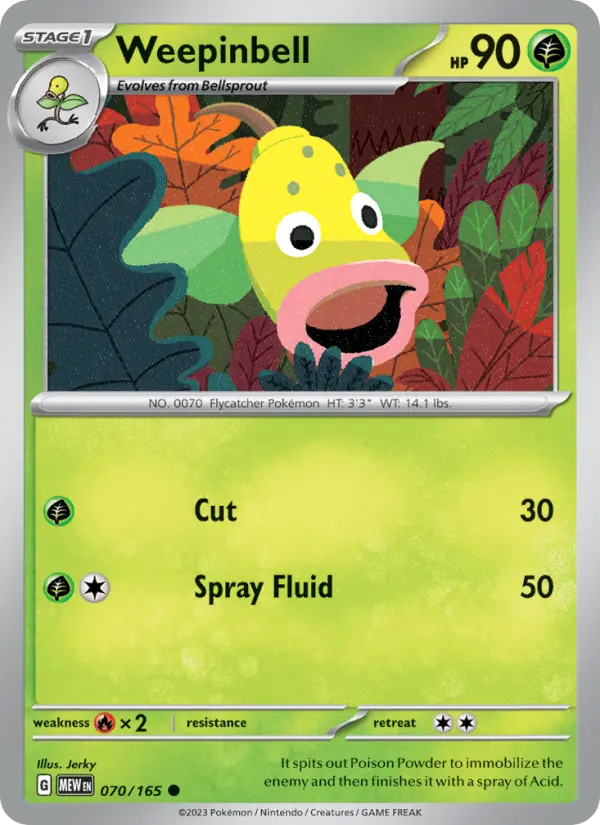
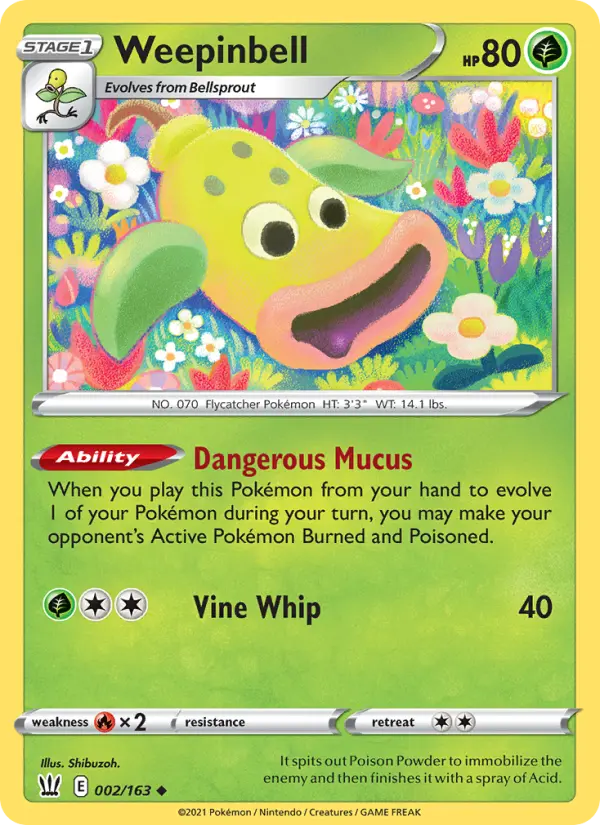
It spits out POISONPOWDER to immobilize the enemy and then finishes it with a spray of ACID.
When hungry, it swallows anything that moves. Its hapless prey is melted inside by strong acids.
Even though it is filled with ACID, it does not melt because it also oozes a neutral izing fluid.
If its prey is bigger than its mouth, it slices up the victim with sharp leaves, then eats every morsel.
When it's hungry, it swings its razor-sharp leaves, slicing up any unlucky object nearby for food.
WEEPINBELL has a large hook on its rear end. At night, the POKéMON hooks on to a tree branch and goes to sleep. If it moves around in its sleep, it may wake up to find itself on the ground.
At night, a WEEPINBELL hangs on to a tree branch with its hooked rear and sleeps. If it moves around in its sleep, it may wake up to find itself on the ground.
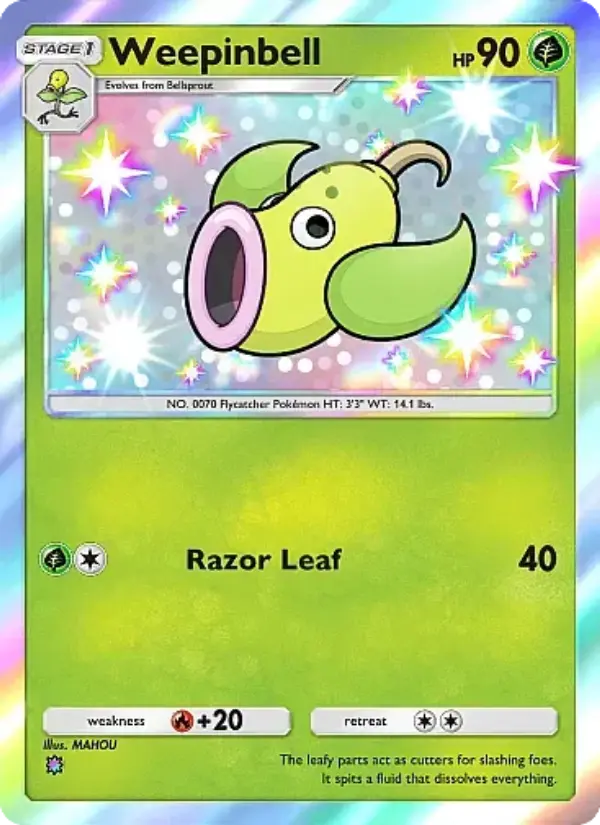
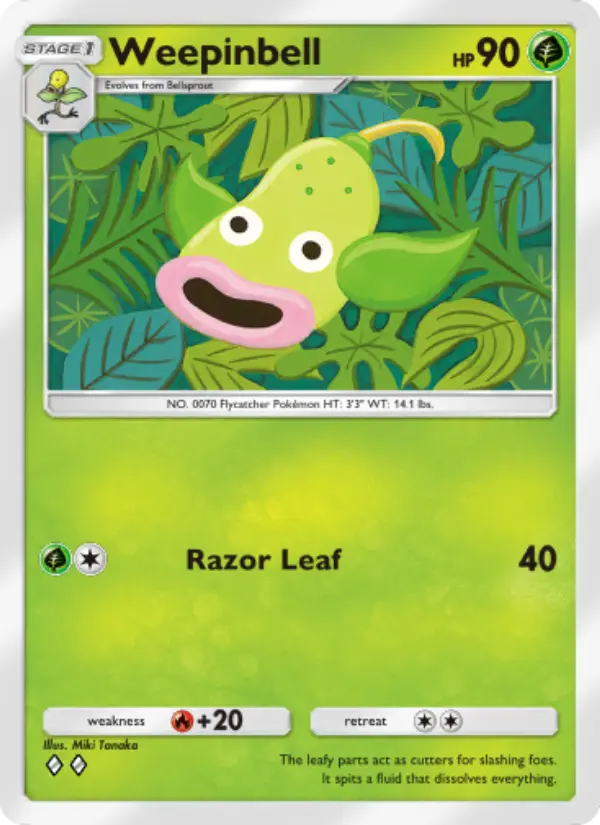
The leafy parts act as cutters for slashing foes. It spits a fluid that dissolves everything.
It spits out POISONPOWDER to immobilize the enemy and then finishes it with a spray of ACID.
A Pokémon that appears to be a plant. It captures unwary prey by dousing them with a toxic powder.
Even though it is filled with acid, it does not melt because it also oozes a protective fluid.
If its prey is bigger than its mouth, it slices up the victim with sharp leaves, then eats every morsel.
A Pokémon that appears to be a plant. It captures unwary prey by dousing them with a toxic powder.
A Pokémon that appears to be a plant. It captures unwary prey by dousing them with a toxic powder.
The leafy parts act as cutters for slashing foes. It spits a fluid that dissolves everything.
It spits out Poison Powder to immobilize the enemy and then finishes it with a spray of Acid.
Weepinbell has a large hook on its rear end. At night, the Pokémon hooks on to a tree branch and goes to sleep. If it moves around in its sleep, it may wake up to find itself on the ground.
When hungry, it swallows anything that moves. Its hapless prey is dissolved by strong acids.
Weepinbell Name Origin & Design Inspiration
Weepinbell's name traces to a clever combination of 'weeping' and 'bell,' perfectly encapsulating both the Pokémon's bell-shaped silhouette and the drooping, downturned mouth that gives it a perpetually sorrowful expression despite its carnivorous nature. The Japanese name Utsudon uses 'utsu,' which refers to the Pokémon's poisonous spray, combined with 'don,' suggesting the bell shape, creating a distinctly different linguistic foundation while achieving similar conceptual goals. From a design perspective, Weepinbell represents a straightforward evolution of Bellsprout's aesthetic, enlarging and refining the original form into something distinctly more threatening while maintaining recognizable visual continuity. The artist deliberately emphasized the carnivorous plant inspiration, particularly the pitcher plant family, evident in the bell-shaped body, gaping mouth, and leaf appendages that function as cutting implements. The color palette of soft yellows contrasted with green leaves and brown stem creates a deceptively pleasant appearance that masks the creature's lethal nature—a design philosophy that reflects the real-world camouflage strategies employed by carnivorous plants in nature. The addition of the distinctive hook-shaped rear stem serves both functional and aesthetic purposes, providing a method of suspension while adding unique silhouette recognition that distinguishes Weepinbell from other Grass-types.
Learnable Moves
Weepinbell can learn 82 moves:
Move | Type | Cat. | Power | Acc. | PP |
|---|---|---|---|---|---|
| acid | poison | Special | 40 | 100 | 30 |
| acid spray | poison | Special | 40 | 100 | 20 |
| attract | normal | Status | — | 100 | 15 |
| bide | normal | Physical | — | — | 10 |
| bind | normal | Physical | 15 | 85 | 20 |
| body slam | normal | Physical | 85 | 100 | 15 |
| bug bite | bug | Physical | 60 | 100 | 20 |
| bullet seed | grass | Physical | 25 | 100 | 30 |
| captivate | normal | Status | — | 100 | 20 |
| clear smog | poison | Special | 50 | — | 15 |
| confide | normal | Status | — | — | 20 |
| curse | ghost | Status | — | — | 10 |
| cut | normal | Physical | 50 | 95 | 30 |
| double team | normal | Status | — | — | 15 |
| double edge | normal | Physical | 120 | 100 | 15 |
| encore | normal | Status | — | 100 | 5 |
| endure | normal | Status | — | — | 10 |
| energy ball | grass | Special | 90 | 100 | 10 |
| facade | normal | Physical | 70 | 100 | 20 |
| flash | normal | Status | — | 100 | 20 |
| frustration | normal | Physical | — | 100 | 20 |
| gastro acid | poison | Status | — | 100 | 10 |
| giga drain | grass | Special | 75 | 100 | 10 |
| grass knot | grass | Special | — | 100 | 20 |
| grassy glide | grass | Physical | 55 | 100 | 20 |
| grassy terrain | grass | Status | — | — | 10 |
| growth | normal | Status | — | — | 20 |
| headbutt | normal | Physical | 70 | 100 | 15 |
| hidden power | normal | Special | 60 | 100 | 15 |
| infestation | bug | Special | 20 | 100 | 20 |
| ingrain | grass | Status | — | — | 20 |
| knock off | dark | Physical | 65 | 100 | 20 |
| leaf storm | grass | Special | 130 | 90 | 5 |
| leech life | bug | Physical | 80 | 100 | 10 |
| lunge | bug | Physical | 80 | 100 | 15 |
| magical leaf | grass | Special | 60 | — | 20 |
| mega drain | grass | Special | 40 | 100 | 15 |
| mimic | normal | Status | — | — | 10 |
| natural gift | normal | Physical | — | 100 | 15 |
| nature power | normal | Status | — | — | 20 |
| poison jab | poison | Physical | 80 | 100 | 20 |
| poison powder | poison | Status | — | 75 | 35 |
| pounce | bug | Physical | 50 | 100 | 20 |
| power whip | grass | Physical | 120 | 85 | 10 |
| protect | normal | Status | — | — | 10 |
| rage | normal | Physical | 20 | 100 | 20 |
| razor leaf | grass | Physical | 55 | 95 | 25 |
| reflect | psychic | Status | — | — | 20 |
| rest | psychic | Status | — | — | 5 |
| return | normal | Physical | — | 100 | 20 |
| round | normal | Special | 60 | 100 | 15 |
| secret power | normal | Physical | 70 | 100 | 20 |
| seed bomb | grass | Physical | 80 | 100 | 15 |
| slam | normal | Physical | 80 | 75 | 20 |
| sleep powder | grass | Status | — | 75 | 15 |
| sleep talk | normal | Status | — | — | 10 |
| sludge bomb | poison | Special | 90 | 100 | 10 |
| sludge wave | poison | Special | 95 | 100 | 10 |
| snore | normal | Special | 50 | 100 | 15 |
| solar beam | grass | Special | 120 | 100 | 10 |
| strength sap | grass | Status | — | 100 | 10 |
| stun spore | grass | Status | — | 75 | 30 |
| substitute | normal | Status | — | — | 10 |
| sucker punch | dark | Physical | 70 | 100 | 5 |
| sunny day | fire | Status | — | — | 5 |
| swagger | normal | Status | — | 85 | 15 |
| sweet scent | normal | Status | — | 100 | 20 |
| swift | normal | Special | 60 | — | 20 |
| swords dance | normal | Status | — | — | 20 |
| synthesis | grass | Status | — | — | 5 |
| take down | normal | Physical | 90 | 85 | 20 |
| tera blast | normal | Special | 80 | 100 | 10 |
| thief | dark | Physical | 60 | 100 | 25 |
| tickle | normal | Status | — | 100 | 20 |
| toxic | poison | Status | — | 90 | 10 |
| trailblaze | grass | Physical | 50 | 100 | 20 |
| venoshock | poison | Special | 65 | 100 | 10 |
| vine whip | grass | Physical | 45 | 100 | 25 |
| weather ball | normal | Special | 50 | 100 | 10 |
| worry seed | grass | Status | — | 100 | 10 |
| wrap | normal | Physical | 15 | 90 | 20 |
| wring out | normal | Special | — | 100 | 5 |
Weepinbell Competitive Battle Guide
Weepinbell's competitive viability centers primarily on its respectable Special Attack stat of 85 combined with its surprisingly useful Chlorophyll ability, which doubles Speed during weather-dependent sun teams—a niche but legitimate competitive application. The Pokémon's Attack stat of 90 provides a secondary offensive avenue, allowing it to function as a mixed attacker when the situation demands physical coverage moves like Leaf Blade or Acid Powder combined with special moves such as Sludge Bomb and Energy Ball. However, Weepinbell's relatively fragile defensive profile, with Defense and Special Defense stats of only 50 and 45 respectively, severely limits its survivability against competent opponents, making careful team construction and speed control essential for success. The species' mediocre Speed stat of 55 without Chlorophyll support further compounds its vulnerabilities, as Weepinbell often finds itself unable to outpace common threats and lacking the bulk to survive their attacks. In competitive formats where Weepinbell might see occasional use, experienced players typically employ it as a specialized role player within sun teams where its Chlorophyll ability can be reliably activated, transforming it into a moderately threatening sweeper. Its movepool remains competent though not exceptional, offering access to Poison-type moves, Grass-type coverage, and some utility options, but lacking the breadth of coverage that would elevate it to consistent threat status. Most competitive players recognize that investing in the final evolution Victreebel represents superior value, as that form's significantly enhanced Attack and Special Attack statistics address many of Weepinbell's fundamental limitations.
Commonly Asked Questions About Weepinbell
What type is Weepinbell?
Weepinbell is a grass and poison type Pokemon.
What does Weepinbell evolve into?
Weepinbell evolves into victreebel.
What are Weepinbell's weaknesses?
Weepinbell is weak to flying, fire, psychic and ice type moves.
Does Weepinbell evolve by trading?
No — Weepinbell evolves entirely through leveling up, with no trade required at any stage.
Where can I find Weepinbell?
Weepinbell can be found in kanto route 13 (kanto), kanto route 12 (kanto) and kanto route 14 (kanto) and 16 other locations.
Weepinbell Cultural Impact & Franchise History
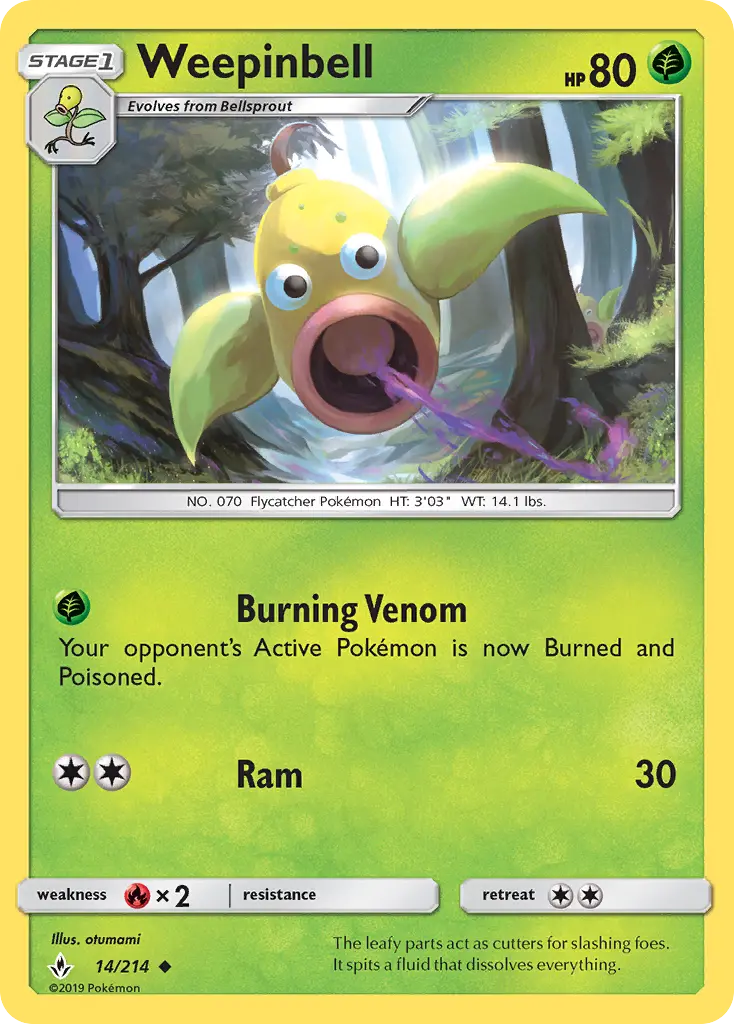
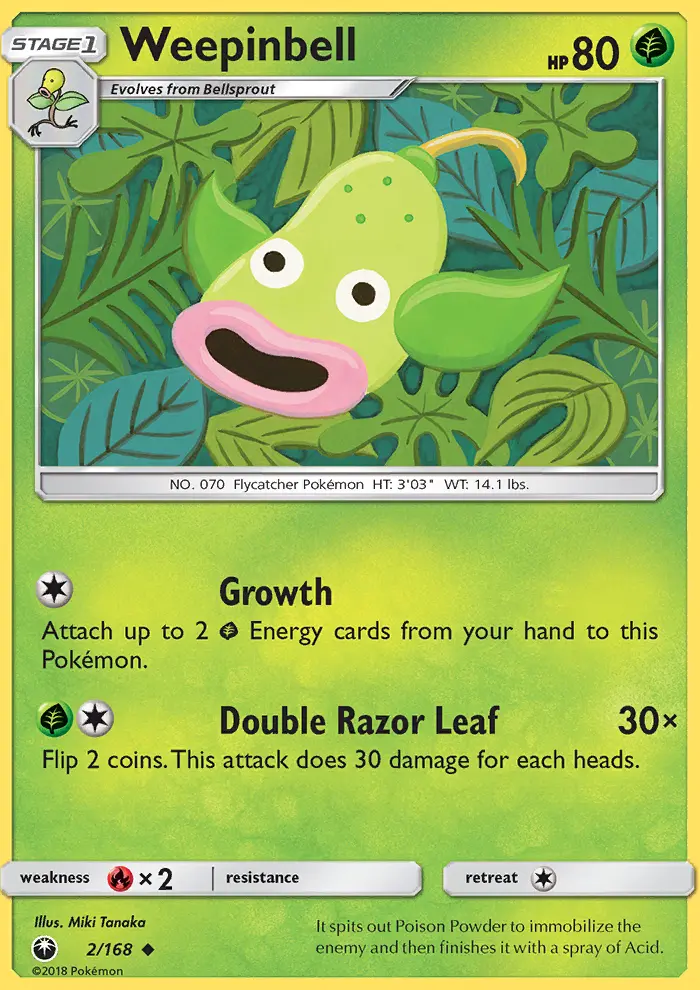
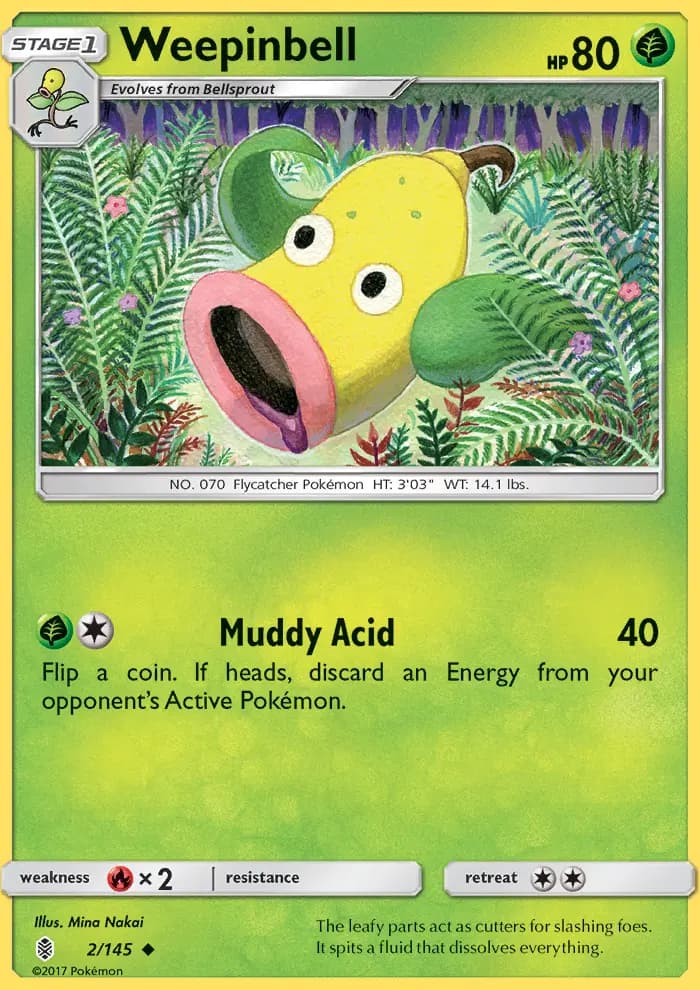
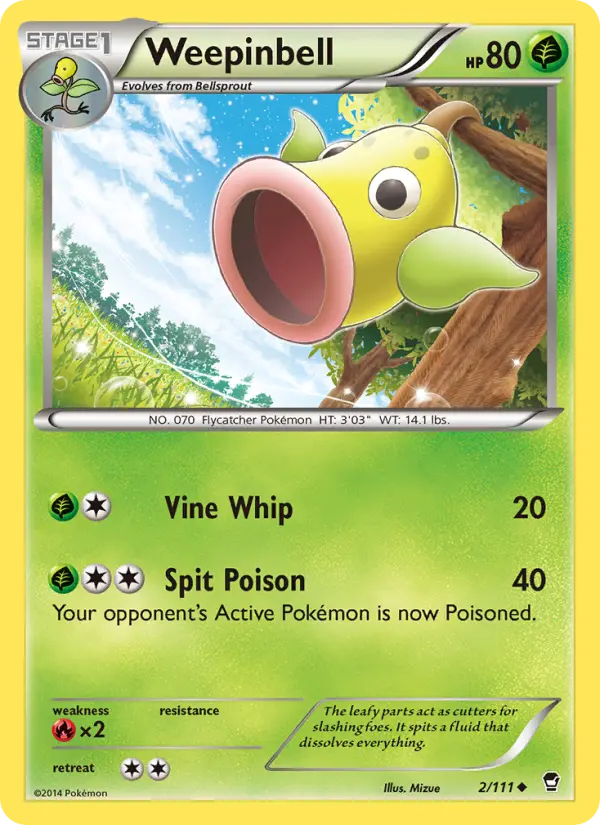
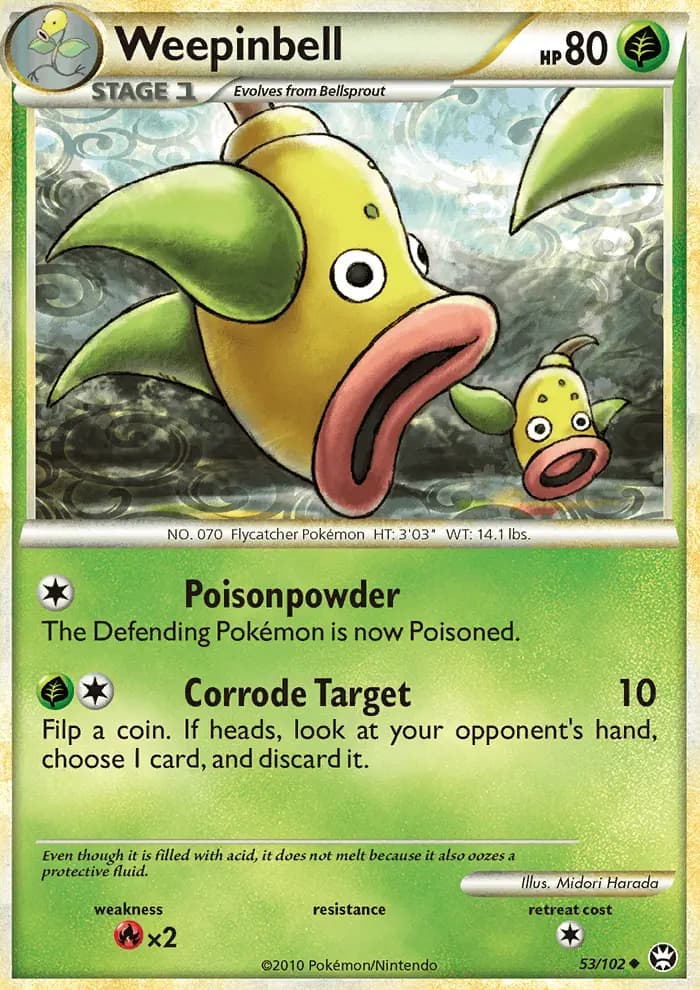
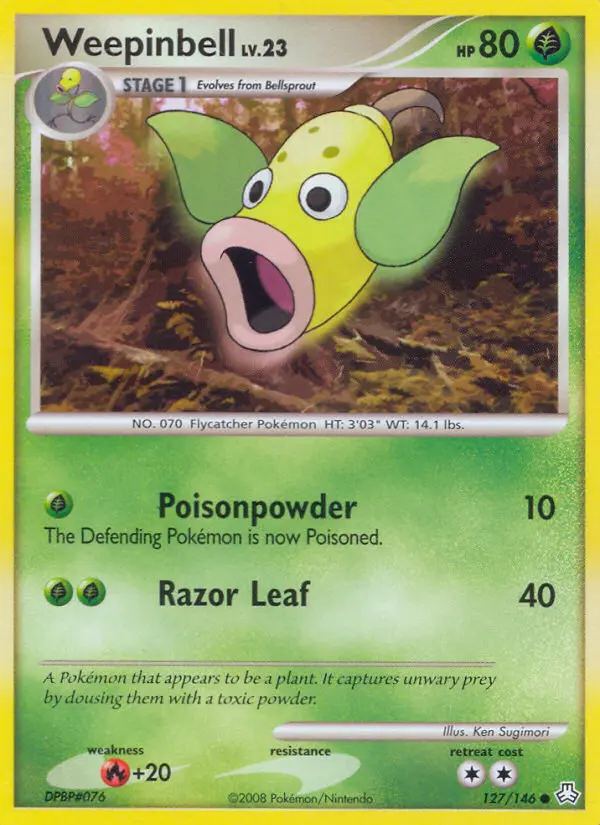
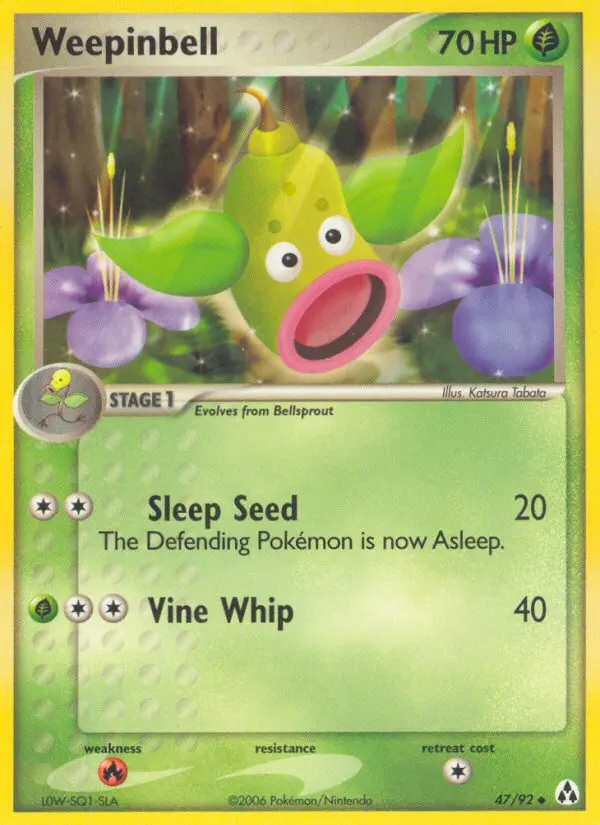
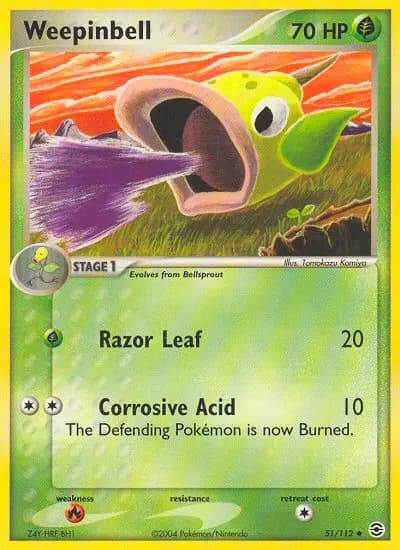
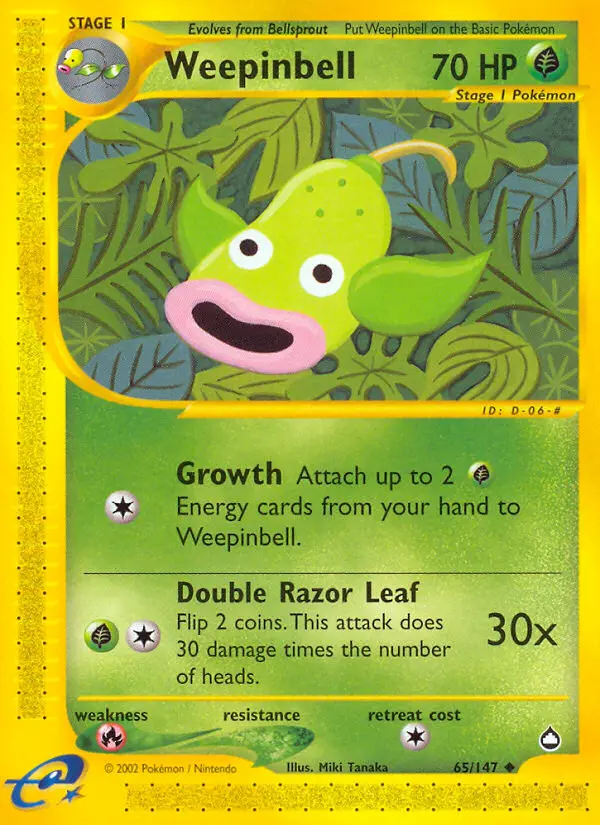
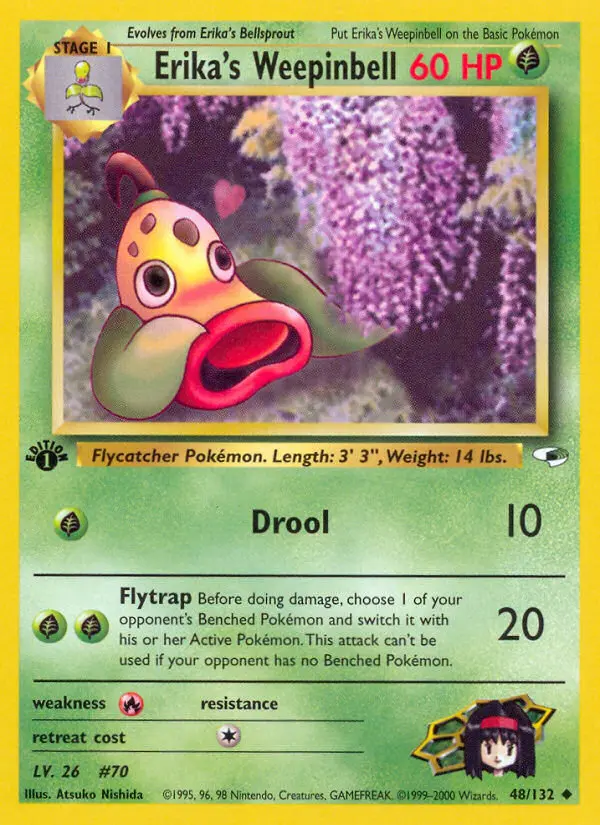
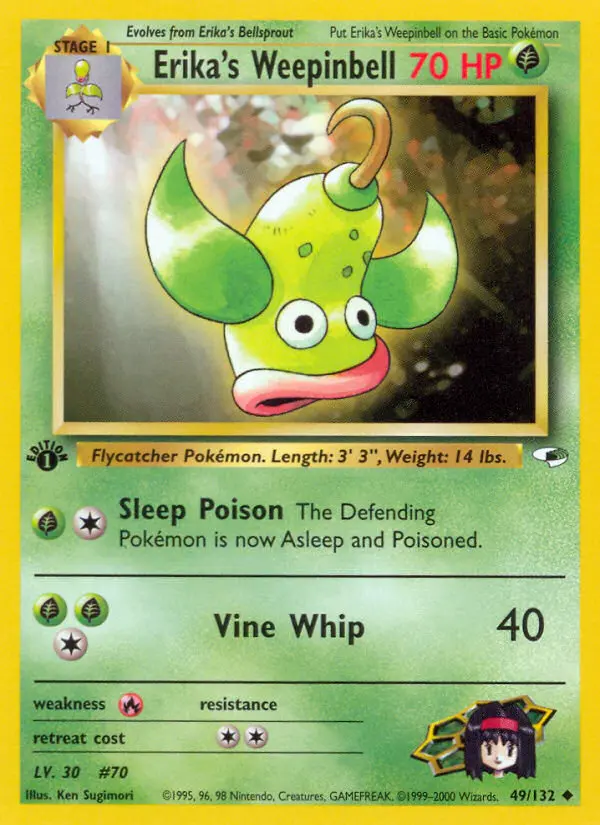
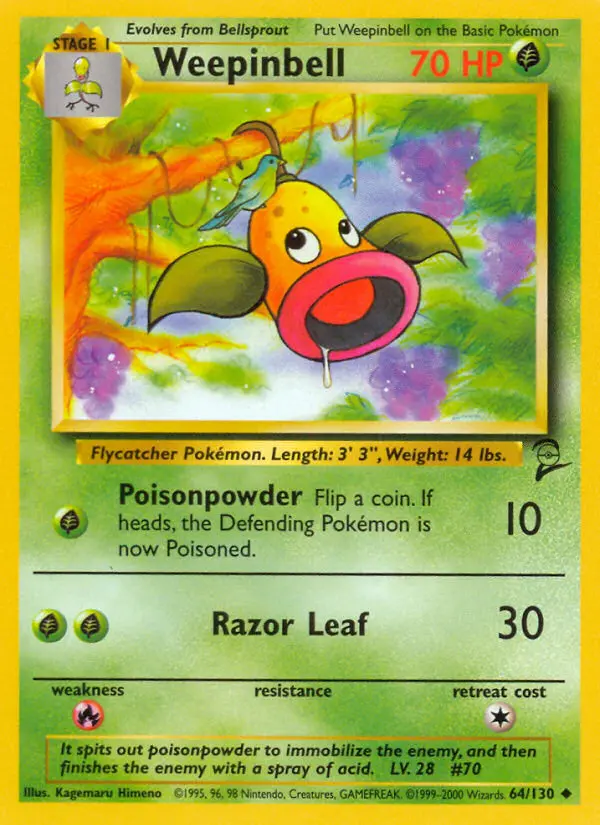
Weepinbell holds considerable nostalgic significance within the Pokémon franchise, particularly among players who experienced the original Generation I games on Game Boy platforms where it served as a reliable team member for many trainers undertaking their initial journey through Kanto. The species received notable anime representation through James's Weepinbell, an iconic partnership that featured prominently throughout the early seasons of the Pokémon anime series, where the creature's unpredictable behavior and surprising effectiveness in battle endeared it to viewers despite its middling competitive status. This anime prominence contributed significantly to Weepinbell's lasting recognition among the broader Pokémon fanbase, ensuring its place in gaming culture despite its eventual overshadowing by more mechanically powerful alternatives. The design's clear inspiration from real-world carnivorous plants, particularly the pitcher plant family, resonated with audiences and educators alike, making Weepinbell a compelling example of how Pokémon design can educate while entertaining. Within trading card game communities, Weepinbell has appeared in numerous collectible card iterations spanning multiple generations, with vintage Base Set and Jungle Set cards maintaining appreciable value among completionists and nostalgia-driven collectors. The species' accessibility and moderate statistical profile made it approachable for casual players while remaining sufficiently distinctive to avoid feeling entirely generic, contributing to its enduring presence in Pokémon media across multiple decades.
Where to Find Weepinbell in Every Pokémon Game
Weepinbell's availability varies considerably across different Pokémon games, reflecting its position as a moderately common species that nonetheless requires some intentional effort to obtain. In the original Red, Blue, and Yellow versions, Weepinbell can be encountered in Viridian Forest, Route 24-25, and Route 5-7 as a wild encounter, making it relatively accessible to players willing to train a Bellsprout from early levels or catch wild Weepinbell directly. Across subsequent generations, the species maintains similar availability patterns, appearing in various grassy routes and forested areas appropriate to the region's ecology, though specific locations shift with each game's regional design. In modern games, particularly Pokémon Let's Go Pikachu and Let's Go Eevee, Weepinbell appears in wild encounters and can also be obtained through evolution of Bellsprout at level 21, providing players multiple pathways to acquisition. The species rarely appears as a gift or trade encounter, meaning players typically must either capture wild specimens or undertake the breeding process themselves to obtain Weepinbell with specific desired characteristics. In Pokémon Legends: Arceus and The Teal Mask DLC content, Weepinbell's availability reflects those respective games' unique mechanics and regional species distributions. The moderate capture rate of 120 means Weepinbell proves relatively easy to catch with standard Poké Balls when encountered in the wild, encouraging players to attempt captures without requiring specialized ball types or status conditions to ensure success.