Bellsprout
Generation I · #0069 — Flower Pokémon
Bellsprout measures in at 0.7 m and 4 kg, a build that matches its chlorophyll ability better than it matches raw offense or defense. Despite its diminutive stature at just 0.7 meters tall and a mere 4.0 kilograms in weight, Bellsprout possesses remarkable physical agility and predatory instincts that belie its gentle botanical appearance. Its extremely high catch rate of 255 reflects its role as one of the most commonly encountered grass-type Pokémon in the early routes of various games, making it a staple of many trainers' initial rosters. With a aggregate stat total of 300 and a medium-slow growth rate, Bellsprout gradually develops into a more formidable combatant through dedicated training and evolution.
Editor's Take
Bellsprout's line has the same stone-branch structure as Oddish's without either endpoint being interesting, which makes it the clearest case of Gen 1 duplicating an idea it had already used better.
Base Stats
Height
0.7m
Weight
4.0kg
Category
Flower Pokémon
Gender
Male 50% / Female 50%
Color
green
Shape
humanoid
Habitat
forest
Abilities
Doubles Speed during strong sunlight.
Makes the Pokémon eat any held Berry triggered by low HP below 1/2 its max HP.

Bellsprout Biology & Physical Characteristics
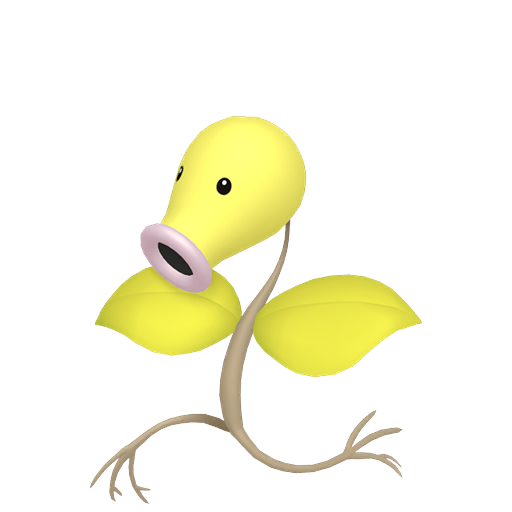
Bellsprout's distinctive morphology reflects its carnivorous nature despite its plant-based origins. The Pokémon features a slender, bell-shaped yellow head with what appear to be delicate pink lips, crowned by a single pair of opposing green leaves extending from each side of its stem-like brown body. Its most notable adaptation is its pair of vine-like appendages that extend from its head, capable of rapid extension and contraction to ensnare unsuspecting prey with remarkable speed. The creature's base possesses root-like feet that it uses for bipedal locomotion, though these roots serve a dual purpose: they allow Bellsprout to anchor itself firmly into soil to replenish water reserves essential for its survival. Most remarkably, Bellsprout can expel a corrosive fluid from its mouth that possesses the remarkable property of melting even iron, making it a formidable defensive weapon despite the Pokémon's seemingly fragile constitution. Its thin and extraordinarily flexible body grants Bellsprout the ability to contort and sway with balletic grace, permitting it to dodge incoming attacks with impressive evasiveness that far exceeds what its base defense stat of 35 might suggest.
Pokedex Numbers
Training
Breeding
Bellsprout Breeding, Gender Ratio & Egg Groups
Bellsprout exhibits a perfectly balanced gender distribution with a 50% male to 50% female ratio, ensuring equal opportunities for both sexes in breeding scenarios and competitive contexts. The species belongs exclusively to the Grass egg group, meaning Bellsprout can only breed with other Pokémon sharing this egg group classification, including other grass-type species and certain other Pokémon with botanical affinities. This restrictive breeding pool reflects Bellsprout's specialized ecological niche and limits the diversity of movesets achievable through breeding compared to Pokémon in more populous egg groups. With a base happiness value of 70 and a notably high base experience yield, Bellsprout represents an excellent early-game choice for trainers seeking to develop strong bonds with their Pokémon quickly. The relatively short egg hatch counter of 20 cycles translates to approximately 4,884 to 5,140 steps required for a Bellsprout egg to hatch, making it a practical choice for breeders seeking to rapidly produce multiple individuals for training or trading purposes. Bellsprout's accessibility and moderate breeding requirements have made it a popular choice for casual breeders since Generation I, and its continuing availability across multiple generations ensures that trainers can always obtain breeding stock for strategic purposes.
Sprites





TMs & HMs
tm01
lets go pikachu lets go eevee
tm02
crystal
tm02
gold silver
tm03
yellow
tm03
crystal
tm03
gold silver
tm03
red blue
tm03
blue japan
tm03
red green japan
tm05
lets go pikachu lets go eevee
tm06
yellow
tm06
gold silver
tm06
red blue
tm06
crystal
tm06
emerald
tm06
firered leafgreen
tm06
diamond pearl
tm06
platinum
tm06
ruby sapphire
tm06
colosseum
+537 more TMs/HMs
Bellsprout's Evolution Chain


Bellsprout Evolution, Mega Evolution & Special Forms
Bellsprout occupies the foundational position in a straightforward three-stage evolutionary line leading toward increasingly powerful forms. At level 21, Bellsprout evolves into Weepinbell, a more robust Grass-Poison Pokémon that gains substantially in offensive capability and defense statistics. This intermediate form maintains the carnivorous plant aesthetic while developing greater predatory prowess and physical presence. The final evolutionary stage, Victreebel, is achieved by exposing Weepinbell to a Leaf Stone, resulting in a large, formidable creature that fully embraces the carnivorous plant archetype with a venus flytrap-like appearance and dramatically enhanced stats across the board. The evolutionary progression demonstrates a clear design philosophy of escalating power through increasingly menacing biological adaptations, with Victreebel representing the apex predator form of the line. Each stage builds upon the core mechanics and typing of Bellsprout while introducing visual and mechanical refinements that suggest maturation and specialization. Unlike some Pokémon, Bellsprout and its evolutionary relatives possess no alternate forms or Mega Evolution capability, maintaining a consistent design identity throughout their development.
Where to Find
Kanto Route 25
kanto
+32 more
Kanto Route 15
kanto
+9 more
Kanto Route 5
kanto
+24 more
Kanto Route 13
kanto
+9 more
Kanto Route 14
kanto
+9 more
Kanto Route 12
kanto
+9 more
Kanto Route 6
kanto
+24 more
Kanto Route 24
kanto
+42 more
Kanto Route 7
kanto
+3 more
Johto Route 31
johto
+8 more
Johto Route 32
johto
+18 more
Johto Route 44
johto
+6 more
Johto Route 36
johto
Berry Forest
kanto
Cape Brink
kanto
Bond Bridge
kanto
Water Path
kanto
Sinnoh Sea Route 230
sinnoh
+5 more
Sinnoh Route 229
sinnoh
+5 more
Sinnoh Route 224
sinnoh
+1 more
+6 more locations in other games
Bellsprout Behaviour and Natural Habitat
Bellsprout exhibits decidedly predatory behavior unusual for grass-type Pokémon, actively hunting and consuming insects as its primary food source. According to Pokédex entries, the species is blindingly fast when pursuing prey, a characteristic that compensates for its otherwise modest speed stat of 40 at lower levels. The Pokémon demonstrates an almost reflexive hunting response, immediately flinging its vines at any object that moves, suggesting an instinct-driven existence rather than a thoughtful, deliberative nature. Bellsprout shows a strong preference for hot and humid environments, naturally inhabiting temperate forests and jungle regions where moisture remains abundant. The species' reliance on deep-rooted hydration creates a critical vulnerability: while anchored to the earth drawing sustenance, Bellsprout cannot flee from approaching danger, essentially immobilizing itself when it plants its feet underground to replenish water. This behavioral trade-off reflects an evolutionary strategy optimized for ambush hunting in humid environments rather than sustained pursuit or evasion. Bellsprout has been observed in Pokémon Sleep research to rest by planting its roots deep in the ground, where it feels sufficiently safe to sleep deeply, though this tendency to forget potential dangers while dormant suggests cognitive limitations.
Pokedex Entries
A carnivorous POKéMON that traps and eats bugs. It uses its root feet to soak up needed moisture.
Prefers hot and humid places. It ensnares tiny insects with its vines and devours them.
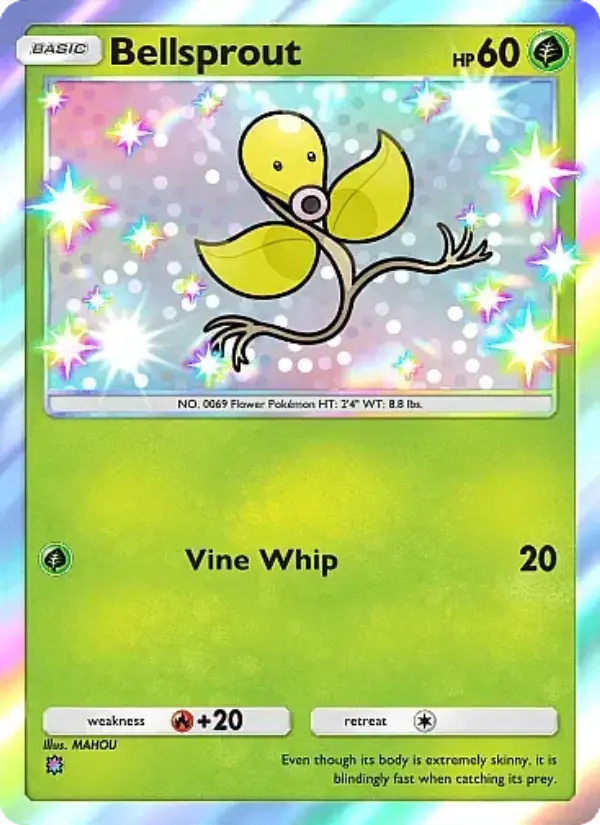
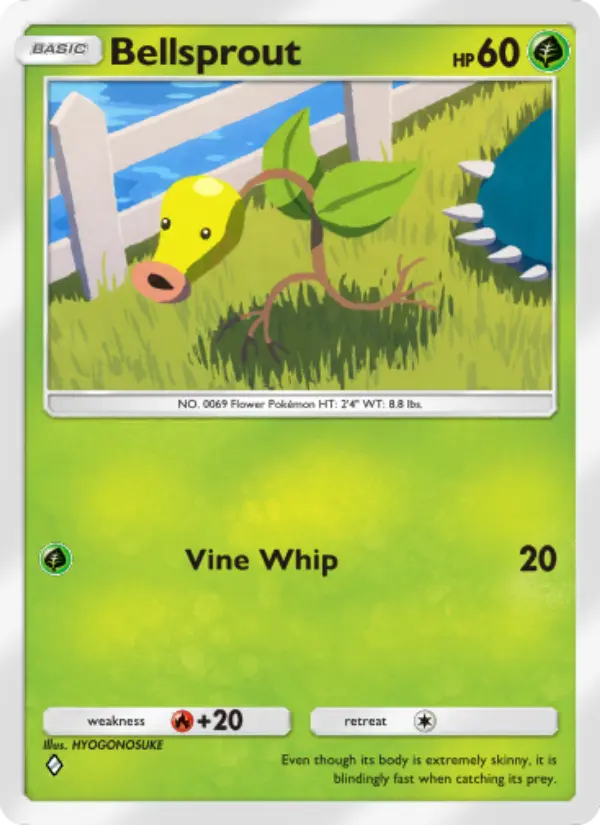
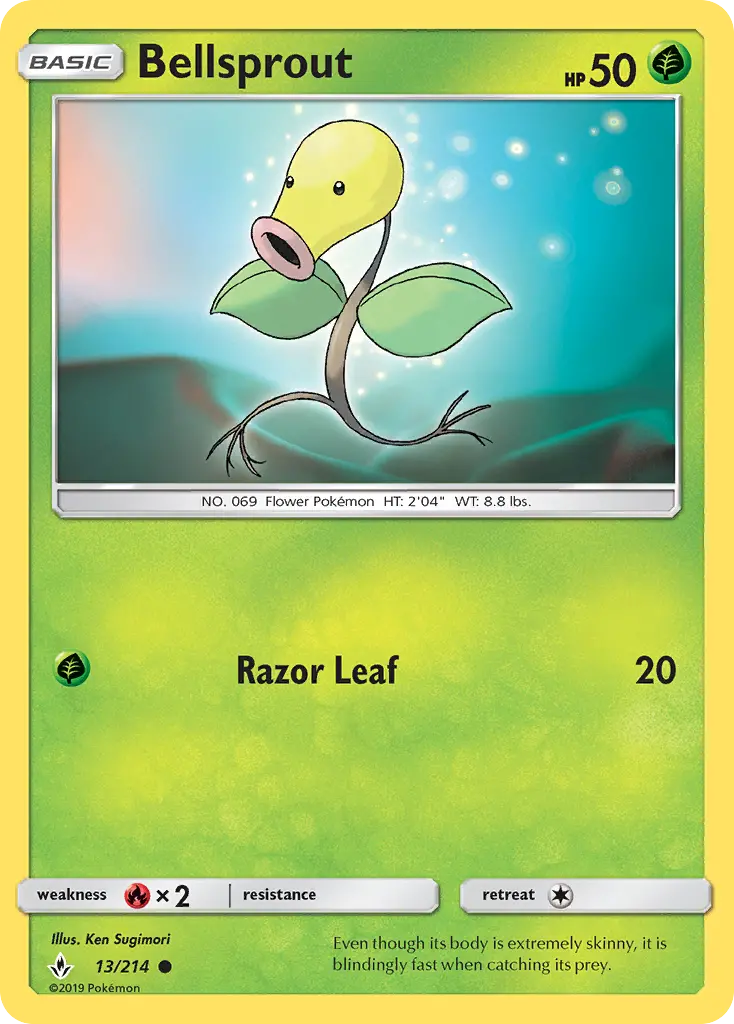
Even though its body is extremely skinny, it is blindingly fast when catching its prey.
It plants its feet deep underground to replenish wa ter. It can't es cape its enemy while it's rooted.
If it notices anything that moves, it immediately flings its vine at the object.
BELLSPROUT’s thin and flexible body lets it bend and sway to avoid any attack, however strong it may be. From its mouth, this POKéMON spits a corrosive fluid that melts even iron.
A BELLSPROUT’s thin and flexible body lets it bend and sway to avoid any attack, however strong it may be. From its mouth, it leaks a fluid that melts even iron.
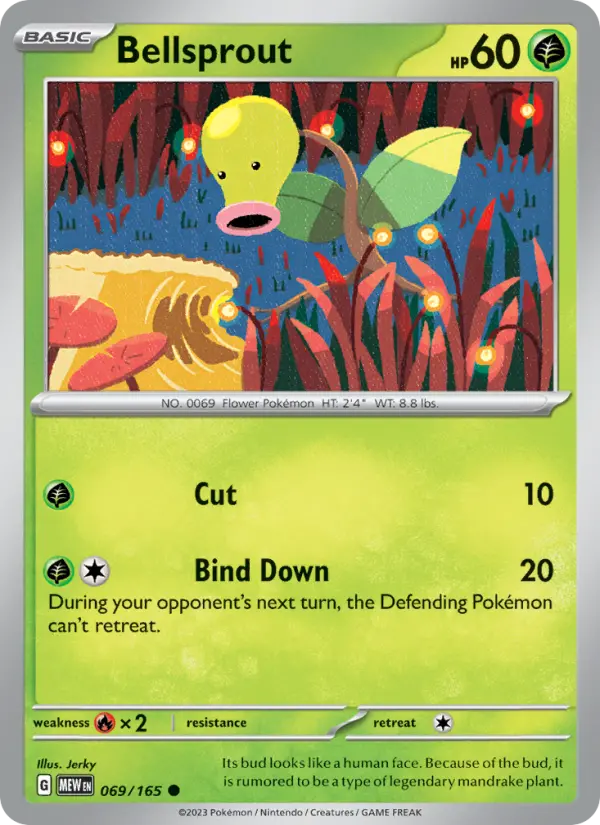
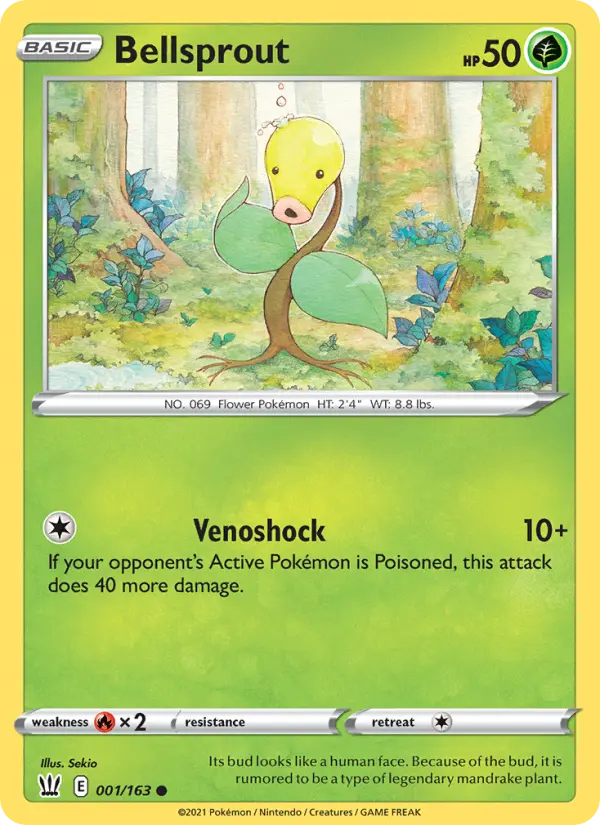
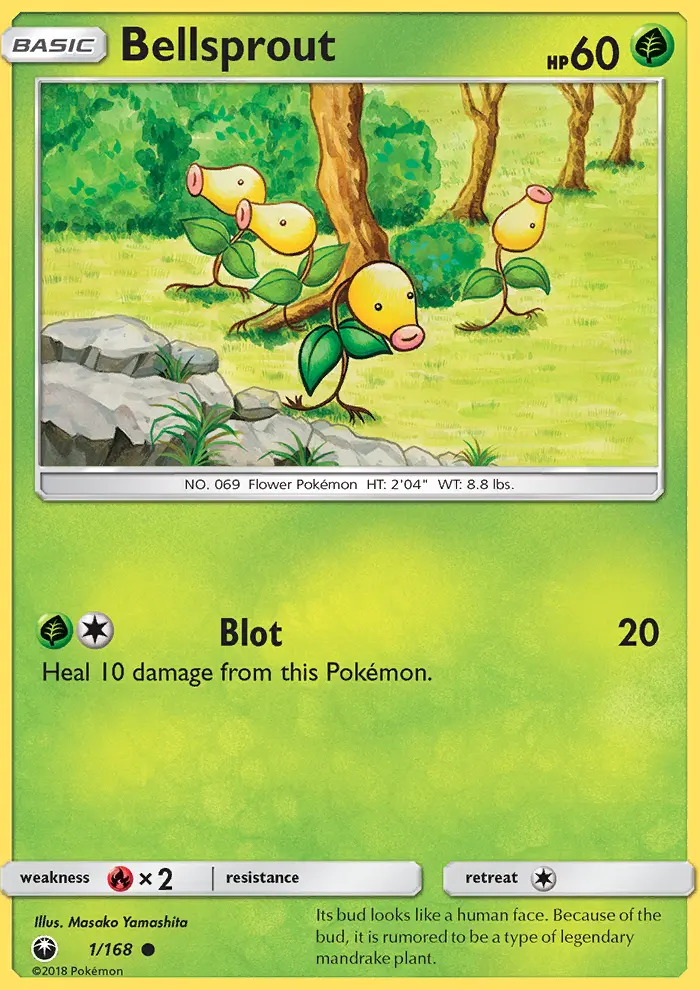
Its bud looks like a human face. Because of the bud, it is rumored to be a type of legendary mandrake plant.
A carnivorous POKéMON that traps and eats bugs. It appears to use its root feet to replenish moisture.
It prefers hot and humid environments. It is quick at capturing prey with its vines.
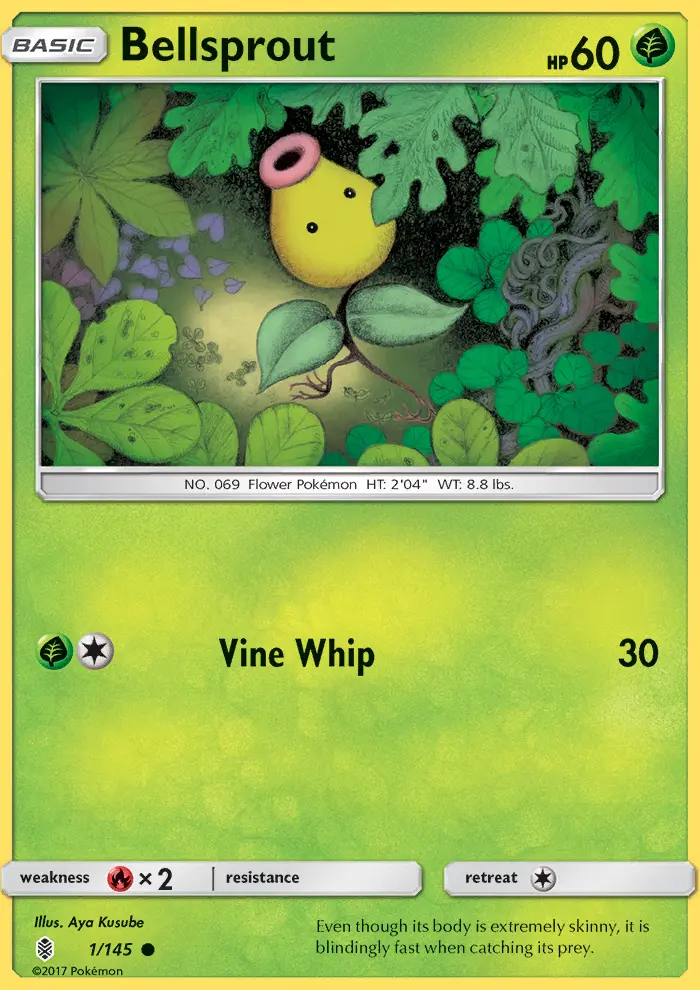
Even though its body is extremely skinny, it is blindingly fast when catching its prey.
It plants its feet deep underground to replenish water. It can’t escape its enemy while it’s rooted.
It prefers hot and humid environments. It is quick at capturing prey with its vines.
It prefers hot and humid environments. It is quick at capturing prey with its vines.
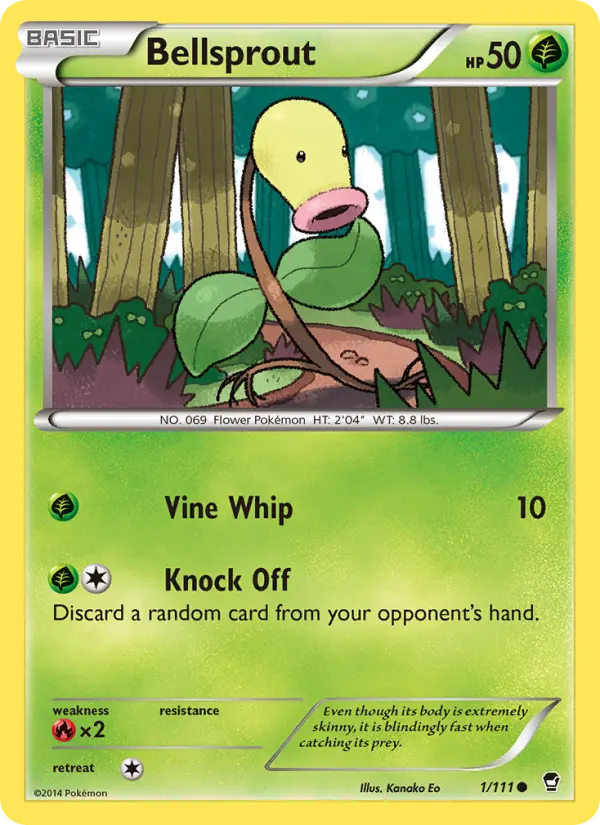
Even though its body is extremely skinny, it is blindingly fast when catching its prey.
Its bud looks like a human face. Because of the bud, it is rumored to be a type of legendary mandrake plant.
Bellsprout’s thin and flexible body lets it bend and sway to avoid any attack, however strong it may be. From its mouth, this Pokémon spits a corrosive fluid that melts even iron.
Bellsprout’s thin and flexible body lets it bend and sway to avoid any attack, however strong it may be. From its mouth, this Pokémon spits a corrosive fluid that melts even iron.
Prefers hot and humid places. It ensnares tiny bugs with its vines and devours them.
Bellsprout Name Origin & Design Inspiration
Bellsprout's design draws heavily from the appearance and characteristics of botanical specimens, particularly bell-shaped flowers and sprouting seedlings, an aesthetic clearly reflected in its Japanese name Madatsubomi, which roughly translates to "hemp-like sprout." The creature's yellow, bell-shaped head evokes morning glories or other pendulous flowering plants, while its overall silhouette recalls an anthropomorphized seedling in its early developmental stages. The addition of prominent vines and the carnivorous plant elements—particularly the corrosive acid and predatory behaviors—introduce a darker, more sinister undertone that elevates Bellsprout beyond simple botanical fantasy into something more menacing. The juxtaposition of delicate pink lips with toxic predatory capabilities creates an intentional cognitive dissonance, suggesting that appearances can deceive regarding a creature's true nature and capabilities. The design philosophy emphasizes the dual Grass-Poison typing through visual metaphor: the botanical elements satisfy the grass classification while the acidic secretions and carnivorous instincts embody the poison aspect. This coherent design integration makes Bellsprout one of the most thematically unified Pokémon despite its humble status, with every visual element serving to reinforce its established role and typing.
Learnable Moves
Bellsprout can learn 80 moves:
Move | Type | Cat. | Power | Acc. | PP |
|---|---|---|---|---|---|
| acid | poison | Special | 40 | 100 | 30 |
| acid spray | poison | Special | 40 | 100 | 20 |
| attract | normal | Status | — | 100 | 15 |
| belch | poison | Special | 120 | 90 | 10 |
| bide | normal | Physical | — | — | 10 |
| bind | normal | Physical | 15 | 85 | 20 |
| bullet seed | grass | Physical | 25 | 100 | 30 |
| captivate | normal | Status | — | 100 | 20 |
| clear smog | poison | Special | 50 | — | 15 |
| confide | normal | Status | — | — | 20 |
| curse | ghost | Status | — | — | 10 |
| cut | normal | Physical | 50 | 95 | 30 |
| double team | normal | Status | — | — | 15 |
| double edge | normal | Physical | 120 | 100 | 15 |
| encore | normal | Status | — | 100 | 5 |
| endure | normal | Status | — | — | 10 |
| energy ball | grass | Special | 90 | 100 | 10 |
| facade | normal | Physical | 70 | 100 | 20 |
| flash | normal | Status | — | 100 | 20 |
| frustration | normal | Physical | — | 100 | 20 |
| gastro acid | poison | Status | — | 100 | 10 |
| giga drain | grass | Special | 75 | 100 | 10 |
| grass knot | grass | Special | — | 100 | 20 |
| grassy glide | grass | Physical | 55 | 100 | 20 |
| grassy terrain | grass | Status | — | — | 10 |
| growth | normal | Status | — | — | 20 |
| headbutt | normal | Physical | 70 | 100 | 15 |
| hidden power | normal | Special | 60 | 100 | 15 |
| infestation | bug | Special | 20 | 100 | 20 |
| ingrain | grass | Status | — | — | 20 |
| knock off | dark | Physical | 65 | 100 | 20 |
| leaf storm | grass | Special | 130 | 90 | 5 |
| leech life | bug | Physical | 80 | 100 | 10 |
| lunge | bug | Physical | 80 | 100 | 15 |
| magical leaf | grass | Special | 60 | — | 20 |
| mega drain | grass | Special | 40 | 100 | 15 |
| mimic | normal | Status | — | — | 10 |
| natural gift | normal | Physical | — | 100 | 15 |
| nature power | normal | Status | — | — | 20 |
| poison jab | poison | Physical | 80 | 100 | 20 |
| poison powder | poison | Status | — | 75 | 35 |
| pounce | bug | Physical | 50 | 100 | 20 |
| power whip | grass | Physical | 120 | 85 | 10 |
| protect | normal | Status | — | — | 10 |
| rage | normal | Physical | 20 | 100 | 20 |
| razor leaf | grass | Physical | 55 | 95 | 25 |
| reflect | psychic | Status | — | — | 20 |
| rest | psychic | Status | — | — | 5 |
| return | normal | Physical | — | 100 | 20 |
| round | normal | Special | 60 | 100 | 15 |
| secret power | normal | Physical | 70 | 100 | 20 |
| seed bomb | grass | Physical | 80 | 100 | 15 |
| slam | normal | Physical | 80 | 75 | 20 |
| sleep powder | grass | Status | — | 75 | 15 |
| sleep talk | normal | Status | — | — | 10 |
| sludge bomb | poison | Special | 90 | 100 | 10 |
| sludge wave | poison | Special | 95 | 100 | 10 |
| snore | normal | Special | 50 | 100 | 15 |
| solar beam | grass | Special | 120 | 100 | 10 |
| strength sap | grass | Status | — | 100 | 10 |
| stun spore | grass | Status | — | 75 | 30 |
| substitute | normal | Status | — | — | 10 |
| sucker punch | dark | Physical | 70 | 100 | 5 |
| sunny day | fire | Status | — | — | 5 |
| swagger | normal | Status | — | 85 | 15 |
| sweet scent | normal | Status | — | 100 | 20 |
| swords dance | normal | Status | — | — | 20 |
| synthesis | grass | Status | — | — | 5 |
| take down | normal | Physical | 90 | 85 | 20 |
| tera blast | normal | Special | 80 | 100 | 10 |
| thief | dark | Physical | 60 | 100 | 25 |
| tickle | normal | Status | — | 100 | 20 |
| toxic | poison | Status | — | 90 | 10 |
| trailblaze | grass | Physical | 50 | 100 | 20 |
| venoshock | poison | Special | 65 | 100 | 10 |
| vine whip | grass | Physical | 45 | 100 | 25 |
| weather ball | normal | Special | 50 | 100 | 10 |
| worry seed | grass | Status | — | 100 | 10 |
| wrap | normal | Physical | 15 | 90 | 20 |
| wring out | normal | Special | — | 100 | 5 |
Bellsprout Competitive Battle Guide
Bellsprout's competitive viability remains severely limited by its modest stat distribution and underwhelming aggregate stat total of 300, which leaves it vulnerable to virtually any competent opponent in standardized competitive formats. The Pokémon's base Attack stat of 75 and Special Attack stat of 70 suggest a relatively balanced offensive approach, but neither stat achieves sufficient power to guarantee reliable damage output against defensively competent foes. Most crippling are Bellsprout's defensive statistics: with a base Defense of 35 and Special Defense of just 30, the Pokémon cannot effectively withstand sustained offensive pressure, typically requiring only moderate investment to be threatened into fainting. Its base speed of 40 ensures that Bellsprout will move last in most matchups, completely negating any benefit from its marginally superior offensive capabilities. However, Bellsprout's ability to learn diverse move types through level-up and TM compatibility grants it surprising coverage options that can catch opponents off-guard in casual play, particularly powder-based moves and corrosive attacks reflecting its poison typing. The hidden ability Gluttony provides a potential niche application by automatically consuming held berries when Bellsprout drops below 50% health, though this utility pales against the utility of Chlorophyll during weather-dependent strategies. Most competitive trainers immediately evolve Bellsprout into Weepinbell and subsequently Victreebel rather than utilizing the base form in any serious capacity.
Commonly Asked Questions About Bellsprout
What type is Bellsprout?
Bellsprout is a grass and poison type Pokemon.
What does Bellsprout evolve into?
Bellsprout evolves into weepinbell, then into victreebel.
What are Bellsprout's weaknesses?
Bellsprout is weak to flying, fire, psychic and ice type moves.
Does Bellsprout evolve by trading?
No — Bellsprout evolves entirely through leveling up, with no trade required at any stage.
Where can I find Bellsprout?
Bellsprout can be found in kanto route 25 (kanto), kanto route 15 (kanto) and kanto route 5 (kanto) and 23 other locations.
Bellsprout Cultural Impact & Franchise History
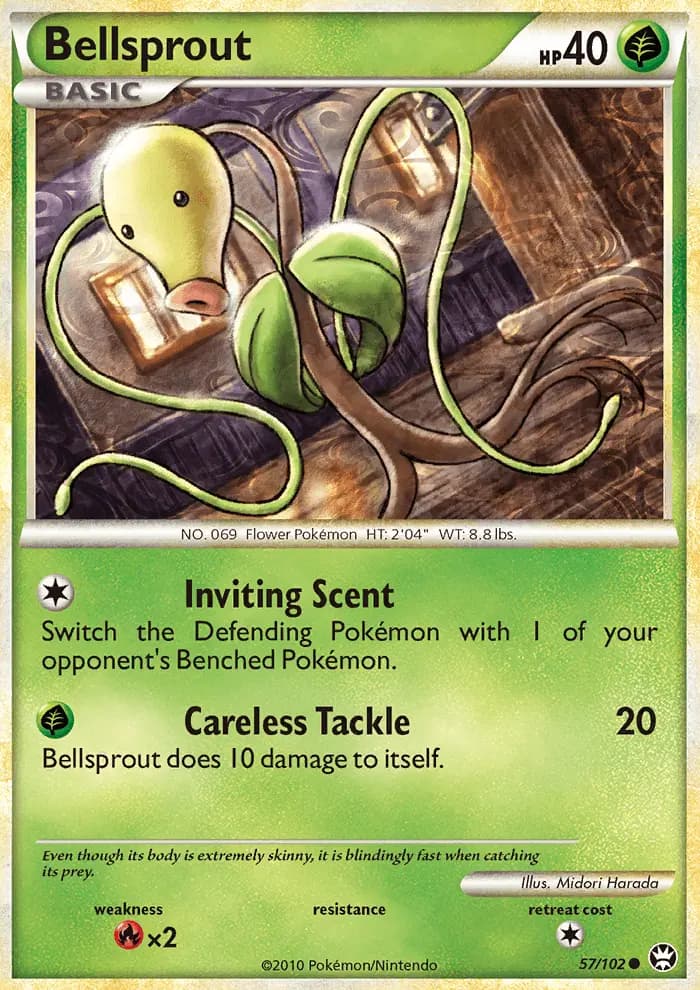
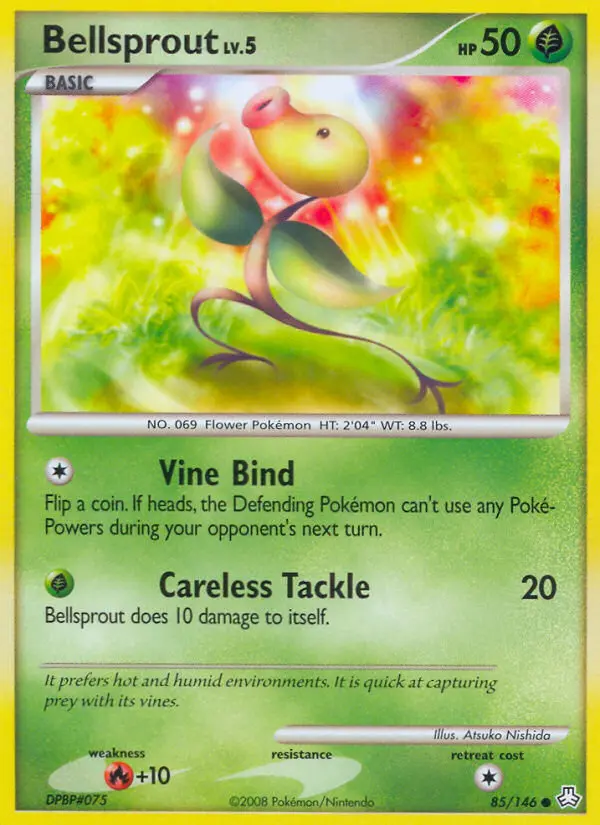
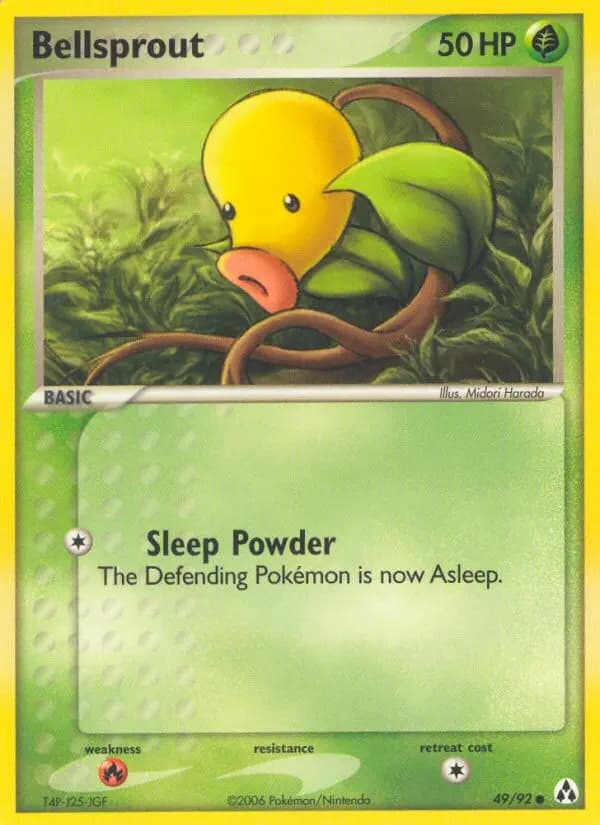
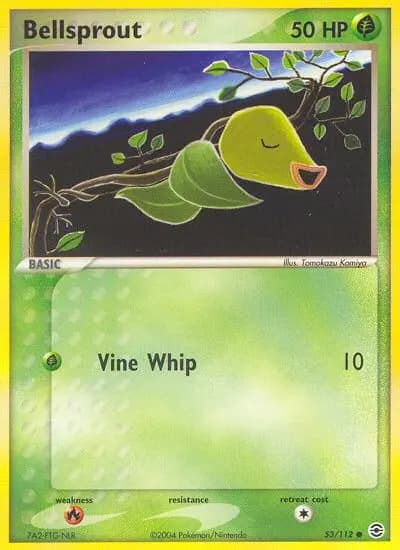
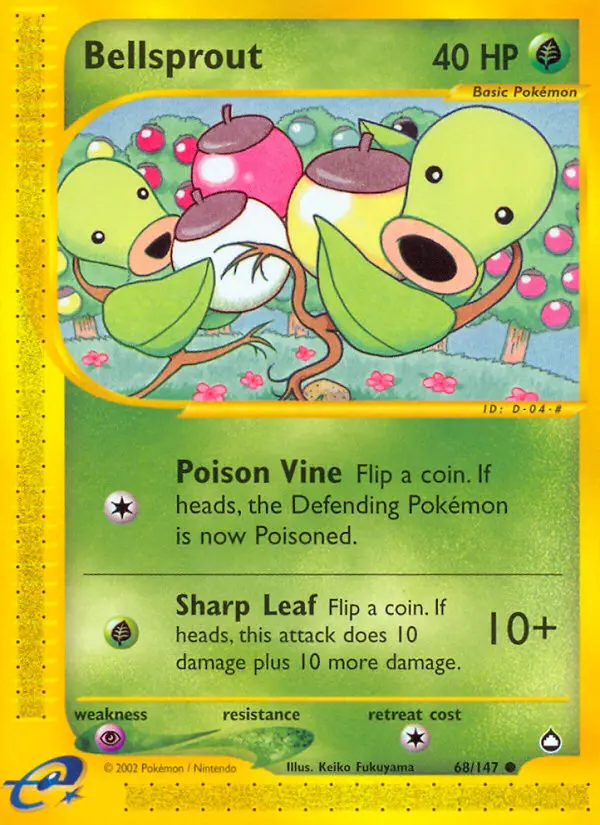
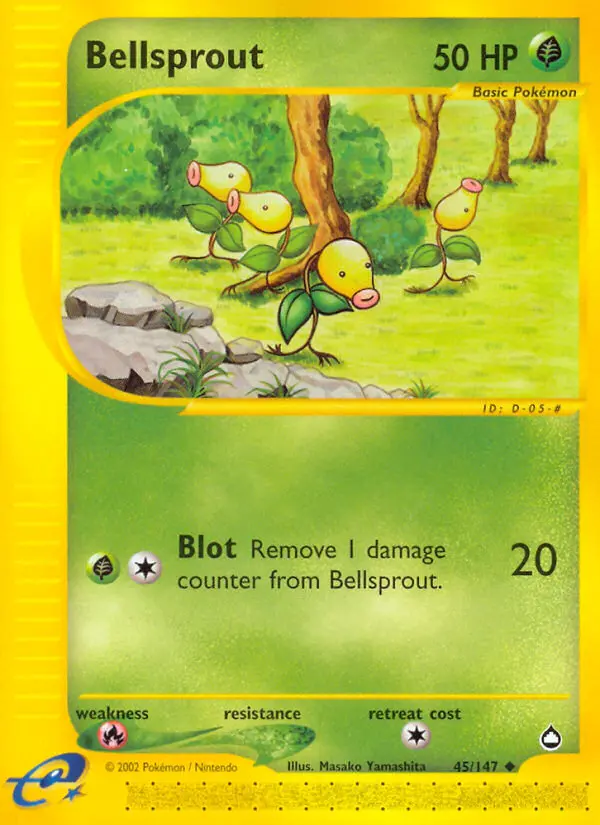
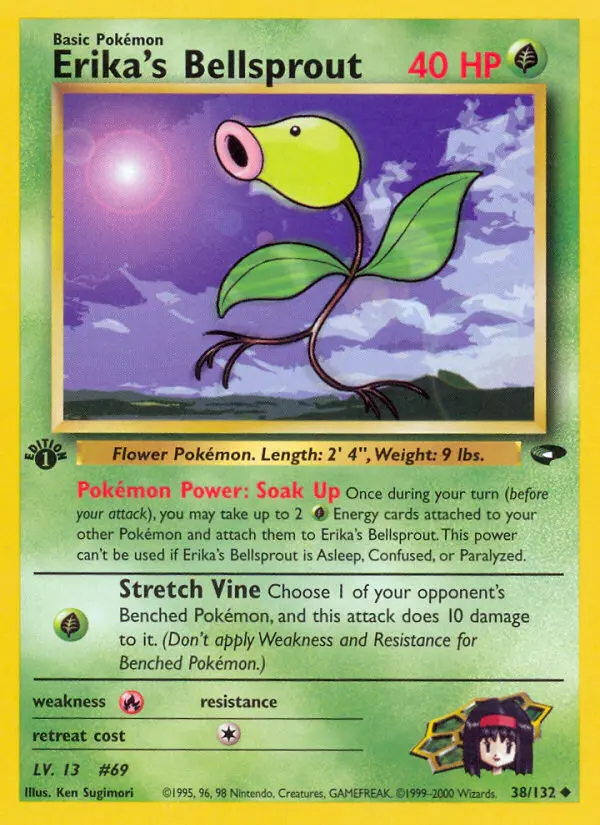
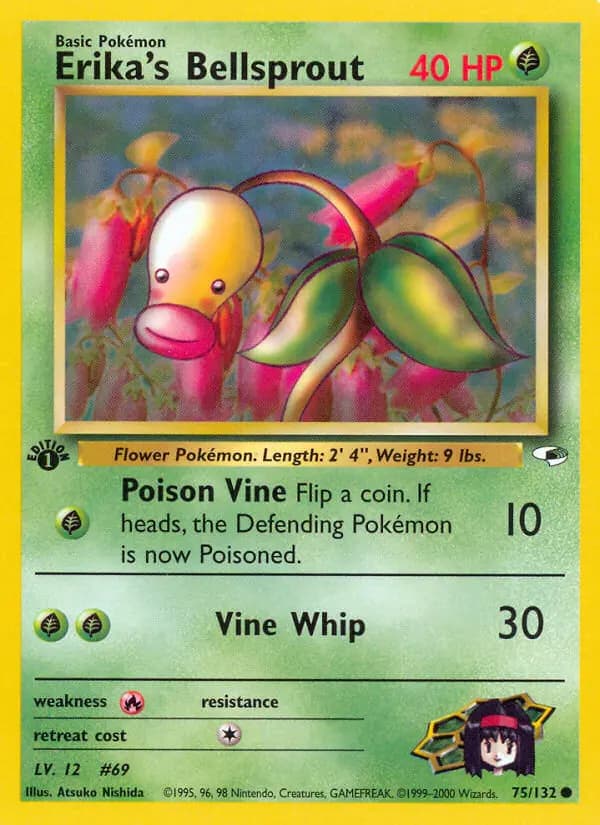
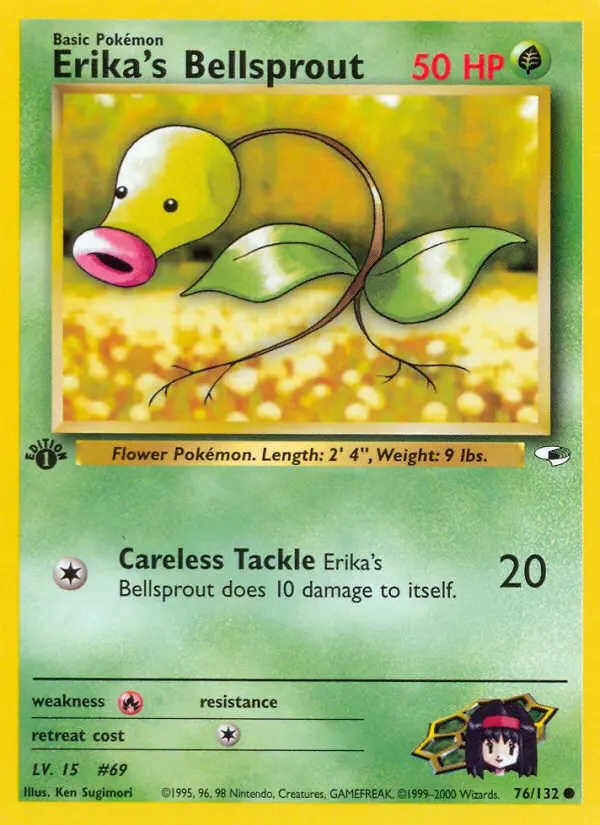
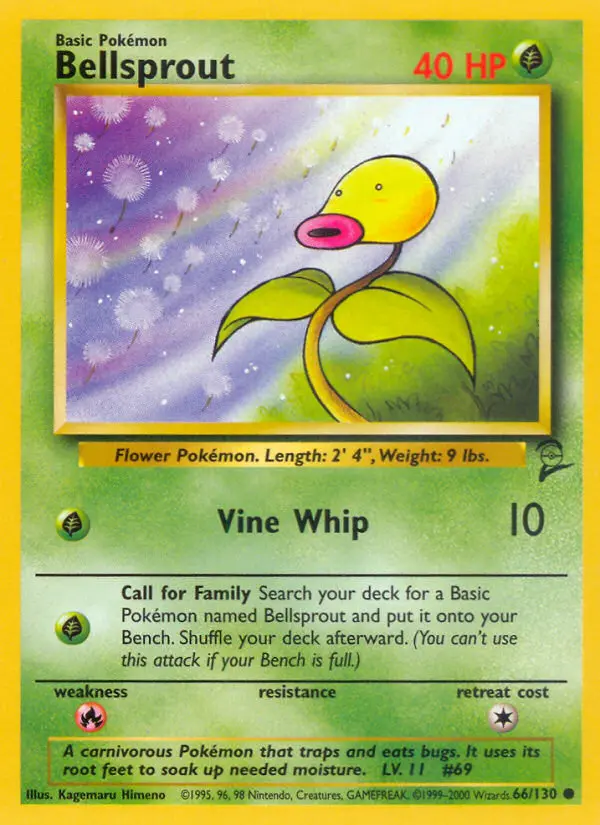
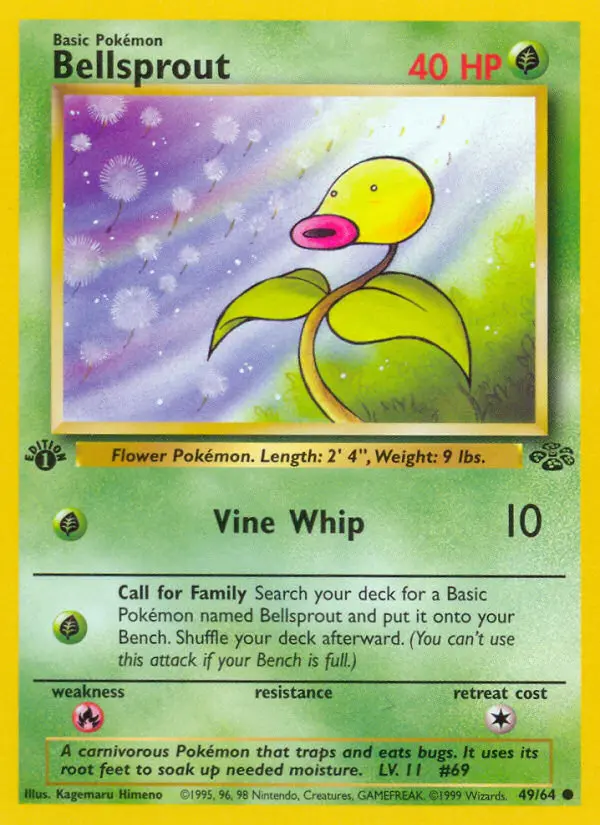
Bellsprout occupies a unique position in Pokémon cultural memory as one of the franchise's earliest and most recognizable grass-type Pokémon, appearing prominently in Generation I materials and remaining a fixture across subsequent games despite its competitive irrelevance. The species became particularly memorable through its recurring appearances in the Pokémon animated series, where Bellsprout encounters established the character archetypes and battle conventions that would define trainer confrontations throughout the franchise's history. The distinctive bell-shaped head and carnivorous nature created a compelling visual identity that resonated with audiences seeking Pokémon that diverged from traditionally cute or powerful aesthetics, instead occupying an unsettling middle ground. Bellsprout's inclusion in early trading card game sets established it as a recognizable icon of the TCG format, with various card printings becoming collectible artifacts valued by enthusiasts. The species has maintained consistent presence across nearly every Pokémon game released since 1996, ensuring that multiple generations of trainers have encountered and potentially trained Bellsprout during their first adventures. Additionally, Bellsprout's relatively high catch rate and early availability made it a staple of casual player experiences, establishing it as a gateway Pokémon for countless trainers entering the franchise. The Pokémon's persistence in popular consciousness, despite its mechanical weakness, demonstrates how effective design and early prominence can create lasting cultural relevance independent of competitive utility.
Where to Find Bellsprout in Every Pokémon Game
Bellsprout demonstrates exceptional availability across the Pokémon franchise, appearing in virtually every generation of games since its introduction in Generation I with remarkable consistency. In the original Red and Blue versions, Bellsprout occupies the Pokédex slot #0069 and can be encountered in early-game routes, establishing its role as an accessible starter option alongside other grass-type species. The Pokémon appears with equal prominence in Yellow version, where Bellsprout hunting remains a fundamental early-game activity for many trainers. Across subsequent generations including Gold and Silver, FireRed and LeafGreen, Diamond and Pearl, and all subsequent entries, Bellsprout maintains relatively high encounter rates in appropriate habitat types, typically jungle and forest regions corresponding to its environmental preferences. The species received specific Pokédex number reassignments in games featuring regional dex modifications, such as its #0064 slot in Gold and Silver's Johto region, reflecting the franchise's commitment to making Bellsprout consistently available throughout the player's initial progression. Modern games including Let's Go Pikachu and Eevee, the Sword and Shield generation, and Scarlet and Violet continue Bellsprout's tradition of early availability, ensuring that new players can reliably obtain and utilize the species from their earliest encounters. This pervasive availability has made Bellsprout one of the most easily obtained Pokémon across the entire franchise, contributing substantially to its status as an entry-level species despite its mechanical limitations.