Wooper
Generation II · #0194 — Water Fish Pokémon
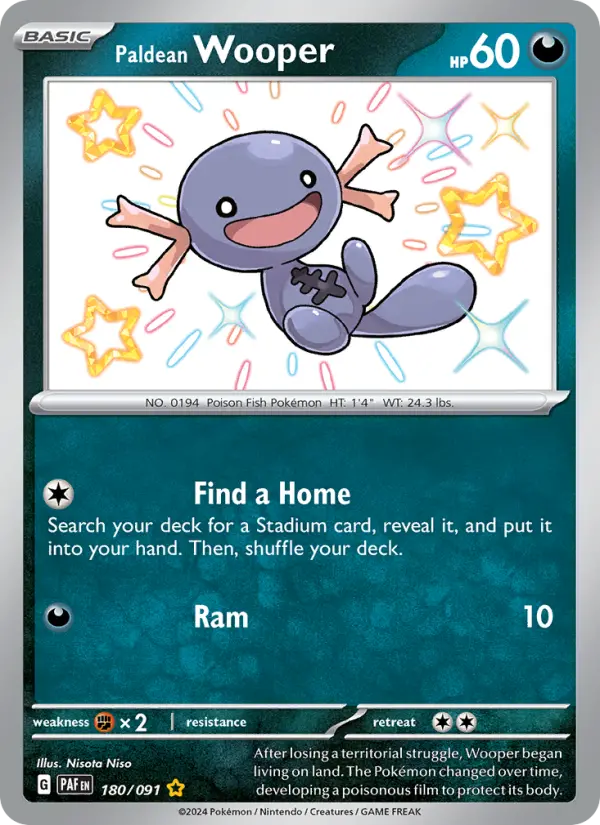
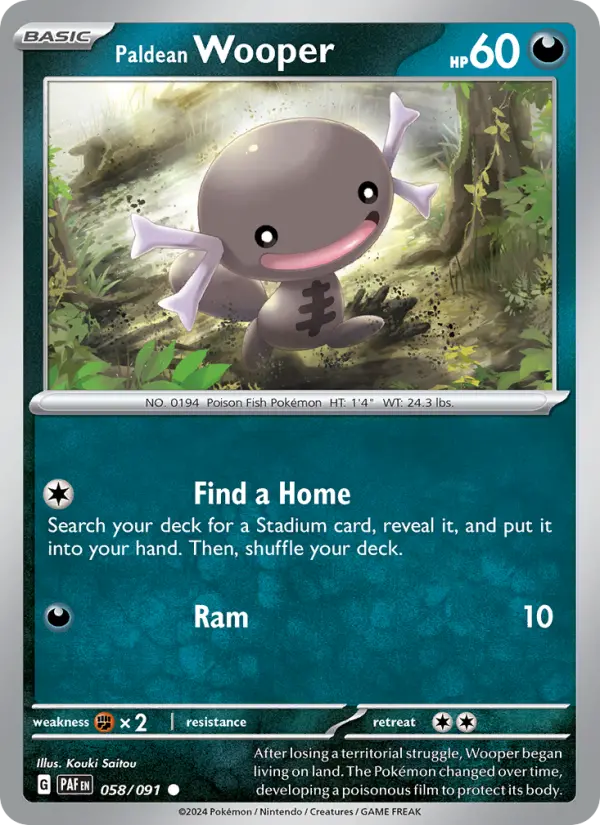
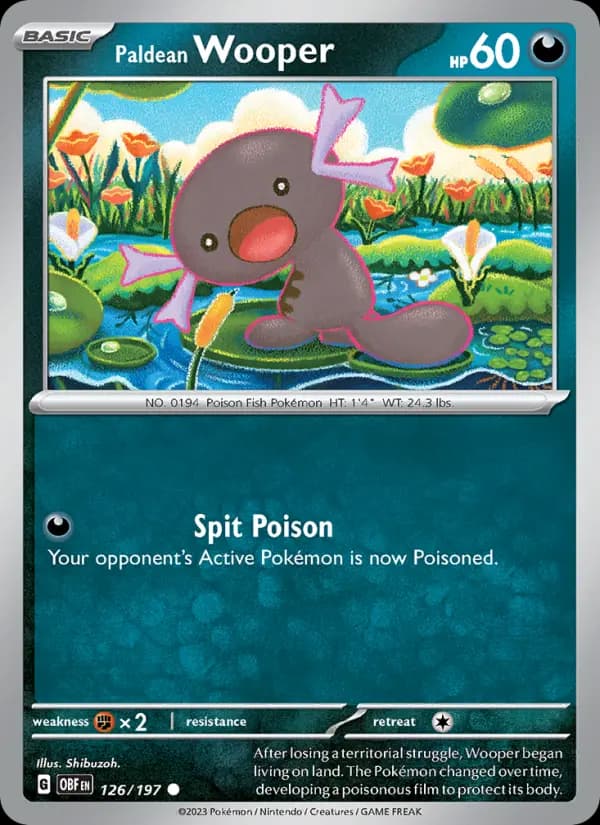
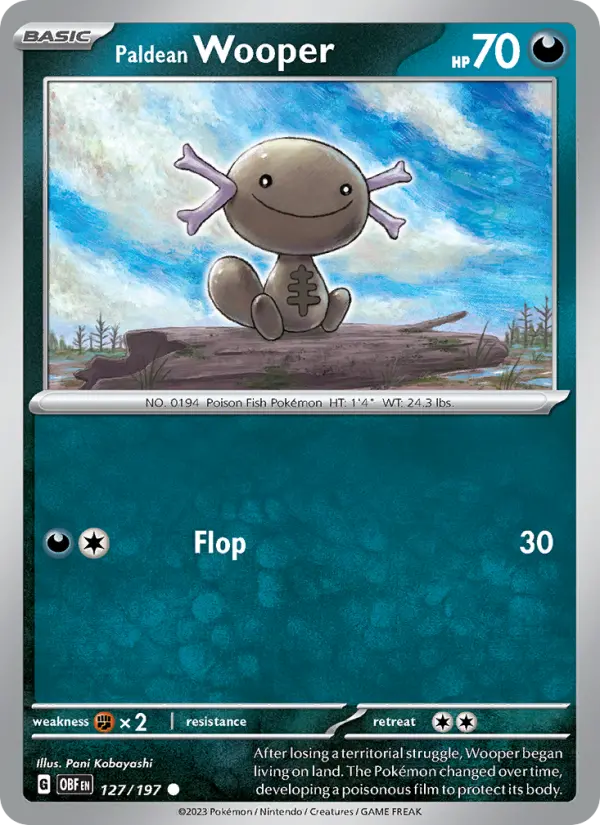
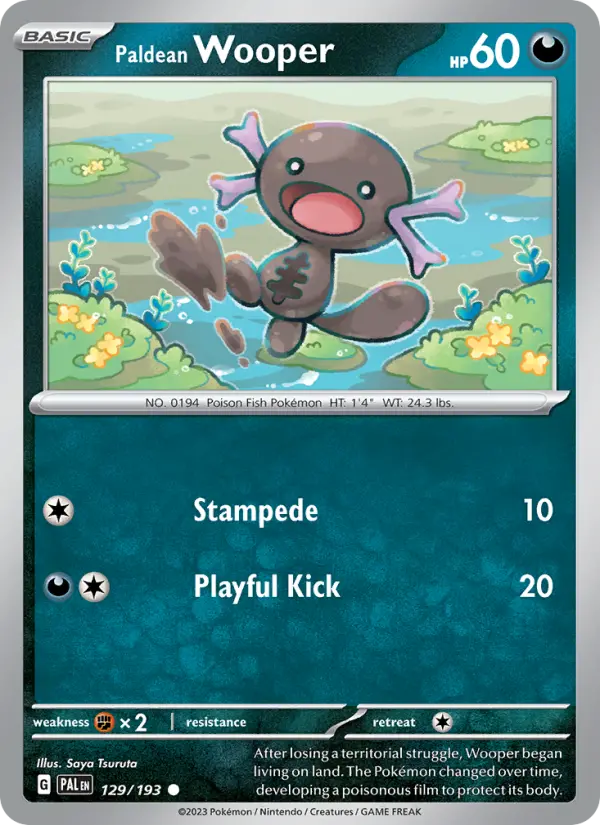
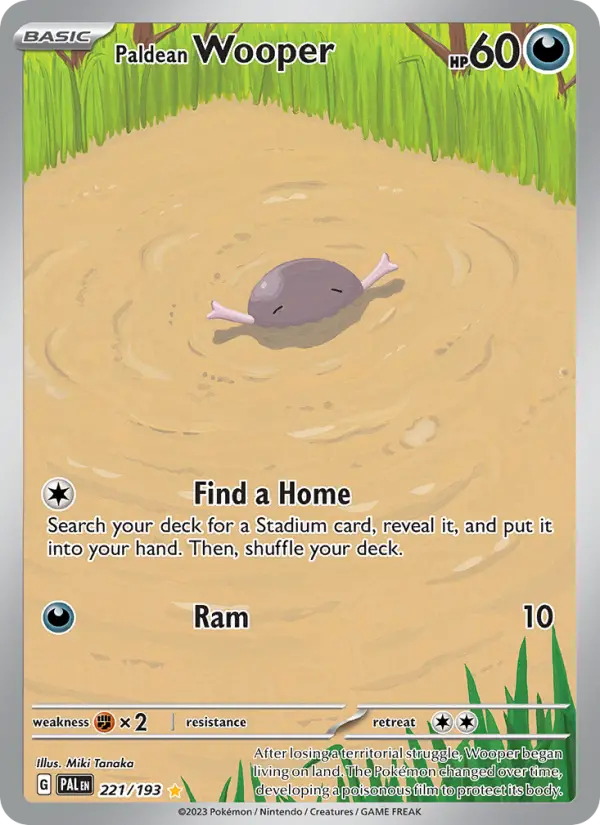
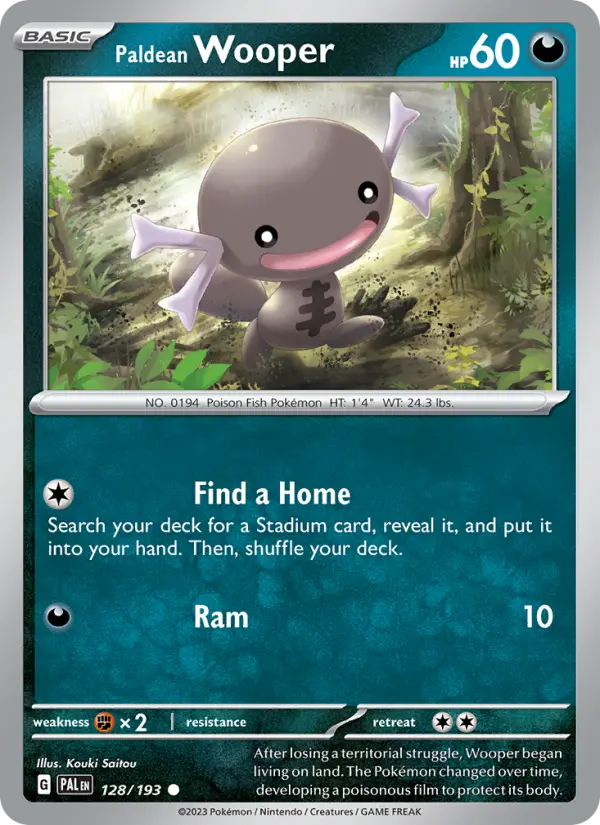
Few water/ground-type Pokémon pair damp with a stat lean toward hp quite like Wooper does. At 0.4 m and 8.5 kg, its build reflects a specialist role rather than a generalist one. With a modest aggregate stat total of 210, Wooper exemplifies the design philosophy of early evolutionary lines—possessing adequate bulk with a base HP of 55 and equal Defense stats of 45, though its offensive and Speed capabilities are notably limited. The species demonstrates exceptional availability, boasting a Capture Rate of 255, making it one of the easiest Pokémon to catch in the wild. Wooper's friendly nature is reflected in its base happiness rating of 70, establishing it as an approachable companion for trainers. In modern games, particularly Pokémon Scarlet and Violet, a regional variant called Paldean Wooper has emerged with a Poison/Ground typing, offering trainers an alternative interpretation of this classic species.
Editor's Take
Wooper's line ends in Quagsire with Unaware, and the Paldean variant later producing Clodsire is a rare case of a joke Pokémon getting two genuinely useful endpoints.
Base Stats
Height
0.4m
Weight
8.5kg
Category
Water Fish Pokémon
Gender
Male 50% / Female 50%
Color
blue
Shape
legs
Habitat
waters-edge
Abilities
Prevents self destruct, explosion, and aftermath from working while the Pokémon is in battle.
Absorbs water moves, healing for 1/4 max HP.
Ignores other Pokémon's stat modifiers for damage and accuracy calculation.

Wooper Biology & Physical Characteristics
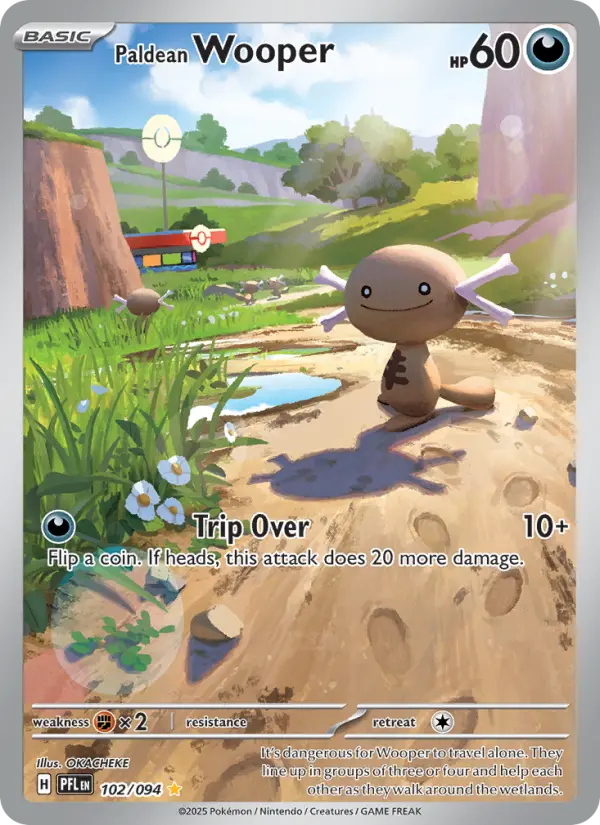
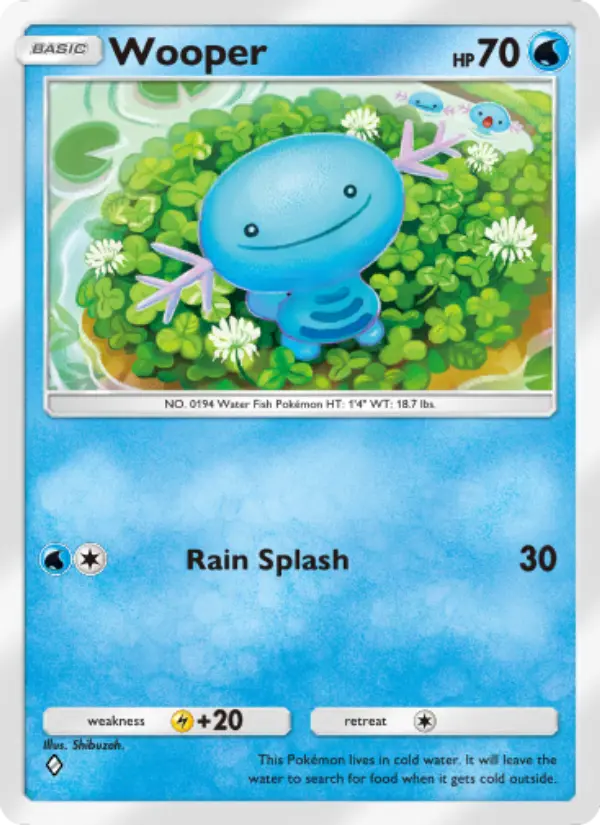
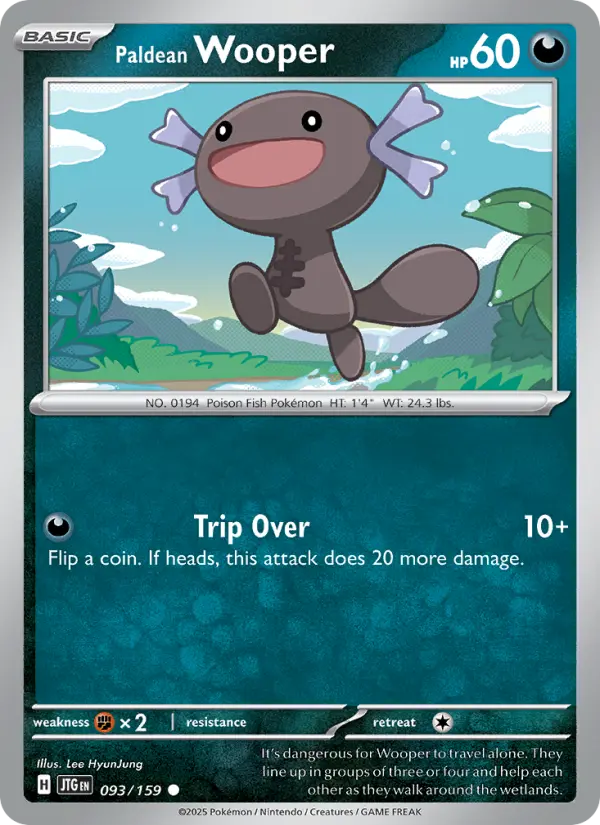
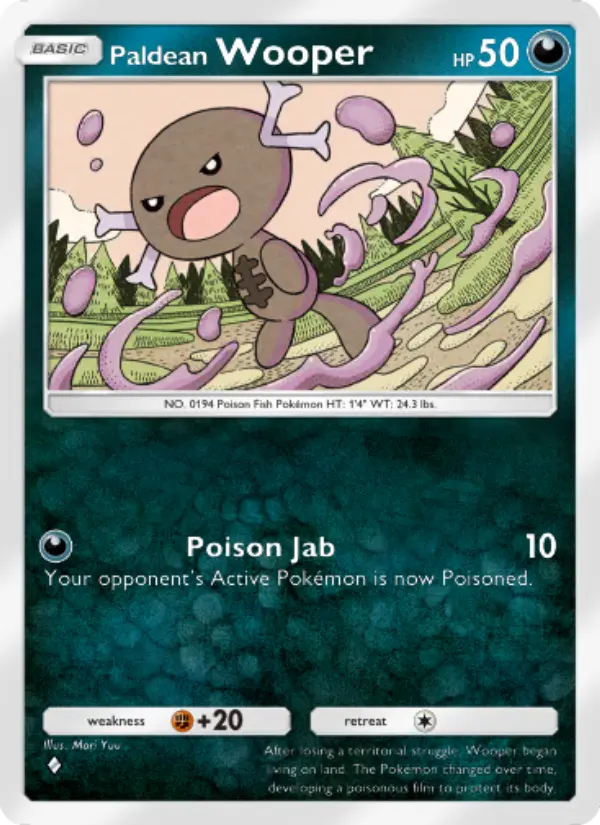
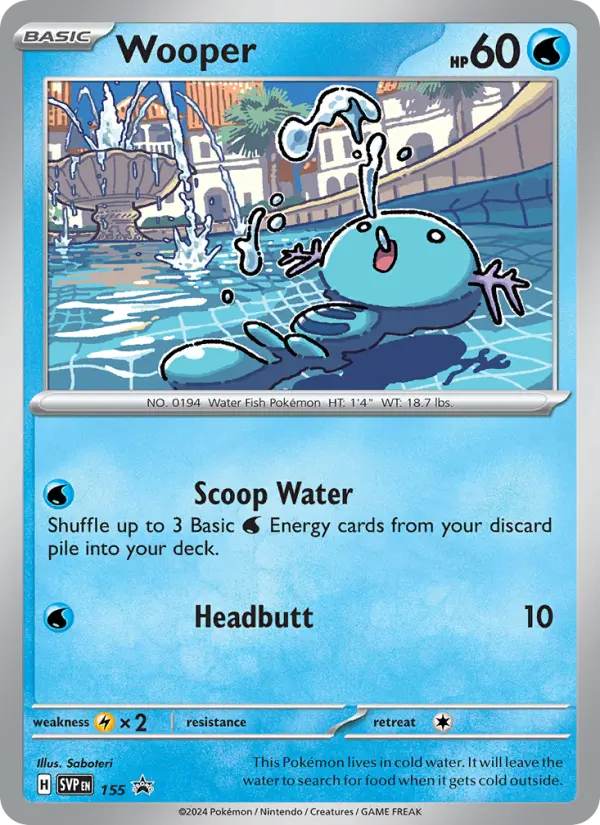
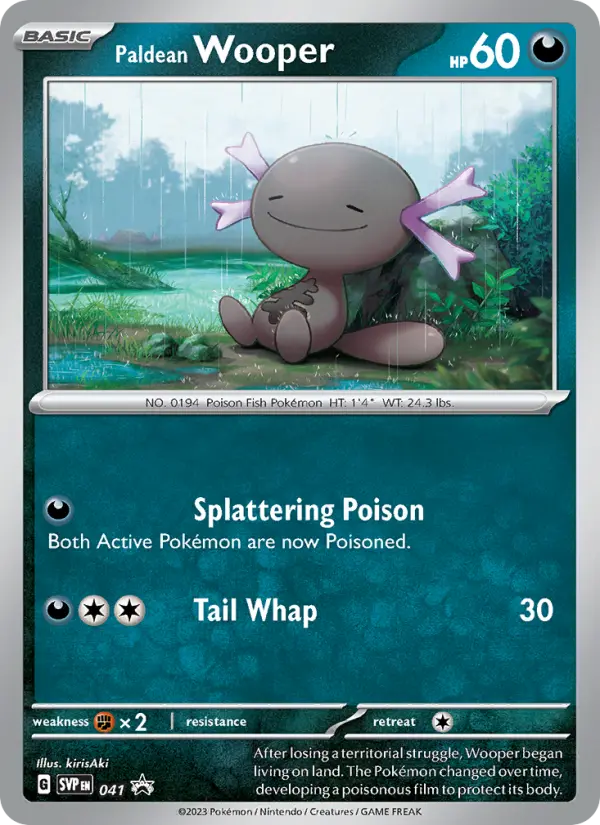
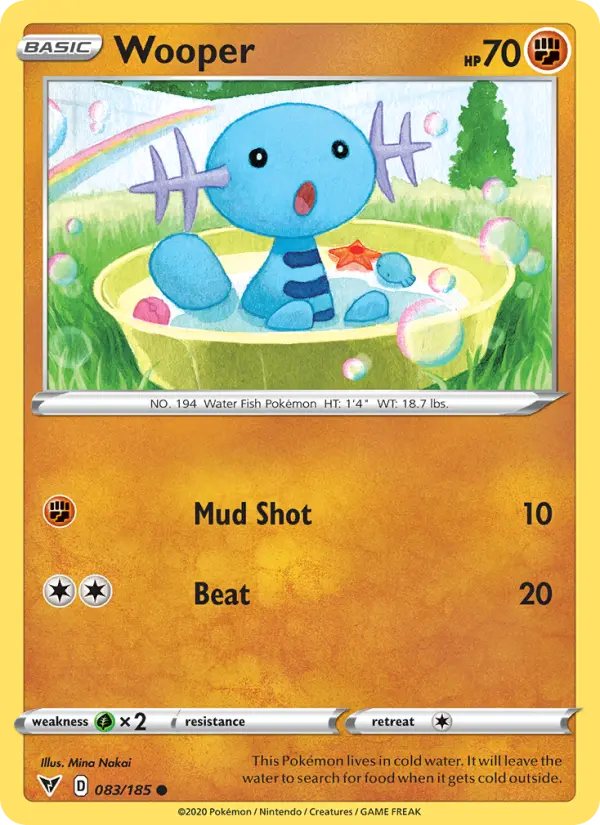
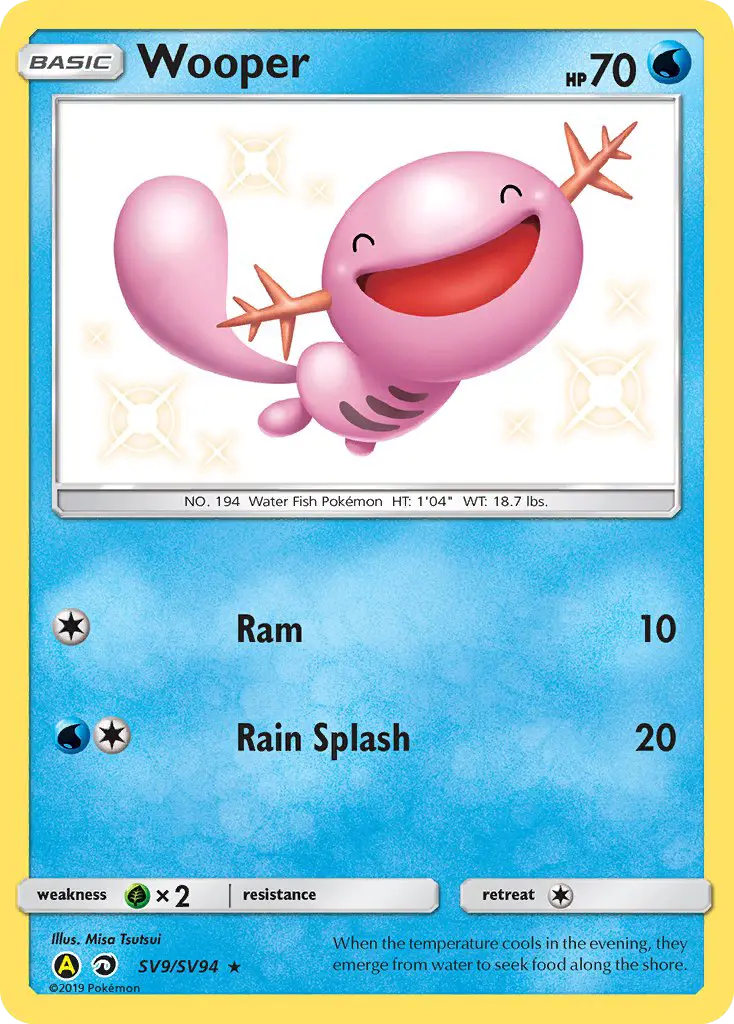
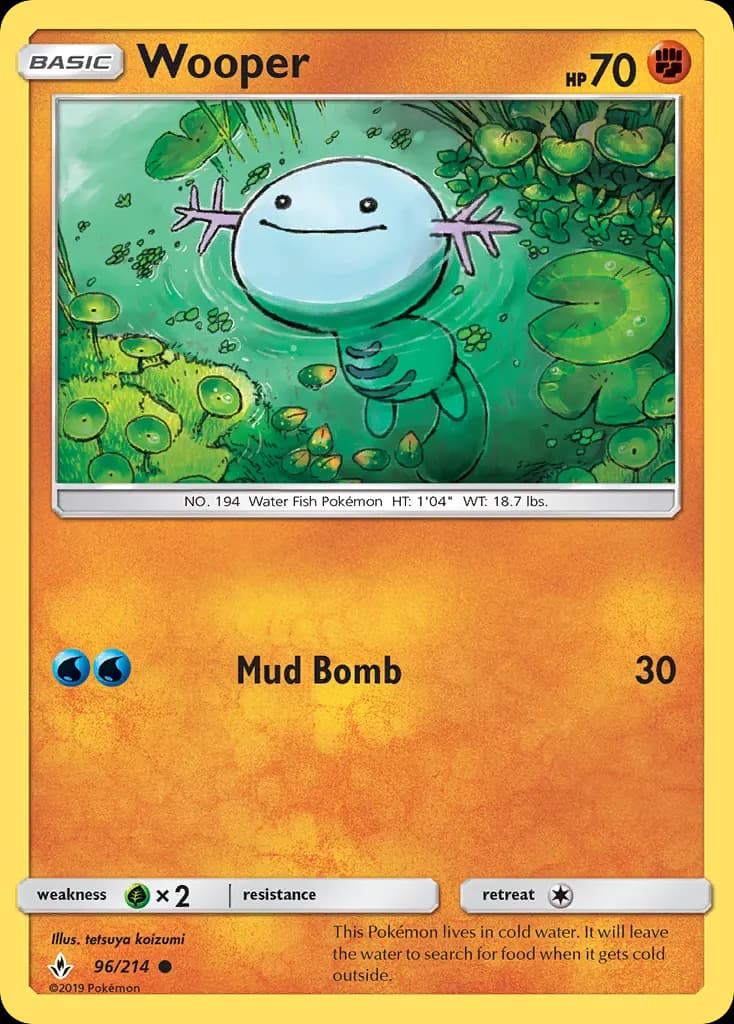
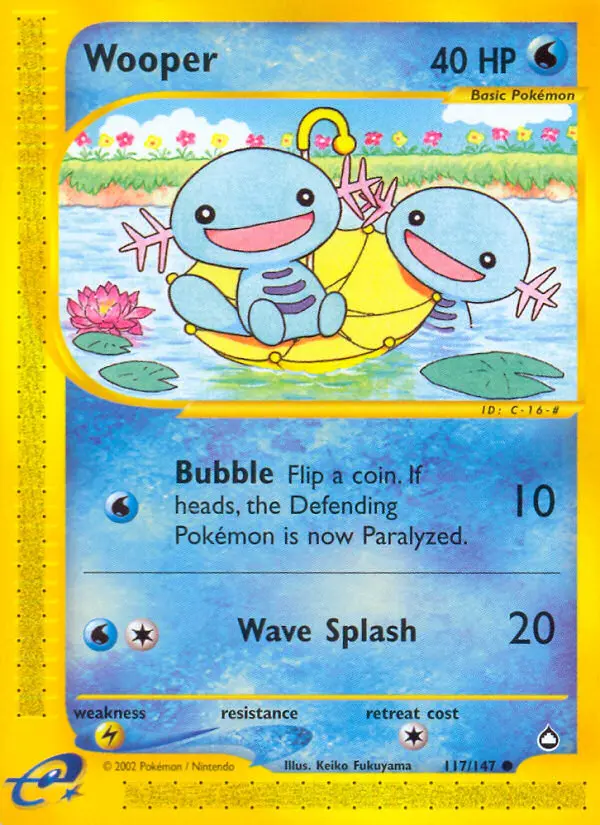
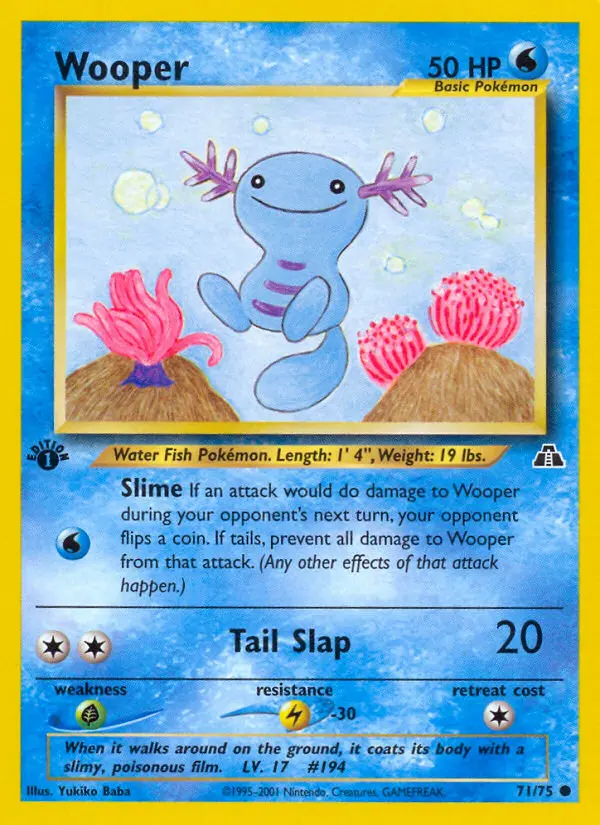
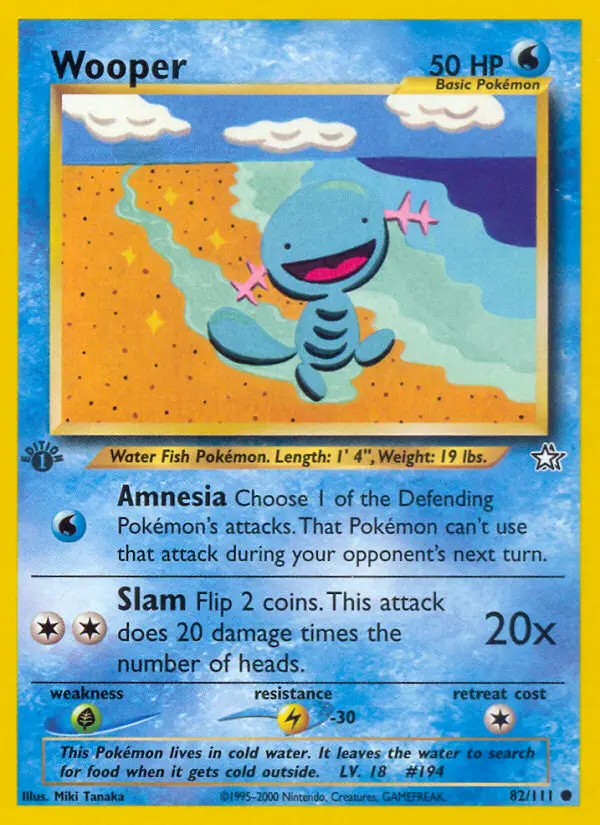
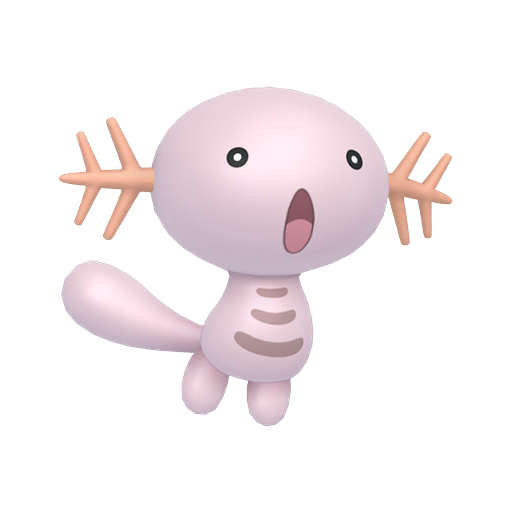
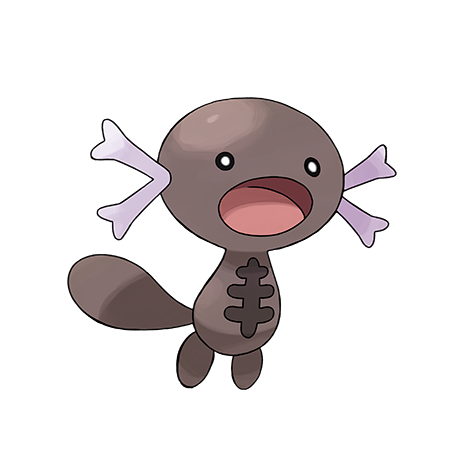
Wooper is a mostly blue, amphibious Pokémon that bears a striking resemblance to an upright, armless axolotl. Its proportions are distinctly characteristic, with a large head dominating its compact body and small, round black eyes conveying an expression of gentle curiosity. The species features distinctive purple, branching gills on either side of its head that serve as a visual indicator of sexual dimorphism—males display more elaborated gill branches compared to females. Standing on two small, round feet, Wooper supports itself with a large, thick tail that aids in both aquatic and terrestrial locomotion. Its belly is marked with dark blue curved patterns that contrast subtly against its primary coloration. The most notable biological adaptation is the slimy, poisonous mucous membrane that covers Wooper's entire body when it ventures onto land. This membrane is sufficiently caustic that direct contact with bare skin causes shooting pain, as documented in Pokédex entries. The Paldean regional form deviates from this template, presenting a more robust physique and shifting its biological composition toward a Poison/Ground classification, though it maintains the characteristic gill structure and overall amphibious nature.
Pokedex Numbers
Training
Breeding
Wooper Breeding, Gender Ratio & Egg Groups
Wooper exhibits a perfectly balanced 50% male to 50% female gender ratio, ensuring equal representation across both sexes in wild populations and bred specimens. This balanced distribution facilitates breeding endeavors for trainers seeking to produce Wooper offspring through Pokémon daycare or breeding centers. The species belongs to two breeding egg groups—Water 1 and Ground—providing considerable flexibility in cross-breeding compatibility with other Pokémon species from these categories. The Water 1 egg group connection links Wooper to numerous aquatic and semi-aquatic Pokémon including Lapras, Slowbro, and Squirtle, while the Ground classification opens breeding possibilities with terrestrial species such as Sandslash, Rhydon, and Cubone. Wooper's relatively short egg cycle of 20 cycles (approximately 4,884 to 5,140 steps) makes breeding this species reasonably efficient compared to many other Pokémon. Notably, the base happiness of 70 suggests Wooper eggs hatch with a predisposition toward trusting their trainers, facilitating smoother integration into active teams. Sexual dimorphism in Wooper is visible primarily through gill branching patterns, with males exhibiting more elaborate gill structures than females, though these differences prove subtle in gameplay contexts. The species' breeding mechanics remain consistent across both standard and Paldean forms, maintaining compatibility despite the regional variant's typing alterations.
Sprites





TMs & HMs
tm01
gold silver
tm01
crystal
tm01
lets go pikachu lets go eevee
tm02
crystal
tm02
gold silver
tm03
crystal
tm03
gold silver
tm03
ruby sapphire
tm03
platinum
tm03
firered leafgreen
tm03
heartgold soulsilver
tm03
diamond pearl
tm03
emerald
tm03
xd
tm03
colosseum
tm03
lets go pikachu lets go eevee
tm04
gold silver
tm04
crystal
tm04
sword shield
tm05
lets go pikachu lets go eevee
+662 more TMs/HMs
Gender Differences
This Pokémon has visible differences between male and female forms.
Wooper's Evolution Chain


Wooper Evolution, Mega Evolution & Special Forms
Wooper's evolutionary line represents a straightforward progression toward greater strength and specialization. At level 20, Wooper evolves into Quagsire, a significantly bulkier Water/Ground-type Pokémon that dramatically increases in both defensive capabilities and physical dimensions. This evolution represents the natural maturation point for trainers seeking to enhance their Wooper's combat effectiveness, with Quagsire gaining substantial improvements across all statistical categories, particularly in Defense and Special Attack. The evolution from Wooper to Quagsire marks the transition from a passive, slow-moving amphibian to a more formidable aquatic combatant, retaining the Water/Ground typing while gaining access to improved move pools and greater physical presence. In the Paldea region, the Paldean Wooper follows a different evolutionary trajectory, evolving into Clodsire—a Poison/Ground-type that represents a more toxic, terrestrial-oriented form. This regional variant provides trainers with an alternative evolutionary path that emphasizes poison-based mechanics over the traditional Water-type characteristics. Both evolutionary lines reflect conscious design choices that allow trainers to specialize their team composition based on regional availability and desired competitive attributes. Neither form receives Mega Evolution capabilities, as Wooper's line predates or falls outside the Mega Evolution framework in most game generations.
Where to Find
Ruins of Alph
johto
+4 more
Union Cave
johto
+9 more
Johto Route 32
johto
+12 more
Hoenn Safari Zone
hoenn
Four Island
kanto
+1 more
Icefall Cave
kanto
Ruin Valley
kanto
+3 more
Great Marsh
sinnoh
+51 more
Sinnoh Route 212
sinnoh
+15 more
Johto Safari Zone
johto
+35 more
Violet City
johto
Johto Route 47
johto
+5 more
Wooper Behaviour and Natural Habitat
Wooper exhibits fascinating behavioral patterns that reflect its amphibious nature and environmental adaptations. The species typically inhabits cold water environments, displaying a preference for aquatic settings that mirror its biological heritage. However, Wooper demonstrates remarkable behavioral flexibility by periodically leaving its aquatic home to search for food, particularly when external temperatures drop and food becomes scarce in its water-based habitat. This dual-environment lifestyle is supported by its unique physiological adaptation—when traversing land, Wooper secretes a thick, gooey, and toxic film across its entire body that serves as both protection and a hunting aid. This mucous membrane not only protects the delicate amphibian from terrestrial hazards but also facilitates predation on land-based prey. The species' preference for cold water suggests that Wooper thrives in arctic or temperate aquatic regions, potentially explaining its prevalence in areas like the Ilex Forest and surrounding water bodies in the Johto region. Trainers encountering Wooper typically find them wading in shallow waters or along muddy banks, where their amphibious capabilities provide distinct advantages. The species' gentle disposition and leisurely pace reflect an existence centered around survival rather than aggressive competition.
Pokedex Entries
This POKéMON lives in cold water. It will leave the water to search for food when it gets cold outside.
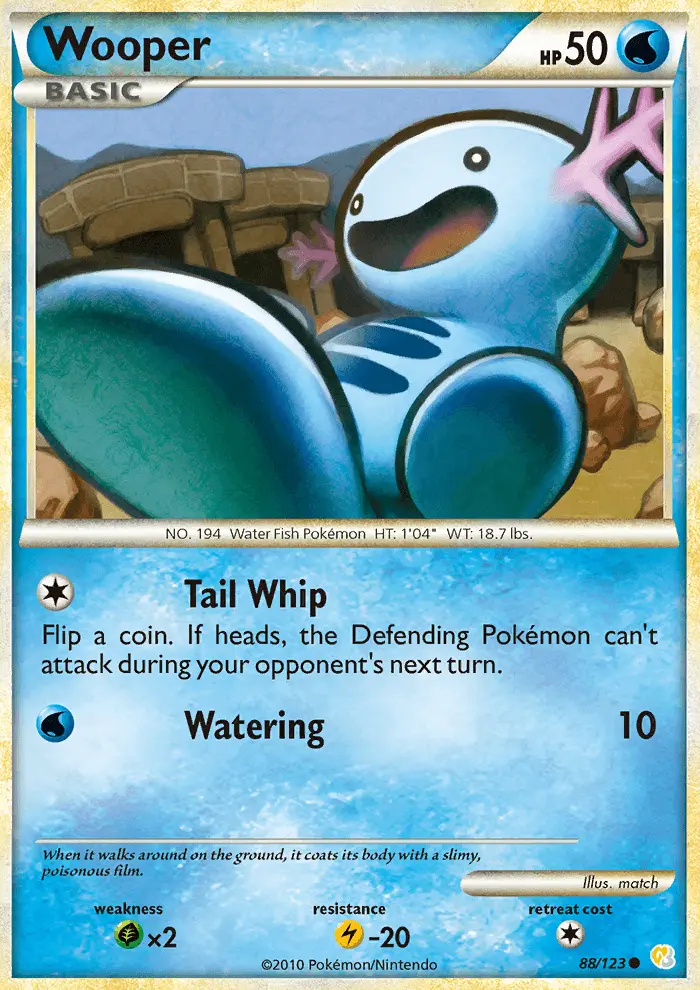
When it walks a round on the ground, it coats its body with a slimy, poisonous film.
A mucous membrane covers its body. Touching it barehanded will cause a shooting pain.
WOOPER usually lives in water. However, it occasionally comes out onto land in search of food. On land, it coats its body with a gooey, toxic film.
WOOPER usually live in water but come out onto land seeking food occasionally. On land, they coat their bodies with a gooey, toxic film.
When it walks around on the ground, it coats its body with a slimy, poisonous film.
This POKéMON lives in cold water. It will leave the water to search for food when it gets cold outside.
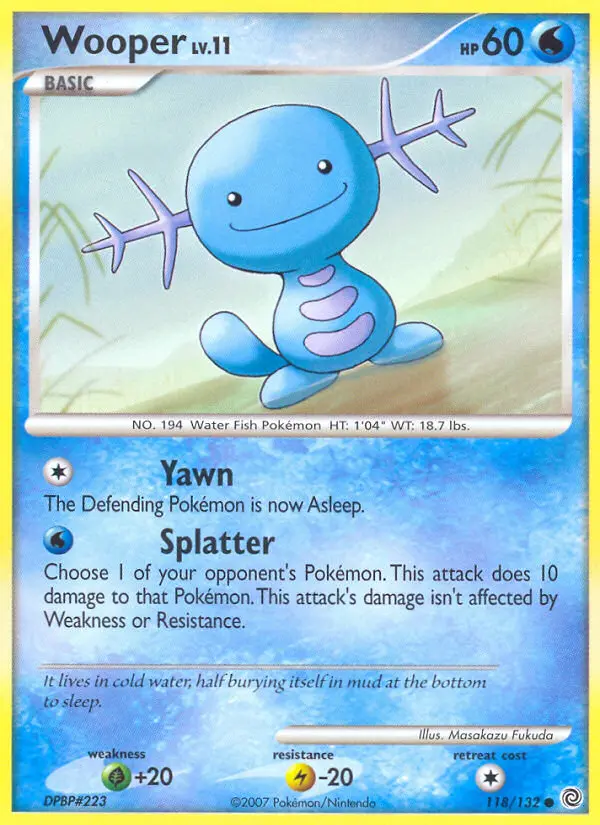
It lives in cold water, half burying itself in mud at the bottom to sleep.
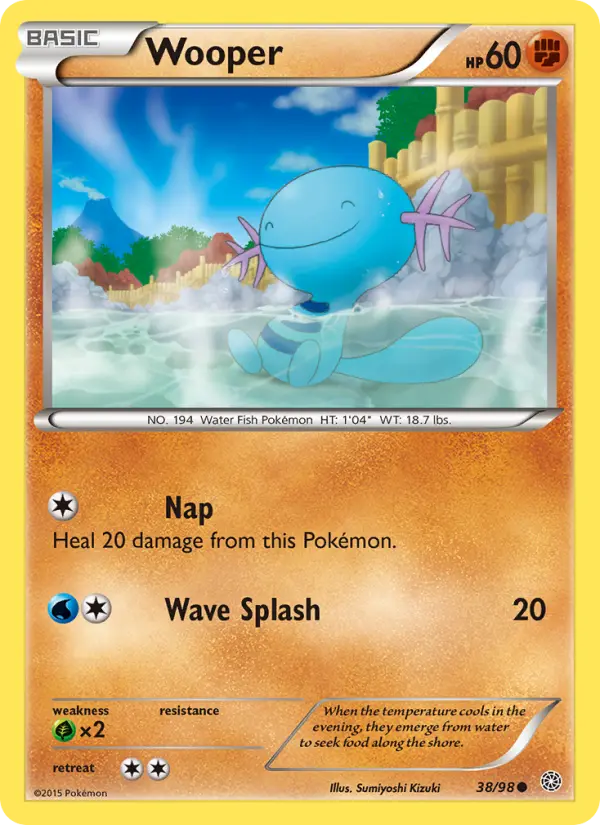
When the temperature cools in the evening, they emerge from water to seek food along the shore.
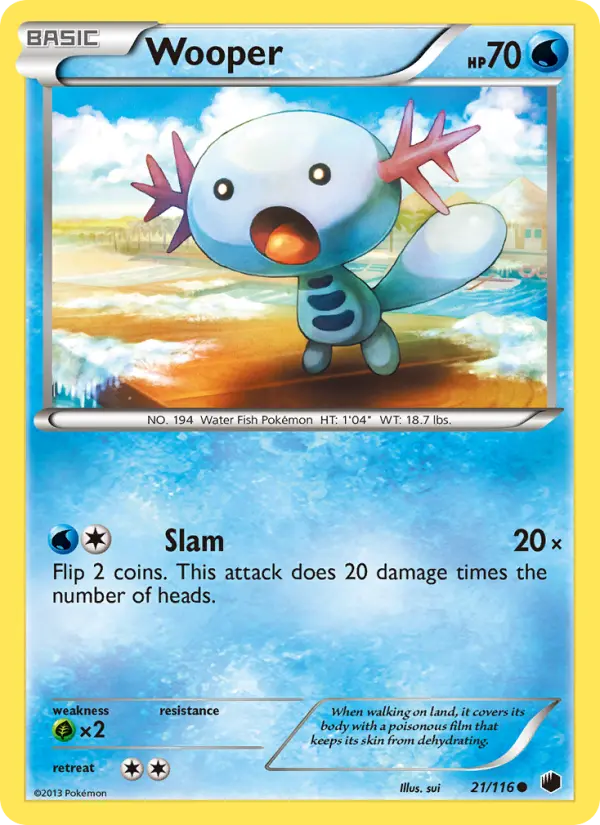
When walking on land, it covers its body with a poisonous film that keeps its skin from dehydrating.
This Pokémon lives in cold water. It will leave the water to search for food when it gets cold outside.
When it walks around on the ground, it coats its body with a slimy, poisonous film.
When walking on land, it covers its body with a poisonous film that keeps its skin from dehydrating.
When walking on land, it covers its body with a poisonous film that keeps its skin from dehydrating.
This Pokémon lives in cold water. It will leave the water to search for food when it gets cold outside.
When the temperature cools in the evening, they emerge from water to seek food along the shore.
Wooper usually lives in water. However, it occasionally comes out onto land in search of food. On land, it coats its body with a gooey, toxic film.
This Pokémon lives in cold water. It will leave the water to search for food when it gets cold outside.
When walking on land, it covers its body with a poisonous film that keeps its skin from dehydrating.
Wooper Name Origin & Design Inspiration
The name 'Wooper' derives from the Japanese name 'Upah' (ウパー), which itself is a reference to the axolotl, a real-world amphibian species native to Mexico. The axolotl connection is unmistakable in Wooper's design—the creature mimics the distinctive external gill structures, aquatic lifestyle, and perpetually benign facial expression characteristic of these fascinating salamanders. The Western nomenclature 'Wooper' likely combines phonetic elements suggesting the creature's waddling, somewhat ungainly movement pattern alongside aquatic associations. This naming convention aligns with Generation II's tendency toward descriptive, onomatopoetic Pokémon names that evoke the creature's physical characteristics and behavioral patterns. The genus classification of 'Water Fish Pokémon' for standard Wooper accurately describes its dual-natured existence, though the classification proves slightly misleading given Wooper's amphibian rather than strictly ichthyological nature. The Paldean variant's reclassification as 'Poison Fish Pokémon' emphasizes the toxicological shift inherent in its regional mutation. The design philosophy emphasizes accessibility and charm—Wooper was deliberately conceived as an approachable, non-threatening water-type suitable for early-game trainer encounters, with its gentle demeanor and ungainly proportions creating an endearing aesthetic that contrasts sharply with more aggressive water-type designs.
Learnable Moves
Wooper can learn 80 moves:
Move | Type | Cat. | Power | Acc. | PP |
|---|---|---|---|---|---|
| acid spray | poison | Special | 40 | 100 | 20 |
| after you | normal | Status | — | — | 15 |
| amnesia | psychic | Status | — | — | 20 |
| ancient power | rock | Special | 60 | 100 | 5 |
| aqua tail | water | Physical | 90 | 90 | 10 |
| attract | normal | Status | — | 100 | 15 |
| avalanche | ice | Physical | 60 | 100 | 10 |
| blizzard | ice | Special | 110 | 70 | 5 |
| body slam | normal | Physical | 85 | 100 | 15 |
| captivate | normal | Status | — | 100 | 20 |
| counter | fighting | Physical | — | 100 | 20 |
| curse | ghost | Status | — | — | 10 |
| defense curl | normal | Status | — | — | 40 |
| dig | ground | Physical | 80 | 100 | 10 |
| dive | water | Physical | 80 | 100 | 10 |
| double kick | fighting | Physical | 30 | 100 | 30 |
| double team | normal | Status | — | — | 15 |
| double edge | normal | Physical | 120 | 100 | 15 |
| dynamic punch | fighting | Physical | 100 | 50 | 5 |
| earth power | ground | Special | 90 | 100 | 10 |
| earthquake | ground | Physical | 100 | 100 | 10 |
| encore | normal | Status | — | 100 | 5 |
| endure | normal | Status | — | — | 10 |
| facade | normal | Physical | 70 | 100 | 20 |
| flash | normal | Status | — | 100 | 20 |
| frustration | normal | Physical | — | 100 | 20 |
| guard swap | psychic | Status | — | — | 10 |
| hail | ice | Status | — | — | 10 |
| haze | ice | Status | — | — | 30 |
| headbutt | normal | Physical | 70 | 100 | 15 |
| helping hand | normal | Status | — | — | 20 |
| hidden power | normal | Special | 60 | 100 | 15 |
| hydro pump | water | Special | 110 | 80 | 5 |
| ice beam | ice | Special | 90 | 100 | 10 |
| ice punch | ice | Physical | 75 | 100 | 15 |
| icy wind | ice | Special | 55 | 95 | 15 |
| iron tail | steel | Physical | 100 | 75 | 15 |
| mimic | normal | Status | — | — | 10 |
| mist | ice | Status | — | — | 30 |
| mud bomb | ground | Special | 65 | 85 | 10 |
| mud shot | ground | Special | 55 | 95 | 15 |
| mud sport | ground | Status | — | — | 15 |
| mud slap | ground | Special | 20 | 100 | 10 |
| muddy water | water | Special | 90 | 85 | 10 |
| natural gift | normal | Physical | — | 100 | 15 |
| protect | normal | Status | — | — | 10 |
| rain dance | water | Status | — | — | 5 |
| recover | normal | Status | — | — | 5 |
| rest | psychic | Status | — | — | 5 |
| return | normal | Physical | — | 100 | 20 |
| rock slide | rock | Physical | 75 | 90 | 10 |
| rock smash | fighting | Physical | 40 | 100 | 15 |
| rock tomb | rock | Physical | 60 | 95 | 15 |
| rollout | rock | Physical | 30 | 90 | 20 |
| round | normal | Special | 60 | 100 | 15 |
| safeguard | normal | Status | — | — | 25 |
| sandstorm | rock | Status | — | — | 10 |
| secret power | normal | Physical | 70 | 100 | 20 |
| slam | normal | Physical | 80 | 75 | 20 |
| sleep talk | normal | Status | — | — | 10 |
| sludge bomb | poison | Special | 90 | 100 | 10 |
| sludge wave | poison | Special | 95 | 100 | 10 |
| snore | normal | Special | 50 | 100 | 15 |
| spikes | ground | Status | — | — | 20 |
| spit up | normal | Special | — | 100 | 10 |
| stealth rock | rock | Status | — | — | 20 |
| stockpile | normal | Status | — | — | 20 |
| stone edge | rock | Physical | 100 | 80 | 5 |
| substitute | normal | Status | — | — | 10 |
| surf | water | Special | 90 | 100 | 15 |
| swagger | normal | Status | — | 85 | 15 |
| swallow | normal | Status | — | — | 10 |
| tail whip | normal | Status | — | 100 | 30 |
| take down | normal | Physical | 90 | 85 | 20 |
| toxic | poison | Status | — | 90 | 10 |
| water gun | water | Special | 40 | 100 | 25 |
| water pulse | water | Special | 60 | 100 | 20 |
| waterfall | water | Physical | 80 | 100 | 15 |
| whirlpool | water | Special | 35 | 85 | 15 |
| yawn | normal | Status | — | — | 10 |
Wooper Competitive Battle Guide
Wooper's competitive viability is severely limited by its abysmal stat distribution, with a base total of only 210 spread across categories that leave it inadequate for serious competitive battling. The species' Special Attack and Special Defense bases of 25 each render it virtually incapable of executing special-type moves effectively, while its Speed base of 15 places it among the slowest Pokémon in existence. This glacial pace virtually guarantees that Wooper will move last in most encounters, a catastrophic disadvantage in turn-based competition where initiative determines engagement outcomes. The Attack stat of 45 provides marginally better options for physical move utilization, though the Defense base of 45 fails to compensate for the species' lack of offensive pressure. Wooper's abilities offer interesting utility rather than direct damage enhancement—Damp prevents both self-destruct and explosion effects, while Water Absorb provides passive healing equivalent to one-quarter maximum HP when hit by Water-type moves, granting basic sustainability. The hidden ability Unaware presents superior competitive potential by ignoring opponent stat modifications during damage calculations, effectively neutralizing common competitive strategies centered on stat manipulation. However, even Unaware's utility cannot overcome Wooper's fundamental stat deficiencies. Competitive trainers universally recognize Wooper as a temporary early-game asset to be replaced by competent alternatives rather than a viable endgame team component, relegating the species to Pokédex completion and casual play contexts.
Commonly Asked Questions About Wooper
What type is Wooper?
Wooper is a water and ground type Pokemon.
What does Wooper evolve into?
Wooper evolves into quagsire, then into clodsire.
What are Wooper's weaknesses?
Wooper is weak to grass and electric type moves.
Does Wooper evolve by trading?
No — Wooper evolves entirely through leveling up, with no trade required at any stage.
Where can I find Wooper?
Wooper can be found in ruins of alph (johto), union cave (johto) and johto route 32 (johto) and 9 other locations.
Wooper Cultural Impact & Franchise History
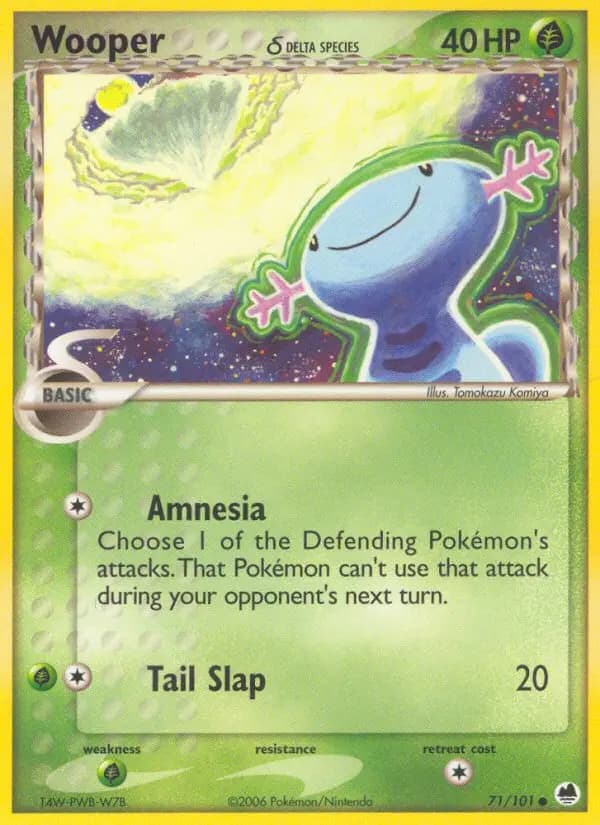
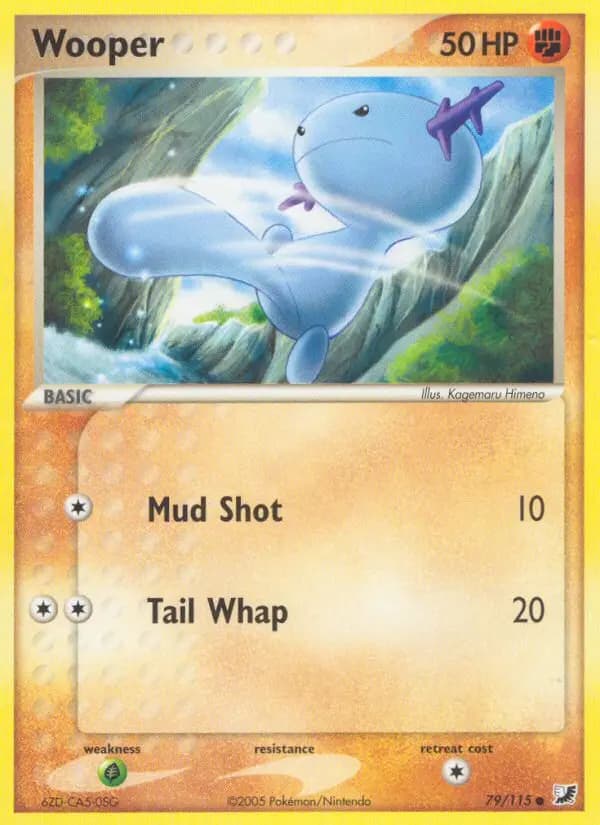
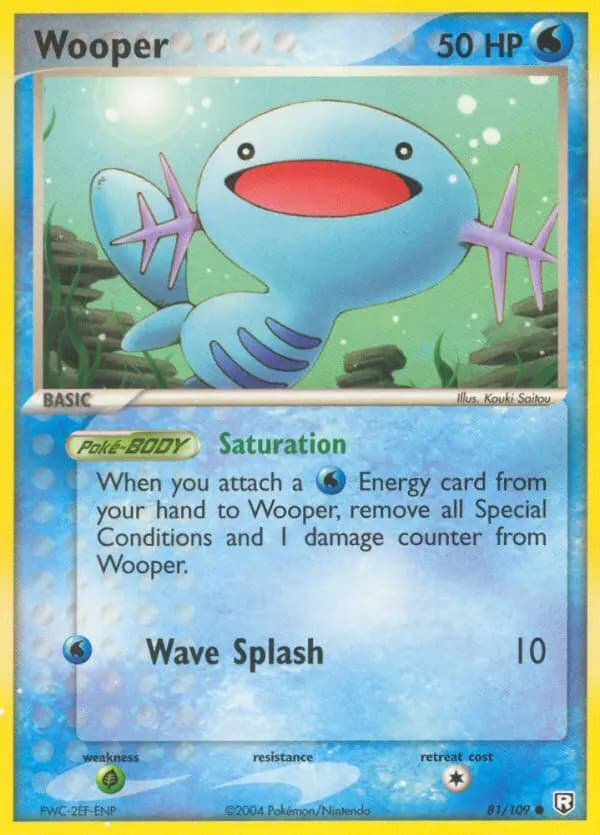
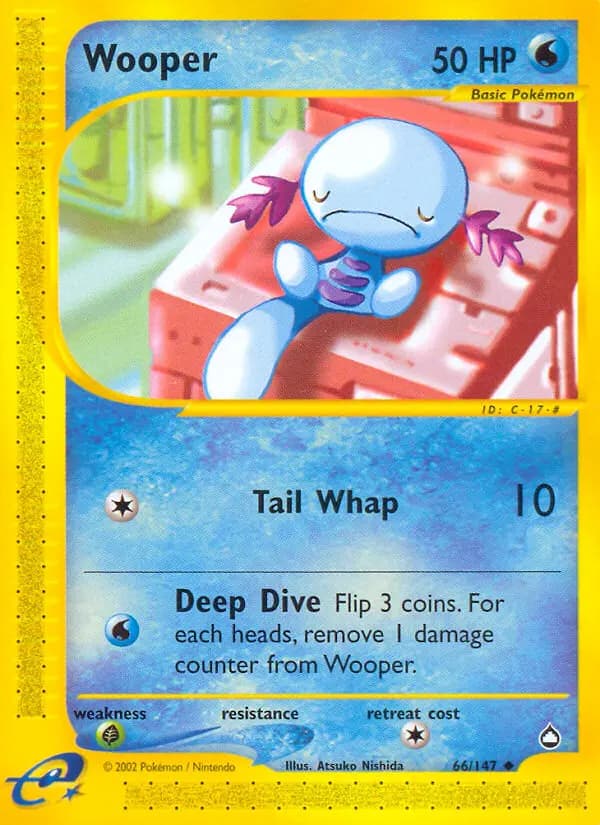
Wooper has cultivated a dedicated fanbase throughout the Pokémon franchise despite its statistical weakness, embodying the charm and approachability that defined Generation II's design philosophy. The species became an iconic representation of the Johto region's aquatic ecosystems, featured prominently in promotional materials and anime depictions throughout the early Gold/Silver era. Its gentle appearance and amphibious nature resonated with players seeking non-threatening, companionable Pokémon rather than imposing combat specialists. Within fan communities, Wooper transformed into a beloved meme symbol during Pokémon Scarlet and Violet's release, with the unexpected Paldean variant generating substantial discussion regarding regional form design and biological adaptation. The species' representation in the Pokémon anime through recurring character Wooper and its appearances throughout multiple series generated nostalgic associations for long-time franchise enthusiasts. Wooper's presence in peripheral media, including trading card games and merchandise lines, established it as a recognizable character deserving of collectible status despite competitive irrelevance. The recent Paldean regional variant reinvigorated interest in the species among contemporary audiences, demonstrating that Game Freak recognized Wooper's cultural significance and its potential for recontextualization through evolutionary reimagining. This sustained cultural presence, spanning from Generation II through present-day releases, illustrates how Pokémon design transcends numerical statistics to encompass aesthetic appeal, emotional resonance, and community-driven cultural significance.
Where to Find Wooper in Every Pokémon Game
Wooper demonstrates remarkable availability across the Pokémon franchise, appearing in virtually every generation since Generation II with consistent accessibility to trainers. In the original Gold/Silver/Crystal games, Wooper inhabits the Ilex Forest and surrounding water bodies in Johto, available early in the player's journey through standard wild encounters. The species reappears in Diamond/Pearl and Platinum within the Great Marsh, maintaining its status as an accessible early-game capture. HeartGold/SoulSilver restored Wooper to Johto's signature locations, reinforcing its connection to this region. X/Y introduced Wooper to Mountain Kalos, expanding its continental range further. Sword/Shield incorporated Wooper into the Galar region's Pokédex, ensuring availability to players during the series' evolutionary leap to eighth-generation mechanics. The Isle of Armor DLC provided an alternative encounter location, increasing accessibility options. Brilliant Diamond/Shining Pearl maintained Wooper's presence in the Sinnoh region for faithful remakes. Most significantly, Pokémon Scarlet/Violet introduced the Paldean regional variant available in the Paldea region, providing trainers with both standard and regionally adapted forms. The Teal Mask DLC incorporated additional Wooper availability, demonstrating continued development commitment toward the species. Wooper's exceptional Capture Rate of 255 ensures that encounters conclude successfully with minimal resource expenditure, removing artificial availability barriers. This near-universal presence across generations and regions reflects Wooper's status as a franchise cornerstone suitable for players seeking accessible early-game Water/Ground-type options.