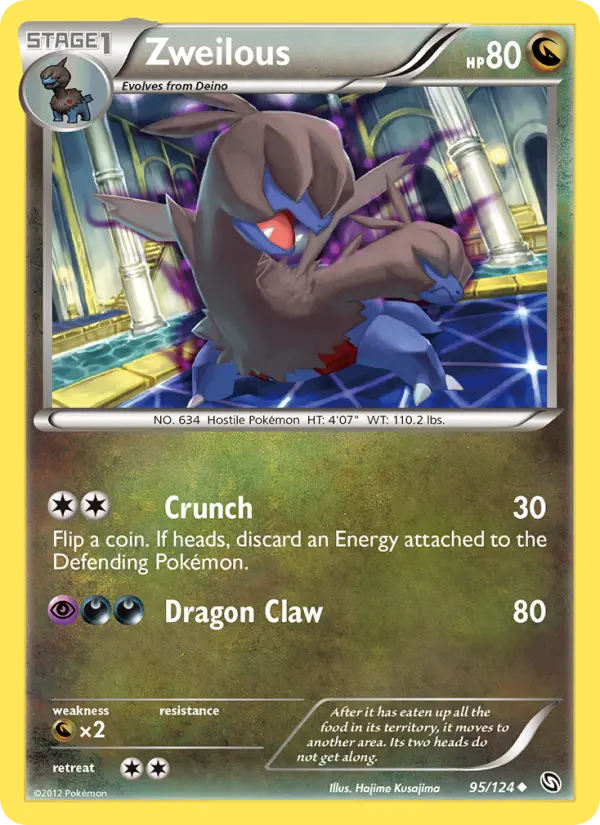
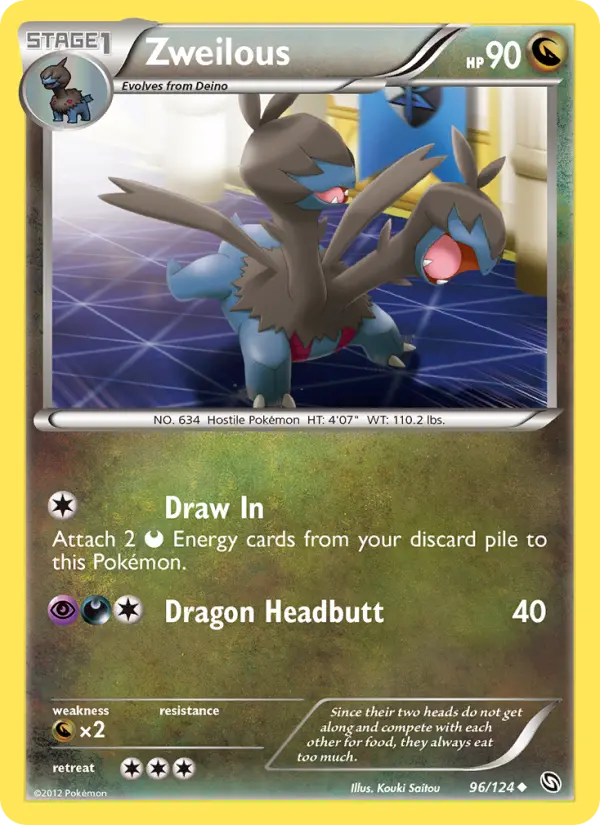
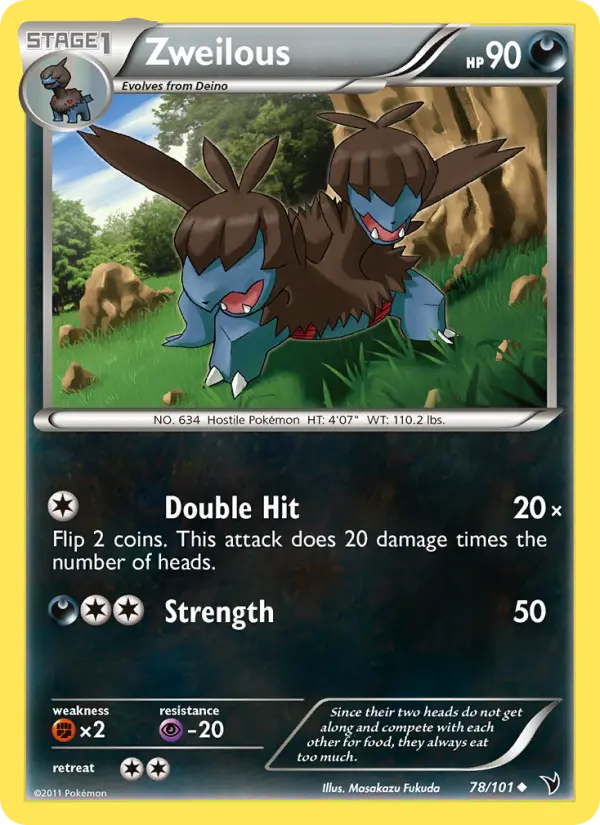
Zweilous
Generation V · #0634 — Hostile Pokémon
The numbers on Zweilous tell you where to look first: Attack at 85, well above what its dark/dragon typing alone would predict. Standing 1.4 meters tall and weighing 50 kilograms, this quadrupedal beast maintains a aggregate stat total of 420, with notable strength in physical attack at 85, making it a formidable mid-stage evolution. The Pokédex entries paint a vivid picture of internal conflict, noting that Zweilous are covered in scars even without external battle, their two heads constantly competing for food and leadership. This internal struggle becomes the very mechanism through which Zweilous grows stronger, requiring no allies or external assistance to develop its combat prowess. Despite its fractious nature, Zweilous remains approachable through gameplay with a capture rate of 45 and a base happiness of 35, though trainers should expect a lengthy bond-building process given its naturally hostile disposition.
Editor's Take
Zweilous has two heads that fight each other constantly according to its Pokédex entry, and level 64 for the third head is the longest wait in the series.
Base Stats
Height
1.4m
Weight
50.0kg
Category
Hostile Pokémon
Gender
Male 50% / Female 50%
Color
blue
Shape
quadruped
Abilities
Strengthens physical moves to inflict 1.5× damage, but decreases their accuracy to 0.8×.
Zweilous Biology & Physical Characteristics
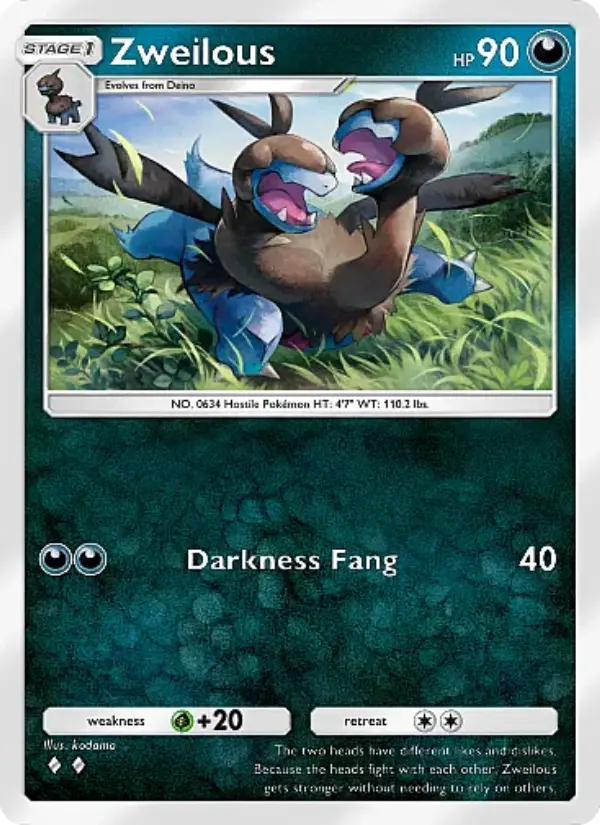
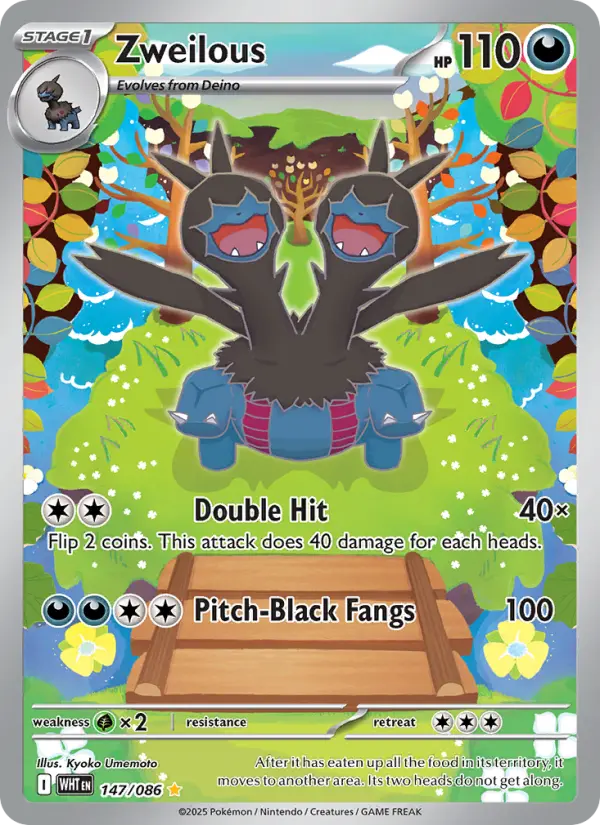
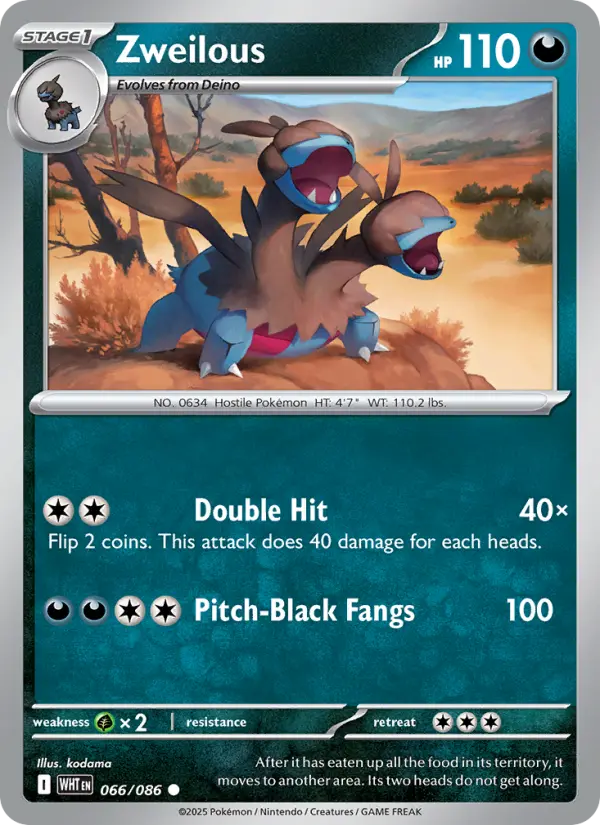
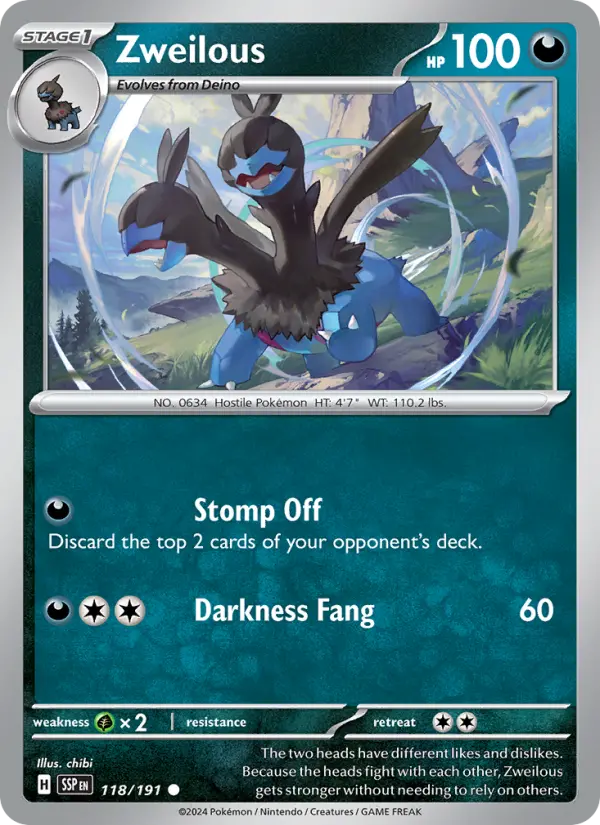
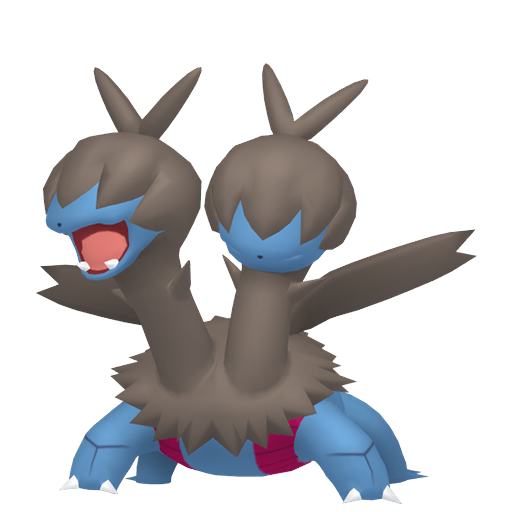
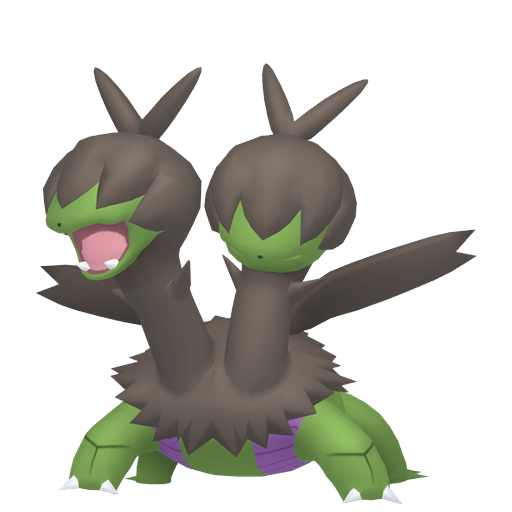
Zweilous presents a distinctly draconic form characterized by its dark-blue coloration and distinctive dual-headed structure. The Pokémon's body is covered in black fur concentrated around its necks and dorsal region, with two well-developed muscular front legs each equipped with two sharp claws, contrasting against less-defined rear legs bearing small, backward-pointing toes. Tufts of fur crown each of its two heads, rising to rounded points that give Zweilous an appearance of perpetual aggression. Most intriguingly, Zweilous appears to lack visible eyes, leaving its sensory mechanisms somewhat mysterious to researchers. Its back sproutes two thin, pointed wings—vestigial perhaps, yet functional enough to suggest its ultimate evolution's aerial capabilities. The most striking visual element is the fuchsia striped banding that runs along its sides and legs, providing sharp contrast to its predominantly dark coloration. This two-headed anatomy represents more than mere aesthetic curiosity; it fundamentally shapes Zweilous's biology, physiology, and behavior patterns. The separate neural systems governing each head create distinct preferences and competitive drives, resulting in a Pokémon that literally battles itself while maintaining surprising biological cohesion.
Pokedex Numbers
Training
Breeding
Zweilous Breeding, Gender Ratio & Egg Groups
Zweilous maintains an even gender distribution with exactly 50 percent male and 50 percent female representation within the species, ensuring balanced breeding opportunities regardless of individual trainer preferences. The Pokémon belongs to the Dragon egg group, restricting breeding compatibility to other creatures within that classification, including legendary dragons, pseudo-legendary lines, and various other draconic Pokémon. As a non-baby Pokémon with a base happiness of 35—notably lower than the standard baseline of 50—Zweilous requires extra effort from trainers to reach breeding conditions when attempting to produce Deino offspring. The slow growth rate of 40 egg cycles translates to approximately 10,024 to 10,280 steps required for egg hatching, representing a significant investment of time and effort in breeding programs. The lower base happiness suggests that Zweilous, regardless of gender, maintains its hostile and competitive disposition across all reproductive activities, though this does not prevent breeding when conditions are met. Trainers seeking to breed Zweilous should note that the resulting Deino will begin at the first stage of the evolutionary line, requiring substantial leveling investment to eventually reach Zweilous itself. The Dragon egg group classification connects Zweilous to a prestigious lineage of powerful draconic creatures, emphasizing its role as a legitimate member of dragon-type breeding communities despite its unusual dual-headed morphology and Dark-type secondary classification.
Sprites




TMs & HMs
tm01
lets go pikachu lets go eevee
tm01
ultra sun ultra moon
tm01
sun moon
tm02
crystal
tm02
gold silver
tm02
lets go pikachu lets go eevee
tm03
lets go pikachu lets go eevee
tm05
ruby sapphire
tm05
emerald
tm05
gold silver
tm05
crystal
tm05
diamond pearl
tm05
black white
tm05
platinum
tm05
heartgold soulsilver
tm05
firered leafgreen
tm05
black 2 white 2
tm05
omega ruby alpha sapphire
tm05
x y
tm05
xd
+514 more TMs/HMs
Zweilous's Evolution Chain


Zweilous Evolution, Mega Evolution & Special Forms
Zweilous occupies a critical position within the three-stage Deino evolutionary line, evolving from Deino at level 50 and advancing to the apex predator Hydreigon at level 64. The evolution from Deino to Zweilous marks the point at which the single-headed juvenile gains its second head, fundamentally transforming its behavioral profile and combat capabilities. While Deino represents an immature, somewhat timid creature, Zweilous exhibits the violent temperament and internal conflict that defines the line's core identity. The progression toward Hydreigon at level 64 represents Zweilous reaching its ultimate form, where it gains additional heads and wings, achieving three total heads and full aerial capability. This evolutionary sequence demonstrates a clear developmental arc: from single-headed vulnerability, through dual-headed internal conflict and strength-building competition, to the ultimate integration and dominance of the three-headed apex form. The relatively slow growth rate of 40 egg cycles and the requirement to reach level 64 for final evolution ensures that trainers experience an extended partnership with Zweilous, allowing for meaningful bond development despite the Pokémon's naturally low base happiness of 35. This extended middle stage creates a crucial juncture where trainers must demonstrate commitment and patience, mirroring the personal struggle Zweilous itself endures.
Where to Find
Unova Victory Road 2
unova
+13 more
Kalos Victory Road
kalos
+13 more
Zweilous Behaviour and Natural Habitat
The behavior of Zweilous is entirely dominated by the perpetual discord between its two heads, each possessing independent likes, dislikes, and competitive drives. According to Pokédex data, the two heads constantly bicker and fight, particularly over food consumption, with whichever head manages to eat more establishing temporary dominance and leadership. This internal competition drives Zweilous toward constant overeating, accumulating battle scars across its body even in the absence of external combat. The competitive eating pattern suggests that Zweilous requires significantly more calories than comparable Pokémon, driving it to consume all available prey within its territory before migrating to new hunting grounds. As a nomadic creature, Zweilous wanders widely throughout its domain, hunting prey with both heads often disagreeing about which direction to pursue, creating chaotic and unpredictable movement patterns. While Zweilous typically makes its habitat in caves, it demonstrates territorial behavior, aggressively consuming food resources and moving on only when an area has been thoroughly depleted. Interestingly, this internal conflict mechanism proves developmentally advantageous—Zweilous becomes stronger through self-competition without requiring allies or external challenges, suggesting that the constant stress and struggle with itself serves as an evolutionary adaptation rather than a weakness.
Pokedex Entries
After it has eaten up all the food in its territory, it moves to another area. Its two heads do not get along.
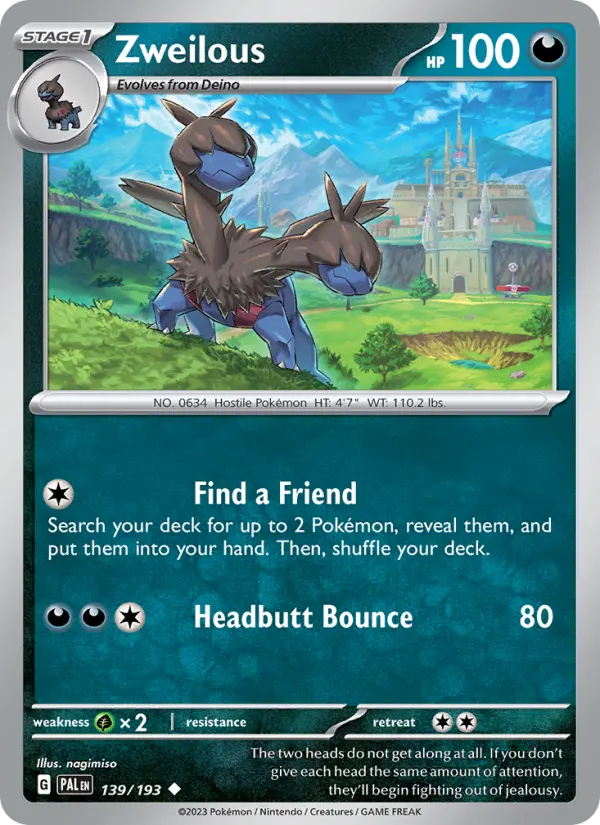
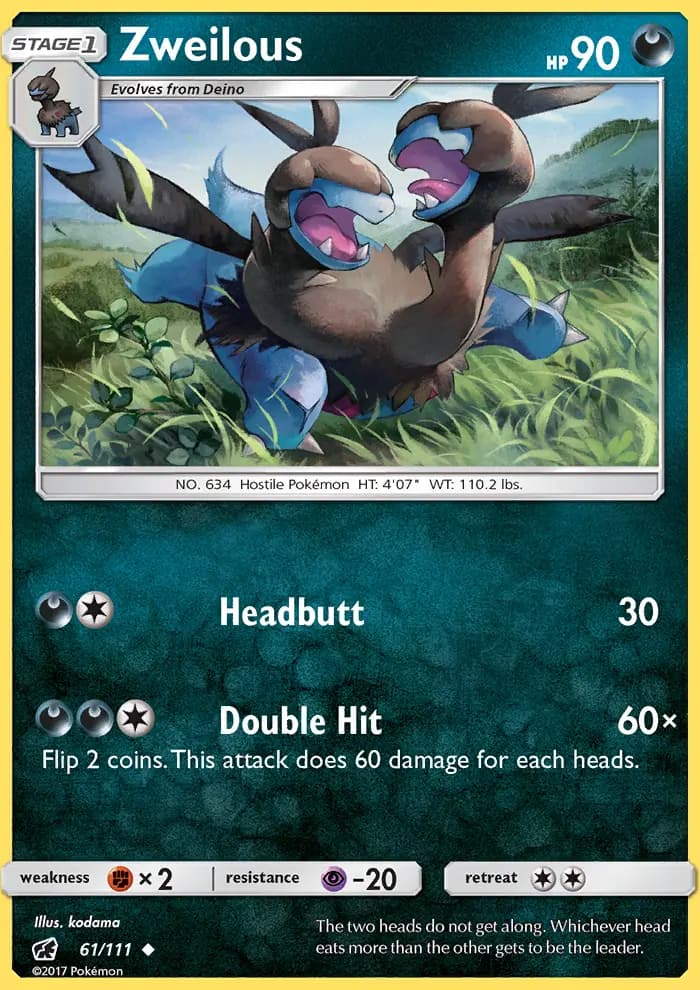
The two heads do not get along. Whichever head eats more than the other gets to be the leader.
Since their two heads do not get along and compete with each other for food, they always eat too much.
The two heads do not get along. Whichever head eats more than the other gets to be the leader.
After it has eaten up all the food in its territory, it moves to another area. Its two heads do not get along.
The two heads do not get along. Whichever head eats more than the other gets to be the leader.
After it has eaten up all the food in its territory, it moves to another area. Its two heads do not get along.
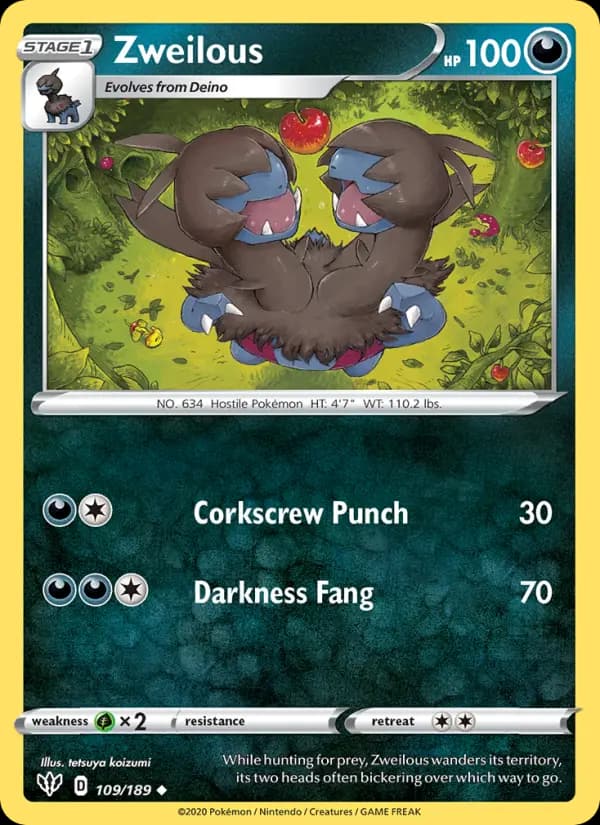
While hunting for prey, Zweilous wanders its territory, its two heads often bickering over which way to go.
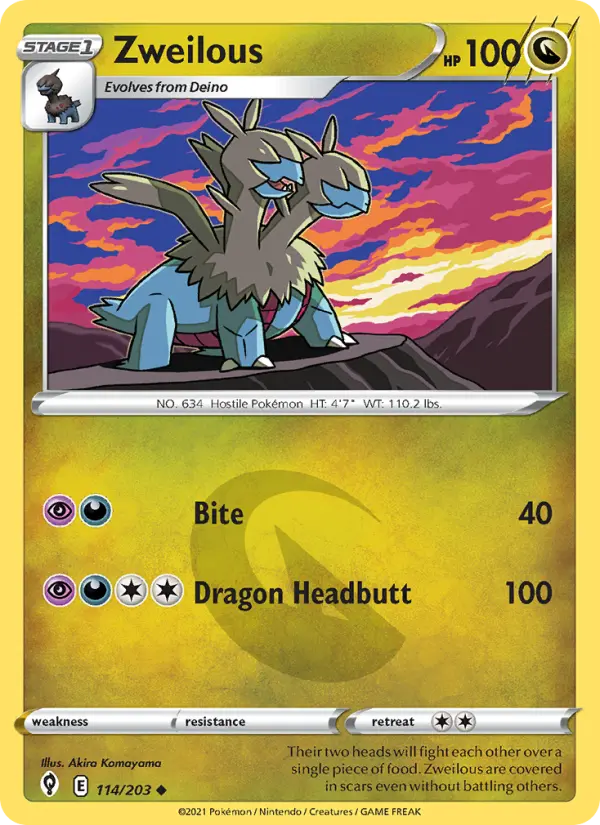
Their two heads will fight each other over a single piece of food. Zweilous are covered in scars even without battling others.
Zweilous Name Origin & Design Inspiration
Zweilous's name traces to the German numeral 'zwei,' meaning two, combined with the English suffix '-ous,' emphasizing the dualistic nature that defines this creature. The Japanese name 'Jīheddo' similarly breaks down into 'jī' (representing the number two or division) and 'heddo' (head), creating an elegant linguistic representation of the Pokémon's defining characteristic. The design philosophy clearly prioritizes the visual and conceptual representation of internal conflict and dual consciousness, with the two heads serving as both literal anatomical features and metaphorical representations of competing drives and ambitions. Zweilous draws inspiration from various mythological two-headed creatures, particularly dragons from Western tradition, blending draconic majesty with the almost comedic tragedy of self-inflicted conflict. The dark coloration and aggressive posturing align with the Dark-type classification, while the draconic elements—wings, scaled appearance, and predatory build—establish its Dragon-type identity. The fuchsia striping provides striking visual contrast, breaking up the darker palette and suggesting the internal divisions that characterize the species. The evolutionary progression from Deino's single-headed uncertainty through Zweilous's conflicted duality to Hydreigon's multi-headed harmony creates a design narrative arc that explores themes of identity integration and personal development, making Zweilous more than simply a mid-stage evolution but rather a conceptual meditation on internal struggle.
Learnable Moves
Zweilous can learn 68 moves:
Move | Type | Cat. | Power | Acc. | PP |
|---|---|---|---|---|---|
| aqua tail | water | Physical | 90 | 90 | 10 |
| assurance | dark | Physical | 60 | 100 | 10 |
| attract | normal | Status | — | 100 | 15 |
| beat up | dark | Physical | — | 100 | 10 |
| bite | dark | Physical | 60 | 100 | 25 |
| body slam | normal | Physical | 85 | 100 | 15 |
| confide | normal | Status | — | — | 20 |
| crunch | dark | Physical | 80 | 100 | 15 |
| dark pulse | dark | Special | 80 | 100 | 15 |
| double hit | normal | Physical | 35 | 90 | 10 |
| double team | normal | Status | — | — | 15 |
| draco meteor | dragon | Special | 130 | 90 | 5 |
| dragon breath | dragon | Special | 60 | 100 | 20 |
| dragon cheer | dragon | Status | 0 | 0 | 15 |
| dragon pulse | dragon | Special | 85 | 100 | 10 |
| dragon rage | dragon | Special | — | 100 | 10 |
| dragon rush | dragon | Physical | 100 | 75 | 10 |
| dragon tail | dragon | Physical | 60 | 90 | 10 |
| earth power | ground | Special | 90 | 100 | 10 |
| endure | normal | Status | — | — | 10 |
| facade | normal | Physical | 70 | 100 | 20 |
| fire fang | fire | Physical | 65 | 95 | 15 |
| focus energy | normal | Status | — | — | 30 |
| frustration | normal | Physical | — | 100 | 20 |
| headbutt | normal | Physical | 70 | 100 | 15 |
| helping hand | normal | Status | — | — | 20 |
| hidden power | normal | Special | 60 | 100 | 15 |
| hyper voice | normal | Special | 90 | 100 | 10 |
| ice fang | ice | Physical | 65 | 95 | 15 |
| incinerate | fire | Special | 60 | 100 | 15 |
| lash out | dark | Physical | 75 | 100 | 5 |
| nasty plot | dark | Status | — | — | 20 |
| outrage | dragon | Physical | 120 | 100 | 10 |
| protect | normal | Status | — | — | 10 |
| psych up | normal | Status | — | — | 10 |
| rain dance | water | Status | — | — | 5 |
| rest | psychic | Status | — | — | 5 |
| return | normal | Physical | — | 100 | 20 |
| roar | normal | Status | — | — | 20 |
| rock smash | fighting | Physical | 40 | 100 | 15 |
| round | normal | Special | 60 | 100 | 15 |
| scary face | normal | Status | — | 100 | 10 |
| screech | normal | Status | — | 85 | 40 |
| secret power | normal | Physical | 70 | 100 | 20 |
| shock wave | electric | Special | 60 | — | 20 |
| slam | normal | Physical | 80 | 75 | 20 |
| sleep talk | normal | Status | — | — | 10 |
| snarl | dark | Special | 55 | 95 | 15 |
| snore | normal | Special | 50 | 100 | 15 |
| spite | ghost | Status | — | 100 | 10 |
| stomping tantrum | ground | Physical | 75 | 100 | 10 |
| strength | normal | Physical | 80 | 100 | 15 |
| substitute | normal | Status | — | — | 10 |
| sunny day | fire | Status | — | — | 5 |
| superpower | fighting | Physical | 120 | 100 | 5 |
| swagger | normal | Status | — | 85 | 15 |
| tackle | normal | Physical | 40 | 100 | 35 |
| take down | normal | Physical | 90 | 85 | 20 |
| taunt | dark | Status | — | 100 | 20 |
| tera blast | normal | Special | 80 | 100 | 10 |
| thief | dark | Physical | 60 | 100 | 25 |
| thunder fang | electric | Physical | 65 | 95 | 15 |
| thunder wave | electric | Status | — | 90 | 20 |
| torment | dark | Status | — | 100 | 15 |
| toxic | poison | Status | — | 90 | 10 |
| uproar | normal | Special | 90 | 100 | 10 |
| work up | normal | Status | — | — | 30 |
| zen headbutt | psychic | Physical | 80 | 90 | 15 |
Zweilous Competitive Battle Guide
Judged by competitive standards, Zweilous occupies a niche role as a mid-stage transitional Pokémon, generally outclassed by both its pre-evolution Deino in early-game scenarios and its final evolution Hydreigon in tournament formats. However, Zweilous's signature ability Hustle merits serious consideration in specific strategic contexts. This ability multiplies physical attack power by 1.5x, effectively raising its base attack of 85 to an effective 127.5, while simultaneously reducing accuracy to 80 percent—a significant trade-off that requires careful move selection and team composition to optimize. Zweilous's stat distribution emphasizes physical offense with attack as its primary strength, complemented by passable defenses of 70 base in both special defense and defense, and a concerning speed stat of just 58. The Dark and Dragon typing provides access to powerful moves like Crunch, Outrage, and Dragon Dance while offering useful resistances to Ghost and Dark-type attacks with 0.5x effectiveness. Competitive players should recognize that Zweilous functions most effectively in niche strategies involving accuracy-boosting support from teammates or in formats where mid-stage evolutions receive consideration. The low speed stat necessitates either speed-control strategies through team support or acceptance of outspeeding only the slowest opposing threats. While Hydreigon supersedes Zweilous in virtually all competitive contexts, dedicated players experimenting with mid-stage Pokémon may find creative applications for its high physical attack and dual typing, particularly in formats explicitly designed around Pokémon at specific evolution stages.
Commonly Asked Questions About Zweilous
What type is Zweilous?
Zweilous is a dark and dragon type Pokemon.
What does Zweilous evolve into?
Zweilous evolves into hydreigon.
What are Zweilous's weaknesses?
Zweilous is weak to fighting, bug, ice, dragon and fairy type moves.
Does Zweilous evolve by trading?
No — Zweilous evolves entirely through leveling up, with no trade required at any stage.
Where can I find Zweilous?
Zweilous can be found in unova victory road 2 (unova) and kalos victory road (kalos).
Zweilous Cultural Impact & Franchise History
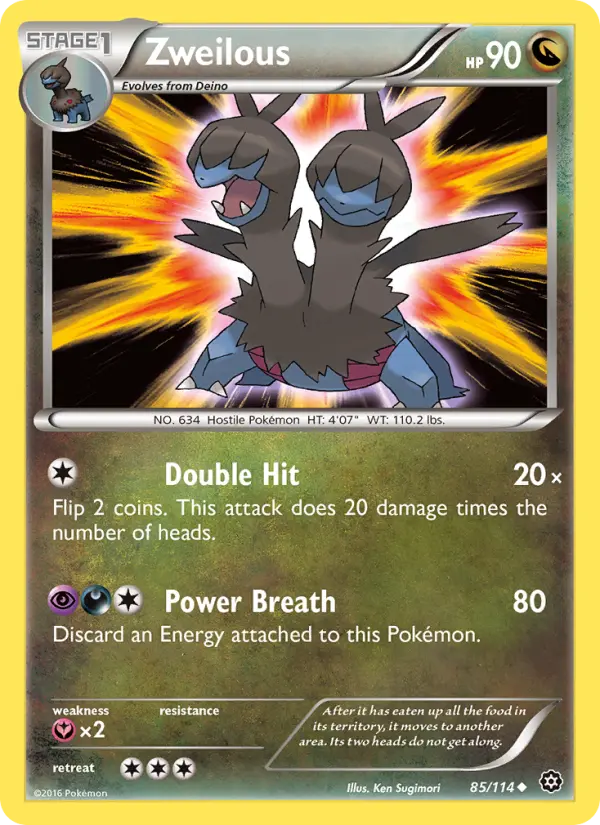
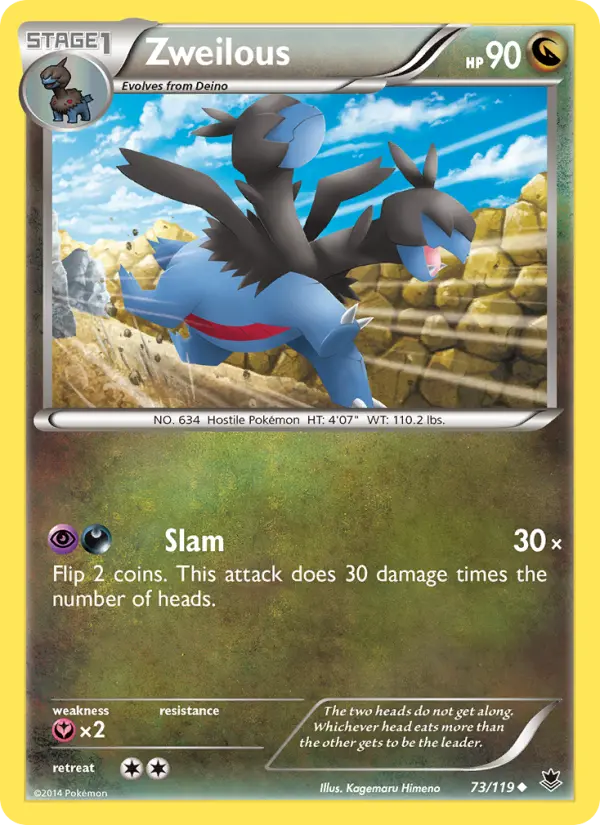
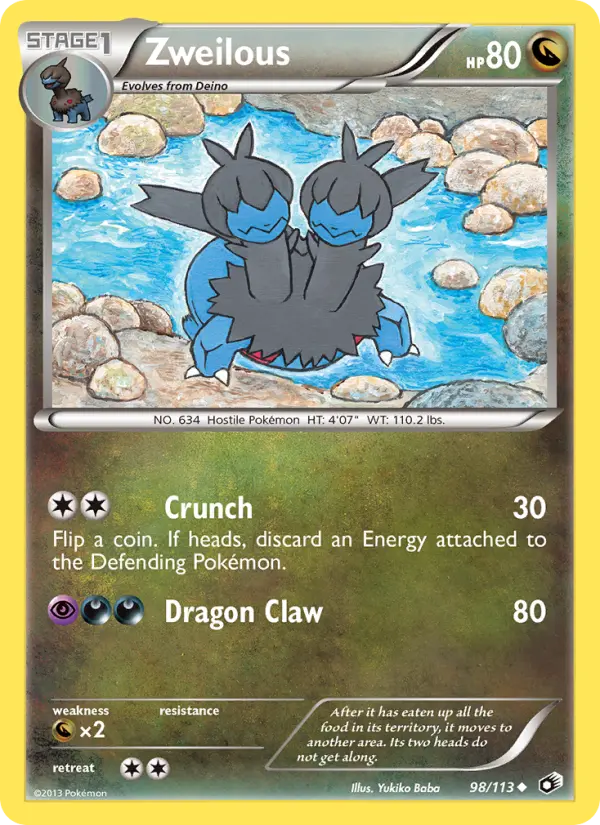
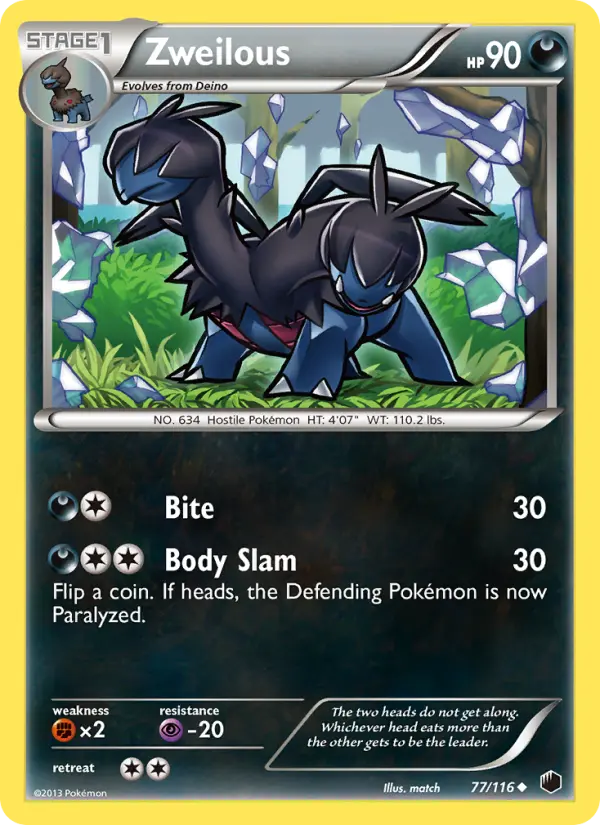
Zweilous, as the first dual-headed evolution in the Pokémon franchise's history at its release in Generation V, created an immediate cultural impact through its visually striking and conceptually novel design. The Pokémon's two-headed morphology resonated with audiences seeking Pokémon designs that broke from established conventions, offering philosophical depth through its literal representation of internal conflict and competing motivations. Within Pokémon media, Zweilous has appeared in various anime episodes and trading card game releases, though typically overshadowed by its more impressive final evolution Hydreigon. The concept of a creature deriving strength from internal struggle rather than external competition proved popular among fans interested in character-driven narratives and psychological depth. Gaming communities frequently discuss Zweilous in the context of evolutionary design philosophy, using the Deino line as an example of how Pokémon generations approached narrative complexity through systematic visual and mechanical progression. The species has inspired fan artwork, fiction, and theoretical discussions about consciousness, identity, and the nature of competitive evolution. Zweilous's role as a transitional stage elevated it beyond mere mechanical stepping stone to become an object of cultural fascination, with players forming emotional attachments to their Zweilous during the extended leveling period required to reach Hydreigon. The species symbolizes Generation V's willingness to explore darker, more morally ambiguous Pokémon designs that challenged earlier generation sensibilities about what constitutes a desirable creature.
Where to Find Zweilous in Every Pokémon Game
Zweilous availability varies significantly across Pokémon generations and game versions. In Generation V's Black and White, Zweilous appears as Pokédex #140 in Unova's native numbering and can be obtained through the standard evolutionary process from Deino, which appears in caves throughout the game. Black 2 and White 2 renumber Zweilous as #274, maintaining availability through Deino encounters and evolution. In Generation VI, X and Y assign it #143 within Mountain Kalos, making it accessible to players exploring that region's caves and mountainous terrain. Omega Ruby and Alpha Sapphire similarly include Zweilous within the expanded Hoenn Pokédex. Generation VII sees Zweilous numbered #387 in the Alola region, appearing in various cave locations accessible during the story progression. Sword and Shield place Zweilous as #371 in the Galar Pokédex, making it available within the base game and accessible through wild encounters and Dynamax Adventures. The Crown Tundra DLC specifically assigns it #137, guaranteeing availability for players engaging with that post-game content. Generation IX's Scarlet and Violet include Zweilous as #371 in the Paldea region Pokédex, available through wild encounters, Pokédex completion rewards, and breeding Deino obtained through various methods. Additionally, Pokémon Legends: Z-A has been confirmed to feature Zweilous, though specific availability details remain forthcoming. The consistent presence of Zweilous across multiple generations and versions reflects its status as a legitimate member of the broader Pokédex rather than a region-exclusive or limited-availability species, ensuring accessibility for trainers committed to completing the Deino evolutionary line across virtually any game version released since Generation V's initial debut.