Farfetchd
Generation I · #0083 — Wild Duck Pokémon
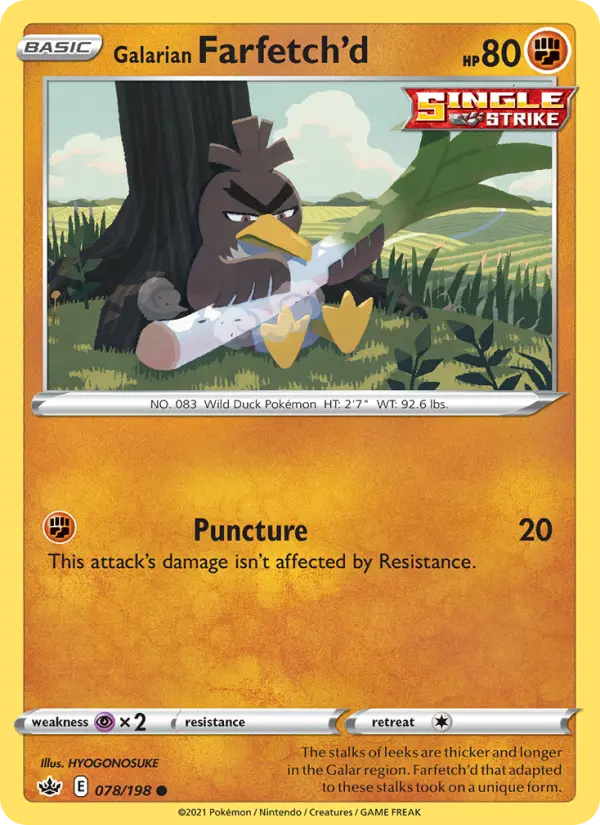
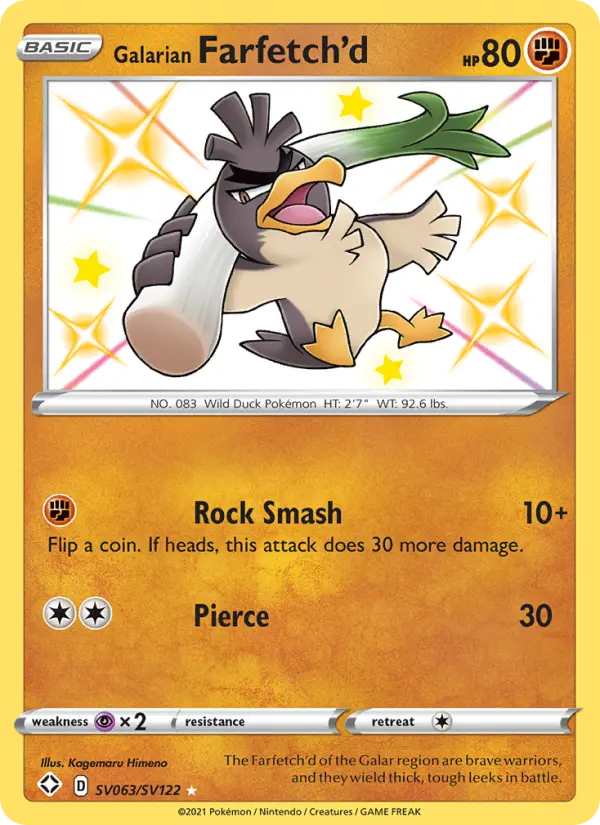
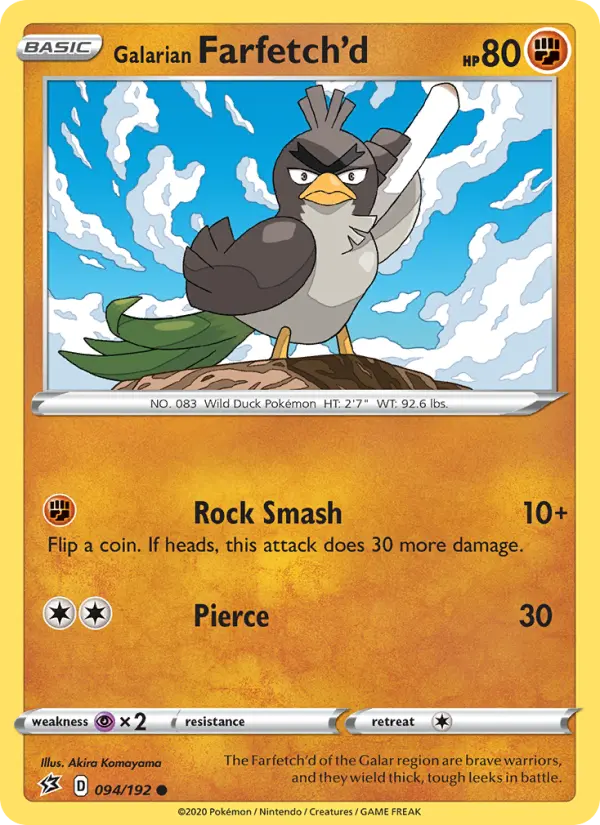
Farfetchd measures in at 0.8 m and 15 kg, a build that matches its keen eye ability better than it matches raw offense or defense. It measures 0.8 m and 15.0 kg, dimensions that pair with that stat lean in noticeable ways. With a cumulative stat total of 377, Farfetch'd demonstrates a specialized combat profile that heavily favors physical attack at 90, making it a formidable offensive presence despite its modest defensive capabilities. The Pokémon exists in a unique ecological niche, distinguished primarily by its inseparable relationship with a plant stick that serves as both weapon and survival tool. In the Galar region, a regional Fighting-type form of Farfetch'd emerged, introducing new strategic possibilities and leading to an evolutionary line that was previously absent in the original Kantonian form.
Editor's Take
Farfetch'd was a joke Pokémon for eight generations and Sirfetch'd is a genuinely good Fighting-type, which makes the Galarian line the most complete rehabilitation in the series.
Base Stats
Height
0.8m
Weight
15.0kg
Category
Wild Duck Pokémon
Gender
Male 50% / Female 50%
Color
brown
Shape
wings
Habitat
grassland
Abilities
Prevents accuracy from being lowered.
Prevents flinching.
Raises Attack two stages upon having any stat lowered.

Farfetchd Biology & Physical Characteristics
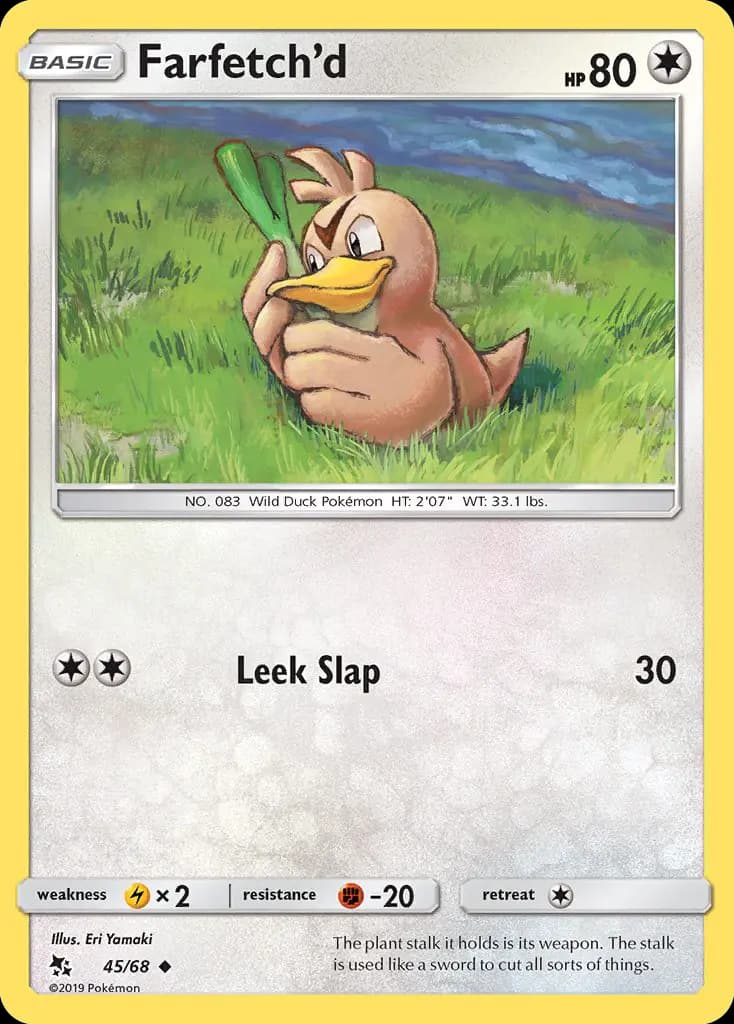
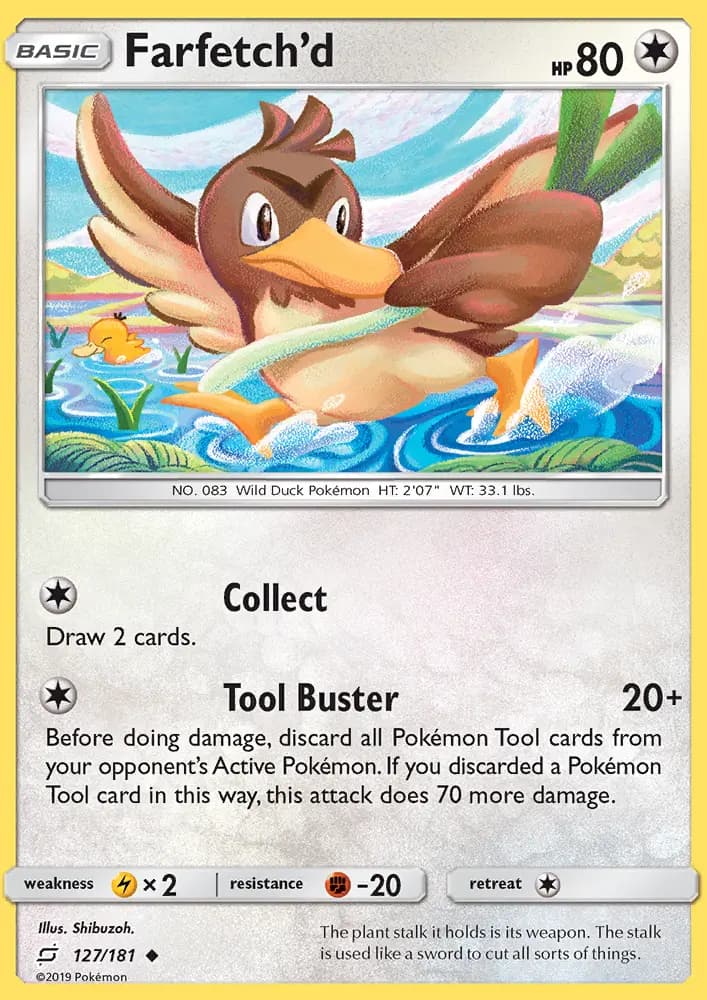
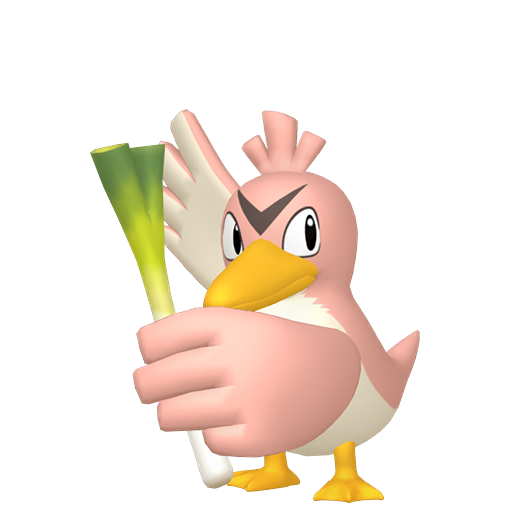
Farfetch'd is an avian Pokémon with a resemblance to a mallard duck, featuring a light brown body contrasted by a white underbelly. Its most distinctive physical characteristic is its flat yellow beak and prominent V-shaped black marking across its forehead, giving it a perpetually stern expression. Standing at just 0.8 meters tall and weighing 15.0 kilograms, Farfetch'd is relatively diminutive compared to other Flying-types of its generation. The Pokémon's biological structure is optimized for aerial mobility, though its base Speed stat of 60 suggests it is not among the fastest fliers. The three known abilities associated with Farfetch'd—Keen Eye, Inner Focus, and its Hidden Ability Defiant—provide interesting mechanical interpretations of the Pokémon's combat nature. Keen Eye prevents opponents from lowering its accuracy, Inner Focus eliminates flinching, while the Hidden Ability Defiant raises its already respectable Attack by two stages whenever any of its stats are lowered, turning defensive pressure into an offensive advantage.
Pokedex Numbers
Training
Breeding
Farfetchd Breeding, Gender Ratio & Egg Groups
Farfetch'd exhibits an equal gender distribution with a 50% male to 50% female ratio, ensuring balanced breeding opportunities for trainers seeking to develop their own specimens. The species belongs to the Flying and Ground egg groups, though the Ground egg group classification might seem counterintuitive given its aerial nature and aquatic habitat preferences. Newly hatched Farfetch'd require approximately 20 egg cycles to develop, translating to roughly 4,884 to 5,140 steps of active gameplay before hatching. The species possesses a moderate base happiness value of 70, indicating a reasonable degree of friendliness toward its trainer from the moment of capture or hatching. This relatively high base happiness facilitates faster friendship-based evolution mechanics for Pokémon with whom Farfetch'd might breed, and it contributes to smoother initial bonding between trainer and Pokémon. The medium growth rate classification suggests Farfetch'd reaches its developmental plateau at a moderate pace compared to faster-leveling species, placing it comfortably within the standard progression timeline expected of most wild-caught Pokémon.
Sprites





Held Items
Stick
species-specific
Raises Farfetch’d’s critical hit ratio by two stages.
Cost: 1000
Stick
species-specific
Raises Farfetch’d’s critical hit ratio by two stages.
Cost: 1000
Stick
species-specific
Raises Farfetch’d’s critical hit ratio by two stages.
Cost: 1000
Stick
species-specific
Raises Farfetch’d’s critical hit ratio by two stages.
Cost: 1000
Stick
species-specific
Raises Farfetch’d’s critical hit ratio by two stages.
Cost: 1000
Stick
species-specific
Raises Farfetch’d’s critical hit ratio by two stages.
Cost: 1000
Stick
species-specific
Raises Farfetch’d’s critical hit ratio by two stages.
Cost: 1000
Stick
species-specific
Raises Farfetch’d’s critical hit ratio by two stages.
Cost: 1000
Stick
species-specific
Raises Farfetch’d’s critical hit ratio by two stages.
Cost: 1000
Stick
species-specific
Raises Farfetch’d’s critical hit ratio by two stages.
Cost: 1000
Stick
species-specific
Raises Farfetch’d’s critical hit ratio by two stages.
Cost: 1000
Stick
species-specific
Raises Farfetch’d’s critical hit ratio by two stages.
Cost: 1000
Stick
species-specific
Raises Farfetch’d’s critical hit ratio by two stages.
Cost: 1000
Stick
species-specific
Raises Farfetch’d’s critical hit ratio by two stages.
Cost: 1000
Stick
species-specific
Raises Farfetch’d’s critical hit ratio by two stages.
Cost: 1000
Stick
species-specific
Raises Farfetch’d’s critical hit ratio by two stages.
Cost: 1000
Stick
species-specific
Raises Farfetch’d’s critical hit ratio by two stages.
Cost: 1000
Stick
species-specific
Raises Farfetch’d’s critical hit ratio by two stages.
Cost: 1000
Stick
species-specific
Raises Farfetch’d’s critical hit ratio by two stages.
Cost: 1000
Stick
species-specific
Raises Farfetch’d’s critical hit ratio by two stages.
Cost: 1000
Stick
species-specific
Raises Farfetch’d’s critical hit ratio by two stages.
Cost: 1000
Stick
species-specific
Raises Farfetch’d’s critical hit ratio by two stages.
Cost: 1000
Stick
species-specific
Raises Farfetch’d’s critical hit ratio by two stages.
Cost: 1000
Stick
species-specific
Raises Farfetch’d’s critical hit ratio by two stages.
Cost: 1000
Stick
species-specific
Raises Farfetch’d’s critical hit ratio by two stages.
Cost: 1000
Stick
species-specific
Raises Farfetch’d’s critical hit ratio by two stages.
Cost: 1000
Stick
species-specific
Raises Farfetch’d’s critical hit ratio by two stages.
Cost: 1000
Stick
species-specific
Raises Farfetch’d’s critical hit ratio by two stages.
Cost: 1000
Stick
species-specific
Raises Farfetch’d’s critical hit ratio by two stages.
Cost: 1000
Stick
species-specific
Raises Farfetch’d’s critical hit ratio by two stages.
Cost: 1000
Stick
species-specific
Raises Farfetch’d’s critical hit ratio by two stages.
Cost: 1000
Stick
species-specific
Raises Farfetch’d’s critical hit ratio by two stages.
Cost: 1000
Stick
species-specific
Raises Farfetch’d’s critical hit ratio by two stages.
Cost: 1000
Stick
species-specific
Raises Farfetch’d’s critical hit ratio by two stages.
Cost: 1000
Stick
species-specific
Raises Farfetch’d’s critical hit ratio by two stages.
Cost: 1000
Stick
species-specific
Raises Farfetch’d’s critical hit ratio by two stages.
Cost: 1000
Stick
species-specific
Raises Farfetch’d’s critical hit ratio by two stages.
Cost: 1000
Stick
species-specific
Raises Farfetch’d’s critical hit ratio by two stages.
Cost: 1000
Stick
species-specific
Raises Farfetch’d’s critical hit ratio by two stages.
Cost: 1000
Stick
species-specific
Raises Farfetch’d’s critical hit ratio by two stages.
Cost: 1000
Stick
species-specific
Raises Farfetch’d’s critical hit ratio by two stages.
Cost: 1000
Stick
species-specific
Raises Farfetch’d’s critical hit ratio by two stages.
Cost: 1000
Stick
species-specific
Raises Farfetch’d’s critical hit ratio by two stages.
Cost: 1000
Stick
species-specific
Raises Farfetch’d’s critical hit ratio by two stages.
Cost: 1000
TMs & HMs
tm01
lets go pikachu lets go eevee
tm01
ultra sun ultra moon
tm01
sun moon
tm02
yellow
tm02
red blue
tm02
crystal
tm02
gold silver
tm02
blue japan
tm02
red green japan
tm03
yellow
tm03
crystal
tm03
gold silver
tm03
red blue
tm03
lets go pikachu lets go eevee
tm04
yellow
tm03
blue japan
tm04
red blue
tm03
red green japan
tm04
red green japan
tm04
blue japan
+545 more TMs/HMs

Farfetchd's Evolution Chain


Farfetchd Evolution, Mega Evolution & Special Forms
Unlike most Pokémon from Generation I, the original Kantonian Farfetch'd does not evolve into any other Pokémon, making it a terminal evolutionary form. However, the regional variant discovered in the Galar region follows a dramatically different evolutionary pathway. Galarian Farfetch'd, distinguished by its Fighting-type classification and enhanced physical attributes, can evolve into Sirfetch'd—a formidable Fighting-type Pokémon—by executing three critical hits during a single battle without escaping or losing. This unique evolution mechanic emphasizes aggressive play and precise combat technique, rewarding players who master critical hit rates and battle strategy. The introduction of Sirfetch'd represents the only evolutionary progression available to any Farfetch'd form and marks a significant departure from the static nature of the Kantonian variant. This evolution method adds an engaging layer of gameplay mechanics that necessitates specific battle conditions, making the transformation feel like a genuine achievement rather than a simple level-up.
Where to Find
Kanto Route 13
kanto
+1 more
Kanto Route 12
kanto
+1 more
Johto Route 38
johto
+10 more
Johto Route 39
johto
+8 more
Johto Route 43
johto
Sinnoh Route 221
sinnoh
+3 more
Johto Route 47
johto
+1 more
Johto Safari Zone
johto
+9 more
Johto Route 48
johto
+1 more
Kalos Route 22
kalos
+1 more
Farfetchd Behaviour and Natural Habitat
Farfetch'd lives exclusively where reedy plants grow, preferring wetland and marshland environments where the vegetation it depends upon flourishes. Its behavior is intrinsically linked to the plant sticks it carries; the Pokémon demonstrates clear preferences for particular sticks and has been documented engaging in territorial disputes with others of its kind over access to quality specimens. The Pokédex entries reveal that Farfetch'd uses its stick much like a metal sword, wielding it defensively against anything that threatens the reedy plant zones where it dwells. If circumstances become dire and food becomes scarce, Farfetch'd will consume its emergency ration stick, compelling it to embark on a quest to locate a suitable replacement. These behavioral patterns suggest a high degree of intelligence and adaptability within its ecological niche. Despite their importance to their ecosystem, Farfetch'd populations have historically declined, prompting concerned conservationists and breeders to intensify efforts to maintain stable populations and prevent extinction.
Pokedex Entries
The sprig of green onions it holds is its weapon. It is used much like a metal sword.
Lives where reedy plants grow. They are rarely seen, so it's thought their numbers are decreasing.
If anyone tries to disturb where the essential plant sticks grow, it uses its own stick to thwart them.
If it eats the plant stick it carries as emer gency rations, it runs off in search of a new stick.
In order to pre vent their extinction, more people have made an effort to breed these POKéMON.
FARFETCH’D is always seen with a stick from a plant of some sort. Apparently, there are good sticks and bad sticks. This POKéMON has been known to fight with others over sticks.
It is always seen with a stick from a plant. Apparently, there are good sticks and bad sticks. This POKéMON occasionally fights with others over choice sticks.
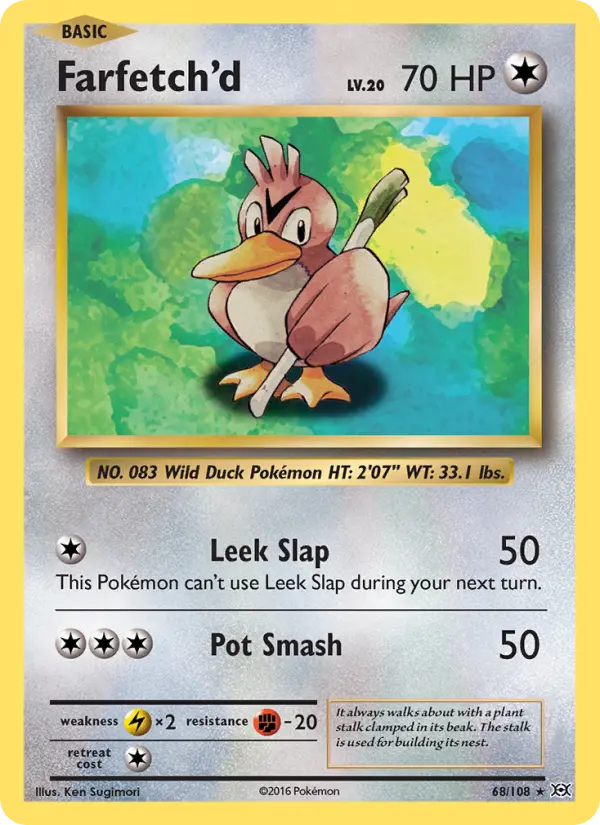
It always walks about with a plant stalk clamped in its beak. The stalk is used for building its nest.
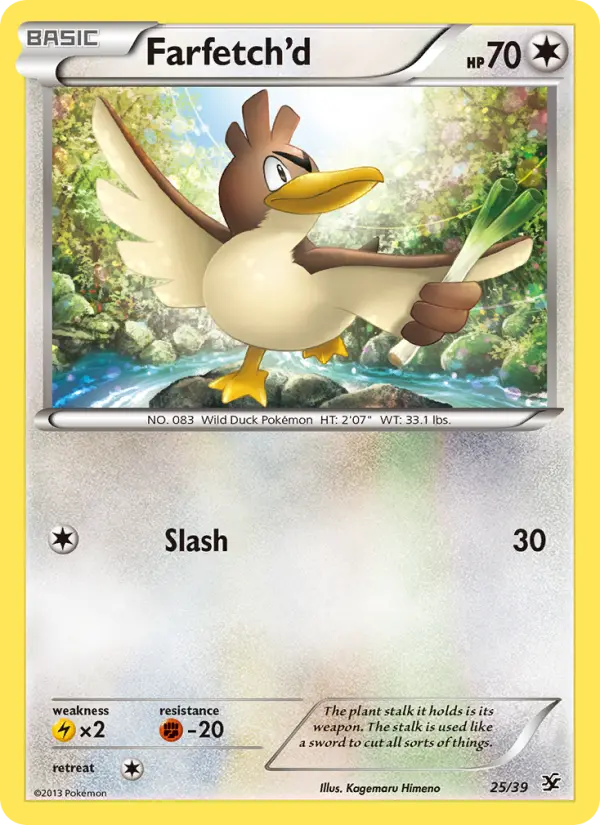
The plant stalk it holds is its weapon. The stalk is used like a sword to cut all sorts of things.
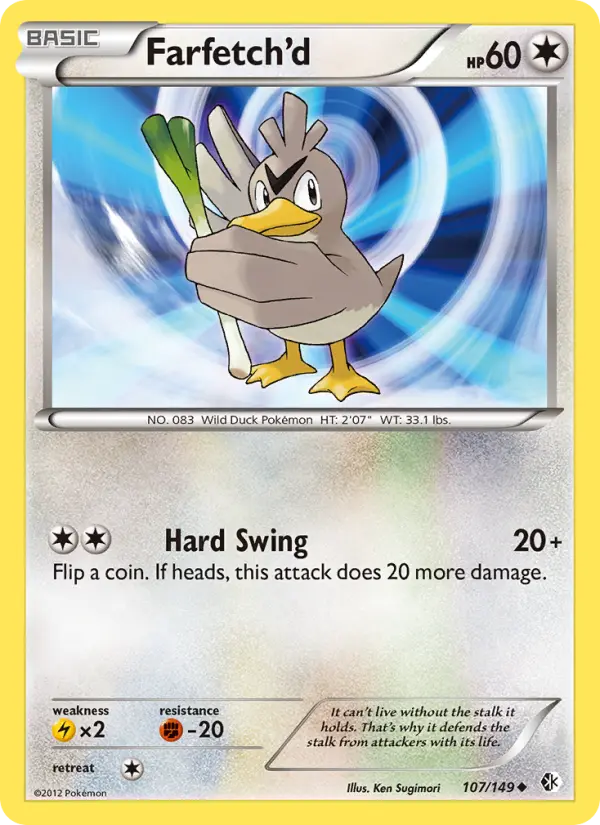
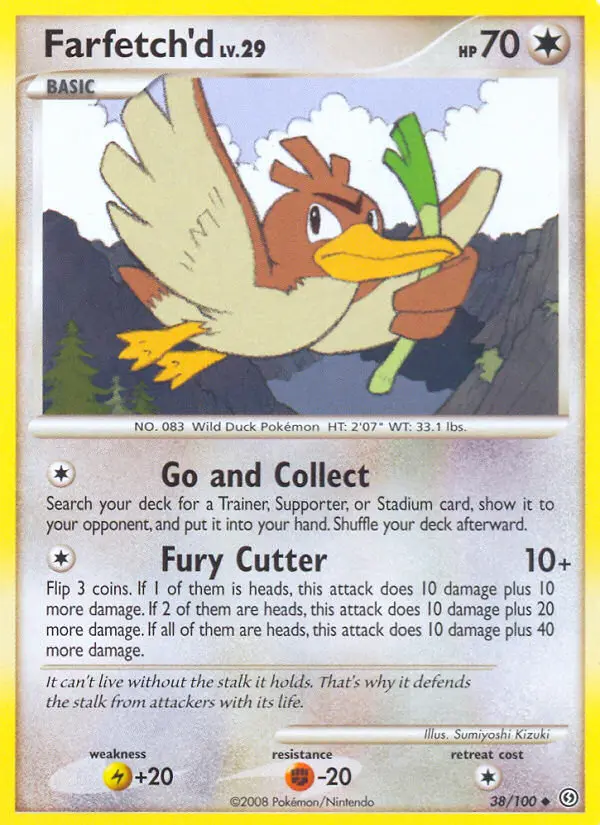
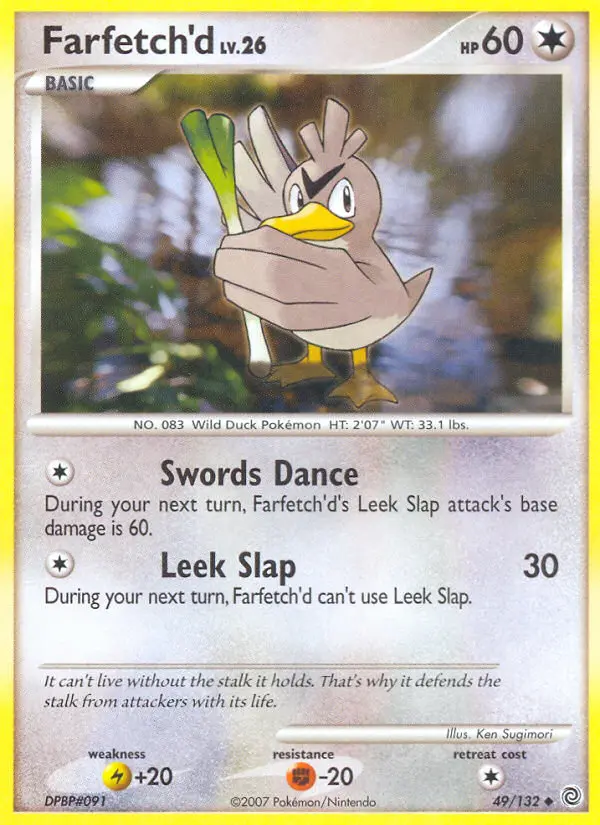
It can’t live without the stalk it holds. That’s why it defends the stalk from attackers with its life.
If anyone tries to disturb where the essential plant stalks grow, it uses its own stalk to thwart them.
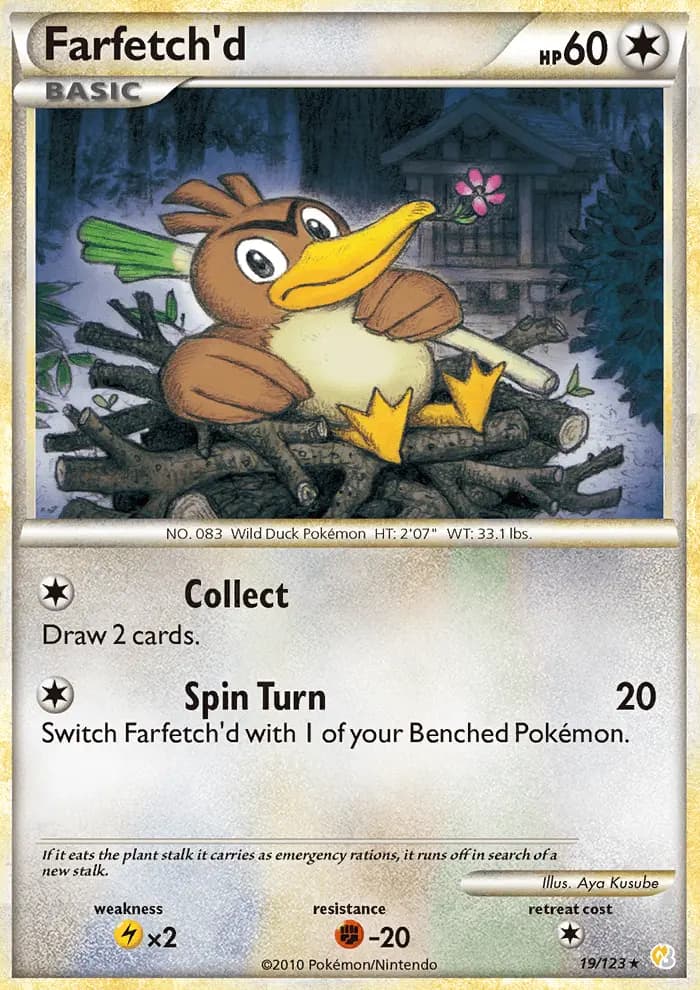
If it eats the plant stalk it carries as emergency rations, it runs off in search of a new stalk.
It can’t live without the stalk it holds. That’s why it defends the stalk from attackers with its life.
It can’t live without the stalk it holds. That’s why it defends the stalk from attackers with its life.
The plant stalk it holds is its weapon. The stalk is used like a sword to cut all sorts of things.
It always walks about with a plant stalk clamped in its beak. The stalk is used for building its nest.
Farfetch’d is always seen with a stalk from a plant of some sort. Apparently, there are good stalks and bad stalks. This Pokémon has been known to fight with others over stalks.
They live where reedy plants grow. Farfetch’d are rarely seen, so it’s thought their numbers are decreasing.
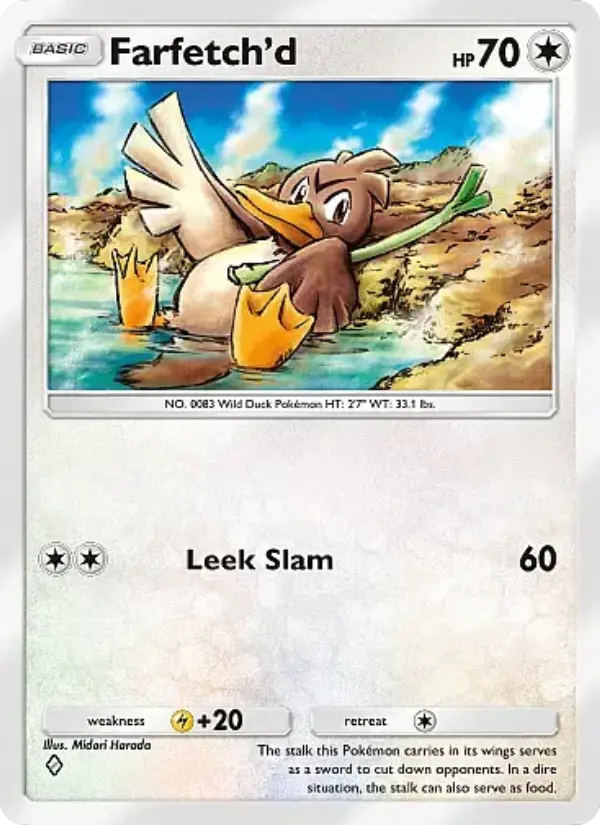
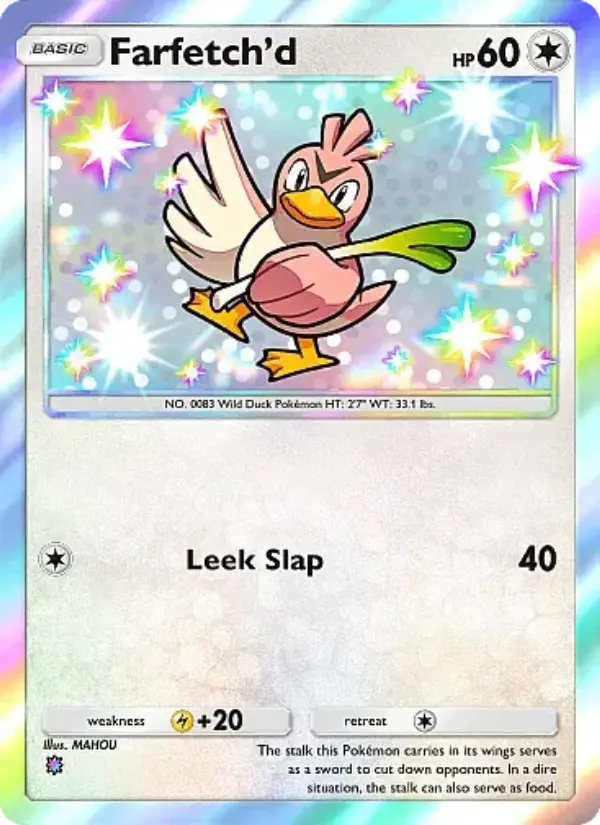
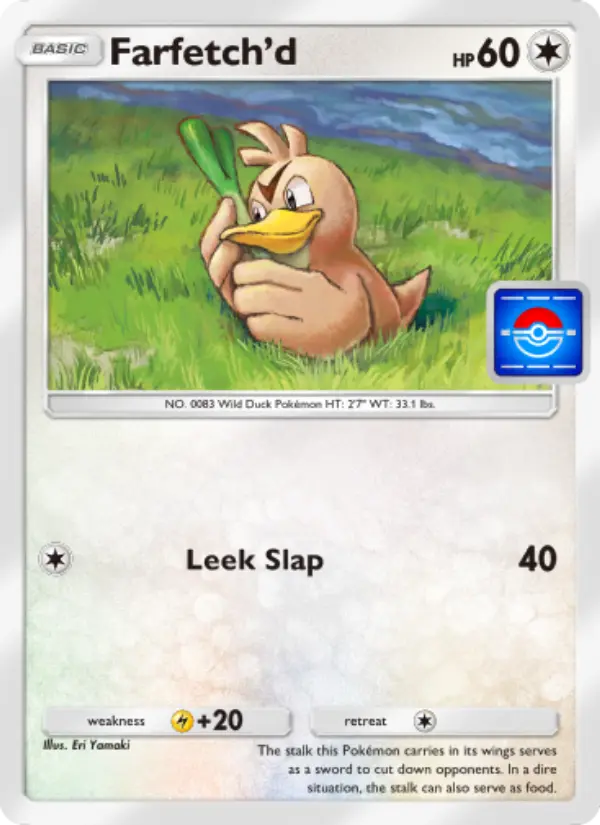
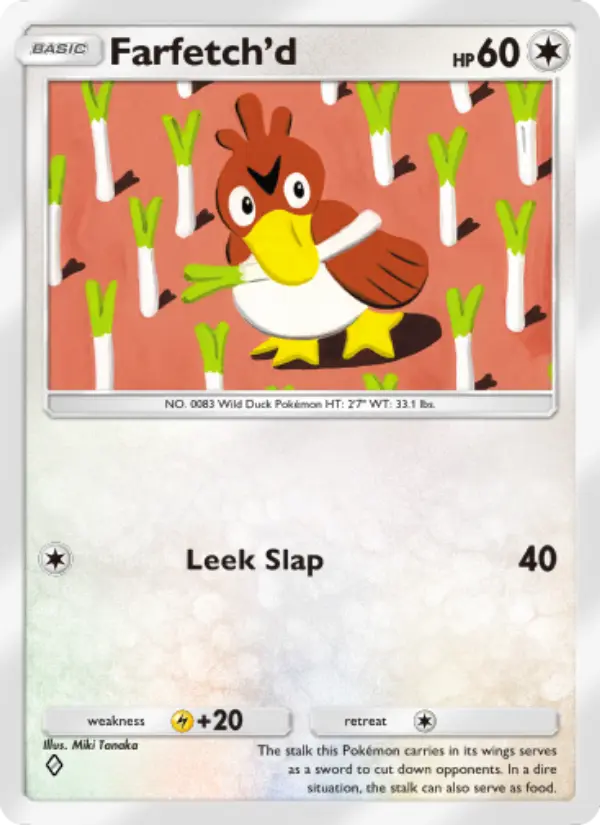
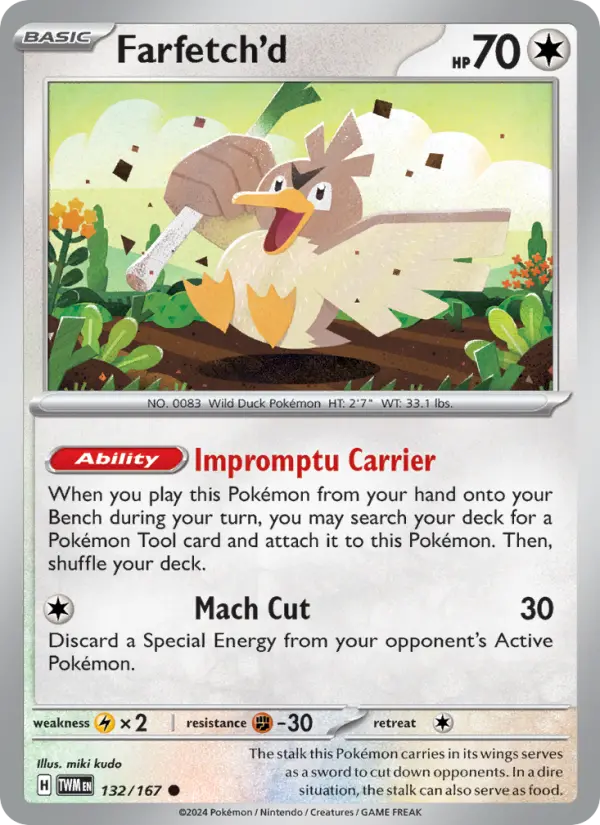
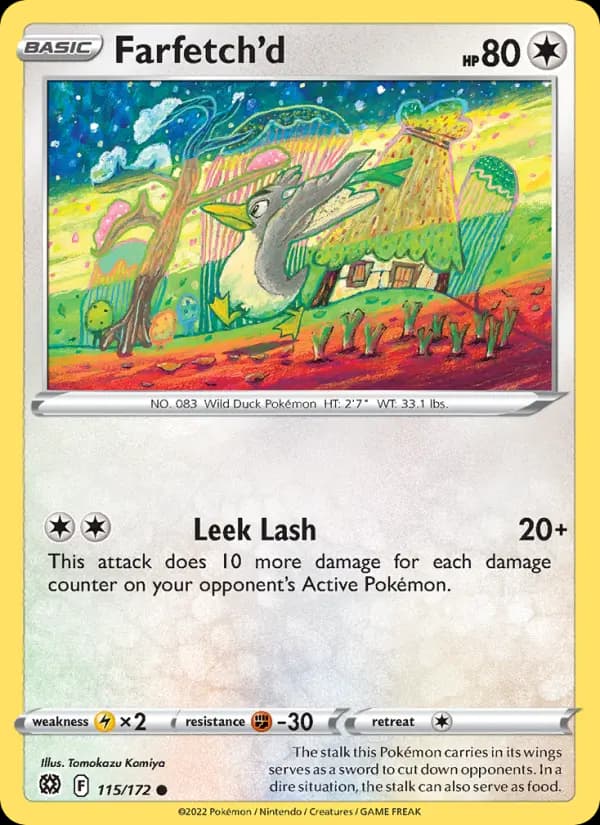
The stalk this Pokémon carries in its wings serves as a sword to cut down opponents. In a dire situation, the stalk can also serve as food.
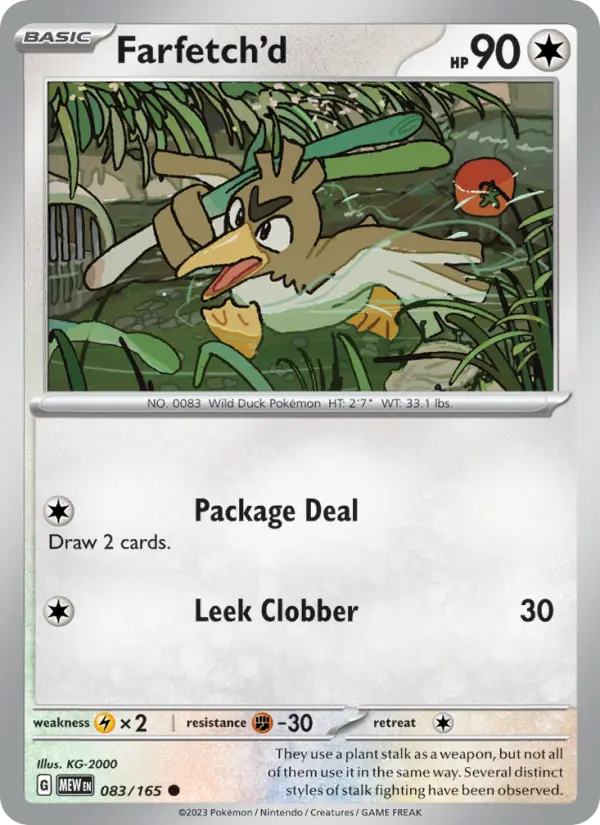
They use a plant stalk as a weapon, but not all of them use it in the same way. Several distinct styles of stalk fighting have been observed.
Farfetchd Name Origin & Design Inspiration
The name Farfetch'd derives from the English phrase 'far-fetched,' reflecting the Pokémon's unusual and rather improbable appearance—particularly its signature plant stick weapon. The Japanese name Kamonegi combines 'kamo' (duck) with 'negi' (Japanese green onion or scallion), directly referencing both the Pokémon's avian nature and its inseparable botanical companion. This nomenclature choice is delightfully literal, as the Pokémon does indeed resemble a duck carrying a green onion, creating an immediately recognizable visual concept. The design philosophy behind Farfetch'd appears rooted in the principle of creating memorable distinctiveness through specific details rather than imposing form. The V-shaped facial marking serves as a characteristic identifier that remains constant across all official artwork and media depictions. In the Galarian form, the design shifts to emphasize a more martial quality, with the stick becoming a more prominent and formidable weapon, supporting the Fighting-type classification and the aggressive evolution requirements.
Learnable Moves
Farfetchd can learn 81 moves:
Move | Type | Cat. | Power | Acc. | PP |
|---|---|---|---|---|---|
| acrobatics | flying | Physical | 55 | 100 | 15 |
| aerial ace | flying | Physical | 60 | — | 20 |
| agility | psychic | Status | — | — | 30 |
| air cutter | flying | Special | 60 | 95 | 25 |
| attract | normal | Status | — | 100 | 15 |
| baton pass | normal | Status | — | — | 40 |
| bide | normal | Physical | — | — | 10 |
| body slam | normal | Physical | 85 | 100 | 15 |
| captivate | normal | Status | — | 100 | 20 |
| close combat | fighting | Physical | 120 | 100 | 5 |
| covet | normal | Physical | 60 | 100 | 25 |
| curse | ghost | Status | — | — | 10 |
| cut | normal | Physical | 50 | 95 | 30 |
| detect | fighting | Status | — | — | 5 |
| double team | normal | Status | — | — | 15 |
| double edge | normal | Physical | 120 | 100 | 15 |
| endure | normal | Status | — | — | 10 |
| facade | normal | Physical | 70 | 100 | 20 |
| false swipe | normal | Physical | 40 | 100 | 40 |
| feather dance | flying | Status | — | 100 | 15 |
| final gambit | fighting | Special | — | 100 | 5 |
| flail | normal | Physical | — | 100 | 15 |
| fly | flying | Physical | 90 | 95 | 15 |
| focus energy | normal | Status | — | — | 30 |
| foresight | normal | Status | — | — | 40 |
| frustration | normal | Physical | — | 100 | 20 |
| fury attack | normal | Physical | 15 | 85 | 20 |
| fury cutter | bug | Physical | 40 | 95 | 20 |
| gust | flying | Special | 40 | 100 | 35 |
| headbutt | normal | Physical | 70 | 100 | 15 |
| heat wave | fire | Special | 95 | 90 | 10 |
| helping hand | normal | Status | — | — | 20 |
| hidden power | normal | Special | 60 | 100 | 15 |
| iron tail | steel | Physical | 100 | 75 | 15 |
| knock off | dark | Physical | 65 | 100 | 20 |
| last resort | normal | Physical | 140 | 100 | 5 |
| leaf blade | grass | Physical | 90 | 100 | 15 |
| leer | normal | Status | — | 100 | 30 |
| mimic | normal | Status | — | — | 10 |
| mirror move | flying | Status | — | — | 20 |
| mud slap | ground | Special | 20 | 100 | 10 |
| ominous wind | ghost | Special | 60 | 100 | 5 |
| peck | flying | Physical | 35 | 100 | 35 |
| pluck | flying | Physical | 60 | 100 | 20 |
| poison jab | poison | Physical | 80 | 100 | 20 |
| protect | normal | Status | — | — | 10 |
| psych up | normal | Status | — | — | 10 |
| quick attack | normal | Physical | 40 | 100 | 30 |
| rage | normal | Physical | 20 | 100 | 20 |
| razor leaf | grass | Physical | 55 | 95 | 25 |
| razor wind | normal | Special | 80 | 100 | 10 |
| reflect | psychic | Status | — | — | 20 |
| rest | psychic | Status | — | — | 5 |
| retaliate | normal | Physical | 70 | 100 | 5 |
| return | normal | Physical | — | 100 | 20 |
| revenge | fighting | Physical | 60 | 100 | 10 |
| round | normal | Special | 60 | 100 | 15 |
| sand attack | ground | Status | — | 100 | 15 |
| secret power | normal | Physical | 70 | 100 | 20 |
| simple beam | normal | Status | — | 100 | 15 |
| skull bash | normal | Physical | 130 | 100 | 10 |
| sky attack | flying | Physical | 140 | 90 | 5 |
| slash | normal | Physical | 70 | 100 | 20 |
| sleep talk | normal | Status | — | — | 10 |
| snore | normal | Special | 50 | 100 | 15 |
| steel wing | steel | Physical | 70 | 90 | 25 |
| substitute | normal | Status | — | — | 10 |
| sunny day | fire | Status | — | — | 5 |
| swagger | normal | Status | — | 85 | 15 |
| swift | normal | Special | 60 | — | 20 |
| swords dance | normal | Status | — | — | 20 |
| tailwind | flying | Status | — | — | 15 |
| take down | normal | Physical | 90 | 85 | 20 |
| thief | dark | Physical | 60 | 100 | 25 |
| toxic | poison | Status | — | 90 | 10 |
| trump card | normal | Special | — | — | 5 |
| twister | dragon | Special | 40 | 100 | 20 |
| u turn | bug | Physical | 70 | 100 | 20 |
| uproar | normal | Special | 90 | 100 | 10 |
| whirlwind | normal | Status | — | — | 20 |
| work up | normal | Status | — | — | 30 |
Farfetchd Competitive Battle Guide
Within competitive battling, Farfetch'd occupies an interesting but ultimately limited role due to its modest cumulative stat total of 377 and unbalanced distribution. Its Attack stat of 90 represents its primary offensive asset, though this value falls short of the thresholds established by more competitive physical attackers. The Hidden Ability Defiant provides intriguing defensive utility by converting opponent stat reductions into personal Attack increases, making it valuable in matchups against Pokémon reliant on stat manipulation via moves like Intimidate. However, Farfetch'd's weaknesses to Electric, Rock, and Ghost-type moves, combined with mediocre Special Defense and Speed stats of 62 and 60 respectively, significantly limit its viability in modern competitive formats. Its movepool, while functional, lacks the specialized coverage moves that would elevate it to threatening status. The Galarian Farfetch'd presents a marginally improved competitive prospect with its Fighting-type classification and access to superior physical move options, though even its evolved form Sirfetch'd struggles against established metagame threats. Casual and lower-tier competitive play represent the most appropriate venues for Farfetch'd utilization.
Commonly Asked Questions About Farfetchd
What type is Farfetchd?
Farfetchd is a normal and flying type Pokemon.
What does Farfetchd evolve into?
Farfetchd evolves into sirfetchd.
What are Farfetchd's weaknesses?
Farfetchd is weak to rock, electric and ice type moves.
Does Farfetchd evolve by trading?
No — Farfetchd evolves entirely through leveling up, with no trade required at any stage.
Where can I find Farfetchd?
Farfetchd can be found in kanto route 13 (kanto), kanto route 12 (kanto) and johto route 38 (johto) and 7 other locations.
Farfetchd Cultural Impact & Franchise History
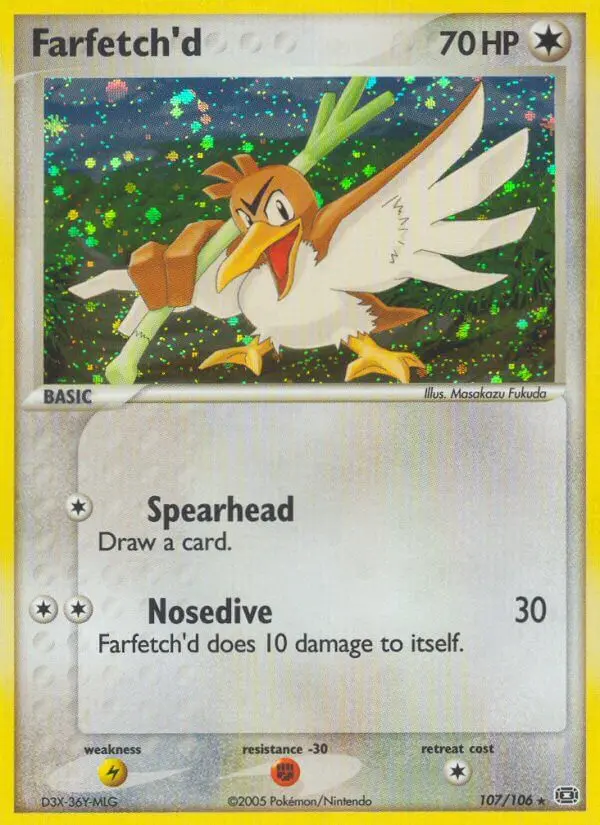
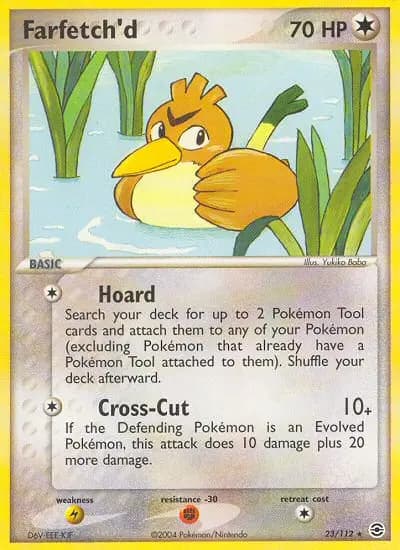
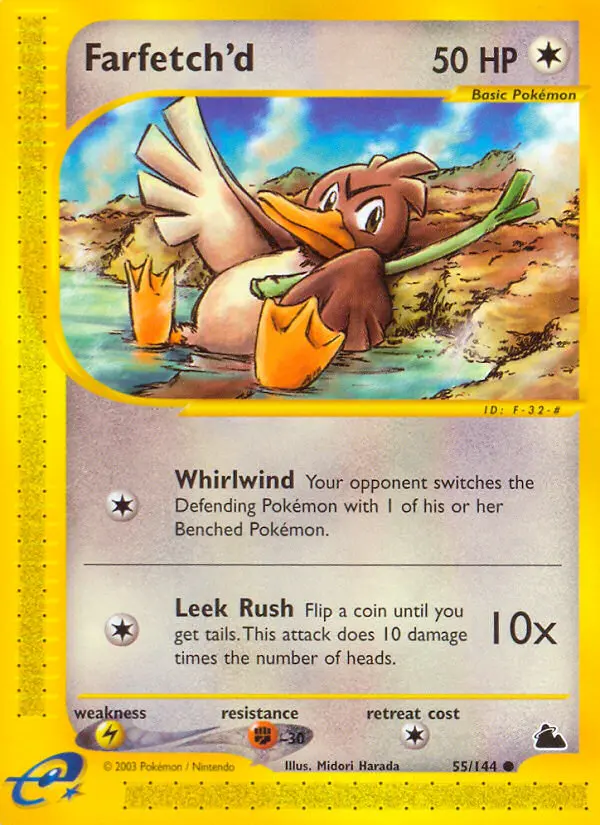
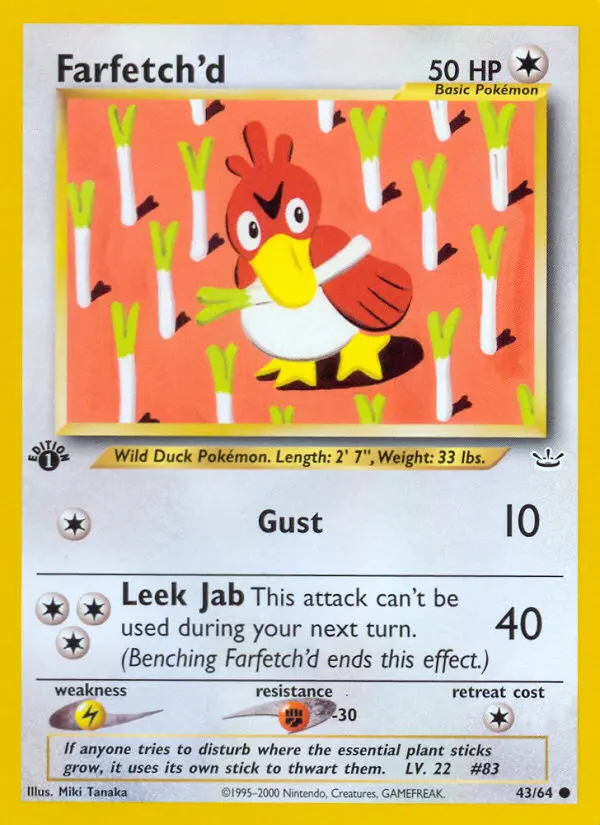
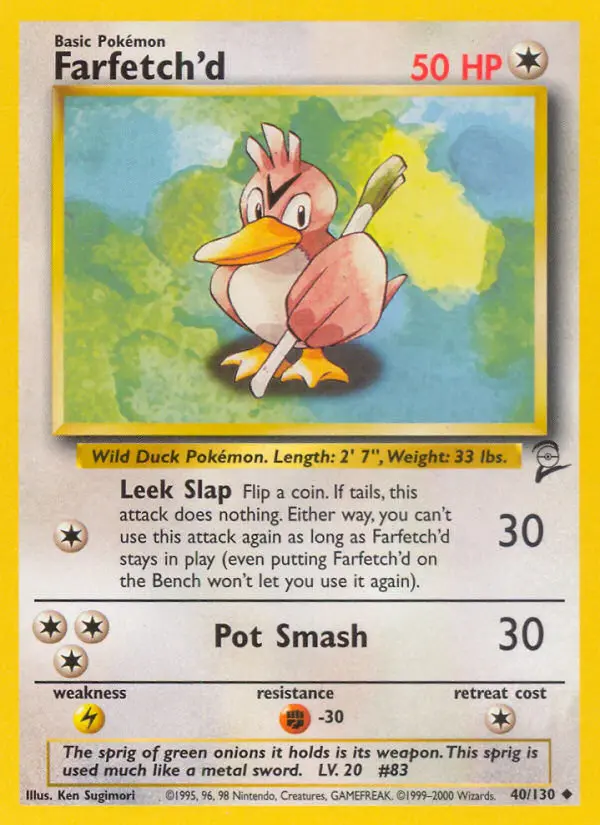
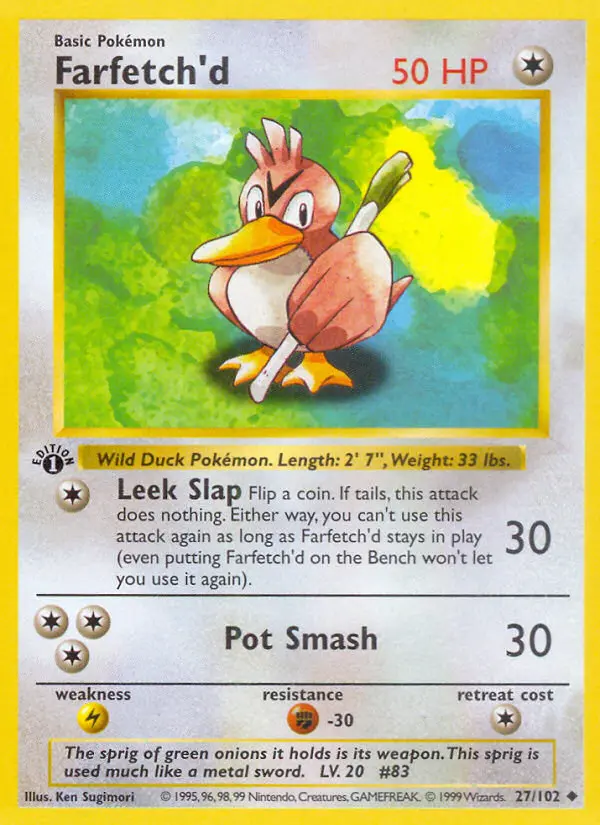
Farfetch'd has maintained a consistent presence in Pokémon popular culture since its introduction in Generation I, appearing prominently in multiple anime series iterations and becoming a beloved character in its own right. The Pokémon's distinctive design—particularly its signature stick—has made it instantly recognizable and memorable to audiences worldwide, contributing to its enduring appeal across decades of media. In the Pokémon anime, multiple significant trainers have captured and utilized Farfetch'd as part of their teams, demonstrating its cultural relevance beyond merely being a Pokédex entry. The species has been featured in trading card game releases across multiple generations, further cementing its place in the broader Pokémon franchise ecosystem. Its appearance in Super Smash Bros. Ultimate as a Poké Ball summon introduced the Pokémon to audiences beyond traditional Pokémon fans. The recent introduction of Galarian Farfetch'd in Pokémon Sword and Shield sparked renewed interest in the species, attracting both nostalgic veterans and newer players eager to experience the previously unavailable evolution line. Merchandise featuring Farfetch'd, from plush toys to collectible figurines, continues to circulate in the market, demonstrating sustained fan affection.
Where to Find Farfetchd in Every Pokémon Game
Farfetch'd's availability varies significantly across the Pokémon games, reflecting its classification as a moderately uncommon species. In the original Red, Blue, and Yellow versions for the Game Boy, Farfetch'd could be encountered in Route 12 and Route 16, making it reasonably accessible to determined trainers. The species maintains a capture rate of 45, translating to approximately 11.9% success with a standard Poké Ball against a full-health specimen, requiring modest effort to add to one's team. Across subsequent generations including Gold/Silver/Crystal, FireRed/LeafGreen, and HeartGold/SoulSilver, Farfetch'd appeared in various routes and locations with differing encounter rates and availability windows. In more recent titles including Let's Go Pikachu/Eevee and Pokémon Sword/Shield, the species remains obtainable though sometimes locked behind specific game versions or postgame content. The introduction of the Galarian form in Sword/Shield restricted availability of the original Kantonian form to specific areas or through Pokédex completion rewards. Players seeking to obtain Farfetch'd in contemporary titles should consult location-specific guides, as availability shifts frequently between game editions and regions. Trading remains a reliable method for acquiring the species across most game versions when wild encounters prove elusive.