
Alolan Geodude
Generation I · #10109 — Rock Pokémon
As a Generation I rock/electric-type, Geodude-Alola leans on magnet pull to cover what its raw numbers don't, particularly on the hp side. Standing at 0.4 meters tall and weighing 20.3 kilograms, this crystalline boulder-like Pokémon bears a striking resemblance to magnetite-rich rock formations found in Alola's volcanic regions. The transition from pure Rock/Ground typing to Rock/Electric typing represents one of the most significant design changes among Alolan forms, fundamentally altering how trainers interact with this classic first-generation Pokémon.
Editor's Take
Alolan Geodude's Rock/Electric typing is one of the few regional variant combinations that had never existed anywhere in the Pokédex before, which is a better reason for a variant to exist than a stat adjustment.
Base Stats
Height
0.4m
Weight
20.3kg
Category
Rock Pokémon
Gender
Male 50% / Female 50%
Color
brown
Shape
arms
Habitat
mountain
Abilities
Prevents steel opponents from fleeing or switching out.
Prevents being KOed from full HP, leaving 1 HP instead. Protects against the one-hit KO moves regardless of HP.
This Pokémon's Normal moves are Electric and have their power increased to 1.2×.
Alolan Geodude Biology & Physical Characteristics
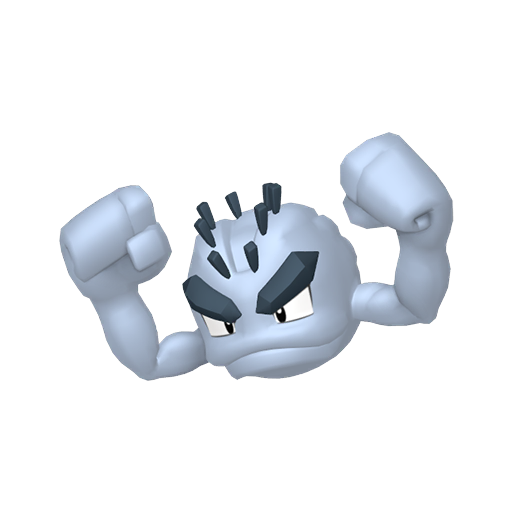
Alolan Geodude's biology reflects a remarkable adaptation to Alola's electromagnetic landscape, with its body composition incorporating magnetic minerals and conductive crystalline structures. Unlike its Kanto form, Alolan Geodude's rocky exterior contains magnetic properties that allow it to generate and manipulate electrical energy. The Pokémon's arms, which traditional Geodude use for climbing mountain paths, serve a dual purpose in the Alolan variant—enabling both physical manipulation and the channeling of electrical current. Its compact, roughly cubic form measures approximately 0.4 meters in any direction, making it deceptively heavy at 20.3 kilograms due to its dense, mineral-rich composition. The base stats reveal a creature optimized for defensive capabilities, with a defensive stat of 100 being its most notable strength, while its speed stat of merely 20 indicates this is a stationary Pokémon relying on positioning and endurance rather than mobility. The presence of electromagnetic properties within its structure grants it access to abilities like Magnet Pull, which prevents Steel-type opponents from escaping battle, demonstrating how Alolan environmental pressures have fundamentally altered the species' evolutionary trajectory.
Pokedex Numbers
Training
Breeding
Alolan Geodude Breeding, Gender Ratio & Egg Groups
Alolan Geodude maintains a balanced 50% male to 50% female gender ratio, consistent with most non-legendary Pokémon and identical to its Kanto form. This equal distribution allows trainers flexibility in breeding programs, whether pursuing specific natures, abilities, or competitive movesets. The Pokémon belongs to the Mineral Egg Group, a classification it shares with other rock and metal-type Pokémon, restricting breeding partners to compatible species within this category. With a base friendship value of 70, Alolan Geodude demonstrates moderate approachability, suggesting these Pokémon can develop meaningful bonds with their trainers though they lack the innate cuddliness of higher-friendship species. Egg cycles total 15, translating to approximately 3,599 to 3,855 steps required for an egg to hatch, a timeframe consistent with other early-route Pokémon. The breeding mechanics remain unchanged from the original Geodude, ensuring that players familiar with traditional breeding strategies can apply their knowledge seamlessly. When breeding Alolan Geodude with compatible Mineral Egg Group partners, the offspring will inherit the Alolan form if the mother is Alolan Geodude, though breeding an Alolan Geodude with a non-Alolan form will produce offspring matching the mother's regional variant.
Sprites




Held Items
Cell Battery
held-items
Held: Raises the holder’s Attack by one stage when it takes Electric-type damage.
Cost: 4000
Cell Battery
held-items
Held: Raises the holder’s Attack by one stage when it takes Electric-type damage.
Cost: 4000
Cell Battery
held-items
Held: Raises the holder’s Attack by one stage when it takes Electric-type damage.
Cost: 4000
Cell Battery
held-items
Held: Raises the holder’s Attack by one stage when it takes Electric-type damage.
Cost: 4000
TMs & HMs
tm01
platinum
tm01
emerald
tm01
diamond pearl
tm01
firered leafgreen
tm01
ruby sapphire
tm01
xd
tm01
colosseum
tm01
heartgold soulsilver
tm01
lets go pikachu lets go eevee
tm02
crystal
tm02
gold silver
tm03
crystal
tm03
gold silver
tm03
sword shield
tm04
gold silver
tm04
crystal
tm05
sword shield
tm05
lets go pikachu lets go eevee
tm06
yellow
tm06
gold silver
+667 more TMs/HMs

Alolan Geodude's Evolution Chain


Alolan Geodude Evolution, Mega Evolution & Special Forms
Alolan Geodude begins its evolutionary journey as the first stage in a three-stage evolutionary line exclusive to the Alola region. It evolves into Alolan Graveler upon reaching level 25, maintaining its Rock/Electric typing while gaining additional size and power. The final evolution, Alolan Golem, is achieved through a trade mechanism, a traditional method that encourages social interaction among trainers. This evolution method mirrors the original Kanto Geodude line but with the critical difference that Alolan Geodude and its evolutions remain Rock/Electric types throughout their development, with each stage gaining increased electrical capabilities and expanded move pools. The evolutionary line benefits from a medium-slow growth rate, requiring trainers to invest considerable time and experience to reach the final form. Unlike some regional variants that diverge significantly in typing during evolution, the Alolan line maintains perfect type consistency, allowing trainers to plan their team compositions with confidence. Notably, there is no Mega Evolution available for any form of Alolan Geodude, as the line evolved during a generation where Mega Evolution mechanics were being phased out in favor of other power-boosting mechanics.
Where to Find
Alola Route 12
alola
Blush Mountain
alola
Vermilion City
kanto
Alolan Geodude Behaviour and Natural Habitat
Alolan Geodude inhabits the volcanic and electromagnetically-active regions of the Alola archipelago, distinctly different from the mountain terrain preferred by its Kanto relatives. These Pokémon are commonly discovered in areas with strong magnetic fields, particularly near volcanic rock formations and geothermal hotspots throughout Alola. Despite their sessile nature and incredibly low speed stat of 20, Alolan Geodude remain vigilant in their chosen locations, using their magnetic properties to sense vibrations and electrical disturbances in their environment. Much like their traditional counterparts, they are frequently mistaken for ordinary boulders by unsuspecting travelers, and stepping on one accidentally will provoke an angry response. The Pokédex entries reveal that these creatures often embed themselves partially into magnetite-rich volcanic soil, remaining dormant until disturbed. Their territorial behavior is driven by the need to maintain position in electromagnetically stable zones, where they can absorb ambient electrical energy from Alola's unique volcanic activity. The harsh, unforgiving nature of Alolan terrain has made these Pokémon even more sedentary than their Kanto cousins, as the energetic benefits of remaining stationary in high-magnetic-field areas outweigh the advantages of mobility.
Pokedex Entries
Found in fields and mountains. Mistaking them for boulders, people often step or trip on them.
Commonly found near mountain trails, etc. If you step on one by accident, it gets angry.
Most people may not notice, but a closer look should reveal that there are many GEODUDE around.
It uses its arms to steadily climb steep mountain paths. It swings its fists around if angered.
Proud of their sturdy bodies, they bash against each other in a contest to prove whose is harder.
The longer a GEODUDE lives, the more its edges are chipped and worn away, making it more rounded in appearance. However, this POKéMON’s heart will remain hard, craggy, and rough always.
When GEODUDE sleeps deeply, it buries itself halfway into the ground. It will not awaken even if hikers step on it unwittingly. In the morning, this POKéMON rolls downhill in search of food.
It climbs mountain paths using only the power of its arms. Because they look just like boulders lining paths, hikers may step on them without noticing.
Its round form makes it easy to pick up. Some people have used them to hurl at each other in a snowball fight.
Found in fields and mountains. Mistaking them for boulders, people often step or trip on them.
Many live on mountain trails and remain half buried while keeping an eye on climbers.
It is impossible to distinguish from rocks. It slams against others in contests of hardness.
At rest, it looks just like a rock. Carelessly stepping on it will make it swing its fists angrily.
Most people may not notice, but a closer look should reveal that there are many GEODUDE around.
It uses its arms to steadily climb steep mountain paths. It swings its fists around if angered.
At rest, it looks just like a rock. Carelessly stepping on it will make it swing its fists angrily.
At rest, it looks just like a rock. Carelessly stepping on it will make it swing its fists angrily.
Found in fields and mountains. Mistaking them for boulders, people often step or trip on them.
It is impossible to distinguish from rocks. It slams against others in contests of hardness.
The longer a Geodude lives, the more its edges are chipped and worn away, making it more rounded in appearance. However, this Pokémon’s heart will remain hard, craggy, and rough always.
When Geodude sleeps deeply, it buries itself halfway into the ground. It will not awaken even if hikers step on it unwittingly. In the morning, this Pokémon rolls downhill in search of food.
Its round body makes it easy to pick up, but it is hard and heavy. It’s dangerous to play with them as if they were snowballs.
Geodude that have lived a long life have had all their edges smoothed out until they’re totally round. They also have a calm, quiet disposition.
There are plenty of them to be found along any road. A scholar with too much free time once counted a hundred of them along a single route.
It uses both hands to climb precipitous cliffs. People who see it in action have been known to take up bouldering.
Commonly found near mountain trails and the like. If you step on one by accident, it gets angry.
Makes its home in mountainous regions, using its arms to climb along harsh mountain roads. Can be troublesome—carelessly kicking one will cause it to fly into a rage and chase after you.
Alolan Geodude Name Origin & Design Inspiration
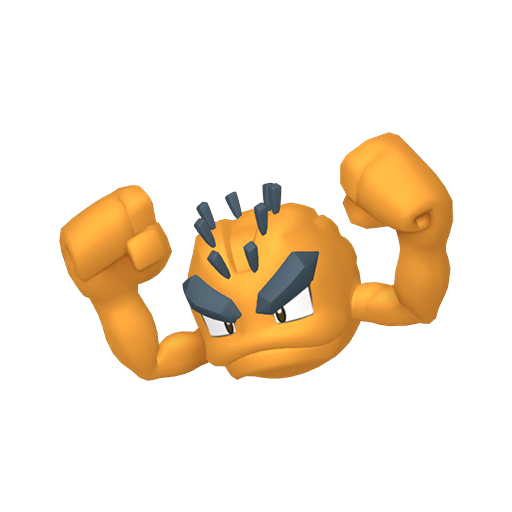
The name Alolan Geodude derives from combining 'Alola,' the region where this variant originates, with the original name 'Geodude,' which itself combines 'geological' or 'geode' with the casual term 'dude.' In Japanese, it remains 'Isitsubute' (イシツブテ), literally meaning 'stone pebble,' a fitting description for both the original and Alolan forms. The design of Alolan Geodude reflects the volcanic and electromagnetic character of the Alola region, with its appearance suggesting a magnetite-rich boulder rather than generic stone. The visual aesthetic incorporates golden or yellowish hues reminiscent of electrum or mineral deposits found in geothermal environments, distinguishing it clearly from the grey, neutral coloration of traditional Geodude. The designers deliberately emphasized its electromagnetic nature through subtle visual cues—the positioning of its arms, the reflective quality of its surface, and the overall body composition all suggest a Pokémon adapted to conduct and channel electrical energy. This reimagining demonstrates Game Freak's sophisticated approach to regional variants, where form changes serve not merely as aesthetic updates but as meaningful biological adaptations reflecting each region's unique environmental pressures and resource availability.
Learnable Moves
Alolan Geodude can learn 79 moves:
Move | Type | Cat. | Power | Acc. | PP |
|---|---|---|---|---|---|
| attract | normal | Status | — | 100 | 15 |
| autotomize | steel | Status | — | — | 15 |
| bide | normal | Physical | — | — | 10 |
| block | normal | Status | — | — | 5 |
| body slam | normal | Physical | 85 | 100 | 15 |
| brick break | fighting | Physical | 75 | 100 | 15 |
| brutal swing | dark | Physical | 60 | 100 | 20 |
| bulldoze | ground | Physical | 60 | 100 | 20 |
| charge | electric | Status | — | — | 20 |
| charge beam | electric | Special | 50 | 90 | 10 |
| confide | normal | Status | — | — | 20 |
| counter | fighting | Physical | — | 100 | 20 |
| curse | ghost | Status | — | — | 10 |
| defense curl | normal | Status | — | — | 40 |
| dig | ground | Physical | 80 | 100 | 10 |
| discharge | electric | Special | 80 | 100 | 15 |
| double team | normal | Status | — | — | 15 |
| double edge | normal | Physical | 120 | 100 | 15 |
| earth power | ground | Special | 90 | 100 | 10 |
| earthquake | ground | Physical | 100 | 100 | 10 |
| electroweb | electric | Special | 55 | 95 | 15 |
| endure | normal | Status | — | — | 10 |
| explosion | normal | Physical | 250 | 100 | 5 |
| facade | normal | Physical | 70 | 100 | 20 |
| fire blast | fire | Special | 110 | 85 | 5 |
| fire punch | fire | Physical | 75 | 100 | 15 |
| flail | normal | Physical | — | 100 | 15 |
| flamethrower | fire | Special | 90 | 100 | 15 |
| fling | dark | Physical | — | 100 | 10 |
| focus punch | fighting | Physical | 150 | 100 | 20 |
| frustration | normal | Physical | — | 100 | 20 |
| gyro ball | steel | Physical | — | 100 | 5 |
| headbutt | normal | Physical | 70 | 100 | 15 |
| hidden power | normal | Special | 60 | 100 | 15 |
| high horsepower | ground | Physical | 95 | 95 | 10 |
| iron defense | steel | Status | — | — | 15 |
| magnet rise | electric | Status | — | — | 10 |
| mud shot | ground | Special | 55 | 95 | 15 |
| mud slap | ground | Special | 20 | 100 | 10 |
| nature power | normal | Status | — | — | 20 |
| protect | normal | Status | — | — | 10 |
| rest | psychic | Status | — | — | 5 |
| return | normal | Physical | — | 100 | 20 |
| rock blast | rock | Physical | 25 | 90 | 10 |
| rock climb | normal | Physical | 90 | 85 | 20 |
| rock polish | rock | Status | — | — | 20 |
| rock slide | rock | Physical | 75 | 90 | 10 |
| rock throw | rock | Physical | 50 | 90 | 15 |
| rock tomb | rock | Physical | 60 | 95 | 15 |
| rollout | rock | Physical | 30 | 90 | 20 |
| round | normal | Special | 60 | 100 | 15 |
| sandstorm | rock | Status | — | — | 10 |
| screech | normal | Status | — | 85 | 40 |
| seismic toss | fighting | Physical | — | 100 | 20 |
| self destruct | normal | Physical | 200 | 100 | 5 |
| sleep talk | normal | Status | — | — | 10 |
| smack down | rock | Physical | 50 | 100 | 15 |
| snore | normal | Special | 50 | 100 | 15 |
| spark | electric | Physical | 65 | 100 | 20 |
| stealth rock | rock | Status | — | — | 20 |
| stone edge | rock | Physical | 100 | 80 | 5 |
| substitute | normal | Status | — | — | 10 |
| sunny day | fire | Status | — | — | 5 |
| supercell slam | electric | Physical | 100 | 95 | 15 |
| superpower | fighting | Physical | 120 | 100 | 5 |
| swagger | normal | Status | — | 85 | 15 |
| tackle | normal | Physical | 40 | 100 | 35 |
| take down | normal | Physical | 90 | 85 | 20 |
| tera blast | normal | Special | 80 | 100 | 10 |
| thunder | electric | Special | 110 | 70 | 10 |
| thunder punch | electric | Physical | 75 | 100 | 15 |
| thunder shock | electric | Special | 40 | 100 | 30 |
| thunder wave | electric | Status | — | 90 | 20 |
| thunderbolt | electric | Special | 90 | 100 | 15 |
| toxic | poison | Status | — | 90 | 10 |
| volt switch | electric | Special | 70 | 100 | 20 |
| wide guard | rock | Status | — | — | 10 |
| wild charge | electric | Physical | 90 | 100 | 15 |
| zap cannon | electric | Special | 120 | 50 | 5 |
Alolan Geodude Competitive Battle Guide
Alolan Geodude occupies a unique niche in competitive Pokémon battling, leveraging its Rock/Electric typing and defensive capabilities to function as a specialized support Pokémon rather than a sweeper. Its standout defensive stat of 100, combined with respectable HP of 40, provides a reasonable bulk that allows it to absorb hits and maintain battlefield presence. The Magnet Pull ability is particularly valuable, preventing Steel-type opponents from switching out, which creates opportunities for teammates to exploit forced switches or enables Alolan Geodude itself to maintain momentum through chip damage with moves like Thunder Wave or Volt Switch. Its hidden ability, Galvanize, converts all Normal-type moves to Electric-type moves with a 1.2x power boost, granting access to boosted variants of moves like Autotomize or Screech that would otherwise lack offensive utility. However, Alolan Geodude's abysmal speed stat of 20 severely limits its viability, making it almost certainly the slowest Pokémon in most competitive formats and necessitating Trick Room support to function effectively. Its special attack of 30 is equally problematic for a Pokémon that would benefit from access to special moves like Thunderbolt, though its attack stat of 80 remains serviceable for physical alternatives. Professional players have experimented with Alolan Geodude in doubles formats where its support abilities and Magnet Pull effect create tactical advantages, particularly in team structures built around Steel-type Pokémon.
Commonly Asked Questions About Alolan Geodude
What type is Alolan Geodude?
Alolan Geodude is a rock and electric type Pokemon.
What does Alolan Geodude evolve into?
Alolan Geodude does not evolve into any other Pokemon. It is the final form in its evolution line.
What are Alolan Geodude's weaknesses?
Alolan Geodude is weak to fighting, ground, water and grass type moves.
Where can I find Alolan Geodude?
Alolan Geodude can be found in alola route 12 (alola), blush mountain (alola) and vermilion city (kanto).
Alolan Geodude Cultural Impact & Franchise History
While not achieving the mainstream recognition of certain iconic Pokémon like Pikachu or Charizard, Alolan Geodude has cultivated a devoted following within the competitive and casual Pokémon communities since its introduction in Generation VII. The Alolan form represents a broader cultural moment in Pokémon design philosophy, where Game Freak demonstrated that even the most humble, early-route creatures could receive meaningful reimaginings that respect their original identity while embracing regional uniqueness. Fans have celebrated the creative geological and electrical fusion that Alolan Geodude represents, with its design appearing in numerous fan artworks, competitive team showcases, and community discussions about regional variant superiority. The transformation of Geodude from a simple Rock/Ground type to a Rock/Electric variant sparked conversation about environmental determinism in Pokémon adaptation, influencing how players understood the theoretical mechanisms behind regional variation. In Alola specifically, Alolan Geodude became emblematic of the region's volcanic personality, appearing in gym leader and trial captain teams throughout Pokémon Sun and Moon's narrative. The Pokémon's presence in more recent games like Pokémon Legends: Arceus and the Scarlet/Violet DLC Indigo Disk indicates continued developer investment in ensuring this regional variant remains competitively and narratively relevant.
Where to Find Alolan Geodude in Every Pokémon Game
Alolan Geodude is exclusively available within the Alola region and its associated games, primarily appearing in Pokémon Sun, Moon, Ultra Sun, and Ultra Moon. In these titles, players encounter Alolan Geodude on various volcanic and mountain routes throughout Alola, with the highest encounter rates typically occurring in electrically-active volcanic zones where the species' electromagnetic adaptation proves most advantageous. The Pokémon later became available in subsequent games including Pokémon Sword and Shield's DLC content, as well as Pokémon Legends: Arceus and Pokémon Scarlet and Violet's The Indigo Disk DLC, where it inhabits Blueberry Academy's Terarium environment. The catch rate of 255—the maximum possible value—reflects Alolan Geodude's common status throughout Alola and makes acquiring specimens relatively straightforward even early in a playthrough. Trainers seeking the Alolan form specifically must either capture wild specimens in these games or transfer existing Geodude through specialized regional form-conversion mechanics in games like Pokémon Home, which provides limited availability for regional variants in non-Alola-native games. The species' presence in the Alola Pokédex at entry #229 (Sun/Moon) and #298 (Ultra Sun/Ultra Moon) documents its importance to the regional Pokédex, though players seeking competitive specimens with optimal natures, IV distributions, or hidden abilities may require breeding or soft-resetting efforts. Its availability in Blueberry Academy's Terarium in recent titles suggests it remains considered a foundational species despite its status as a regional variant.