Gible
Generation IV · #0443 — Land Shark Pokémon
Gible is a dragon/ground-type Pokémon whose hp — 50 at base — does more to define its role than its overall spread does. Its combination of Dragon and Ground typing grants it a unique set of resistances and vulnerabilities that define its role in both casual and competitive play.
Editor's Take
Gible's line ends in Garchomp, one of the few Pokémon to be banned from standard play on stats alone, and finding one in the Gen 4 underground is a genuine time investment.
Base Stats
Height
0.7m
Weight
20.5kg
Category
Land Shark Pokémon
Gender
Male 50% / Female 50%
Color
blue
Shape
upright
Abilities
Increases evasion to 1.25× during a sandstorm. Protects against sandstorm damage.
Damages attacking Pokémon for 1/8 their max HP on contact.
Gible Biology & Physical Characteristics
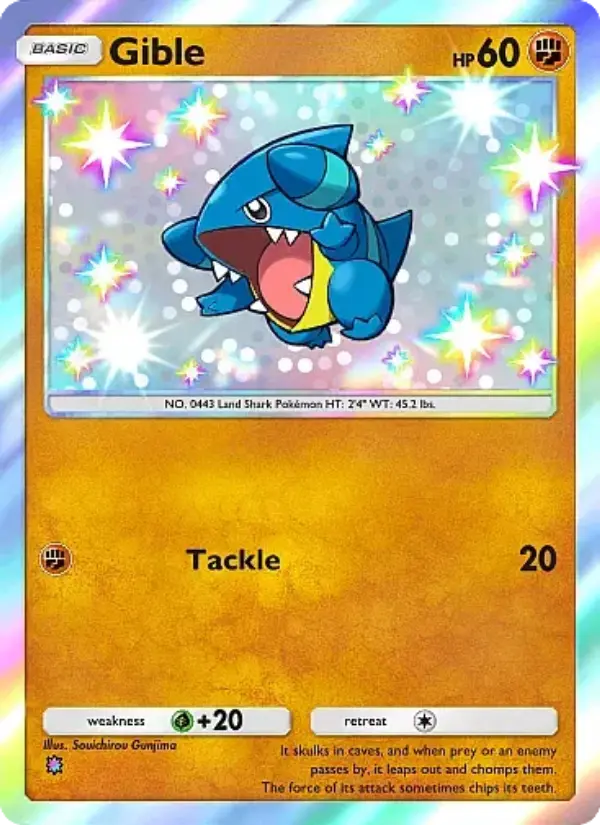
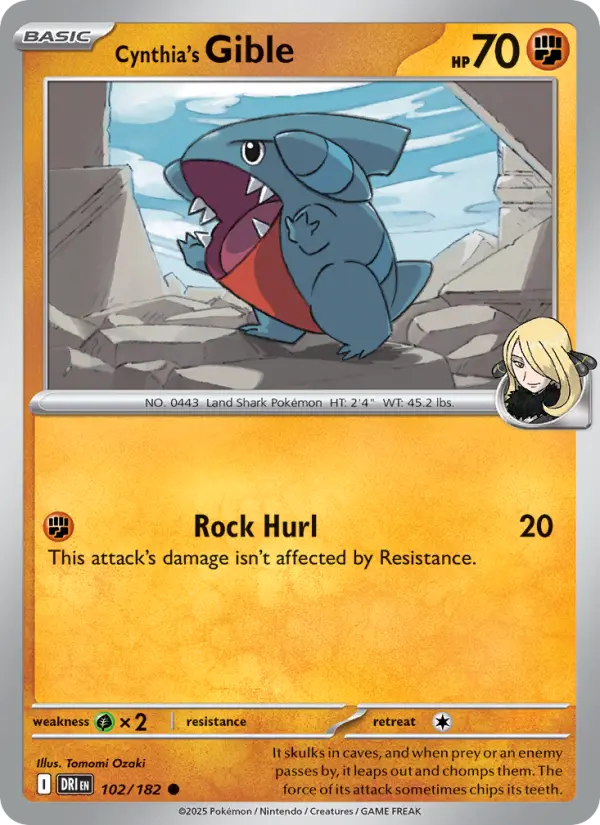
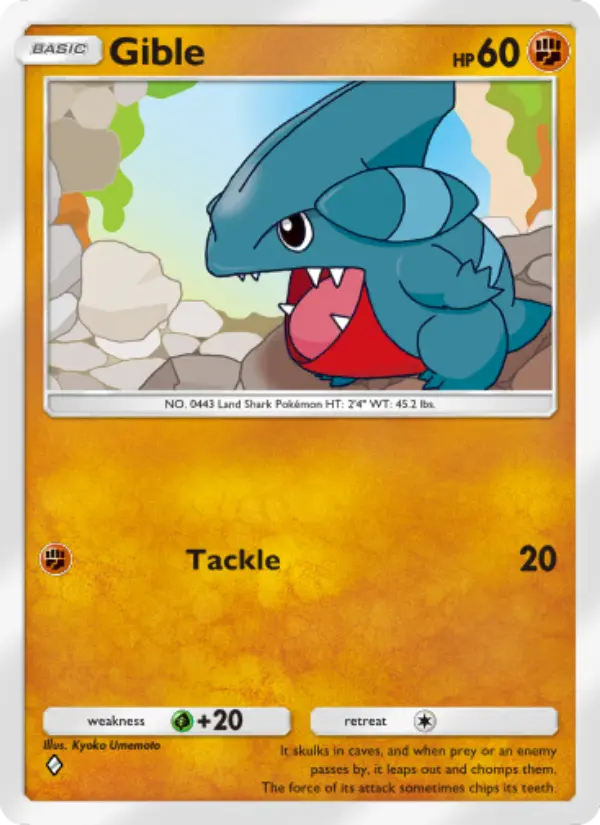
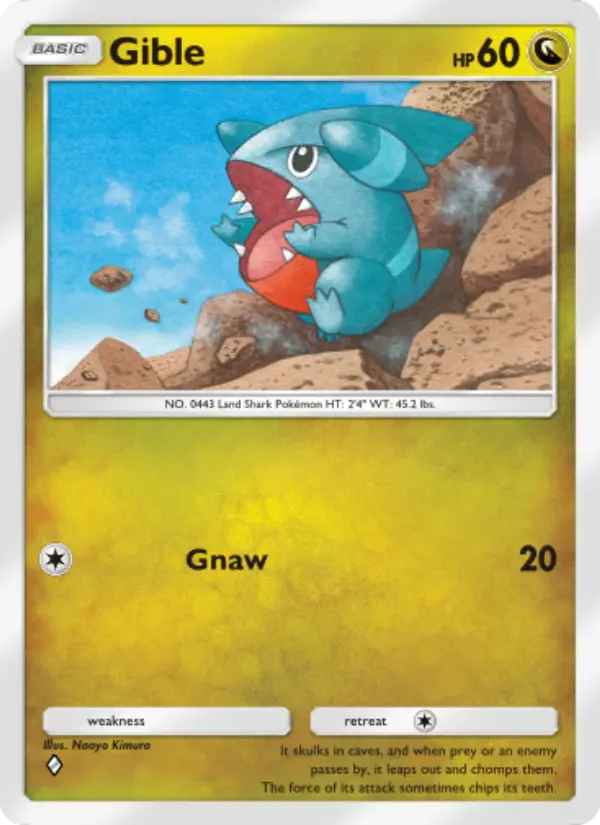
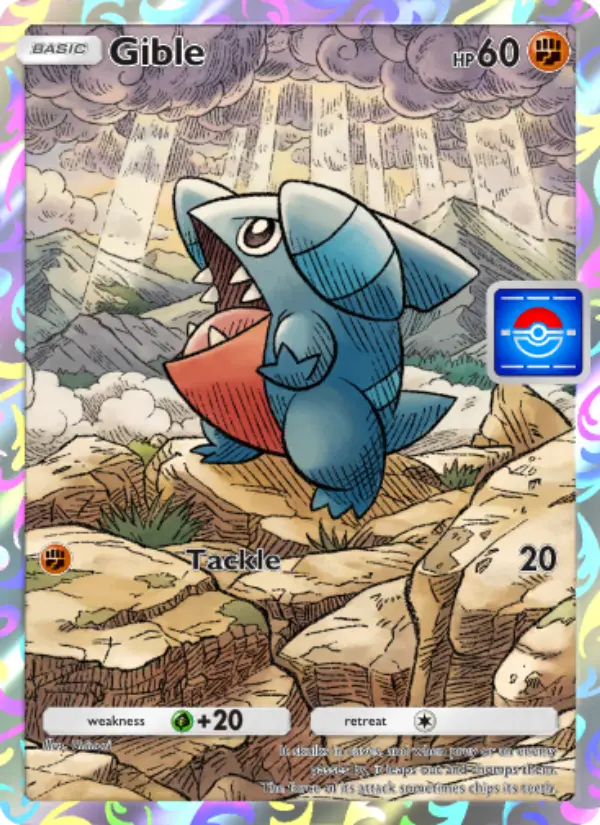
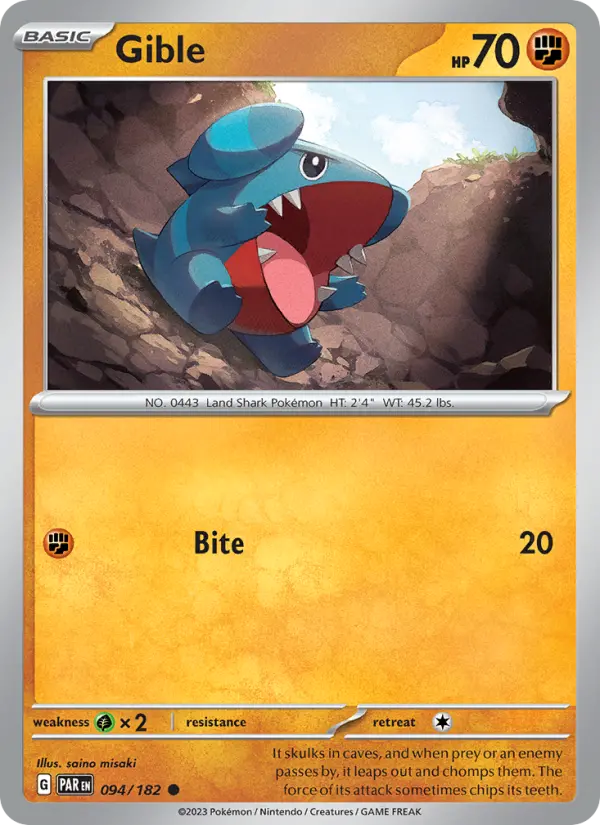
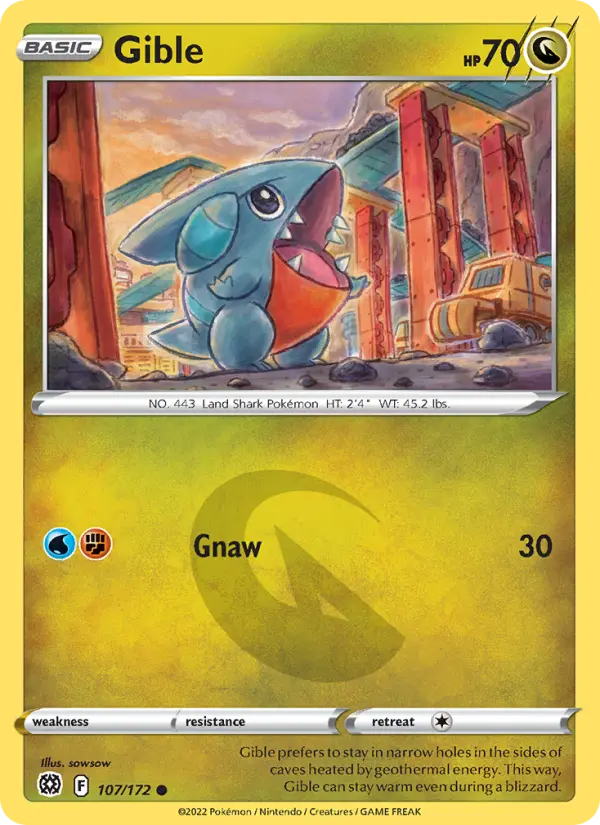
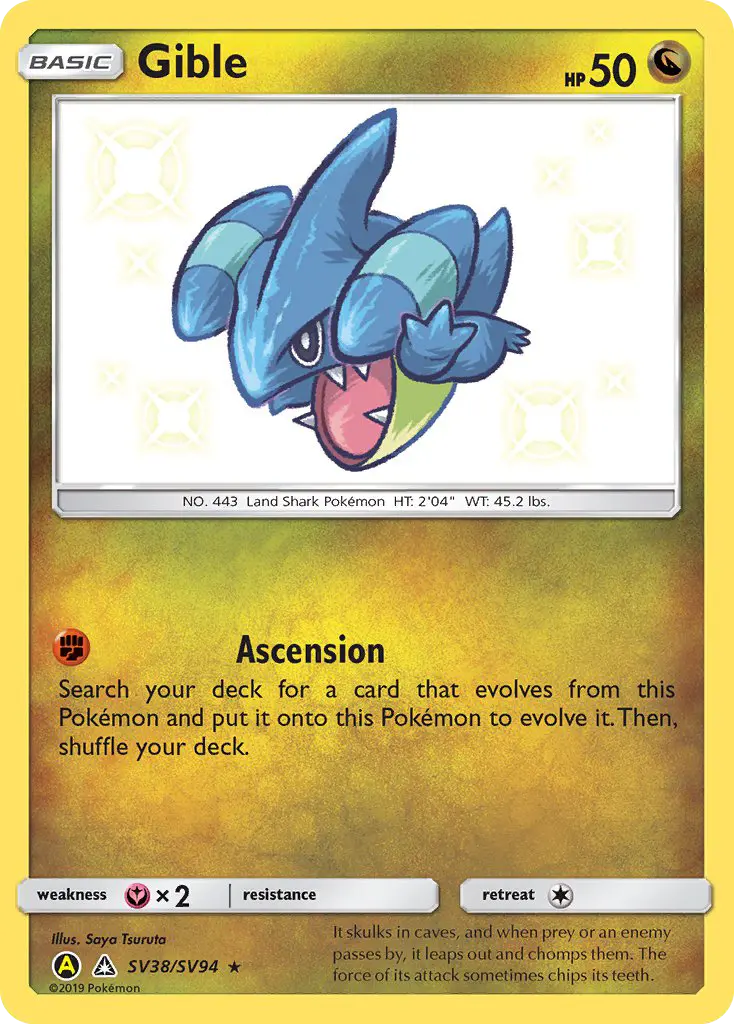
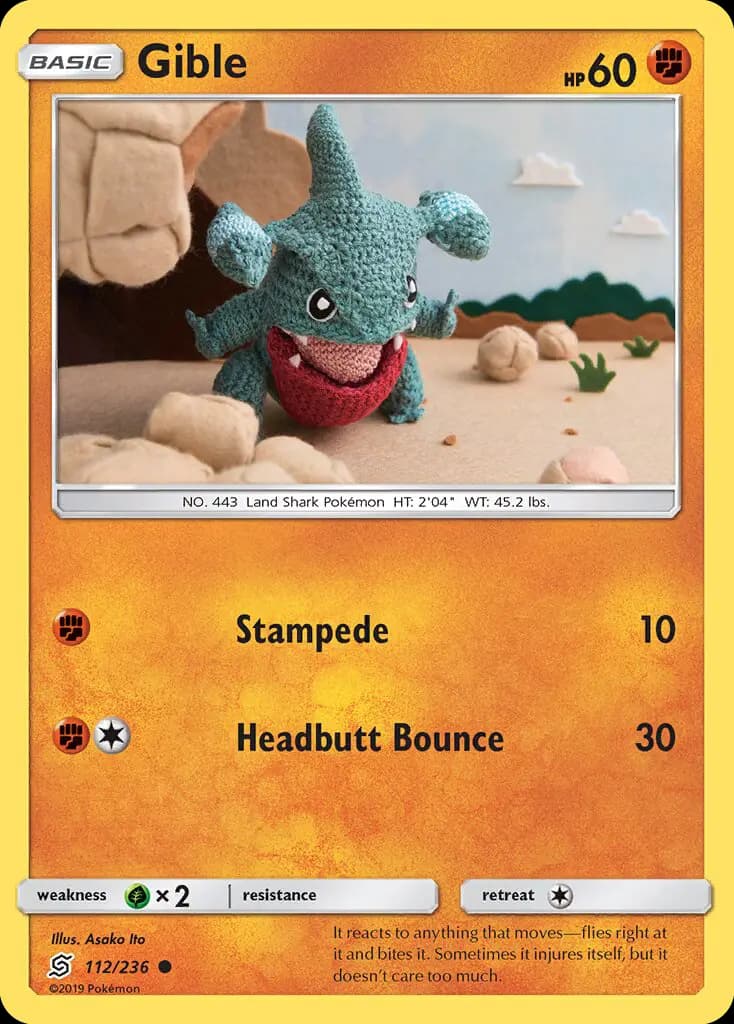
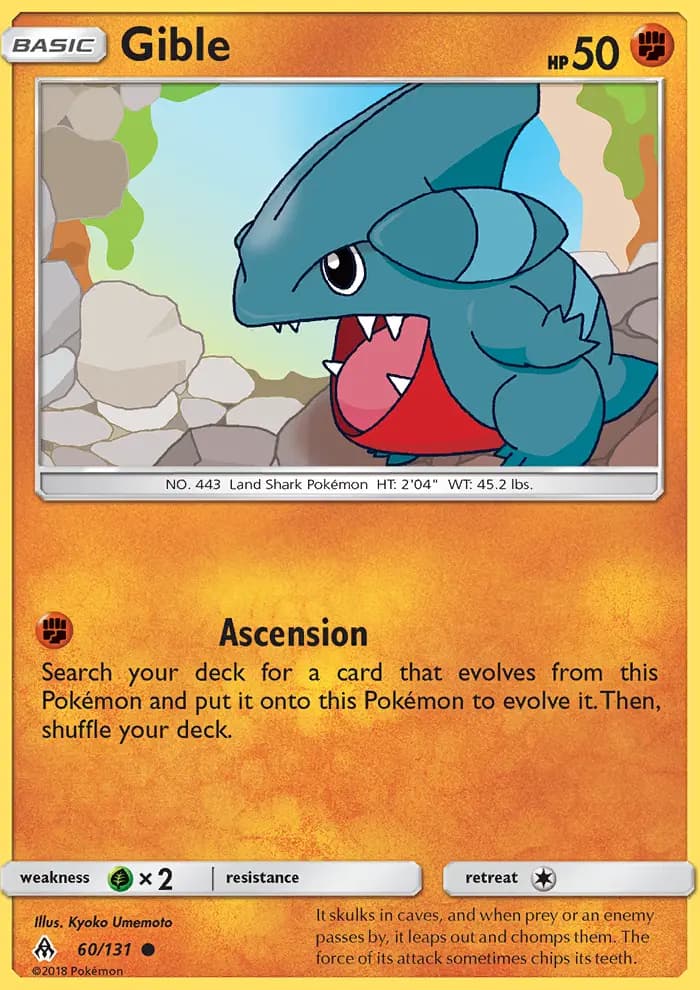
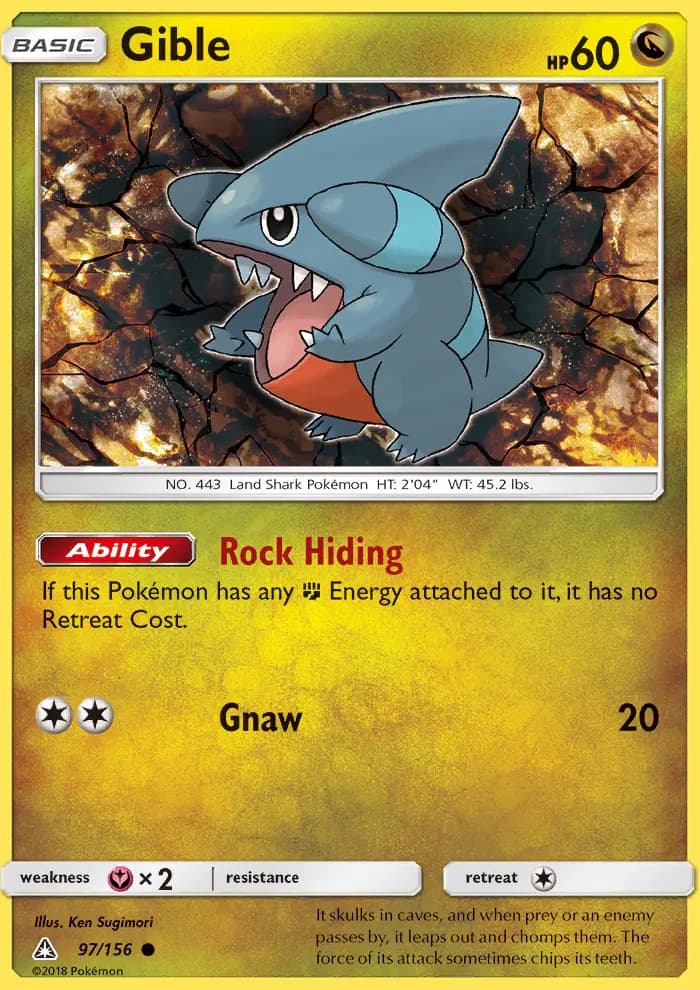
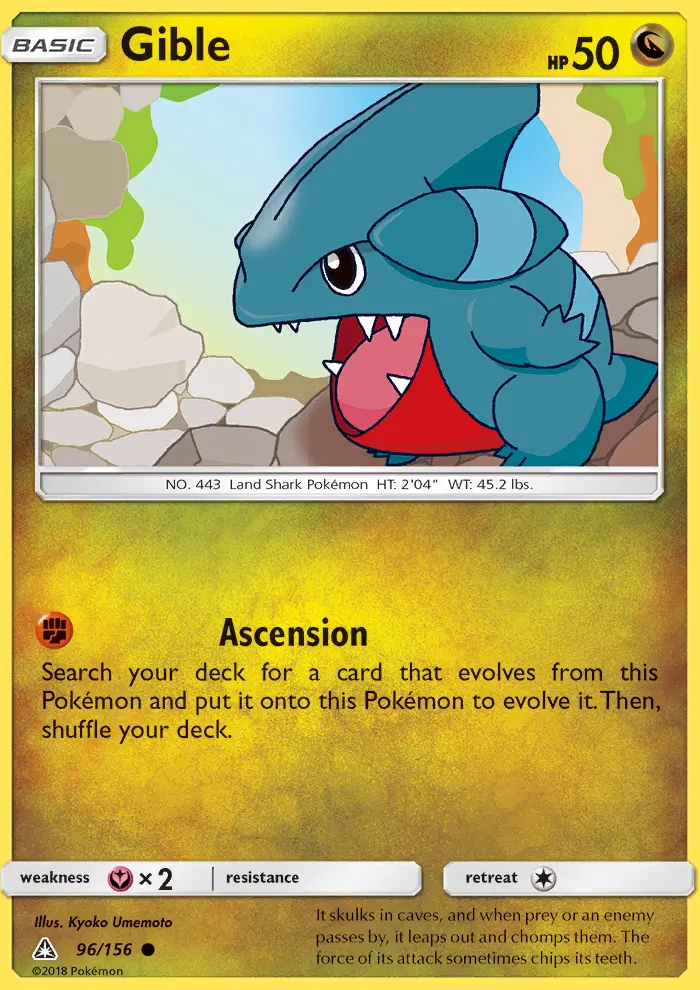
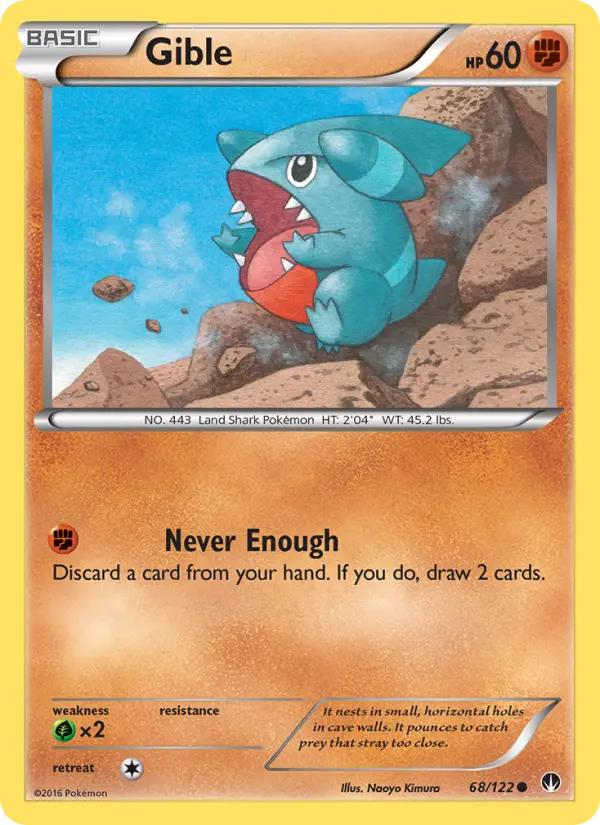
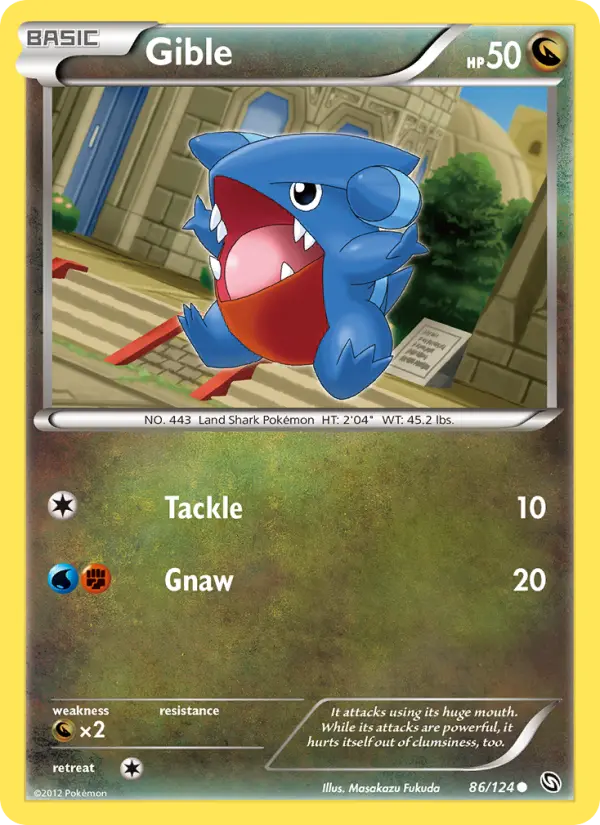
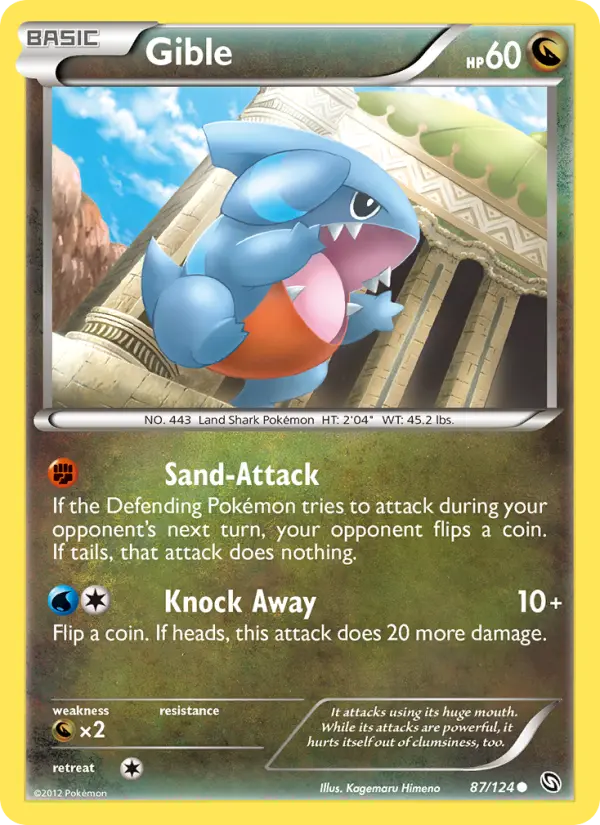
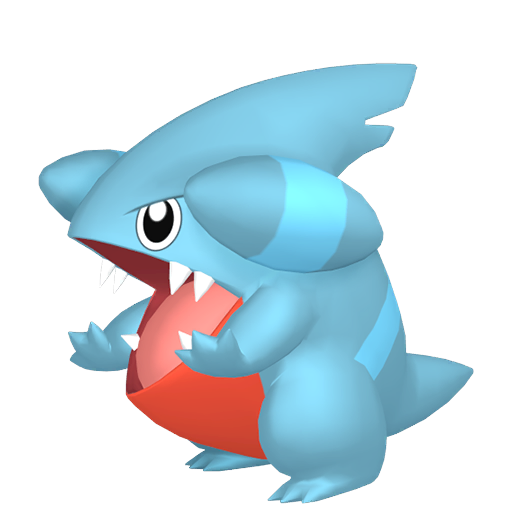
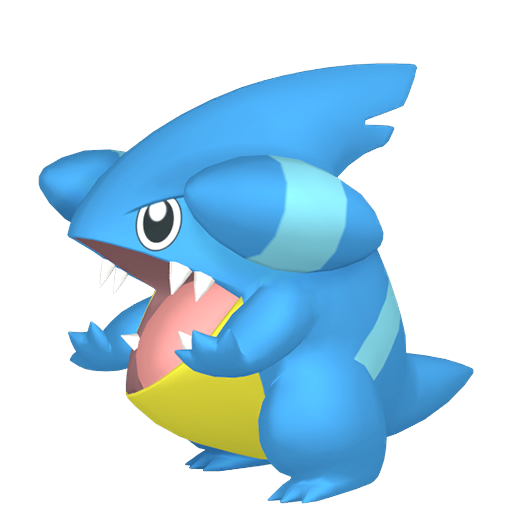
Gible is a small, bipedal dragon-like Pokémon that showcases a primarily grayish-blue coloration with distinctive features that emphasize its predatory nature. Its most prominent characteristic is its enormously oversized mouth, filled with razor-sharp teeth that dominate its compact body, though there is virtually no neck separating the jaw from its torso. A vibrant red underbelly stretches from its abdomen to the lower jaw, creating a striking color contrast. Atop its head sits a dorsal fin complete with a distinctive notch on males, which is sturdy enough to carry a person. Two horns resembling jet or plane engines extend from the sides of its head, each adorned with a light blue stripe running down the center. A single light blue stripe also wraps around its back, and it possesses a relatively short tail. The Pokédex notes that Gible has tremendously powerful jaws capable of delivering devastating bites, though its own clumsiness frequently results in chipped or lost teeth during attacks—a quirk that doesn't seem to bother the species in the slightest.
Pokedex Numbers
Training
Breeding
Gible Breeding, Gender Ratio & Egg Groups
Gible's population splits evenly by gender, 50% each way, ensuring equal breeding opportunities regardless of sex. Male Gible can be distinguished from females by the distinctive notch present on their dorsal fin—a subtle but reliable visual difference that allows trainers to determine sex at a glance. Both genders are fully capable of breeding and will produce Gible eggs when paired appropriately. Gible belongs to both the Monster and Dragon egg groups, making it compatible with a surprisingly diverse range of breeding partners and allowing for strategic breeding to pass down desirable movesets or abilities. The species has a base happiness value of 70, indicating a reasonably friendly disposition that makes it receptive to trainer bonding without requiring extensive effort. With a hatch counter of 40 cycles (approximately 10,024 to 10,280 steps), Gible eggs require a moderate amount of travel time to produce viable offspring, neither particularly fast nor exceptionally slow compared to other dragon-type Pokémon. This moderate breeding timeframe makes Gible an accessible choice for trainers interested in breeding their own dragons without excessive time investment.
Sprites




Held Items
Haban Berry
type-protection
Held: Consumed when struck by a super-effective Dragon-type attack to halve the damage.
Cost: 80
Haban Berry
type-protection
Held: Consumed when struck by a super-effective Dragon-type attack to halve the damage.
Cost: 80
Haban Berry
type-protection
Held: Consumed when struck by a super-effective Dragon-type attack to halve the damage.
Cost: 80
Haban Berry
type-protection
Held: Consumed when struck by a super-effective Dragon-type attack to halve the damage.
Cost: 80
Haban Berry
type-protection
Held: Consumed when struck by a super-effective Dragon-type attack to halve the damage.
Cost: 80
Haban Berry
type-protection
Held: Consumed when struck by a super-effective Dragon-type attack to halve the damage.
Cost: 80
Haban Berry
type-protection
Held: Consumed when struck by a super-effective Dragon-type attack to halve the damage.
Cost: 80
Haban Berry
type-protection
Held: Consumed when struck by a super-effective Dragon-type attack to halve the damage.
Cost: 80
Haban Berry
type-protection
Held: Consumed when struck by a super-effective Dragon-type attack to halve the damage.
Cost: 80
TMs & HMs
tm01
black white
tm01
black 2 white 2
tm01
lets go pikachu lets go eevee
tm01
omega ruby alpha sapphire
tm01
x y
tm02
emerald
tm02
crystal
tm02
firered leafgreen
tm02
ruby sapphire
tm02
gold silver
tm02
black white
tm02
heartgold soulsilver
tm02
platinum
tm02
colosseum
tm02
diamond pearl
tm02
black 2 white 2
tm02
sun moon
tm02
omega ruby alpha sapphire
tm02
x y
tm02
xd
+683 more TMs/HMs
Gender Differences
This Pokémon has visible differences between male and female forms.
Gible's Evolution Chain


Gible Evolution, Mega Evolution & Special Forms
Gible evolves into Gabite starting at level 24, continuing its progression along the evolutionary chain that represents one of the most significant transformations in Pokémon development. At level 24, Gible's base stat total increases substantially and its physical form becomes noticeably more intimidating, with enhanced attack power and improved defensive capabilities. When Gabite reaches level 48, it undergoes its final evolution into Garchomp, one of the most formidable pseudo-legendary Pokémon in the entire series. This three-stage evolution line represents a dramatic power curve; while Gible's base stats total only 300 with merely 70 attack and 45 defense, Garchomp boasts 600 base stats with 130 attack and 95 defense, making it a competitive powerhouse. The evolution line emphasizes physical growth and combat prowess, with each stage becoming progressively more dragon-like and dangerous. Garchomp's introduction in Generation IV as a late-game pseudo-legendary option provided players with an alternative to traditional dragon-types, and its strong competitive viability has made the Gible evolution line a perennial favorite among trainers seeking high-performance dragon-ground combinations.
Where to Find
Wayward Cave
sinnoh
+19 more
Floccesy Town
unova
Kalos Route 13
kalos
+5 more
Gible Behaviour and Natural Habitat
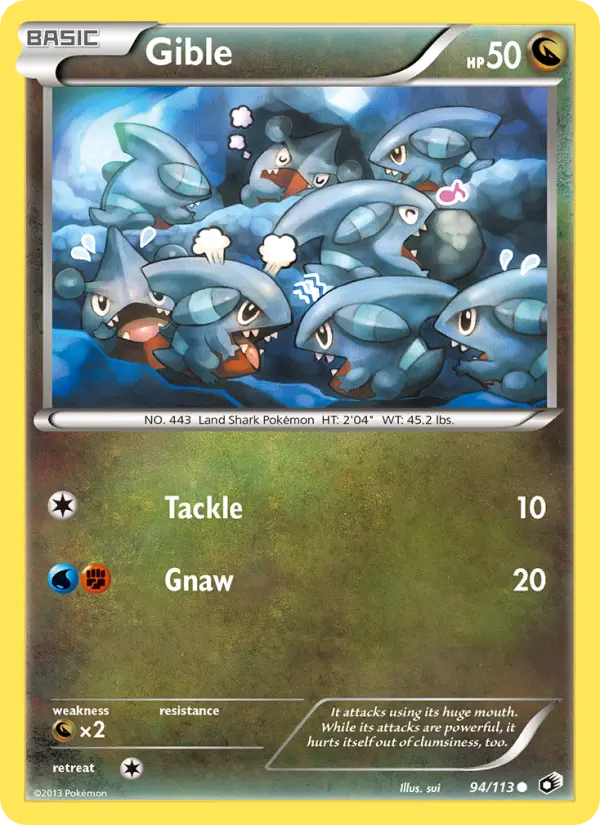
Gible inhabits deep caves warmed by geothermal heat, a preference believed to stem from its evolutionary origin in tropical climates. According to Pokédex entries, it nests in small horizontal holes carved into cave walls, which it appears to excavate with considerable skill. When cold weather arrives, Gible huddles closely with other members of its species for warmth, though these gatherings often devolve into playful sparring matches that showcase its social nature. The species is primarily nocturnal and ambush-based in its hunting strategy; it skulks within its cave dwelling until unsuspecting prey or enemies pass nearby, at which point it launches itself with explosive force and delivers powerful chomping attacks. While its predatory instincts are fierce and its bite strength is formidable, Gible's overall clumsiness means it frequently injures itself during these encounters, sometimes with enough force to damage its own teeth. This combination of aggressive hunting behavior and self-inflicted damage has become a defining characteristic of the species, appearing consistently across multiple Pokédex entries from different generations and regions.
Pokedex Entries
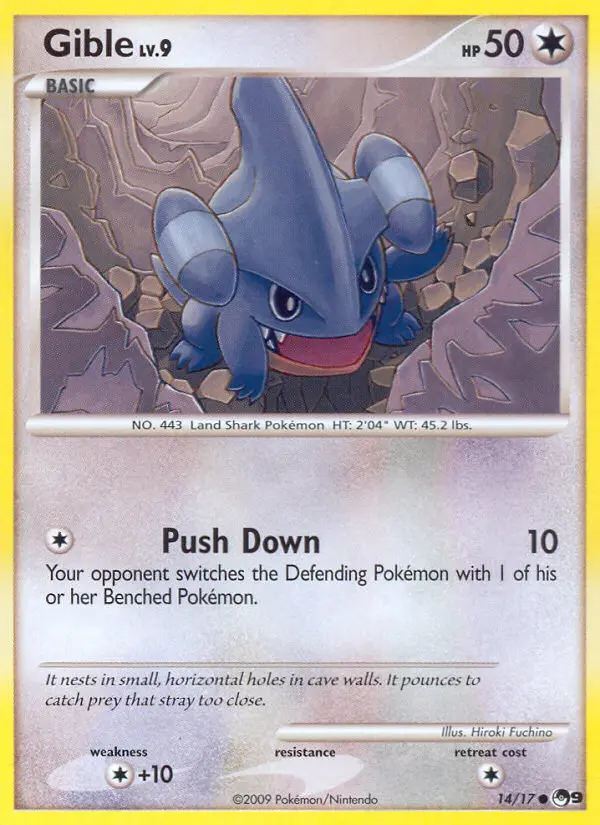
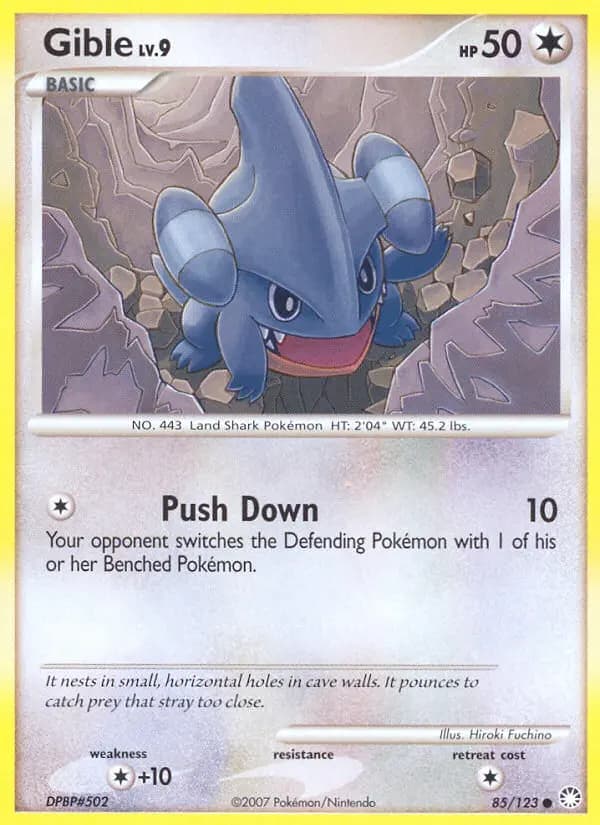
It nests in small, horizontal holes in cave walls. It pounces to catch prey that stray too close.
It once lived in the tropics. To avoid the cold, it lives in caves warmed by geothermal heat.
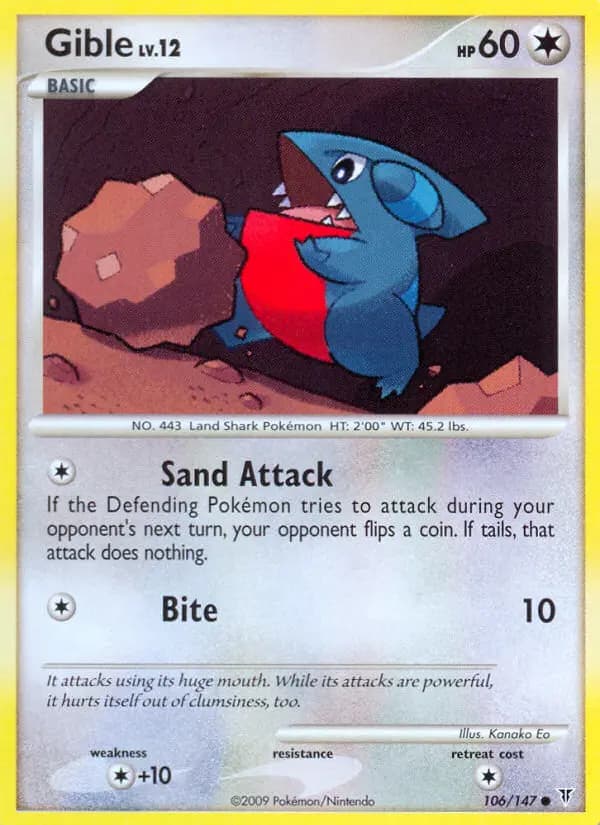
It attacks using its huge mouth. While its attacks are powerful, it hurts itself out of clumsiness, too.
It nests in horizontal holes warmed by geothermal heat. Foes who get too close can expect to be pounced on and bitten.
It attacks using its huge mouth. While its attacks are powerful, it hurts itself out of clumsiness, too.
It attacks using its huge mouth. While its attacks are powerful, it hurts itself out of clumsiness, too.
It nests in horizontal holes warmed by geothermal heat. Foes who get too close can expect to be pounced on and bitten.
It nests in small, horizontal holes in cave walls. It pounces to catch prey that stray too close.
It nests in horizontal holes warmed by geothermal heat. Foes who get too close can expect to be pounced on and bitten.
It nests in small, horizontal holes in cave walls. It pounces to catch prey that stray too close.
It lives in caves warmed by geothermal heat. Even so, when the weather gets cold, it will huddle close with others of its kind.
It reacts to anything that moves—flies right at it and bites it. Sometimes it injures itself, but it doesn’t care too much.
It skulks in caves, and when prey or an enemy passes by, it leaps out and chomps them. The force of its attack sometimes chips its teeth.
Its original home is an area much hotter than Alola. If you’re planning to live with one, your heating bill will soar.
Gible prefers to stay in narrow holes in the sides of caves heated by geothermal energy. This way, Gible can stay warm even during a blizzard.
Gible attacks anything that moves, and it drags whatever it catches into the crevice that is its lair. Despite the big mouth, Gible’s stomach is small.
It nests in caves untouched by sunlight. Its sharp teeth may fall out when worn away or after an impact, but they regrow within a few days.
Gible Name Origin & Design Inspiration
Gible's name origin lies in a combination of terms emphasizing its predatory nature and geographical environment. The English name likely combines 'Giga' (suggesting its disproportionately large mouth) with 'Nibble,' perfectly capturing its habit of biting despite its small stature. The Japanese name Fukamaru (フカマル) draws from 'Fuka' (深, meaning deep) and 'Maru' (丸, meaning round or complete), referencing both its deep-cave habitat and rounded body shape. The design itself appears to take inspiration from prehistoric creatures and contemporary sharks, particularly in the oversized jaws and streamlined body form. The jet engine-like horns suggest a connection to speed and power despite the Pokémon's actually modest speed stat, while the dorsal fin and overall silhouette evoke both aquatic predators and aerial threats. This design philosophy establishes Gible as a creature of geological environments, equally comfortable in subterranean tunnels and evolving toward aerial dominance in its final form. The species epithet 'Land Shark Pokémon' succinctly captures this design intent, positioning Gible as a terrestrial apex predator that mimics the hunting strategies and physical characteristics of oceanic sharks while existing entirely within cave ecosystems.
Learnable Moves
Gible can learn 77 moves:
Move | Type | Cat. | Power | Acc. | PP |
|---|---|---|---|---|---|
| aerial ace | flying | Physical | 60 | — | 20 |
| attract | normal | Status | — | 100 | 15 |
| bite | dark | Physical | 60 | 100 | 25 |
| body slam | normal | Physical | 85 | 100 | 15 |
| bulldoze | ground | Physical | 60 | 100 | 20 |
| captivate | normal | Status | — | 100 | 20 |
| confide | normal | Status | — | — | 20 |
| cut | normal | Physical | 50 | 95 | 30 |
| dig | ground | Physical | 80 | 100 | 10 |
| double team | normal | Status | — | — | 15 |
| double edge | normal | Physical | 120 | 100 | 15 |
| draco meteor | dragon | Special | 130 | 90 | 5 |
| dragon breath | dragon | Special | 60 | 100 | 20 |
| dragon cheer | dragon | Status | 0 | 0 | 15 |
| dragon claw | dragon | Physical | 80 | 100 | 15 |
| dragon pulse | dragon | Special | 85 | 100 | 10 |
| dragon rage | dragon | Special | — | 100 | 10 |
| dragon rush | dragon | Physical | 100 | 75 | 10 |
| dragon tail | dragon | Physical | 60 | 90 | 10 |
| earth power | ground | Special | 90 | 100 | 10 |
| earthquake | ground | Physical | 100 | 100 | 10 |
| endure | normal | Status | — | — | 10 |
| facade | normal | Physical | 70 | 100 | 20 |
| false swipe | normal | Physical | 40 | 100 | 40 |
| fire blast | fire | Special | 110 | 85 | 5 |
| fire fang | fire | Physical | 65 | 95 | 15 |
| flamethrower | fire | Special | 90 | 100 | 15 |
| frustration | normal | Physical | — | 100 | 20 |
| fury cutter | bug | Physical | 40 | 95 | 20 |
| headbutt | normal | Physical | 70 | 100 | 15 |
| helping hand | normal | Status | — | — | 20 |
| hidden power | normal | Special | 60 | 100 | 15 |
| hone claws | dark | Status | — | — | 15 |
| incinerate | fire | Special | 60 | 100 | 15 |
| iron head | steel | Physical | 80 | 100 | 15 |
| iron tail | steel | Physical | 100 | 75 | 15 |
| metal claw | steel | Physical | 50 | 95 | 35 |
| mud shot | ground | Special | 55 | 95 | 15 |
| mud slap | ground | Special | 20 | 100 | 10 |
| natural gift | normal | Physical | — | 100 | 15 |
| outrage | dragon | Physical | 120 | 100 | 10 |
| protect | normal | Status | — | — | 10 |
| rain dance | water | Status | — | — | 5 |
| rest | psychic | Status | — | — | 5 |
| return | normal | Physical | — | 100 | 20 |
| roar | normal | Status | — | — | 20 |
| rock climb | normal | Physical | 90 | 85 | 20 |
| rock slide | rock | Physical | 75 | 90 | 10 |
| rock smash | fighting | Physical | 40 | 100 | 15 |
| rock tomb | rock | Physical | 60 | 95 | 15 |
| round | normal | Special | 60 | 100 | 15 |
| sand attack | ground | Status | — | 100 | 15 |
| sand tomb | ground | Physical | 35 | 85 | 15 |
| sandstorm | rock | Status | — | — | 10 |
| scale shot | dragon | Physical | 25 | 90 | 20 |
| scary face | normal | Status | — | 100 | 10 |
| scorching sands | ground | Special | 70 | 100 | 10 |
| secret power | normal | Physical | 70 | 100 | 20 |
| shadow claw | ghost | Physical | 70 | 100 | 15 |
| slash | normal | Physical | 70 | 100 | 20 |
| sleep talk | normal | Status | — | — | 10 |
| snore | normal | Special | 50 | 100 | 15 |
| stealth rock | rock | Status | — | — | 20 |
| stone edge | rock | Physical | 100 | 80 | 5 |
| strength | normal | Physical | 80 | 100 | 15 |
| substitute | normal | Status | — | — | 10 |
| sunny day | fire | Status | — | — | 5 |
| swagger | normal | Status | — | 85 | 15 |
| swift | normal | Special | 60 | — | 20 |
| swords dance | normal | Status | — | — | 20 |
| tackle | normal | Physical | 40 | 100 | 35 |
| take down | normal | Physical | 90 | 85 | 20 |
| tera blast | normal | Special | 80 | 100 | 10 |
| thrash | normal | Physical | 120 | 100 | 10 |
| thunder fang | electric | Physical | 65 | 95 | 15 |
| toxic | poison | Status | — | 90 | 10 |
| twister | dragon | Special | 40 | 100 | 20 |
Gible Competitive Battle Guide
Gible's competitive viability is severely limited by its base stats, which total only 300 and feature critical weaknesses in both offensive and defensive categories. Its attack stat of 70 and special attack of 40 mean that Gible struggles to deal meaningful damage even to neutral opponents, while its defenses of 45 in both categories leave it vulnerable to virtually any incoming attack. The speed stat of 42 ensures that Gible will move last in most battles, eliminating any possibility of outspeeding threats or executing priority strategies. Where Gible gains relevance in competitive play is through its abilities and typing advantages. Sand Veil increases evasion to 1.25 times during sandstorm conditions, potentially allowing Gible to dodge attacks, while its hidden ability Rough Skin punishes physical attackers by dealing 1/8 of their maximum HP in damage on contact. The Dragon/Ground typing, while providing excellent type coverage and useful resistances to electric, poison, and rock attacks, cannot overcome Gible's fundamental stat disadvantages. Competitive players view Gible primarily as a stepping stone to its evolution Garchomp rather than a viable standalone competitor. In amateur or casual formats, Gible can serve as a beginner-friendly introduction to dragon-type mechanics, but serious competitive use virtually never features Gible, as its evolutions provide dramatically superior stats and capabilities without requiring significantly more investment.
Commonly Asked Questions About Gible
What type is Gible?
Gible is a dragon and ground type Pokemon.
What does Gible evolve into?
Gible evolves into gabite, then into garchomp.
What are Gible's weaknesses?
Gible is weak to ice, dragon and fairy type moves.
Does Gible evolve by trading?
No — Gible evolves entirely through leveling up, with no trade required at any stage.
Where can I find Gible?
Gible can be found in wayward cave (sinnoh), floccesy town (unova) and kalos route 13 (kalos).
Gible Cultural Impact & Franchise History
Gible achieved significant prominence in the Pokémon anime series through several major character appearances that elevated its cultural visibility beyond typical Generation IV newcomers. Ash Ketchum captured a female Gible early in the Sinnoh region saga, and this particular Gible became famous for enthusiastically biting Ash whenever he approached, earning it considerable screen time and fan affection despite its relatively small role in the overall narrative. Iris, a prominent character and eventual Gym Leader, also featured a Gible in her team, emphasizing the species' role in competitive training circles. Cynthia, the Champion of the Sinnoh region and one of the most formidable trainers in the series, possessed a Gible as part of her professional team, lending the species credibility and prestige through association with excellence. These high-profile anime appearances transformed Gible from a simple Generation IV addition into a recognized and beloved member of the broader Pokémon cultural landscape. The comedic biting behavior, while sometimes played for laughs, created a memorable personality trait that distinguished Gible from more stoic dragon-types and made it relatable to audiences. This combination of official media prominence and the species' eventual evolution into the powerhouse Garchomp has maintained Gible's relevance across multiple generations and media formats.
Where to Find Gible in Every Pokémon Game
Gible's availability varies significantly across different Pokémon games, with initial scarcity in its debut Generation IV games gradually improving in subsequent releases. In the original Diamond and Pearl versions, Gible is encountered relatively late in the game as a wild Pokémon in Wayward Cave, making it a valuable find for players seeking dragon-types for their main team. In Platinum, availability expanded to include Route 206 and Route 210, making Gible more accessible to players. Subsequent generations maintained decent availability; Gible appears in volcanic and cave areas throughout Kalos, Alola, and later regions, though availability remains contingent on specific in-game locations. Cynthia's Garchomp in the Sinnoh remakes (Brilliant Diamond and Shining Pearl) continues to emphasize the species' strategic importance within the game's narrative. Generation V's Black and White versions relegated Gible to post-game content, reflecting its status as a pseudo-legendary early-game option. More recently, Gible has been made available in various DLC packs and expansions, including appearance in The Crown Tundra and The Teal Mask, ensuring that players in modern titles can obtain this desirable dragon-type. Trading with other players has always served as an alternative acquisition method, particularly given Gible's moderate 45 capture rate, which means that even when encountered in the wild, multiple attempts may be necessary to successfully catch this somewhat evasive Pokémon.