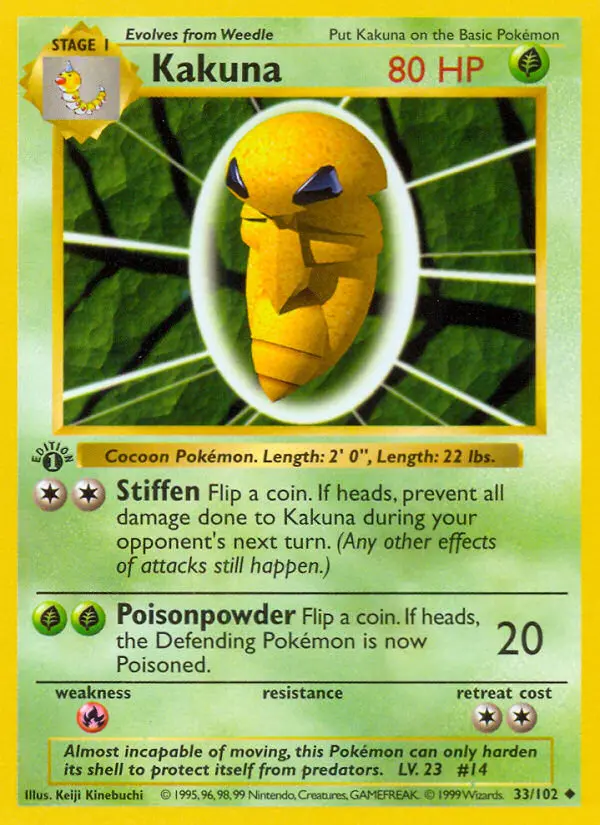
Kakuna
Generation I · #0014 — Cocoon Pokémon
Kakuna measures in at 0.6 m and 10 kg, a build that matches its shed skin ability better than it matches raw offense or defense. At 0.6 m and 10.0 kg, its build reflects a specialist role rather than a generalist one. Despite its apparent immobility and defensive posture, this small cocoon-like creature is internally undergoing dramatic physiological changes that would result in one of the Bug-type's most dangerous evolutionary forms. With a aggregate stat total of 205, Kakuna is intentionally designed as a transitional Pokémon, neither particularly offensive nor specialized in any single stat, yet its defensive capabilities hint at what lies ahead in its evolution. The creature's gentle yellow coloration and passive demeanor belie its poisonous nature, making it an intriguing subject of study for trainers interested in understanding the nuances of Pokémon development.
Editor's Take
Kakuna exists for exactly nine levels and the Weedle line's whole appeal is skipping through it as fast as possible — the fastest fully-evolved Pokémon in Gen 1 comes at the cost of the worst middle stage.
Base Stats
Height
0.6m
Weight
10.0kg
Category
Cocoon Pokémon
Gender
Male 50% / Female 50%
Color
yellow
Shape
squiggle
Habitat
forest
Abilities
Has a 33% chance of curing any major status ailment after each turn.
Kakuna Biology & Physical Characteristics
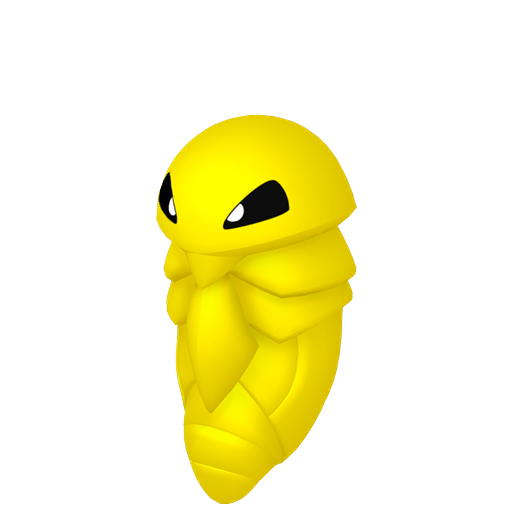
Kakuna presents a distinctly insectoid appearance, with a dome-shaped head featuring two striking triangular black eyes that glow with white pupils, creating an almost contemplative expression. The Pokémon's body is predominantly yellow and possesses a segmented, cocoon-like structure, with two scythe-like arms positioned in the middle of its small frame. These appendages, while appearing delicate, serve a critical defensive function—when threatened, Kakuna can extend poison barbs from these limbs to deter predators. The most fascinating biological aspect of Kakuna is the dramatic thermal activity occurring beneath its hardened external shell; as the Pokédex entries from Ruby and Sapphire reveal, the shell becomes noticeably warm to the touch due to the intense metabolic processes happening within. This thermogenesis is a direct consequence of the Pokémon's cellular restructuring and energy expenditure during its preparation for evolution. Standing at only 0.6 meters tall and weighing a mere 10.0 kilograms, Kakuna is among the smallest and lightest Pokémon, reflecting its role as an intermediate stage rather than a fully developed creature.
Pokedex Numbers
Training
Breeding
Kakuna Breeding, Gender Ratio & Egg Groups
Kakuna exhibits a balanced gender distribution of 50% male and 50% female, reflecting the species' role as a standard evolutionary intermediate with no gender-specific variations or breeding complications. The species belongs exclusively to the Bug egg group, which encompasses the majority of insect-type Pokémon and allows Kakuna to be bred with other Bug-group members in the Pokémon breeding system. With a base happiness value of 70, Kakuna demonstrates moderate friendliness toward trainers, suggesting it is neither particularly aloof nor exceptionally affectionate in its interactions. The species has a relatively short egg hatch counter of 15 cycles, translating to approximately 3,599 to 3,855 steps required for an egg to hatch into a Weedle, which then quickly evolves into Kakuna at level 7. This rapid progression from egg to cocoon stage means that trainers who invest in breeding Kakuna will quickly witness the full evolutionary line's development within a single playthrough. Female Kakuna breed true with male Kakuna or other compatible Bug-type males without producing offspring of different species, maintaining the evolutionary line's integrity across generations. The capture rate of 120 indicates that wild Kakuna are moderately easy to catch compared to other Pokémon, making them accessible specimens for trainers working to complete their Pokédex.
Sprites




TMs & HMs
tm104
scarlet violet
tm182
scarlet violet
tr46
sword shield
tm211
scarlet violet
tm182
the teal mask
tm104
the indigo disk
tm211
the indigo disk
tm82
sword shield
Kakuna's Evolution Chain


Kakuna Evolution, Mega Evolution & Special Forms
Kakuna occupies a brief but essential position in the Weedle evolutionary line, evolving from Weedle starting at level 7 and subsequently evolving into the powerful Beedrill at level 10. This makes Kakuna one of the shortest-lived evolutions in Pokémon, typically remaining in this cocoon stage for merely three levels of experience. The evolutionary progression from Weedle to Kakuna represents the creature's commitment to its chrysalis state, where the flexible, mobile larval form becomes increasingly rigid and defensive. The transition from Kakuna to Beedrill marks one of the most dramatic transformations in Pokémon biology, as the immobile cocoon suddenly awakens as a highly aggressive, swift insect fully capable of flight and combat. The Ruby/Sapphire Pokédex entries emphasize that despite appearing static on the outside, Kakuna is frantically busy internally, preparing for its metamorphosis through rapid cellular reorganization and development of new physiological systems. Trainers who have observed this evolution report that the process happens almost instantaneously upon reaching level 10, with the hardened shell splitting open to reveal the fully formed, aggressive Beedrill within. This evolutionary sequence demonstrates nature's elegant design, where apparent weakness and defenselessness in Kakuna serve as necessary precursors to the strength and capability exhibited by Beedrill.
Where to Find
Viridian Forest
kanto
+17 more
Kanto Route 25
kanto
+3 more
Kanto Route 24
kanto
+1 more
Johto Route 39
johto
Lake of Rage
johto
Kanto Route 26
kanto
Kanto Route 27
kanto
Kanto Route 2
kanto
+11 more
Azalea Town
johto
Johto Route 36
johto
Johto Route 37
johto
Johto Route 38
johto
Johto Route 30
johto
+7 more
Johto Route 31
johto
+7 more
Ilex Forest
johto
+11 more
Johto Route 34
johto
Johto Route 35
johto
National Park
johto
+3 more
Pattern Bush
kanto
Eterna Forest
sinnoh
+2 more
+2 more locations in other games
Kakuna Behaviour and Natural Habitat
Kakuna's behavior is fundamentally defined by immobility and patience. As multiple Pokédex entries consistently note, this Pokémon is almost completely incapable of independent movement, spending its days clinging to tree branches and wooden structures via silken strands it produces. Rather than actively seeking food or engaging in typical Pokémon behaviors, Kakuna enters a state of dormancy while its internal transformation progresses toward evolution. The creature typically inhabits temperate forests and misty wooded areas, where it finds shelter among dense vegetation and sturdy branches suitable for suspension. Occasionally, Kakuna will nest at the mouths of caves and tunnels, as documented in Pokémon Snap observations, suggesting the species can adapt to various environments so long as there are suitable anchoring points. When endangered despite its generally passive nature, Kakuna demonstrates surprising agency by extending its poison barbs as a last-resort defense mechanism—a behavior that showcases the creature's ability to respond to threats despite its severe motor limitations. The species' survival strategy relies heavily on camouflage and the protection afforded by its hardening shell rather than any capacity for escape or combat, making predator avoidance through stillness its primary survival mechanism.
Pokedex Entries
Almost incapable of moving, this POKéMON can only harden its shell to protect itself from predators.
Able to move only slightly. When endangered, it may stick out its stinger and poison its enemy.
Although it is a cocoon, it can move a little. It can extend its poison barb if it is attacked.
From this form, it will grow into an adult. As its body becomes soft er, the external shell hardens.
Nearly incapable of movement, it leans against stout trees while waiting for its evolution.
KAKUNA remains virtually immobile as it clings to a tree. However, on the inside, it is extremely busy as it prepares for its coming evolution. This is evident from how hot the shell becomes to the touch.
It remains virtually immobile while it clings to a tree. However, on the inside, it busily prepares for evolution. This is evident from how hot its shell becomes.
This POKéMON is in a temporary stage while making its body. It is almost completely unable to move on its own.
Almost incapable of moving, this POKéMON can only harden its shell to protect itself when it is in danger.
While awaiting evolution, it hides from predators under leaves and in nooks of branches.
Although it is a cocoon, it can move a little. It can extend its poison barb if it is attacked.
From this form, it will grow into an adult. As its body becomes softer, the external shell hardens.
While awaiting evolution, it hides from predators under leaves and in nooks of branches.
While awaiting evolution, it hides from predators under leaves and in nooks of branches.
Almost incapable of moving, this Pokémon can only harden its shell to protect itself when it is in danger.
While awaiting evolution, it hides from predators under leaves and in nooks of branches.
Kakuna remains virtually immobile as it clings to a tree. However, on the inside, it is extremely busy as it prepares for its coming evolution. This is evident from how hot the shell becomes to the touch.
Kakuna remains virtually immobile as it clings to a tree. However, on the inside, it is extremely busy as it prepares for its coming evolution. This is evident from how hot the shell becomes to the touch.
Able to move only slightly. When endangered, it may stick out its stinger and poison its enemy.
Kakuna Name Origin & Design Inspiration
Kakuna's name traces back to the Japanese word 'cocoon' (コクーン, 'kokūn'), directly referencing the Pokémon's biological appearance and function as an insect in its pupal stage. This straightforward nomenclature reflects the early Pokémon design philosophy of using clear, descriptive names that immediately convey a creature's primary characteristic. The design itself is an intentional simplification and hardening of Weedle's form, maintaining the species' general silhouette while adding defensive structures like the hardened shell exterior. The Pokémon's appearance draws inspiration from real-world cocoons and pupae, particularly those of butterflies and moths, though the presence of functional scythe-like arms and poison barbs gives it a distinctly Pokémon interpretation of metamorphosis. The yellow coloration serves both as a visual continuation of Weedle's color scheme and as a warm, inviting hue that contrasts with the species' deadly poison typing. Designers chose to emphasize Kakuna's vulnerability through its immobility and small stature, creating visual harmony with its defensive stat distribution and establishing a clear developmental narrative where apparent weakness transforms into strength through evolution. The dome-shaped head with its glowing eyes gives Kakuna an almost meditative appearance, suggesting the internal focus and concentration required for such a profound biological transformation.
Learnable Moves
Kakuna Competitive Battle Guide
In tournament-level play, Kakuna occupies an unusual niche as a deliberately weak Pokémon that trainers generally skip over immediately upon reaching level 7 and evolving from Weedle, with most serious competitors advancing directly to Beedrill at level 10. Kakuna's aggregate stat total of 205 is distributed unfavorably for combat, with particularly poor offensive capabilities—its Attack and Special Attack both stand at a meager 25, while its Speed stat of 35 ensures it will move last in nearly every confrontation. Its only moderately useful stat is Defense at 50, which provides minimal survivability against even weakly-hitting attacks. The Pokémon's sole ability, Shed Skin, offers limited utility by granting a 33% chance per turn to cure status conditions like paralysis, poison, burn, sleep, and freeze, potentially providing some defensive value in longer battles. However, the minimal investment most trainers place in Kakuna means competitive strategies rarely account for this ability's potential. The creature's movepool is extremely limited, learning only basic moves like Poison Powder, String Shot, and Harden, none of which provide meaningful offensive pressure. In formats where trainers are restricted to using only Kakuna, the Pokémon's extreme weakness and inability to deal meaningful damage make it essentially uncompetitive, serving purely as a temporary placeholder in a trainer's roster between Weedle and Beedrill.
Commonly Asked Questions About Kakuna
What type is Kakuna?
Kakuna is a bug and poison type Pokemon.
What does Kakuna evolve into?
Kakuna evolves into beedrill.
What are Kakuna's weaknesses?
Kakuna is weak to flying, rock, fire and psychic type moves.
Does Kakuna evolve by trading?
No — Kakuna evolves entirely through leveling up, with no trade required at any stage.
Where can I find Kakuna?
Kakuna can be found in viridian forest (kanto), kanto route 25 (kanto) and kanto route 24 (kanto) and 19 other locations.
Kakuna Cultural Impact & Franchise History
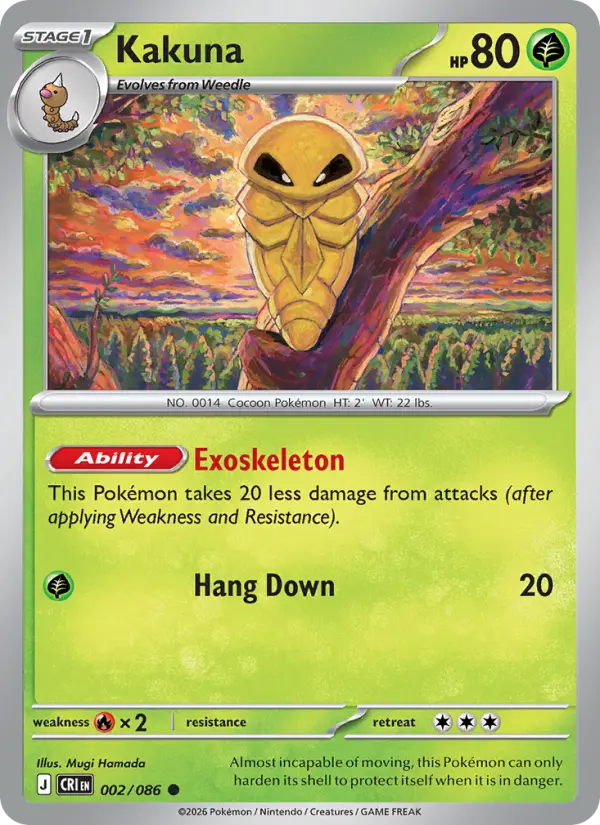
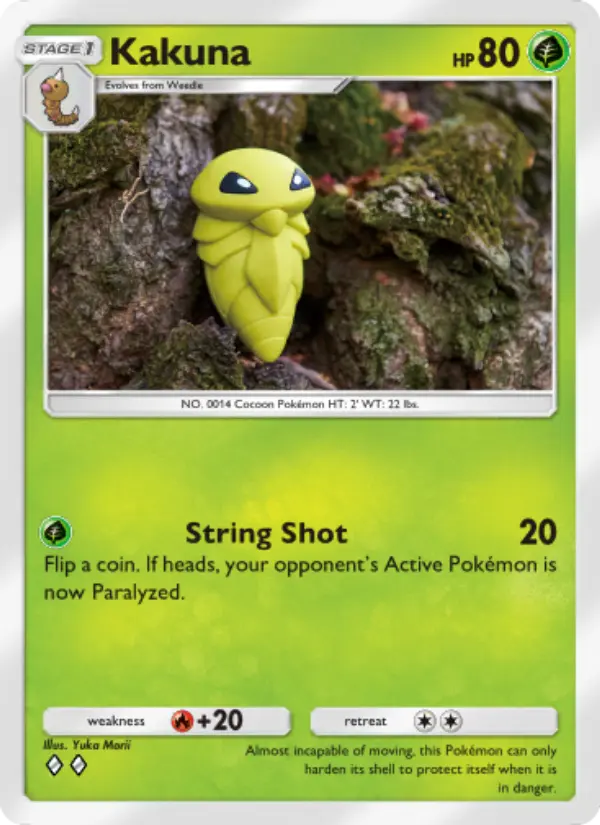
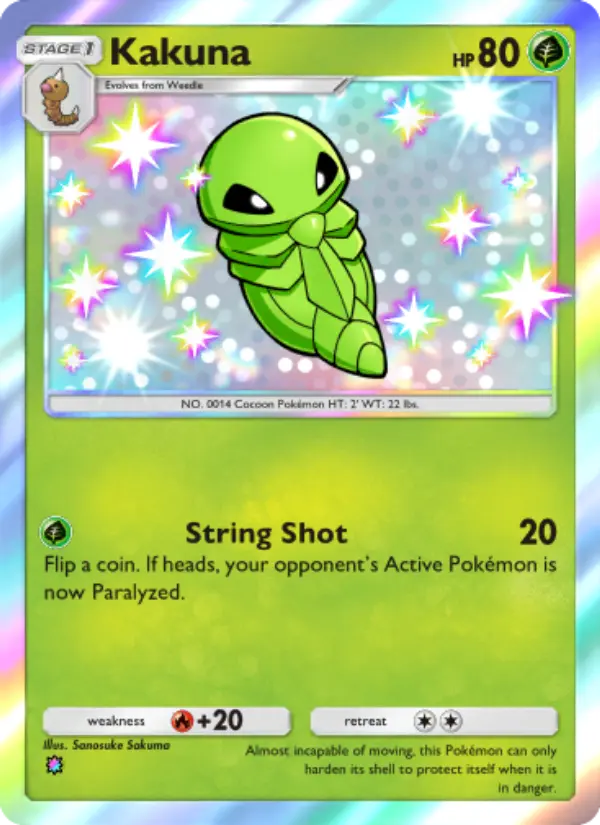
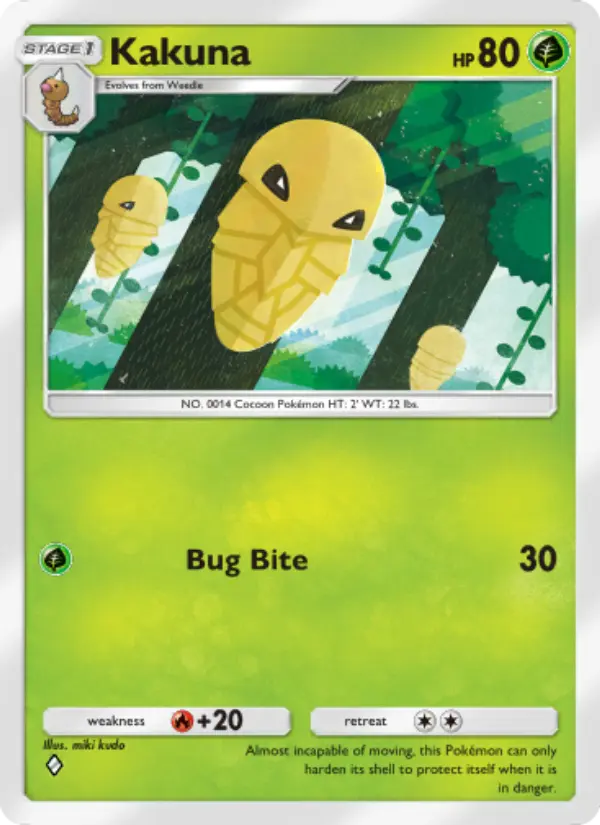
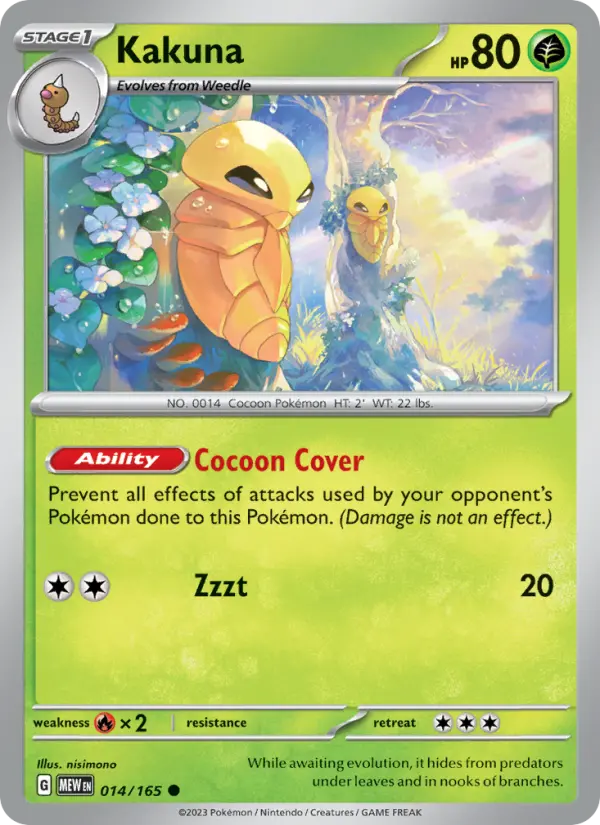
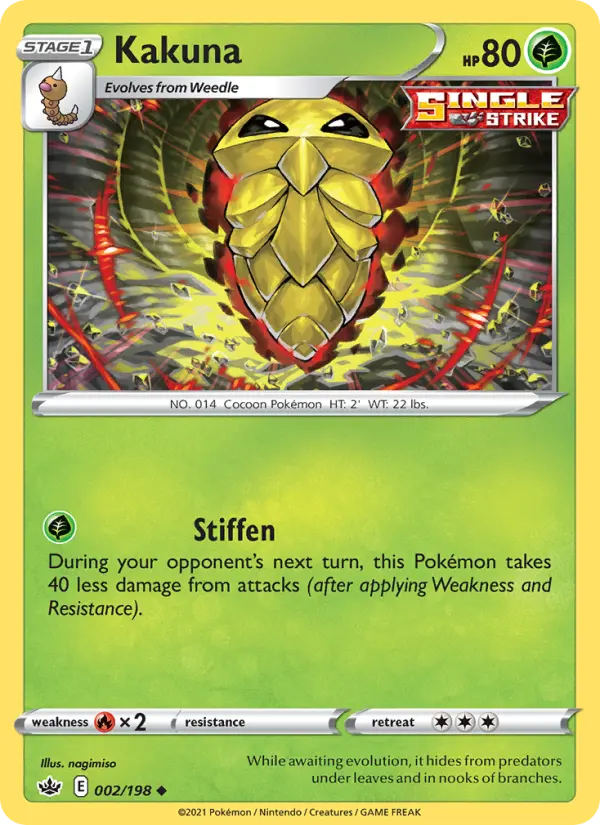
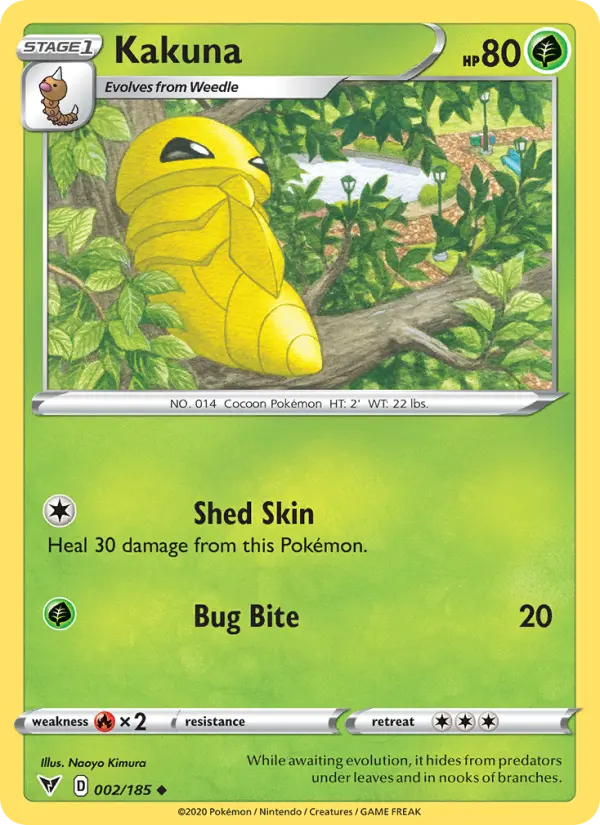
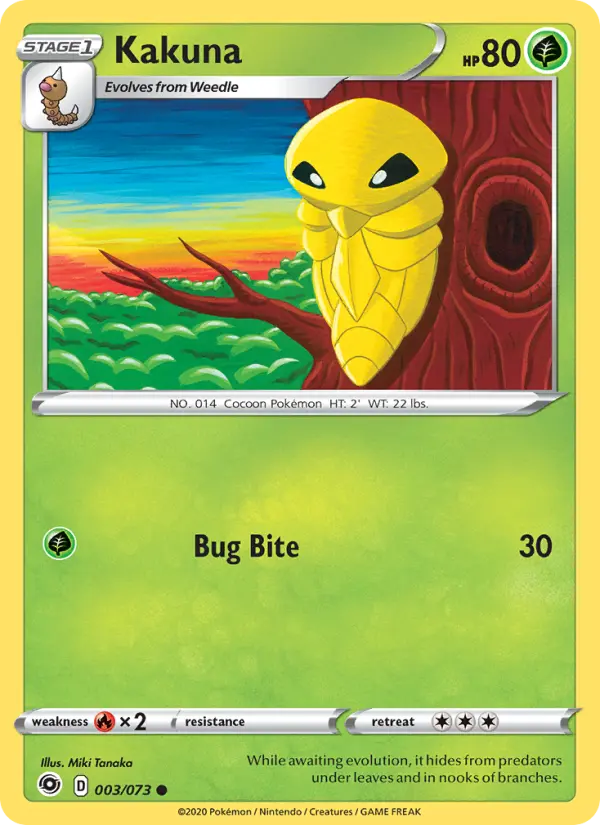
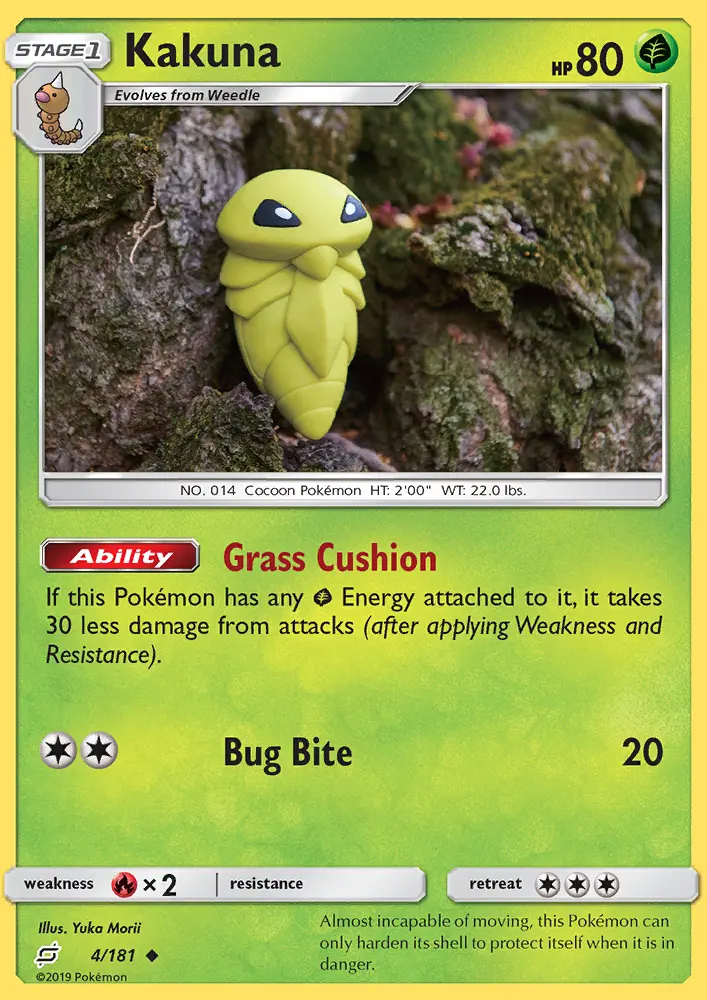
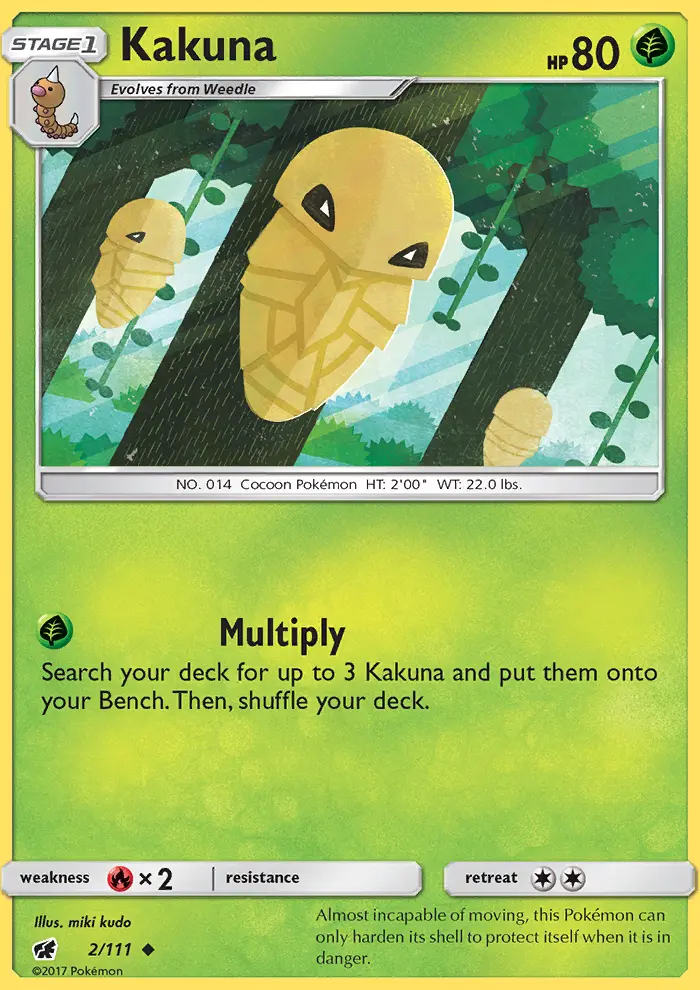
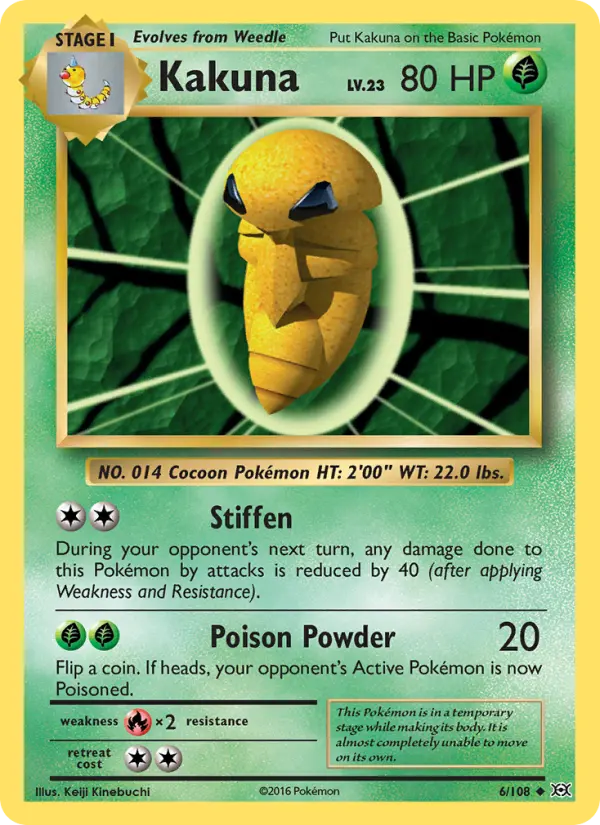
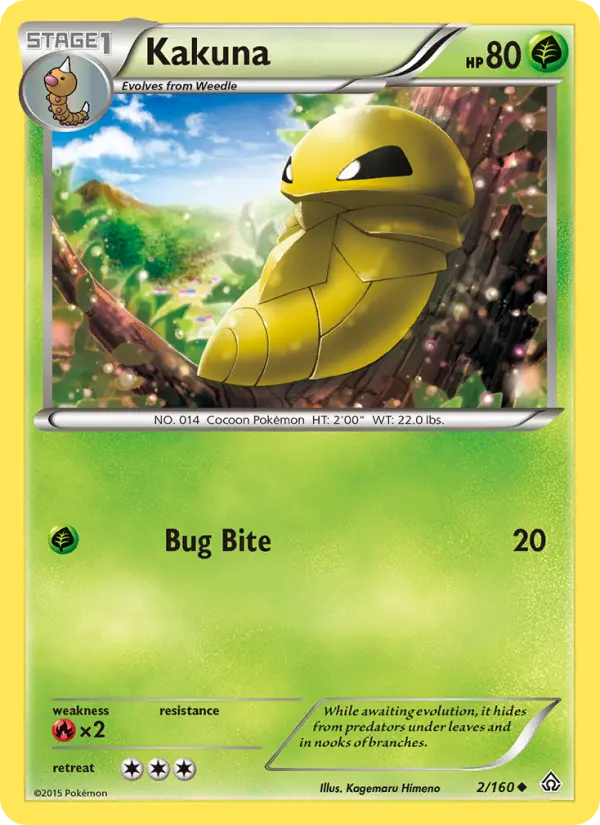
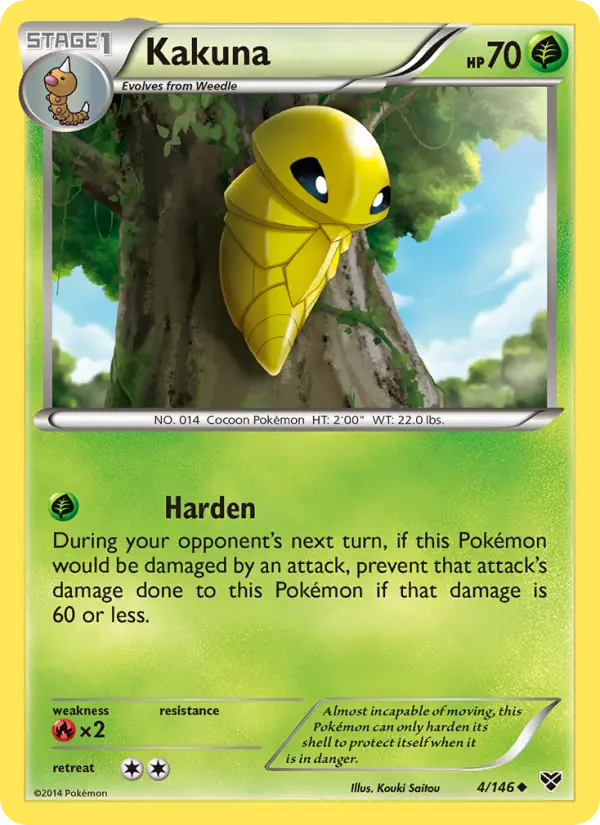
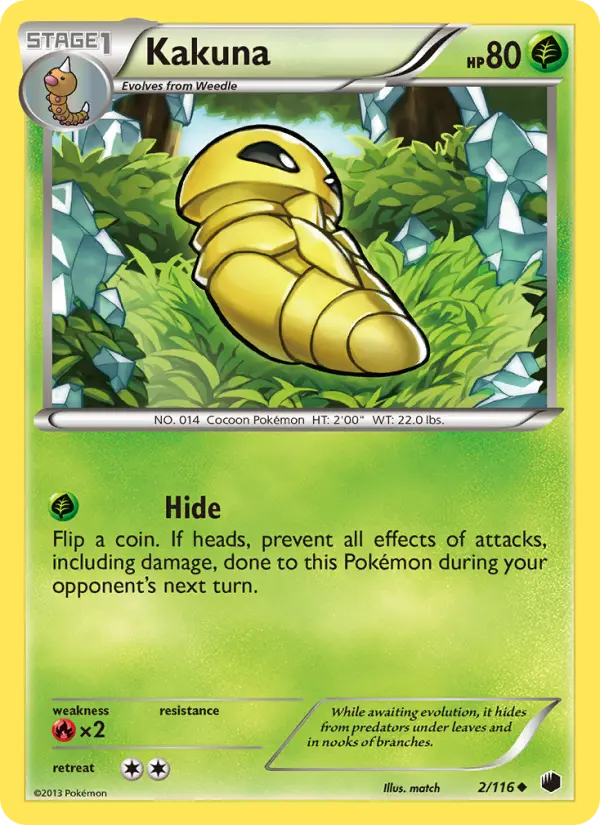
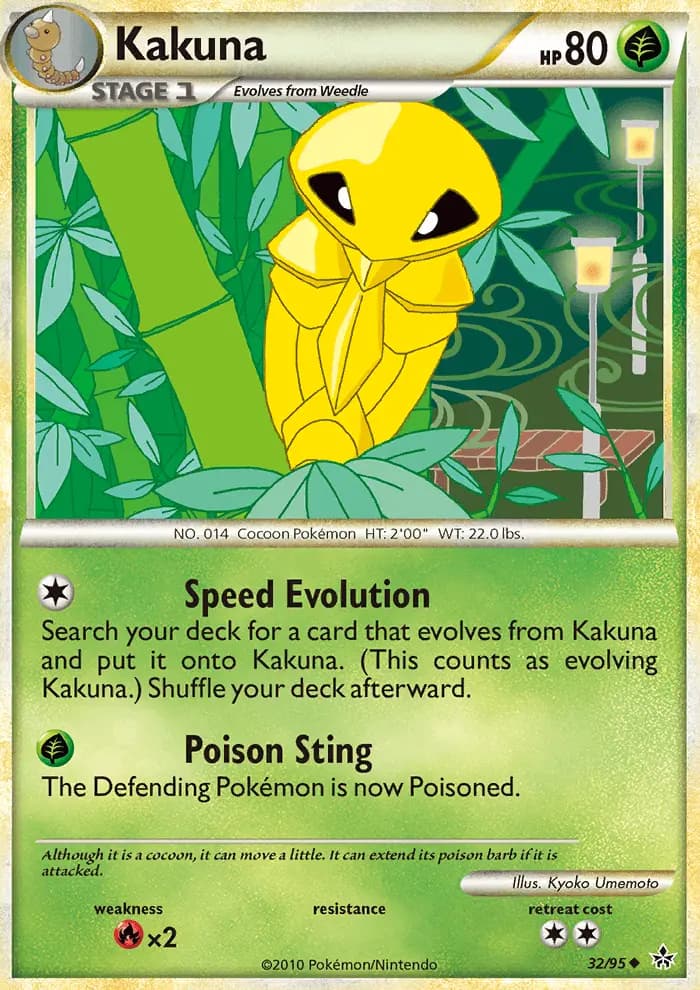
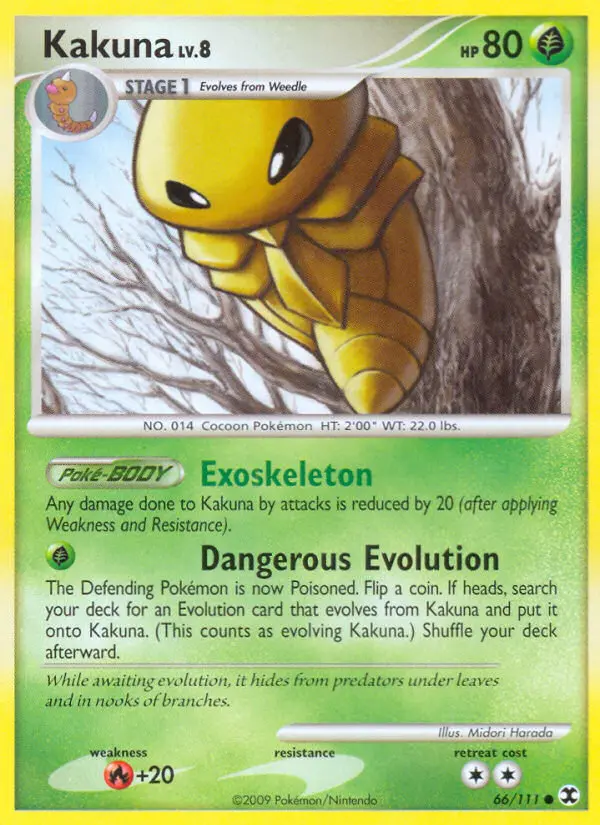
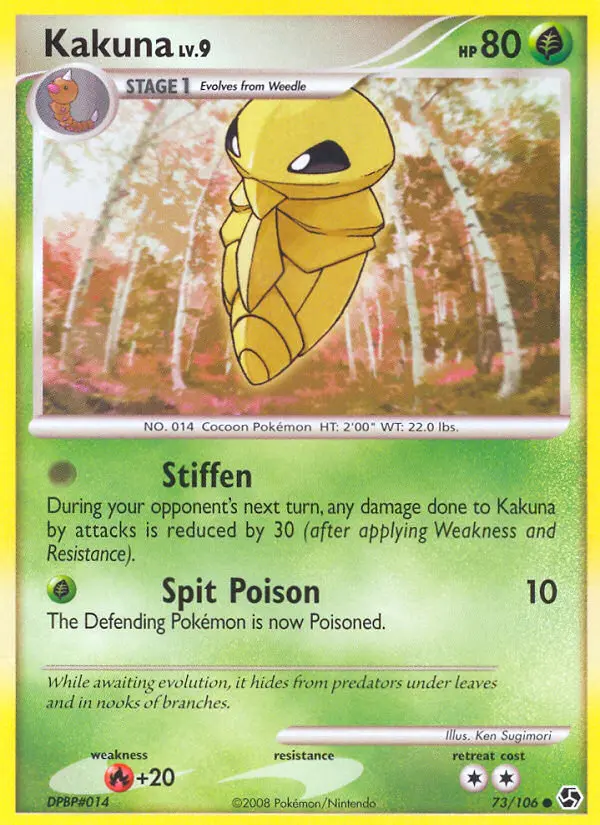
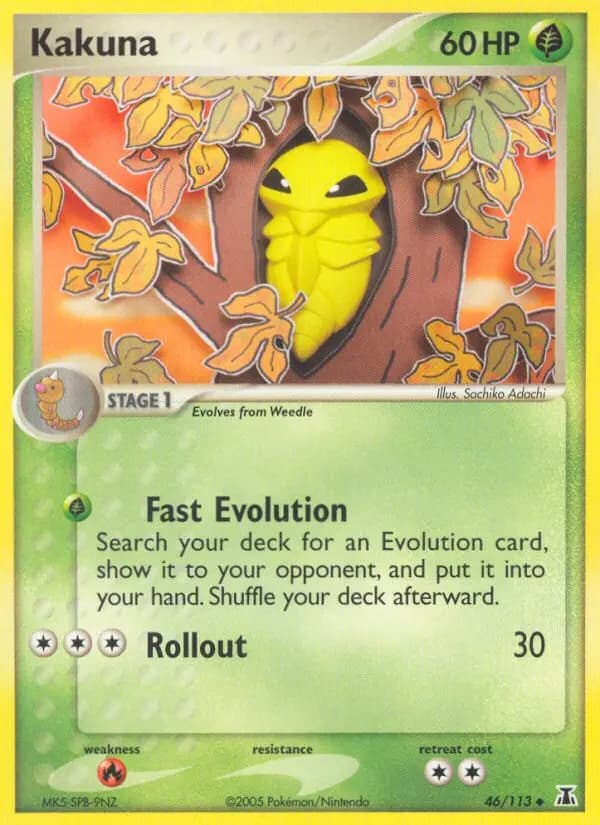
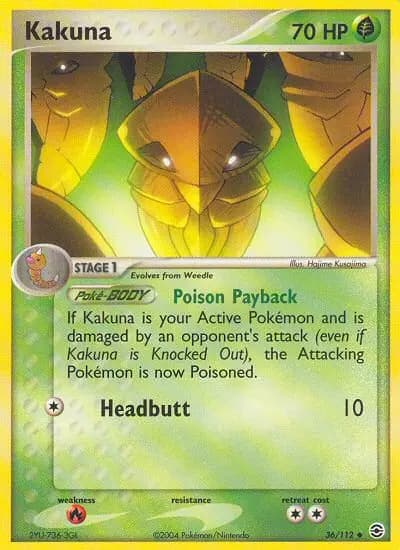
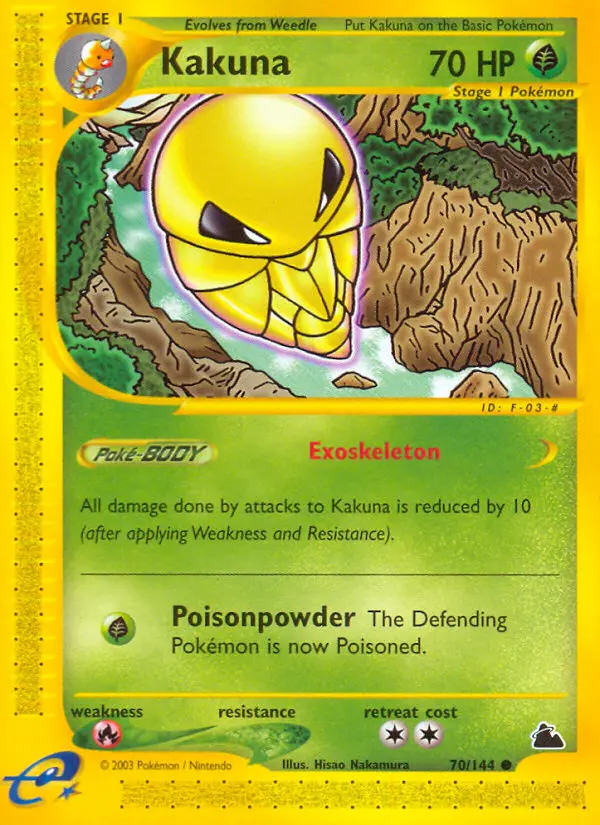
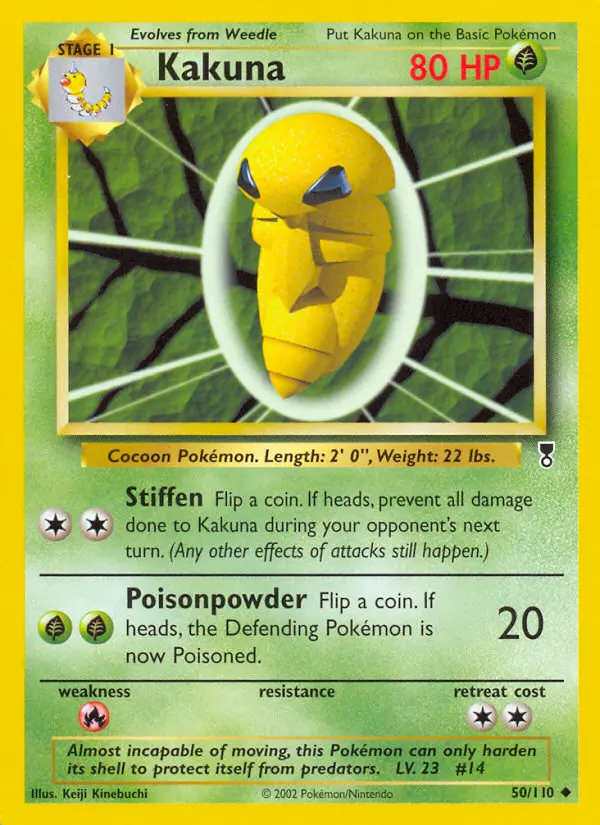
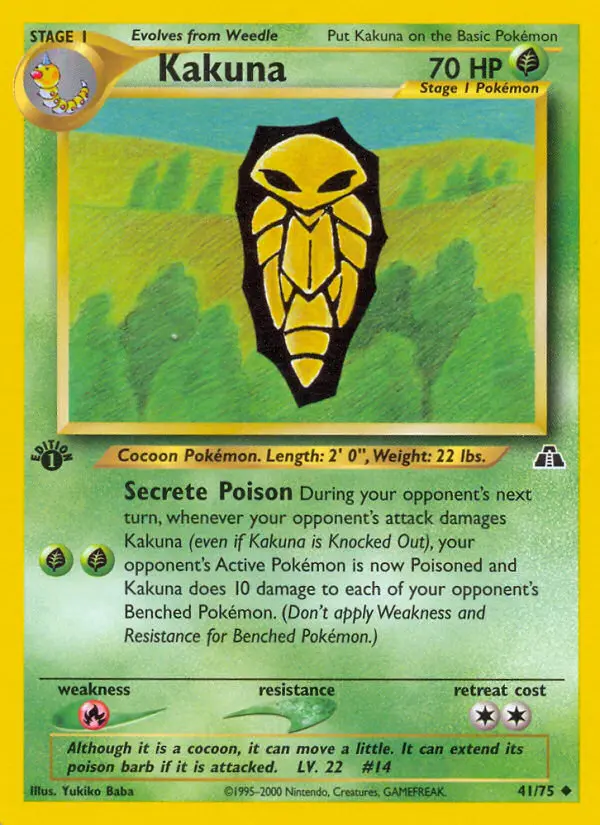
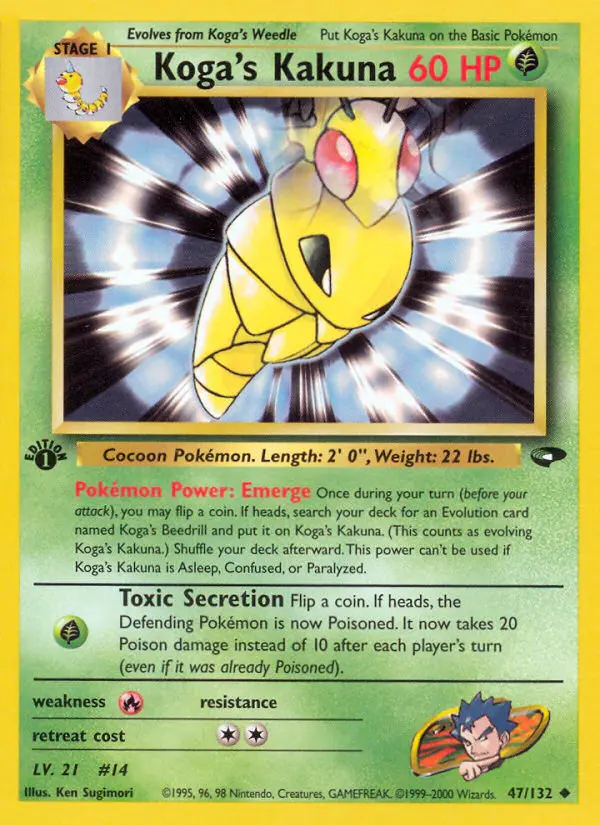
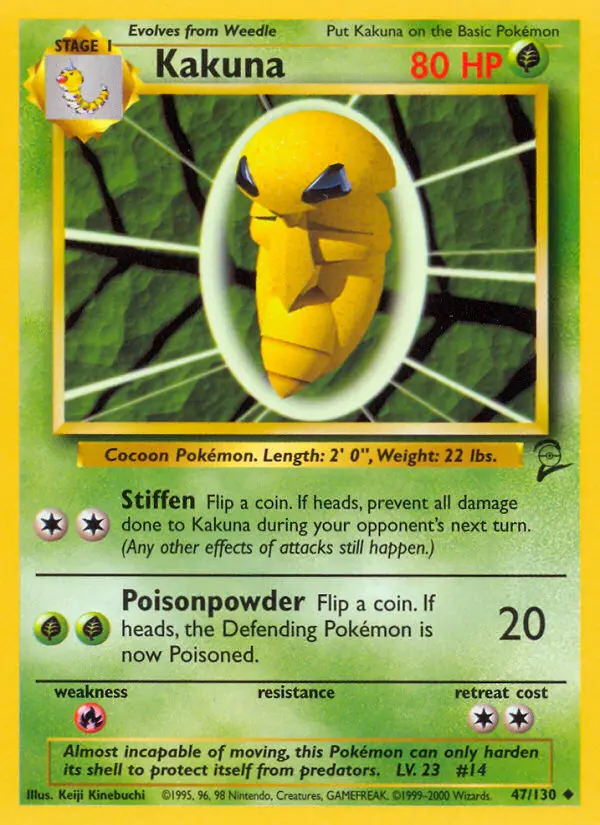
Kakuna holds a distinctive place in Pokémon's cultural history as the embodiment of transformation and patience, themes that resonate throughout the franchise's narrative and philosophical underpinnings. As one of the earliest Pokémon players encounter, Kakuna serves an important pedagogical function in teaching new trainers about evolution mechanics and the concept of growth through stages. The Pokémon's appearance in early Kanto-based games, particularly in the tutorial routes where players first capture Weedle, makes it a recognizable figure for anyone who has engaged with the franchise since its inception. In the anime series, Kakuna has appeared across multiple generations and storylines, often highlighting the themes of patience and internal growth that its cocoon form naturally invokes. The image of Kakuna clinging to a tree branch has become iconic in Pokémon's visual language, frequently used in promotional materials and encyclopedic content to represent evolution, metamorphosis, and the passage of time. Competitive players and speedrunners often joke about the brief duration of Kakuna's existence in their parties, with the creature becoming a running gag about the inevitable rush to reach Beedrill. The Pokémon has also featured prominently in trading card games, with various Kakuna cards serving as stepping stones in evolution-based deck strategies. Educational materials often use Kakuna as a teaching tool when explaining insect life cycles and metamorphosis to students, making it a bridge between scientific education and Pokémon fandom.
Where to Find Kakuna in Every Pokémon Game
Kakuna's availability throughout the Pokémon game series reflects its role as an early-game, common Bug-type Pokémon accessible to nearly all players during their initial playthrough. In the original Red, Blue, and Yellow versions, Kakuna appears primarily on Routes 2, 3, and in Viridian Forest as an evolution of the more commonly caught Weedle, with a catch rate of 120 that makes encountering and capturing individuals relatively straightforward. Subsequent generations have maintained Kakuna's accessibility, appearing in corresponding early routes and forests in remakes and new regions, including FireRed/LeafGreen, HeartGold/SoulSilver, and Let's Go Pikachu/Eevee. In later generations like X/Y, the Pokémon appears in Kalos's Central region with appropriate placement for a basic bug-type, maintaining its role as an introductory species. The creature is consistently available as an evolution of Weedle, meaning trainers interested in obtaining Kakuna simply need to catch a Weedle and raise it to level 7, making it an inevitably encountered Pokémon for most players rather than requiring specific hunting efforts. Kakuna can be bred from compatible Bug-group Pokémon, allowing dedicated players to produce as many specimens as desired, though the rapid three-level duration of the species in most playthroughs limits practical breeding motivation. Transfer mechanics in modern games like Pokémon Home have made historical Kakuna from older generations accessible on contemporary platforms, ensuring the species remains available across the entire evolutionary timeline of the franchise.