Weedle
Generation I · #0013 — Hairy Bug Pokémon
Weedle's shield dust ability is the first thing worth knowing about it — everything else, from its bug/poison typing to its build, follows from how that ability gets used. With a catch rate of 255, Weedle is one of the easiest Pokémon to capture, making it an ideal choice for novice trainers beginning their Pokédex completion or early-game team building. Its defensive ability Shield Dust, which protects against the secondary effects of incoming moves, provides a valuable tactical advantage that carries forward to its evolution Beedrill, lending Weedle strategic relevance despite its modest individual statistics.
Editor's Take
Weedle's Shield Dust is easy to overlook on a first-route bug, but it's the same ability that quietly makes Compoundeyes-style secondary effects a non-issue — a small mechanical safety net on one of the least threatening Pokémon in the game.
Base Stats
Height
0.3m
Weight
3.2kg
Category
Hairy Bug Pokémon
Gender
Male 50% / Female 50%
Color
brown
Shape
armor
Habitat
forest
Abilities
Protects against incoming moves' extra effects.
Ensures success fleeing from wild battles.
Weedle Biology & Physical Characteristics
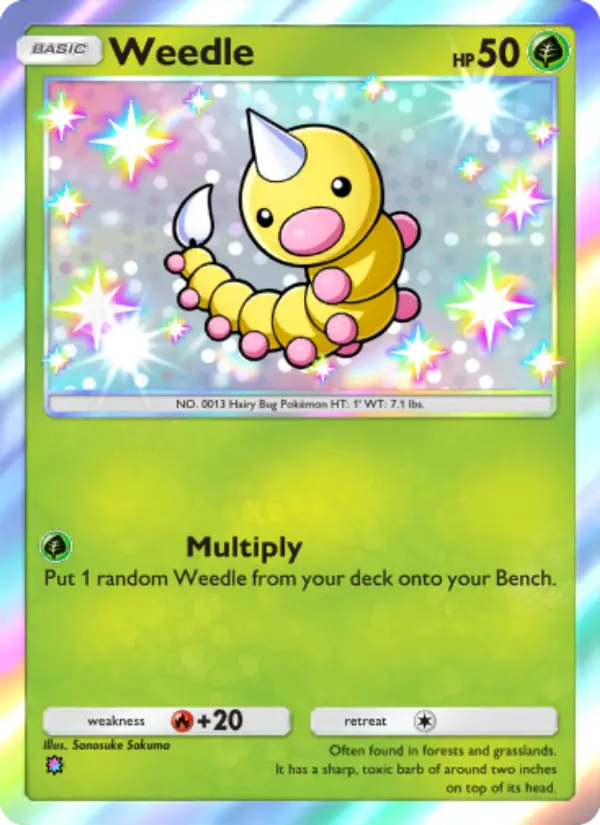
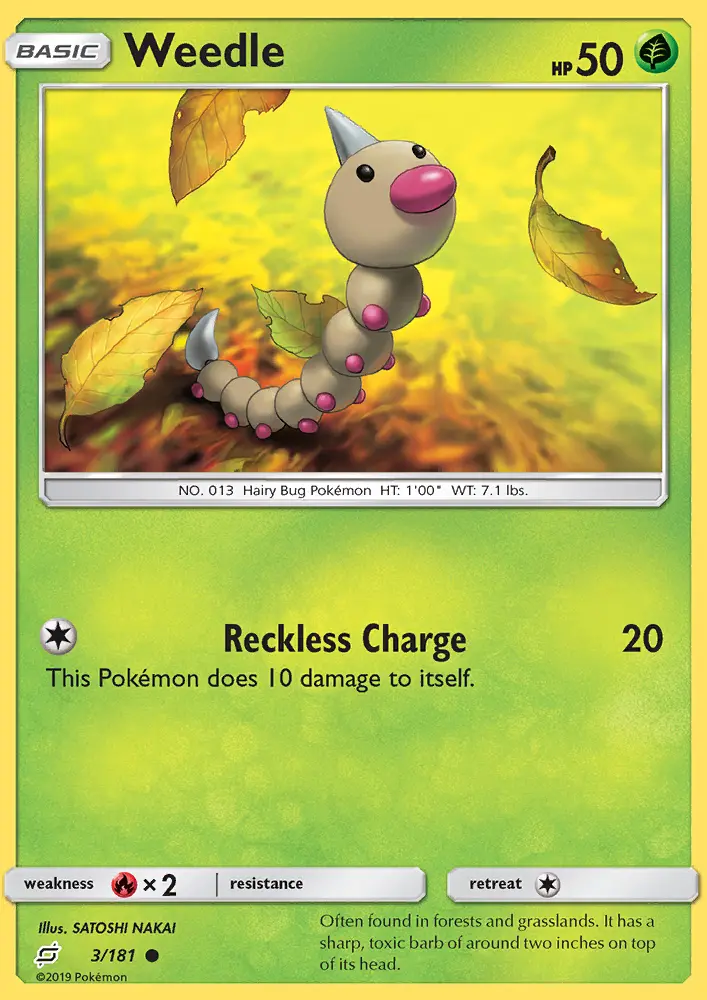
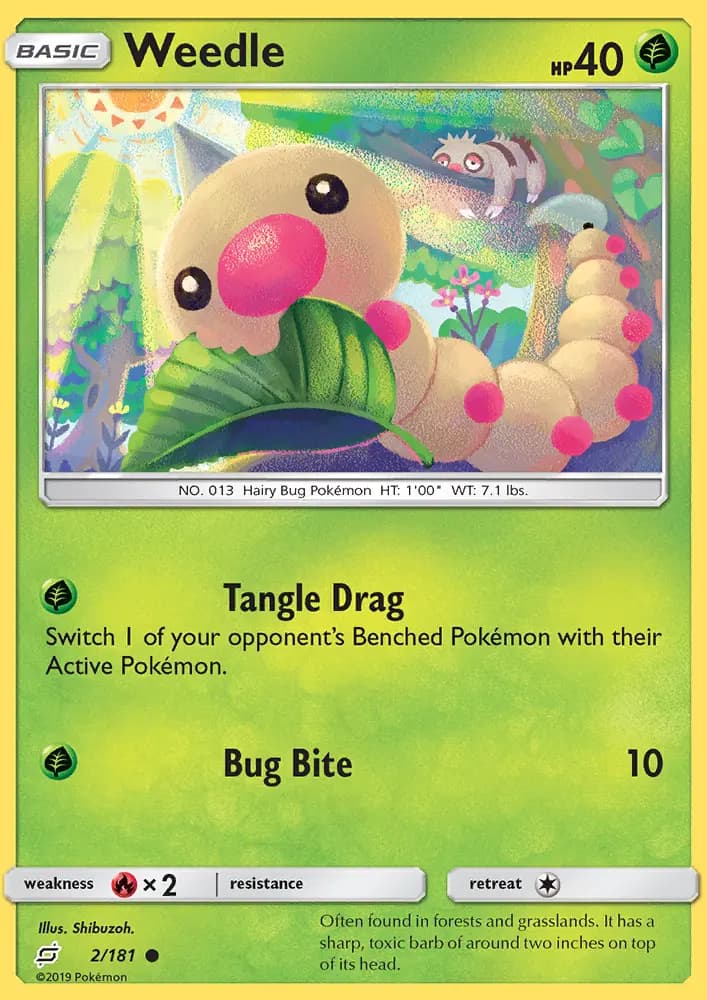
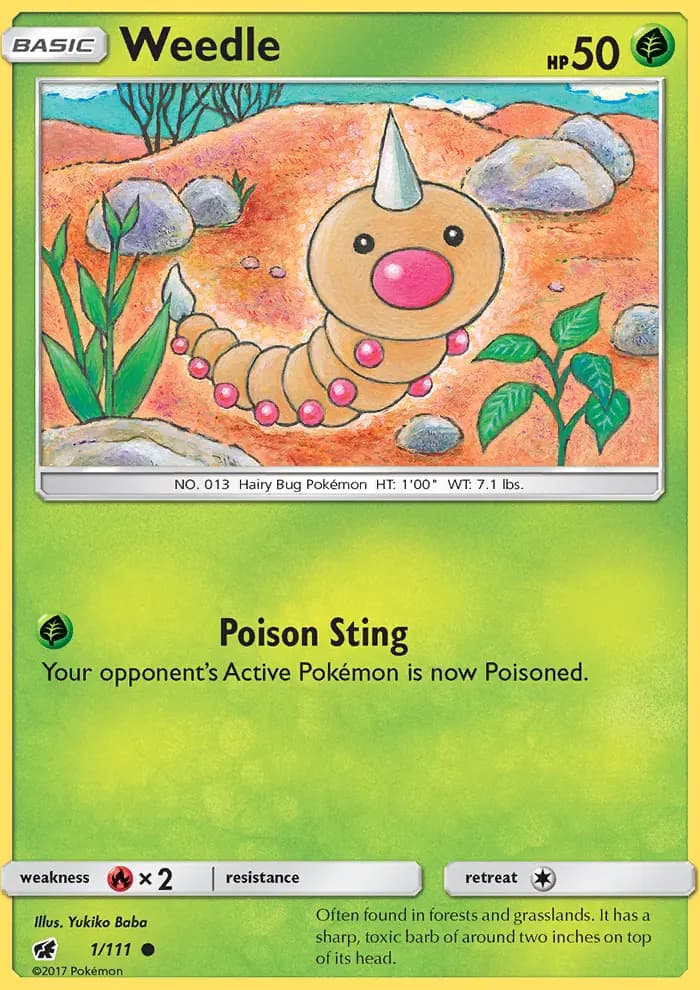
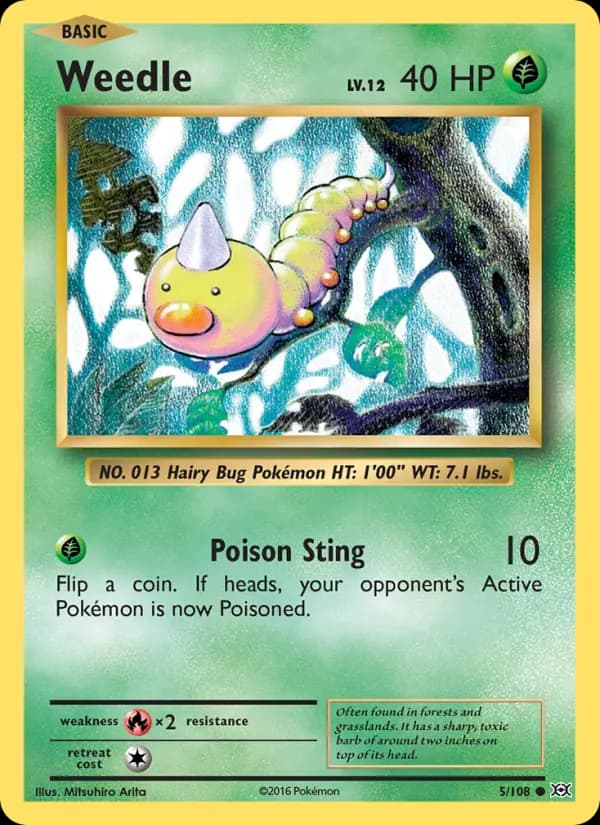
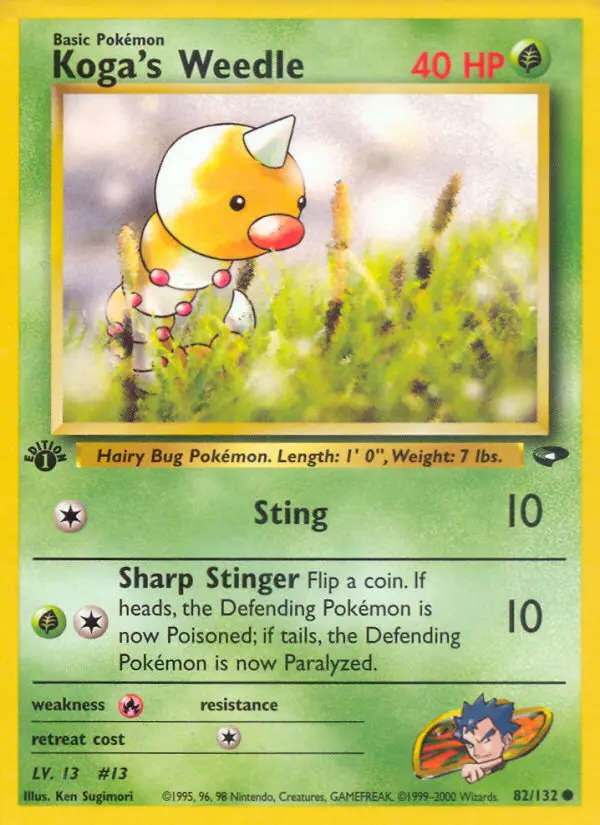
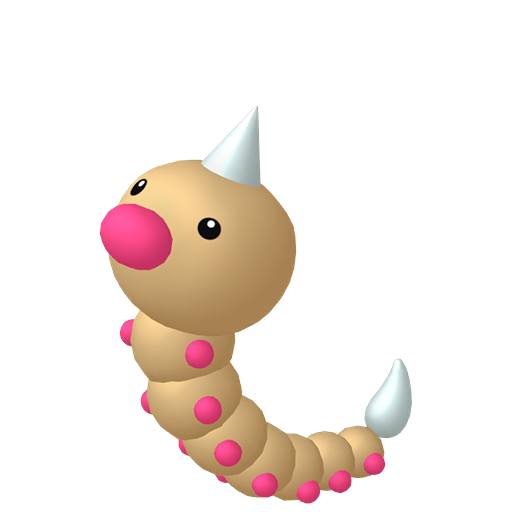
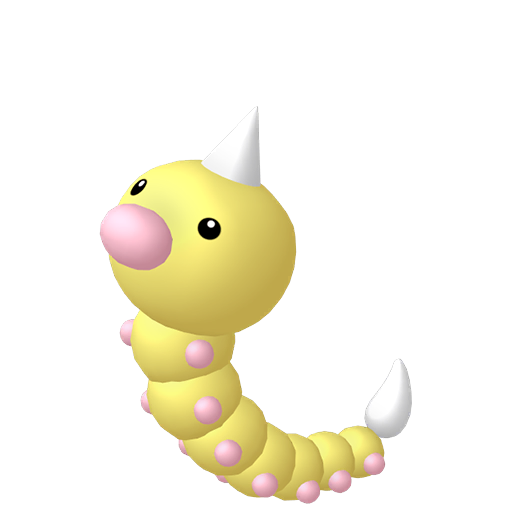
Weedle is a larval insect Pokémon with a distinctly segmented, caterpillar-like body composed of rounded spherical segments that range in color from bright yellow to reddish-brown. The creature's most distinctive anatomical feature is its prominent two-inch venomous stinger positioned atop its head, complemented by a barbed stinger on its tail, both capable of delivering potent toxic compounds to would-be threats. Its bulbous, proboscis-like red nose dominates its face and serves as an extraordinarily sensitive olfactory organ, granting Weedle an acute sense of smell that allows it to distinguish between preferred leaf varieties and those it dislikes with remarkable precision. Two small black eyes peer from either side of its face, while pairs of spherical feet positioned on each body segment facilitate its movement through dense vegetation. The bright coloration of Weedle's body, particularly the vivid yellow and red markings, serves as aposematic coloration—a biological warning signal to potential predators that the creature is poisonous and should be avoided. As a young larval stage, Weedle possesses exceptional appetitive requirements, consuming its own body weight in leaves daily to fuel its rapid growth and development toward its pupal stage. Shiny Weedle is a recolor rare enough that most players go through many standard encounters before finding one in the wild; breeding for the Masuda Method or building up an Odds chain remain the most reliable ways to guarantee one.
Pokedex Numbers
Training
Breeding
Weedle Breeding, Gender Ratio & Egg Groups
Weedle exhibits a perfectly balanced gender distribution, with exactly 50 percent male and 50 percent female representation among wild populations and breeding populations alike. As a member of the Bug Egg Group, Weedle can only breed with other Pokémon within this classification, including compatible species such as Caterpie, Paras, Venonat, and Scyther. The breeding process for Weedle results in eggs that require 15 cycles to hatch, translating to approximately 3,599 to 3,855 steps in-game, positioning Weedle in the moderate hatching time category. Weedle possesses a base Friendship value of 70 (increased to 70 in Generations 2-7), indicating a moderately receptive disposition toward trainer interaction and care, making it relatively easy to establish affection-based bond mechanics. This friendliness level supports early-game training endeavors where friendship-dependent moves and evolutions may be beneficial. The species' moderate growth rate ensures that Weedle's level progression occurs at a steady, predictable pace—neither accelerated nor decelerated compared to other Pokémon. When breeding occurs, the offspring always emerges as Weedle regardless of parental forms, as eggs always produce the earliest stage in an evolution line, meaning trainer-bred Weedle must progress through the natural evolution sequence to reach Kakuna and Beedrill.
Sprites




TMs & HMs
tm182
scarlet violet
tm211
scarlet violet
tm182
the teal mask
tm211
the indigo disk
tm82
sword shield
Weedle's Evolution Chain


Weedle Evolution, Mega Evolution & Special Forms
Weedle follows a two-stage evolution chain that represents one of the most dramatic transformations in Pokémon development. At level 7, Weedle evolves into Kakuna, a cocoon-like pupal stage that emphasizes defensive capabilities with significantly increased Defense stats while maintaining Bug/Poison typing. Kakuna serves as an intermediate evolutionary form where Weedle undergoes its metamorphosis, eventually achieving its final form at level 10 when it transforms into Beedrill, a fully-fledged Bug/Poison insectoid creature that dramatically reverses the evolution line's tactical approach by emphasizing physical Attack and Speed over defensive bulk. Beedrill represents a complete departure from Weedle's lumbering larval existence, featuring a base Speed of 75—a 50% improvement—and a base Attack of 90 that transforms the line into a legitimate offensive threat. The Beedrill line notably received a Mega Evolution in Generation VI with Mega Beedrill, which further amplifies the final form's offensive capabilities while introducing the ability Adaptability, enabling devastating STAB-boosted moves. This evolution line exemplifies the biological principle of insect metamorphosis, transitioning from a slow, defensive larval stage through a vulnerable pupal form into a swift, aggressive adult form optimized for predation and reproduction.
Where to Find
Kanto Route 25
kanto
+3 more
Kanto Route 24
kanto
+1 more
Viridian Forest
kanto
+17 more
Kanto Route 2
kanto
+23 more
National Park
johto
+10 more
Johto Route 30
johto
+11 more
Johto Route 31
johto
+8 more
Ilex Forest
johto
+17 more
Johto Route 38
johto
+2 more
Johto Route 39
johto
+2 more
Lake of Rage
johto
+2 more
Kanto Route 26
kanto
+2 more
Kanto Route 27
kanto
+2 more
Azalea Town
johto
+2 more
Johto Route 34
johto
+2 more
Johto Route 35
johto
+2 more
Johto Route 36
johto
+2 more
Johto Route 37
johto
+2 more
Pattern Bush
kanto
Sinnoh Route 204
sinnoh
+5 more
+4 more locations in other games
Weedle Behaviour and Natural Habitat
Weedle is primarily found in temperate forests, woodlands, and grassy meadows where abundant foliage provides sustenance for its voracious herbivorous diet. These creatures typically inhabit areas beneath tall grass, within dense bushes, and under the very leaves upon which they feed, using dense vegetation as both shelter from predators and cover while consuming their meals. The Pokédex entries consistently emphasize Weedle's sedentary, leaf-focused lifestyle, noting that it spends most of its time eating and remains relatively stationary throughout the day. When threatened or stepped upon, Weedle demonstrates defensive behavior by retaliation with its potent poison stinger, making even unintentional encounters with this Pokémon potentially dangerous to careless travelers. Despite possessing relatively low offensive stats, with a base Attack of only 35 and Special Attack of 20, Weedle's defensive posture and toxic stinger make it a surprisingly resilient early-game adversary. The creature's hidden ability Run Away reflects its natural inclination to avoid unnecessary confrontation, allowing it to escape from wild Pokémon encounters, though its docile nature and slow speed of 50 base Speed suggest it would rarely engage in pursuit-based combat.
Pokedex Entries
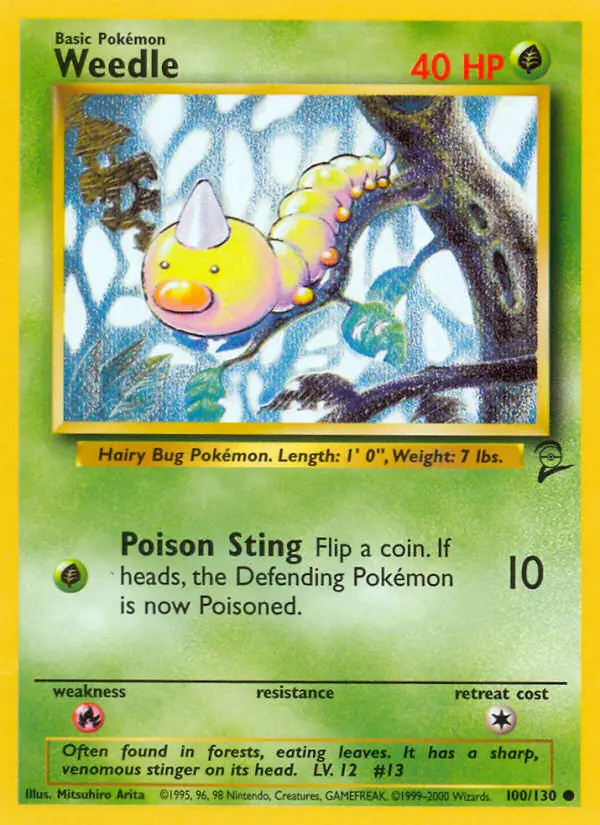
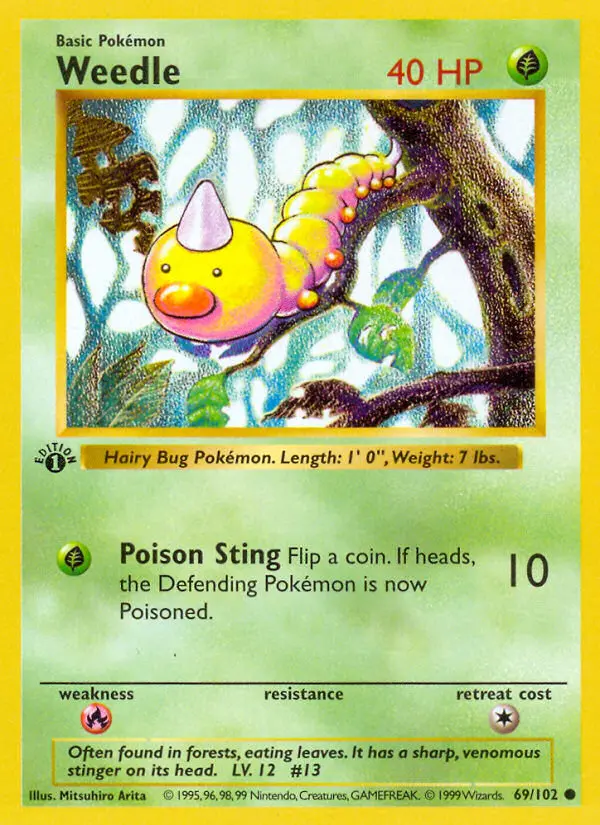
Often found in forests, eating leaves. It has a sharp venomous stinger on its head.
Beware of the sharp stinger on its head. It hides in grass and bushes where it eats leaves.
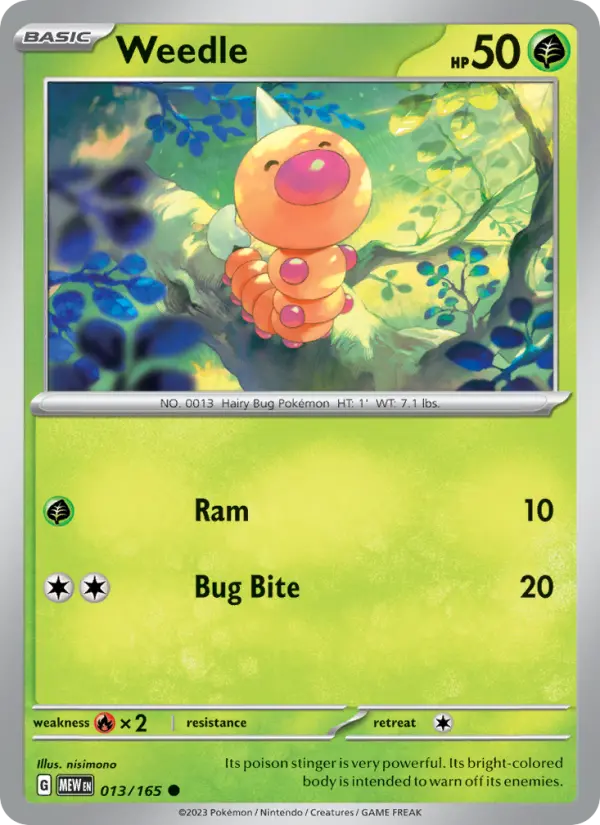
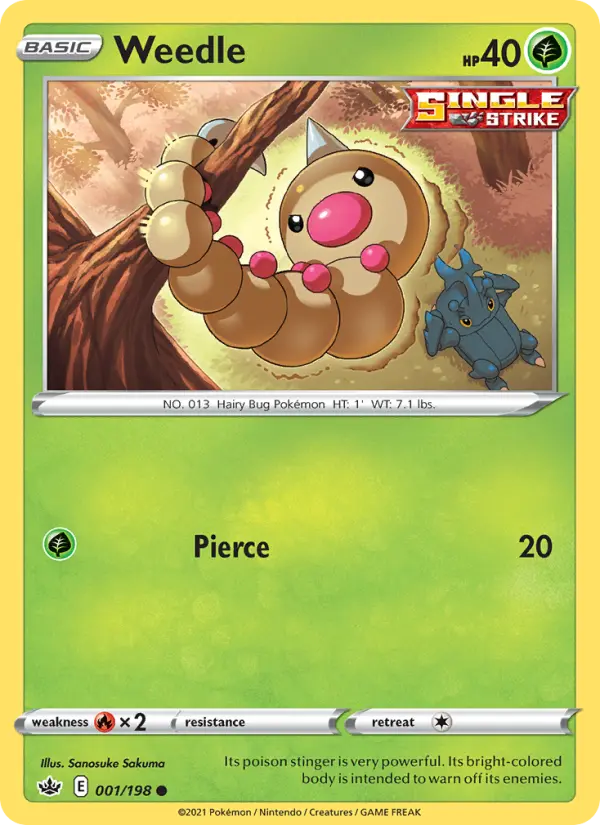
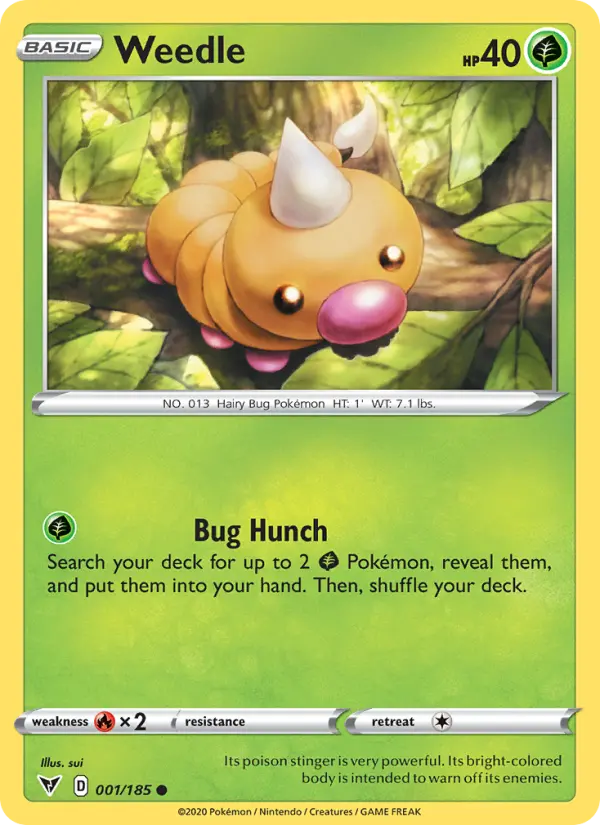
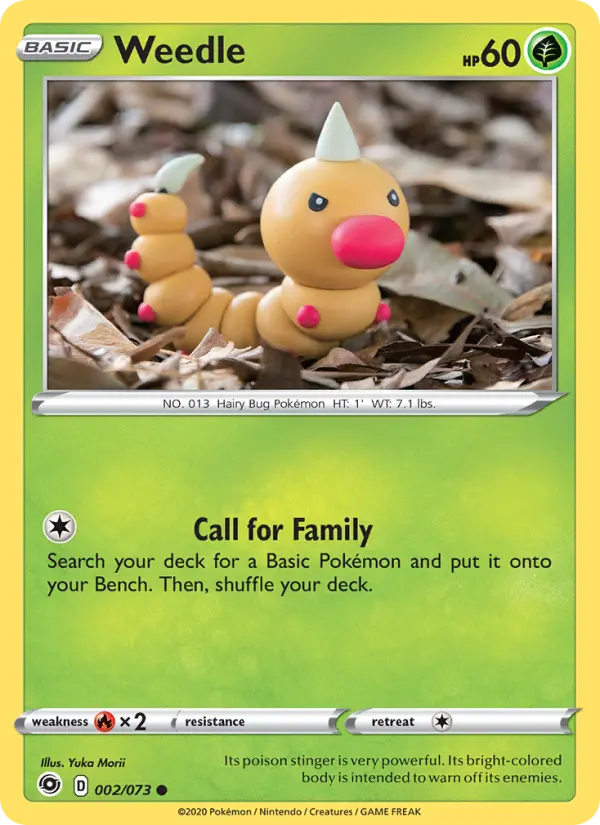
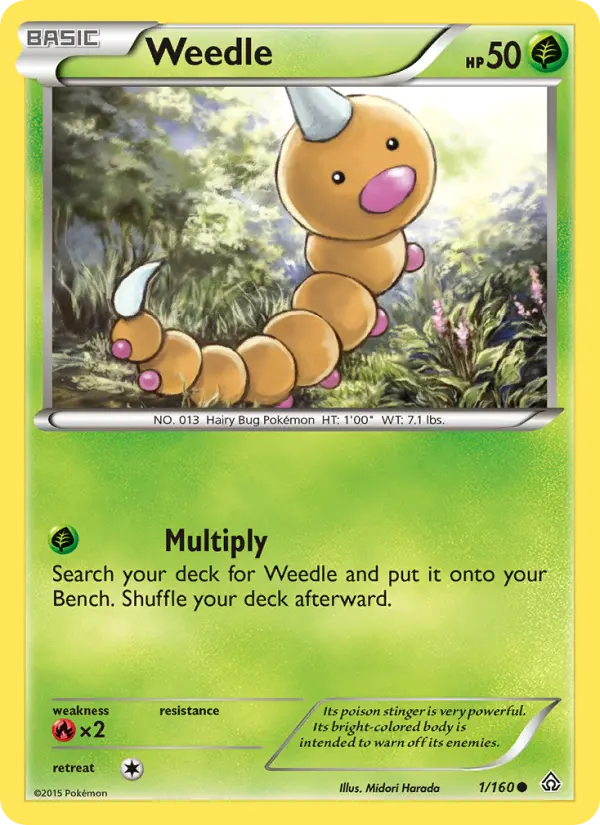
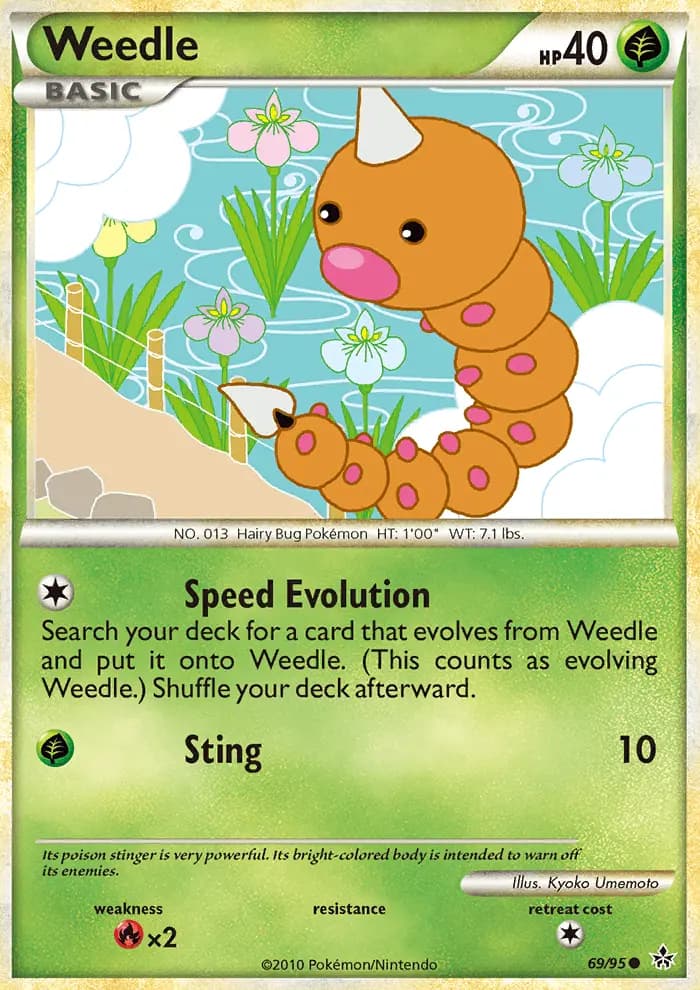
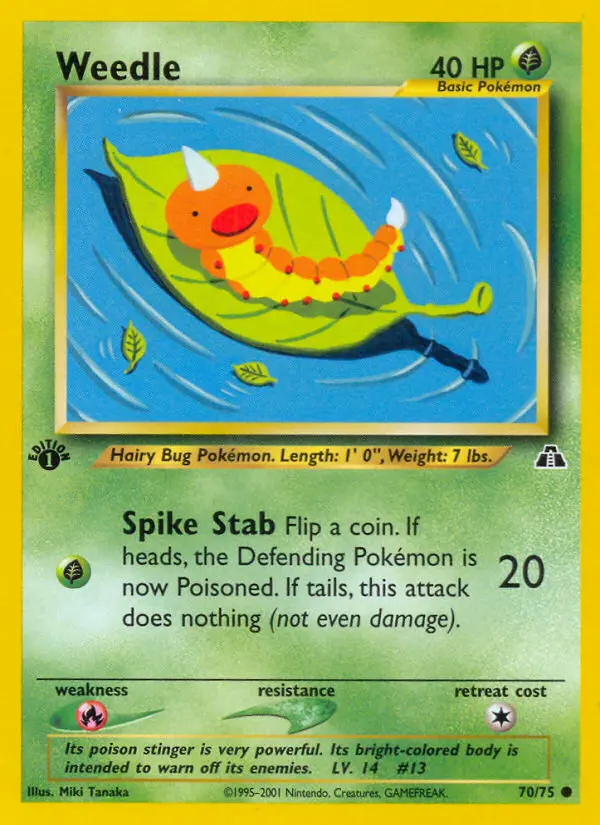
Its poison stinger is very powerful. Its bright-colored body is intended to warn off its enemies.
It attacks using a two-inch poison barb on its head. It can usually be found under the leaves it eats.
The barb on top of its head secretes a strong poison. It uses this toxic barb to protect itself.
WEEDLE has an extremely acute sense of smell. It is capable of distinguishing its favorite kinds of leaves from those it dislikes just by sniffing with its big red proboscis (nose).
A WEEDLE has an extremely acute sense of smell. It distinguishes its favorite kinds of leaves from those it dislikes by sniffing with its big red proboscis (nose).
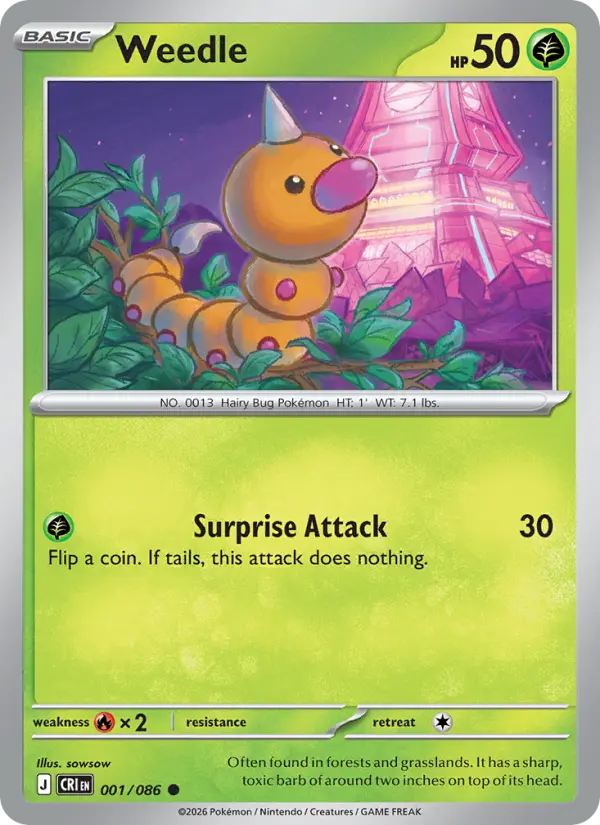
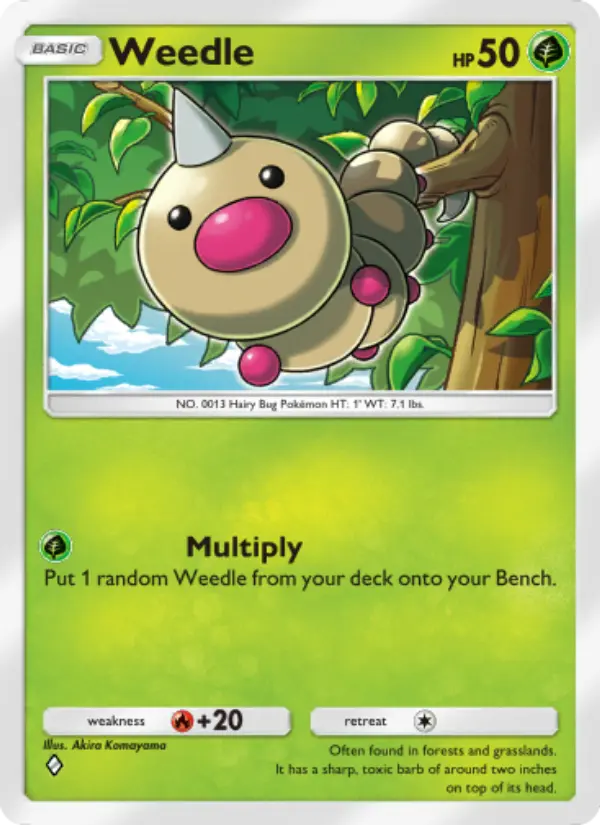
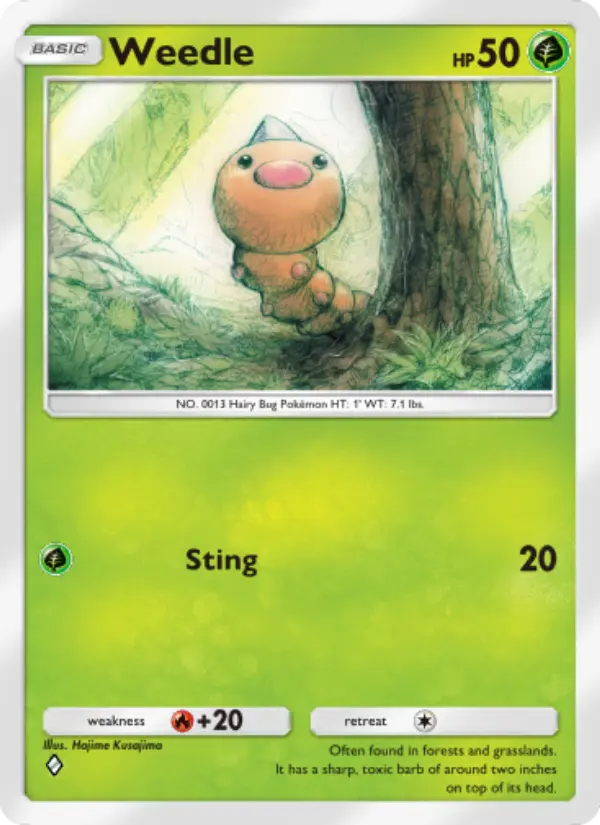
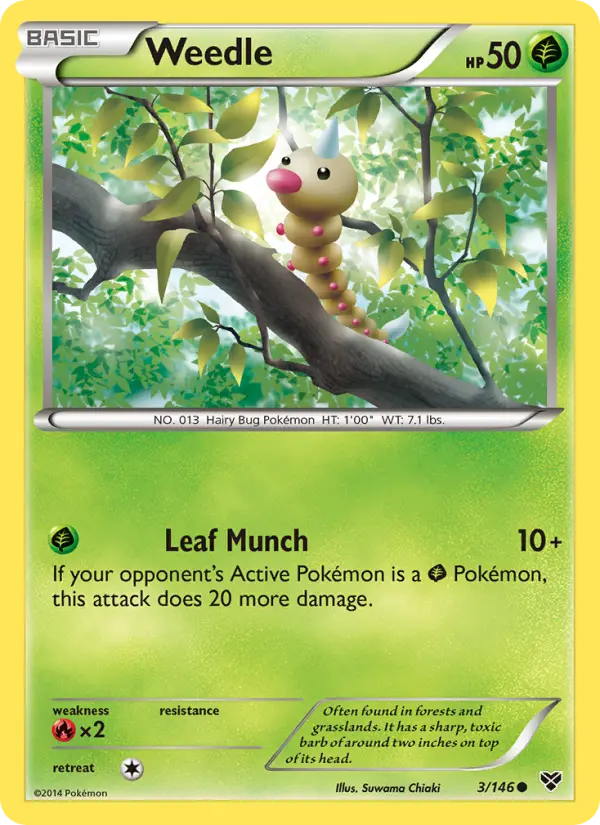
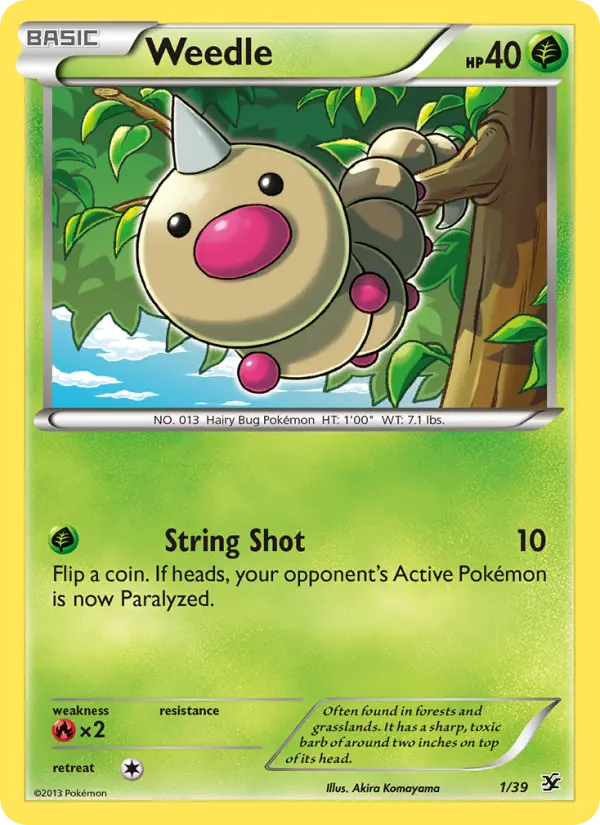
Often found in forests and grasslands. It has a sharp, toxic barb of around two inches on top of its head.
Often found in forests, eating leaves. It has a sharp stinger on its head that injects poison.
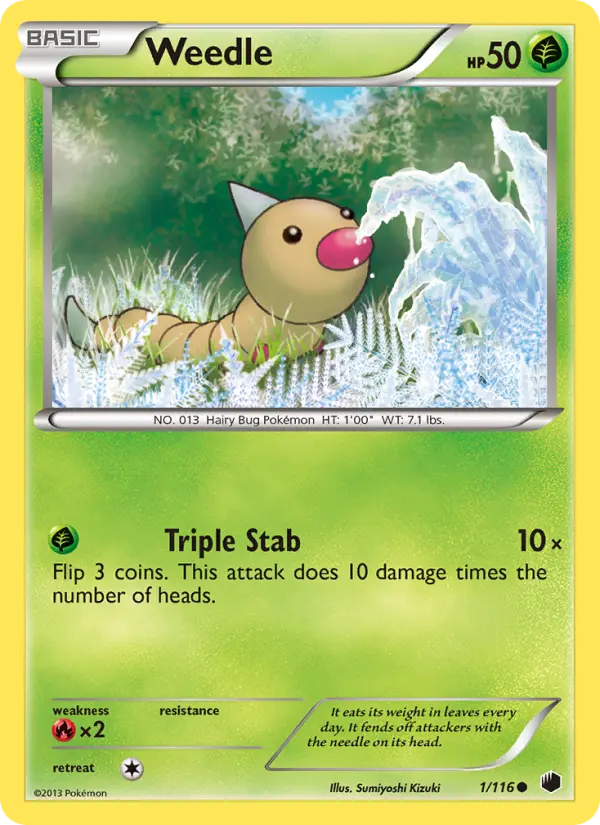
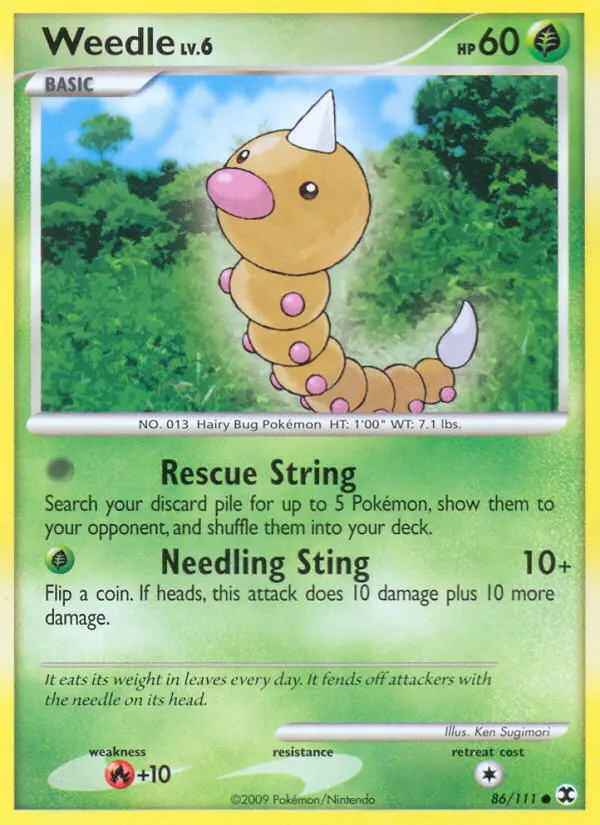
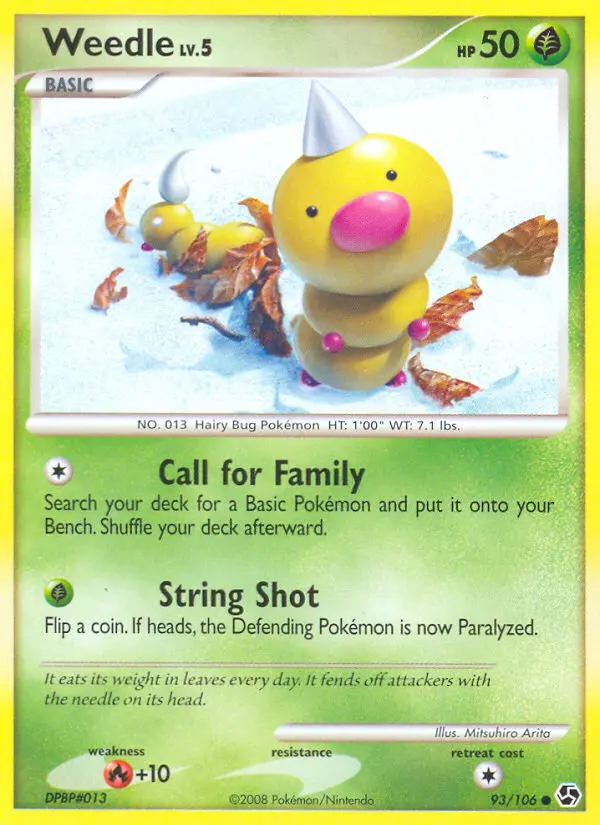
It eats its weight in leaves every day. It fends off attackers with the needle on its head.
Its poison stinger is very powerful. Its bright-colored body is intended to warn off its enemies.
It attacks using a two-inch poison barb on its head. It can usually be found under the leaves it eats.
It eats its weight in leaves every day. It fends off attackers with the needle on its head.
It eats its weight in leaves every day. It fends off attackers with the needle on its head.
Often found in forests and grasslands. It has a sharp, toxic barb of around two inches on top of its head.
Its poison stinger is very powerful. Its bright-colored body is intended to warn off its enemies.
Weedle has an extremely acute sense of smell. It is capable of distinguishing its favorite kinds of leaves from those it dislikes just by sniffing with its big red proboscis (nose).
Weedle has an extremely acute sense of smell. It is capable of distinguishing its favorite kinds of leaves from those it dislikes just by sniffing with its big red proboscis (nose).
Beware of the sharp stinger on its head. It hides in grass and bushes where it eats leaves.
Weedle Name Origin & Design Inspiration
Weedle's name comes from a straightforward combination of 'weed' and 'needle,' directly referencing both its herbivorous diet and its signature venomous stinger. The Japanese name Beedle similarly suggests a connection to 'bee' and 'needle,' though Weedle's actual classification as a caterpillar rather than a bee underscores the creative naming choices of Pokémon design. The creature's visual design draws heavy inspiration from real-world caterpillar larvae, particularly the distinctive appearance of poison or stinging caterpillars with warning coloration patterns. The bright yellow and red color scheme, combined with its segmented body structure, echoes the visual presentation of genuine venomous caterpillars that employ aposematism to advertise their toxicity. The oversized red proboscis nose is likely inspired by butterfly and moth caterpillars, which often possess prominent feeding appendages. The evolutionary line's progression from larva to pupa to adult insect directly mirrors the complete metamorphosis (holometabolism) exhibited by real insects like butterflies and wasps, demonstrating the designers' commitment to biological accuracy within a fantastical framework. The symmetry of Weedle's segmented form, with identical spherical body sections, simplifies the creature's silhouette while maintaining immediate visual recognizability.
Learnable Moves
Weedle Competitive Battle Guide
Weedle occupies a severely limited competitive niche due to its drastically underwhelming base stat distribution, with particularly abysmal Special Attack (20) and Special Defense (20) values that make special-based strategies virtually nonexistent. Its measly base Attack of 35 further constrains offensive options, though physical moves like Poison Powder, Bug Bite, and String Shot provide marginal utility in casual encounters rather than serious competitive formats. The creature's base Speed of 50 ensures that even many slower Pokémon will act first in combat, effectively limiting Weedle's ability to control initiative in any meaningful way. However, Weedle's defensive ability Shield Dust provides genuine strategic value by blocking secondary effects from incoming attacks, such as paralysis from Thunder Wave, burns from Flame Charge, or stat reductions from various moves. This defensive orientation suggests that Weedle functions better as a defensive pivot or walls specific threats rather than an offensive sweeper, though its base 40 HP and 30 Defense make even this role problematic at higher competitive tiers. In official competitive formats and casual play, Weedle rarely sees practical usage beyond novelty team compositions or themed challenges, as its evolution Beedrill provides superior statistics across nearly every category. The dramatic stat difference between Weedle and even moderately powered first-stage Pokémon demonstrates why most competitive players immediately prioritize rapid evolution to Kakuna and subsequently Beedrill.
Commonly Asked Questions About Weedle
What type is Weedle?
Weedle is a bug and poison type Pokemon.
What does Weedle evolve into?
Weedle evolves into kakuna, then into beedrill.
What are Weedle's weaknesses?
Weedle is weak to flying, rock, fire and psychic type moves.
Does Weedle evolve by trading?
No — Weedle evolves entirely through leveling up, with no trade required at any stage.
Where can I find Weedle?
Weedle can be found in kanto route 25 (kanto), kanto route 24 (kanto) and viridian forest (kanto) and 21 other locations.
Is Shiny Weedle different in stats from a normal Weedle?
No — a Shiny Weedle has identical base stats, abilities, and movepool to the standard form. The only difference is the color palette; nothing about its performance in or out of battle changes.
How rare is Shiny Weedle in the wild?
Like any Shiny Pokémon, a wild Shiny Weedle has roughly a 1-in-4096 base encounter rate in modern games (better with a Shiny Charm). Breeding with the Masuda Method or building up an Odds/chain encounter both shorten those odds significantly for trainers hunting one specifically.
Weedle Cultural Impact & Franchise History
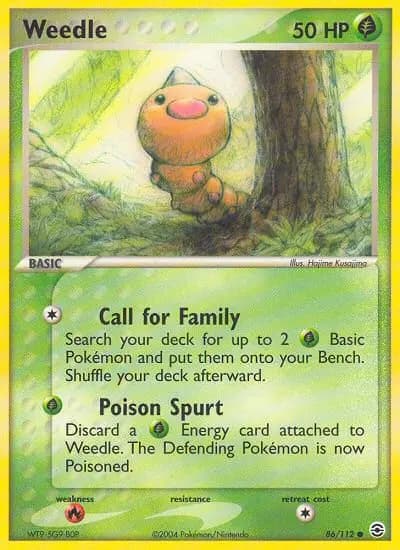
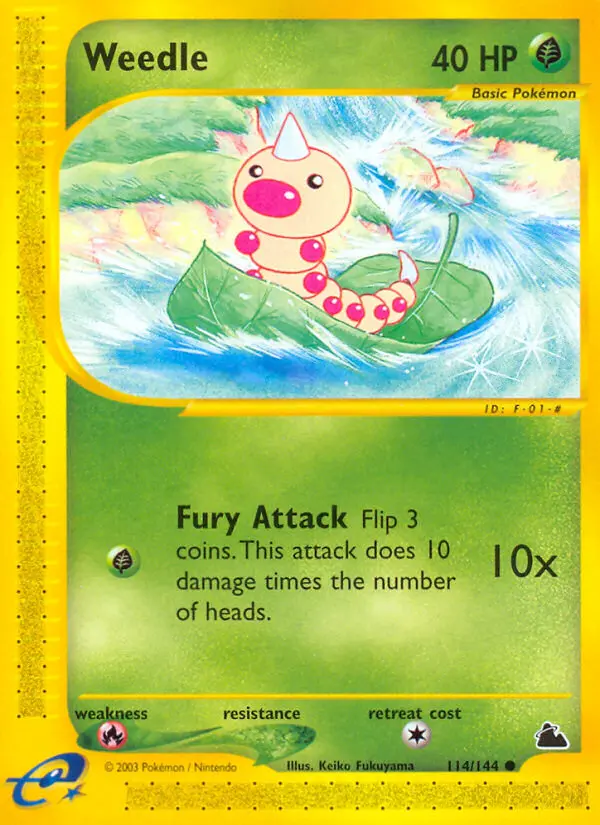
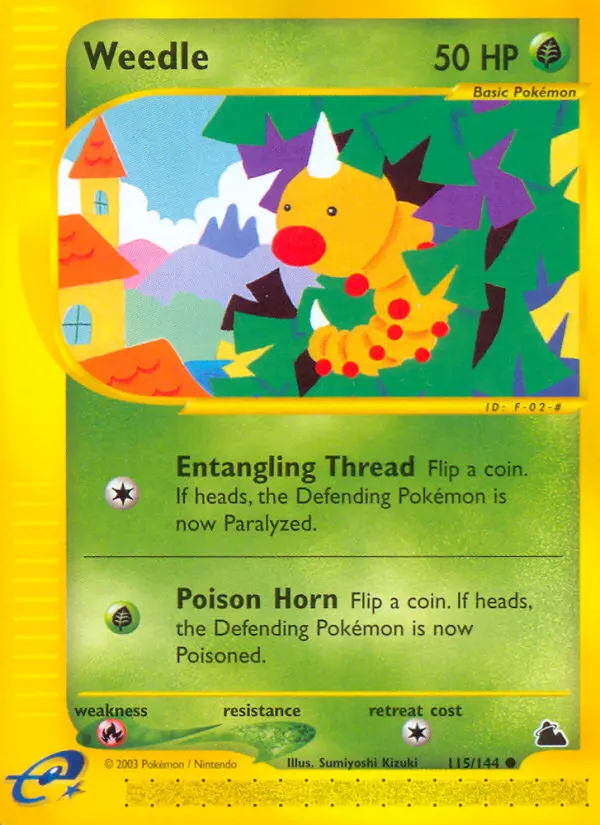
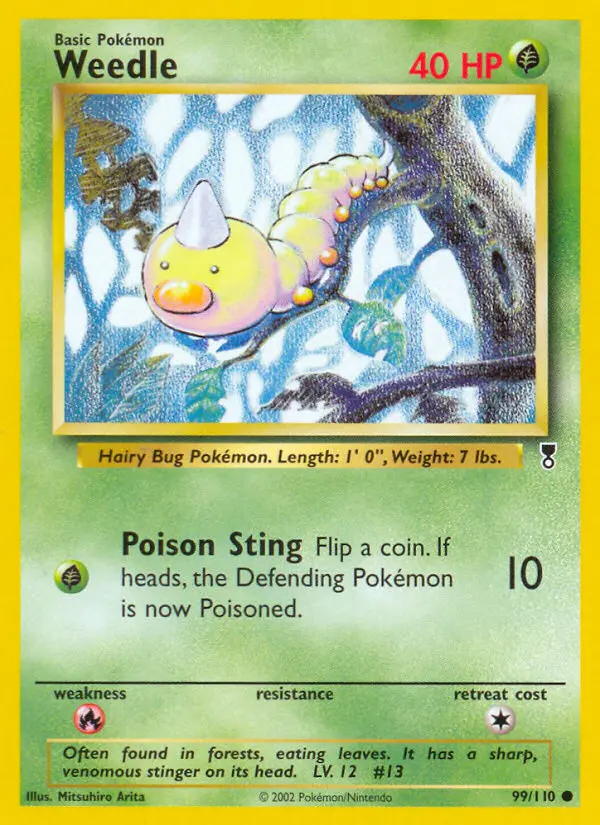
Weedle holds significant cultural importance within the Pokémon franchise as one of the original 151 Generation I Pokémon, establishing foundational Bug-type representation during the franchise's historic inception. Its prevalence in early-game Kanto encounters, combined with its ease of capture and availability, made Weedle a gateway experience for trainers encountering Bug-type Pokémon for the first time, shaping player perceptions of the entire Bug-type classification. Weedle's appearances in multiple anime series, particularly the original Pokémon animated series where it features prominently as a common encounter alongside Caterpie, cemented its status as an iconic early-game Pokémon recognizable to international audiences. The creature's evolution into the formidable Beedrill demonstrates the franchise's central narrative of growth and improvement, providing aspirational appeal for players seeking to develop their initial humble team members into powerful competitors. Merchandise featuring Weedle, including trading cards, plushies, and figures, has maintained consistent availability since the franchise's inception, indicating sustained commercial viability. The simplicity of Weedle's design made it accessible for sprite artists during the pixel-art era of early Pokémon games, establishing a visual template that has remained largely consistent across generations while receiving incremental improvements as graphical capabilities expanded. Weedle's role in starter team recommendations and beginner guides across multiple generations has ensured that several hundred million players have encountered and potentially captured this Pokémon as part of their initial gaming experiences.
Where to Find Weedle in Every Pokémon Game
Weedle demonstrates consistent availability throughout the Pokémon franchise, appearing as a common encounter in early-game areas across numerous titles spanning Generation I through the present day. In the original Red/Blue/Yellow versions, Weedle inhabits Viridian Forest as a standard grass encounter, establishing it as one of the first Bug-type Pokémon accessible to players progressing through Kanto. Subsequent Kanto-based remakes, including FireRed/LeafGreen and Let's Go Pikachu/Eevee, maintain Weedle's presence in equivalent early-forest environments, ensuring trainers can reliably obtain the species during their initial playthroughs. In Gold/Silver/Crystal and their remakes HeartGold/SoulSilver, Weedle appears in Johto's early-game forests, though with somewhat reduced prevalence compared to its Kanto appearances. The species remains obtainable in numerous subsequent generations, though availability typically concentrates in early-game areas and routes designated for novice trainers, reflecting Weedle's intended position in the progression curve. In modern titles including Sword/Shield and Scarlet/Violet, Weedle maintains accessibility through various game areas, ensuring new trainers can continue the franchise tradition of encountering this species early in their adventure. Additionally, Weedle has appeared in multiple spin-off titles, special distribution events, and Pokémon GO, where it remains a common spawn in grass-heavy biomes worldwide. The species' exceptional catch rate of 255 ensures that capturing Weedle requires minimal effort compared to rarer Pokémon, making it an ideal candidate for beginning trainers and team completion objectives.