Mantyke
BabyGeneration IV · #0458 — Kite Pokémon
As a Generation IV water/flying-type, Mantyke leans on swift swim to cover what its raw numbers don't, particularly on the hp side. At 1.0 m and 65.0 kg, its build reflects a specialist role rather than a generalist one. Despite its classification as a baby Pokémon, Mantyke possesses a respectable defensive stat line with a base Special Defense of 120, making it surprisingly resilient for its evolutionary stage. With a cumulative stat total of 345 and a slow growth rate, Mantyke represents an interesting paradox—a young Pokémon with mature defensive capabilities that hint at its evolution into the more formidable Mantine.
Editor's Take
Mantyke needing a Remoraid in the party to evolve is one of the least discoverable conditions in the series, and it gates a genuinely usable special wall behind trivia.
Base Stats
Height
1.0m
Weight
65.0kg
Category
Kite Pokémon
Gender
Male 50% / Female 50%
Color
blue
Shape
wings
Abilities
Doubles Speed during rain.
Absorbs water moves, healing for 1/4 max HP.
Prevents burns.
Mantyke Biology & Physical Characteristics
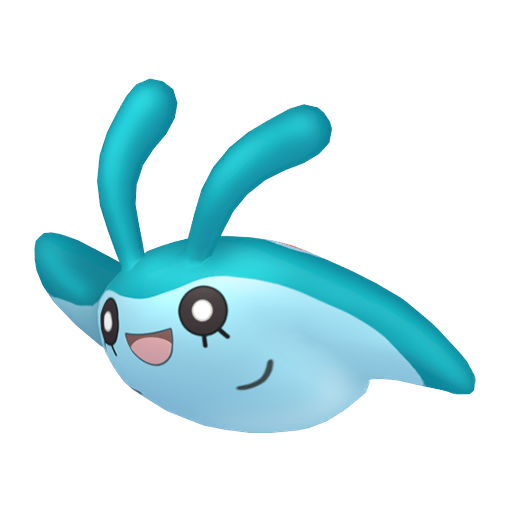
Mantyke bears a striking resemblance to a manta ray, featuring a round body with wide, flat fins that enable graceful aquatic movement. Its coloration is distinctively bimodal, with a dark-blue dorsal surface contrasting against a light-blue ventral side. The most recognizable feature of Mantyke is the pair of distinctive markings on its back—two red spots outlined in white accompanied by a light-blue curved line that collectively resemble a smiling face. Remarkably, these facial markings vary subtly by geographic region, a phenomenon that has fascinated researchers and collectors alike. Atop its head extend two long, gracefully curving antennae that serve a crucial sensory function, allowing Mantyke to detect and interpret the subtle flows and currents of seawater with remarkable precision. Its eyes are characteristically black, framed by delicate eyelash-like markings that contribute to its endearing appearance. Despite its seemingly delicate nature, Mantyke is an accomplished swimmer, capable of navigating oceanic environments with surprising agility and speed when conditions favor its abilities.
Pokedex Numbers
Training
Breeding
Mantyke Breeding, Gender Ratio & Egg Groups
Mantyke maintains a perfect 50/50 gender ratio between males and females, yet it cannot be bred through conventional breeding mechanics due to its classification in the Undiscovered egg group, alongside other baby Pokémon and legendaries. This breeding restriction ensures that Mantyke remains obtainable exclusively through wild encounters or event distributions, preserving its status as a special and somewhat rare addition to a trainer's roster. The inability to breed Mantyke has significant implications for competitive breeding programs, as trainers seeking perfect Individual Values or specific natures must either invest substantial effort into catching wild specimens with desirable stats or rely on earlier-generation breeding of its evolution, Mantine, though such offspring will not produce Mantyke offspring themselves. The base friendship value of 70 (reduced from the original Generation IV value of 70 in later generations) indicates that Mantyke has a moderate predisposition toward bonding with trainers, though it will require patient, consistent interaction to achieve maximum friendship and unlock moves or evolutions that depend on affection mechanics. This moderate baseline ensures that Mantyke rewards dedicated trainers while remaining attainable for casual players.
Sprites





TMs & HMs
tm01
lets go pikachu lets go eevee
tm02
crystal
tm02
gold silver
tm03
ruby sapphire
tm03
platinum
tm03
firered leafgreen
tm03
heartgold soulsilver
tm03
diamond pearl
tm03
emerald
tm03
xd
tm03
colosseum
tm03
lets go pikachu lets go eevee
tm05
lets go pikachu lets go eevee
tm06
yellow
tm06
gold silver
tm06
red blue
tm06
crystal
tm06
emerald
tm06
firered leafgreen
tm06
diamond pearl
+525 more TMs/HMs
Mantyke's Evolution Chain


Mantyke Evolution, Mega Evolution & Special Forms
Mantyke's evolution into Mantine represents one of Generation IV's most unique evolution mechanics, requiring that a Remoraid be present in the player's party when Mantyke levels up. This evolution requirement fundamentally differs from traditional level-based evolutions and emphasizes the deep interdependence between these two species. Once this condition is met and Mantyke gains a level, it evolves into Mantine, a significantly more powerful Water/Flying-type Pokémon with improved stats across nearly every category. The evolutionary transition reflects Mantyke's transition from juvenile independence toward mature partnership, with Mantine inheriting the behavioral traits and sensory capabilities of its pre-evolution while developing greater offensive and overall physical prowess. Unlike many Water/Flying-types, neither Mantyke nor Mantine receives a Mega Evolution, keeping their development grounded in their natural ecological story rather than artificial enhancement.
Where to Find
Sunyshore City
sinnoh
+3 more
Sinnoh Sea Route 223
sinnoh
+6 more
Undella Bay
unova
+9 more
Undella Town
unova
Unova Route 21
unova
Shalour City
kalos
+1 more
Azure Bay
kalos
Kalos Route 12
kalos
Hauoli City
alola
Kalae Bay
alola
Melemele Sea
alola
Mantyke Behaviour and Natural Habitat
Mantyke is renowned for its exceptional friendliness and docile temperament, making it one of the most approachable Pokémon species found in marine environments. It exhibits highly social behavior, frequently swimming in organized schools alongside Remoraid, with whom it maintains a symbiotic relationship—the two species work in concert to repel potential attackers and navigate through potentially dangerous waters. This close association with Remoraid is not merely tactical; the prolonged companionship between Mantyke and Remoraid eventually triggers Mantyke's evolution into Mantine, suggesting a deep ecological and possibly emotional bond. Mantyke can be found near the ocean's surface where it approaches boats and ships, allowing human observers to witness its distinctive back patterns. The species' docile nature has made it immensely popular for organized swimming tours, particularly in coastal regions where people seek to interact with and observe these charming creatures in their natural habitat. In regions with colder waters, such as Galar, Mantyke reportedly move more slowly, suggesting that water temperature significantly influences its metabolic and behavioral patterns.
Pokedex Entries
A friendly Pokémon that captures the subtle flows of seawater using its two antennae.
Scientists discovered that the distinctive patterns on its back differ by region.
People organize tours to see this Pokémon frolic and skim the tops of waves with REMORAID.
When it swims close to the surface of the ocean, people aboard ships are able to observe the pattern on its back.
People organize tours to see this Pokémon frolic and skim the tops of waves with Remoraid.
The pattern on its back varies by region. It often swims in a school of Remoraid.
The pattern on its back varies by region. It often swims in a school of Remoraid.
When it swims close to the surface of the ocean, people aboard ships are able to observe the pattern on its back.
The pattern on its back varies by region. It often swims in a school of Remoraid.
When it swims close to the surface of the ocean, people aboard ships are able to observe the pattern on its back.
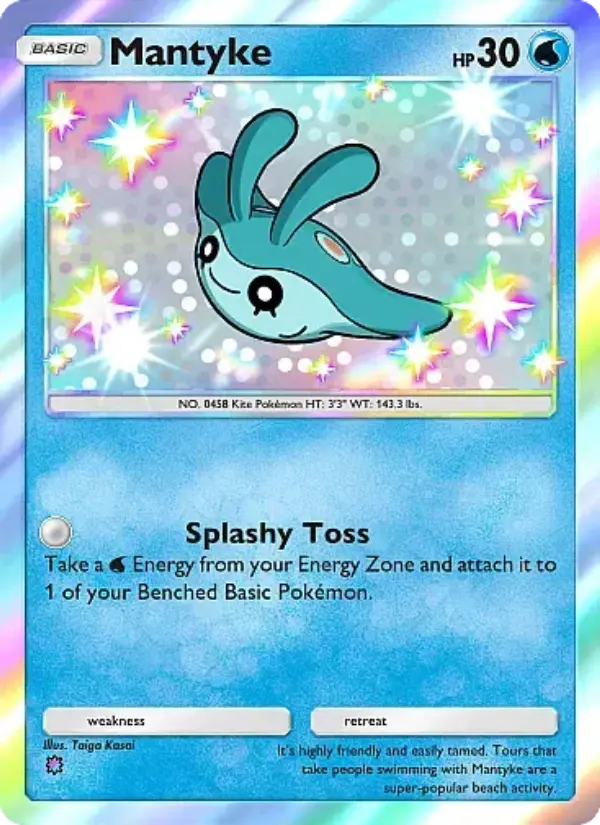
It’s highly friendly and easily tamed. Tours that take people swimming with Mantyke are a super-popular beach activity.
Mantyke are friendly toward people and will approach boats closely. The patterns on their backs differ depending on their habitat.
Mantyke living in Galar seem to be somewhat sluggish. The colder waters of the seas in this region may be the cause.
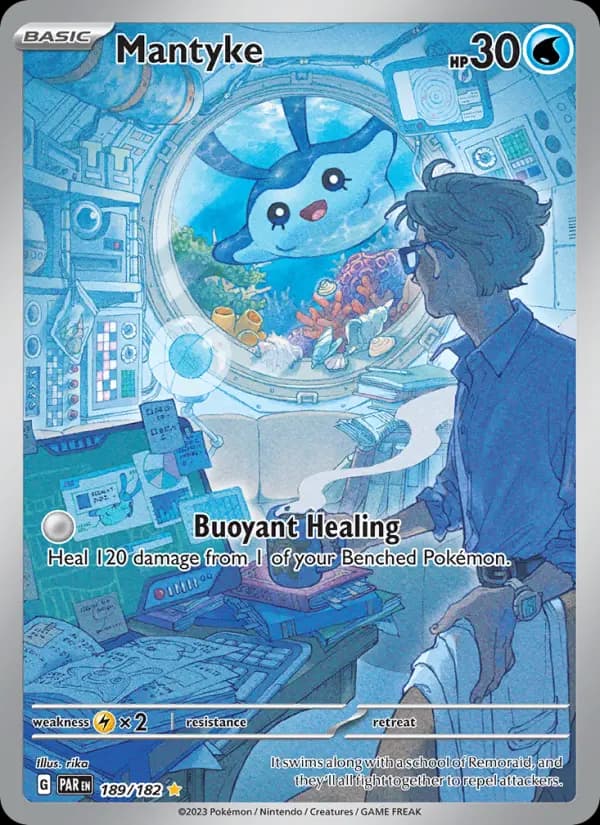
It swims along with a school of Remoraid, and they’ll all fight together to repel attackers.
Though ball-like in shape, this Pokémon is a proficient swimmer. I have discovered that if a Mantyke spends much time with schools of Remoraid, it will eventually achieve evolution.
Mantyke Name Origin & Design Inspiration
Mantyke's name traces back to a combination of 'manta,' referencing the manta ray that inspired its biological design, and 'tyke,' a colloquial British English term for a child or small creature—a linguistic choice that perfectly captures its status as a baby Pokémon. In Japanese, Mantyke is called Tamanta (タマンタ), which combines 'tama' (meaning ball or sphere, referencing its round body) with 'manta,' creating a name that emphasizes both its spherical silhouette and aquatic lineage. The Kite Pokémon designation reflects both its graceful, kite-like swimming style and the kite-shaped profile created by its wide fins and diminutive body. The regional variation in back markings, while biologically explained as geographic adaptation, serves a meta-narrative purpose—encouraging players to seek out and compare different Mantyke specimens and reinforcing the diversity of Pokémon populations across the Pokémon world. This design philosophy makes Mantyke one of the few Pokémon where aesthetic variation carries genuine in-world significance rather than serving purely as postgame collectible variants.
Learnable Moves
Mantyke can learn 66 moves:
Move | Type | Cat. | Power | Acc. | PP |
|---|---|---|---|---|---|
| acrobatics | flying | Physical | 55 | 100 | 15 |
| aerial ace | flying | Physical | 60 | — | 20 |
| agility | psychic | Status | — | — | 30 |
| air cutter | flying | Special | 60 | 95 | 25 |
| air slash | flying | Special | 75 | 95 | 15 |
| amnesia | psychic | Status | — | — | 20 |
| aqua ring | water | Status | — | — | 20 |
| attract | normal | Status | — | 100 | 15 |
| blizzard | ice | Special | 110 | 70 | 5 |
| bounce | flying | Physical | 85 | 85 | 5 |
| bubble | water | Special | 40 | 100 | 30 |
| bubble beam | water | Special | 65 | 100 | 20 |
| bulldoze | ground | Physical | 60 | 100 | 20 |
| captivate | normal | Status | — | 100 | 20 |
| confide | normal | Status | — | — | 20 |
| confuse ray | ghost | Status | — | 100 | 10 |
| dive | water | Physical | 80 | 100 | 10 |
| double team | normal | Status | — | — | 15 |
| double edge | normal | Physical | 120 | 100 | 15 |
| earthquake | ground | Physical | 100 | 100 | 10 |
| endure | normal | Status | — | — | 10 |
| facade | normal | Physical | 70 | 100 | 20 |
| frustration | normal | Physical | — | 100 | 20 |
| hail | ice | Status | — | — | 10 |
| haze | ice | Status | — | — | 30 |
| headbutt | normal | Physical | 70 | 100 | 15 |
| helping hand | normal | Status | — | — | 20 |
| hidden power | normal | Special | 60 | 100 | 15 |
| hydro pump | water | Special | 110 | 80 | 5 |
| ice beam | ice | Special | 90 | 100 | 10 |
| icy wind | ice | Special | 55 | 95 | 15 |
| mirror coat | psychic | Special | — | 100 | 20 |
| mud sport | ground | Status | — | — | 15 |
| mud slap | ground | Special | 20 | 100 | 10 |
| natural gift | normal | Physical | — | 100 | 15 |
| protect | normal | Status | — | — | 10 |
| rain dance | water | Status | — | — | 5 |
| rest | psychic | Status | — | — | 5 |
| return | normal | Physical | — | 100 | 20 |
| rock slide | rock | Physical | 75 | 90 | 10 |
| roost | flying | Status | — | — | 5 |
| round | normal | Special | 60 | 100 | 15 |
| scald | water | Special | 80 | 100 | 15 |
| secret power | normal | Physical | 70 | 100 | 20 |
| signal beam | bug | Special | 75 | 100 | 15 |
| slam | normal | Physical | 80 | 75 | 20 |
| sleep talk | normal | Status | — | — | 10 |
| snore | normal | Special | 50 | 100 | 15 |
| splash | normal | Status | — | — | 40 |
| substitute | normal | Status | — | — | 10 |
| supersonic | normal | Status | — | 55 | 20 |
| surf | water | Special | 90 | 100 | 15 |
| swagger | normal | Status | — | 85 | 15 |
| swift | normal | Special | 60 | — | 20 |
| tackle | normal | Physical | 40 | 100 | 35 |
| tailwind | flying | Status | — | — | 15 |
| take down | normal | Physical | 90 | 85 | 20 |
| toxic | poison | Status | — | 90 | 10 |
| twister | dragon | Special | 40 | 100 | 20 |
| water gun | water | Special | 40 | 100 | 25 |
| water pulse | water | Special | 60 | 100 | 20 |
| water sport | water | Status | — | — | 15 |
| waterfall | water | Physical | 80 | 100 | 15 |
| whirlpool | water | Special | 35 | 85 | 15 |
| wide guard | rock | Status | — | — | 10 |
| wing attack | flying | Physical | 60 | 100 | 35 |
Mantyke Competitive Battle Guide
In competitive Pokémon, Mantyke occupies a niche role as a specialized defensive wall, primarily due to its exceptional Special Defense base stat of 120, which is remarkably high for a baby Pokémon and rivals many fully-evolved Water-types. Its ability options provide distinct strategic advantages: Swift Swim doubles its Speed during rain, transforming Mantyke into a potent rain-based sweeper despite its modest base Speed of 50 and lower Attack stat of 20; Water Absorb provides passive healing equivalent to 1/4 of maximum HP whenever it absorbs Water-type moves, creating opportunities for defensive pivoting; and its hidden ability Water Veil prevents status burns, useful in metagames where Scald and fire coverage are prevalent. Mantyke's defensive typing grants immunity to Ground-type moves and resistance to Fire, Water, Ice, and Fighting-type attacks, though it suffers from vulnerabilities to Electric-type moves (4x weakness) and Rock-type coverage. Its offensive movepool, while limited by its low Attack and Special Attack of 60, includes utility moves like Scald, Aqua Ring, and Mirror Coat, allowing it to function as a specially-defensive pivot. However, Mantyke's competitive viability remains largely restricted to Little Cup formats where baby Pokémon are legal, as its relatively low stats and typing disadvantages make it impractical in standard competitive tiers. In Little Cup, Mantyke serves as a respected bulky Water-type option capable of absorbing hits and supporting teammates.
Commonly Asked Questions About Mantyke
What type is Mantyke?
Mantyke is a water and flying type Pokemon.
What does Mantyke evolve into?
Mantyke evolves into mantine.
What are Mantyke's weaknesses?
Mantyke is weak to rock and electric type moves.
Does Mantyke evolve by trading?
No — Mantyke evolves entirely through leveling up, with no trade required at any stage.
Where can I find Mantyke?
Mantyke can be found in sunyshore city (sinnoh), sinnoh sea route 223 (sinnoh) and undella bay (unova) and 8 other locations.
Mantyke Cultural Impact & Franchise History
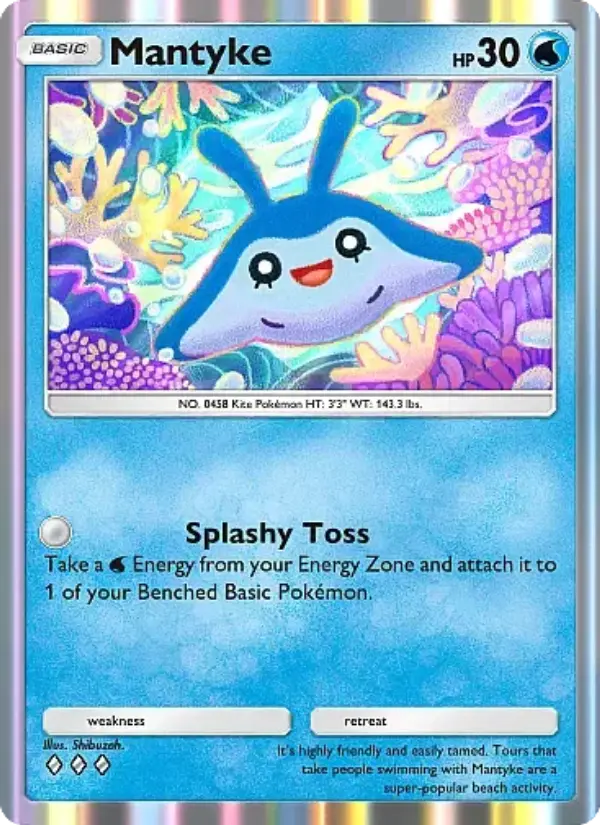
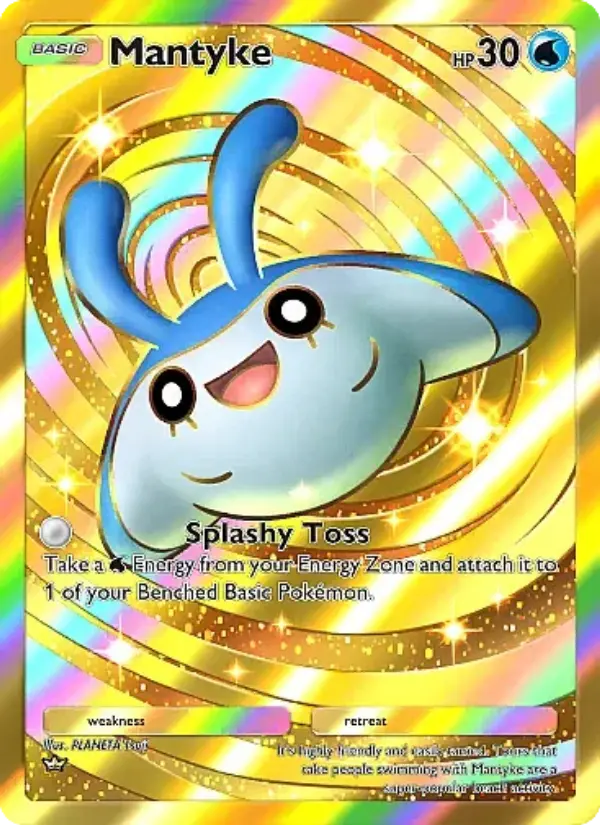
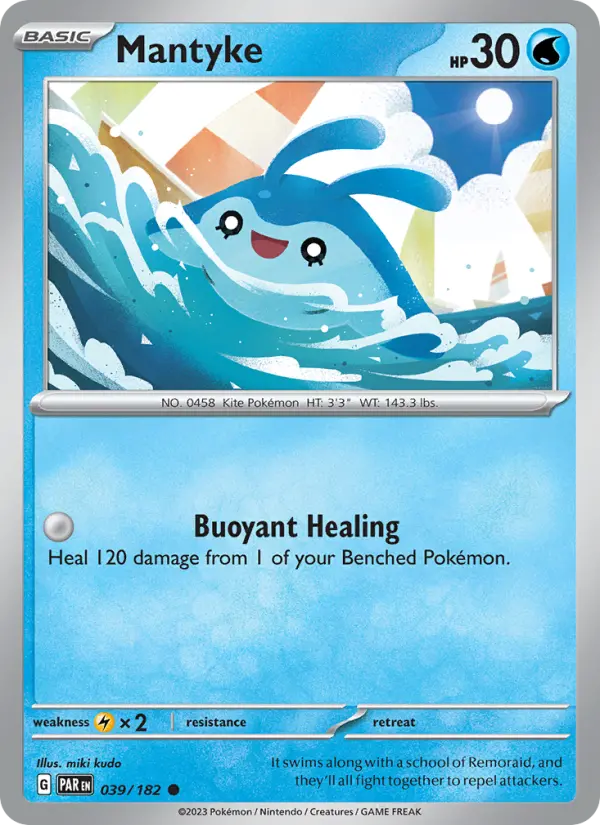
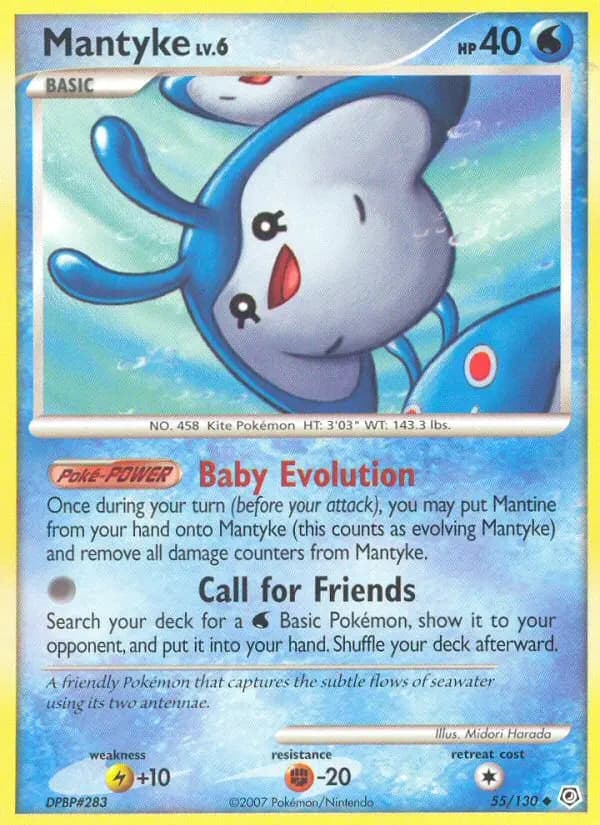
Mantyke has carved out a distinctive cultural presence within the Pokémon franchise, particularly through its role in the anime series where it achieved notable popularity. Goh's Mantyke, featured prominently in the newer anime series, introduced millions of viewers to this charming species and demonstrated its friendly, trainable nature through entertaining storylines and character development. The species' association with organized swimming tours and eco-tourism within the Pokémon world has positioned Mantyke as a symbol of environmental conservation and human-Pokémon harmony. Regional variation in Mantyke's back markings created a unique collecting incentive, encouraging players to seek specimens from different in-game regions and establishing Mantyke as one of the first baby Pokémon to feature meaningful regional aesthetics. The requirement to partner Mantyke with Remoraid for evolution created memorable narrative moments in games and spawned extensive fan theories and discussions about the deeper relationship between these species. Its appearance in trading card games and merchandise has maintained consistent popularity, particularly among collectors who appreciate its charming design and the cultural significance of baby Pokémon within the broader franchise ecosystem.
Where to Find Mantyke in Every Pokémon Game
Mantyke's availability varies significantly across Pokémon games, reflecting its status as a Generation IV-introduced species that required subsequent games for wider distribution. In the original Diamond and Pearl, Mantyke could be encountered in the Trophy Garden and Ocean areas, making it moderately accessible to players who progressed through Sinnoh. Subsequent remakes and versions expanded availability: Brilliant Diamond and Shining Pearl restored Mantyke to Sinnoh-based locations, while Sword and Shield added it to the wild encounter pools, particularly in water-based areas such as the Wild Area where it appears during specific weather conditions. In the Isle of Armor DLC, Mantyke became available through both wild encounters and Pokémon Home integration. Legends: Arceus offered alternative encounters through its action-based capture mechanics, allowing players to engage with Mantyke in a fundamentally different gameplay context. Pokémon Scarlet and Violet's integration of Pokémon Home enabled players to transfer Mantyke from earlier games, ensuring continued accessibility. Its base capture rate of 25, combined with the Undiscovered egg group classification, reinforces that wild encounters remain the primary legitimate acquisition method. Event distributions have periodically featured Mantyke with competitive movesets or advantageous natures, rewarding players who engage with official Pokémon distribution events and demonstrating the species' continued relevance to the franchise.