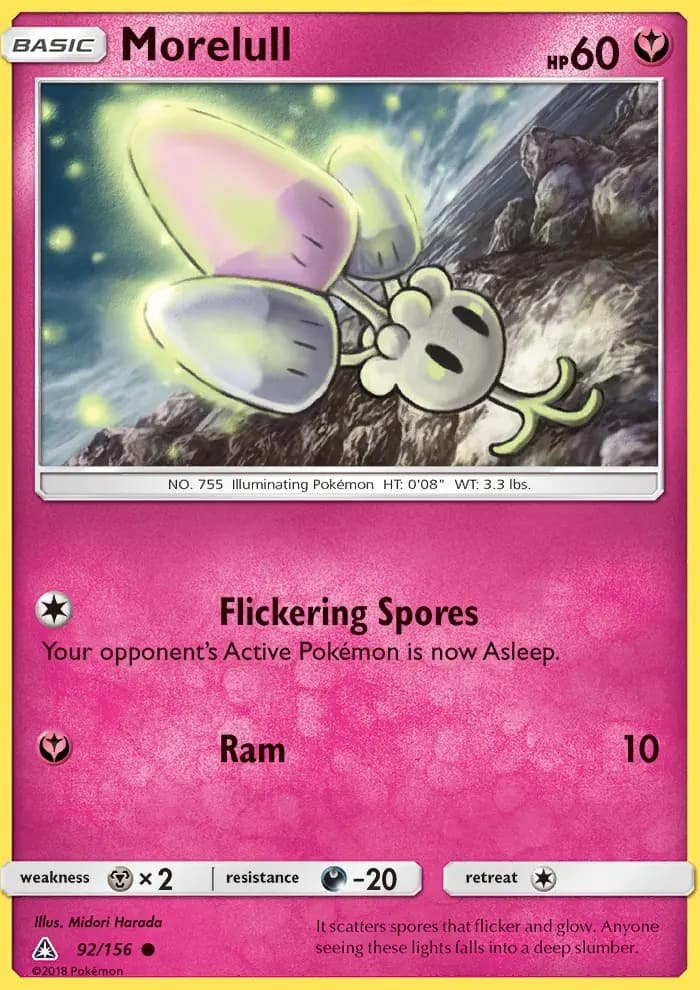
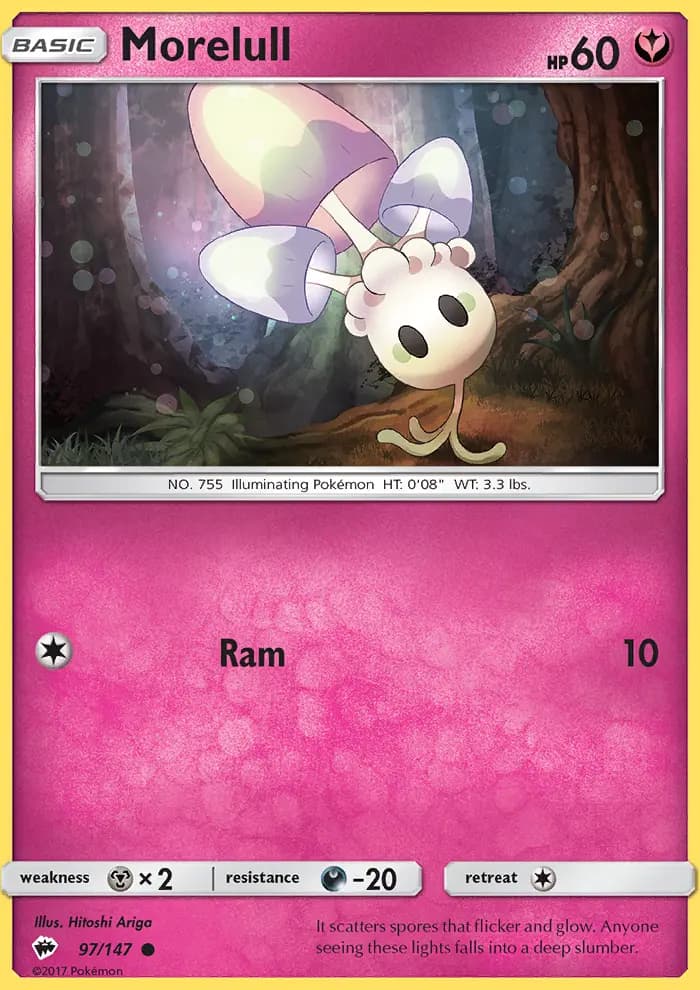
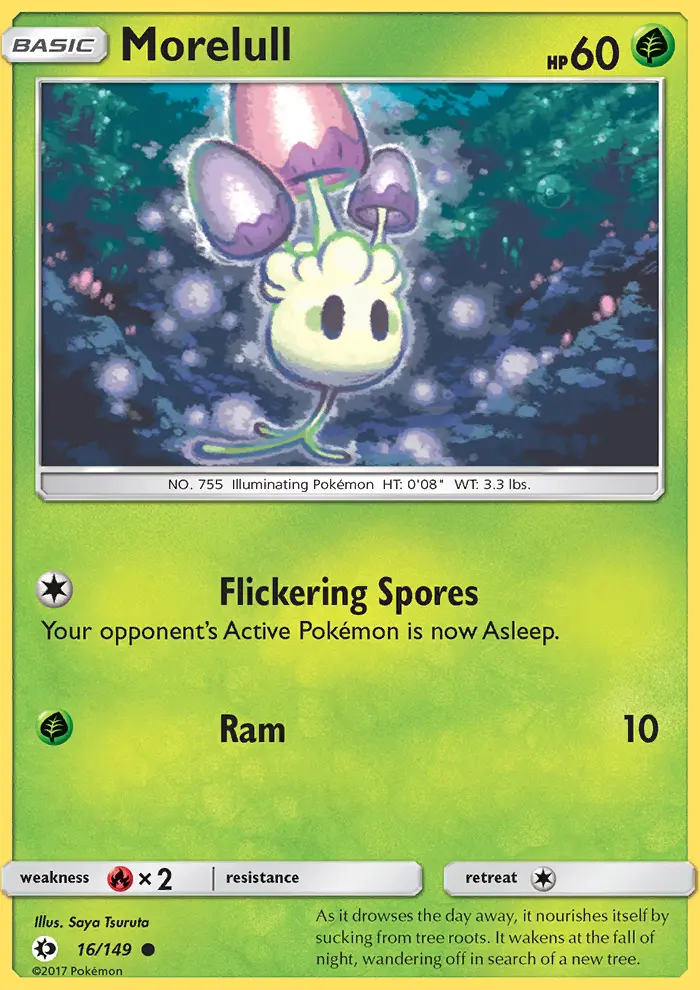
Morelull
Generation VII · #0755 — Illuminating Pokémon
Few grass/fairy-type Pokémon pair illuminate with a stat lean toward special defense quite like Morelull does. It measures 0.2 m and 1.5 kg, dimensions that pair with that stat lean in noticeable ways. Despite its diminutive stature, this mushroom-like creature possesses a remarkable ability to manipulate bioluminescent spores that glow with an ethereal beauty. With a combined stat total of 285, Morelull leans toward special defense (75) and special attack (65), making it better suited for magical attacks rather than physical confrontations. Its most distinctive characteristic is its ability to scatter flickering spores that induce drowsiness in those who witness their hypnotic dance, a trait that has earned it a place of wonder and caution in Alola's forests.
Editor's Take
Morelull's line ends in Shiinotic, and Effect Spore plus Illuminate on a Grass/Fairy type with 30 base Speed is about as passive as a Pokémon gets.
Base Stats
Height
0.2m
Weight
1.5kg
Category
Illuminating Pokémon
Gender
Male 50% / Female 50%
Color
purple
Shape
blob
Abilities
Doubles the wild encounter rate.
Has a 30% chance of inflcting either paralysis, poison, or sleep on attacking Pokémon on contact.
Heals for 1/16 max HP after each turn during rain.
Morelull Biology & Physical Characteristics
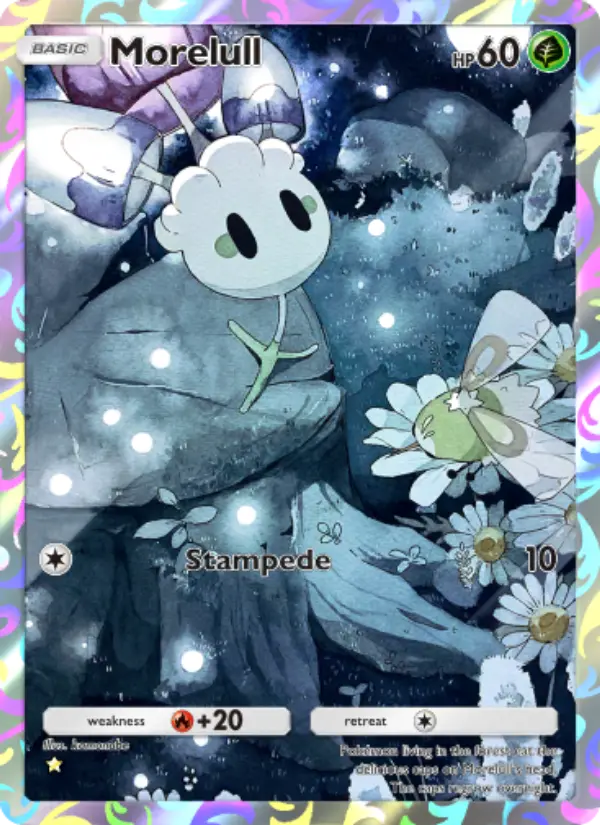
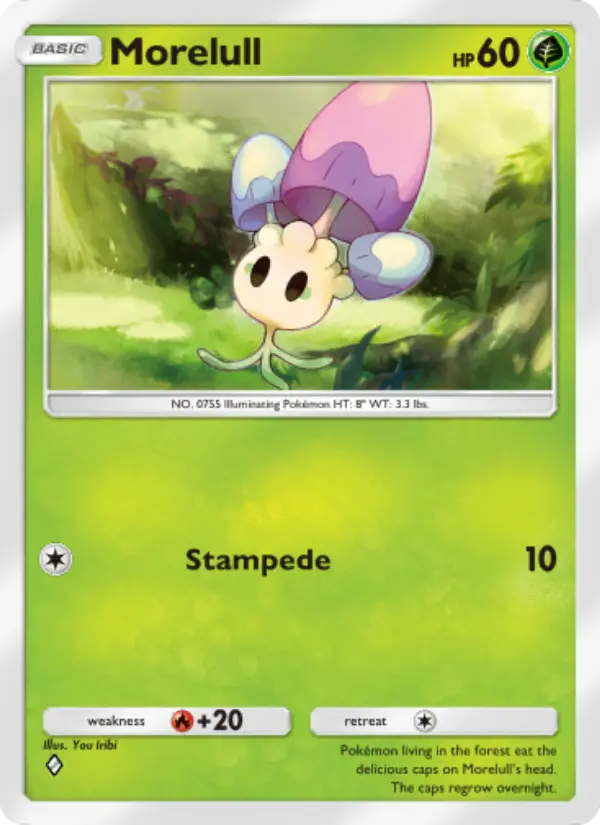
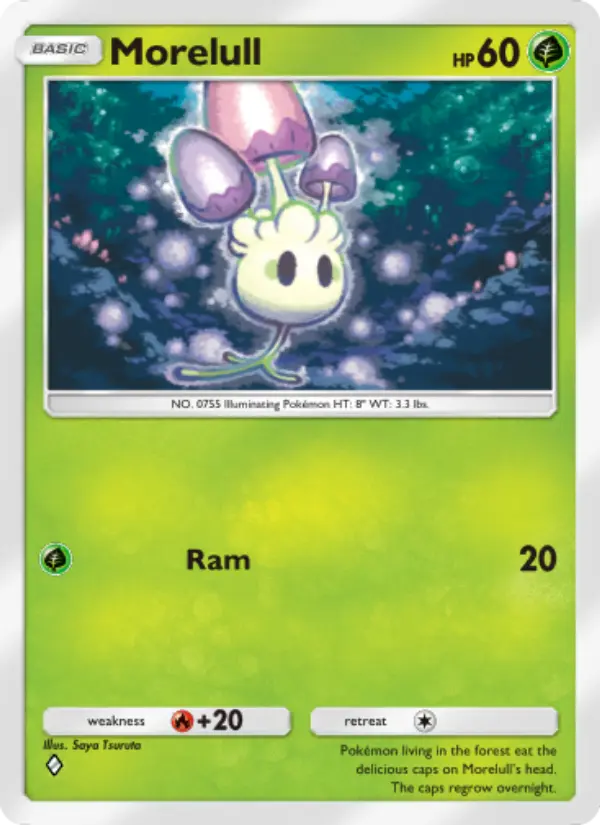
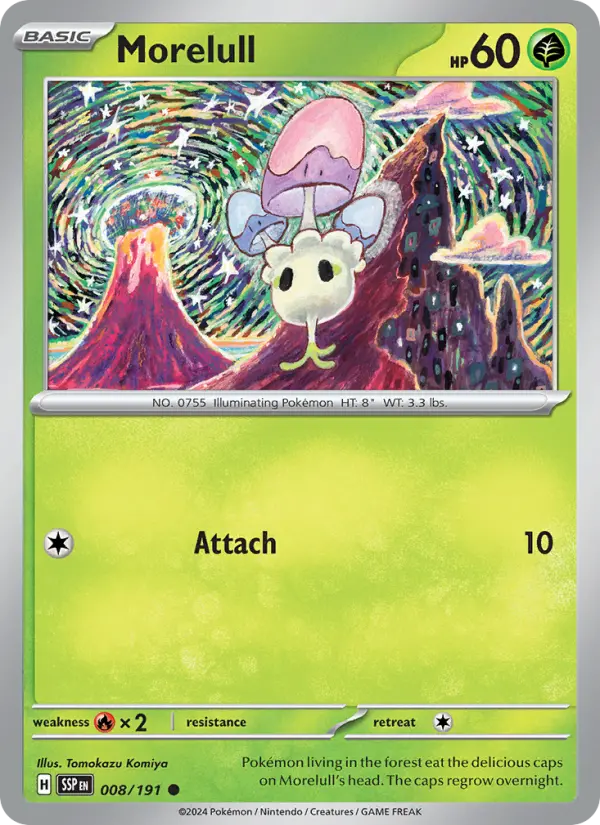
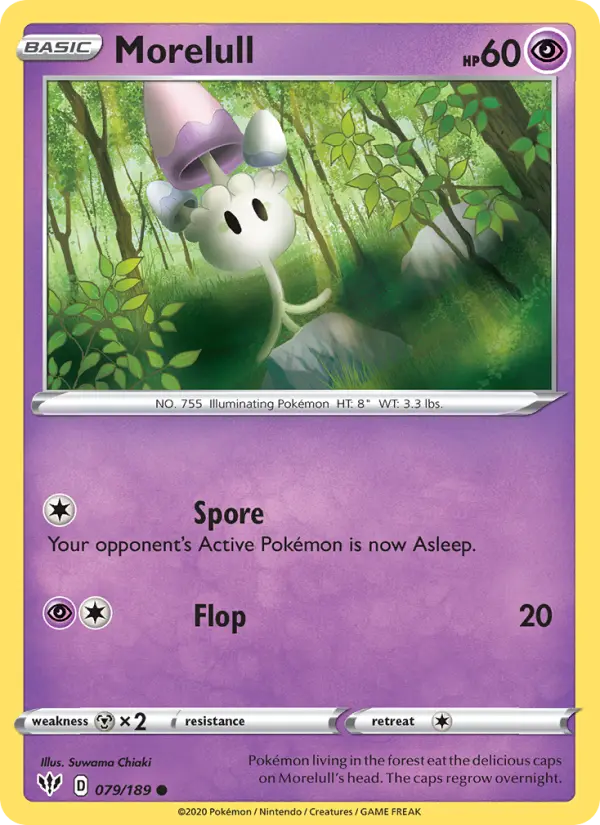
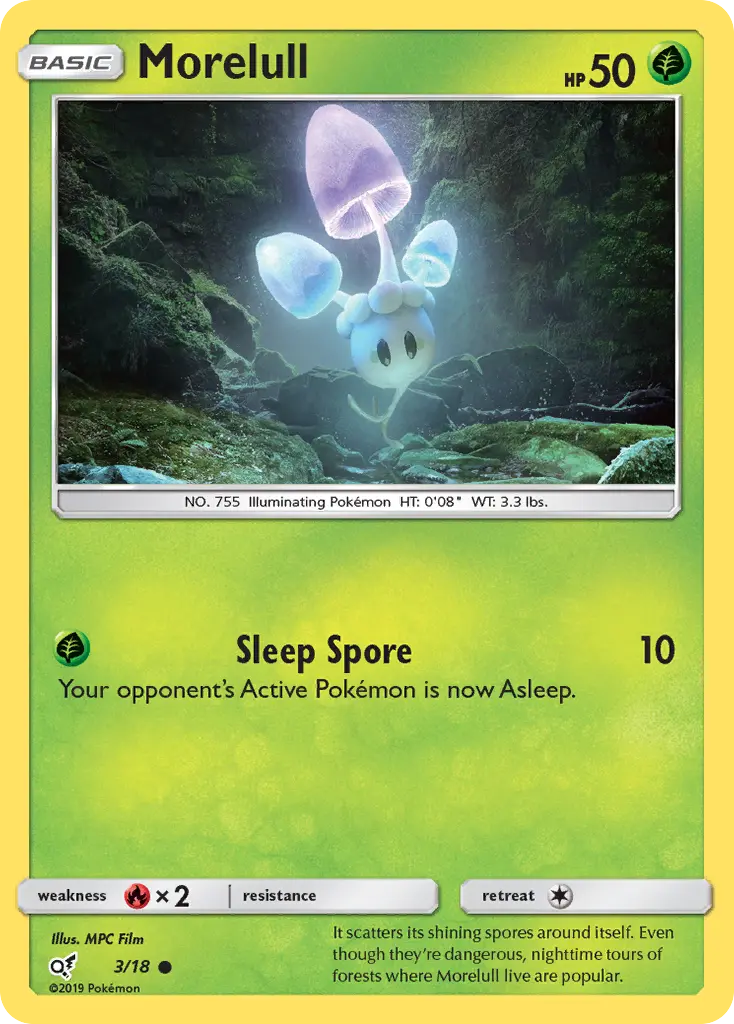
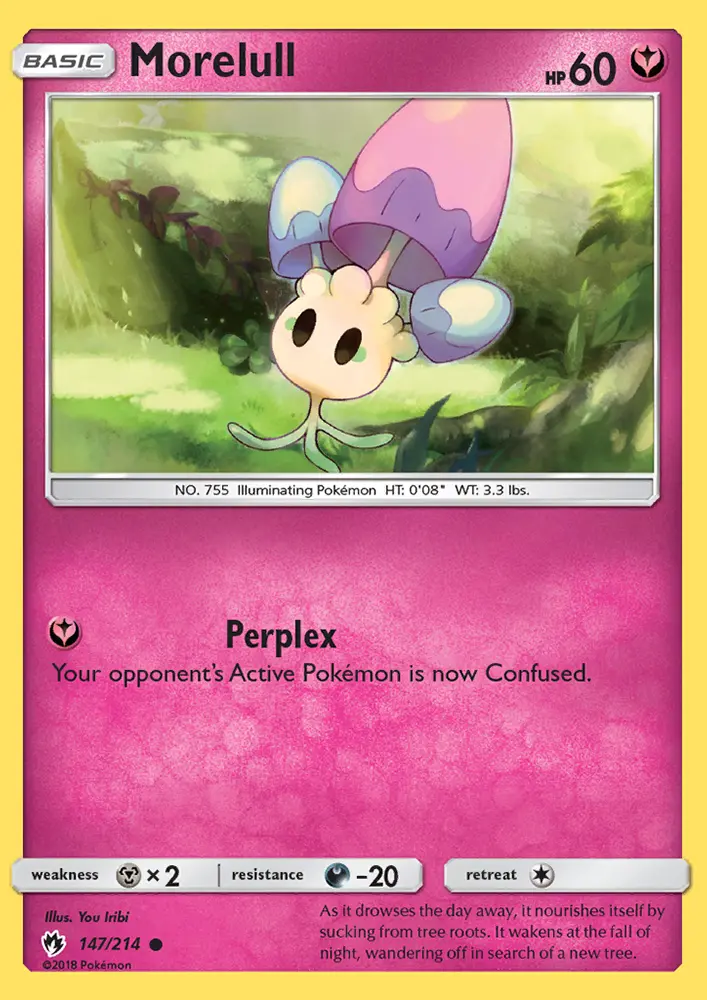
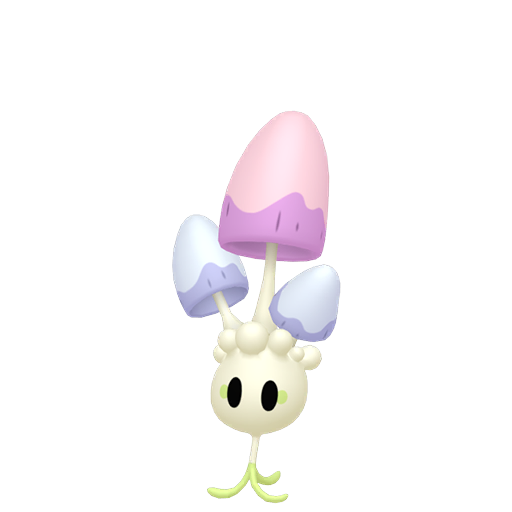
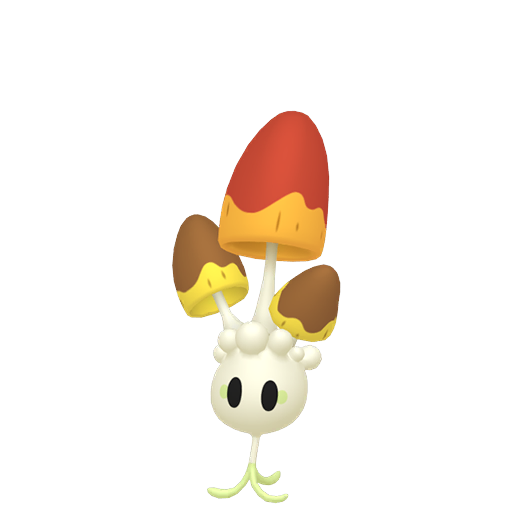
Morelull displays a fascinating mushroom-inspired physiology that sets it apart within the Grass-type family. Its body consists of a large, rounded white head with prominent black eyes adorned with pale green half-circle markings, connected to a thin, stem-like body that branches into three green root-like appendages at the base, which serve as both feet and sensory organs. Sprouting from the crown of its head are three distinct mushrooms: a central light pink mushroom and two smaller purplish-blue ones, each featuring a thin white stem and a darker ring at the base of the cap. These mushroom caps contain specialized spore-producing tissues that, when activated at night, emit a soft, glowing luminescence. The caps themselves are edible and constitute a delicacy for forest-dwelling Pokémon, yet remarkably regenerate overnight, suggesting an accelerated metabolic process. Morelull's roots serve a dual purpose beyond locomotion, functioning as communication organs that allow individual Morelull to maintain contact with one another across forest floors through chemical and tactile signals.
Pokedex Numbers
Training
Breeding
Morelull Breeding, Gender Ratio & Egg Groups
Morelull exhibits a standard gender distribution with a fifty-fifty split between males and females, allowing for straightforward breeding mechanics. The species belongs to the Plant egg group, enabling breeding with various Grass-type and Plant-type Pokémon across multiple generations. Eggs require twenty cycles to hatch, translating to approximately 4,884 to 5,140 steps of travel, making Morelull relatively quick to breed compared to many other Pokémon species. In Generation VII, Morelull boasts a base friendship value of 70, indicating a reasonably positive disposition toward trainers and facilitating faster bonding and happiness evolution mechanics for species that require such conditions. The relatively high catch rate of 190 combined with solid base friendship values makes Morelull an accessible Pokémon for players seeking breeding partners or team members early in their adventures, though captured specimens will require additional friendship building compared to eggs hatched through trainer care.
Sprites




Held Items
Tiny Mushroom
loot
Fire Red and Leaf Green: Trade two for prior Level-up moves. Sell for 250 Pokédollars, or to Hungry Maid for 500 Pokédollars.
Cost: 500
Tiny Mushroom
loot
Fire Red and Leaf Green: Trade two for prior Level-up moves. Sell for 250 Pokédollars, or to Hungry Maid for 500 Pokédollars.
Cost: 500
Tiny Mushroom
loot
Fire Red and Leaf Green: Trade two for prior Level-up moves. Sell for 250 Pokédollars, or to Hungry Maid for 500 Pokédollars.
Cost: 500
Tiny Mushroom
loot
Fire Red and Leaf Green: Trade two for prior Level-up moves. Sell for 250 Pokédollars, or to Hungry Maid for 500 Pokédollars.
Cost: 500
Big Mushroom
loot
Fire Red and Leaf Green: Trade for prior Level-up moves. Sell for 2500 Pokédollars, or to Hungry Maid for 5000 Pokédollars.
Cost: 5000
Big Mushroom
loot
Fire Red and Leaf Green: Trade for prior Level-up moves. Sell for 2500 Pokédollars, or to Hungry Maid for 5000 Pokédollars.
Cost: 5000
Big Mushroom
loot
Fire Red and Leaf Green: Trade for prior Level-up moves. Sell for 2500 Pokédollars, or to Hungry Maid for 5000 Pokédollars.
Cost: 5000
Big Mushroom
loot
Fire Red and Leaf Green: Trade for prior Level-up moves. Sell for 2500 Pokédollars, or to Hungry Maid for 5000 Pokédollars.
Cost: 5000
TMs & HMs
tm05
lets go pikachu lets go eevee
tm06
yellow
tm06
gold silver
tm06
red blue
tm06
crystal
tm06
emerald
tm06
firered leafgreen
tm06
diamond pearl
tm06
platinum
tm06
ruby sapphire
tm06
colosseum
tm06
black 2 white 2
tm06
xd
tm06
black white
tm06
heartgold soulsilver
tm06
omega ruby alpha sapphire
tm06
lets go pikachu lets go eevee
tm06
ultra sun ultra moon
tm06
sun moon
tm06
x y
+425 more TMs/HMs
Morelull's Evolution Chain


Morelull Evolution, Mega Evolution & Special Forms
Morelull evolves into Shiinotic upon reaching level 24, marking a significant transformation in both appearance and capabilities. This evolution represents a maturation process where the young, mobile Morelull develops into a more stationary, symbiotic organism more closely integrated with forest ecosystems. While specific details of the evolved form's biology differ, the evolutionary stage retains the Grass/Fairy typing and builds upon Morelull's foundational abilities. The evolution is straightforward and occurs at a relatively moderate level, allowing trainers to develop Morelull into a more capable special attacker and special defender relatively early in their journey through Alola or other regions. This level-based evolution mechanism makes Morelull accessible for players seeking to develop strong Grass/Fairy type team members without requiring rare evolutionary stones or specific conditions.
Where to Find
Lush Jungle
alola
+9 more
Brooklet Hill
alola
+3 more
Alola Route 11
alola
Morelull Behaviour and Natural Habitat
Morelull is a strictly nocturnal Pokémon that exhibits unique ecological behavior centered around nutrient conservation and sustainable foraging. According to Pokédex entries, these creatures spend their daylight hours in a dormant state, drowsing while drawing sustenance from tree roots in the darkened forest environments they inhabit—forests so dense that sunlight rarely penetrates their canopy. As night falls, Morelull awakens and migrates to new trees and locations, a behavior driven by an instinctive understanding that prolonged feeding in one area would deplete the soil's nutrients and wither surrounding vegetation. This nomadic lifestyle represents a remarkable example of ecological balance in the Pokémon world. When threatened, Morelull scatters its signature glowing spores in bright, glittering bursts designed to induce drowsiness in potential predators or aggressors. Morelull prefers damp, dark locations such as dense jungles and forests, thriving in the humid conditions that promote spore vitality. Interestingly, their spores are potent enough that a documented incident involving a disturbed group of Morelull scattering spores simultaneously nearly caused a plane to lose control, highlighting both the danger and the genuine wonder these Pokémon inspire.
Pokedex Entries
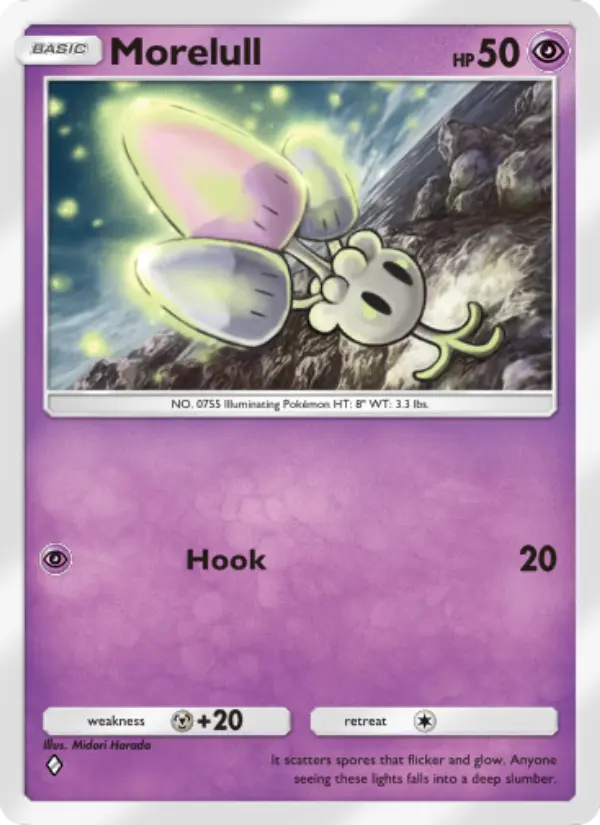
It scatters spores that flicker and glow. Anyone seeing these lights falls into a deep slumber.
It scatters its shining spores around itself. Even though they’re dangerous, nighttime tours of forests where Morelull live are popular.
As it drowses the day away, it nourishes itself by sucking from tree roots. It wakens at the fall of night, wandering off in search of a new tree.
It likes damp dark places. When night falls, the spores filling the caps of its mushrooms glow.
Pokémon living in the forest eat the delicious caps on Morelull’s head. The caps regrow overnight.
Morelull live in forests that stay dark even during the day. They scatter flickering spores that put enemies to sleep.
Morelull Name Origin & Design Inspiration
Morelull's name combines "morel," referring to the morel mushroom variety, with "lull," reflecting its sleep-inducing spore ability and drowsy daytime behavior. The Japanese name "Nemasyu" derives from the words for thread (nema) and mushroom (kinoko), aptly describing the thin-stemmed mushroom aesthetic. Visually, Morelull draws inspiration from several real-world fungi, particularly the bioluminescent mushrooms found in various ecosystems that produce a gentle glow in darkness. The color palette—white body with pink and purple mushroom caps—evokes both natural mushroom varieties and the fantastical nature appropriate to Fairy-type Pokémon. The design's emphasis on small stature and delicate proportions conveys vulnerability and charm, reinforcing its role as a non-aggressive forest dweller. The three distinct mushroom caps represent growth and vitality, while the root-like feet anchor Morelull to its forest habitat both literally and thematically, creating a design that feels simultaneously alien and connected to terrestrial ecosystems.
Learnable Moves
Morelull can learn 56 moves:
Move | Type | Cat. | Power | Acc. | PP |
|---|---|---|---|---|---|
| absorb | grass | Special | 20 | 100 | 25 |
| after you | normal | Status | — | — | 15 |
| amnesia | psychic | Status | — | — | 20 |
| astonish | ghost | Physical | 30 | 100 | 15 |
| attract | normal | Status | — | 100 | 15 |
| confide | normal | Status | — | — | 20 |
| confuse ray | ghost | Status | — | 100 | 10 |
| dazzling gleam | fairy | Special | 80 | 100 | 10 |
| double team | normal | Status | — | — | 15 |
| draining kiss | fairy | Special | 50 | 100 | 10 |
| dream eater | psychic | Special | 100 | 100 | 15 |
| endure | normal | Status | — | — | 10 |
| energy ball | grass | Special | 90 | 100 | 10 |
| facade | normal | Physical | 70 | 100 | 20 |
| flash | normal | Status | — | 100 | 20 |
| frustration | normal | Physical | — | 100 | 20 |
| giga drain | grass | Special | 75 | 100 | 10 |
| grass knot | grass | Special | — | 100 | 20 |
| growth | normal | Status | — | — | 20 |
| hidden power | normal | Special | 60 | 100 | 15 |
| ingrain | grass | Status | — | — | 20 |
| leech seed | grass | Status | — | 90 | 10 |
| light screen | psychic | Status | — | — | 30 |
| magic coat | psychic | Status | — | — | 15 |
| magic room | psychic | Status | — | — | 10 |
| mega drain | grass | Special | 40 | 100 | 15 |
| moonblast | fairy | Special | 95 | 100 | 15 |
| moonlight | fairy | Status | — | — | 5 |
| nature power | normal | Status | — | — | 20 |
| poison powder | poison | Status | — | 75 | 35 |
| pollen puff | bug | Special | 90 | 100 | 15 |
| protect | normal | Status | — | — | 10 |
| recycle | normal | Status | — | — | 10 |
| rest | psychic | Status | — | — | 5 |
| return | normal | Physical | — | 100 | 20 |
| round | normal | Special | 60 | 100 | 15 |
| safeguard | normal | Status | — | — | 25 |
| seed bomb | grass | Physical | 80 | 100 | 15 |
| signal beam | bug | Special | 75 | 100 | 15 |
| sleep powder | grass | Status | — | 75 | 15 |
| sleep talk | normal | Status | — | — | 10 |
| sludge bomb | poison | Special | 90 | 100 | 10 |
| snore | normal | Special | 50 | 100 | 15 |
| solar beam | grass | Special | 120 | 100 | 10 |
| spore | grass | Status | — | 100 | 15 |
| spotlight | normal | Status | — | — | 15 |
| strength sap | grass | Status | — | 100 | 10 |
| stun spore | grass | Status | — | 75 | 30 |
| substitute | normal | Status | — | — | 10 |
| sunny day | fire | Status | — | — | 5 |
| swagger | normal | Status | — | 85 | 15 |
| synthesis | grass | Status | — | — | 5 |
| thunder wave | electric | Status | — | 90 | 20 |
| toxic | poison | Status | — | 90 | 10 |
| wonder room | psychic | Status | — | — | 10 |
| worry seed | grass | Status | — | 100 | 10 |
Morelull Competitive Battle Guide
Morelull's competitive viability is severely limited by its extremely low base speed of 15, making it one of the slowest Pokémon in the entire National Pokédex. However, its special attack base of 65 and special defense base of 75 provide a foundation for defensive or supporting roles in competitive play. The species benefits from its dual Grass/Fairy typing, which grants useful resistances to Dark, Dragon, and Fighting-type moves while providing immunity to Dragon-type attacks through Fairy typing. Its abilities offer strategic variety: Illuminate increases wild encounter rates for team synergy, Effect Spore provides defensive coverage by potentially inflicting paralysis, poison, or sleep on physical attackers, and the hidden ability Rain Dish provides passive recovery in weather-dependent strategies. Morelull's movepool and stat distribution suggest it functions best as a support or defensive Pokémon rather than an offensive threat, potentially filling niches in rain teams or defensive cores. However, its evolution into Shiinotic typically provides superior competitive options, and even within casual play, Morelull's minimal attack and speed stats necessitate careful team composition and strategic planning to maximize effectiveness.
Commonly Asked Questions About Morelull
What type is Morelull?
Morelull is a grass and fairy type Pokemon.
What does Morelull evolve into?
Morelull evolves into shiinotic.
What are Morelull's weaknesses?
Morelull is weak to flying, poison, steel, fire and ice type moves.
Does Morelull evolve by trading?
No — Morelull evolves entirely through leveling up, with no trade required at any stage.
Where can I find Morelull?
Morelull can be found in lush jungle (alola), brooklet hill (alola) and alola route 11 (alola).
Morelull Cultural Impact & Franchise History
Since its introduction in Generation VII, Morelull has captured the imagination of the Pokémon community through its unique bioluminescent aesthetic and enchanting lore. The Pokédex entry describing a near-disaster involving a plane affected by Morelull spores has become particularly memorable, lending an air of mysterious danger to this otherwise gentle-seeming creature. This combination of beauty and peril has made Morelull a favorite subject for fan art, often depicted with glowing spores illuminating dark forest environments. The species has appeared in various Pokémon media, contributing to its recognition among newer generation fans. Morelull's role as a nocturnal forest guardian has resonated with players appreciating ecological themes in Pokémon design, and its appearance in Alola's nighttime environments created memorable encounters for players exploring the region's unique ecosystems. The concept of edible mushroom caps that regrow overnight has also inspired creative fan interpretations exploring sustainable resource management in the Pokémon world, making Morelull a touchstone for discussions about environmental storytelling within game design.
Where to Find Morelull in Every Pokémon Game
Morelull's availability has been primarily limited to specific regions and generations since its introduction in Generation VII. In Pokémon Sun and Moon, Morelull appears in the Alola dex and can be encountered in dark forest locations befitting its habitat preferences. It remains obtainable in Ultra Sun and Ultra Moon, continuing its presence in Alolan forests. The species was made available in later generation games including Pokémon Sword and Shield, where it appears in the National Pokédex with the local number 340. Its capture rate of 190 makes it relatively easy to catch with standard Poké Balls, particularly when encountered in the wild at low health. The species' distribution across multiple generations ensures that players can obtain Morelull and develop it into Shiinotic without requiring event distributions or obscure trading mechanics. Breeding Morelull is accessible for players seeking specific natures or individual values, as the species belongs to the readily-available Plant egg group and maintains a standard gender ratio. Players seeking Morelull outside of main game availability may use National Pokédex features in newer games or pursue trading through online communities to obtain this charming nocturnal Pokémon.