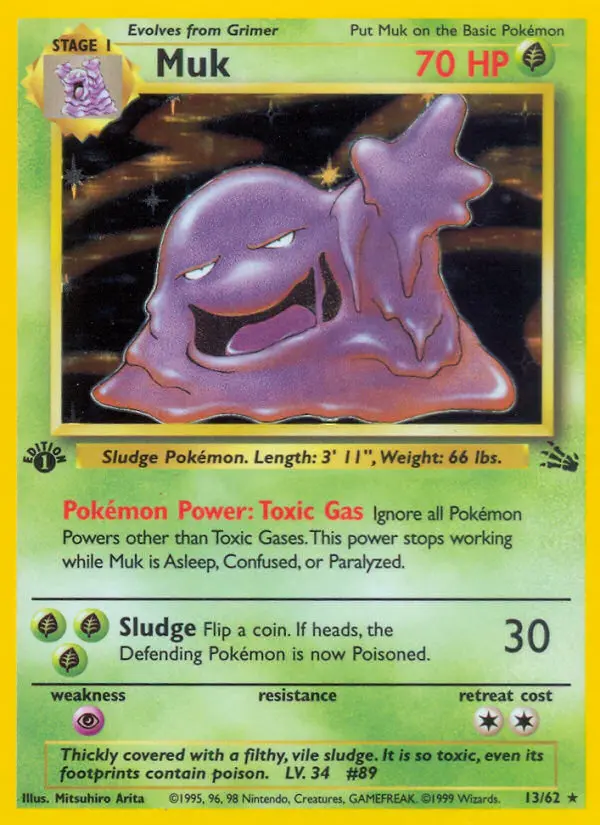
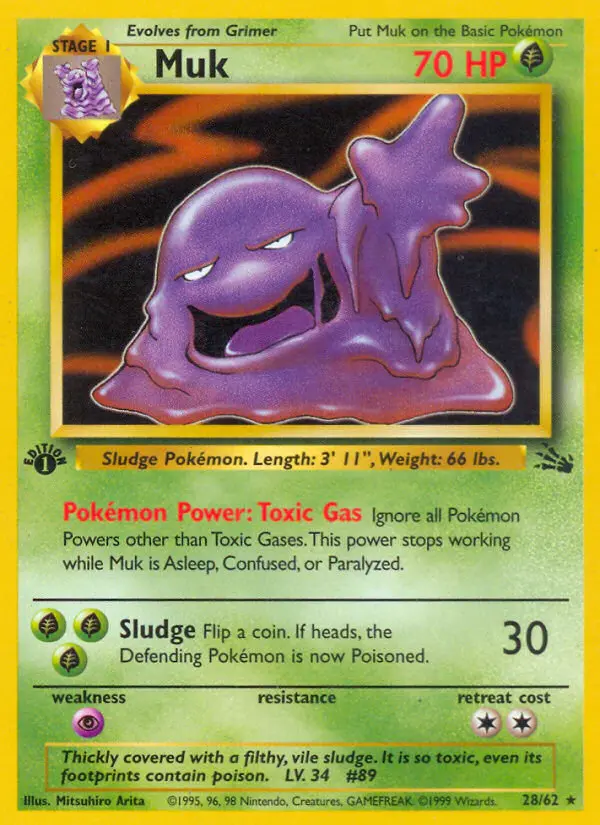
Muk
Generation I · #0089 — Sludge Pokémon
Muk measures in at 1.2 m and 30 kg, a build that matches its stench ability better than it matches raw offense or defense. It measures 1.2 m and 30.0 kg, dimensions that pair with that stat lean in noticeable ways. This amorphous creature stands 1.2 meters tall and weighs 30 kilograms, composed entirely of living toxic sludge that poses an immediate biohazard to everything in its vicinity. With a aggregate stat total of 500, Muk distributes its capabilities relatively evenly across offensive and defensive metrics, particularly excelling in HP (105) and Attack (105) while maintaining solid Special Defense (100). The creature's remarkable ability to poison targets through direct contact, combined with its distinctive stench-based intimidation tactics, makes it a memorable early-generation design that emphasizes the dangers of unchecked industrial pollution.
Editor's Take
Muk has 105 base Attack and 50 base Speed, which describes a Pokémon that hits hard exactly once before something faster removes it from the game.
Base Stats
Height
1.2m
Weight
30.0kg
Category
Sludge Pokémon
Gender
Male 50% / Female 50%
Color
purple
Shape
arms
Habitat
urban
Abilities
Has a 10% chance of making target Pokémon flinch with each hit.
Prevents a held item from being removed by other Pokémon.
Has a 30% chance of poisoning target Pokémon upon contact.
Muk Biology & Physical Characteristics
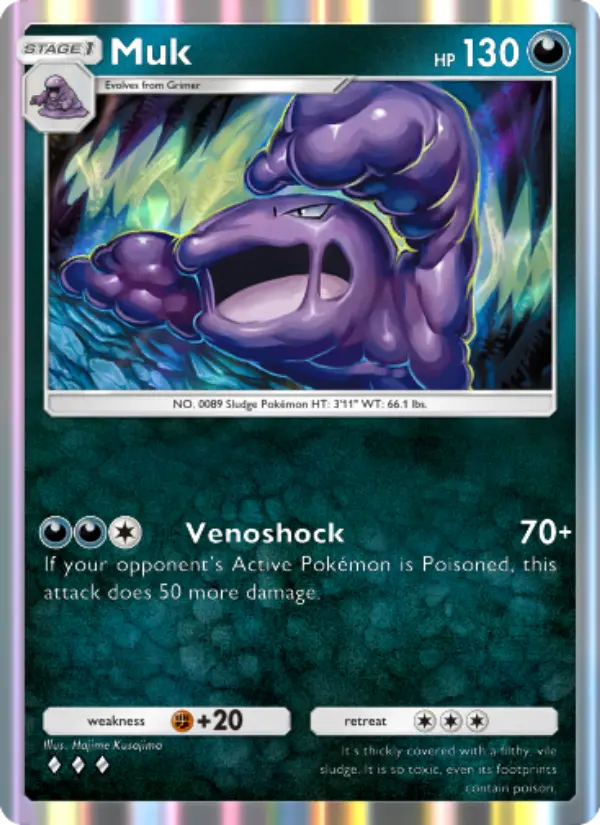
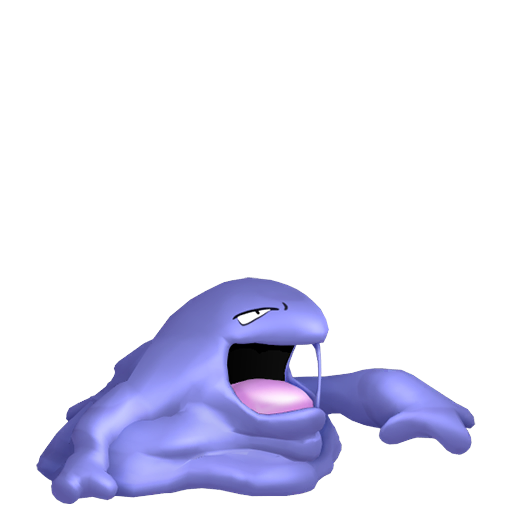
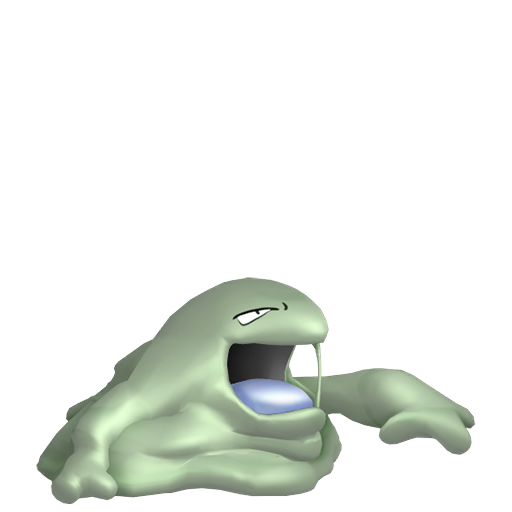
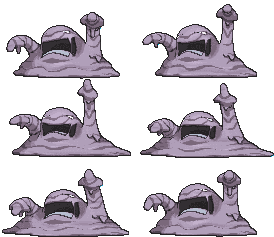
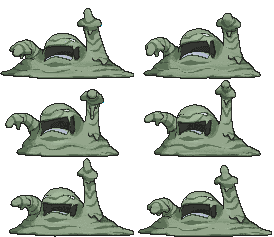
Muk is fundamentally an amorphous mass of sentient, toxic sludge held together by biological cohesion rather than any recognizable skeletal structure. Its bulbous form is predominantly purple in coloration, featuring two small, dark-pupiled eyes that convey surprising expressiveness despite the creature's gelatinous composition. The most distinctive feature is its enormous mouth, lined with a gray tongue and connected by viscous strands of ooze between its upper and lower jaws, creating an unsettling appearance that emphasizes its role as a living biohazard. Despite lacking visible legs, Muk possesses two three-fingered hands, typically keeping one tucked into its body while extending the other for interaction or aggression. The creature's biology is essentially toxic in nature—every aspect of its physiology leaks powerful poisons that render soil barren for extended periods and instantly wilt plant life through mere proximity. According to Pokédex entries, just a single drop of Muk's body fluid can transform an entire pool of water into a stagnant, unusable swamp, making this creature not merely dangerous but actively destructive to ecosystems it inhabits.
Pokedex Numbers
Training
Breeding
Muk Breeding, Gender Ratio & Egg Groups
Muk exhibits a standard 50% male to 50% female gender distribution, allowing balanced breeding opportunities for trainers seeking to produce competitive offspring or complete their collections. As members of the Amorphous Egg Group, Muk can breed with other Amorphous-type Pokémon including Ditto, Koffing, Grimer, Muk, Shellder, Cloyster, Gastly, Haunter, Gengar, and others within this classification. The species demonstrates a base friendship of 70, indicating moderate ease in cultivation despite its inherently toxic nature—trainers do not require extreme efforts to develop positive relationships with captured specimens. Eggs require 20 cycles to hatch, translating to approximately 4,884 to 5,140 steps of overland travel before a new Grimer emerges ready to begin its own journey toward evolution. Female Muk possess no particular breeding advantages or disadvantages compared to males, making gender selection purely a matter of trainer preference or collection completion goals. The breeding mechanics ensure accessibility for trainers who wish to utilize Muk in competitive breeding programs or create teams of multiple specimens with complementary natures and individual values.
Sprites


Held Items
Nugget
loot
Sell for 5000 Pokédollars, or to Ore Collector for 10000 Pokédollars.
Cost: 10000
Nugget
loot
Sell for 5000 Pokédollars, or to Ore Collector for 10000 Pokédollars.
Cost: 10000
Nugget
loot
Sell for 5000 Pokédollars, or to Ore Collector for 10000 Pokédollars.
Cost: 10000
Nugget
loot
Sell for 5000 Pokédollars, or to Ore Collector for 10000 Pokédollars.
Cost: 10000
Nugget
loot
Sell for 5000 Pokédollars, or to Ore Collector for 10000 Pokédollars.
Cost: 10000
Nugget
loot
Sell for 5000 Pokédollars, or to Ore Collector for 10000 Pokédollars.
Cost: 10000
Nugget
loot
Sell for 5000 Pokédollars, or to Ore Collector for 10000 Pokédollars.
Cost: 10000
Nugget
loot
Sell for 5000 Pokédollars, or to Ore Collector for 10000 Pokédollars.
Cost: 10000
Nugget
loot
Sell for 5000 Pokédollars, or to Ore Collector for 10000 Pokédollars.
Cost: 10000
Nugget
loot
Sell for 5000 Pokédollars, or to Ore Collector for 10000 Pokédollars.
Cost: 10000
Toxic Orb
bad-held-items
Held: Inflicts Toxic on the holder at the end of the turn. Activates after Poison damage would occur.
Cost: 4000
Toxic Orb
bad-held-items
Held: Inflicts Toxic on the holder at the end of the turn. Activates after Poison damage would occur.
Cost: 4000
Black Sludge
held-items
Held: Poison-type holder recovers 1/16 (6.25%) max HP each turn. Non-Poison-Types take 1/8 (12.5%) max HP damage.
Cost: 4000
Black Sludge
held-items
Held: Poison-type holder recovers 1/16 (6.25%) max HP each turn. Non-Poison-Types take 1/8 (12.5%) max HP damage.
Cost: 4000
Black Sludge
held-items
Held: Poison-type holder recovers 1/16 (6.25%) max HP each turn. Non-Poison-Types take 1/8 (12.5%) max HP damage.
Cost: 4000
Black Sludge
held-items
Held: Poison-type holder recovers 1/16 (6.25%) max HP each turn. Non-Poison-Types take 1/8 (12.5%) max HP damage.
Cost: 4000
Black Sludge
held-items
Held: Poison-type holder recovers 1/16 (6.25%) max HP each turn. Non-Poison-Types take 1/8 (12.5%) max HP damage.
Cost: 4000
Black Sludge
held-items
Held: Poison-type holder recovers 1/16 (6.25%) max HP each turn. Non-Poison-Types take 1/8 (12.5%) max HP damage.
Cost: 4000
Black Sludge
held-items
Held: Poison-type holder recovers 1/16 (6.25%) max HP each turn. Non-Poison-Types take 1/8 (12.5%) max HP damage.
Cost: 4000
Black Sludge
held-items
Held: Poison-type holder recovers 1/16 (6.25%) max HP each turn. Non-Poison-Types take 1/8 (12.5%) max HP damage.
Cost: 4000
Black Sludge
held-items
Held: Poison-type holder recovers 1/16 (6.25%) max HP each turn. Non-Poison-Types take 1/8 (12.5%) max HP damage.
Cost: 4000
Black Sludge
held-items
Held: Poison-type holder recovers 1/16 (6.25%) max HP each turn. Non-Poison-Types take 1/8 (12.5%) max HP damage.
Cost: 4000
Nugget
loot
Sell for 5000 Pokédollars, or to Ore Collector for 10000 Pokédollars.
Cost: 10000
Nugget
loot
Sell for 5000 Pokédollars, or to Ore Collector for 10000 Pokédollars.
Cost: 10000
Nugget
loot
Sell for 5000 Pokédollars, or to Ore Collector for 10000 Pokédollars.
Cost: 10000
Nugget
loot
Sell for 5000 Pokédollars, or to Ore Collector for 10000 Pokédollars.
Cost: 10000
Nugget
loot
Sell for 5000 Pokédollars, or to Ore Collector for 10000 Pokédollars.
Cost: 10000
Nugget
loot
Sell for 5000 Pokédollars, or to Ore Collector for 10000 Pokédollars.
Cost: 10000
Nugget
loot
Sell for 5000 Pokédollars, or to Ore Collector for 10000 Pokédollars.
Cost: 10000
Nugget
loot
Sell for 5000 Pokédollars, or to Ore Collector for 10000 Pokédollars.
Cost: 10000
Nugget
loot
Sell for 5000 Pokédollars, or to Ore Collector for 10000 Pokédollars.
Cost: 10000
Nugget
loot
Sell for 5000 Pokédollars, or to Ore Collector for 10000 Pokédollars.
Cost: 10000
Toxic Orb
bad-held-items
Held: Inflicts Toxic on the holder at the end of the turn. Activates after Poison damage would occur.
Cost: 4000
Toxic Orb
bad-held-items
Held: Inflicts Toxic on the holder at the end of the turn. Activates after Poison damage would occur.
Cost: 4000
Black Sludge
held-items
Held: Poison-type holder recovers 1/16 (6.25%) max HP each turn. Non-Poison-Types take 1/8 (12.5%) max HP damage.
Cost: 4000
Black Sludge
held-items
Held: Poison-type holder recovers 1/16 (6.25%) max HP each turn. Non-Poison-Types take 1/8 (12.5%) max HP damage.
Cost: 4000
Black Sludge
held-items
Held: Poison-type holder recovers 1/16 (6.25%) max HP each turn. Non-Poison-Types take 1/8 (12.5%) max HP damage.
Cost: 4000
Black Sludge
held-items
Held: Poison-type holder recovers 1/16 (6.25%) max HP each turn. Non-Poison-Types take 1/8 (12.5%) max HP damage.
Cost: 4000
Black Sludge
held-items
Held: Poison-type holder recovers 1/16 (6.25%) max HP each turn. Non-Poison-Types take 1/8 (12.5%) max HP damage.
Cost: 4000
Black Sludge
held-items
Held: Poison-type holder recovers 1/16 (6.25%) max HP each turn. Non-Poison-Types take 1/8 (12.5%) max HP damage.
Cost: 4000
Black Sludge
held-items
Held: Poison-type holder recovers 1/16 (6.25%) max HP each turn. Non-Poison-Types take 1/8 (12.5%) max HP damage.
Cost: 4000
Black Sludge
held-items
Held: Poison-type holder recovers 1/16 (6.25%) max HP each turn. Non-Poison-Types take 1/8 (12.5%) max HP damage.
Cost: 4000
Black Sludge
held-items
Held: Poison-type holder recovers 1/16 (6.25%) max HP each turn. Non-Poison-Types take 1/8 (12.5%) max HP damage.
Cost: 4000
Black Sludge
held-items
Held: Poison-type holder recovers 1/16 (6.25%) max HP each turn. Non-Poison-Types take 1/8 (12.5%) max HP damage.
Cost: 4000
TMs & HMs
tm01
gold silver
tm01
crystal
tm01
platinum
tm01
emerald
tm01
diamond pearl
tm01
firered leafgreen
tm01
ruby sapphire
tm01
xd
tm01
colosseum
tm01
heartgold soulsilver
tm01
lets go pikachu lets go eevee
tm02
crystal
tm02
gold silver
tm02
lets go pikachu lets go eevee
tm03
crystal
tm03
gold silver
tm03
lets go pikachu lets go eevee
tm03
sword shield
tm04
sword shield
tm05
sword shield
+754 more TMs/HMs


Muk Evolution, Mega Evolution & Special Forms
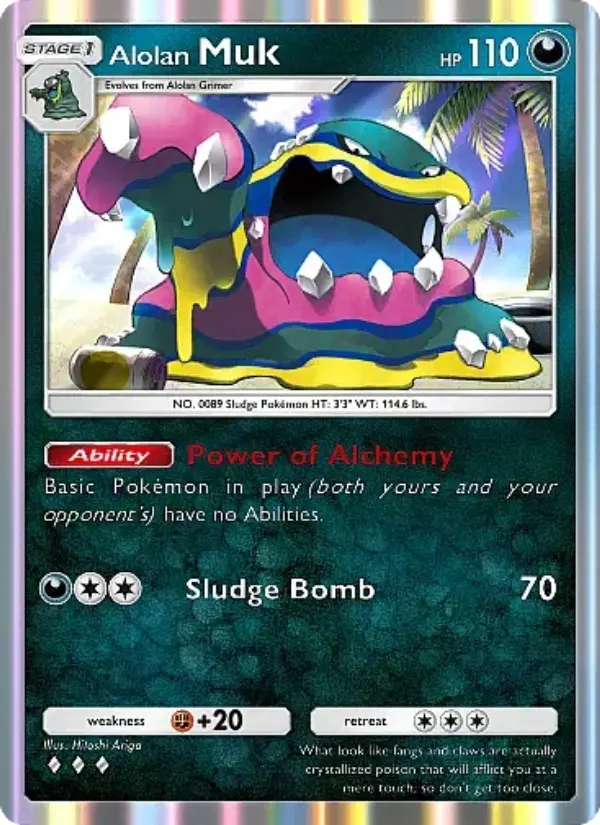
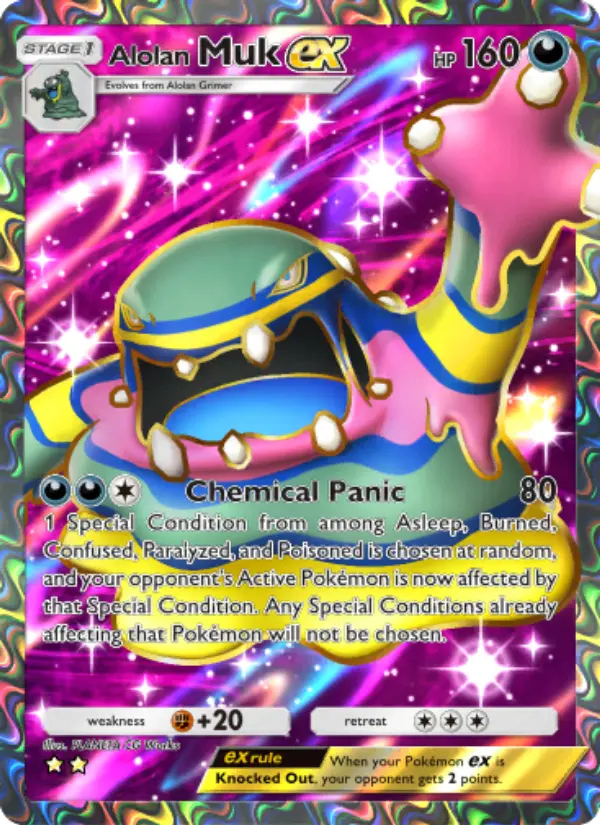
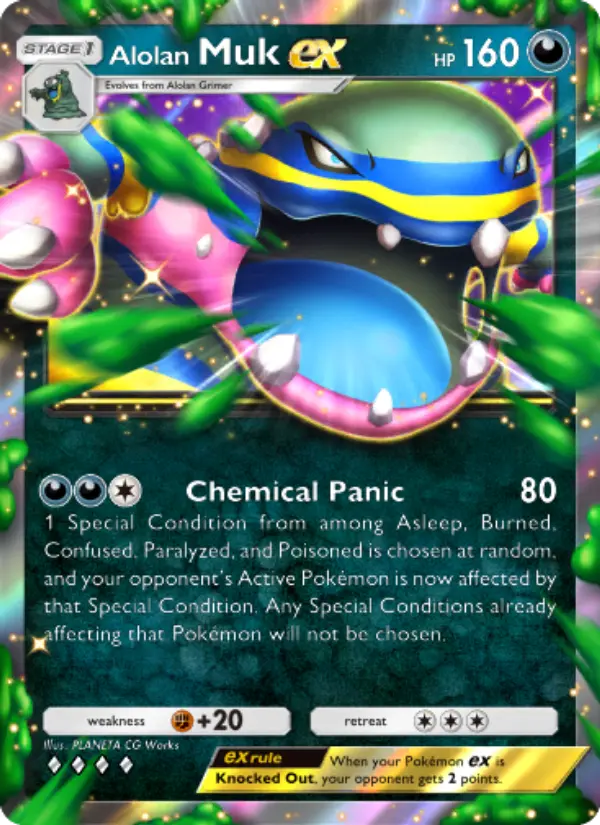
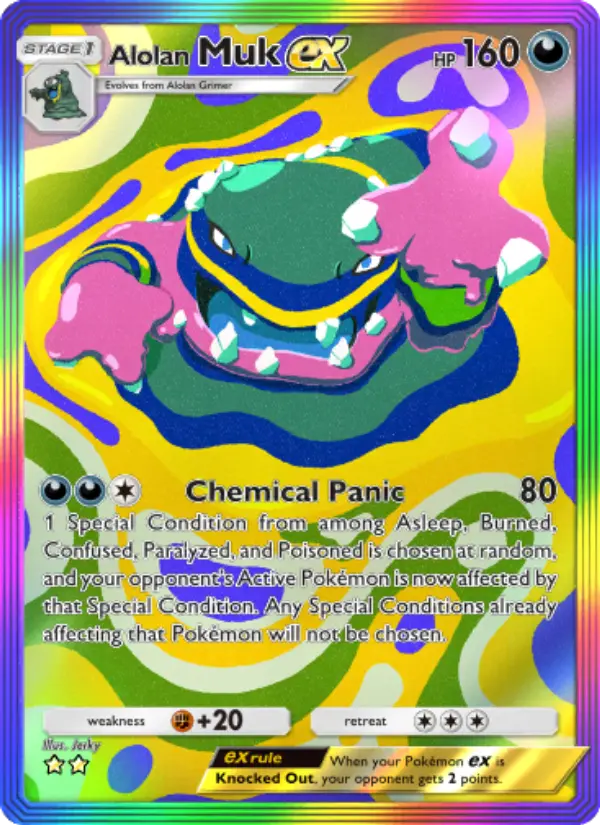
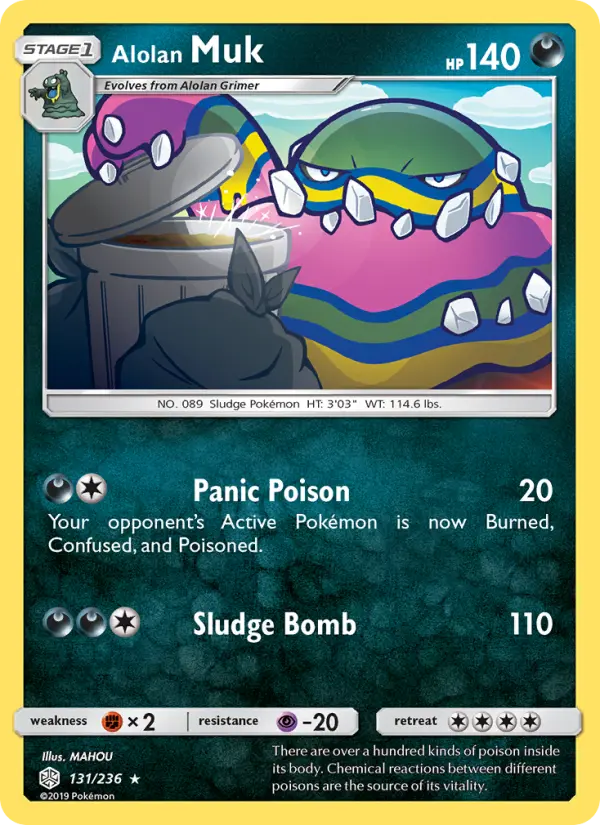
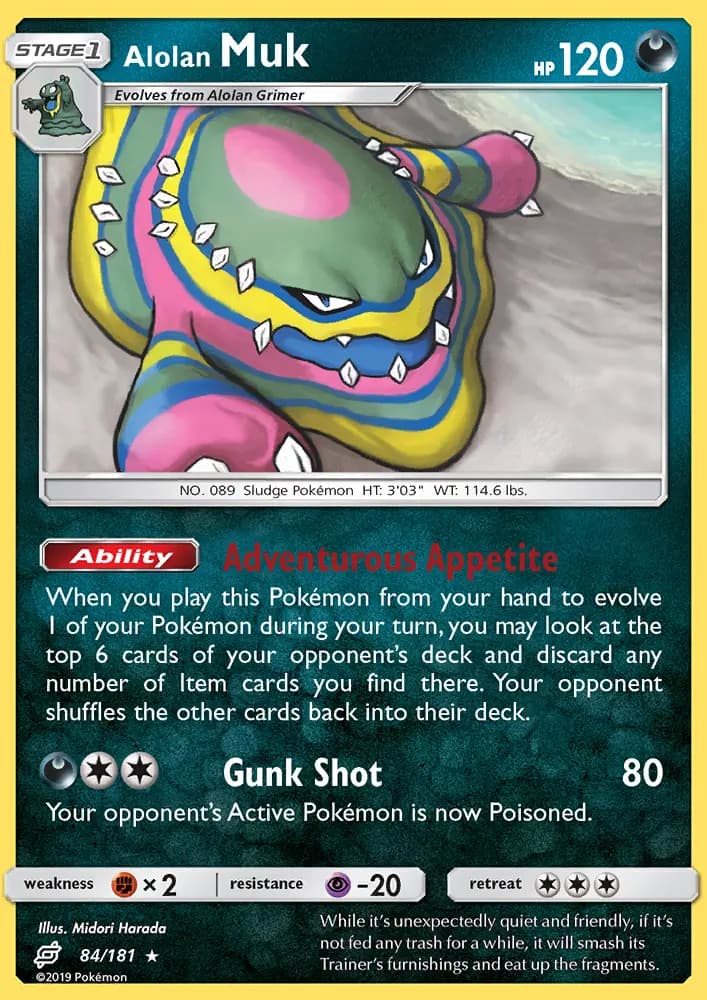
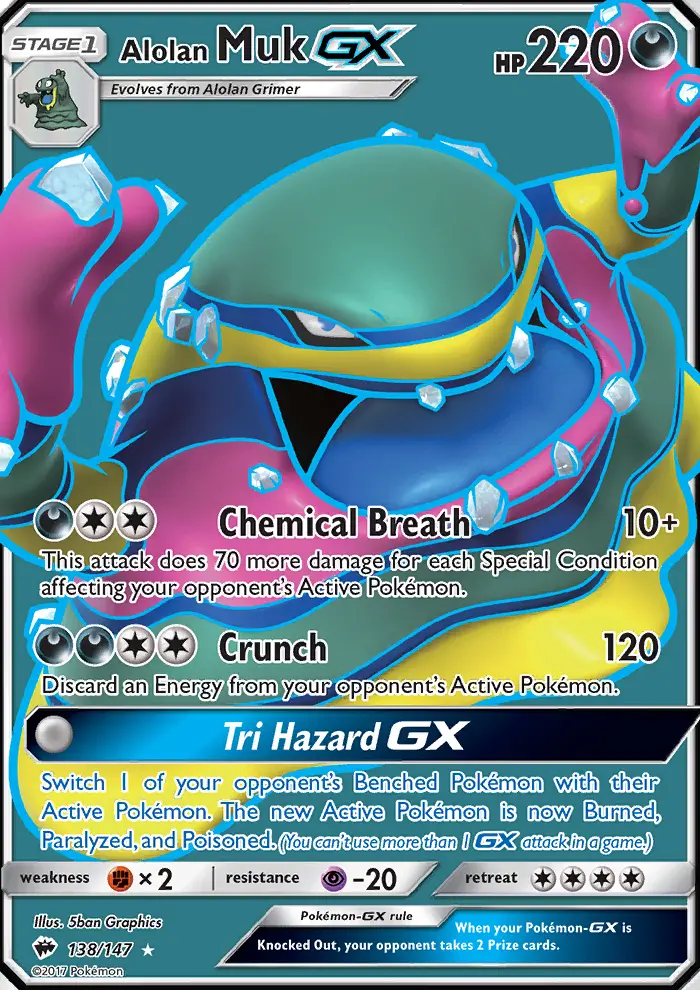
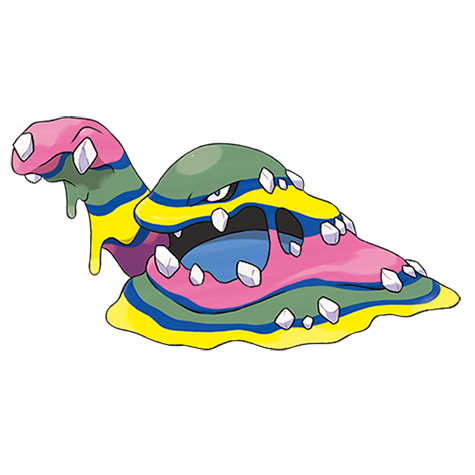
Muk evolves from Grimer at level 38, a straightforward progression that sees the smaller, more slug-like Grimer transform into a significantly larger and more amorphous sludge mass. The evolution represents a dramatic increase in toxic potency and physical mass, with Muk's body becoming progressively less defined and more thoroughly saturated with poisonous secretions. This evolution also represents a shift in behavioral classification, with the evolved form displaying more aggressive territorial tendencies and a notable increase in its ability to contaminate large areas. Beyond the standard Kantonian Muk, an Alolan regional variant was introduced in Generation VII, featuring a Poison/Dark typing that emerges when Grimer from the Alola region reaches level 38. The Alolan form is notably smaller at 1.0 meter tall and weighs 52 kilograms, with a darker, more aggressive appearance reflecting Alola's unique environmental pressures. While mechanically similar in base stat distribution, the Alolan variant's secondary Dark typing grants it different type immunities and resistances, most notably immunity to Psychic-type moves rather than the relatively modest defensive profile of its Kantonian counterpart. Both forms share the same evolutionary trigger and comparable stat totals, ensuring that trainers selecting either variant receive a competent Poison-type evolution with distinct strategic implications.
Where to Find
Pokemon Mansion
kanto
+28 more
Power Plant
kanto
Kanto Route 17
kanto
+25 more
Kanto Route 16
kanto
+19 more
Kanto Route 18
kanto
+23 more
Celadon City
kanto
+6 more
Castelia Sewers
unova
+17 more
Unova Route 9
unova
+1 more
Muk Behaviour and Natural Habitat
Muk exhibits a distinct preference for contaminated environments where sludge naturally accumulates, making derelict industrial areas, polluted waterways, and refuse-filled towns their natural habitats. These Pokémon are attracted to filthy locations and appear to thrive on degraded matter, having evolved to consume substances that would prove toxic to virtually any other organism. The Pokédex notes that in dirty towns where litter accumulates without concern, Muk are virtually guaranteed to gather in increasing numbers, essentially serving as a biological indicator of severe environmental neglect. Rather than viewing their presence as coincidental, it appears Muk actively seek out the worst pollution, driven by an instinctive need to inhabit spaces that match their toxic nature. Their behavior toward other creatures tends toward aggressive territorial displays, leveraging their overwhelming stench as a primary intimidation tool—encounters can cause fainting simply from the olfactory assault, despite the irony that Muk itself has lost its sense of smell through degeneration. This combination of habitat preference and behavioral aggression makes Muk a genuine danger to both human settlements and natural ecosystems, forcing trainers who encounter them to maintain strict distance protocols.
Pokedex Entries
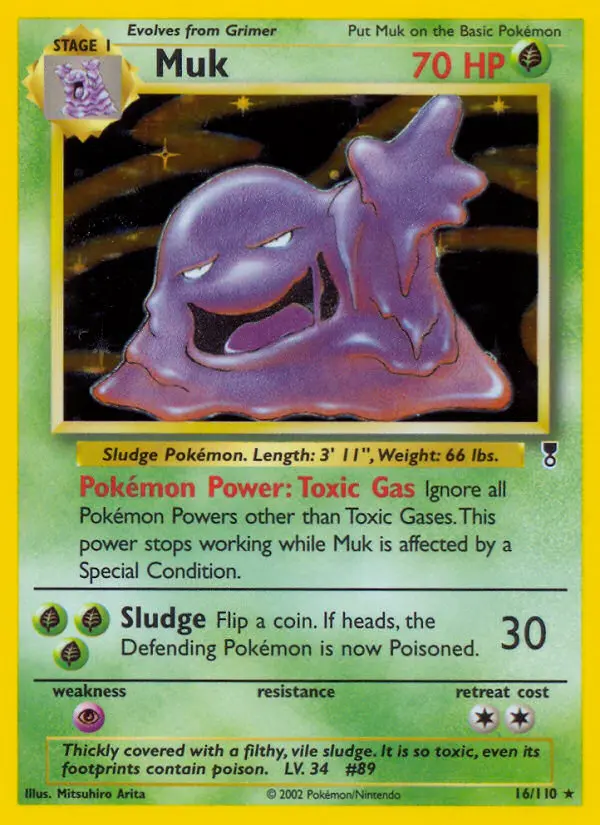
Thickly covered with a filthy, vile sludge. It is so toxic, even its footprints contain poison.
Smells so awful, it can cause fainting. Through degeneration, it lost its sense of smell.
They love to gath er in smelly areas where sludge ac cumulates, making the stench around them worse.
Its body is made of a powerful poi son. Touching it accidentally will cause a fever that requires bed rest.
As it moves, a very strong poison leaks from it, making the ground there barren for three years.
From MUK’s body seeps a foul fluid that gives off a nose-bendingly horrible stench. Just one drop of this POKéMON’s body fluid can turn a pool stagnant and rancid.
This POKéMON’s favorite food is anything that is repugnantly filthy. In dirty towns where people think nothing of throwing away litter on the streets, MUK are certain to gather.
It prefers warm and humid habitats. In the summertime, the toxic substances in its body intensify, making MUK reek like putrid kitchen garbage.
It is usually undetectable because it blends in with the ground. Touching it can cause terrible poisoning.
Thickly covered with a filthy, vile sludge. It is so toxic, even its footprints contain poison.
A toxic fluid seeps from its body. The fluid instantly kills plants and trees on contact.
They love to gather in smelly areas where sludge accumulates, making the stench around them worse.
Its body is made of a powerful poison. Touching it accidentally will cause a fever that requires bed rest.
A toxic fluid seeps from its body. The fluid instantly kills plants and trees on contact.
It’s so stinky! Muk’s body contains toxic elements, and any plant will wilt when it passes by.
They love to gather in smelly areas where sludge accumulates, making the stench around them worse.
A toxic fluid seeps from its body. The fluid instantly kills plants and trees on contact.
From Muk’s body seeps a foul fluid that gives off a nose-bendingly horrible stench. Just one drop of this Pokémon’s body fluid can turn a pool stagnant and rancid.
This Pokémon’s favorite food is anything that is repugnantly filthy. In dirty towns where people think nothing of throwing away litter on the streets, Muk are certain to gather.
The stench it gives off will make your nose scrunch up. Still, there are Muk fans who think that’s a good thing.
Their food sources have decreased, and their numbers have declined sharply. Sludge ponds are being built to prevent their extinction.
After recent environmental improvements, this Pokémon is now hardly seen at all. People speculate that it may go extinct at some point.
Because they scatter germs everywhere, they’ve long been targeted for extermination, leading to a steep decline in their population.
Smells so awful, it can cause fainting. Through degeneration of its nose, it lost its sense of smell.
Muk Name Origin & Design Inspiration
Muk's name origin lies in the English word 'muck,' perfectly encapsulating the creature's fundamental essence as living industrial waste given animated form. The Japanese name Betbeton (ベトベトン) similarly references 'beta beta,' meaning sticky or gooey in Japanese, combined with the suffix 'ton' common to Pokémon naming conventions. Visually, Muk represents a creative interpretation of sentient pollution, translating abstract environmental concerns into a tangible, threatening creature that embodies the consequences of unchecked industrialization. The creature's design emphasizes organic grotesqueness—its formless body, oversized mouth, and constant secretion of toxins create an intentionally repellent appearance that discourages trainer engagement. This design philosophy stands in stark contrast to more appealing Pokémon, making Muk's appearance itself a commentary on environmental degradation. The color palette of sickly purple with grayish highlights reinforces its toxic nature, while the character design choices ensure that Muk remains instantly recognizable and thematically cohesive despite its minimal structural complexity. The evolution from Grimer to Muk emphasizes growth through contamination rather than natural development, suggesting that exposure to pollutants causes physical transformation and toxic enhancement.
Learnable Moves
Muk can learn 85 moves:
Move | Type | Cat. | Power | Acc. | PP |
|---|---|---|---|---|---|
| acid armor | poison | Status | — | — | 20 |
| acid spray | poison | Special | 40 | 100 | 20 |
| attract | normal | Status | — | 100 | 15 |
| belch | poison | Special | 120 | 90 | 10 |
| bide | normal | Physical | — | — | 10 |
| body slam | normal | Physical | 85 | 100 | 15 |
| brick break | fighting | Physical | 75 | 100 | 15 |
| confide | normal | Status | — | — | 20 |
| confuse ray | ghost | Status | — | 100 | 10 |
| curse | ghost | Status | — | — | 10 |
| dig | ground | Physical | 80 | 100 | 10 |
| disable | normal | Status | — | 100 | 20 |
| double team | normal | Status | — | — | 15 |
| dynamic punch | fighting | Physical | 100 | 50 | 5 |
| endure | normal | Status | — | — | 10 |
| explosion | normal | Physical | 250 | 100 | 5 |
| facade | normal | Physical | 70 | 100 | 20 |
| fire blast | fire | Special | 110 | 85 | 5 |
| fire punch | fire | Physical | 75 | 100 | 15 |
| flamethrower | fire | Special | 90 | 100 | 15 |
| focus punch | fighting | Physical | 150 | 100 | 20 |
| frustration | normal | Physical | — | 100 | 20 |
| giga drain | grass | Special | 75 | 100 | 10 |
| giga impact | normal | Physical | 150 | 90 | 5 |
| gunk shot | poison | Physical | 120 | 80 | 5 |
| harden | normal | Status | — | — | 30 |
| haze | ice | Status | — | — | 30 |
| headbutt | normal | Physical | 70 | 100 | 15 |
| helping hand | normal | Status | — | — | 20 |
| hex | ghost | Special | 65 | 100 | 10 |
| hidden power | normal | Special | 60 | 100 | 15 |
| hyper beam | normal | Special | 150 | 90 | 5 |
| ice punch | ice | Physical | 75 | 100 | 15 |
| imprison | psychic | Status | — | — | 10 |
| incinerate | fire | Special | 60 | 100 | 15 |
| knock off | dark | Physical | 65 | 100 | 20 |
| mega drain | grass | Special | 40 | 100 | 15 |
| memento | dark | Status | — | 100 | 10 |
| metronome | normal | Status | — | — | 10 |
| mimic | normal | Status | — | — | 10 |
| minimize | normal | Status | — | — | 10 |
| moonblast | fairy | Special | 95 | 100 | 15 |
| mud bomb | ground | Special | 65 | 85 | 10 |
| mud slap | ground | Special | 20 | 100 | 10 |
| pain split | normal | Status | — | — | 20 |
| poison gas | poison | Status | — | 90 | 40 |
| pound | normal | Physical | 40 | 100 | 35 |
| protect | normal | Status | — | — | 10 |
| rage | normal | Physical | 20 | 100 | 20 |
| rain dance | water | Status | — | — | 5 |
| rest | psychic | Status | — | — | 5 |
| return | normal | Physical | — | 100 | 20 |
| rock slide | rock | Physical | 75 | 90 | 10 |
| rock smash | fighting | Physical | 40 | 100 | 15 |
| rock tomb | rock | Physical | 60 | 95 | 15 |
| round | normal | Special | 60 | 100 | 15 |
| sandstorm | rock | Status | — | — | 10 |
| scary face | normal | Status | — | 100 | 10 |
| screech | normal | Status | — | 85 | 40 |
| secret power | normal | Physical | 70 | 100 | 20 |
| self destruct | normal | Physical | 200 | 100 | 5 |
| shadow ball | ghost | Special | 80 | 100 | 15 |
| sleep talk | normal | Status | — | — | 10 |
| sludge | poison | Special | 65 | 100 | 20 |
| sludge bomb | poison | Special | 90 | 100 | 10 |
| sludge wave | poison | Special | 95 | 100 | 10 |
| smog | poison | Special | 30 | 70 | 20 |
| snore | normal | Special | 50 | 100 | 15 |
| spite | ghost | Status | — | 100 | 10 |
| strength | normal | Physical | 80 | 100 | 15 |
| substitute | normal | Status | — | — | 10 |
| sunny day | fire | Status | — | — | 5 |
| swagger | normal | Status | — | 85 | 15 |
| swift | normal | Special | 60 | — | 20 |
| take down | normal | Physical | 90 | 85 | 20 |
| taunt | dark | Status | — | 100 | 20 |
| thief | dark | Physical | 60 | 100 | 25 |
| thunder | electric | Special | 110 | 70 | 10 |
| thunder punch | electric | Physical | 75 | 100 | 15 |
| thunderbolt | electric | Special | 90 | 100 | 15 |
| torment | dark | Status | — | 100 | 15 |
| toxic | poison | Status | — | 90 | 10 |
| venom drench | poison | Status | — | 100 | 20 |
| zap cannon | electric | Special | 120 | 50 | 5 |
| zen headbutt | psychic | Physical | 80 | 90 | 15 |
Muk Competitive Battle Guide
In terms of competitive use, Muk occupies a niche role as a physical threat with respectable defensive capabilities despite its meager Speed stat of 50. Its dual offensive bases of 105 HP and 105 Attack provide a solid foundation for physical sweeping strategies, particularly when augmented with appropriate Nature selections and training regimens favoring Attack investment. The ability Stench, which grants a 10% flinch chance on every contact move landed, provides probabilistic disruption that can swing close battles through accumulated damage and turn denial. Alternatively, Poison Touch as a hidden ability offers a 30% chance to poison any Pokémon making contact with Muk, creating a persistent threat that pressures opposing teams regardless of move selection. Sticky Hold prevents opponents from removing or stealing Muk's held item through moves like Knock Off or ability-based removal, ensuring that carefully selected held items remain in place throughout extended battles. The creature's Special Defense base of 100 provides respectable bulk against special attackers despite its lower Special Attack of 65, making it primarily suited for physical attacks. However, Muk's glacially slow Speed necessitates either priority move reliance or team support through trick room mechanics to function competitively, limiting its viability in faster-paced metagames despite its respectable offensive and defensive statistics.
Commonly Asked Questions About Muk
What type is Muk?
Muk is a poison type Pokemon.
What does Muk evolve from?
Muk evolved from grimer.
What are Muk's weaknesses?
Muk is weak to ground and psychic type moves.
Where can I find Muk?
Muk can be found in pokemon mansion (kanto), power plant (kanto) and kanto route 17 (kanto) and 5 other locations.
Muk Cultural Impact & Franchise History
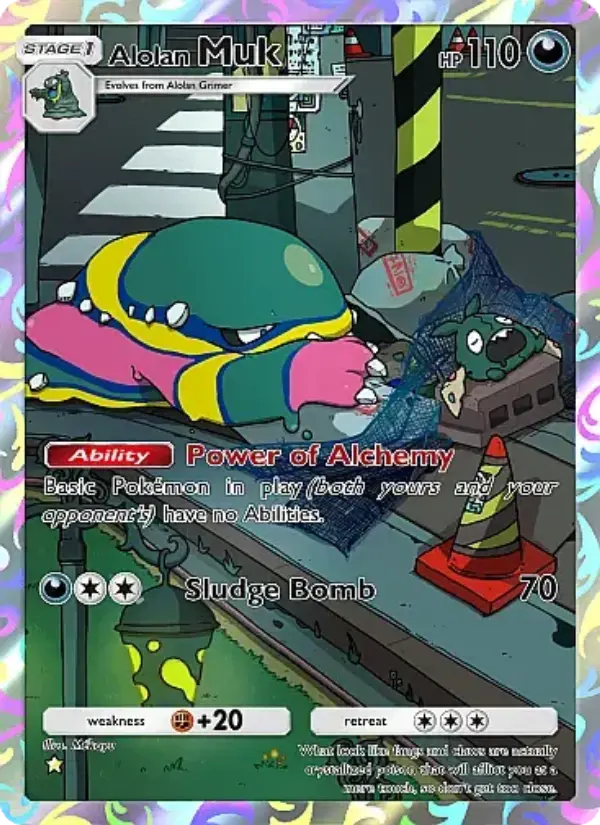
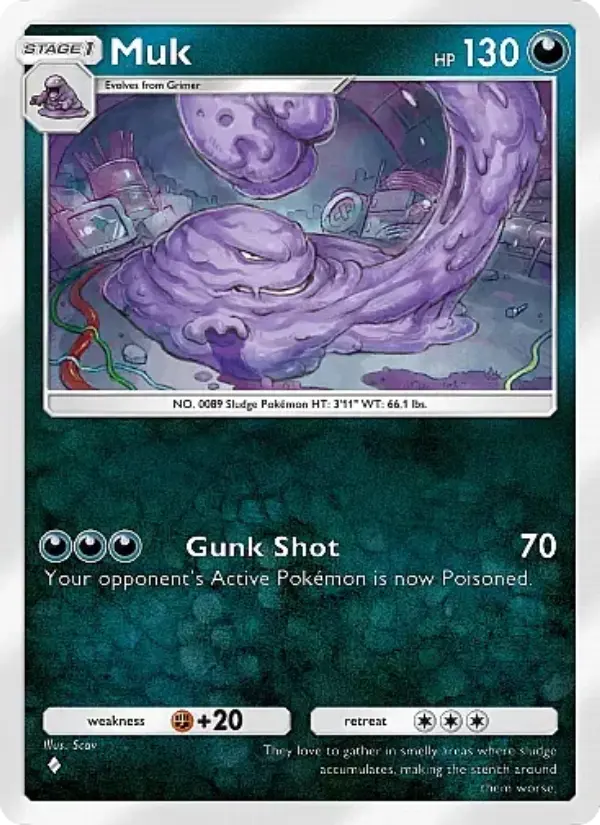
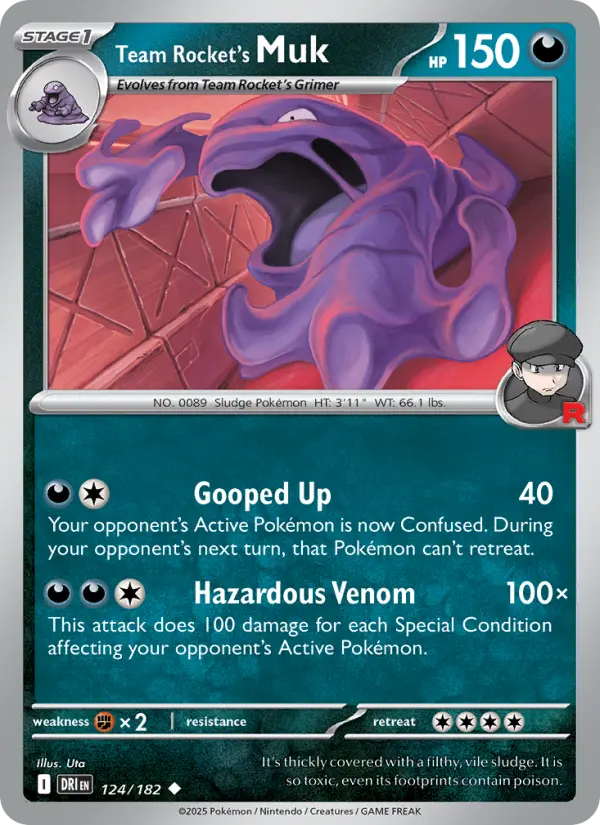
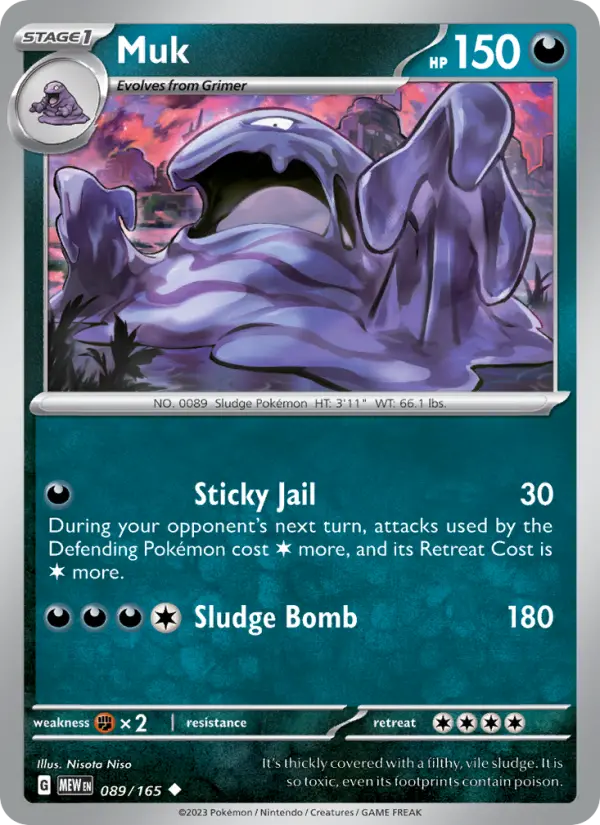
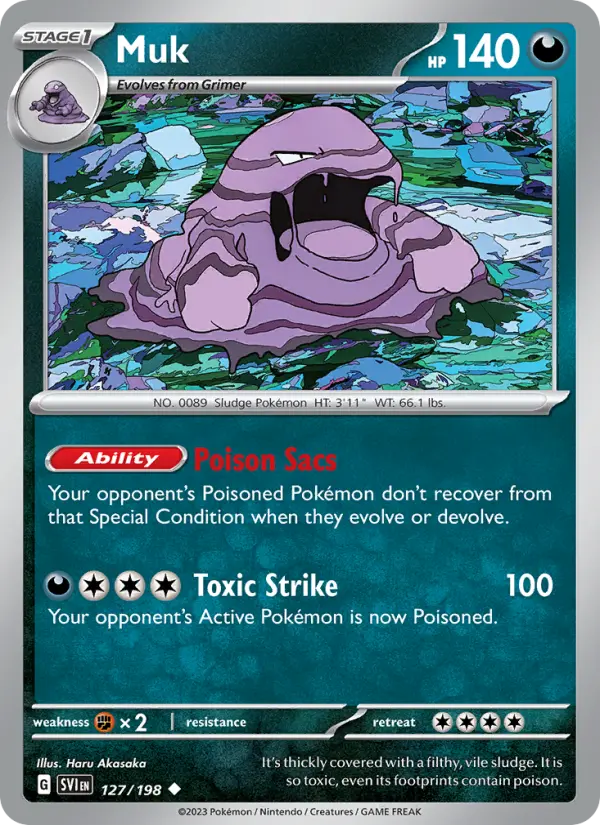
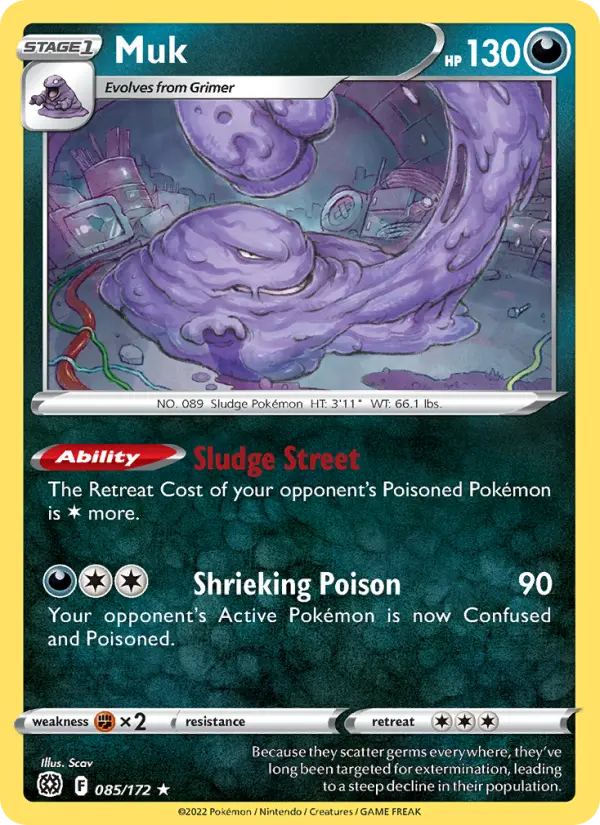
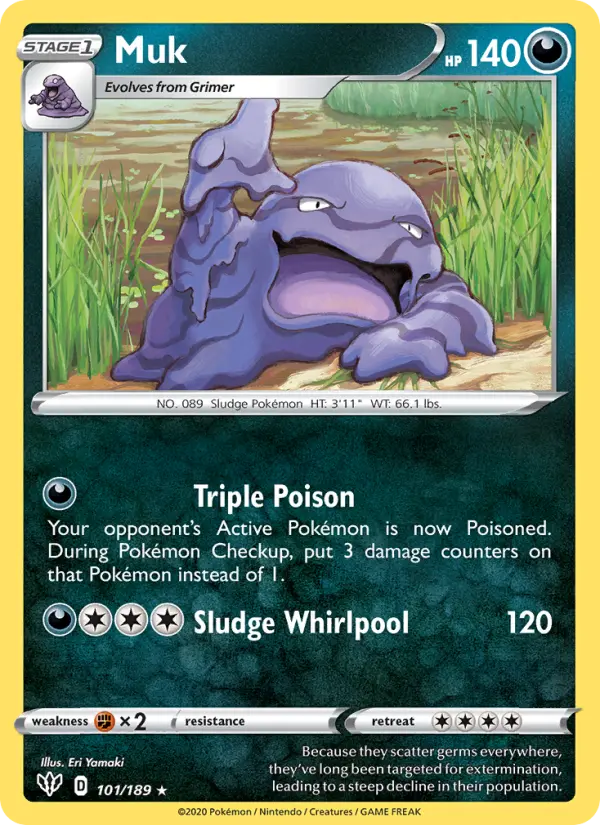
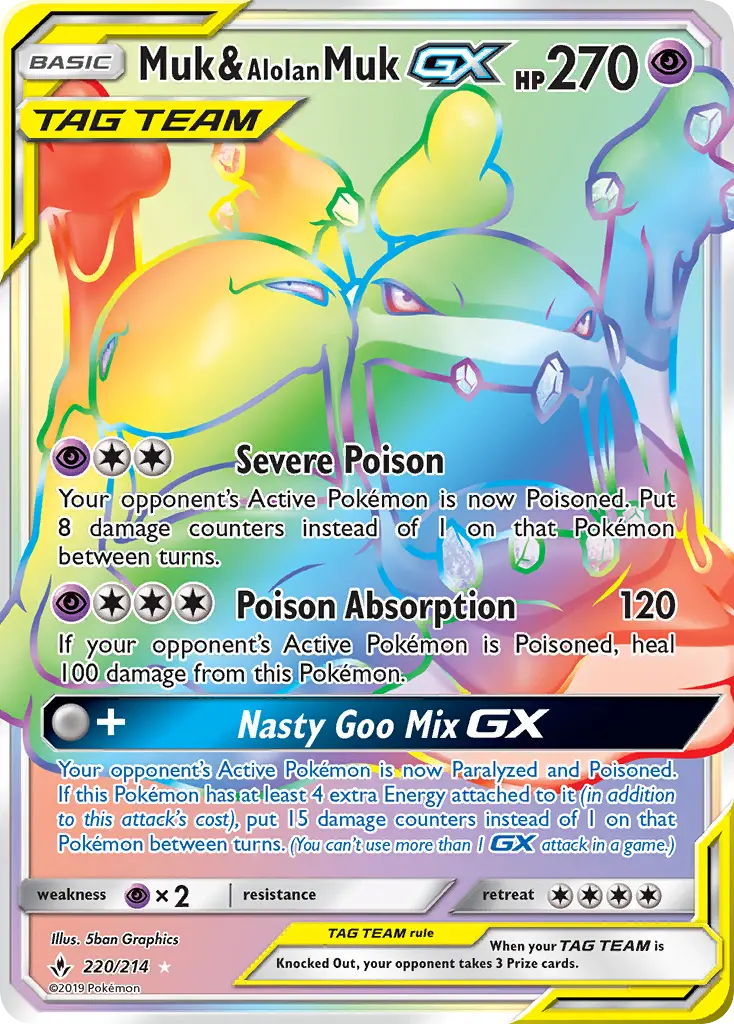
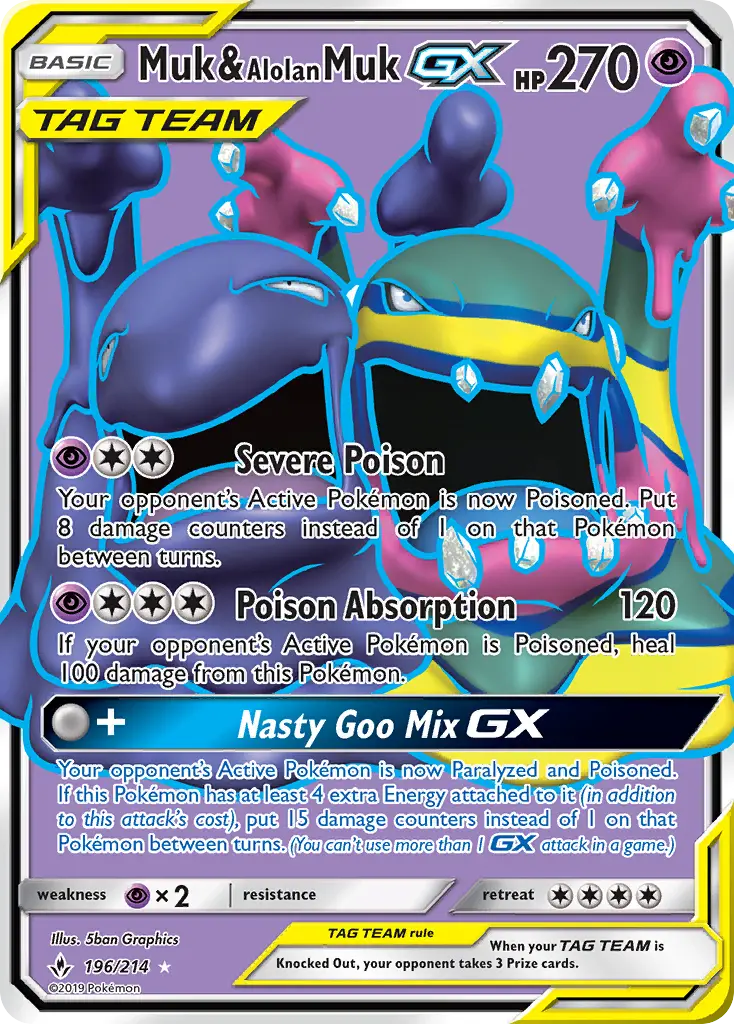
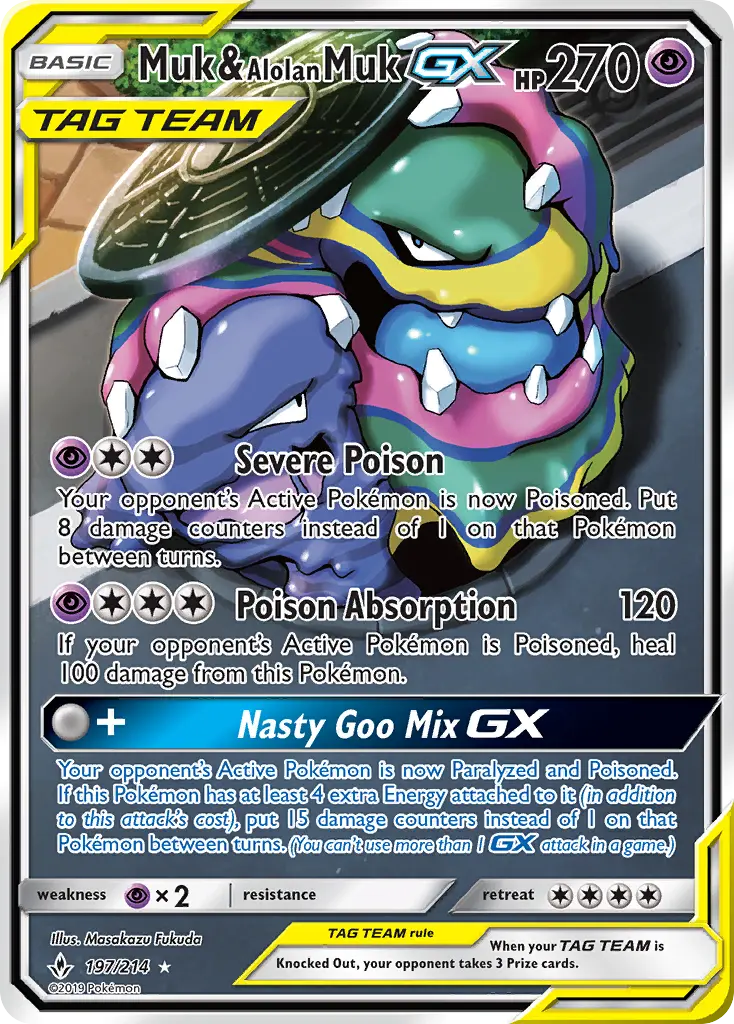
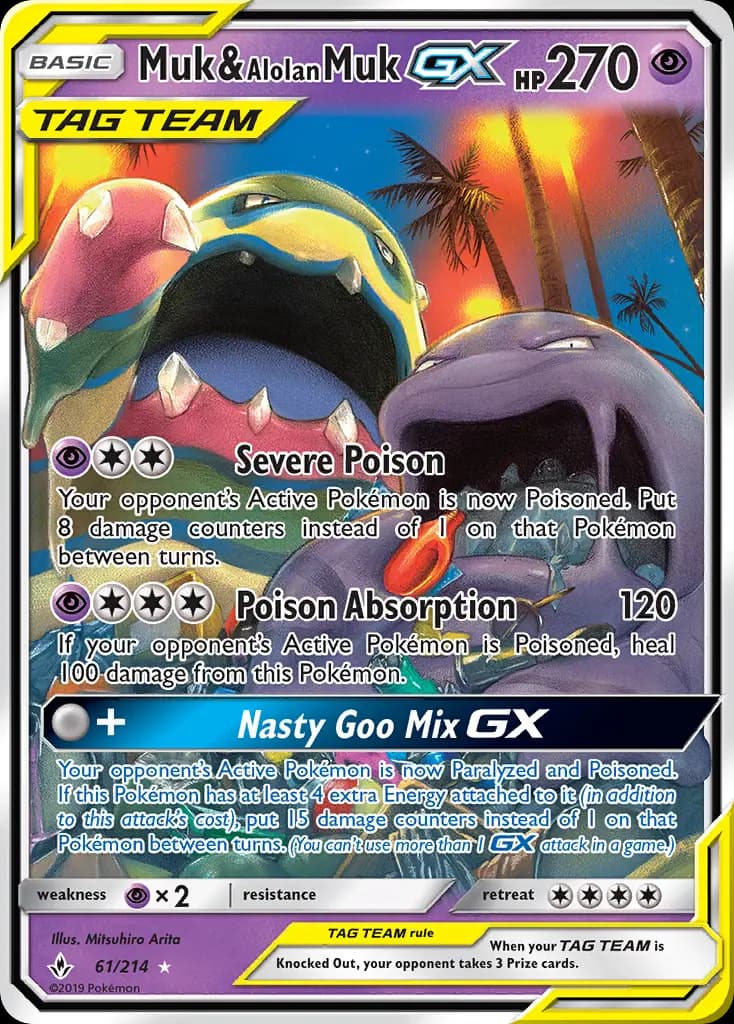
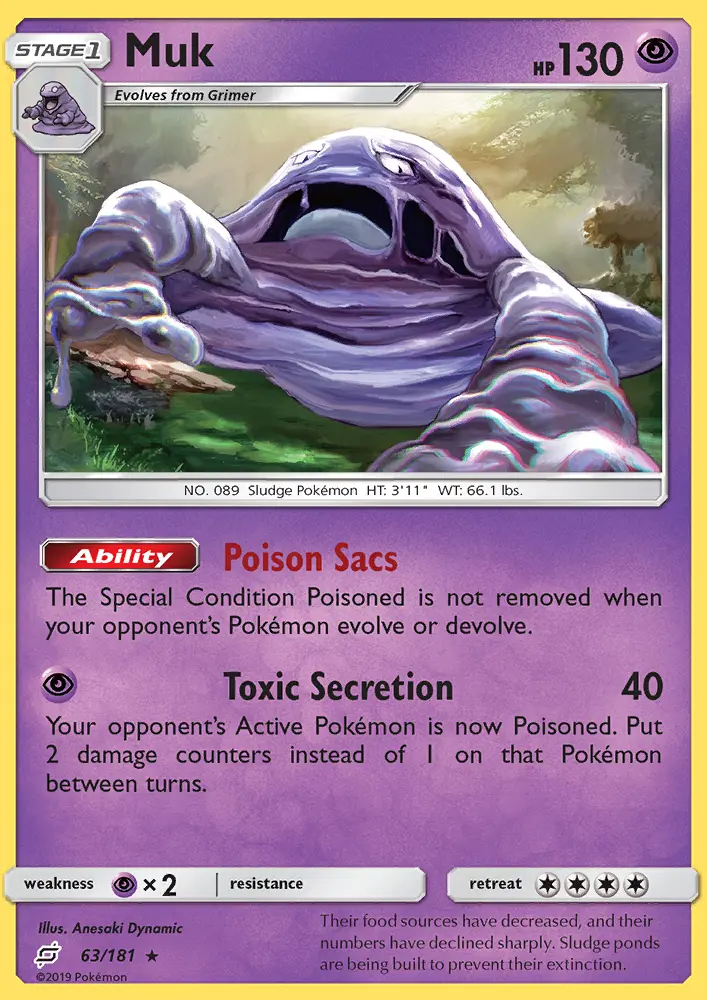
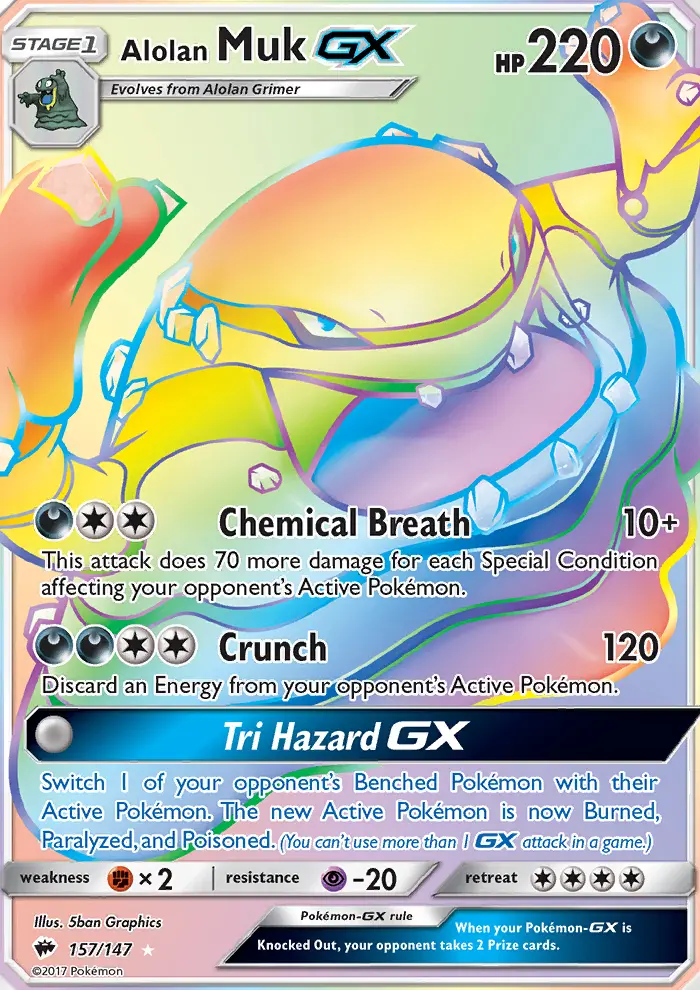
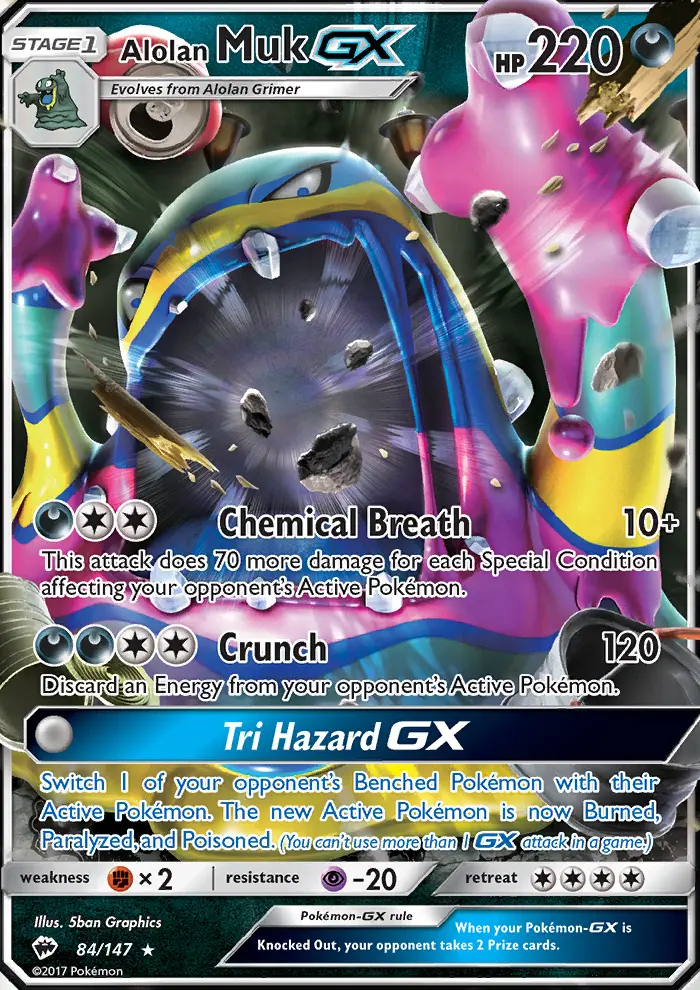
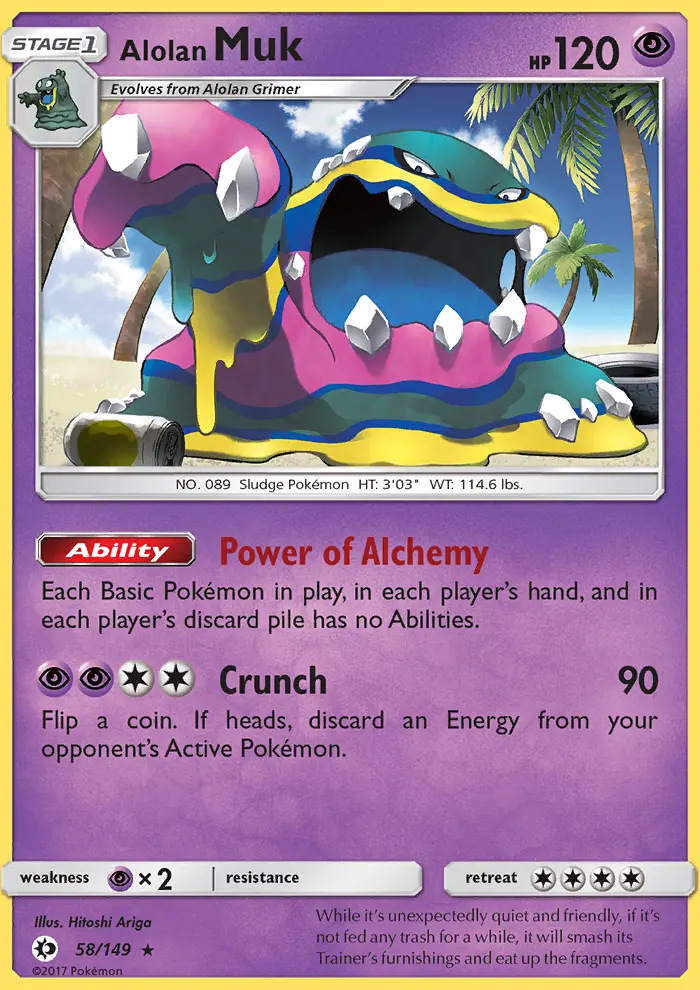
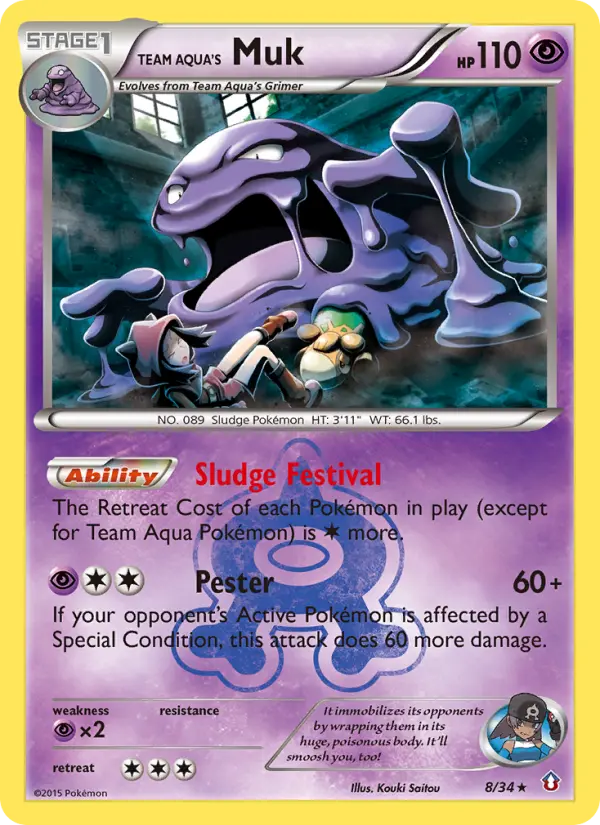
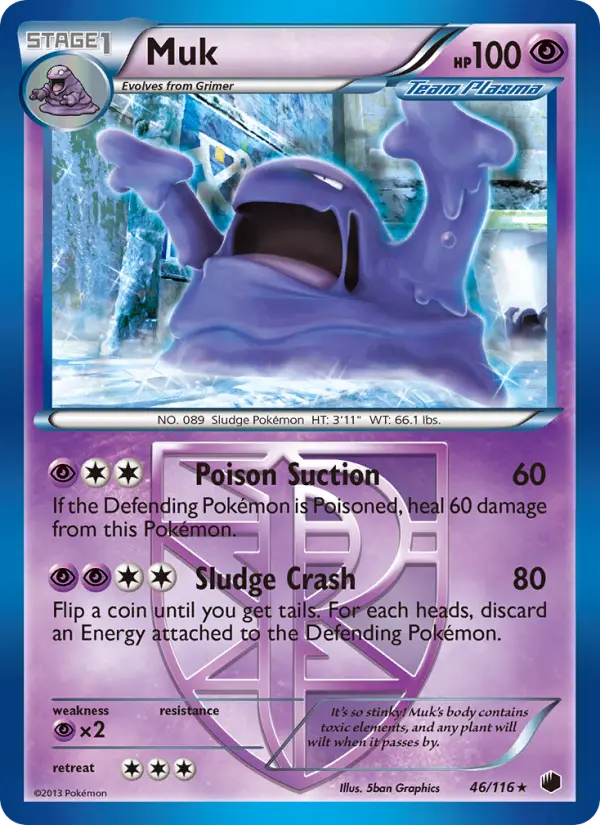
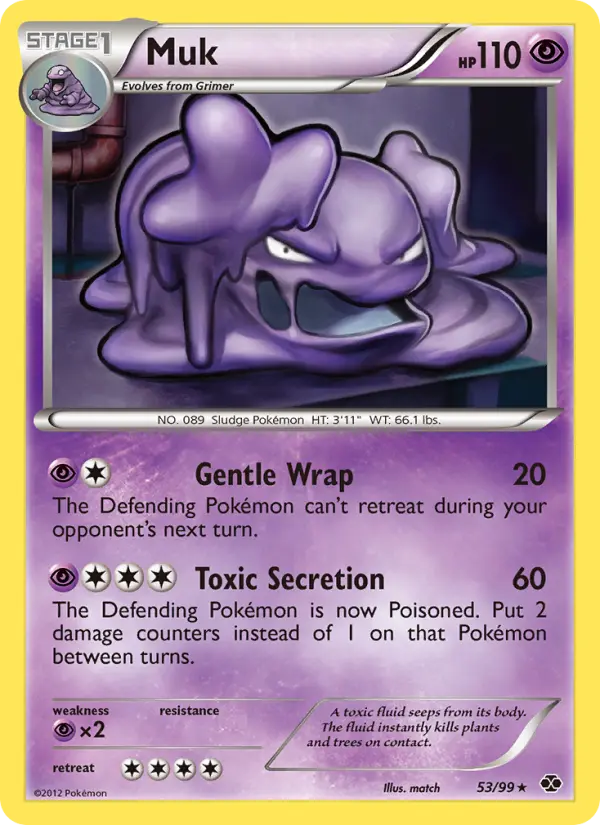
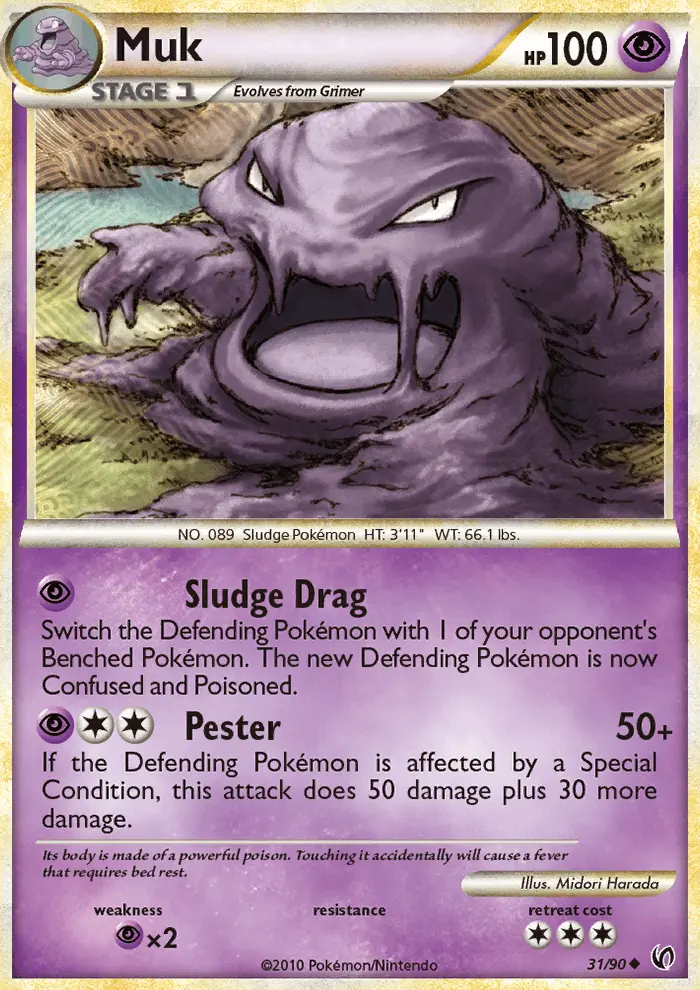
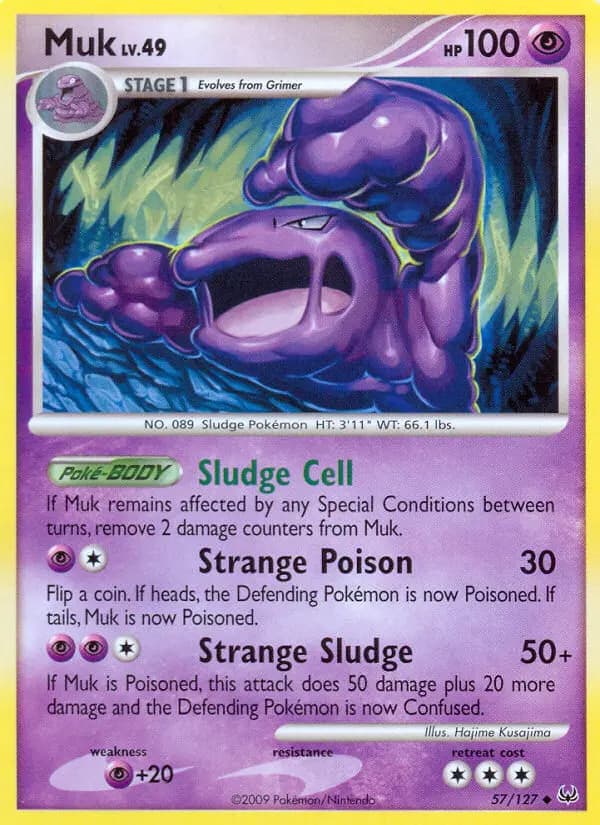
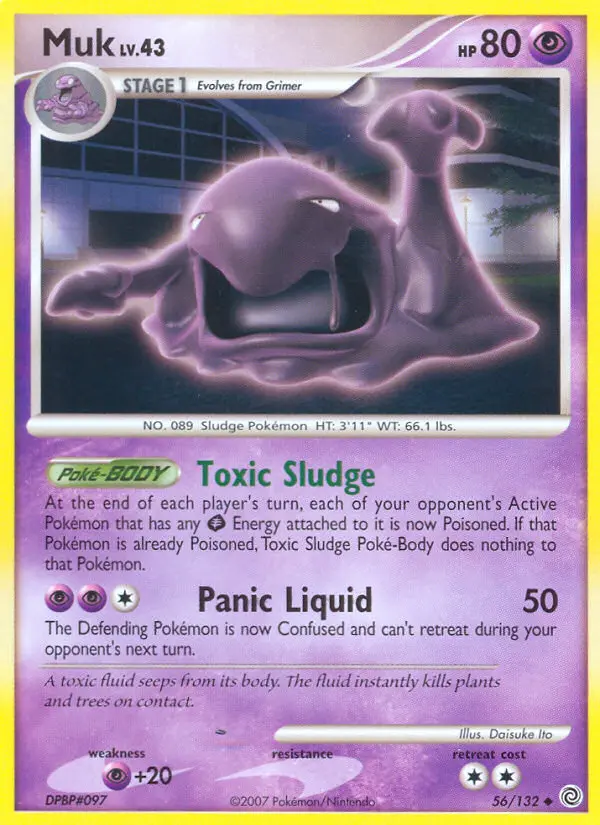
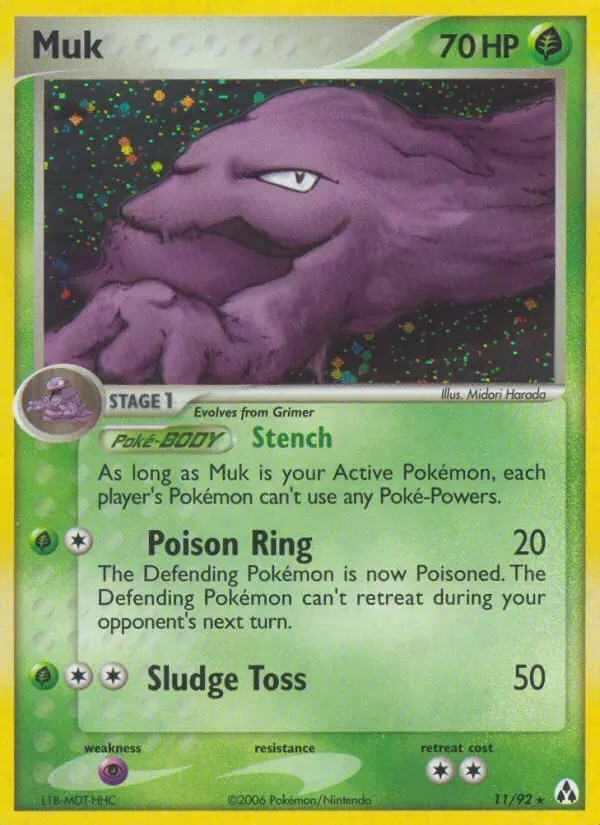
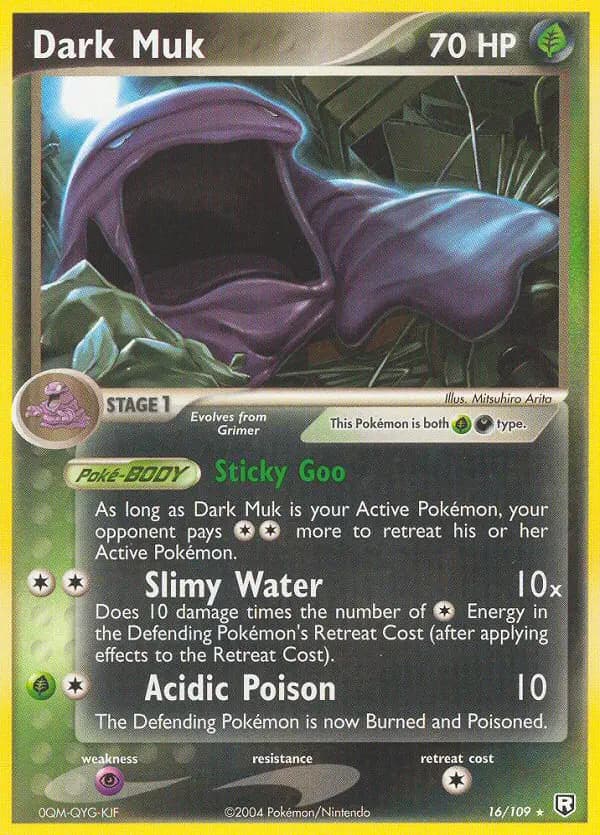
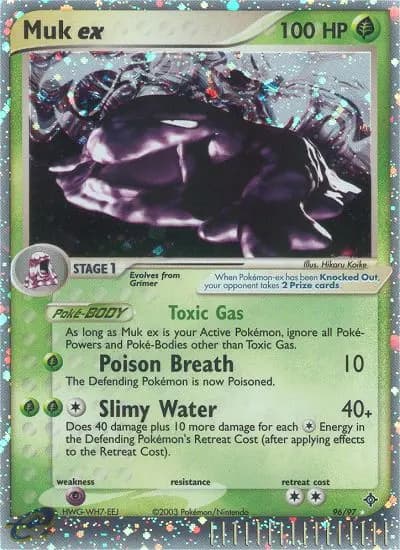
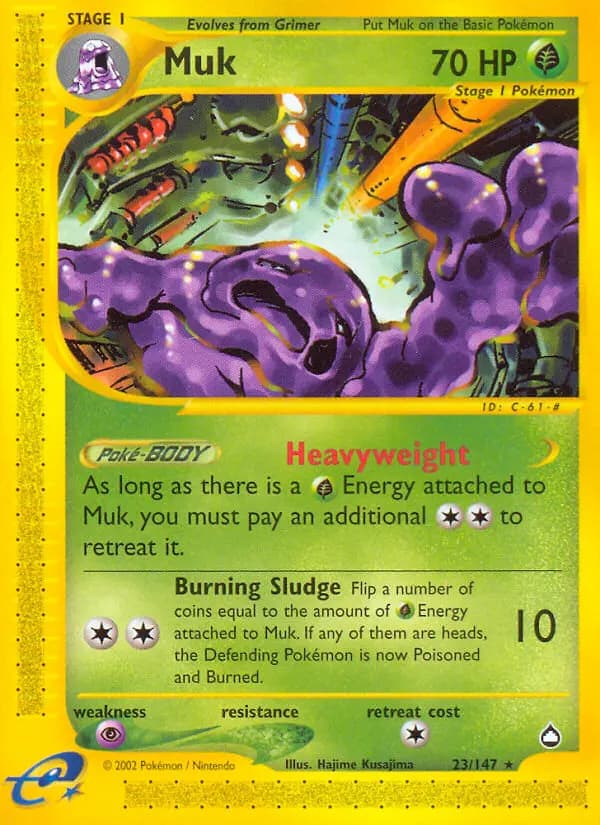
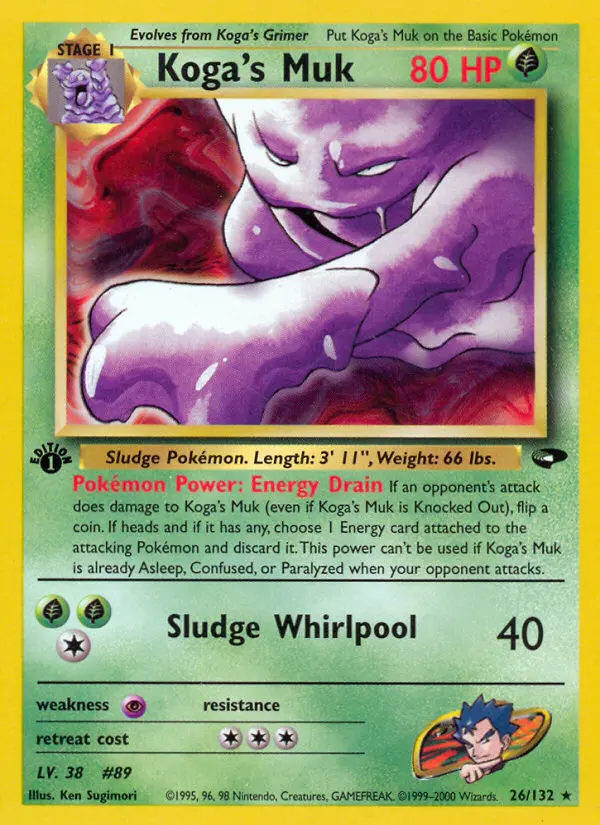
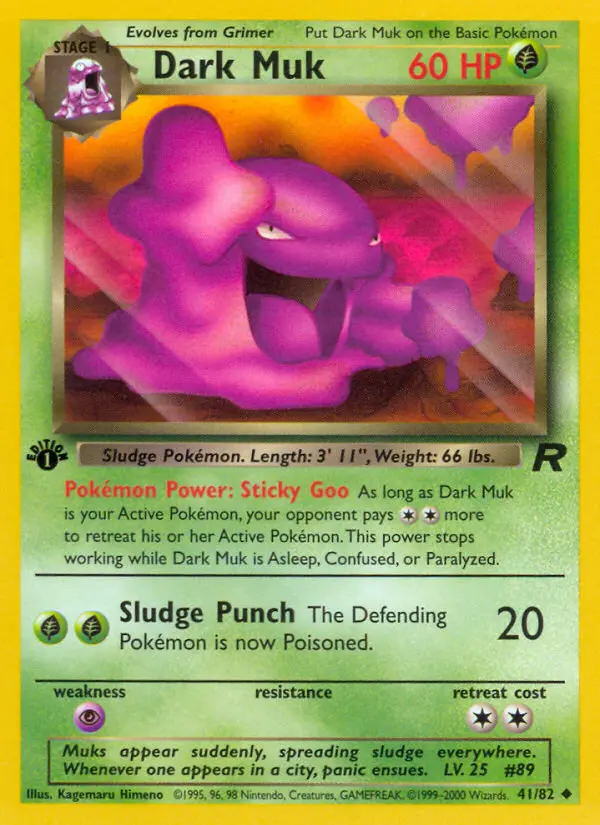
Muk achieved considerable prominence in the Pokémon animated series through Ash's personal Muk, which evolved from Grimer during his travels in the Kanto region and became a frequent team member throughout multiple seasons. This Muk's characteristic affection for Ash—despite its revolting appearance and toxic nature—created memorable comedic moments while simultaneously introducing young audiences to themes of accepting creatures regardless of their unpleasant attributes. The character helped establish Muk as an iconic representation of early-generation Pokémon design philosophy, demonstrating that functionality and emotional resonance could transcend traditional aesthetic appeal. In broader gaming culture, Muk has remained consistently available across nearly every mainline Pokémon title, ensuring multigenerational familiarity and nostalgic attachment from players who encountered it during their initial Game Boy experiences. The creature's thematic consistency—always portrayed as contamination made manifest, always occupying polluted spaces, always threatening environmental health—has made it a reliable environmental commentary device across multiple games and media. Trading card game representations have similarly emphasized Muk's toxic nature and overwhelming defensive capabilities, with various card iterations utilizing strategies built around poisoning and status condition propagation. The introduction of Alolan Muk expanded the species' cultural presence by demonstrating how regional variants could maintain thematic consistency while introducing mechanical diversity, making the character relevant to newer generational cohorts while maintaining longtime player familiarity.
Where to Find Muk in Every Pokémon Game
Muk's distribution across Pokémon games spans the entire franchise history, beginning with its original appearance in Pokémon Red, Blue, and Yellow as a Kanto region fixture that could be encountered in polluted areas or obtained through Grimer evolution. The species maintained consistent presence throughout subsequent generations, appearing in Gold/Silver/Crystal, Ruby/Sapphire/Emerald, FireRed/LeafGreen, HeartGold/SoulSilver, and Black 2/White 2 with varying regional Pokédex numbers reflecting its region-specific rarity. Modern titles including Pokémon Scarlet and Violet include Muk in their National Pokédex, with the Indigo Disk DLC specifically featuring opportunities to encounter and train Muk within the Blueberry Academy Terarium. The Alolan variant became available beginning with Pokémon Sun and Moon, where it inhabited the Alola region and appeared in subsequent Ultra Sun and Ultra Moon iterations with expanded availability. Pokémon Sword and Shield initially excluded Muk from the regional Pokédex but later included it through DLC expansions, ensuring competitive players maintained access to this toxic titan. The Let's Go series' faithful recreation of Kanto guaranteed Muk's inclusion and availability to modern players experiencing the first generation through contemporary mechanical frameworks. Additionally, Pokémon GO has featured Muk with periodic events and encounters, making it accessible to mobile-focused trainers who may not engage with mainline console titles, ensuring the species' continued relevance across disparate gaming platforms.