
Totem Alolan Raticate
Generation I · #10093 — Mouse Pokémon
At 1.4 m and 105 kg, Raticate-Totem-Alola doesn't look like much on paper, but its gluttony ability shapes how it actually plays more than its size suggests.
Editor's Take
Totem Raticate is simply a larger Alolan Raticate with a stat boost, and the Totem mechanic being exclusive to one generation makes these among the most stranded forms in the Pokédex.
Base Stats
Height
1.4m
Weight
105.0kg
Category
Mouse Pokémon
Gender
Male 50% / Female 50%
Color
brown
Shape
quadruped
Habitat
grassland
Abilities
Makes the Pokémon eat any held Berry triggered by low HP below 1/2 its max HP.
Strengthens physical moves to inflict 1.5× damage, but decreases their accuracy to 0.8×.
Halves damage from fire and ice moves.

Totem Alolan Raticate Biology & Physical Characteristics
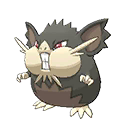
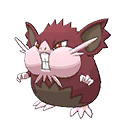
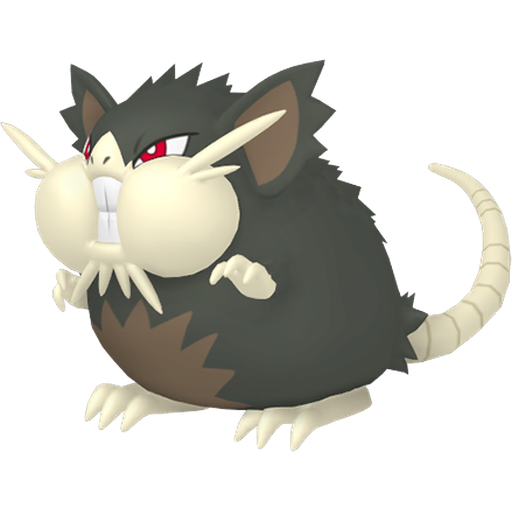
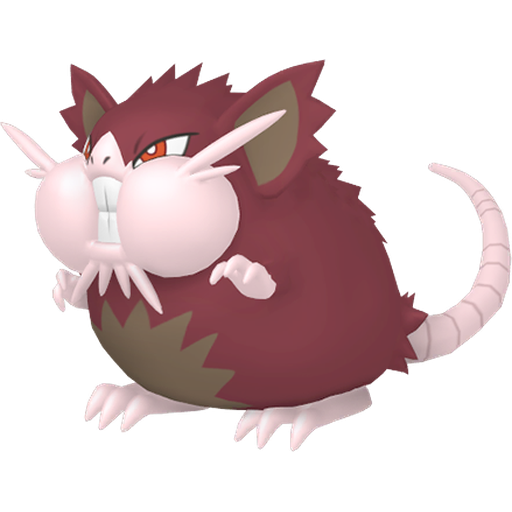
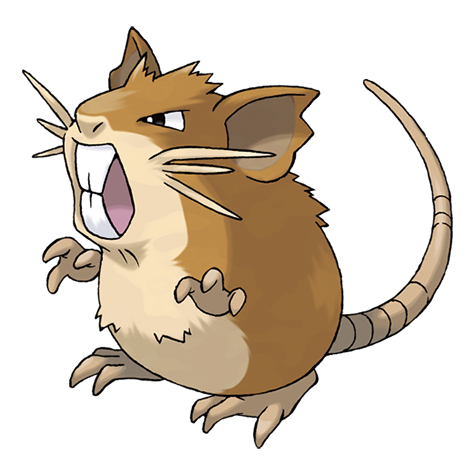
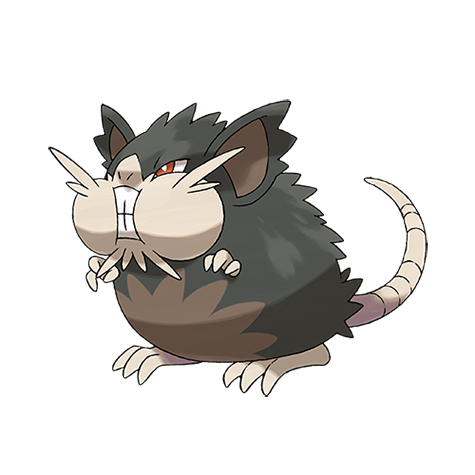
Alolan Raticate retains the fundamental rodent physiology of its base form but exhibits significant morphological adaptations suited to an island lifestyle. The species maintains its characteristic large incisors that grow constantly, prominent three-toed webbed feet designed for swimming, and long, scaly tail, but the Alolan form has developed a darker coloration scheme reflecting its Dark-type classification. Its body appears more robust and compact compared to the sleeker standard Raticate, with thicker limbs and a broader frame that supports its significantly increased weight of 105 kilograms. The webbed hind feet are particularly pronounced in this form, functioning as efficient flippers for aquatic navigation. The Pokédex notes that its hind feet are webbed, allowing it to be a strong swimmer capable of crossing rivers and sometimes even oceans, making these adaptations crucial to its survival in Alola's island-based geography. The species' whiskers remain prominent, serving the same function as in other Raticate forms for maintaining balance, though the overall musculature suggests a more powerful, sturdy frame than its Kanto relative.
Pokedex Numbers
Training
Breeding
Totem Alolan Raticate Breeding, Gender Ratio & Egg Groups
Alolan Raticate maintains a perfect 50-50 gender distribution, with both male and female specimens occurring equally in the wild and in breeding scenarios. The species belongs to the Field egg group, classifying it among terrestrial and semi-aquatic Pokémon capable of breeding together within that category. With a base happiness value of 70, Alolan Raticate demonstrates moderate receptiveness to its trainer, neither particularly distant nor exceptionally affectionate by default. Breeding pairs of Alolan Raticate require approximately 15 egg cycles to produce viable offspring, translating to 3,599 to 3,855 steps before hatching, making it a moderately quick-hatching species compared to more evolved legendaries or pseudo-legendaries. The species follows a medium growth rate, achieving level 20—the evolution threshold from Alolan Rattata—relatively quickly during early training phases. Gender-specific differences are not prominently documented in Pokédex entries, suggesting that male and female Alolan Raticate are visually and behaviorally similar, unlike some species where sexual dimorphism is pronounced. Trainers seeking specific natures or individual values can breed Alolan Raticate pairs efficiently, though the requirement to evolve Alolan Rattata specifically at night means breeders must carefully manage evolution timing to produce the desired regional form.
Sprites


Held Items
Pecha Berry
medicine
Held: Consumed when poisoned to cure poison.
Cost: 80
Pecha Berry
medicine
Held: Consumed when poisoned to cure poison.
Cost: 80
Pecha Berry
medicine
Held: Consumed when poisoned to cure poison.
Cost: 80
Pecha Berry
medicine
Held: Consumed when poisoned to cure poison.
Cost: 80
TMs & HMs
tm02
lets go pikachu lets go eevee
tm03
yellow
tm03
red blue
tm03
blue japan
tm03
red green japan
tm05
ruby sapphire
tm05
emerald
tm05
gold silver
tm05
crystal
tm05
diamond pearl
tm05
black white
tm05
platinum
tm05
heartgold soulsilver
tm05
firered leafgreen
tm05
black 2 white 2
tm05
omega ruby alpha sapphire
tm05
x y
tm05
xd
tm05
colosseum
tm05
lets go pikachu lets go eevee
+614 more TMs/HMs
Regional & Special Forms
Totem Alolan Raticate also has 2 related forms: Raticate and Alolan Raticate.
Gender Differences
This Pokémon has visible differences between male and female forms.
Totem Alolan Raticate's Evolution Chain


Totem Alolan Raticate Evolution, Mega Evolution & Special Forms
Alolan Raticate evolves from Alolan Rattata when leveled up at night, starting at level 20, creating a unique evolution mechanic distinct from the standard Raticate evolution that requires no time condition. This nocturnal evolution requirement reflects the Alolan form's darker nature and potentially suggests behavioral adaptations tied to Alola's day-night cycles. The evolution represents a dramatic transformation in capability and stat distribution compared to evolving standard Rattata into standard Raticate. Base HP increases from 55 to 75, special defense rises from 70 to 80, and overall speed grows from 97 to 77, while special attack drops to just 40, making this a form that trades offensive versatility for defensive durability. Interestingly, neither Raticate form receives Mega Evolution, distinguishing it from many Generation I Pokémon that received Mega Stone adaptations in later generations. The Alolan Raticate essentially represents the final evolution for Alolan Rattata, with no further transformations available, though its three distinct ability options—Gluttony, Hustle, or the hidden ability Thick Fat—provide different strategic directions upon evolution.
Where to Find
Location data not available for this Pokémon in the database.
Totem Alolan Raticate Behaviour and Natural Habitat
Alolan Raticate displays a temperament considerably more aggressive than its appearance suggests, with the Moon version Pokédex entry explicitly warning that trainers should not let their hands get too close to its face, as it could bite clean off. This behavioral shift likely corresponds to its evolution in Alola's more competitive ecosystem where island isolation may have intensified predatory instincts. The species is strongly associated with aquatic environments, as evidenced by its webbed feet and swimming capabilities that allow it to hunt for prey in rivers and navigate between islands. Unlike standard Raticate which frequents underground areas and human settlements, the Alolan form appears to have adapted to semi-aquatic niches, using its superior swimming ability to access food sources unavailable to terrestrial rodents. The species' diet and foraging patterns remain similar to its base form, though accounts suggest Alolan Raticate may have diversified its prey selection to include aquatic creatures encountered during island crossings. Its violent disposition compared to gentler Pokémon suggests it occupies a more prominent predatory role within Alola's food chain than standard Raticate occupies in Kanto.
Pokedex Entries
It uses its whis kers to maintain its balance. It apparently slows down if they are cut off.
Its hind feet are webbed. They act as flippers, so it can swim in rivers and hunt for prey.
Gnaws on anything with its tough fangs. It can even topple concrete buildings by gnaw ing on them.
Its whiskers help it to maintain balance. Its fangs never stop grow ing, so it gnaws to pare them down.
The webs on its hind legs enable it to cross rivers. It search es wide areas for food.
RATICATE’s sturdy fangs grow steadily. To keep them ground down, it gnaws on rocks and logs. It may even chew on the walls of houses.
A RATICATE’s sturdy fangs grow steadily. To keep them ground down, it gnaws on rocks and logs. It may even chew on the walls of houses.
Its rear feet have three toes each. They are webbed, enabling it to swim across rivers.
It uses its whiskers to maintain its balance. It apparently slows down if they are cut off.
It whittles its constantly growing fangs by gnawing on hard things. It can chew apart cinder walls.
Gnaws on anything with its tough fangs. It can even topple concrete buildings by gnawing on them.
Its whiskers help it to maintain balance. Its fangs never stop growing, so it gnaws to pare them down.
It whittles its constantly growing fangs by gnawing on hard things. It can chew apart cinder walls.
With its long fangs, this surprisingly violent Pokémon can gnaw away even thick concrete with ease.
It whittles its constantly growing fangs by gnawing on hard things. It can chew apart cinder walls.
The webs on its hind legs enable it to cross rivers. It searches wide areas for food.
Raticate’s sturdy fangs grow steadily. To keep them ground down, it gnaws on rocks and logs. It may even chew on the walls of houses.
Raticate’s sturdy fangs grow steadily. To keep them ground down, it gnaws on rocks and logs. It may even chew on the walls of houses.
Its hind feet are webbed, so it’s a strong swimmer. It can cross rivers and sometimes even oceans.
People say that it fled from its enemies by using its small webbed hind feet to swim from island to island in Alola.
Its disposition is far more violent than its looks would suggest. Don’t let your hand get too close to its face, as it could bite your hand clean off.
Its whiskers are essential for maintaining its balance. No matter how friendly you are, it will get angry and bite you if you touch its whiskers.
Its hind feet are webbed. They act as flippers, so it can swim in rivers and hunt for prey.
Totem Alolan Raticate Name Origin & Design Inspiration
The name Raticate combines 'rat' with the suffix '-icate,' suggesting multiplication or intensification of the rat concept into a larger, more dangerous specimen. The Alolan regional form maintains this naming convention while emphasizing the Dark-type nature through visual design elements including darker coloration and a more menacing appearance. The genus designation of 'Mouse Pokémon' persists across all Raticate forms despite the species being more accurately described as a large rodent rather than a true mouse, maintaining consistency with Generation I conventions. The design philosophy behind Alolan Raticate appears to draw inspiration from real-world adaptations seen in island fauna, particularly focusing on swimming and diving capabilities that mirror aquatic rodent species. The darker coloration scheme suggests adaptation to nocturnal lifestyles, which aligns with the species' requirement to evolve at night. The increased bulk and emphasis on physical presence over speed reflects the survival pressures of island ecosystems where larger, stronger individuals might outcompete smaller or faster variants in competition for island resources and territory.
Learnable Moves
Totem Alolan Raticate can learn 63 moves:
Move | Type | Cat. | Power | Acc. | PP |
|---|---|---|---|---|---|
| assurance | dark | Physical | 60 | 100 | 10 |
| attract | normal | Status | — | 100 | 15 |
| bite | dark | Physical | 60 | 100 | 25 |
| blizzard | ice | Special | 110 | 70 | 5 |
| bulk up | fighting | Status | — | — | 20 |
| confide | normal | Status | — | — | 20 |
| covet | normal | Physical | 60 | 100 | 25 |
| crunch | dark | Physical | 80 | 100 | 15 |
| dark pulse | dark | Special | 80 | 100 | 15 |
| double team | normal | Status | — | — | 15 |
| double edge | normal | Physical | 120 | 100 | 15 |
| embargo | dark | Status | — | 100 | 15 |
| endeavor | normal | Physical | — | 100 | 5 |
| facade | normal | Physical | 70 | 100 | 20 |
| focus energy | normal | Status | — | — | 30 |
| frustration | normal | Physical | — | 100 | 20 |
| giga impact | normal | Physical | 150 | 90 | 5 |
| grass knot | grass | Special | — | 100 | 20 |
| hidden power | normal | Special | 60 | 100 | 15 |
| hyper beam | normal | Special | 150 | 90 | 5 |
| hyper fang | normal | Physical | 80 | 90 | 15 |
| ice beam | ice | Special | 90 | 100 | 10 |
| icy wind | ice | Special | 55 | 95 | 15 |
| iron tail | steel | Physical | 100 | 75 | 15 |
| knock off | dark | Physical | 65 | 100 | 20 |
| last resort | normal | Physical | 140 | 100 | 5 |
| protect | normal | Status | — | — | 10 |
| pursuit | dark | Physical | 40 | 100 | 20 |
| quash | dark | Status | — | 100 | 15 |
| quick attack | normal | Physical | 40 | 100 | 30 |
| rain dance | water | Status | — | — | 5 |
| rest | psychic | Status | — | — | 5 |
| return | normal | Physical | — | 100 | 20 |
| roar | normal | Status | — | — | 20 |
| round | normal | Special | 60 | 100 | 15 |
| scary face | normal | Status | — | 100 | 10 |
| shadow ball | ghost | Special | 80 | 100 | 15 |
| shadow claw | ghost | Physical | 70 | 100 | 15 |
| shock wave | electric | Special | 60 | — | 20 |
| sleep talk | normal | Status | — | — | 10 |
| sludge bomb | poison | Special | 90 | 100 | 10 |
| sludge wave | poison | Special | 95 | 100 | 10 |
| snarl | dark | Special | 55 | 95 | 15 |
| snatch | dark | Status | — | — | 10 |
| snore | normal | Special | 50 | 100 | 15 |
| stomping tantrum | ground | Physical | 75 | 100 | 10 |
| substitute | normal | Status | — | — | 10 |
| sucker punch | dark | Physical | 70 | 100 | 5 |
| sunny day | fire | Status | — | — | 5 |
| super fang | normal | Physical | — | 90 | 10 |
| swagger | normal | Status | — | 85 | 15 |
| swords dance | normal | Status | — | — | 20 |
| tackle | normal | Physical | 40 | 100 | 35 |
| tail whip | normal | Status | — | 100 | 30 |
| taunt | dark | Status | — | 100 | 20 |
| thief | dark | Physical | 60 | 100 | 25 |
| throat chop | dark | Physical | 80 | 100 | 15 |
| torment | dark | Status | — | 100 | 15 |
| toxic | poison | Status | — | 90 | 10 |
| u turn | bug | Physical | 70 | 100 | 20 |
| uproar | normal | Special | 90 | 100 | 10 |
| venoshock | poison | Special | 65 | 100 | 10 |
| zen headbutt | psychic | Physical | 80 | 90 | 15 |
Totem Alolan Raticate Competitive Battle Guide
Alolan Raticate occupies a unique competitive niche as a bulky Dark-type physical wallbreaker with surprising defensive capabilities thanks to its 80 special defense and 75 HP, creating a total stat distribution that emphasizes durability over offense. The base attack stat of 71 is respectable for physical attacks, though not exceptional, while the speed of 77 allows it to outpace many defensive walls but fall short of dedicated speedsters. Its ability Hustle presents an interesting strategic choice, amplifying physical move power to 1.5× damage while reducing accuracy to 80%, creating high-risk, high-reward offensive plays that demand careful move selection and strategic prediction. The hidden ability Thick Fat proves particularly valuable, halving damage from Fire-type and Ice-type moves, which grants protection against common competitive threats while maintaining competitive viability. Gluttony, the standard ability option, enables Alolan Raticate to consume held berries when health drops below half, providing passive recovery and status condition management during extended battles. The Dark/Normal typing grants useful resistances to Ghost and Dark moves while carrying only Fighting-type weakness, making it less exposed than pure Normal-types, though the 4× weakness to Fighting moves remains a significant vulnerability against common physical attackers. Move pool diversity allows Alolan Raticate to function as a mixed attacker despite poor special attack, accessing important coverage moves that maximize its ability to pressure diverse opponents.
Commonly Asked Questions About Totem Alolan Raticate
What type is Totem Alolan Raticate?
Totem Alolan Raticate is a dark and normal type Pokemon.
What does Totem Alolan Raticate evolve into?
Totem Alolan Raticate does not evolve into any other Pokemon. It is the final form in its evolution line.
What are Totem Alolan Raticate's weaknesses?
Totem Alolan Raticate is weak to fighting, bug and fairy type moves.
Totem Alolan Raticate Cultural Impact & Franchise History
Alolan Raticate represents a significant milestone in Pokémon design philosophy as part of Generation VII's regional form innovations introduced in Pokémon Sun and Moon, establishing the precedent for revisiting classic Generation I species with environmental adaptations. The concept of the Alolan form appealed strongly to competitive players and casual trainers alike, offering fresh takes on familiar creatures while respecting their original designs and cultural significance. Social media communities embraced Alolan Raticate particularly after its appearance as a Totem Pokémon in Sun and Moon, where players encountered this empowered variant as a challenging rival during their Alola adventure. The species' darker appearance and more aggressive personality created interesting narrative contrast with the friendly, bumbling standard Raticate many players remembered from earlier games, sparking discussions about ecological adaptation and environmental influences on Pokémon behavior. Merchandise featuring Alolan Raticate emerged alongside merchandise for other Alolan forms, though Raticate never achieved the overwhelming popularity of Alolan Exeggutor or Alolan Vulpix. Competitive tournaments incorporating Alola-region Pokédex restrictions elevated Alolan Raticate to tournament viability, where skilled players demonstrated its potential as a bulky physical threat capable of surprising unprepared opponents. The Totem variant specifically became iconic within Pokémon Sun and Moon's narrative, serving as a memorable encounter that illustrated how Alolan species outpaced standard variants in power and capability.
Where to Find Totem Alolan Raticate in Every Pokémon Game
Alolan Raticate first became available in Pokémon Sun and Moon, where players could encounter it both as a regular spawn and as a Totem Pokémon variant in specific locations throughout Alola. The regional form has remained available across subsequent Alola-set games including Ultra Sun and Ultra Moon, maintaining its position as a prominent rodent-type option within the island region's Pokédex. In Pokémon Sword and Shield, Alolan Raticate became available through the Isle of Armor expansion DLC, allowing players from later generations to capture and train this regional variant. The species maintains availability in Pokémon Legends: Arceus, Pokémon Scarlet and Violet, and Pokémon Sword and Shield's base game depending on individual version and DLC content, though availability fluctuates based on version exclusivity and post-game content updates. Trainers can capture Alolan Raticate directly as fully evolved specimens in most appearances, or breed Alolan Raticate pairs to produce Alolan Rattata offspring that evolve at night. The Pokémon Home service facilitates transfer of Alolan Raticate between compatible games, allowing players to move captured specimens forward through generations. Its base capture rate of 127 makes Alolan Raticate relatively straightforward to capture with standard Poké Balls, though its aggressive nature and combat capability mean trainers should approach wild encounters prepared for meaningful battles rather than trivial captures.