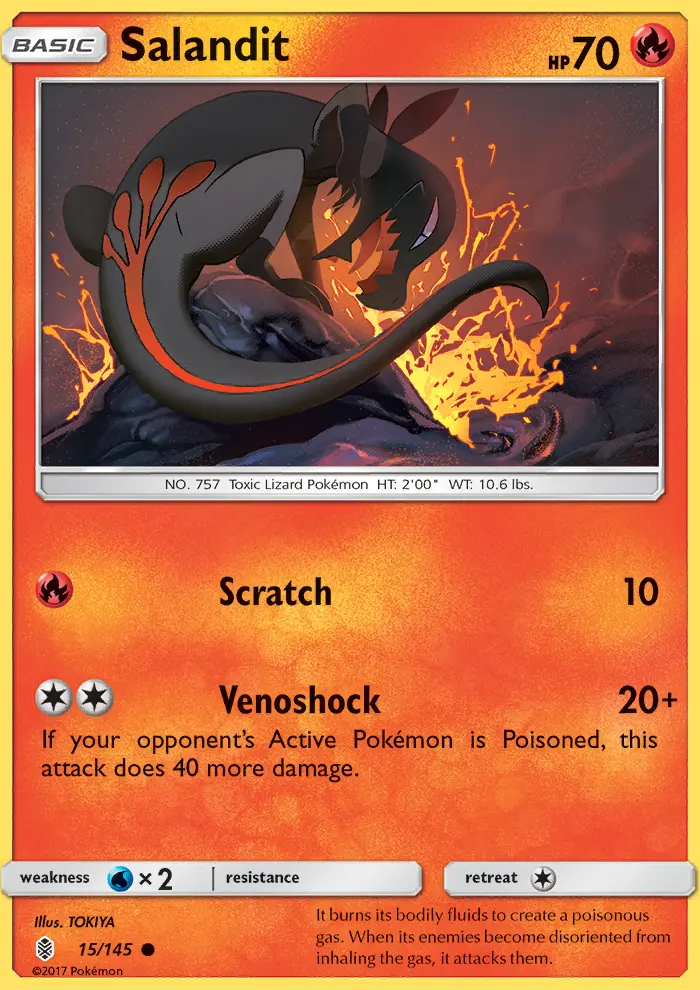
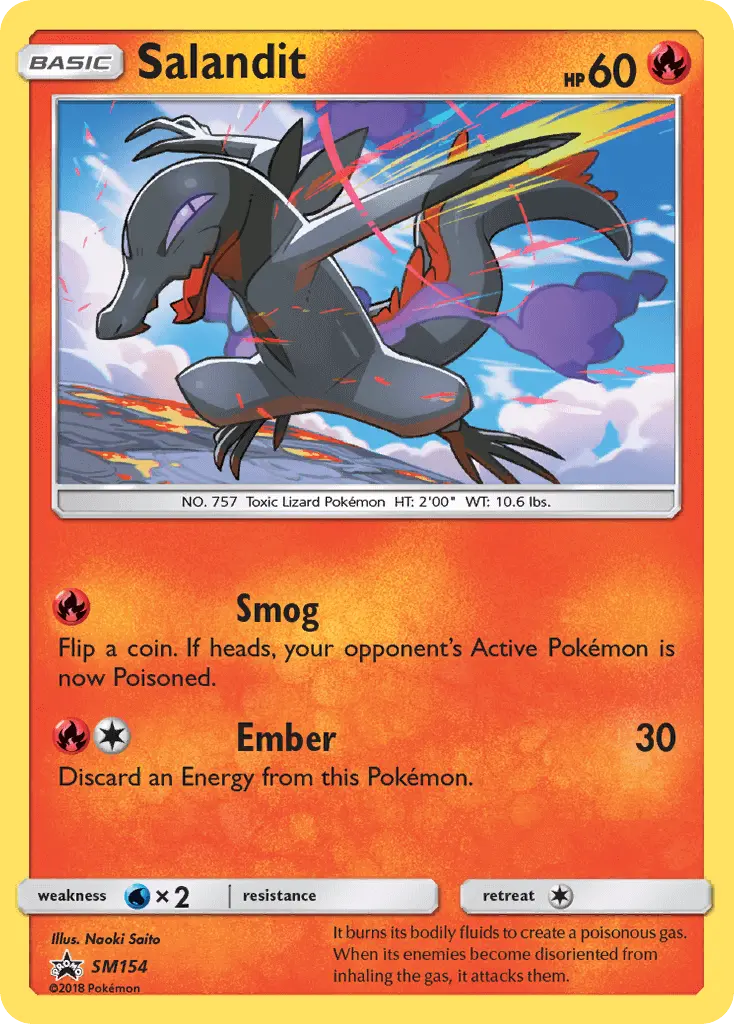
Salandit
Generation VII · #0757 — Toxic Lizard Pokémon
Few poison/fire-type Pokémon pair corrosion with a stat lean toward hp quite like Salandit does. With a total stat allocation of 320, Salandit may not appear formidable at first glance, but its cunning nature and specialized abilities allow it to overcome significantly more powerful opponents through tactical maneuvering and toxic strategy. The species embodies a delicate balance of weakness and strength, where intelligence and environmental adaptation compensate for raw power.
Editor's Take
Salandit only evolves if it is female, which means 87.5% of them are permanently stuck — the same gate Combee faces, applied to a considerably better endpoint.
Base Stats
Height
0.6m
Weight
4.8kg
Category
Toxic Lizard Pokémon
Gender
Male 87.5% / Female 12.5%
Color
black
Shape
quadruped
Abilities
This Pokémon can inflict poison on Poison and Steel Pokémon.
Prevents infatuation and protects against captivate.
Salandit Biology & Physical Characteristics
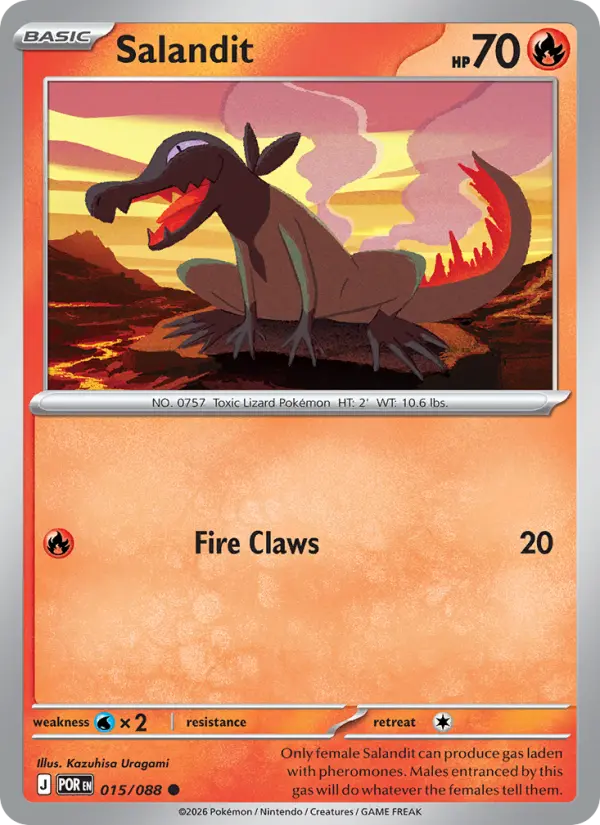
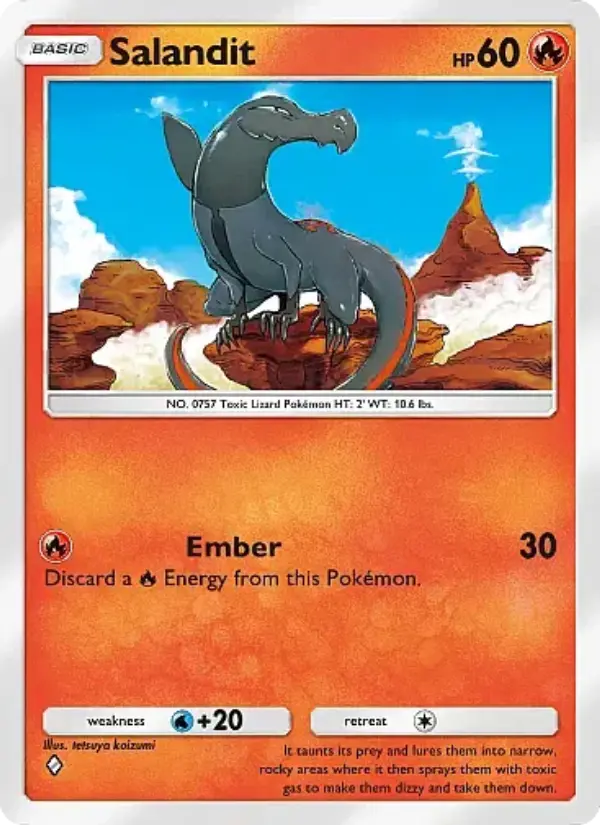
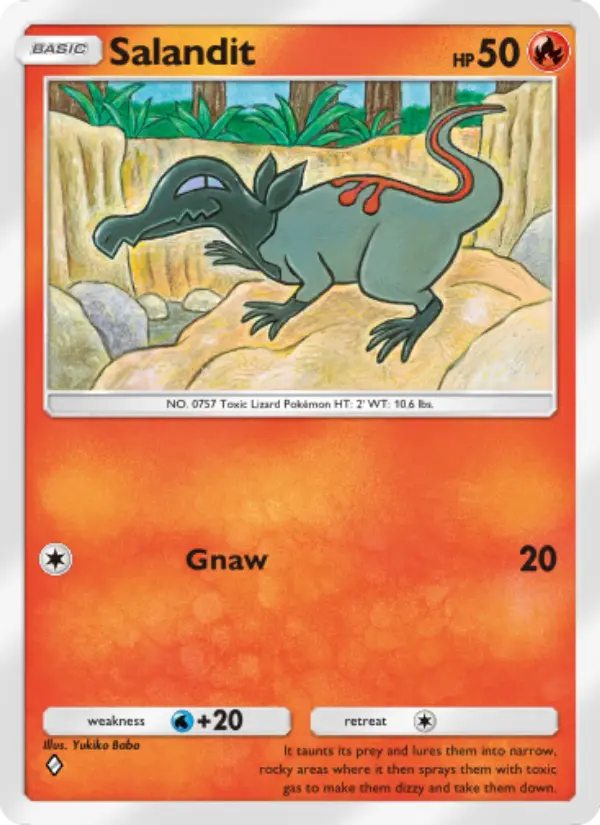
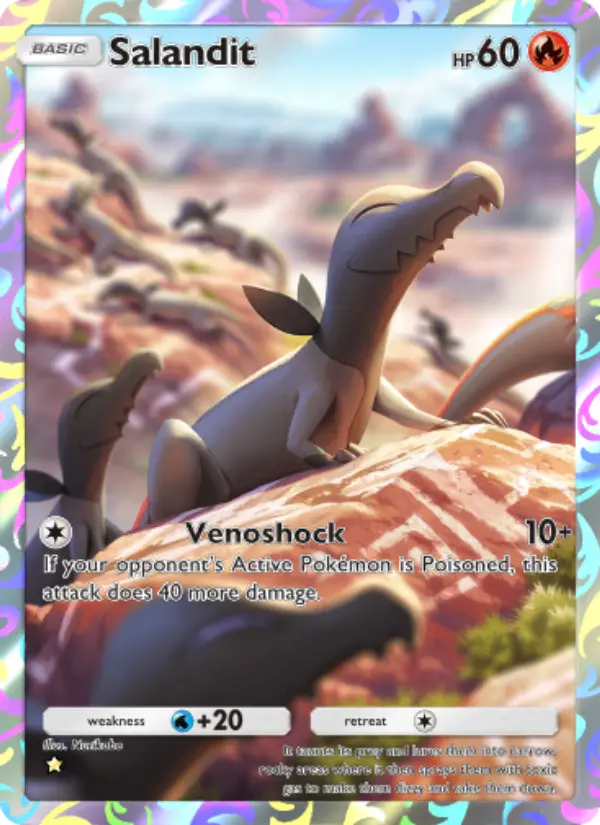
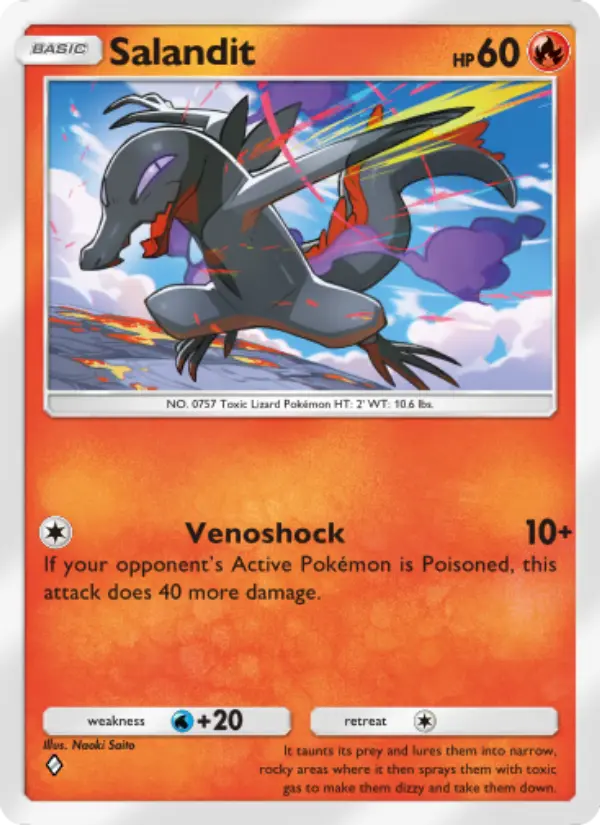
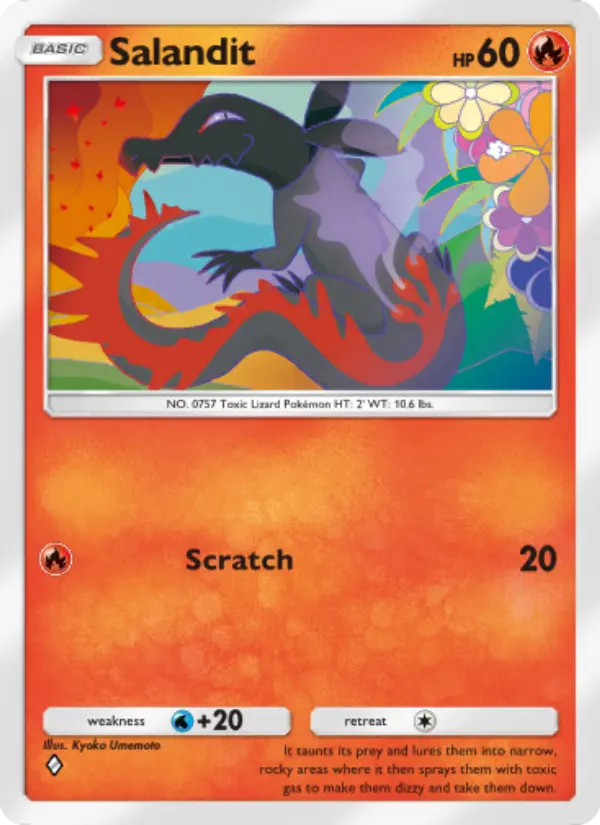
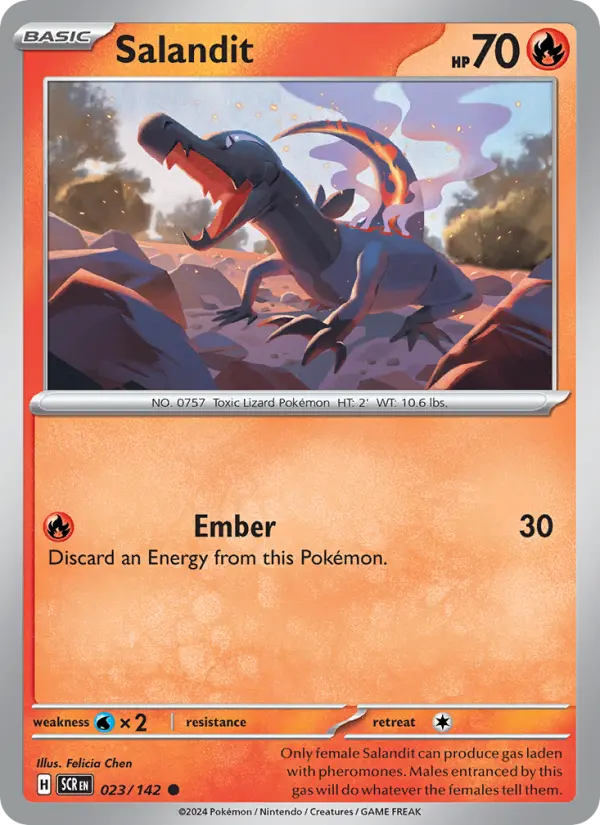
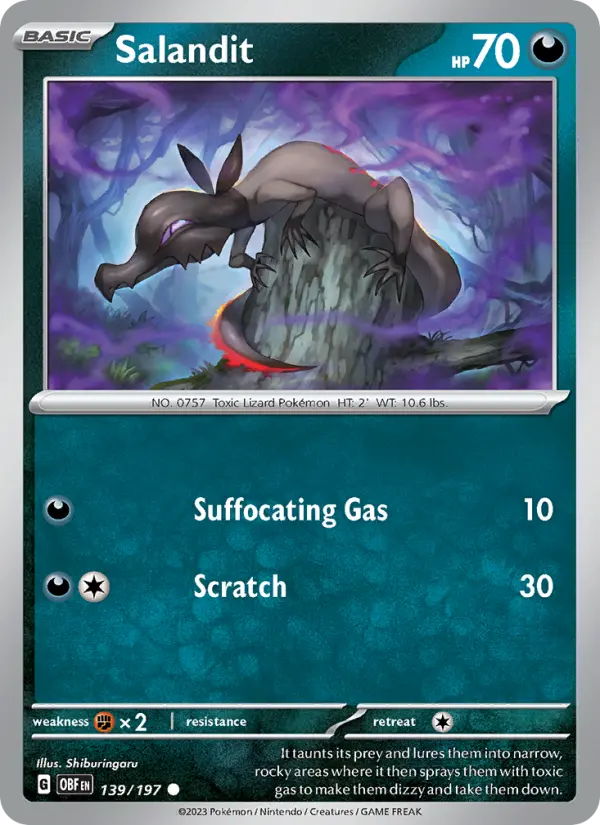
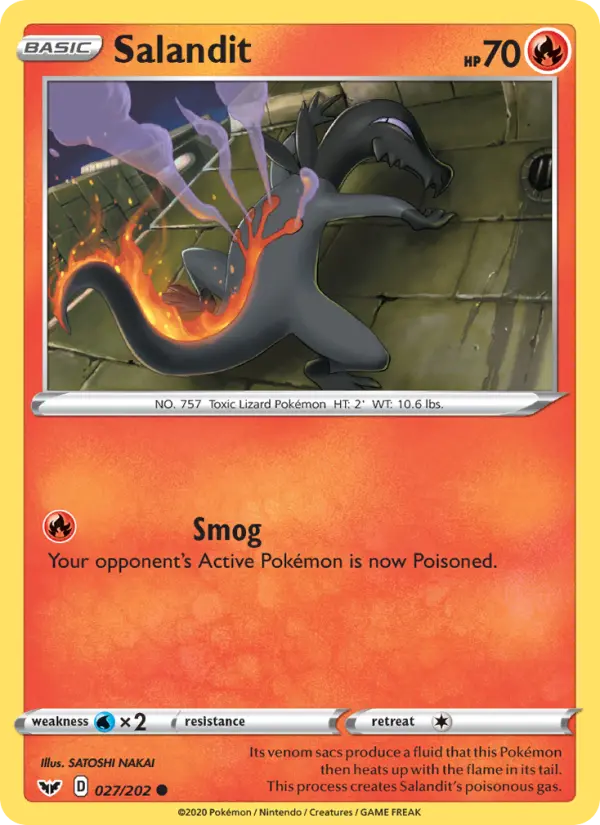
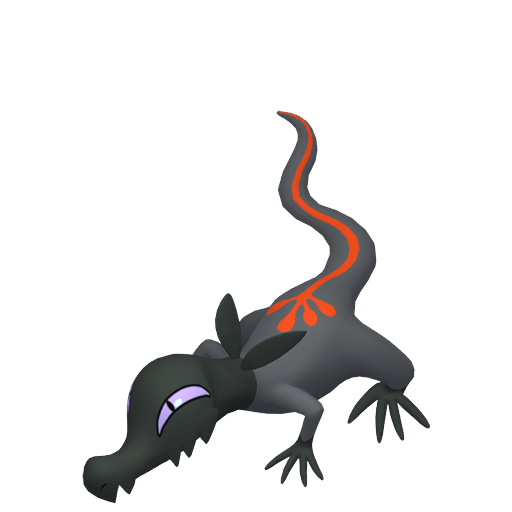
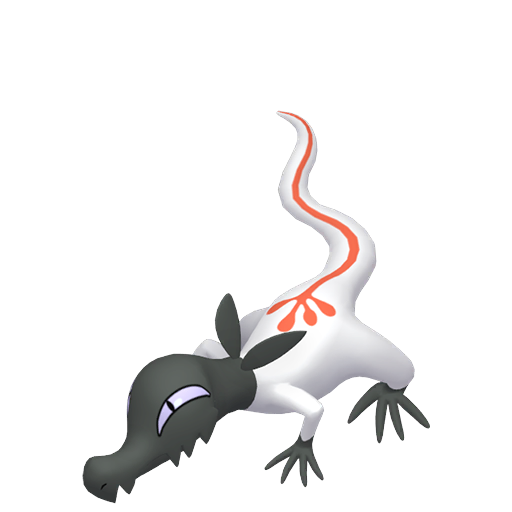
Salandit is a small, salamander-like Pokémon measuring just 0.6 meters in height and weighing a mere 4.8 kilograms, making it one of the lighter Pokémon species. Its body is predominantly dark gray to black, with a distinctive orange-red line running down its back and tail. This coloration extends into four short, rounded lines at the base of the tail—the crucial area from which both toxic gas and flames are emitted. Two flat spines protrude from the base of its neck, creating the appearance of a mask or bandanna, while its light purple eyes with slit pupils and prominent tooth-like protrusions along its upper jaw give it a decidedly menacing expression. According to Pokédex entries from Sword and Shield, Salandit's venom sacs produce a special fluid that the Pokémon heats using the flame in its tail, creating the distinctive poisonous gas through a chemical reaction. This gas possesses a sweet odor that paradoxically attracts Bug-type Pokémon while simultaneously causing dizziness in those who inhale it, making Salandit an efficient hunter despite its modest size and strength.
Pokedex Numbers
Training
Breeding
Salandit Breeding, Gender Ratio & Egg Groups
Salandit exhibits one of the most skewed gender ratios in the Pokémon world, with approximately 87.5% of wild encounters being male and only 12.5% being female. This extreme sexual dimorphism in population distribution directly reflects the species' biological hierarchy, where females dominate social dynamics and males exist in a subordinate role. Female Salandit are significantly rarer and more valuable for breeding purposes, as they alone possess the ability to evolve into Salazzle. The species belongs to both the Monster and Dragon egg groups, allowing for diverse breeding combinations despite its relatively small size. With a base happiness of 70 and a hatch counter of 20 cycles (approximately 4,884 to 5,140 steps), Salandit eggs are reasonably quick to produce, though the overwhelming preponderance of males in the breeding population makes obtaining female specimens considerably more challenging. This breeding mechanic has profound implications for trainers seeking to develop a Salazzle, as acquiring a female Salandit requires either exceptional patience and luck when catching wild specimens, or finding specific trading partners who possess female examples. The gender-based evolution and population skew create a unique strategic consideration in competitive and casual gameplay, making female Salandit considerably more coveted than their male counterparts.
Sprites




Held Items
Smoke Ball
held-items
Held: Allows the Holder to escape from any wild battle.
Cost: 4000
Smoke Ball
held-items
Held: Allows the Holder to escape from any wild battle.
Cost: 4000
Smoke Ball
held-items
Held: Allows the Holder to escape from any wild battle.
Cost: 4000
Smoke Ball
held-items
Held: Allows the Holder to escape from any wild battle.
Cost: 4000
TMs & HMs
tm02
emerald
tm02
firered leafgreen
tm02
ruby sapphire
tm02
black white
tm02
heartgold soulsilver
tm02
platinum
tm02
colosseum
tm02
diamond pearl
tm02
black 2 white 2
tm02
sun moon
tm02
omega ruby alpha sapphire
tm02
x y
tm02
xd
tm02
lets go pikachu lets go eevee
tm02
ultra sun ultra moon
tm03
lets go pikachu lets go eevee
tm05
lets go pikachu lets go eevee
tm06
yellow
tm06
gold silver
tm06
red blue
+578 more TMs/HMs
Salandit's Evolution Chain


Salandit Evolution, Mega Evolution & Special Forms
Salandit's evolution represents one of the most uniquely gendered mechanics in Pokémon evolution, as only female Salandit can evolve into Salazzle starting at level 33. Male Salandit are not known to evolve into any other Pokémon form, remaining permanently in their juvenile state throughout their lives. This evolutionary restriction stems directly from the biological dynamics of the species: female Salandit release pheromones that cause males to prioritize providing food to females, leaving the males themselves malnourished and unable to achieve the necessary physical development for evolution. The Ultra Sun Pokédex entry explicitly states, "The males will do whatever the females tell them. They give the females most of their food. Due to malnutrition, the males can't evolve." This creates a fascinating ecological and biological narrative where the species' reproductive success directly conflicts with individual male development. When a female Salandit reaches level 33, it undergoes a transformation into Salazzle, a more powerful and elegant Poison/Fire-type that becomes the apex predator of its evolutionary line. The evolutionary barrier for males represents an intentional game design choice that reinforces Salandit's role as a smaller, more vulnerable stage with significant growth potential exclusively for females.
Where to Find
Alola Route 8
alola
+1 more
Wela Volcano Park
alola
+1 more
Lush Jungle
alola
Salandit Behaviour and Natural Habitat
Salandit inhabits volcanoes and arid, rocky environments throughout the Alola region, favoring areas of extreme heat and aridity. The species demonstrates remarkable cunning in its hunting behavior, as described in the Shield Pokédex entry: it will slink behind prey and immobilize targets with poisonous gas before they even realize the Pokémon's presence. This stealthy, ambush-based hunting strategy compensates for Salandit's lack of raw physical power, making it an effective predator within its ecological niche. Female Salandit possess particularly fascinating behavioral traits, as they can emit pheromones that attract males of all species—including humans—and may even cause opponents to be controlled by the female's will. The Moon Pokédex entry notes that the sweet-smelling poisonous gas specifically attracts Bug Pokémon, which become easy prey once disoriented. Male Salandit display subservient behavior toward females, offering them most of their food supplies, which ironically leads to severe malnutrition that prevents their evolution into Salazzle.
Pokedex Entries
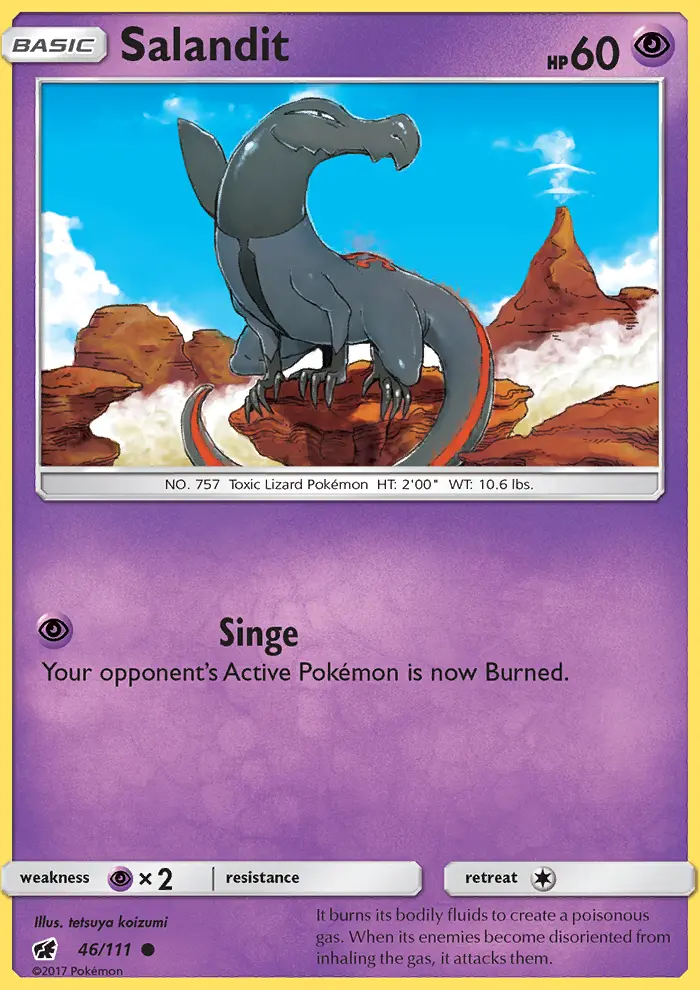
It burns its bodily fluids to create a poisonous gas. When its enemies become disoriented from inhaling the gas, it attacks them.
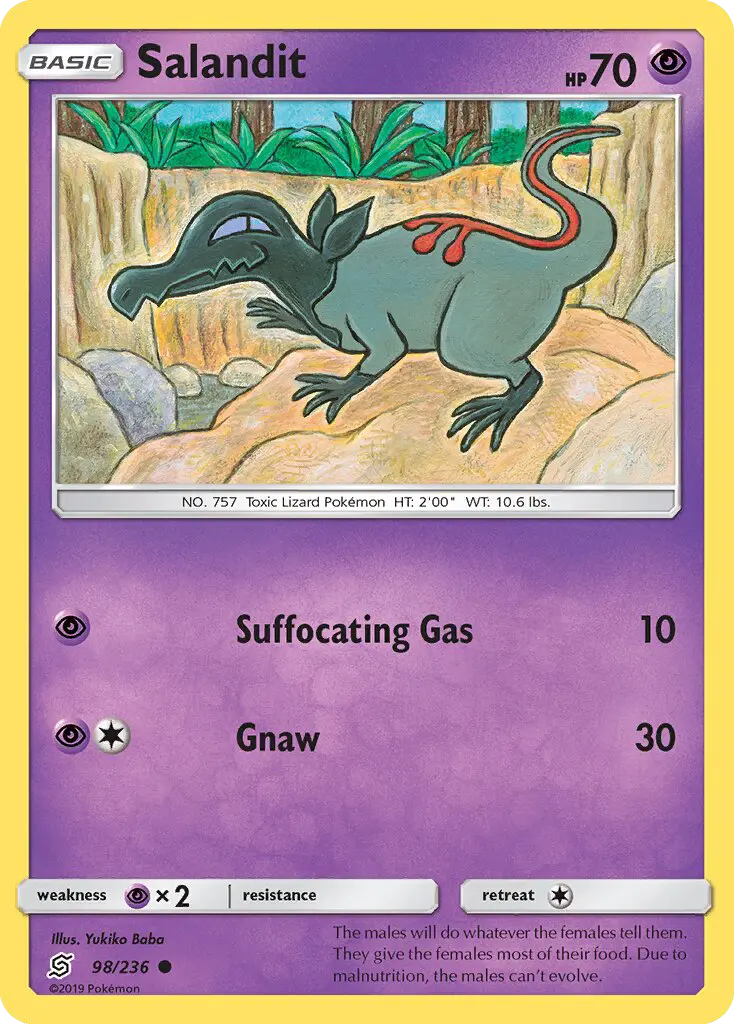
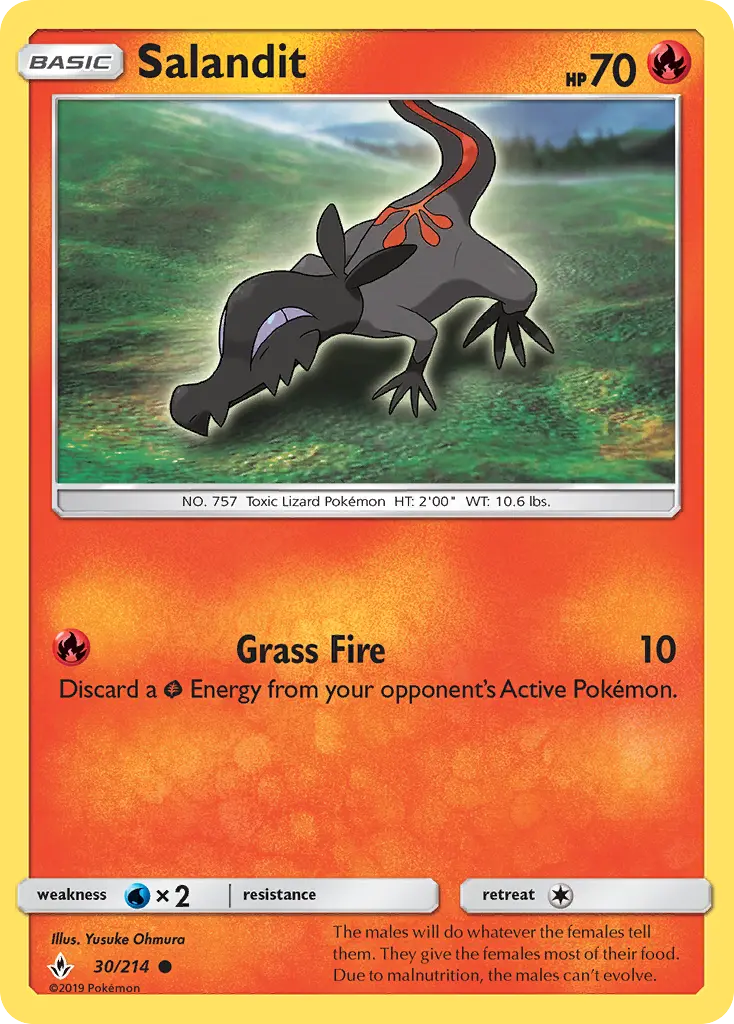
The males will do whatever the females tell them. They give the females most of their food. Due to malnutrition, the males can’t evolve.
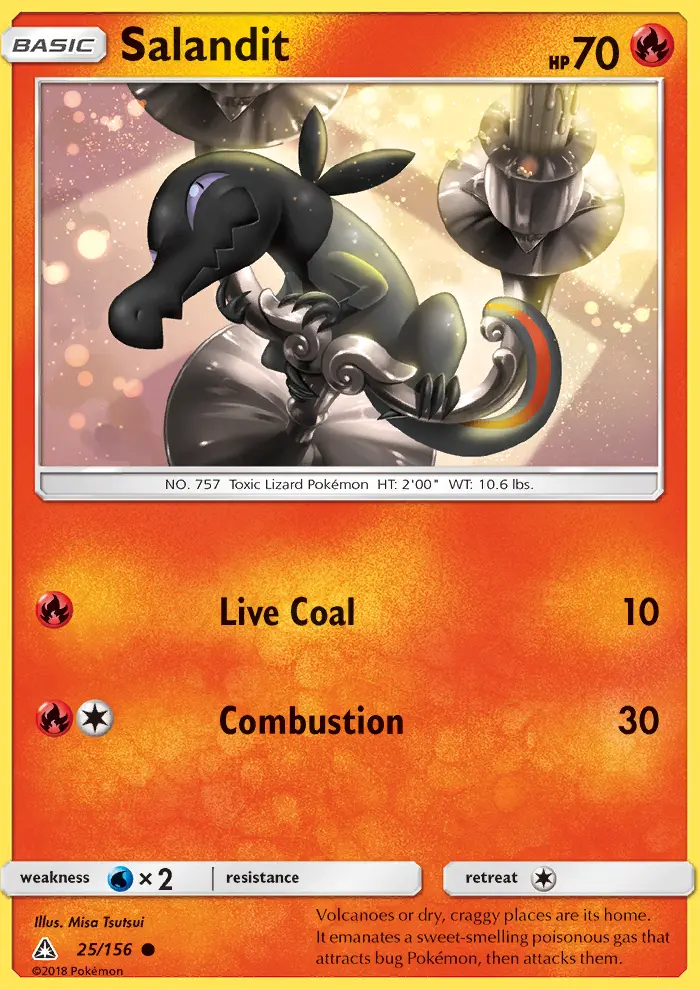
Volcanoes or dry, craggy places are its home. It emanates a sweet-smelling poisonous gas that attracts bug Pokémon, then attacks them.
It weakens opponents and sends them reeling with its poisonous gas. Salandit doesn’t deal well with Spinda, since it’s always reeling.
Its venom sacs produce a fluid that this Pokémon then heats up with the flame in its tail. This process creates Salandit’s poisonous gas.
This sneaky Pokémon will slink behind its prey and immobilize it with poisonous gas before the prey even realizes Salandit is there.
Salandit Name Origin & Design Inspiration
Salandit's name comes from a combination of "salamander" and "bandit," reflecting both its amphibian-inspired appearance and its cunning, predatory nature. The Japanese name Yatoumori (ヤトウモリ) similarly combines elements suggesting both its reptilian nature and its toxic properties. The Pokémon's design draws inspiration from real-world salamanders, particularly the Japanese fire belly newt, incorporating aspects of both terrestrial lizards and aquatic amphibians. The distinctive orange-red line running along its back and splitting into four segments at the tail base recalls the warning coloration patterns of real venomous salamanders, which use bright colors to advertise their toxicity to potential predators. The spines around its neck evoke traditional depictions of bandanas or masks, reinforcing the "bandit" aspect of its naming and its sneaky, ambush-predator behavior. The sweet-smelling poisonous gas mechanic reflects real biological phenomena observed in certain poison dart frogs and toxic salamanders, which use attractive scents to lure insects or serve dual purposes as both warning and hunting tools. Salandit's design successfully bridges the gap between a cute, diminutive creature and a genuinely threatening predator, embodying both vulnerability and cunning intelligence through its visual presentation.
Learnable Moves
Salandit can learn 77 moves:
Move | Type | Cat. | Power | Acc. | PP |
|---|---|---|---|---|---|
| acid spray | poison | Special | 40 | 100 | 20 |
| agility | psychic | Status | — | — | 30 |
| attract | normal | Status | — | 100 | 15 |
| beat up | dark | Physical | — | 100 | 10 |
| belch | poison | Special | 120 | 90 | 10 |
| burning jealousy | fire | Special | 70 | 100 | 5 |
| confide | normal | Status | — | — | 20 |
| covet | normal | Physical | 60 | 100 | 25 |
| double slap | normal | Physical | 15 | 85 | 10 |
| double team | normal | Status | — | — | 15 |
| dragon claw | dragon | Physical | 80 | 100 | 15 |
| dragon pulse | dragon | Special | 85 | 100 | 10 |
| dragon rage | dragon | Special | — | 100 | 10 |
| ember | fire | Special | 40 | 100 | 25 |
| endeavor | normal | Physical | — | 100 | 5 |
| endure | normal | Status | — | — | 10 |
| facade | normal | Physical | 70 | 100 | 20 |
| fake out | normal | Physical | 40 | 100 | 10 |
| fire blast | fire | Special | 110 | 85 | 5 |
| fire fang | fire | Physical | 65 | 95 | 15 |
| flame burst | fire | Special | 70 | 100 | 15 |
| flame charge | fire | Physical | 50 | 100 | 20 |
| flamethrower | fire | Special | 90 | 100 | 15 |
| flare blitz | fire | Physical | 120 | 100 | 15 |
| fling | dark | Physical | — | 100 | 10 |
| foul play | dark | Physical | 95 | 100 | 15 |
| frustration | normal | Physical | — | 100 | 20 |
| gunk shot | poison | Physical | 120 | 80 | 5 |
| heat wave | fire | Special | 95 | 90 | 10 |
| helping hand | normal | Status | — | — | 20 |
| hidden power | normal | Special | 60 | 100 | 15 |
| incinerate | fire | Special | 60 | 100 | 15 |
| iron tail | steel | Physical | 100 | 75 | 15 |
| knock off | dark | Physical | 65 | 100 | 20 |
| leech life | bug | Physical | 80 | 100 | 10 |
| mud slap | ground | Special | 20 | 100 | 10 |
| nasty plot | dark | Status | — | — | 20 |
| overheat | fire | Special | 130 | 90 | 5 |
| payback | dark | Physical | 50 | 100 | 10 |
| poison fang | poison | Physical | 50 | 100 | 15 |
| poison gas | poison | Status | — | 90 | 40 |
| poison jab | poison | Physical | 80 | 100 | 20 |
| poison tail | poison | Physical | 50 | 100 | 25 |
| protect | normal | Status | — | — | 10 |
| rest | psychic | Status | — | — | 5 |
| return | normal | Physical | — | 100 | 20 |
| round | normal | Special | 60 | 100 | 15 |
| sand attack | ground | Status | — | 100 | 15 |
| scale shot | dragon | Physical | 25 | 90 | 20 |
| scary face | normal | Status | — | 100 | 10 |
| scratch | normal | Physical | 40 | 100 | 35 |
| shadow claw | ghost | Physical | 70 | 100 | 15 |
| skitter smack | bug | Physical | 70 | 90 | 10 |
| sleep talk | normal | Status | — | — | 10 |
| sludge bomb | poison | Special | 90 | 100 | 10 |
| sludge wave | poison | Special | 95 | 100 | 10 |
| smog | poison | Special | 30 | 70 | 20 |
| snatch | dark | Status | — | — | 10 |
| snore | normal | Special | 50 | 100 | 15 |
| substitute | normal | Status | — | — | 10 |
| sunny day | fire | Status | — | — | 5 |
| swagger | normal | Status | — | 85 | 15 |
| sweet scent | normal | Status | — | 100 | 20 |
| swift | normal | Special | 60 | — | 20 |
| take down | normal | Physical | 90 | 85 | 20 |
| taunt | dark | Status | — | 100 | 20 |
| temper flare | fire | Physical | 75 | 100 | 10 |
| tera blast | normal | Special | 80 | 100 | 10 |
| thief | dark | Physical | 60 | 100 | 25 |
| thunder wave | electric | Status | — | 90 | 20 |
| torment | dark | Status | — | 100 | 15 |
| toxic | poison | Status | — | 90 | 10 |
| toxic spikes | poison | Status | — | — | 20 |
| trailblaze | grass | Physical | 50 | 100 | 20 |
| venom drench | poison | Status | — | 100 | 20 |
| venoshock | poison | Special | 65 | 100 | 10 |
| will o wisp | fire | Status | — | 85 | 15 |
Salandit Competitive Battle Guide
Assessing its battle viability, Salandit occupies a niche role as a fast, special-attack-oriented support Pokémon rather than a primary sweeper. With a base Special Attack of 71 and a base Speed of 77, Salandit can outpace many common threats and deliver respectable special-based damage, though its relatively low Speed means it will not outrun truly fast Pokémon like Alakazam or Greninja. The species' primary competitive value lies in its signature ability, Corrosion, which allows it to poison Steel and Poison-type Pokémon—a distinction no other Pokémon possessed prior to Generation IX. This ability becomes particularly valuable against Steel-type walls and defensive Poison Pokémon that would otherwise wall conventional poison spreads. However, Salandit's frail defensive stats (40 Defense and 40 Special Defense) mean it cannot reliably switch into attacks, forcing players to carefully position it or utilize defensive pivoting strategies. Its hidden ability, Oblivious, prevents infatuation and protects against the Captivate move, offering utility in specific metagames but lacking the immediate impact of Corrosion. With a total stat allocation of only 320, Salandit rarely sees usage in higher competitive tiers, instead finding occasional applications in lower formats where its Speed and Special Attack become more relevant. Its movepool, while not exceptional, provides adequate coverage options for its intended role as a fast special attacker or support Pokémon.
Commonly Asked Questions About Salandit
What type is Salandit?
Salandit is a poison and fire type Pokemon.
What does Salandit evolve into?
Salandit evolves into salazzle.
What are Salandit's weaknesses?
Salandit is weak to ground, rock, water and psychic type moves.
Does Salandit evolve by trading?
No — Salandit evolves entirely through leveling up, with no trade required at any stage.
Where can I find Salandit?
Salandit can be found in alola route 8 (alola), wela volcano park (alola) and lush jungle (alola).
Salandit Cultural Impact & Franchise History
Salandit has garnered significant attention within the Pokémon community due to its unique gender-based evolution mechanic and the implications this creates for gameplay and worldbuilding. The species sparked considerable discussion among fans regarding gender representation in Pokémon, with its female-exclusive evolution and the biological narrative of male subordination generating both appreciation for the biological complexity and debate about gender dynamics in game design. Female Salandit became a sought-after Pokémon among collectors and competitive players, creating a secondary economy around trading female specimens. The species' design and behavior have been featured prominently in Pokémon media, including the animated series and various Pokédex illustrations, where its predatory nature and toxic abilities are consistently emphasized. Online communities developed strategies and guides specifically focused on locating female Salandit, recognizing the species as a unique collectible with tangible gameplay advantages. The Pokémon's presence in the Alola regional Pokédex and subsequent appearances in later generations have maintained its relevance within the broader franchise. Salandit's combination of vulnerability and cunning has resonated with players who appreciate Pokémon that reward strategic thinking over raw statistical superiority, contributing to a dedicated fanbase that advocates for the species despite its modest competitive viability.
Where to Find Salandit in Every Pokémon Game
Salandit's availability varies considerably across different Pokémon games and regions. In Pokémon Sun and Moon, the original Generation VII games, Salandit appears in the Alola region and serves as regional Pokédex #0161, making it relatively accessible to players progressing through the main storyline. In Pokémon Ultra Sun and Ultra Moon, it retains high availability with a slightly different Alola Pokédex number of #0195. The species also appears in later generations: in Pokémon Sword and Shield, Salandit is available in the base game as Pokédex #0244 and returns in the Isle of Armor DLC as #0159. In Pokémon Scarlet and Violet, it appears as Pokédex #0120 in the main game and #0168 in the Teal Mask DLC expansion. The catch rate of 120 indicates that Salandit is moderately easy to capture compared to other Pokémon, allowing players to obtain specimens relatively quickly. However, the extremely skewed gender ratio means that encountering female specimens requires significantly more dedication, with wild encounters yielding females only approximately one in eight times on average. Players seeking female Salandit for evolution purposes often employ grinding strategies, chain encounters, or resort to trading with other players who have obtained female specimens. Its consistent availability across multiple generations ensures that dedicated players can eventually obtain both male and female examples, though the rarity of females makes Salazzle acquisition a notable achievement for most casual players.