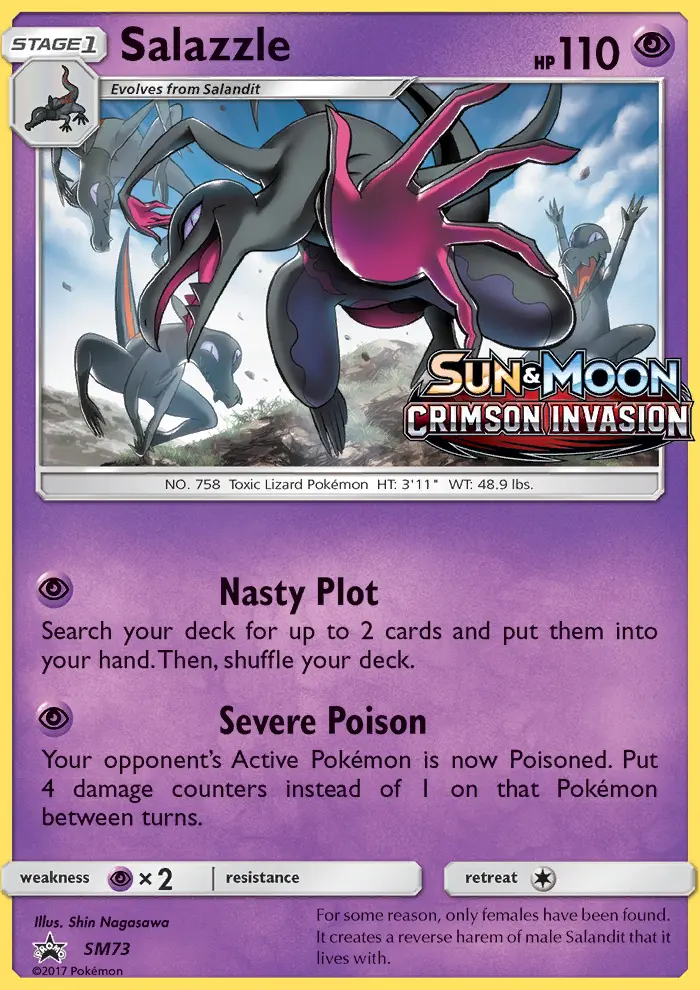
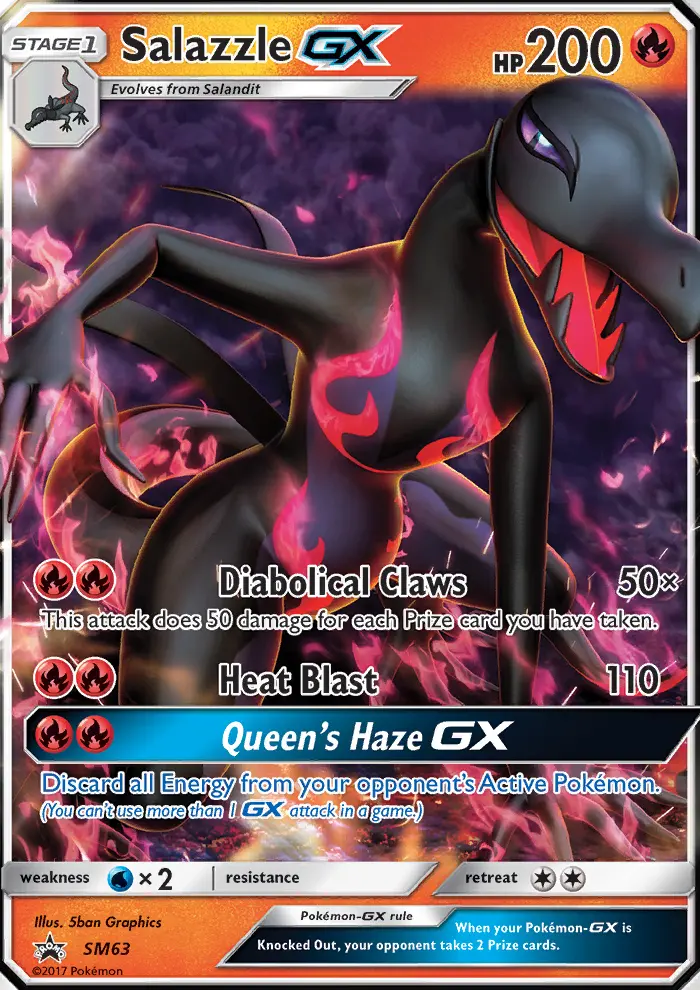
Salazzle
Generation VII · #0758 — Toxic Lizard Pokémon
At 1.2 m and 22.2 kg, Salazzle doesn't look like much on paper, but its corrosion ability shapes how it actually plays more than its size suggests. The species possesses the signature ability Corrosion, which grants it the extraordinary power to poison even traditionally poison-immune Pokémon like Steel and other Poison-types, alongside the hidden ability Oblivious that protects it from infatuation and captivation effects.
Editor's Take
Salazzle's Corrosion letting it poison Steel and Poison types is genuinely unique, and 117 base Speed with Fire/Poison typing makes it a real threat where it is legal.
Base Stats
Height
1.2m
Weight
22.2kg
Category
Toxic Lizard Pokémon
Gender
100% Female
Color
black
Shape
quadruped
Abilities
This Pokémon can inflict poison on Poison and Steel Pokémon.
Prevents infatuation and protects against captivate.
Salazzle Biology & Physical Characteristics
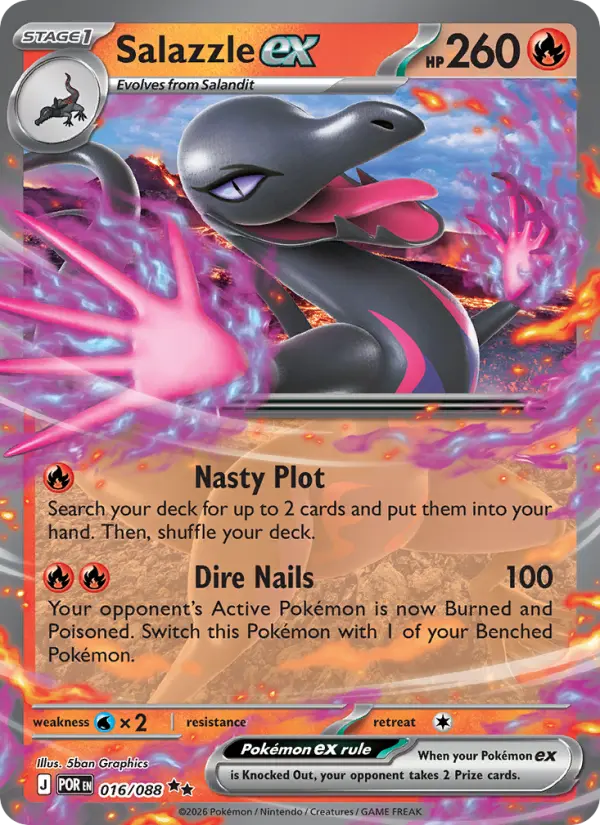
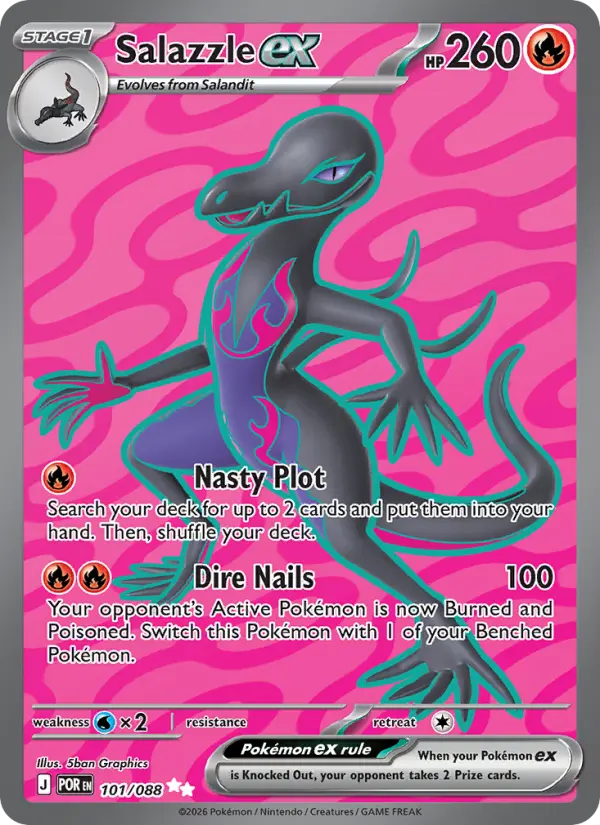
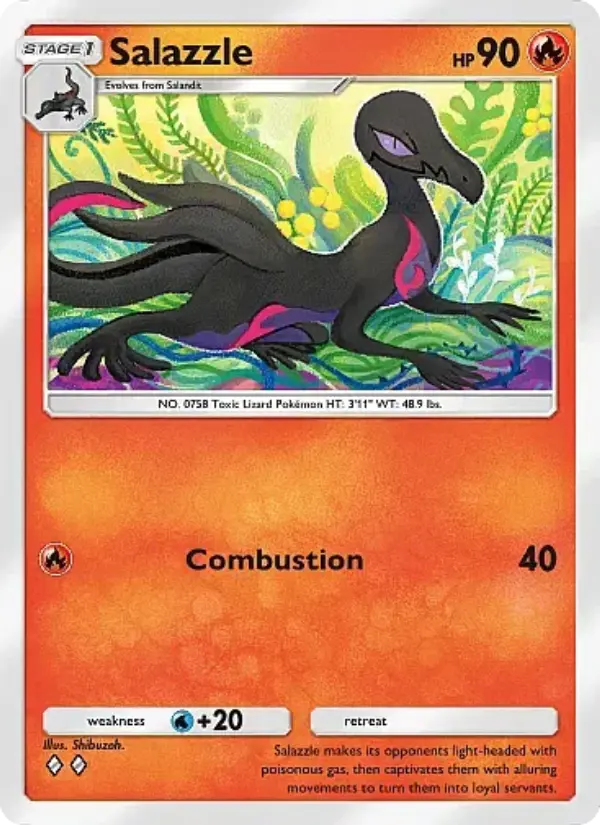
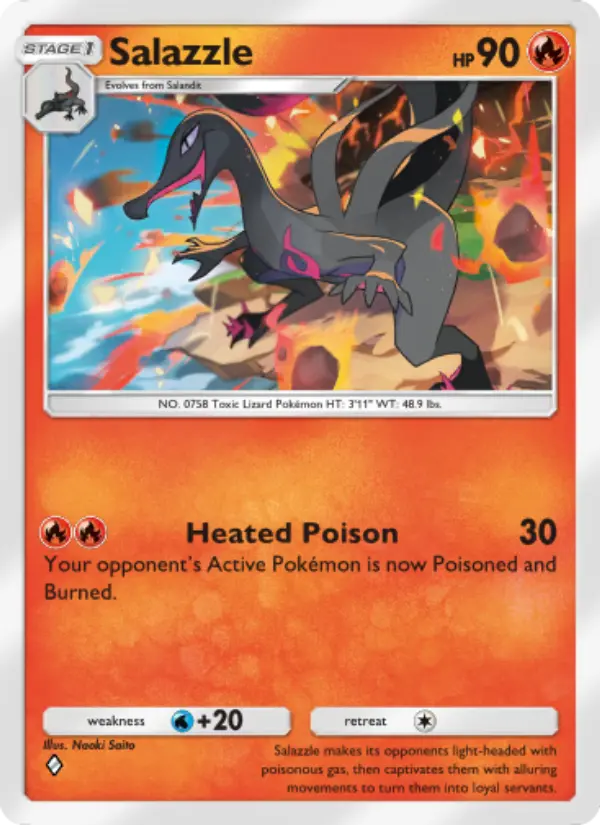
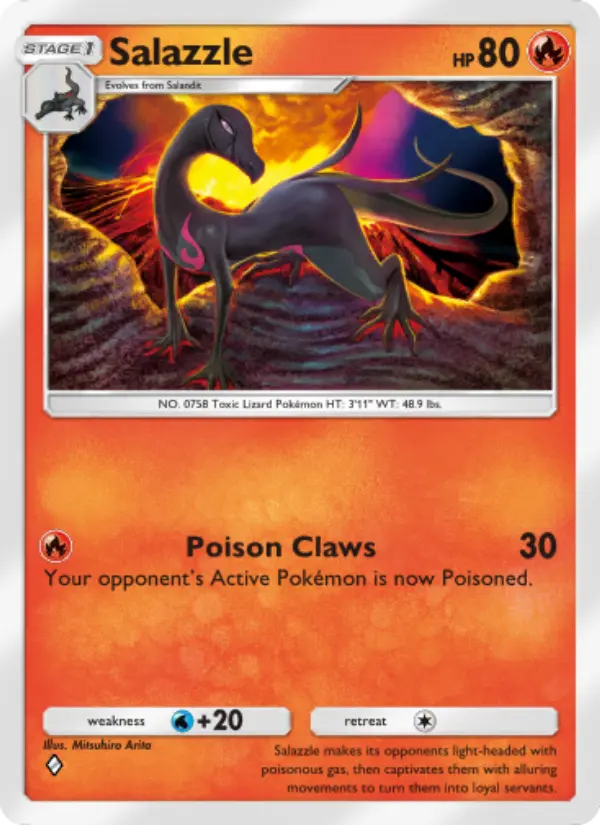
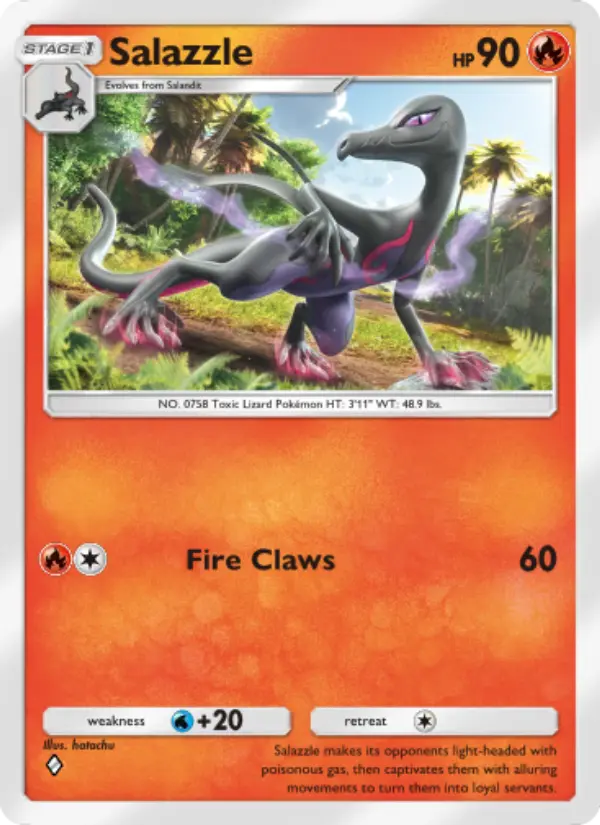
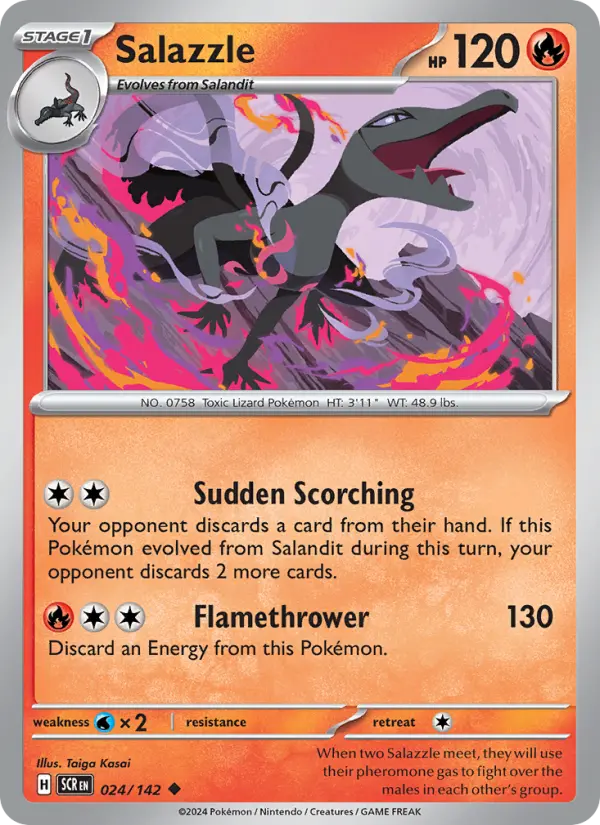
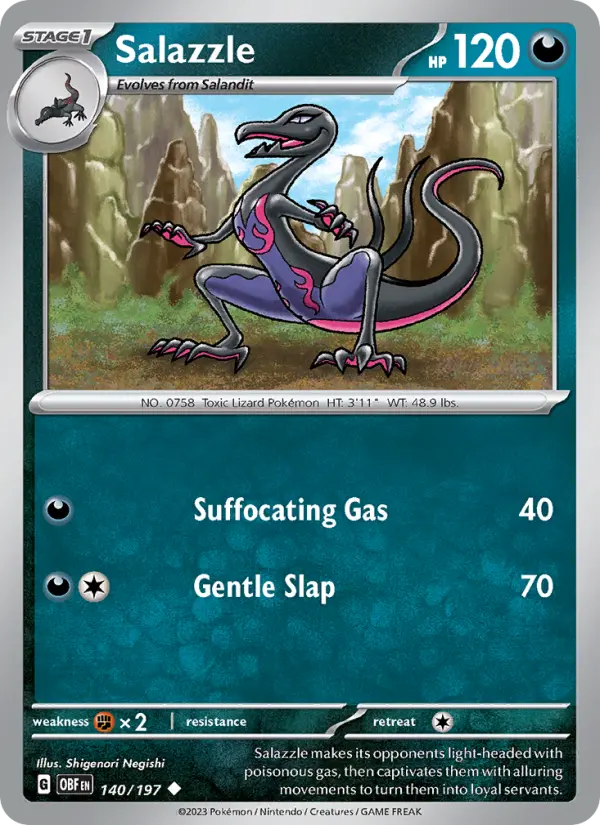
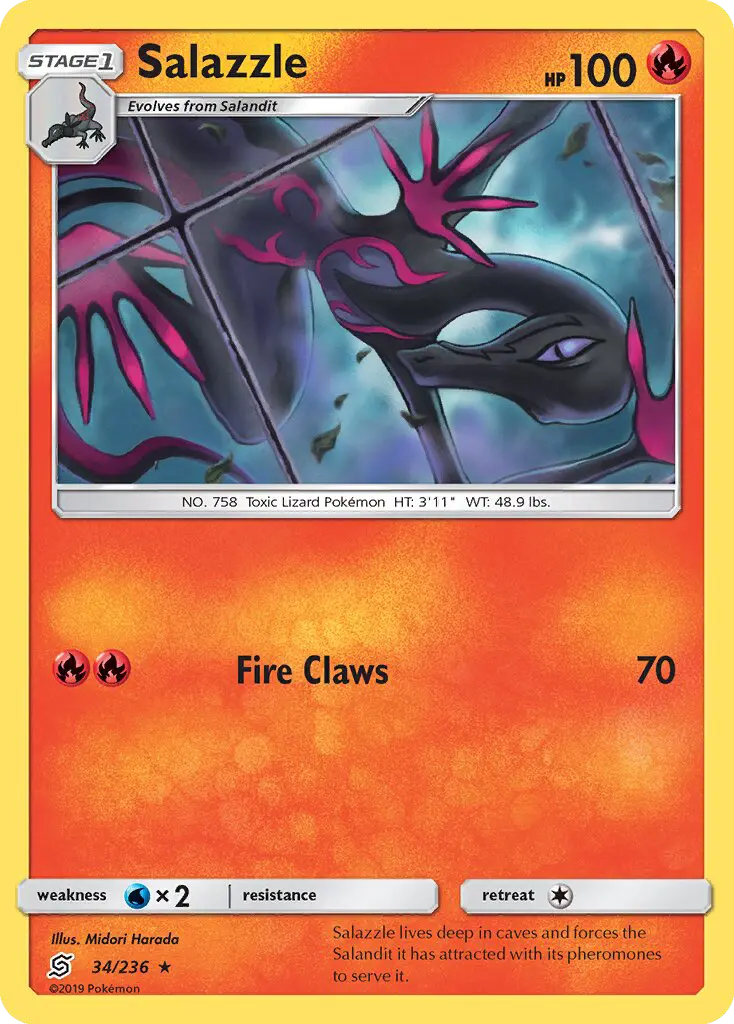
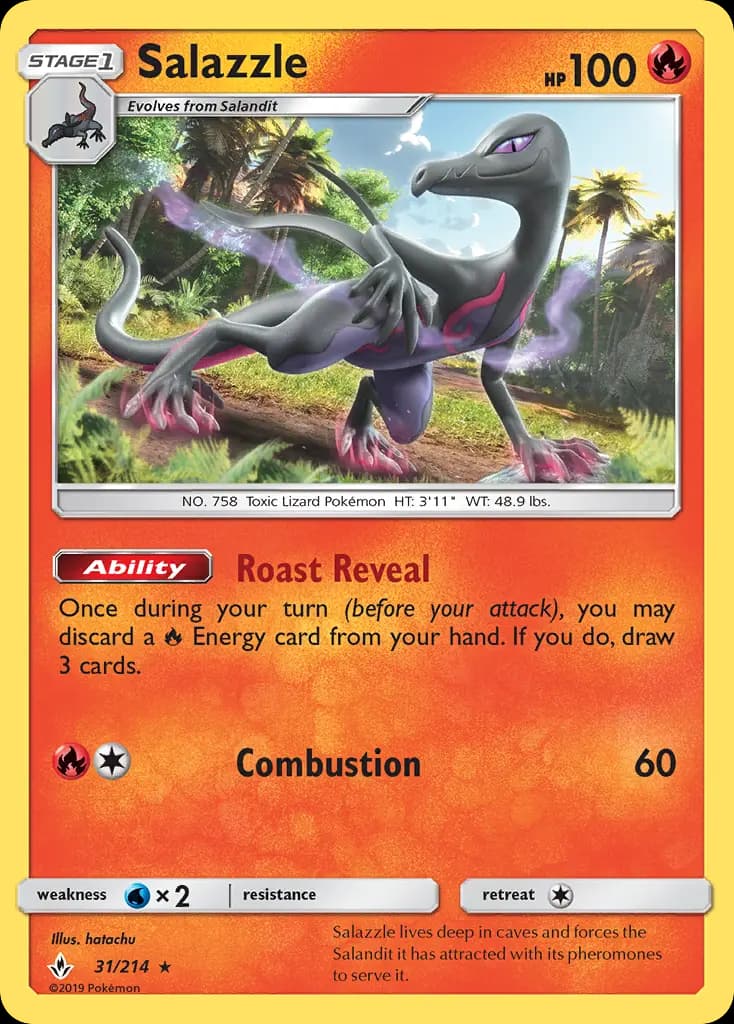
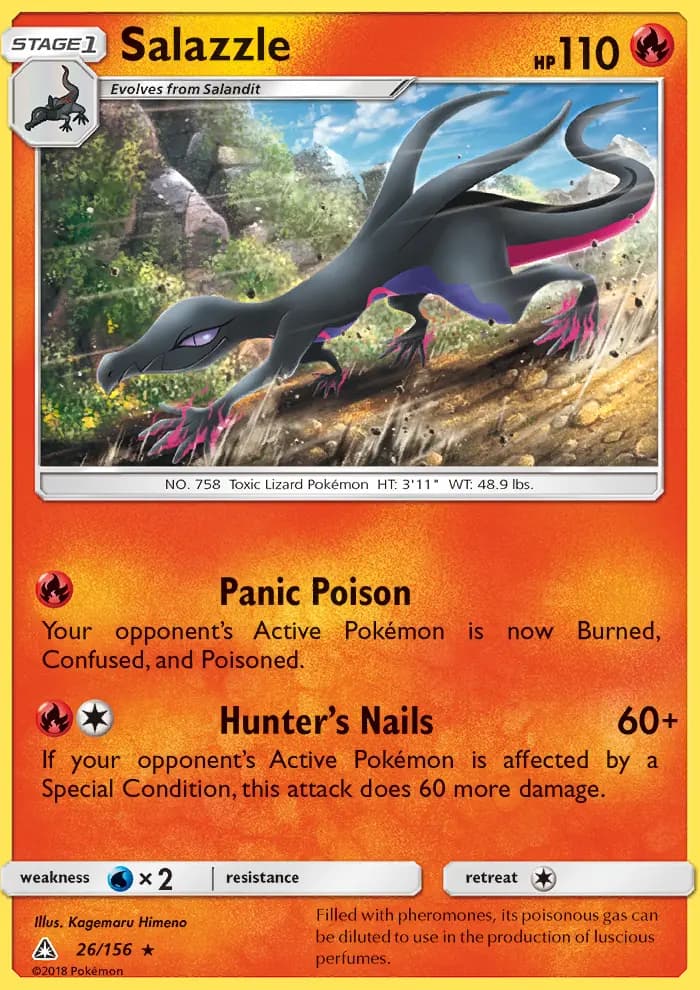
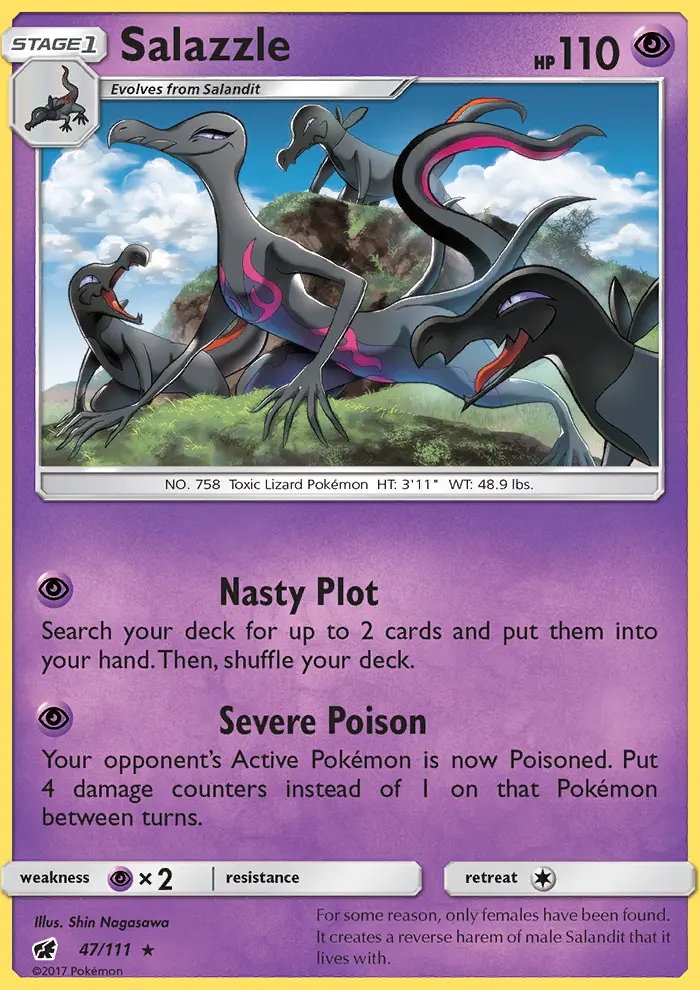
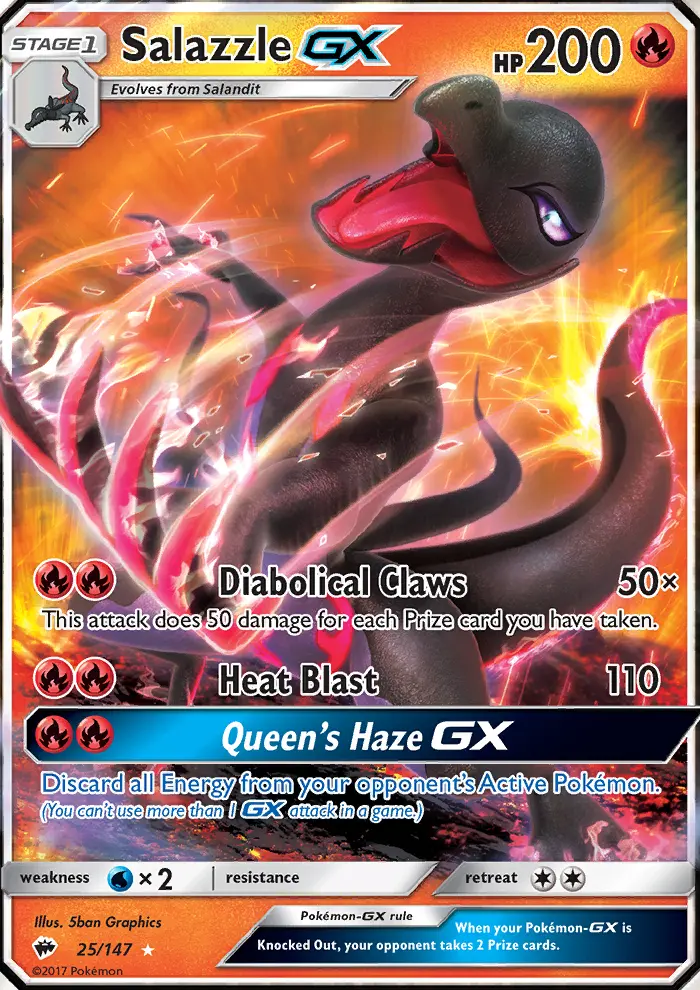
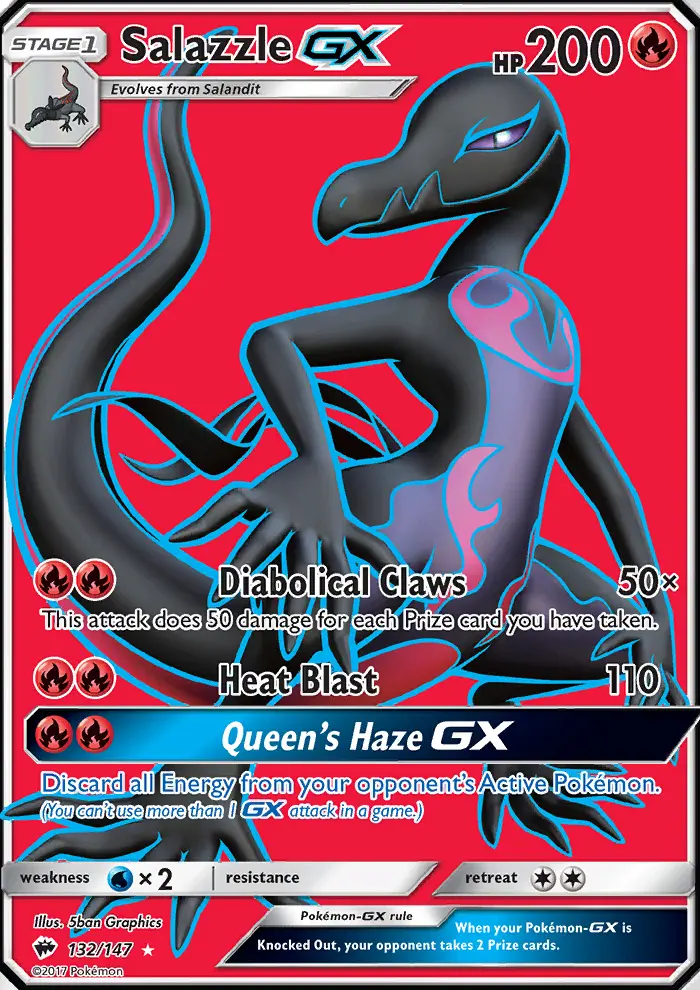
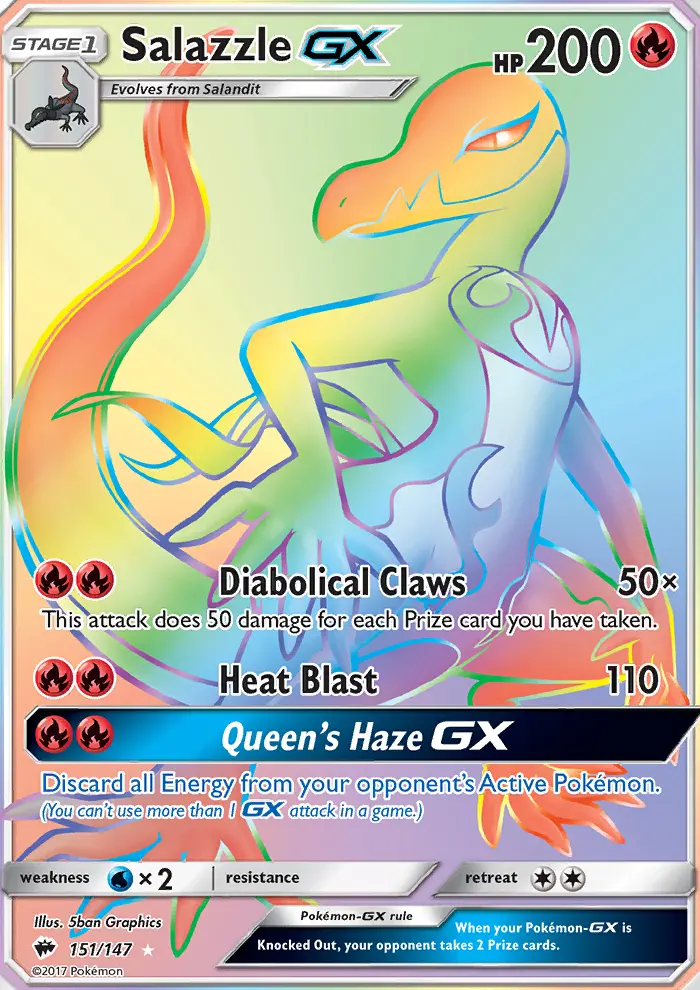
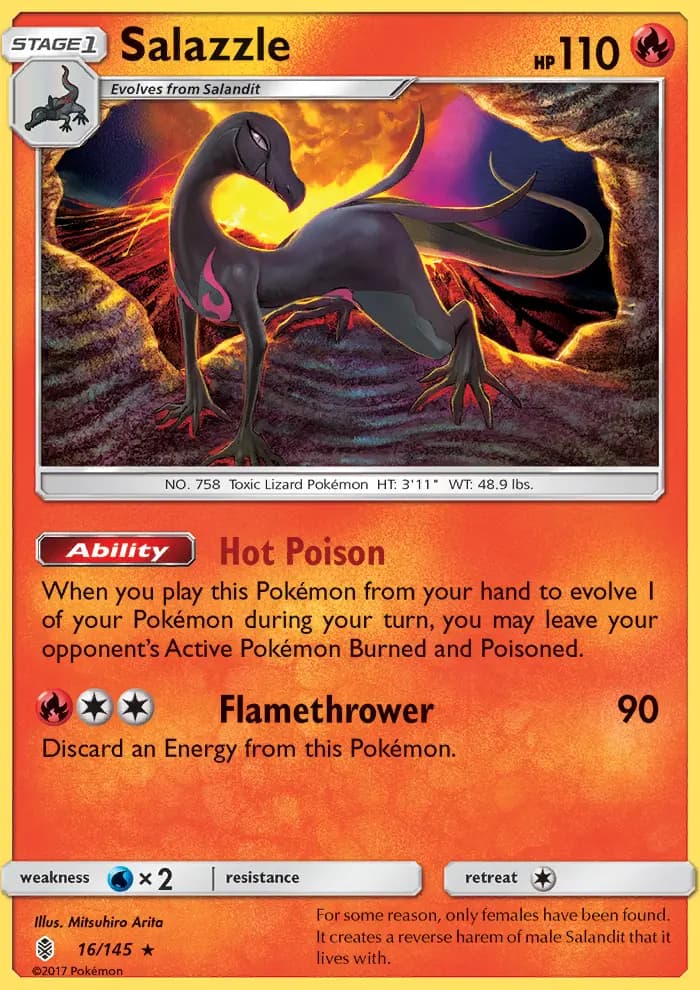
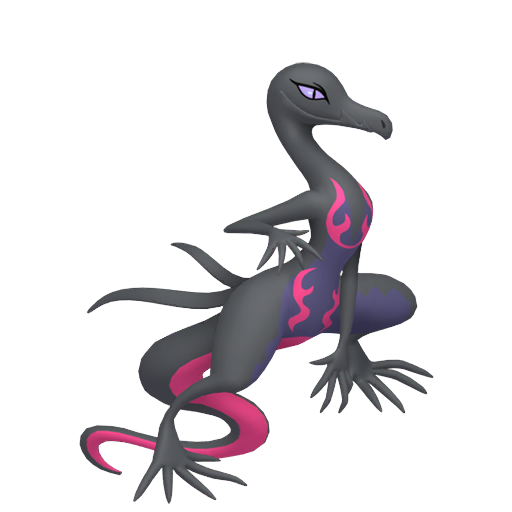
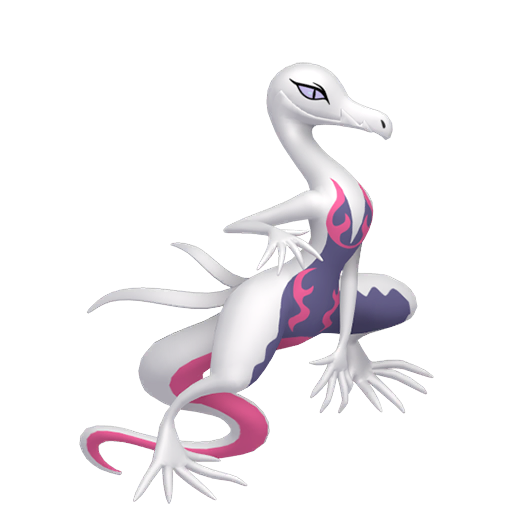
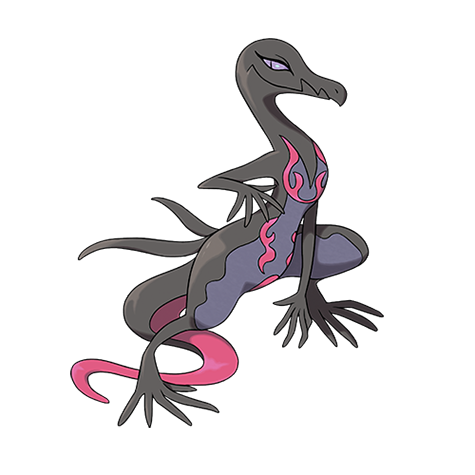
Salazzle's physical appearance is distinctly reptilian, resembling a sleek salamander or desert lizard with an elongated, thin body colored in dark gray with a grayish-purple underside. Its most striking features include several wavy dark pink markings that adorn its body—a distinctive U-shaped chest marking with interior lines and matching markings on its hips that resemble wisps of smoke, visually emphasizing its poisonous nature. The Pokémon possesses a slender head with almond-shaped purple eyes containing slit pupils and two prominent fang-like projections on each side of its lower jaw, giving it an intimidating predatory appearance. Its elongated whip-like tail features a dark pink underside that mirrors the coloring of its palms, which possess remarkable heat-generating properties capable of unleashing flames. Each of Salazzle's hands and feet terminate in five long, thin digits with dark pink palms that serve dual purposes as both manipulative appendages and heat weapons, enabling this Pokémon to deal significant special attack damage through its fire-type moves.
Pokedex Numbers
Training
Breeding
Salazzle Breeding, Gender Ratio & Egg Groups
Salazzle presents an unprecedented breeding scenario in the Pokémon world as the first and primary example of a species that is exclusively female with no male counterpart, resulting in a 0% male, 100% female gender ratio that fundamentally alters standard breeding mechanics. Despite this absolute gender imbalance, Salazzle can still breed with male Pokémon from the Monster and Dragon egg groups, allowing trainers to produce female Salandit offspring that may themselves evolve into Salazzle if properly nurtured. The species exhibits a base friendship value of 70, indicating a reasonably cooperative disposition toward trainers, though this pales in comparison to the commanding attitude they display toward enslaved male Salandit in the wild. With an egg hatch counter of 20 cycles requiring approximately 4,884 to 5,140 steps to incubate, breeding Salazzle requires moderate investment from trainers seeking to acquire this species. The medium growth rate characteristic of Salazzle determines how efficiently experience points translate into level gains, positioning it as a balanced breeder in terms of training time requirements. Male Salandit likewise cannot breed, as they do not evolve and remain dependent on wild Salazzle for care, creating a biological barrier that enforces the strictly female nature of the evolved form.
Sprites




Held Items
Smoke Ball
held-items
Held: Allows the Holder to escape from any wild battle.
Cost: 4000
Smoke Ball
held-items
Held: Allows the Holder to escape from any wild battle.
Cost: 4000
Smoke Ball
held-items
Held: Allows the Holder to escape from any wild battle.
Cost: 4000
Smoke Ball
held-items
Held: Allows the Holder to escape from any wild battle.
Cost: 4000
TMs & HMs
tm02
emerald
tm02
firered leafgreen
tm02
ruby sapphire
tm02
black white
tm02
heartgold soulsilver
tm02
platinum
tm02
colosseum
tm02
diamond pearl
tm02
black 2 white 2
tm02
sun moon
tm02
omega ruby alpha sapphire
tm02
x y
tm02
xd
tm02
lets go pikachu lets go eevee
tm02
ultra sun ultra moon
tm03
lets go pikachu lets go eevee
tm05
lets go pikachu lets go eevee
tm06
yellow
tm06
gold silver
tm06
red blue
+655 more TMs/HMs
Salazzle's Evolution Chain


Salazzle Evolution, Mega Evolution & Special Forms
Salazzle evolves exclusively from female Salandit when they reach level 33, representing a crucial gender-based evolutionary mechanic unique within the Pokémon franchise. Male Salandit are unable to evolve due to chronic malnutrition—they are biologically constrained to remain in their base form regardless of level, as they lack the physical development pathway available to females. This evolutionary restriction creates a fascinating biological dynamic where only properly nourished female Salandit possess the metabolic capacity to undergo the transformation into the larger, more powerful Salazzle form. The evolution process sees Salandit develop greater sophistication in its pheromone production system, enhance its special attack capabilities from a base of 75 to an impressive 111, and dramatically increase its speed stat from 80 to 117. This transformation is not simply growth but rather a complete physiological restructuring that enables the newly-evolved Salazzle to establish and maintain dominance over male Salandit through enhanced pheromone production and improved combat capabilities. Salazzle does not possess a Mega Evolution form, remaining in its final evolved state throughout all games.
Where to Find
Lush Jungle
alola
Wela Volcano Park
alola
Heahea Beach
alola
Salazzle Behaviour and Natural Habitat
According to multiple Pokédex entries, Salazzle exhibits complex and domineering social behavior centered around the accumulation and control of male Salandit in what has been coined a 'reverse harem' arrangement. These female Pokémon dwell deep within cave systems where they emit a sophisticated poisonous gas laden with alluring pheromones, a biochemical adaptation specifically designed to attract and enthrall male Salandit to their presence. The pheromone-infused gas is potent enough to be diluted for commercial use in luxurious perfume production, demonstrating the refined chemical composition of Salazzle's toxic emissions. Once males are attracted to a Salazzle, she forces them into servitude, compelling them to gather food and resources; those males who fail to meet her demands face punishment in the form of fierce flaming slaps delivered from her flame-spewing palms. Salazzle are highly competitive with one another, engaging in pheromone-based conflicts over dominance and the accumulation of male servants, with victory determined by which female manages to gather the largest retinue of male Salandit.
Pokedex Entries
For some reason, only females have been found. It creates a reverse harem of male Salandit that it lives with.
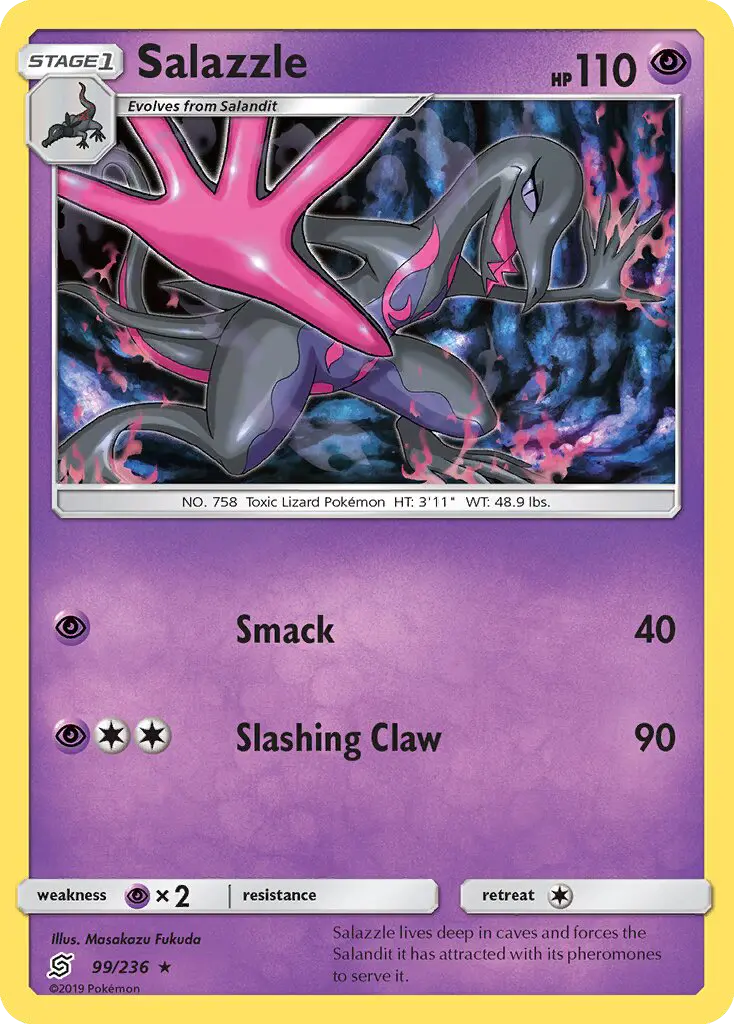
Salazzle lives deep in caves and forces the Salandit it has attracted with its pheromones to serve it.
Filled with pheromones, its poisonous gas can be diluted to use in the production of luscious perfumes.
It punishes Salandit that couldn’t bring it food with a fierce slap of its flame-spewing palm.
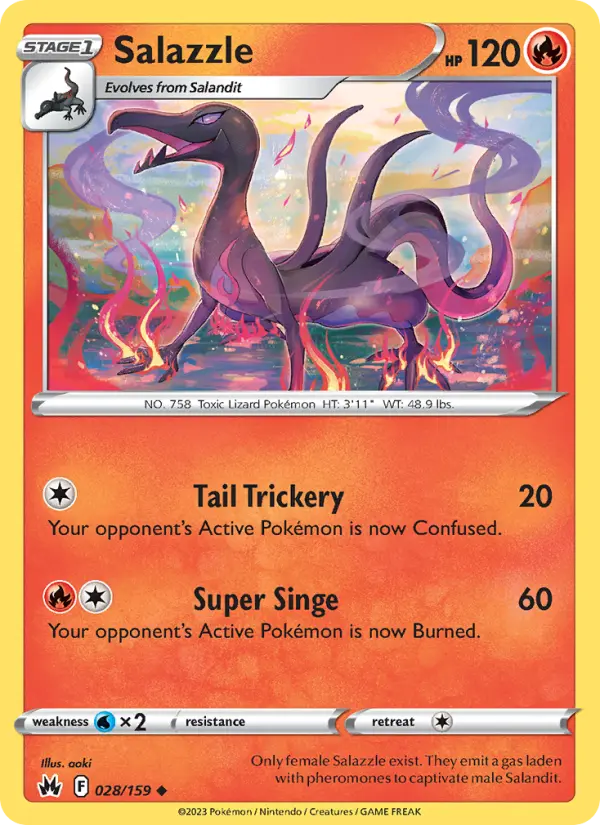
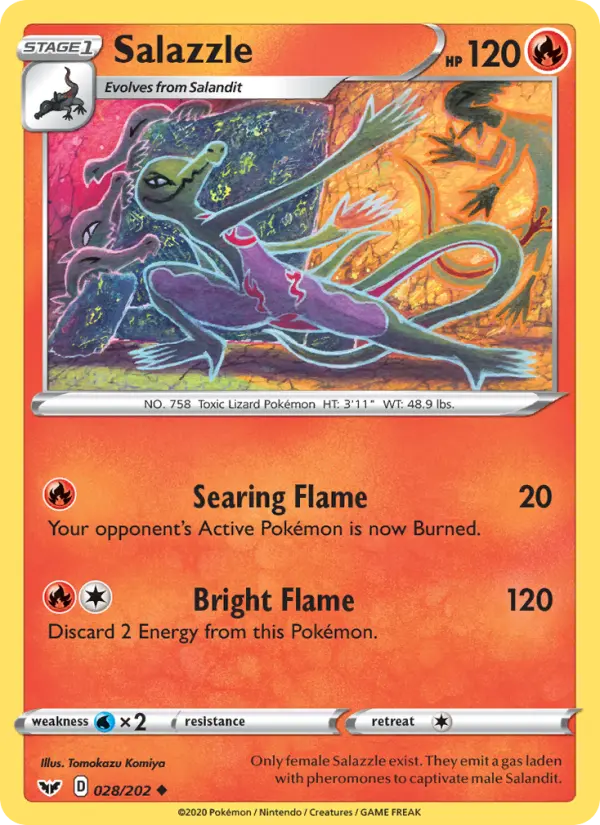
Only female Salazzle exist. They emit a gas laden with pheromones to captivate male Salandit.
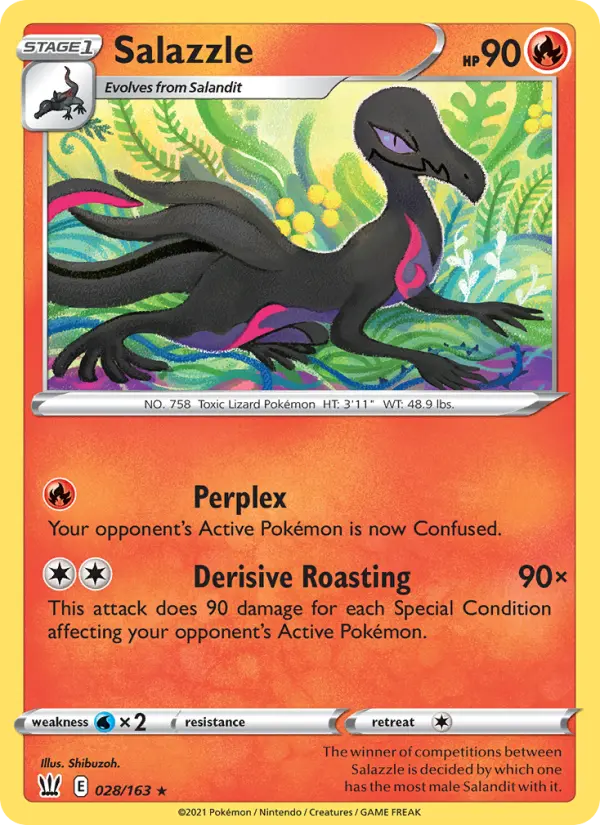
The winner of competitions between Salazzle is decided by which one has the most male Salandit with it.
Salazzle Name Origin & Design Inspiration
Salazzle's name traces back to the combination of 'salamander' and 'razzle,' with the latter term connoting excitement, allure, and showmanship that perfectly encapsulates the Pokémon's pheromone-based attraction abilities and charismatic dominance over its harem. The Japanese name 'Ennewt' combines 'ennui'—suggesting the aloof, superior attitude Salazzle displays toward its subordinates—with 'newt,' the common name for small salamanders. The design itself draws heavy inspiration from the Gila monster and various desert-dwelling lizards, particularly in its sinuous body shape and the wavy markings that suggest flowing toxic gas or heat distortion. The dark coloration with purple-pink accents references both the toxic nature of poison-type Pokémon and the visual language of pheromones and attraction commonly depicted in nature documentaries through bioluminescence and chemical markers. The elongated, whip-like tail and delicate five-fingered digits suggest both predatory grace and refined elegance, reinforcing the concept of a sophisticated creature whose appeal lies in both danger and allure—a creature that weaponizes attraction itself as a form of dominance.
Learnable Moves
Salazzle can learn 92 moves:
Move | Type | Cat. | Power | Acc. | PP |
|---|---|---|---|---|---|
| acid spray | poison | Special | 40 | 100 | 20 |
| acrobatics | flying | Physical | 55 | 100 | 15 |
| agility | psychic | Status | — | — | 30 |
| attract | normal | Status | — | 100 | 15 |
| beat up | dark | Physical | — | 100 | 10 |
| body slam | normal | Physical | 85 | 100 | 15 |
| breaking swipe | dragon | Physical | 60 | 100 | 15 |
| burning jealousy | fire | Special | 70 | 100 | 5 |
| captivate | normal | Status | — | 100 | 20 |
| confide | normal | Status | — | — | 20 |
| corrosive gas | poison | Status | — | 100 | 40 |
| covet | normal | Physical | 60 | 100 | 25 |
| cross poison | poison | Physical | 70 | 100 | 20 |
| disable | normal | Status | — | 100 | 20 |
| double slap | normal | Physical | 15 | 85 | 10 |
| double team | normal | Status | — | — | 15 |
| dragon cheer | dragon | Status | 0 | 0 | 15 |
| dragon claw | dragon | Physical | 80 | 100 | 15 |
| dragon dance | dragon | Status | — | — | 20 |
| dragon pulse | dragon | Special | 85 | 100 | 10 |
| dragon rage | dragon | Special | — | 100 | 10 |
| dragon tail | dragon | Physical | 60 | 90 | 10 |
| ember | fire | Special | 40 | 100 | 25 |
| encore | normal | Status | — | 100 | 5 |
| endeavor | normal | Physical | — | 100 | 5 |
| endure | normal | Status | — | — | 10 |
| facade | normal | Physical | 70 | 100 | 20 |
| fake tears | dark | Status | — | 100 | 20 |
| fire blast | fire | Special | 110 | 85 | 5 |
| fire fang | fire | Physical | 65 | 95 | 15 |
| fire lash | fire | Physical | 80 | 100 | 15 |
| flame burst | fire | Special | 70 | 100 | 15 |
| flame charge | fire | Physical | 50 | 100 | 20 |
| flamethrower | fire | Special | 90 | 100 | 15 |
| flare blitz | fire | Physical | 120 | 100 | 15 |
| fling | dark | Physical | — | 100 | 10 |
| foul play | dark | Physical | 95 | 100 | 15 |
| frustration | normal | Physical | — | 100 | 20 |
| giga impact | normal | Physical | 150 | 90 | 5 |
| gunk shot | poison | Physical | 120 | 80 | 5 |
| heat wave | fire | Special | 95 | 90 | 10 |
| helping hand | normal | Status | — | — | 20 |
| hidden power | normal | Special | 60 | 100 | 15 |
| hyper beam | normal | Special | 150 | 90 | 5 |
| hyper voice | normal | Special | 90 | 100 | 10 |
| incinerate | fire | Special | 60 | 100 | 15 |
| iron tail | steel | Physical | 100 | 75 | 15 |
| knock off | dark | Physical | 65 | 100 | 20 |
| laser focus | normal | Status | — | — | 30 |
| leech life | bug | Physical | 80 | 100 | 10 |
| mud slap | ground | Special | 20 | 100 | 10 |
| nasty plot | dark | Status | — | — | 20 |
| overheat | fire | Special | 130 | 90 | 5 |
| payback | dark | Physical | 50 | 100 | 10 |
| poison fang | poison | Physical | 50 | 100 | 15 |
| poison gas | poison | Status | — | 90 | 40 |
| poison jab | poison | Physical | 80 | 100 | 20 |
| poison tail | poison | Physical | 50 | 100 | 25 |
| pound | normal | Physical | 40 | 100 | 35 |
| protect | normal | Status | — | — | 10 |
| rest | psychic | Status | — | — | 5 |
| return | normal | Physical | — | 100 | 20 |
| round | normal | Special | 60 | 100 | 15 |
| scale shot | dragon | Physical | 25 | 90 | 20 |
| scary face | normal | Status | — | 100 | 10 |
| scratch | normal | Physical | 40 | 100 | 35 |
| shadow claw | ghost | Physical | 70 | 100 | 15 |
| skitter smack | bug | Physical | 70 | 90 | 10 |
| sleep talk | normal | Status | — | — | 10 |
| sludge bomb | poison | Special | 90 | 100 | 10 |
| sludge wave | poison | Special | 95 | 100 | 10 |
| smog | poison | Special | 30 | 70 | 20 |
| snatch | dark | Status | — | — | 10 |
| snore | normal | Special | 50 | 100 | 15 |
| substitute | normal | Status | — | — | 10 |
| sunny day | fire | Status | — | — | 5 |
| swagger | normal | Status | — | 85 | 15 |
| sweet scent | normal | Status | — | 100 | 20 |
| swift | normal | Special | 60 | — | 20 |
| take down | normal | Physical | 90 | 85 | 20 |
| taunt | dark | Status | — | 100 | 20 |
| temper flare | fire | Physical | 75 | 100 | 10 |
| tera blast | normal | Special | 80 | 100 | 10 |
| thief | dark | Physical | 60 | 100 | 25 |
| thunder wave | electric | Status | — | 90 | 20 |
| torment | dark | Status | — | 100 | 15 |
| toxic | poison | Status | — | 90 | 10 |
| toxic spikes | poison | Status | — | — | 20 |
| trailblaze | grass | Physical | 50 | 100 | 20 |
| venom drench | poison | Status | — | 100 | 20 |
| venoshock | poison | Special | 65 | 100 | 10 |
| will o wisp | fire | Status | — | 85 | 15 |
Salazzle Competitive Battle Guide
In tournament-level play, Salazzle has carved out a respectable niche as a fast special attacker with exceptional speed (117 base) and special attack (111 base), allowing it to function effectively in both casual and competitive formats. The signature ability Corrosion is particularly valuable in competitive play, enabling Salazzle to poison defensive Steel-types and other Poison-types that would normally be immune to standard poison moves, thereby breaking through walls and forcing switches that grant momentum advantages. Its Poison/Fire typing provides useful offensive coverage, with STAB moves like Sludge Bomb, Fire Blast, and Flamethrower allowing Salazzle to hit most threats for significant damage, while access to Disable through level-up move pools grants utility options for disrupting opponent strategies. However, Salazzle's relatively modest defensive statistics (60 base defense and special defense) render it vulnerable to priority moves and powerful neutral hits, requiring careful prediction and positioning to maximize its effectiveness. Competitive trainers typically employ Salazzle as a fast special sweeper capable of eliminating threats before they can respond, utilizing its speed advantage to outrun many other threats in the metagame. While Salazzle has never achieved dominant tier status in competitive formats, it maintains viability in mid-tier competitive play and remains a strong choice for casual and regional-level tournaments where its unique ability and respectable offensive capabilities can decisively impact battles.
Commonly Asked Questions About Salazzle
What type is Salazzle?
Salazzle is a poison and fire type Pokemon.
What does Salazzle evolve from?
Salazzle evolved from salandit.
What are Salazzle's weaknesses?
Salazzle is weak to ground, rock, water and psychic type moves.
Where can I find Salazzle?
Salazzle can be found in lush jungle (alola), wela volcano park (alola) and heahea beach (alola).
Salazzle Cultural Impact & Franchise History
Salazzle has achieved notable cultural significance within the Pokémon community primarily through its controversial and fascinating gender mechanics, generating extensive discussion and fan engagement around its exclusive female nature and harem-based social structure. The species sparked considerable debate regarding representation and gender dynamics in Pokémon worldbuilding, with many fans appreciating the biological complexity while others criticized the implications of its mechanics and Pokédex descriptions. In competitive communities, Salazzle developed a dedicated following among players who appreciated its unique aesthetic and the strategic depth offered by its Corrosion ability, establishing itself as a cult-favorite pick despite not achieving mainstream metagame dominance. The Pokémon's design and lore have been extensively featured in fan art, creative fiction, and community discussions exploring concepts of chemical communication, biological specialization, and gender-based evolution mechanics that distinguish it from the vast majority of Pokémon species. Salazzle has become a symbol within fan communities for Game Freak's willingness to explore unconventional biological and social structures in Pokémon design, even when such concepts prove controversial or generate polarized community responses, cementing its position as a memorable and culturally significant entry in Generation VII's roster.
Where to Find Salazzle in Every Pokémon Game
Salazzle became available to trainers beginning in Generation VII with the release of Pokémon Sun and Moon, where it appeared in the Alola regional Pokédex as entry #0162 and could be encountered in volcanic cave environments throughout the Alola region. The species maintained availability through subsequent Generation VII titles including Ultra Sun and Ultra Moon, appearing as Pokédex entry #0196 in those games' expanded Alola dex with potentially enhanced encounter rates or slightly varied locations reflecting the expanded postgame content. In Generation VIII, Salazzle was incorporated into the Galar Pokédex (entry #0245) for Pokémon Sword and Shield, maintaining its accessibility to players of those games before returning in the Expansion Pass content. Generation IX included Salazzle in the Paldea region's Pokédex as entry #0121, with additional availability in the Teal Mask DLC (entry #0160) and the Indigo Disk DLC (entry #0169), ensuring continued access across modern titles. Trainers seeking to obtain Salazzle must first capture a female Salandit and nurture it to level 33 to trigger evolution, as the species does not appear as a wild encounter in base forms—only evolved Salazzle appear in caves, making the evolutionary requirement a consistent gating mechanism for acquisition. The 45 base catch rate indicates moderate difficulty in capturing wild Salazzle, with full HP specimens having approximately a 5.9% capture rate using standard Poké Balls, necessitating either weakening the target or utilizing specialized ball types for more efficient capture.