Vileplume
Generation I · #0045 — Flower Pokémon
At 1.2 m and 18.6 kg, Vileplume doesn't look like much on paper, but its chlorophyll ability shapes how it actually plays more than its size suggests. With a total base stat of 490 and a distinctive appearance dominated by the world's largest flower petals, Vileplume has remained a memorable fixture in the Pokémon franchise since its introduction. The species boasts a respectable Special Attack stat of 110, making it a formidable special attacker despite its sluggish base Speed of 50. Its signature characteristic—the production of highly toxic and allergenic pollen—serves as both its primary combat asset and defining biological feature, making it a genuinely hazardous Pokémon to encounter in the wild.
Editor's Take
Vileplume trades Bellossom's Speed for raw Special Attack and gets Effect Spore, and choosing between them is one of the few Gen 1 stone decisions where both answers are defensible.
Base Stats
Height
1.2m
Weight
18.6kg
Category
Flower Pokémon
Gender
Male 50% / Female 50%
Color
red
Shape
humanoid
Habitat
grassland
Abilities
Doubles Speed during strong sunlight.
Has a 30% chance of inflcting either paralysis, poison, or sleep on attacking Pokémon on contact.

Vileplume Biology & Physical Characteristics
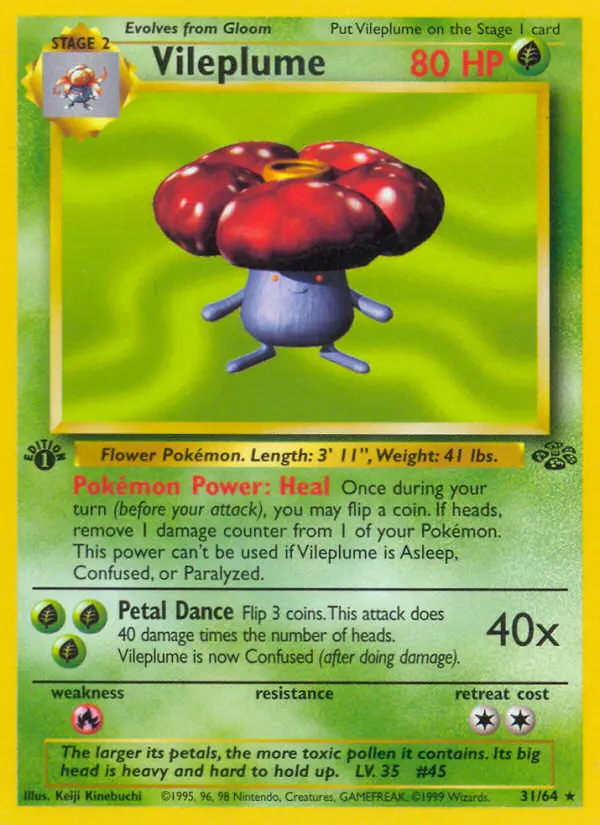
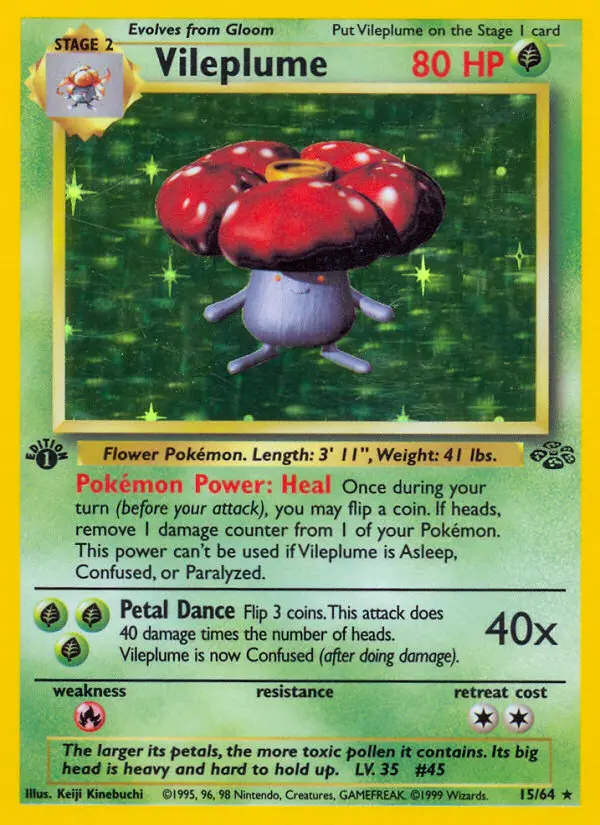
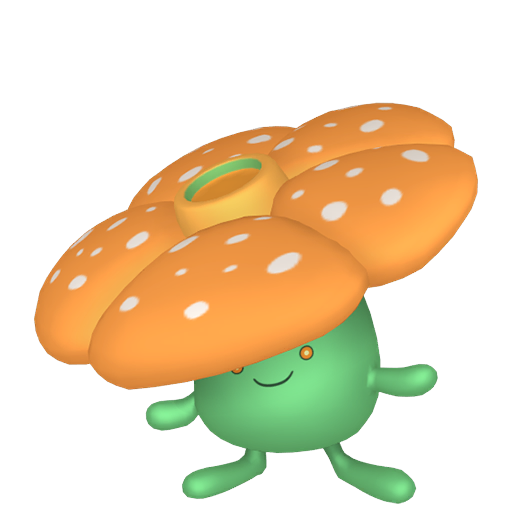
Vileplume is an indigo-colored, bipedal Pokémon with a body structure dominated by an enormous flower crown. The creature stands 1.2 meters tall and weighs approximately 18.6 kilograms, with its massive petals making up a disproportionate amount of its physical form. According to Pokédex records, Vileplume possesses the world's largest flower petals, which are bright red with distinctive white spots—a pattern that exhibits sexual dimorphism, as female Vileplume display fewer but noticeably larger spots on their petals. The Pokémon's body beneath the flower is relatively small, with rudimentary hands and feet, beady red eyes, and a small mouth, creating an almost comical contrast between its tiny frame and its oversized floral appendages. The substantial weight of the flower creates a perpetual burden for the creature, as referenced in multiple Pokédex entries noting that the large head is heavy and hard to hold up. The most significant biological feature of Vileplume is its production of highly toxic pollen stored within the petals themselves—the larger the petals, the more potent the toxin concentration becomes, allowing for a direct correlation between physical size and chemical potency.
Pokedex Numbers
Training
Breeding
Vileplume Breeding, Gender Ratio & Egg Groups
Vileplume exhibits a perfectly balanced gender ratio, with exactly 50 percent male and 50 percent female individuals found in the wild or produced through breeding. The species belongs to the Grass Egg Group, allowing it to breed with a wide variety of plant-based Pokémon as well as creatures from other compatible groups. Female Vileplume can be distinguished from their male counterparts through visual inspection of their petal spots—females possess fewer but significantly larger white spots on their red petals, providing an easy method for trainers to identify gender at a glance. The species has a base happiness value of 70, indicating a moderate disposition and suggesting that newly caught or evolved Vileplume may require some effort to bond with their trainers. With an egg hatch counter of 20 cycles (approximately 4,884 to 5,140 steps), breeding Vileplume requires a reasonable time investment compared to other Grass-type Pokémon. The medium-slow growth rate means that Vileplume reaches higher experience thresholds than many comparable species, making experience grinding a longer process than with faster-growing competitors.
Sprites





Held Items
Absorb Bulb
held-items
Held: Raises the holder’s Special Attack by one stage when it takes Water-type damage.
Cost: 4000
Absorb Bulb
held-items
Held: Raises the holder’s Special Attack by one stage when it takes Water-type damage.
Cost: 4000
Absorb Bulb
held-items
Held: Raises the holder’s Special Attack by one stage when it takes Water-type damage.
Cost: 4000
Absorb Bulb
held-items
Held: Raises the holder’s Special Attack by one stage when it takes Water-type damage.
Cost: 4000
Absorb Bulb
held-items
Held: Raises the holder’s Special Attack by one stage when it takes Water-type damage.
Cost: 4000
Absorb Bulb
held-items
Held: Raises the holder’s Special Attack by one stage when it takes Water-type damage.
Cost: 4000
TMs & HMs
tm01
lets go pikachu lets go eevee
tm02
crystal
tm02
gold silver
tm03
yellow
tm03
crystal
tm03
gold silver
tm03
red blue
tm03
lets go pikachu lets go eevee
tm03
blue japan
tm03
red green japan
tm05
lets go pikachu lets go eevee
tm06
yellow
tm06
gold silver
tm06
red blue
tm06
crystal
tm06
emerald
tm06
firered leafgreen
tm06
diamond pearl
tm06
platinum
tm06
ruby sapphire
+588 more TMs/HMs
Gender Differences
This Pokémon has visible differences between male and female forms.
Vileplume's Evolution Chain


Vileplume Evolution, Mega Evolution & Special Forms
Vileplume evolves from Gloom when exposed to a Leaf Stone, marking the culmination of the Oddish line's transformation from a small, shy bulb to a towering flower Pokémon. This evolution represents a significant shift in both size and toxicity, as Gloom's characteristic odor becomes weaponized pollen dispersal in Vileplume's mature form. However, Vileplume is not the only evolutionary path available to Gloom; trainers can alternatively evolve Gloom into Bellossom by exposing it to a Sun Stone, creating a branching evolution introduced in Generation II. Bellossom represents a sunnier, less toxic alternative, with a completely different appearance and stat distribution emphasizing Special Defense rather than Special Attack. Neither Vileplume nor Bellossom can be further evolved through traditional methods, making them final-stage Pokémon. The evolution method—requiring an external item—reflects Vileplume's dramatic biological shift from its previous form, as the application of a Leaf Stone triggers the full blooming of the massive flower that was only budding in its Gloom stage.
Where to Find
Kanto Sea Route 21
kanto
Vileplume Behaviour and Natural Habitat
Vileplume employs its remarkable flower petals as both a predatory tool and a defensive mechanism, using them to scatter clouds of yellow, toxic pollen that are simultaneously allergenic to humans and poisonous to other Pokémon. The Pokémon flaps or shakes its broad petals to release this pollen in dramatic fashion, producing extremely loud sounds during the process—a characteristic that makes Vileplume's presence unmistakable in jungle environments. The pollen serves a dual purpose: it immobilizes prey through paralysis, poison, or sleep before Vileplume can catch and devour them. Despite being a result of evolution via Leaf Stone, Vileplume occasionally inhabits grassy plains and jungle regions, though such wild encounters remain relatively uncommon. The species' behavior of continually dispersing pollen makes approaching even the most visually attractive flowers in wilderness areas inadvisable, as trainers and naturalists risk triggering atrocious allergy attacks. With every step, Vileplume shakes out heavy clouds of its toxic pollen, making it a walking biohazard to anything in its proximity.
Pokedex Entries
The larger its petals, the more toxic pollen it contains. Its big head is heavy and hard to hold up.
Flaps its broad flower petals to scatter its poisonous pollen. The flapping sound is very loud.
It has the world's largest petals. With every step, the petals shake out heavy clouds of toxic pollen.
The bud bursts into bloom with a bang. It then starts scattering allergenic, poi sonous pollen.
By shaking its big petals, it scat ters toxic pollen into the air, turning the air yellow.
VILEPLUME’s toxic pollen triggers atrocious allergy attacks. That’s why it is advisable never to approach any attractive flowers in a jungle, however pretty they may be.
VILEPLUME has the world’s largest petals. They are used to attract prey that are then doused with toxic spores. Once the prey are immobilized, this POKéMON catches and devours them.
In seasons when it produces more pollen, the air around a VILEPLUME turns yellow with the powder as it walks. The pollen is highly toxic and causes paralysis.
Its petals are the largest in the world. It fiendishly scatters allergy-causing pollen from its petals.
The larger its petals, the more toxic pollen it contains. Its big head is heavy and hard to hold up.
Its petals are the largest in the world. As it walks, it scatters extremely allergenic pollen.
It has the world’s largest petals. With every step, the petals shake out heavy clouds of toxic pollen.
The bud bursts into bloom with a bang. It then starts scattering allergenic, poisonous pollen.
Its petals are the largest in the world. As it walks, it scatters extremely allergenic pollen.
Its petals are the largest in the world. As it walks, it scatters extremely allergenic pollen.
The larger its petals, the more toxic pollen it contains. Its big head is heavy and hard to hold up.
It has the world’s largest petals. With every step, the petals shake out heavy clouds of toxic pollen.
Vileplume’s toxic pollen triggers atrocious allergy attacks. That’s why it is advisable never to approach any attractive flowers in a jungle, however pretty they may be.
Vileplume has the world’s largest petals. They are used to attract prey that are then doused with toxic spores. Once the prey are immobilized, this Pokémon catches and devours them.
Flaps its broad flower petals to scatter its poisonous pollen. The flapping sound is very loud.
It has the world’s largest petals. With every step, the petals shake out heavy clouds of toxic pollen.
The larger its petals, the more toxic pollen it contains. Its big head is heavy and hard to hold up.
Vileplume Name Origin & Design Inspiration
Vileplume's design draws heavy inspiration from the Rafflesia flower, one of the largest and most distinctive flowers in the world, known for its massive petals and pungent smell. The name 'Vileplume' combines 'vile' and 'plume,' directly referencing both the toxic nature of its pollen and its most prominent visual feature—its elaborate floral plumage. In Japanese, Vileplume is called Rafflesia (ラフレシア), making the design inspiration explicit through direct naming. The creature's color palette of indigo body with red petals and white spots creates a striking visual contrast that makes it immediately recognizable despite its awkward proportions. The deliberate mismatch between its tiny body and enormous flower head emphasizes the weight and burden that Vileplume carries, creating a design that is simultaneously beautiful and grotesque. This duality perfectly captures the Pokémon's nature—an attractive flower that is genuinely dangerous to approach, subverting expectations of what a beautiful bloom might represent in the natural world.
Learnable Moves
Vileplume can learn 86 moves:
Move | Type | Cat. | Power | Acc. | PP |
|---|---|---|---|---|---|
| absorb | grass | Special | 20 | 100 | 25 |
| acid | poison | Special | 40 | 100 | 30 |
| acid spray | poison | Special | 40 | 100 | 20 |
| after you | normal | Status | — | — | 15 |
| aromatherapy | grass | Status | — | — | 5 |
| attract | normal | Status | — | 100 | 15 |
| bide | normal | Physical | — | — | 10 |
| body slam | normal | Physical | 85 | 100 | 15 |
| bullet seed | grass | Physical | 25 | 100 | 30 |
| captivate | normal | Status | — | 100 | 20 |
| charm | fairy | Status | — | 100 | 20 |
| confide | normal | Status | — | — | 20 |
| corrosive gas | poison | Status | — | 100 | 40 |
| curse | ghost | Status | — | — | 10 |
| cut | normal | Physical | 50 | 95 | 30 |
| dazzling gleam | fairy | Special | 80 | 100 | 10 |
| double team | normal | Status | — | — | 15 |
| double edge | normal | Physical | 120 | 100 | 15 |
| drain punch | fighting | Physical | 75 | 100 | 10 |
| endure | normal | Status | — | — | 10 |
| energy ball | grass | Special | 90 | 100 | 10 |
| facade | normal | Physical | 70 | 100 | 20 |
| flail | normal | Physical | — | 100 | 15 |
| flash | normal | Status | — | 100 | 20 |
| fling | dark | Physical | — | 100 | 10 |
| frustration | normal | Physical | — | 100 | 20 |
| gastro acid | poison | Status | — | 100 | 10 |
| giga drain | grass | Special | 75 | 100 | 10 |
| giga impact | normal | Physical | 150 | 90 | 5 |
| grass knot | grass | Special | — | 100 | 20 |
| grassy glide | grass | Physical | 55 | 100 | 20 |
| grassy terrain | grass | Status | — | — | 10 |
| growth | normal | Status | — | — | 20 |
| headbutt | normal | Physical | 70 | 100 | 15 |
| helping hand | normal | Status | — | — | 20 |
| hidden power | normal | Special | 60 | 100 | 15 |
| hyper beam | normal | Special | 150 | 90 | 5 |
| infestation | bug | Special | 20 | 100 | 20 |
| ingrain | grass | Status | — | — | 20 |
| leaf storm | grass | Special | 130 | 90 | 5 |
| leech seed | grass | Status | — | 90 | 10 |
| magical leaf | grass | Special | 60 | — | 20 |
| mega drain | grass | Special | 40 | 100 | 15 |
| mimic | normal | Status | — | — | 10 |
| moonblast | fairy | Special | 95 | 100 | 15 |
| moonlight | fairy | Status | — | — | 5 |
| natural gift | normal | Physical | — | 100 | 15 |
| nature power | normal | Status | — | — | 20 |
| petal blizzard | grass | Physical | 90 | 100 | 15 |
| petal dance | grass | Special | 120 | 100 | 10 |
| poison powder | poison | Status | — | 75 | 35 |
| pollen puff | bug | Special | 90 | 100 | 15 |
| protect | normal | Status | — | — | 10 |
| rage | normal | Physical | 20 | 100 | 20 |
| razor leaf | grass | Physical | 55 | 95 | 25 |
| reflect | psychic | Status | — | — | 20 |
| rest | psychic | Status | — | — | 5 |
| return | normal | Physical | — | 100 | 20 |
| round | normal | Special | 60 | 100 | 15 |
| safeguard | normal | Status | — | — | 25 |
| secret power | normal | Physical | 70 | 100 | 20 |
| seed bomb | grass | Physical | 80 | 100 | 15 |
| sleep powder | grass | Status | — | 75 | 15 |
| sleep talk | normal | Status | — | — | 10 |
| sludge bomb | poison | Special | 90 | 100 | 10 |
| sludge wave | poison | Special | 95 | 100 | 10 |
| snore | normal | Special | 50 | 100 | 15 |
| solar beam | grass | Special | 120 | 100 | 10 |
| solar blade | grass | Physical | 125 | 100 | 10 |
| strength sap | grass | Status | — | 100 | 10 |
| stun spore | grass | Status | — | 75 | 30 |
| substitute | normal | Status | — | — | 10 |
| sunny day | fire | Status | — | — | 5 |
| swagger | normal | Status | — | 85 | 15 |
| sweet scent | normal | Status | — | 100 | 20 |
| swords dance | normal | Status | — | — | 20 |
| synthesis | grass | Status | — | — | 5 |
| take down | normal | Physical | 90 | 85 | 20 |
| teeter dance | normal | Status | — | 100 | 20 |
| tera blast | normal | Special | 80 | 100 | 10 |
| tickle | normal | Status | — | 100 | 20 |
| toxic | poison | Status | — | 90 | 10 |
| trailblaze | grass | Physical | 50 | 100 | 20 |
| venoshock | poison | Special | 65 | 100 | 10 |
| weather ball | normal | Special | 50 | 100 | 10 |
| worry seed | grass | Status | — | 100 | 10 |
Vileplume Competitive Battle Guide
Assessing its battle viability, Vileplume's primary strength lies in its exceptional Special Attack base stat of 110, supported by solid Special Defense of 90 and respectable Defense of 85. These stats allow Vileplume to function as a special-attacking wall capable of both dealing damage and absorbing hits, though its critically low Speed of 50 means it will almost always move last in battle without Speed-reducing items or abilities. Vileplume's Chlorophyll ability doubles its Speed during sunny weather, providing a viable strategy in sun-based team compositions that can mitigate its natural sluggishness. The hidden ability Effect Spore offers an alternative approach, granting a 30 percent chance to inflict paralysis, poison, or sleep on any Pokémon that makes physical contact with Vileplume, making it an interesting defensive tool against physical attackers. Its Grass/Poison typing provides useful resistances to Water, Electric, Grass, and Fairy moves while leaving it vulnerable to Fire, Flying, Ice, and Psychic attacks. Coverage moves including Sludge Bomb for reliable Poison-type damage, Solar Beam for raw Special Attack output, and utility moves like Sleep Powder or Stun Spore allow Vileplume to operate as a mixed attacker or a status spreader depending on moveset construction and team needs.
Commonly Asked Questions About Vileplume
What type is Vileplume?
Vileplume is a grass and poison type Pokemon.
What does Vileplume evolve into?
Vileplume evolves into bellossom.
What are Vileplume's weaknesses?
Vileplume is weak to flying, fire, psychic and ice type moves.
Does Vileplume evolve by trading?
No — Vileplume evolves entirely through leveling up, with no trade required at any stage.
Where can I find Vileplume?
Vileplume can be found in kanto sea route 21 (kanto).
Vileplume Cultural Impact & Franchise History
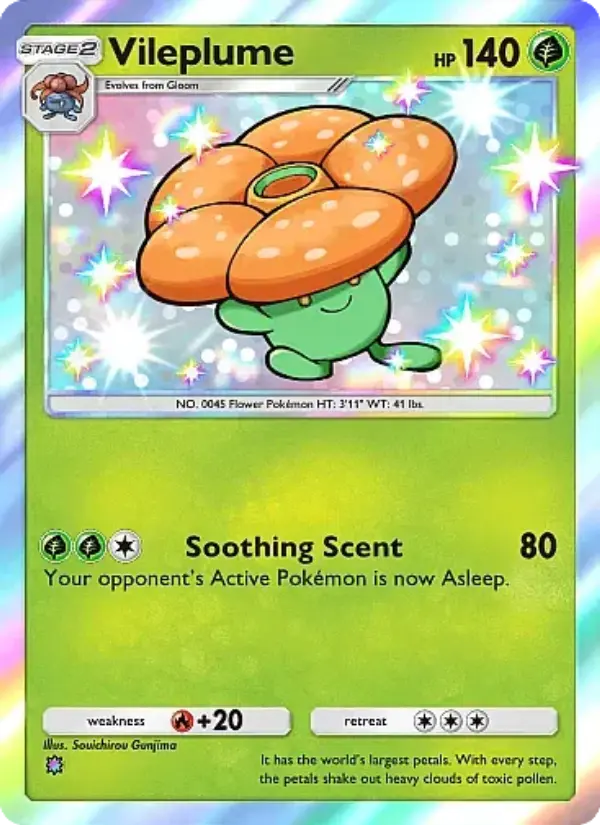
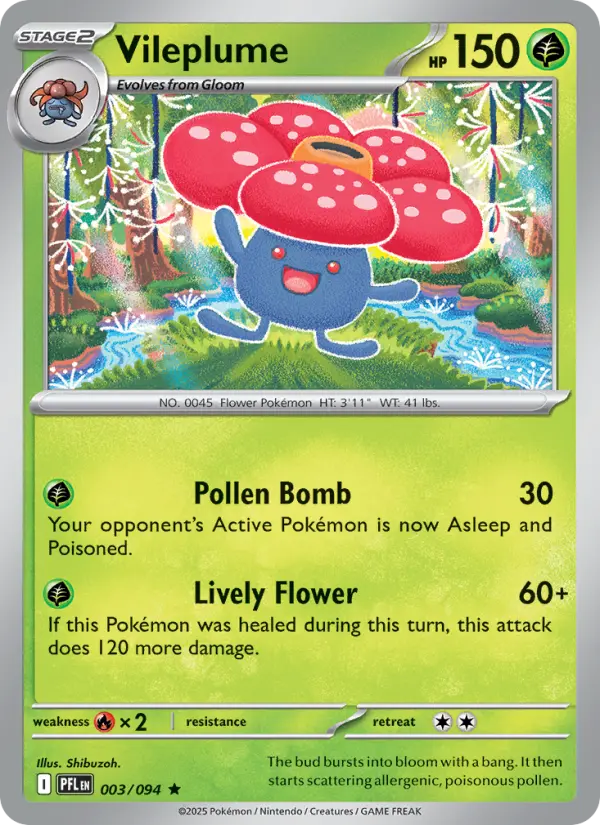
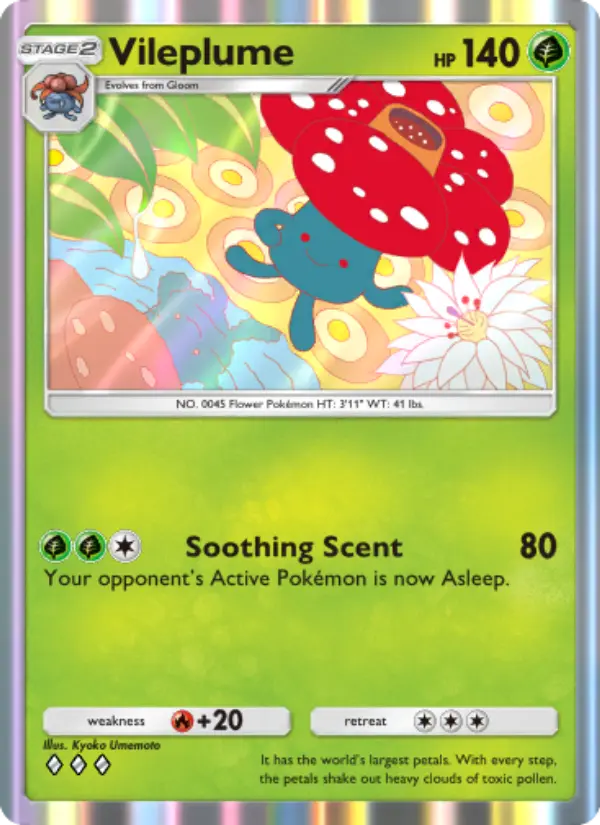
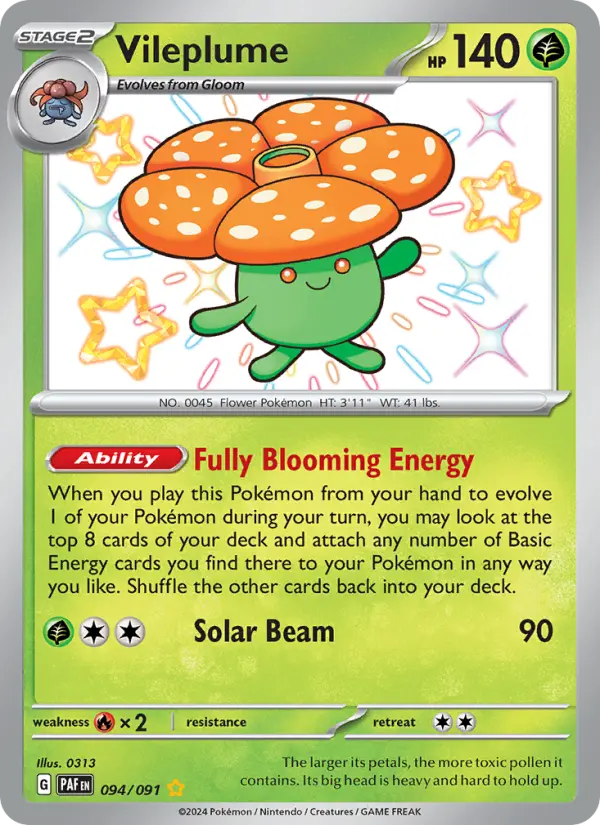
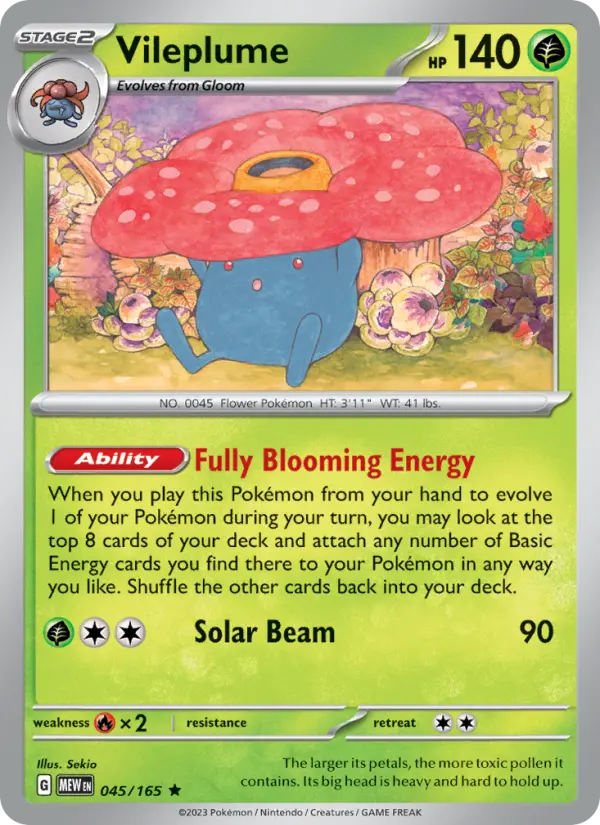
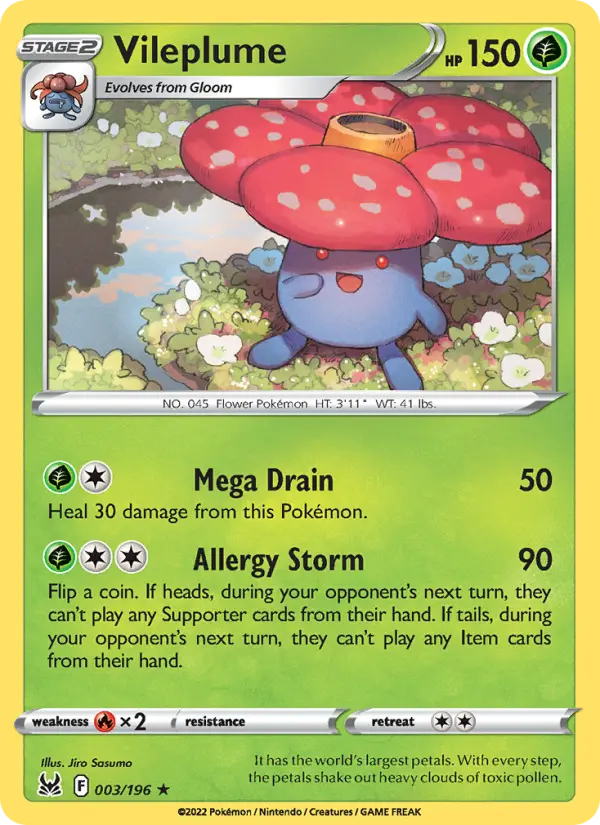
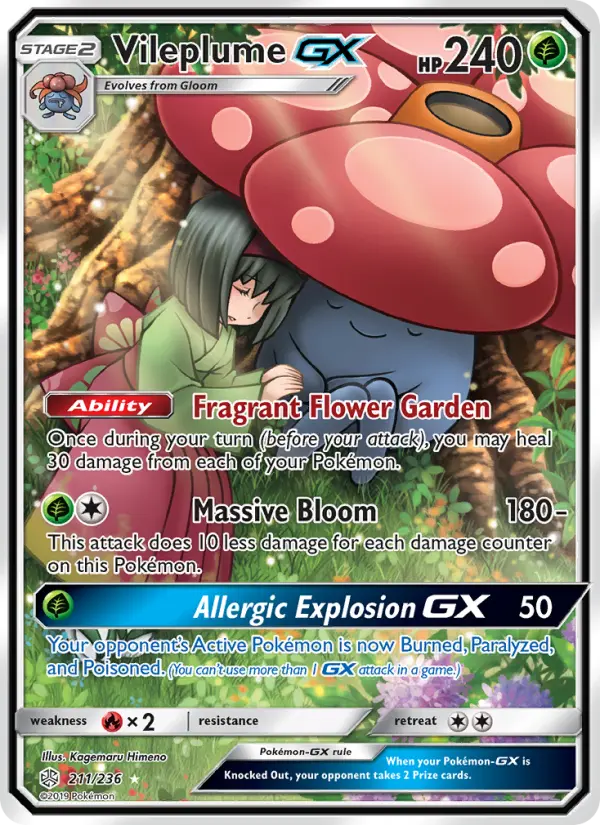
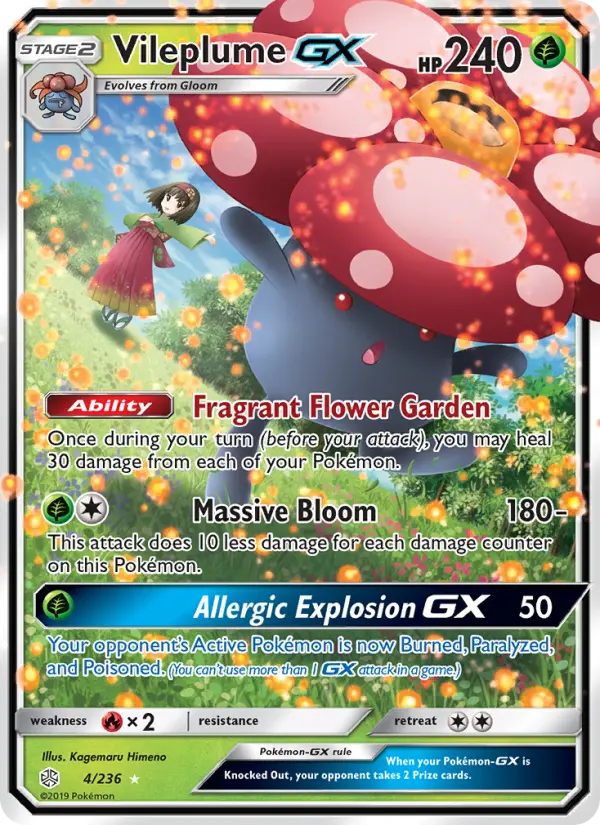
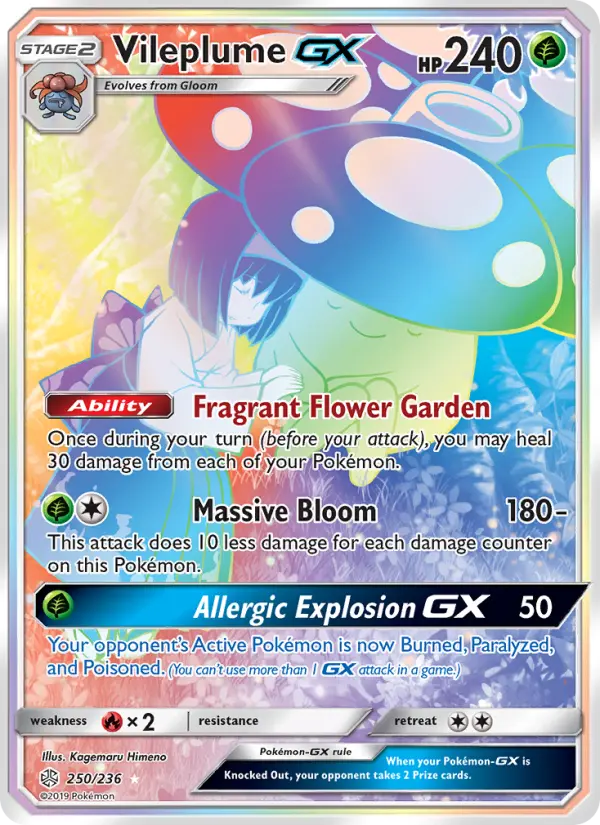
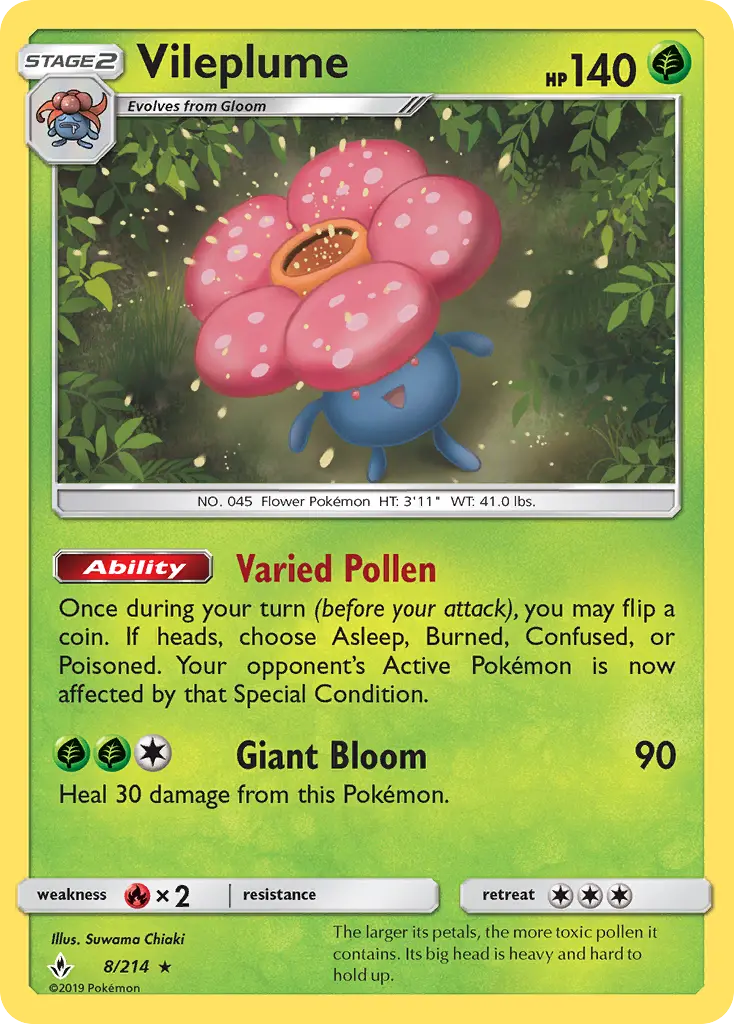
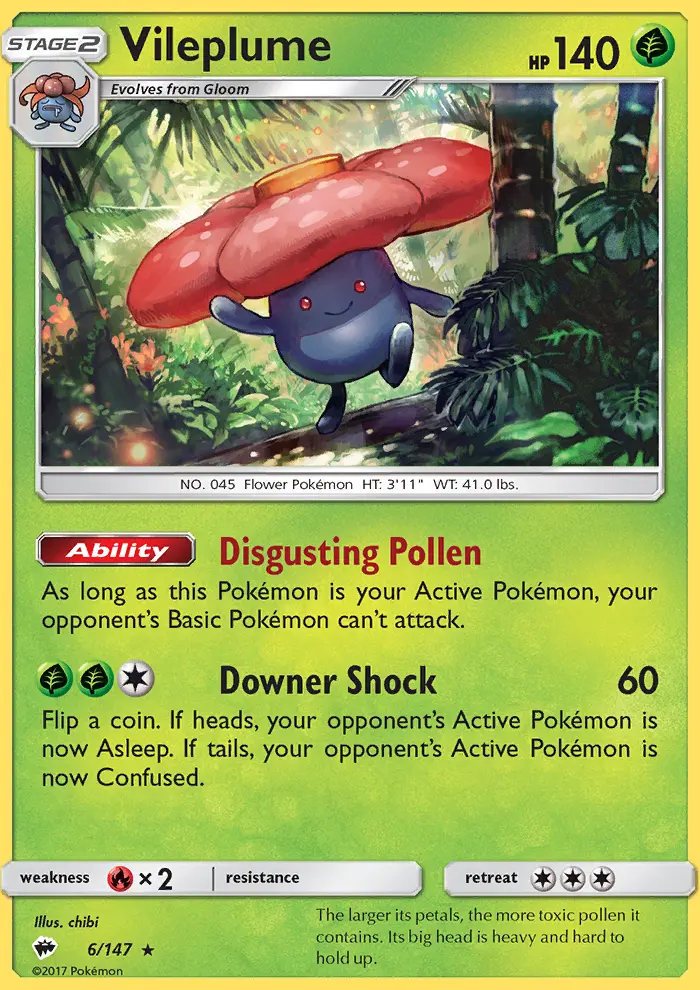
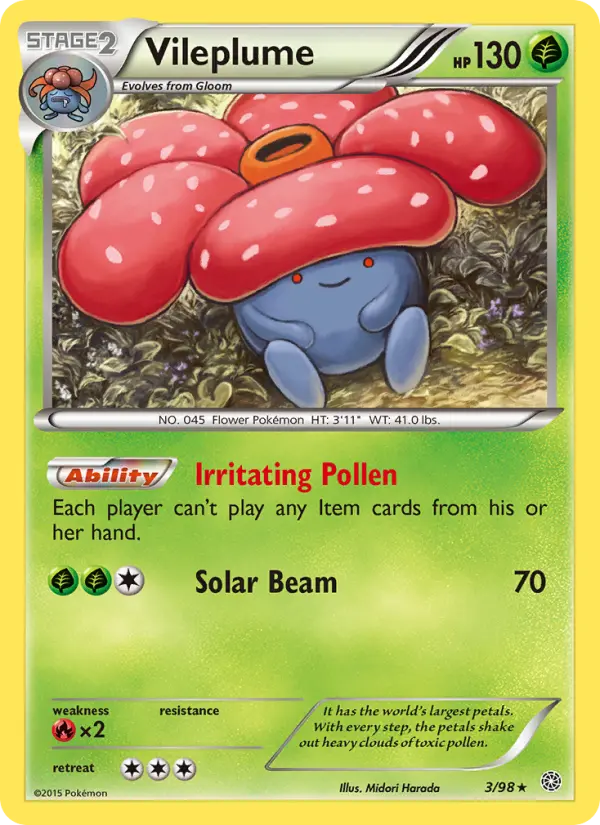
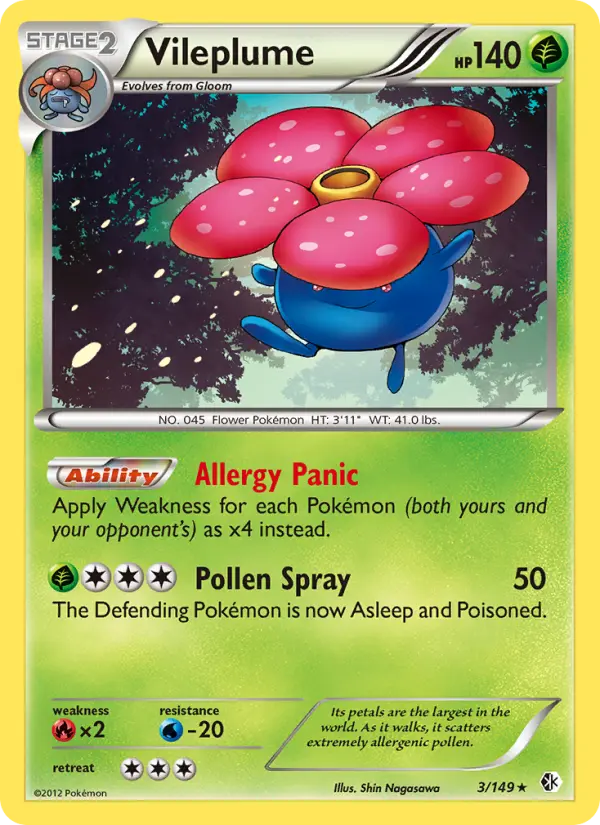
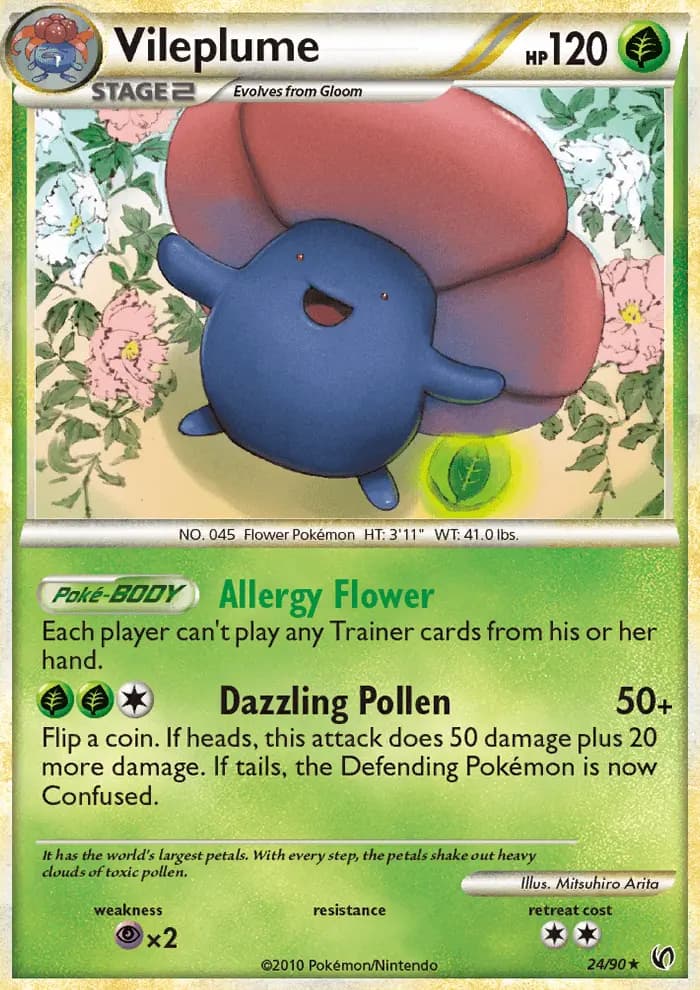
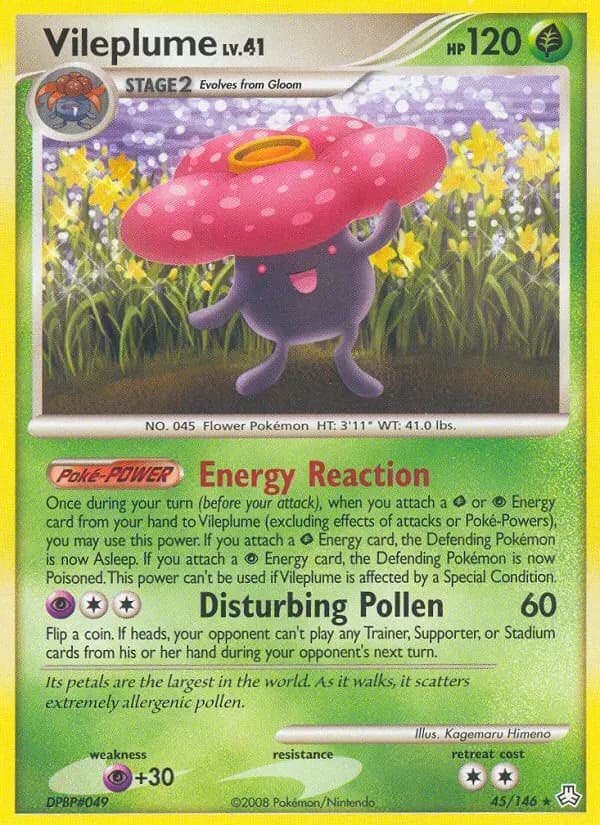
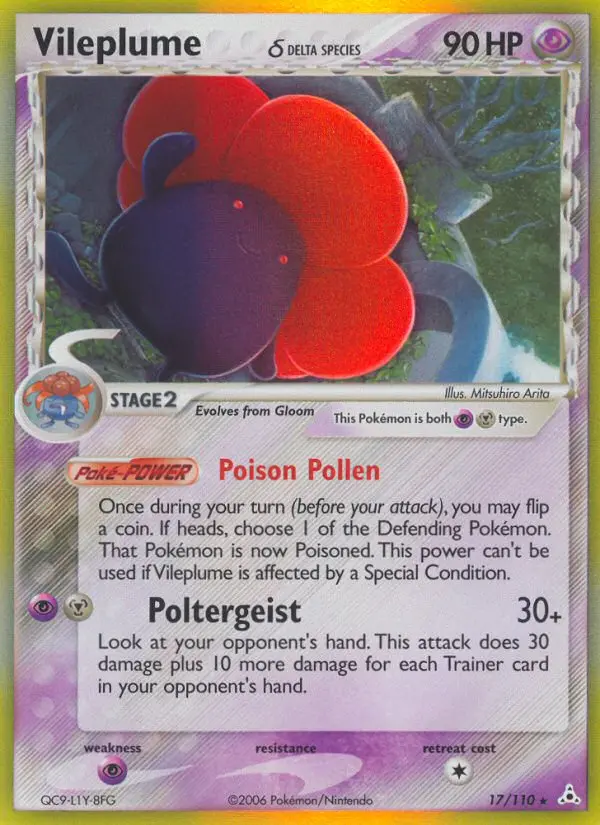
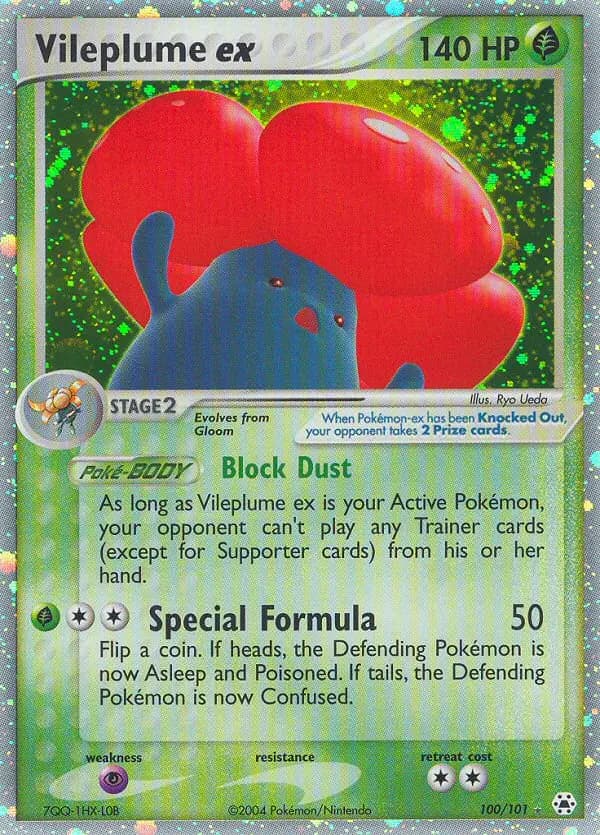
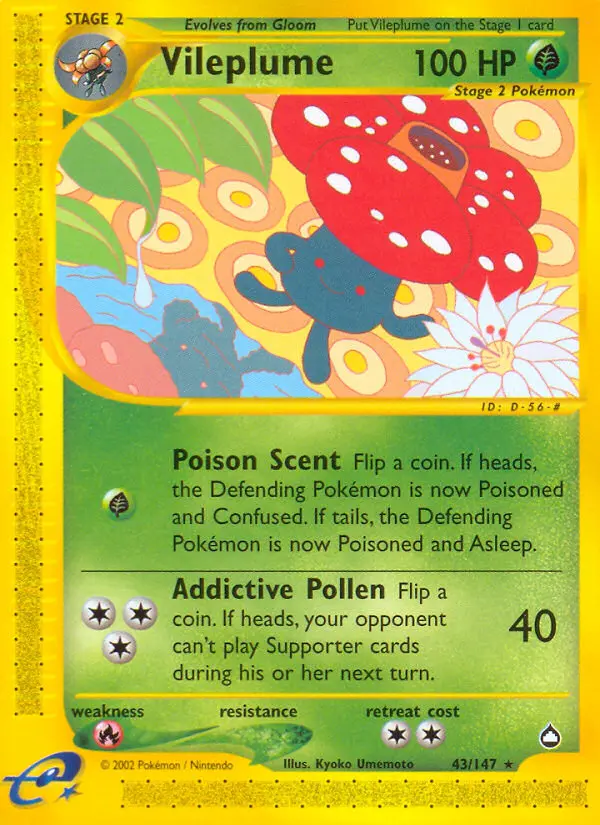
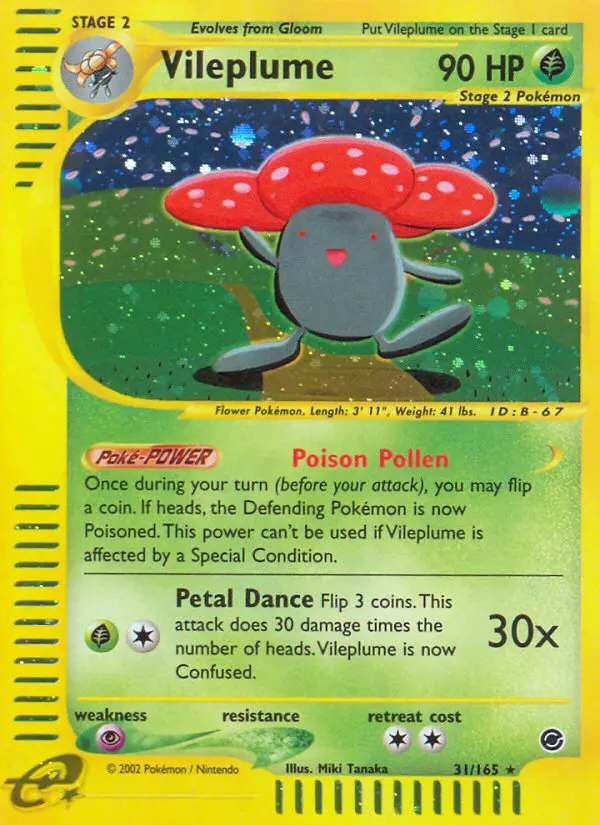
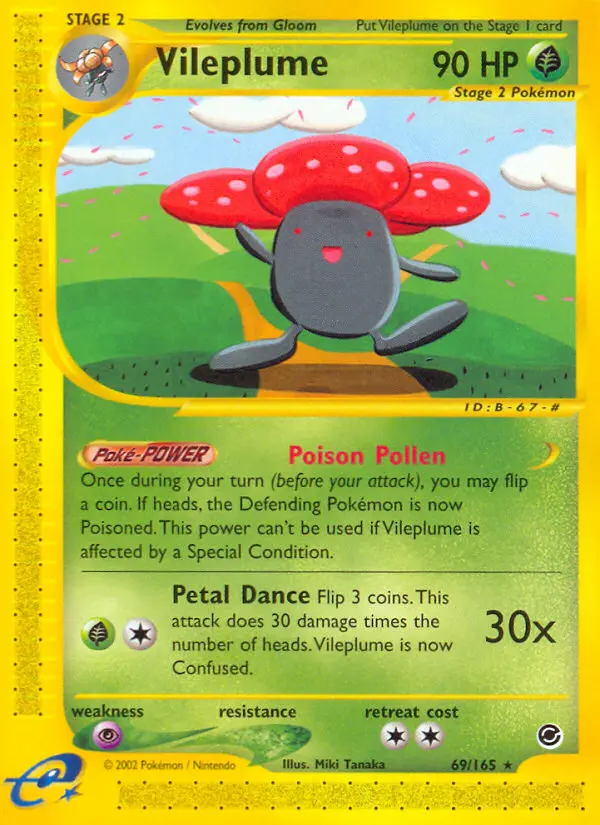
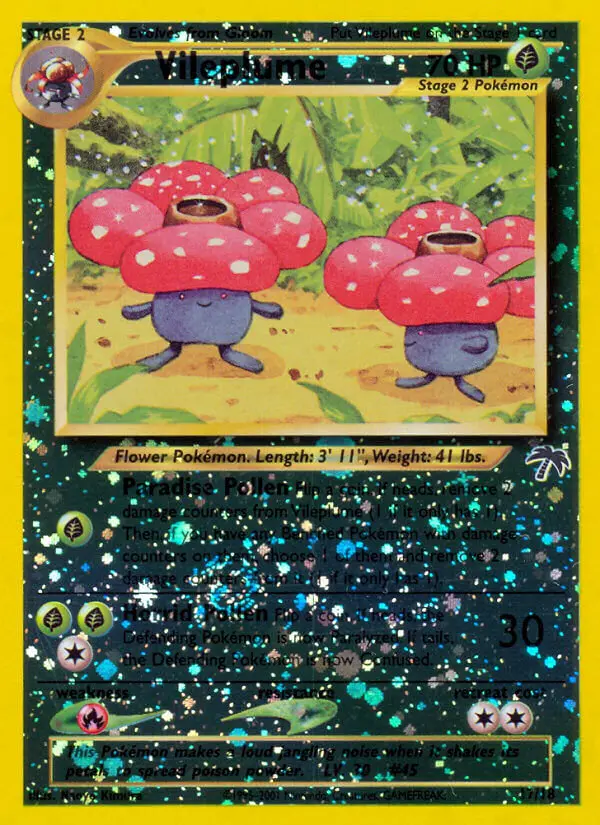
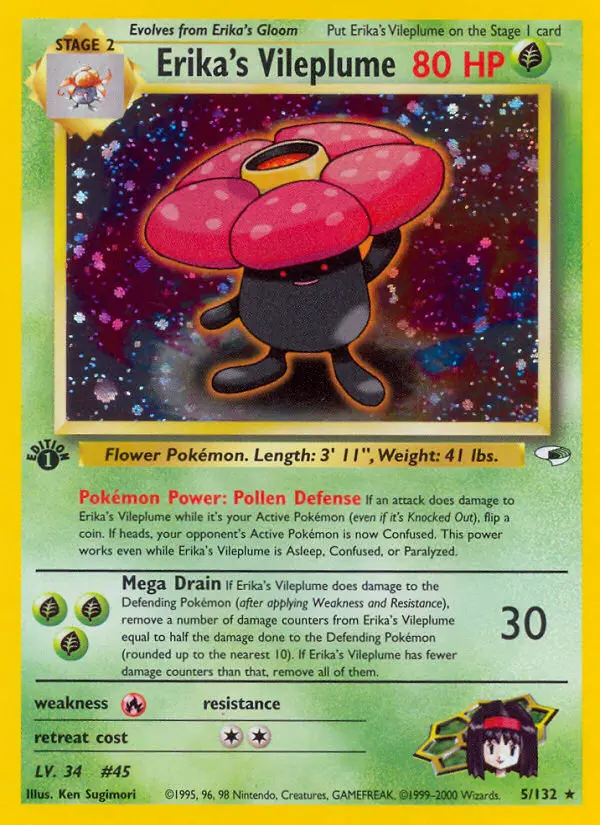
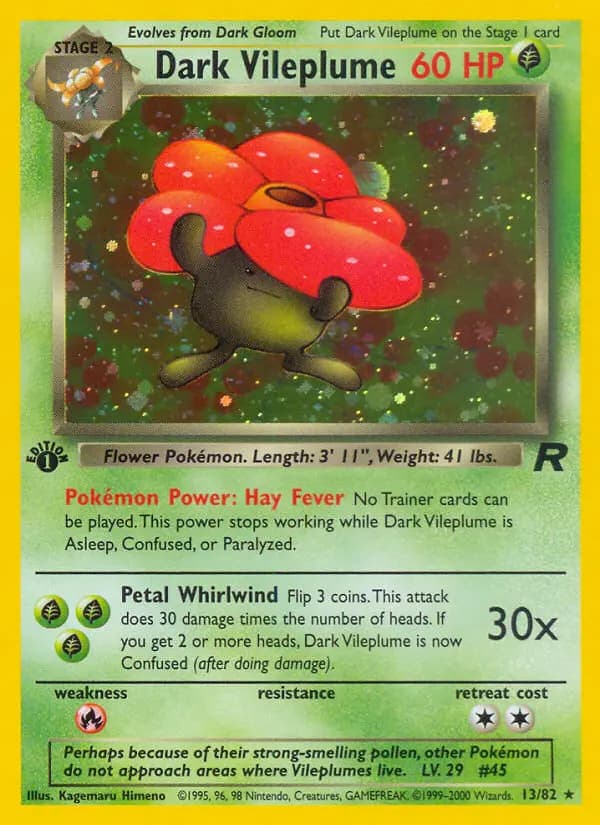
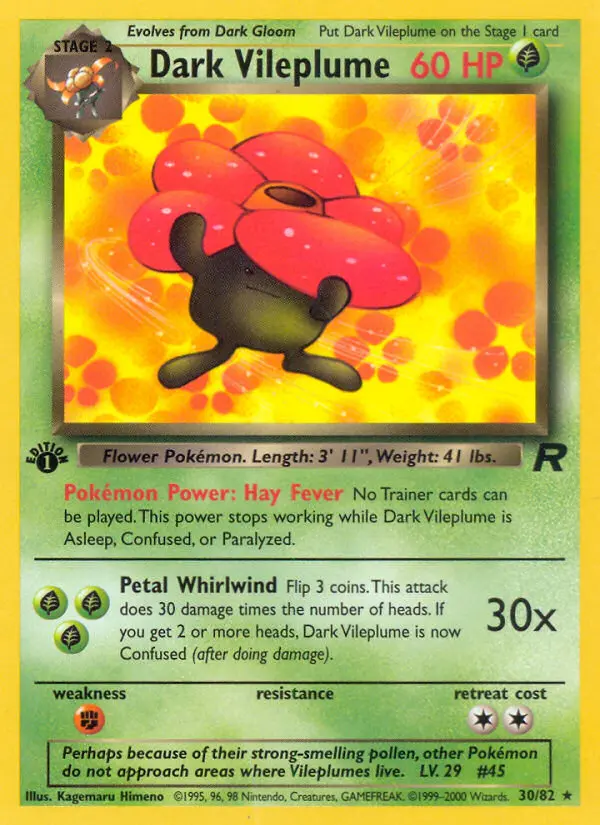
Vileplume has maintained a consistent presence in Pokémon media since Generation I, appearing in numerous anime episodes and establishing itself as a recognizable species within the franchise's ecosystem. While not as iconic as early-generation starters like Venusaur, Vileplume's distinctive appearance and toxic nature have made it memorable enough to warrant appearances across multiple Pokémon generations and spin-off media. The species represents an early example of the franchise's willingness to create genuinely dangerous-looking creatures with clear predatory behaviors—the emphasis on toxic pollen and immobilization of prey makes Vileplume notably more threatening than many contemporary Grass-types. Its design philosophy of combining beauty with danger has influenced subsequent Pokémon design, establishing a template for creatures that are visually appealing but scientifically hazardous. In the trading card game, Vileplume has received various card iterations throughout its history, often emphasizing its pollen-dispersal abilities and toxic characteristics. The Pokémon's Japanese name—Rafflesia—demonstrates how the franchise occasionally maintains more direct connections to real-world inspiration compared to English naming conventions, appealing to players interested in biological authenticity.
Where to Find Vileplume in Every Pokémon Game
Vileplume's availability varies significantly across different Pokémon games, with its primary method of acquisition being the evolution of Gloom via Leaf Stone rather than direct wild encounters. In the original Red, Blue, and Yellow versions, Vileplume can be obtained by catching Oddish in grassy areas and evolving it through the standard progression: Oddish to Gloom at level 21, then to Vileplume through Leaf Stone application. In subsequent generations including Gold/Silver/Crystal, Ruby/Sapphire/Emerald, and Diamond/Pearl/Platinum, similar availability patterns persist with Oddish appearing in early-game grass patches. FireRed and LeafGreen versions maintain close alignment with the original games, allowing players to obtain the complete Oddish line. Modern games including Sword/Shield and their DLC The Indigo Disk feature Vileplume in various Pokédex entries, though specific availability details vary by title and region designation. The catch rate for wild Vileplume encounters (when available) stands at 45, roughly equivalent to an 11.9 percent success rate with a standard Poké Ball against a full-health specimen, making it moderately difficult to capture. The Leaf Stone requirement creates a minor gatekeeping element that prevents casual players from easily obtaining Vileplume early in their journey, though the abundance of Leaf Stones in most games ensures that determined trainers can evolve their Gloom without excessive grinding or trading.